

Receiving an RFID tagging requirement from a major retail customer can create a completely new operational challenge for a supplier.
The requirement may appear simple at first:
Attach an RFID tag to every product before shipment.
In practice, supplier RFID tagging involves much more than applying a label.
A complete implementation may require you to determine:
Getting any of these steps wrong can result in unreadable tags, incorrect product identification, duplicated EPCs, shipping delays, rework, or retailer compliance problems.
This guide explains how suppliers can build a practical RFID tagging workflow from requirement review through tag selection, testing, encoding, verification, and shipment.
The goal is not simply to comply with one order.
A well-designed process should be repeatable and scalable across products, SKUs, customers, and future RFID requirements.
An RFID tag mandate is a requirement from a retailer, customer, marketplace, distributor, or supply-chain partner requiring specified products or packaging to carry RFID identification before they are shipped into that organization's supply chain.
The requirement may define some or all of the following:
Retail RFID mandates are usually associated with passive UHF RFID because it enables fast identification of many tagged items and supports item-level inventory visibility.
However, suppliers should never assume that every retailer uses exactly the same requirements.
The retailer's current specification, supplier playbook, category requirement, or compliance document should always be treated as the primary source of truth.
The main purpose of a retail RFID mandate is usually not the RFID label itself.
The objective is to create a reliable digital identity for individual physical products.
Traditional product inventory frequently operates at SKU level.
For example:
Blue Shirt, Size M — Quantity: 24
Item-level RFID can give every physical unit a unique identity.
Instead of only knowing that 24 shirts should exist, the system can potentially identify each individual tagged shirt as it moves through receiving, stockrooms, sales floors, fulfillment processes, returns, and other controlled RFID read points.
This creates several operational possibilities.
UHF RFID readers can capture multiple compatible tags without requiring an employee to visually locate and scan every individual barcode.
This makes more frequent cycle counting practical.
Retailers can compare digital records with physical inventory more frequently and identify discrepancies earlier.
Tagged merchandise can be identified during receiving workflows instead of relying exclusively on individual optical scans.
Accurate store inventory makes it easier to determine whether additional stock is available in the backroom and should be replenished to the sales floor.
Accurate item-level inventory supports workflows such as:
For a deeper look at these applications, see Syncotek's guide to RFID retail inventory management.
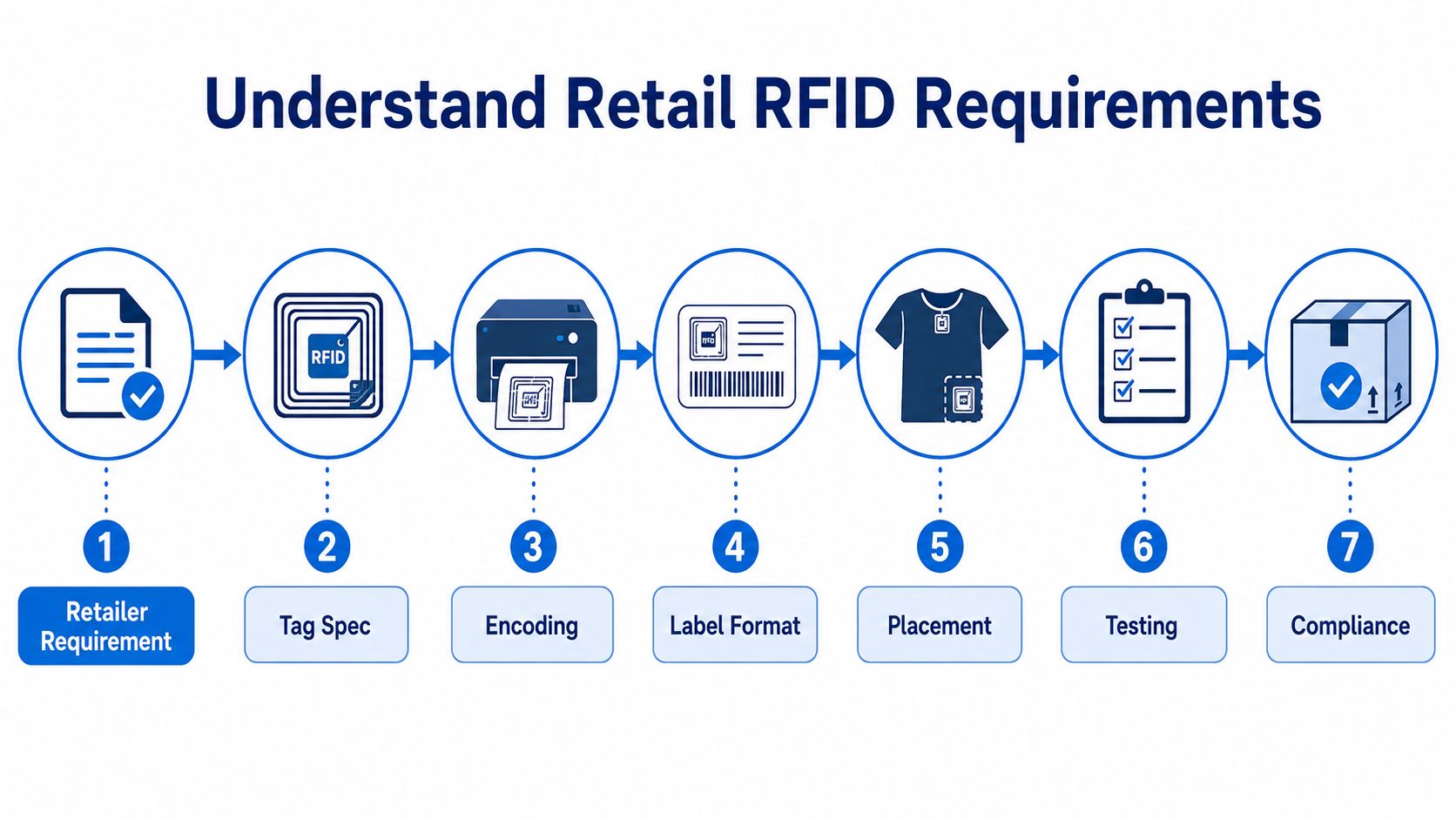
The first step in any supplier RFID project should be understanding exactly what your customer requires.
Do not purchase thousands of RFID labels simply because they are UHF EPC Gen2 compatible.
Two UHF tags can use the same protocol and still perform very differently on a specific product or fail a retailer-specific requirement.
Before purchasing equipment or media, confirm the following.
RFID requirements may differ according to product type.
Examples include:
A suitable RFID label for a cotton shirt may not be suitable for an electronic device, metal product, liquid-filled package, or compact cosmetic container.
Many retail item-level RFID projects use passive UHF RAIN RFID based on EPC Gen2 / ISO 18000-63.
Syncotek's UHF product portfolio also supports EPC Gen2 / ISO 18000-63 for readers and modules used in inventory, encoding, and integration applications.
However, the installation country and retailer specification still determine the required regional operating band and configuration.
A retailer may specify:
Do not substitute another tag solely because it is cheaper or has a similar physical size.
The retailer may specify which electronic identifier must be written to the RFID tag.
Common requirements may involve an Electronic Product Code, or EPC.
GS1 defines EPC as an identification approach that bridges GS1 identifiers with RAIN RFID and supports serialization of items such as trade products.
The visible RFID label may also need printed information such as:
An RFID label therefore often carries two identification layers:
Visible identification
and
Electronic RFID identification
Placement can be just as important as the RFID tag itself.
A retailer may define where the label should be placed on:
Incorrect placement can reduce RFID performance or cause compliance issues even when the correct inlay is used.
Determine whether the program requires:
Some retail RFID programs use formal tag-performance or approval processes. Others rely on different supplier-specific requirements.
Always follow the latest instructions from the customer receiving your goods.
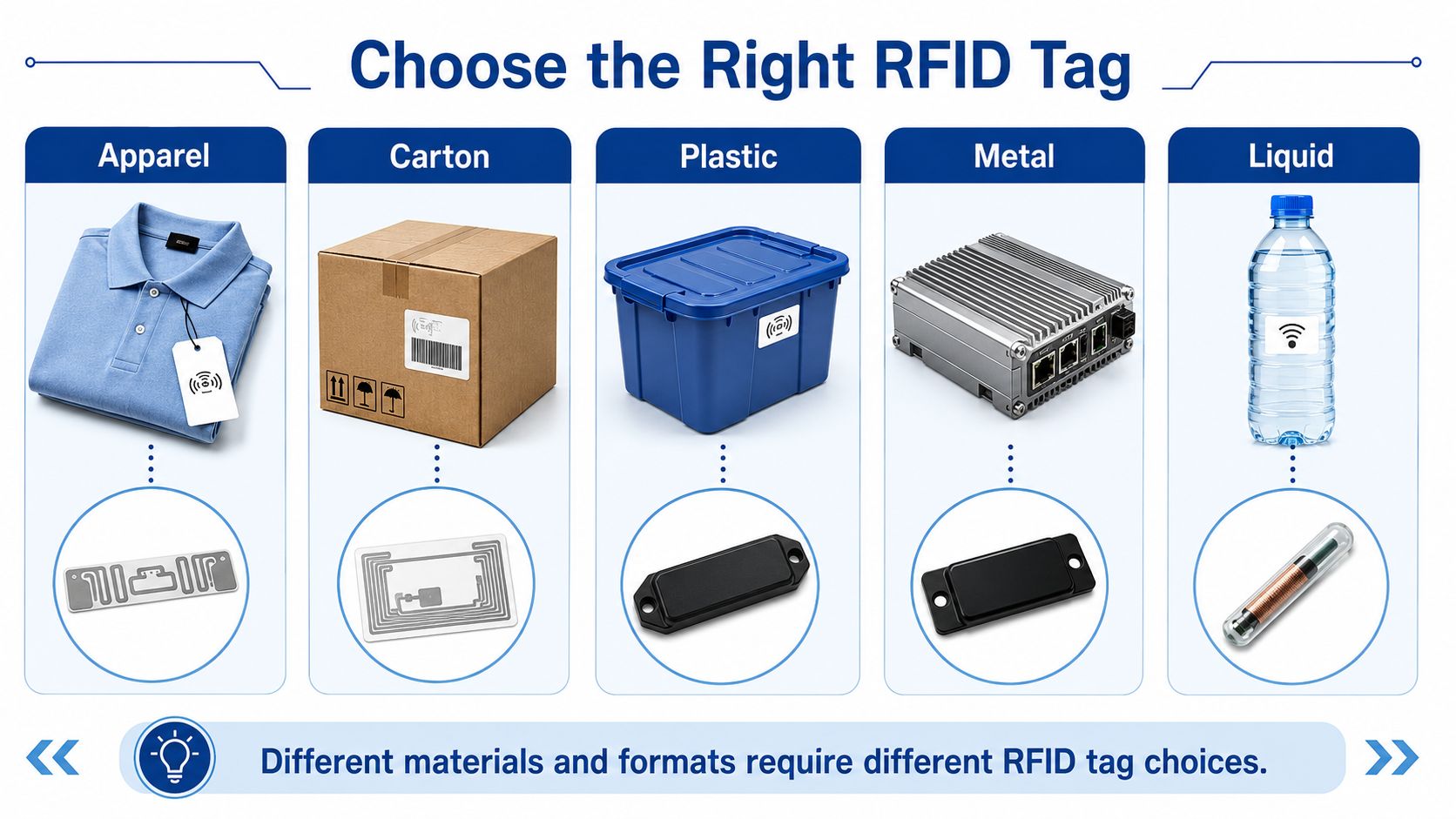
RFID tag selection should begin with the physical product, not with the price list.
The same RFID tag can perform very differently when applied to different materials.
Apparel is generally well suited to passive UHF RFID.
Common formats include:
Important considerations include:
Paperboard and cardboard are usually relatively RFID-friendly materials.
Standard UHF RFID labels may work well for:
However, the products inside the carton can still affect performance.
A box containing clothing behaves very differently from a box containing bottles of liquid or metal components.
Many plastic products can use standard RFID labels, but testing is still required.
Factors include:
Metal can significantly alter the electrical behavior of a UHF RFID antenna.
Applying a conventional RFID label directly to a metal surface can lead to:
Metal products may require specially designed mount-on-metal RFID tags.
Water-rich liquids can absorb UHF RF energy and make tag performance more sensitive to placement and orientation.
Applications involving:
should always be tested with the real filled product.
Suppliers should also understand the form factor they are buying.
An RFID inlay is the chip-and-antenna core.
An RFID label combines an inlay with printable face material, adhesive, and liner.
An RFID tag is a broader finished RFID product that may include labels, hard tags, hangtags, laundry tags, on-metal tags, cards, and other designs.
See RFID Inlays, Tags, and Labels: What's the Difference? for a detailed comparison.
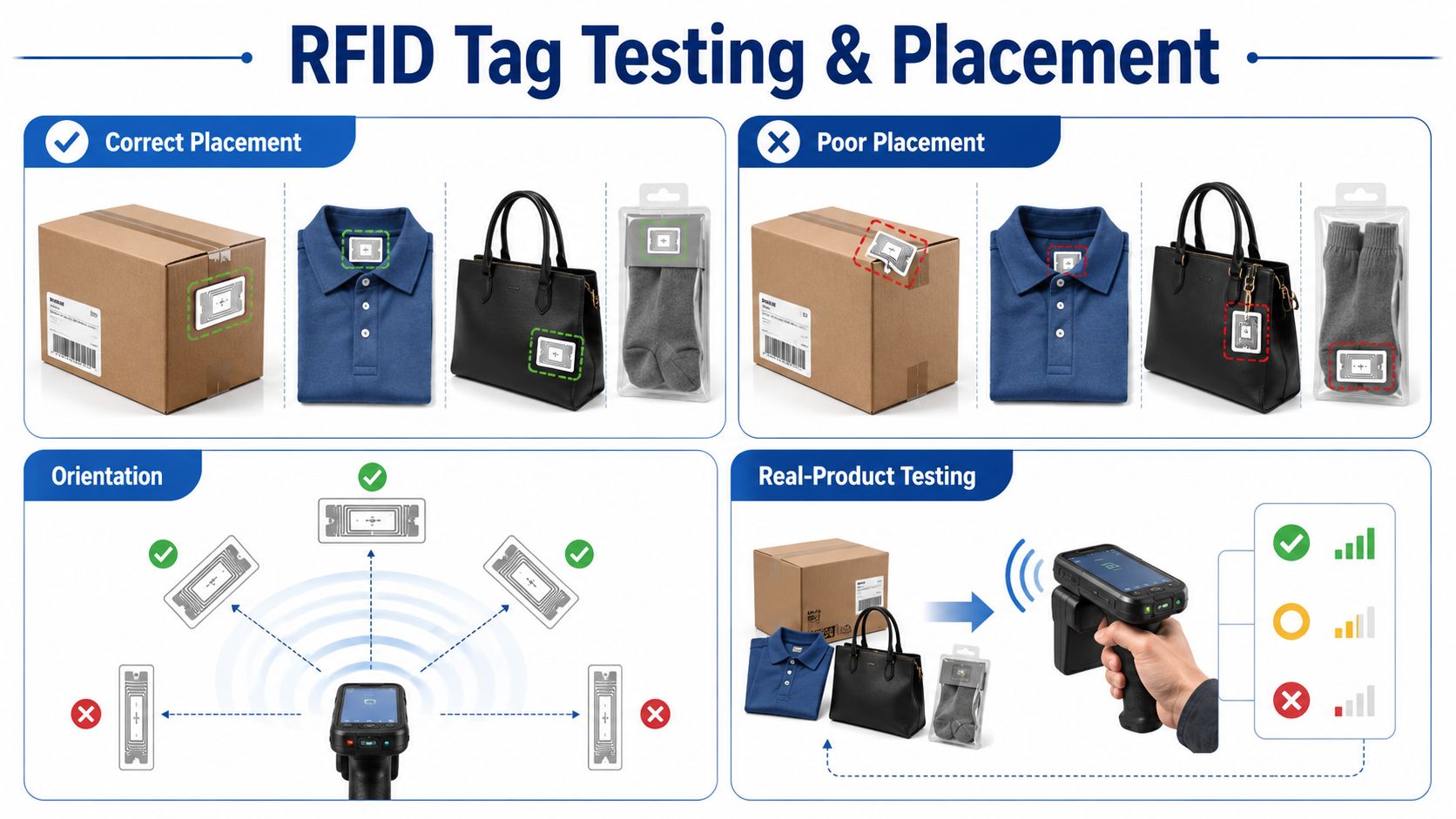
Never approve an RFID tag based only on an open-air read test.
A tag that reads several meters in free space may perform very differently after it is attached to the actual product.
RFID performance is affected by:
If your specification allows several compatible inlays, test more than one option.
Compare:
The smallest or cheapest tag is not automatically the best choice.
Move the tag around the real product.
For example:
A small placement change can significantly affect UHF performance.
Test the product in realistic orientations.
A label may be:
The expected logistics and retail workflow should determine the test positions.
Do not test only one isolated unit if the actual shipment contains:
Test the configuration that will actually move through the customer's supply chain.
A UHF handheld reader can be useful during product testing because the operator can change:
This makes it easier to compare candidate tags before building a fixed test station.
Once the correct tag has been selected, suppliers generally have two operational options.
A specialized RFID tag supplier or service provider prepares the RFID labels for you.
This may be suitable when:
The supplier installs an RFID printer encoder and controls the production process internally.
This is often more attractive when:
An RFID printer combines conventional label printing with RFID encoding.
It can print information such as:
while also writing EPC data into the RFID chip.
Syncotek offers POSTEK RFID printer solutions designed for UHF RFID label printing, encoding, and verification, and its RFID portfolio includes printer, tag, desktop-reader, handheld, antenna, and UHF module options.
For printer selection details, see RFID Printers: How to Choose the Right RFID Printer Encoder.
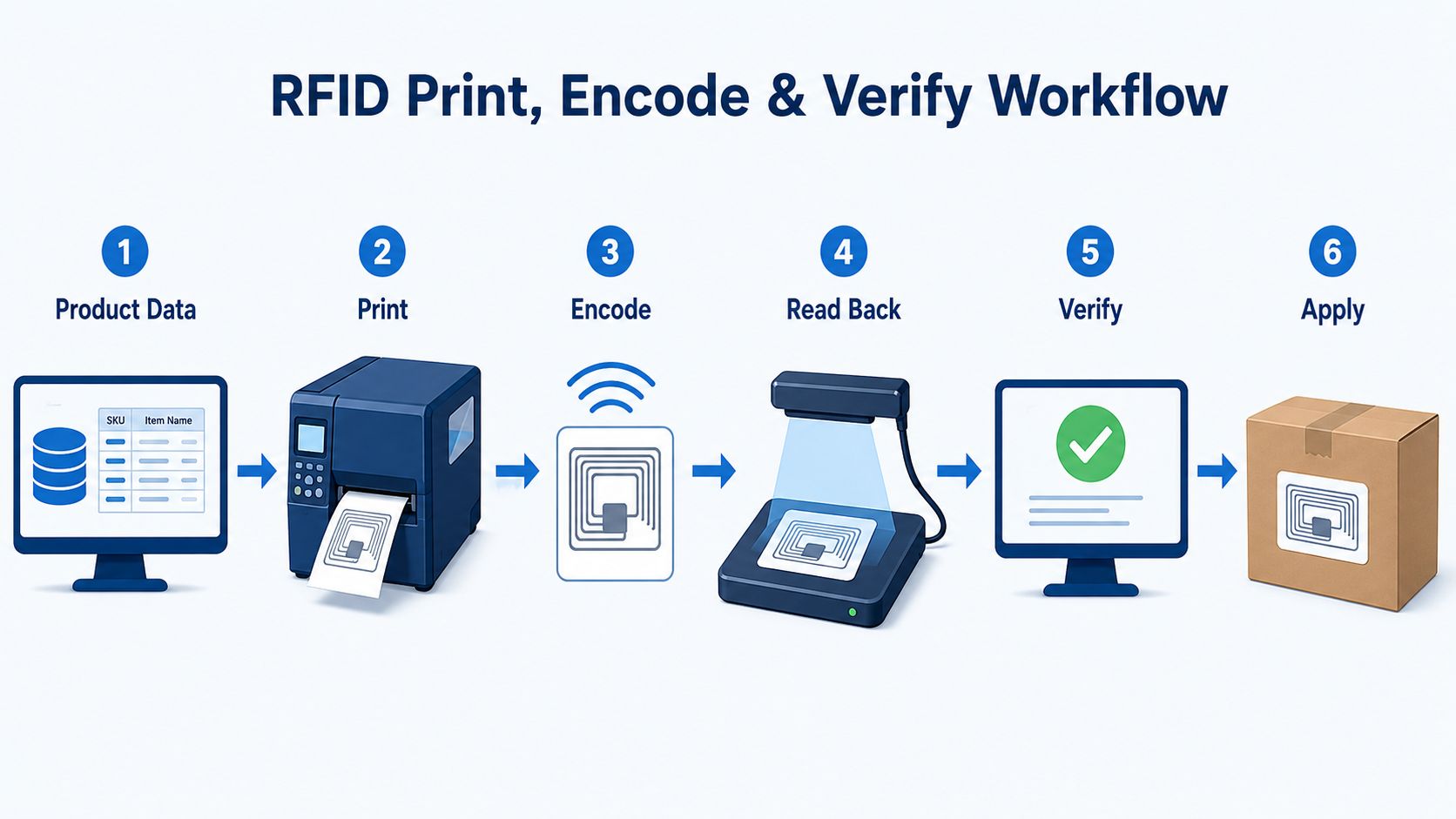
A controlled supplier workflow should treat RFID encoding as a data-production process.
A typical sequence is:
Product Data → Generate Identifier → Print → Encode → Read Back → Verify → Apply
Each stage matters.
The RFID system starts with reliable product information.
This may include:
Incorrect source data will create incorrect RFID labels even if the hardware works perfectly.
The software converts product and serialization data into the required EPC structure.
GS1's EPC Tag Data Standard defines how GS1 identifiers can be represented on EPC/RFID tags. GS1's current TDS framework continues to support established EPC schemes while newer TDS 2.x versions also introduce additional encoding options.
SGTIN means Serialized Global Trade Item Number.
It combines product-level identification with a serial component so that a specific physical trade item can receive an individual identity.
The concept can be understood as:
GTIN identifies the product type
while
serialization identifies the individual unit
SGTIN-96 is a 96-bit EPC binary encoding scheme that has been widely used in UHF RFID deployments.
Its fields include:
Under SGTIN-96, the serial number has specific restrictions: it must be numeric, cannot contain leading zeros except for the value zero itself, and must fit within the 38-bit serial-number range.
This is important because suppliers should not create their own EPC format simply because a number fits into an RFID tag.
Follow the encoding structure required by your retailer or trading partner.
A critical rule in item-level RFID is uniqueness.
Two individual items should not accidentally receive the same serialized EPC.
Duplicate EPCs can cause problems such as:
Serialization should therefore be managed centrally and systematically.
Do not let separate printers, factories, or production lines independently generate overlapping serial ranges.
The printer produces the required visible content.
Depending on the program, this may include:
The printed information must match the electronic encoding where required.
The RFID printer or writer writes the EPC into the appropriate tag memory.
For a more technical explanation of tag memory and writing, see How to Program an RFID Tag.
Never assume that an encoding command was successful.
After encoding, the device should read the tag again.
This verifies that:
A successfully encoded RFID tag can still be wrong if it was encoded for the wrong SKU.
Verification should therefore confirm:
RFID EPC ↔ Printed Label ↔ Product ↔ Order Data
not simply:
RFID tag can be read
Tag placement should be standardized before volume production begins.
Operators should not decide independently where to apply every RFID label.
Create a documented placement specification showing:
RFID inlays contain a physical antenna.
Sharp folding or bending through critical antenna areas may affect performance or damage the tag.
Unless the tag is specifically designed for metal, placing it directly against metal can significantly reduce readability.
A label on the outside of a carton may still be affected by what is inside.
Products containing:
can change RFID performance.
Consistent placement makes:
A tagging SOP should therefore include visual examples for production employees.
RFID verification should be part of production quality control, not an occasional troubleshooting activity.
A supplier should be able to confirm that the RFID labels leaving the factory are:
Read the tag and compare the EPC against the expected value.
Identify duplicate EPCs before products leave the factory.
Confirm that printed:
matches the intended item.
Test a representative sample or the required quantity under the retailer's specified procedure.
Check for:
Maintain records showing which labels and serialization ranges were produced for which order or production batch.
This makes troubleshooting much easier if a problem appears later.
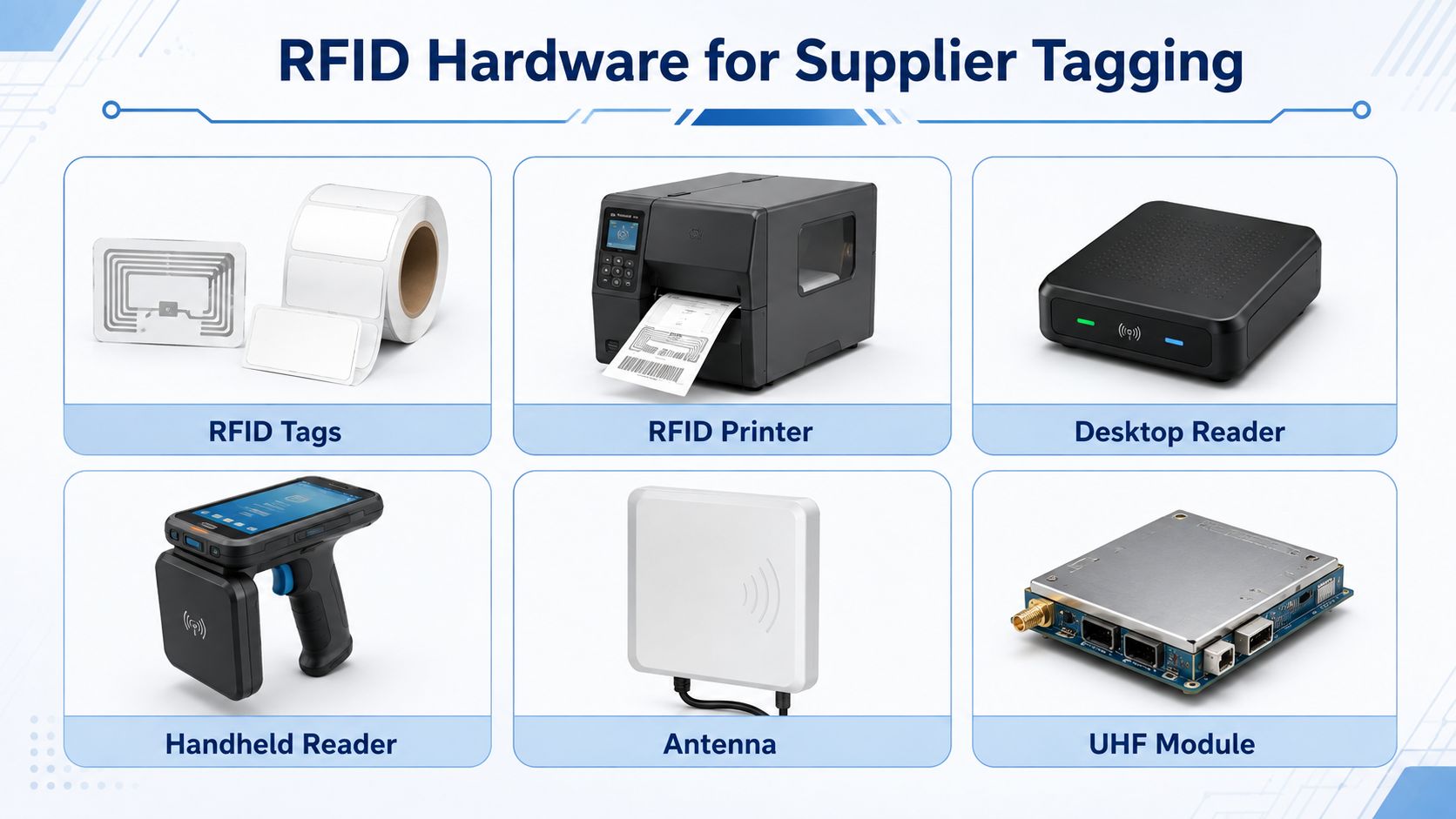
A supplier RFID tagging operation may use several types of hardware.
| Hardware | Typical Supplier Use |
|---|---|
| RFID Tags / Labels | Electronic identification applied to products or packaging |
| RFID Printer Encoder | Print visible data and encode EPC information at production volume |
| UHF Desktop Reader | Tag commissioning, encoding checks and QC verification |
| RFID Handheld | Product testing, placement testing, warehouse inspection and batch checks |
| UHF Antenna | Controlled fixed testing or verification stations |
| UHF Reader Module | Embedded printer, encoder, inspection station or custom OEM equipment |
Syncotek's current RFID portfolio includes UHF tags, desktop readers, handheld devices, antennas, fixed readers, reader modules, intelligent devices and POSTEK RFID printers.
This is usually the core production device for a supplier that wants to produce RFID labels internally.
Choose a printer based on:
Syncotek's POSTEK RFID printer options include industrial and desktop-class configurations for RFID label printing and verification.
A desktop reader-writer can support:
See RFID Reader and Writer: How to Choose the Right Read-Write Device for more information.
A handheld is particularly useful when testing tags on real products because it allows the operator to change:
It can also support warehouse and finished-goods inspection.
Fixed RFID test stations may require controlled antennas to produce repeatable read zones.
Antenna selection should consider:
An OEM supplier or equipment manufacturer may choose an embedded UHF RFID module when developing its own:
Syncotek's UHF modules support EPC Gen2 / ISO 18000-63 and are intended for integrations such as printers, handhelds, kiosks and industrial devices.
Several errors appear repeatedly when suppliers implement RFID for the first time.
Do not assume any EPC Gen2 label will satisfy the customer.
Confirm the exact specification first.
Tag cost matters at scale, but a cheaper tag that fails on your product can create far greater costs through:
A tag that works well before it is attached to the product may fail after application.
Always test on the real item.
Different:
may require different RFID designs.
Duplicate or incorrectly constructed EPCs can undermine the entire item-level system.
Use controlled serialization and validation.
The RFID tag may be encoded correctly but attached to the wrong product or printed with the wrong barcode.
Verification must check the relationship between all three.
A correct tag in a poor location can still fail.
Follow retailer placement rules and validate placement on the real product.
RFID printer compatibility depends on:
Select the tag and printer as a system.
See How to Select the Right RFID Printer Encoder and Supplies for more guidance.
Printing and encoding without reading the tag back creates unnecessary risk.
Every production process should include a defined verification method.
A process that works for one customer should not automatically be used for another.
Maintain separate customer specifications when required.
One of the most important implementation decisions is whether to outsource encoded labels or build your own production capability.
| Factor | Pre-Encoded Labels | In-House Printing & Encoding |
|---|---|---|
| Initial investment | Lower | Higher |
| Technical setup | Lower | Requires setup |
| Best volume | Low to moderate | Moderate to high |
| SKU flexibility | Lower | High |
| Production control | Lower | High |
| Lead time | Depends on supplier | Can be immediate |
| Urgent changes | More difficult | Easier |
| Serialization control | External | Internal |
| Equipment required | Minimal | RFID printer / software / QC |
| Scalability | Depends on supplier | Strong after implementation |
Many suppliers start with outsourced tags and later move encoding in-house after volume justifies the equipment and process.
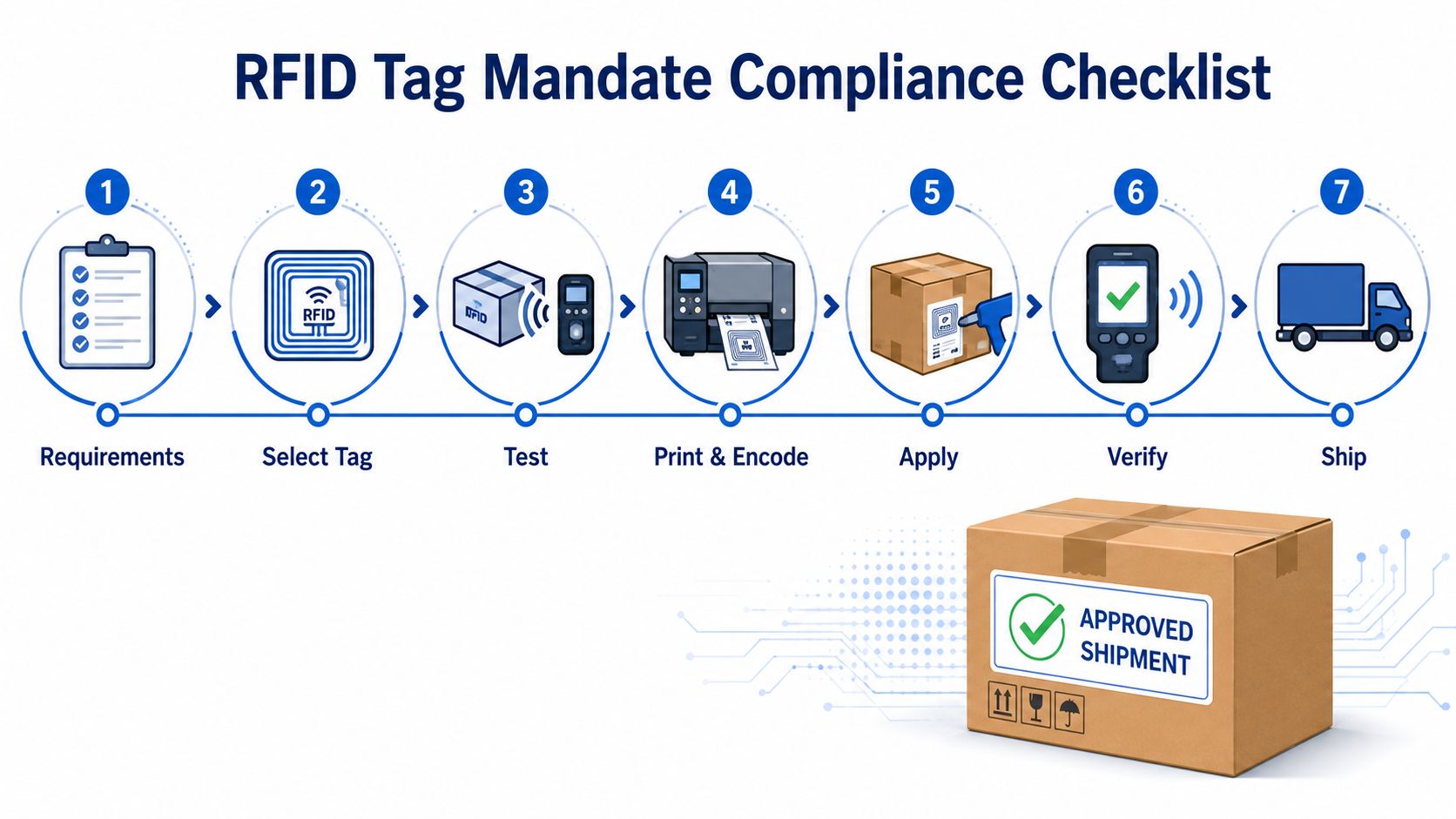
Before shipping RFID-tagged products, confirm the complete process.
The best RFID program is not one that solves a single urgent shipment.
It is one that can be repeated reliably.
A scalable implementation normally develops through several stages.
Start with:
Use this phase to learn:
Document:
Create repeatable SOPs.
Use a centralized system for generating and tracking serialized identifiers.
Avoid manually generating serial numbers in separate spreadsheets or isolated production lines without coordination.
A production station may include:
Depending on production volume, verification may use:
Connect RFID with:
This reduces manual re-entry and mismatch risk.
Once the process is stable, create separate profiles for:
This turns RFID compliance from an emergency project into a normal manufacturing or packaging capability.
Before purchasing equipment, answer the following questions:
A supplier handling 500 RFID labels per month may require a very different system from one encoding hundreds of thousands of tags.
An RFID tag mandate is a requirement from a retailer or trading partner requiring specified products or packaging to carry RFID tags according to defined tagging, encoding, placement, testing, or data rules.
Passive UHF RAIN RFID based on EPC Gen2 / ISO 18000-63 is widely used for retail item-level tagging because it supports fast reading of many tags and serialized product identification.
EPC stands for Electronic Product Code. It provides a way to represent uniquely identified physical objects in RFID and related data-capture systems.
SGTIN-96 is a 96-bit EPC encoding scheme for serialized trade items. It includes product identification and a numeric serial number so individual physical items can have unique EPC identities.
No. Do not assume one encoding requirement applies to every retailer or program. Always check the latest customer specification.
Yes. Suppliers can use an RFID printer encoder or compatible RFID reader-writer to write EPC data into compatible UHF RFID tags.
If you plan to print and encode RFID labels in-house at production volume, an RFID printer encoder is usually the most practical option.
A standard barcode printer can print the label surface but cannot normally write RFID data unless it includes an RFID encoder.
Read the tag back with the printer's verification function, a desktop RFID reader, handheld reader, or another compatible RFID reader and compare the EPC with the expected product data.
Item-level RFID depends on individually identifying physical products. Duplicate EPCs can cause inventory, receiving, traceability, and data-quality problems.
Not necessarily. Product material, size, packaging, metal, liquids, orientation, and retailer requirements can all affect which RFID tag should be used.
Follow the retailer's placement specification and test the tag on the actual product. Avoid positions that interfere with the antenna or place a conventional RFID label directly against metal unless it is designed for that application.
Pre-encoded labels can be practical for lower volumes and pilots. In-house RFID printing becomes more attractive when volumes grow, SKUs change frequently, or faster production control is required.
A typical in-house system may include RFID labels, RFID printer encoder, desktop reader, handheld reader, software, and optionally antennas or UHF modules for custom verification equipment.
Confirm the requirement first, test the tag on real products, standardize placement, control EPC serialization, verify every production process, and maintain traceable records.
RFID tag mandates should not be treated as a simple labeling requirement.
For suppliers, reliable RFID implementation requires a controlled process that connects:
Retailer Requirements → Tag Selection → Product Testing → Encoding → Printing → Placement → Verification → Shipment
The most important principle is to avoid making isolated decisions.
The RFID label, product material, printer, EPC data, tag placement, reader, software, and quality-control process all affect the final result.
Start by understanding the customer's exact requirement.
Then test several suitable tags on the real product, define a controlled encoding and serialization workflow, verify every label, and document the process before scaling.
When RFID becomes a recurring customer requirement, moving from ad-hoc labeling to a standardized in-house system can improve production flexibility, data control, and long-term scalability.
Syncotek provides RFID hardware for suppliers, manufacturers, packaging companies, system integrators, and OEM equipment developers building UHF RFID tagging and verification workflows.
Our RFID portfolio includes:
Whether you need to test RFID labels on your products, establish an internal print-and-encode station, verify serialized EPC data, or integrate UHF RFID into automated packaging equipment, Syncotek can help evaluate suitable hardware for your workflow.
Explore the complete Syncotek RFID product range or review our RFID readers, modules, antennas, and tags to plan your supplier RFID tagging system.
 Guide
Guide
Choosing the right UHF RFID reader is one of the most important decisions in an RFID project. The reader determines how far tags can be detected, how many tags can be inventoried, how stable the system will be in real environments, and how easily RFID data can be connected to your software, kiosk, warehouse system, production line, […]
READ MORE Knowledge
What Is Load Modulation? Load modulation is the uplink method used by most HF RFID and NFC tags to send data back to a reader in the near field. The tag does not generate its own RF carrier. Instead, it changes its electrical load across the tag coil, and that change is coupled back into the reader’s magnetic […]
READ MORE Knowledge
RFID systems generally fall into two big tag categories: passive RFID and active RFID. They solve different problems. If you choose the wrong one, you’ll either overpay (active when passive is enough) or underperform (passive when you truly need real-time long-range visibility). This guide explains the differences in plain English, with practical selection criteria and […]
READ MORE Knowledge
What is RFID software? RFID software is the layer that turns RFID hardware signals (readers, antennas, tags, sensors) into usable data and workflows—inventory updates, asset movements, shipping/receiving events, access logs, and analytics. In most real deployments, RFID systems require middleware: software that sits between RFID interrogators (readers) and enterprise applications (WMS/ERP/MES/POS). It manages/configures devices and processes raw tag data by filtering duplicates […]
READ MORE Knowledge
HF RFID runs at 13.56 MHz and is widely used for access control badges, contactless payments, libraries, healthcare wristbands, and NFC phone tap experiences. When people say “HF RFID,” they often mean very different things—because HF is a frequency band, while standards define the protocol stack (how tags and readers actually communicate). More about HF […]
READ MOREIf you are interested in our services or need customized solutions, please feel free to contact us.