

When businesses start planning an RFID project, they often focus on readers, antennas, and software first. However, one of the most important decisions is the RFID item attached to the object being tracked.
This is where terminology can become confusing. Many people use RFID inlay, RFID tag, and RFID label interchangeably. In some conversations, this may not cause a problem. But in real RFID deployment, these terms describe different levels of construction, protection, usability, and application suitability.
Choosing the wrong RFID form factor can lead to poor read performance, damaged tags, failed printing, weak adhesion, or a solution that does not survive the operating environment.
For businesses building RFID systems for logistics, warehouse control, retail, manufacturing, or industrial asset tracking, understanding the difference between inlays, labels, and tags is a practical starting point before selecting the complete RFID products needed for deployment.
An RFID inlay is the functional core of many RFID products. It usually consists of an RFID chip and an antenna mounted on a thin substrate. The chip stores data, while the antenna receives energy from the reader and sends back the tag response.
In simple terms, the RFID inlay is the “engine” inside many RFID labels and tags.
A typical RFID inlay includes:
The RFID chip stores identification data and handles communication based on the RFID protocol. The antenna receives and transmits RF energy between the tag and reader. The substrate holds the chip and antenna together.
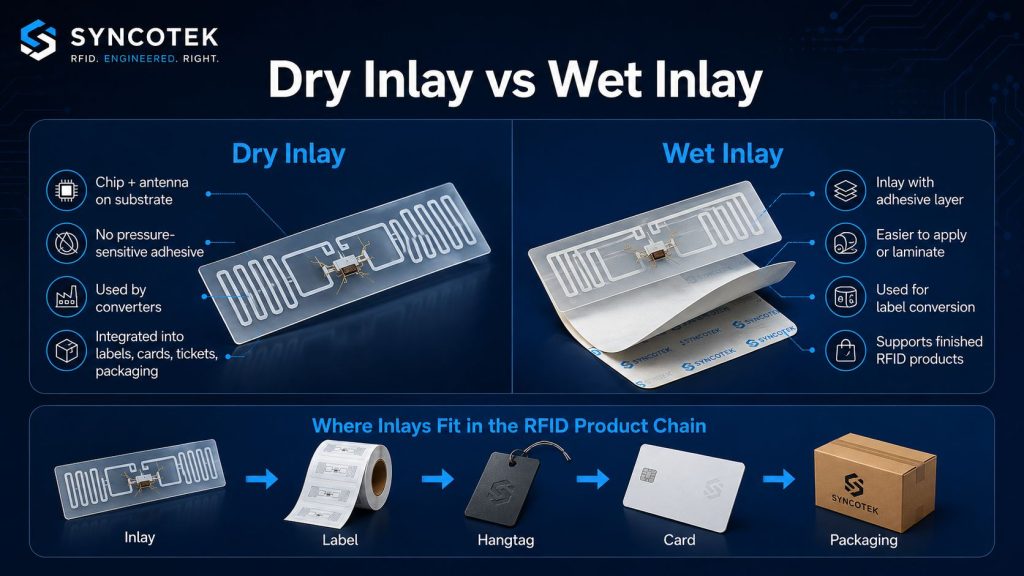
RFID inlays are commonly divided into dry inlays and wet inlays.
| Inlay Type | Structure | Typical Use |
|---|---|---|
| Dry RFID inlay | Chip and antenna on substrate, usually without adhesive | Used by converters to make labels, cards, tickets, and packaging |
| Wet RFID inlay | RFID inlay with adhesive backing | Used when the inlay needs to be applied to another material or converted into a finished label |
Dry inlays are usually used as raw materials in RFID converting. Wet inlays are easier to apply or laminate into labels, tickets, or other finished RFID products.
RFID inlays are commonly used in:
Because inlays are not usually designed for exposed use, they need additional protection if the application involves abrasion, moisture, bending, impact, or harsh handling.
An RFID label is usually an RFID inlay converted into a printable and adhesive label format. It combines RFID functionality with traditional label features such as printed text, barcode, logo, product information, or serial number.
RFID labels are one of the most common choices for item-level tracking, carton labeling, retail inventory, warehouse management, and logistics. They are especially useful when businesses need both visual identification and automated RFID data capture in one format.
For example, in RFID inventory management, labels are commonly applied to cartons, products, pallets, bins, or warehouse stock to support faster counting, stock visibility, and movement tracking.
A typical RFID label may include:
The face stock allows printing. The inlay enables RFID communication. The adhesive allows the label to be applied to a product, carton, pallet, or asset.
RFID labels are widely used because they are:
An RFID label can carry both human-readable information and machine-readable RFID data. This makes it practical for businesses that are upgrading from barcode workflows to RFID-based tracking.
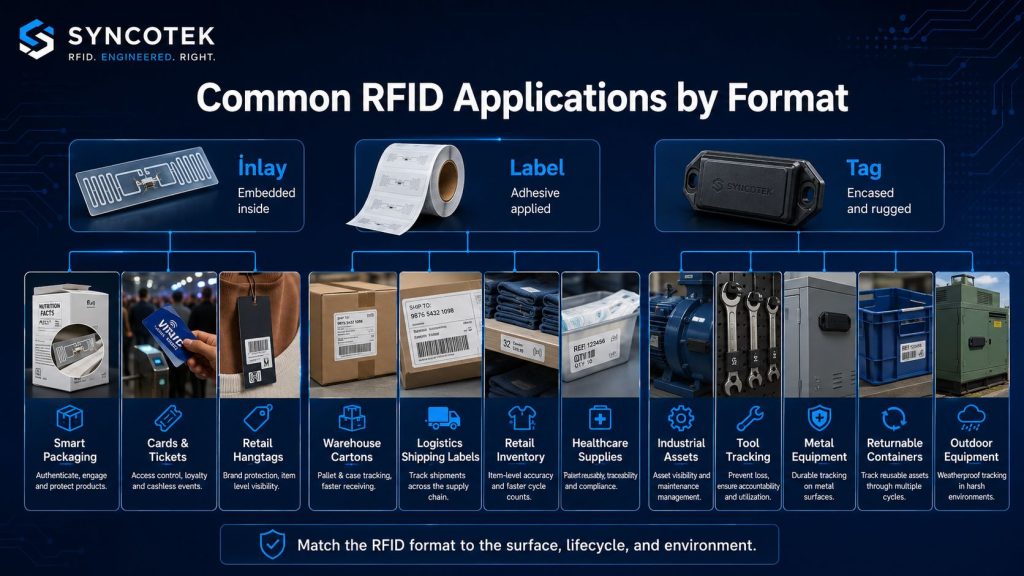
RFID labels are commonly used for:
For many standard indoor applications, RFID labels are the most practical choice.
An RFID tag is a broader term. It can refer to any complete RFID device attached to an item for identification and tracking. An RFID tag usually contains a chip and antenna, but it may also include protective housing, special materials, mounting holes, adhesive, encapsulation, or rugged packaging.
In everyday use, “RFID tag” can include labels, hard tags, cards, wristbands, key fobs, laundry tags, tire tags, and on-metal tags. However, in technical selection, “tag” often refers to a more finished or durable RFID product than a basic inlay.
Common RFID tag types include:
| RFID Tag Type | Typical Use |
|---|---|
| Standard RFID label tag | Cartons, retail goods, packaging |
| Hard RFID tag | Industrial assets, equipment, tools, containers |
| On-metal RFID tag | Metal tools, machines, IT assets, racks |
| High-temperature RFID tag | Manufacturing, paint lines, heat processing |
| Laundry RFID tag | Textile and uniform tracking |
| RFID card | Access control, membership, identification |
| RFID wristband | Events, healthcare, hospitality |
| RFID hangtag | Apparel, retail branding, item-level inventory |
| Tamper-evident RFID tag | Security-sensitive products and assets |
Compared with inlays and labels, RFID tags can offer better durability, stronger mounting options, and more application-specific design.
For metal tools, machines, racks, IT equipment, and metal containers, standard labels may not perform reliably. In these cases, mount on metal RFID tags are usually a better choice because they are designed to reduce the negative effect of metal surfaces on RFID performance.
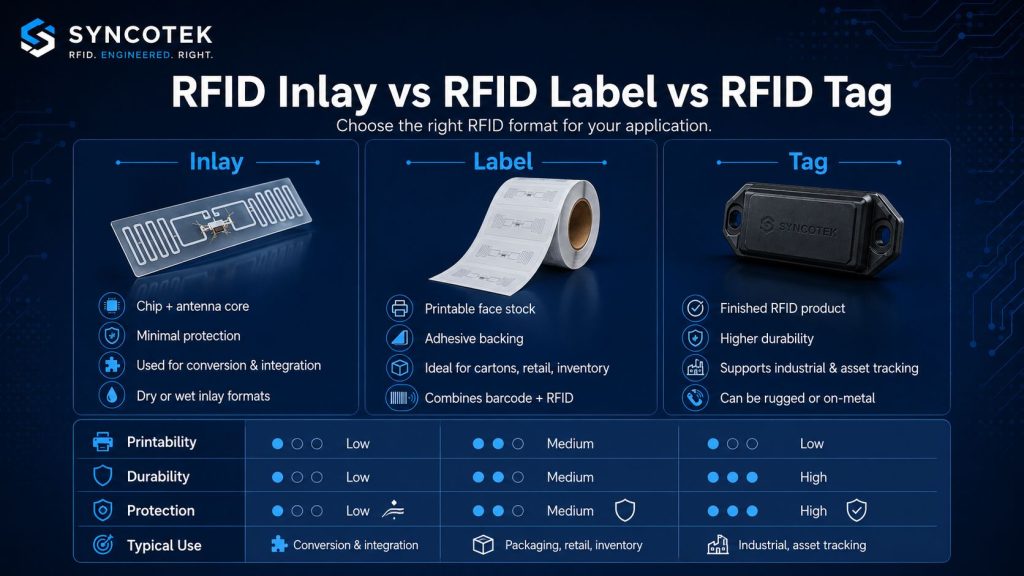
Although these terms are related, they are not the same.
| Factor | RFID Inlay | RFID Label | RFID Tag |
|---|---|---|---|
| Basic meaning | Functional RFID core | Printable adhesive RFID label | Complete RFID identification device |
| Main components | Chip + antenna + substrate | Inlay + face stock + adhesive + liner | Chip + antenna + housing or application structure |
| Printability | Usually no | Yes | Depends on tag type |
| Adhesive | No or optional | Usually yes | Optional |
| Durability | Low | Moderate | Low to very high |
| Protection | Minimal | Label-level protection | Application-specific protection |
| Typical use | Embedded into labels, cards, packaging | Retail, logistics, inventory, cartons | Assets, tools, equipment, harsh environments |
| Best for | Conversion and integration | High-volume labeling | Durable or specialized tracking |
A simple way to understand the relationship:
RFID inlay = core electronic component
RFID label = printable adhesive format built around an inlay
RFID tag = finished RFID product designed for a specific use case
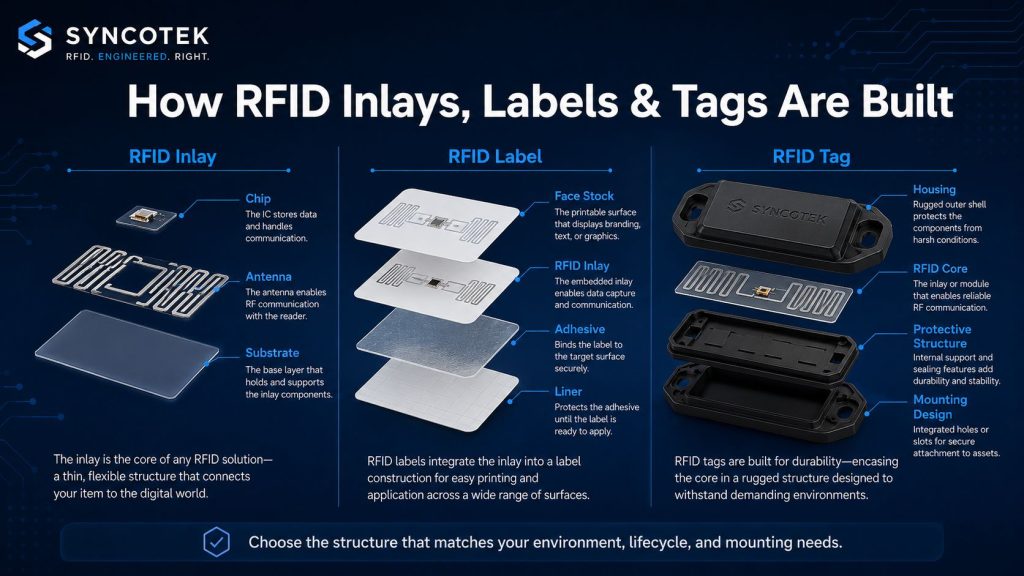
The inlay is the foundation. It is usually thin and flexible, but not very protected. It is designed to be converted into a finished product or embedded into another material.
Inlays are suitable for integration and conversion, but they are not usually the final choice for exposed asset tracking.
An RFID label adds usability to the inlay. It provides a printable surface and adhesive backing, making it easy to apply and identify visually.
RFID labels are often printed and encoded by RFID printer encoders. If a company needs serialized EPC data, barcode printing, product information, or human-readable asset IDs, the label must be compatible with the printer, inlay position, and encoding workflow. This is why choosing the right RFID printer encoder and supplies is important before large-scale label deployment.
An RFID tag may use encapsulation, plastic housing, special adhesives, mounting holes, metal-compatible design, or rugged materials to survive more demanding use.
For industrial factories and production environments, rugged RFID tags are often used together with readers, antennas, and software to support traceability, tool control, and asset movement. This makes them a strong fit for RFID in manufacturing applications.
RFID tags and labels can also be classified as active or passive.
Passive RFID tags do not have an internal battery. They receive energy from the RFID reader’s signal and respond when activated.
Passive RFID is widely used in:
Passive RFID labels are usually more cost-effective and are suitable for high-volume deployment.
Active RFID tags have an internal battery and can transmit signals over longer distances. They are usually larger and more expensive than passive tags.
Active RFID is more suitable for:
Most RFID labels used in retail and logistics are passive. Rugged active tags are usually selected only when the application requires long-range or active broadcasting.
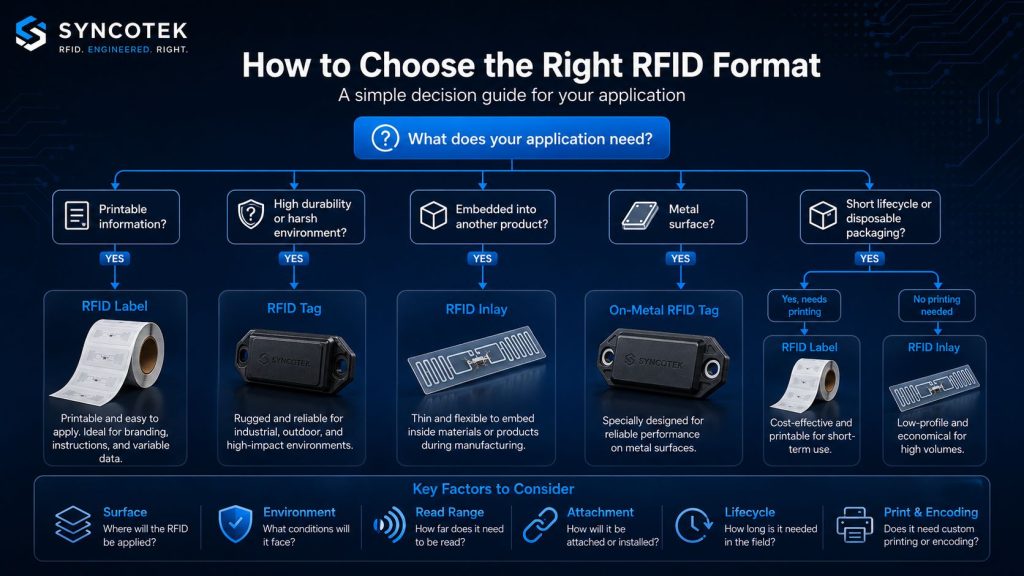
Choosing between RFID inlays, labels, and tags depends on the application, environment, and lifecycle of the tracked item.
RFID inlays are suitable when you need a raw RFID component to be embedded into another product.
Inlays are not usually the best choice for direct exposed asset tracking unless they are protected by another layer.
RFID labels are suitable for high-volume, adhesive-based identification.
RFID labels are ideal when you need both printed information and RFID functionality in one format.
RFID tags are suitable when the application requires better durability, special mounting, or environmental resistance.
If the asset will face impact, weather, chemical exposure, metal surfaces, or repeated handling, a rugged RFID tag is usually a better choice than a standard RFID label.
RFID labels can also include printed barcodes, but RFID and barcode identification work differently.
| Comparison | Barcode Label | RFID Label |
|---|---|---|
| Reading method | Optical scan | Radio frequency scan |
| Line of sight | Required | Not always required |
| Bulk reading | Limited | Supported in many applications |
| Data capacity | Usually printed information only | Chip stores digital ID and data |
| Automation | More manual | More automated |
| Cost | Lower | Higher |
| Best use | Simple visible identification | Inventory visibility and automated tracking |
For many businesses, RFID labels do not completely replace barcode labels at the beginning. Instead, RFID labels often combine both technologies: printed barcode for visual/manual backup and RFID for automated tracking.
The surface material affects RFID performance and adhesive reliability.
Check whether the item is:
For metal surfaces, standard RFID labels may not work well. On-metal RFID labels or rugged metal-mount RFID tags are often required.
The operating environment determines the required durability.
Consider:
A label that works well on a carton may fail quickly on an industrial tool, metal container, or outdoor asset.
Read range depends on the RFID chip, antenna design, tag size, material, reader power, antenna setup, and application environment.
In general:
To achieve stable performance, tag selection should be reviewed together with reader and antenna design. For projects where read distance and read-zone shape matter, it is also important to understand how to select the right RFID antenna for the application.
If you need printed barcodes, product names, logos, serial numbers, or human-readable text, an RFID label is usually more suitable than a raw inlay or hard tag.
Check:
RFID printer and label compatibility should be confirmed before mass production.
RFID labels usually use adhesive, while RFID tags may use different attachment methods.
Common attachment methods include:
The attachment method should match the item lifecycle and environment.
Ask how long the RFID item needs to survive.
Longer lifecycle usually requires a more durable RFID tag rather than a simple label.
RFID labels and tags do not work alone. Their performance depends on the full RFID system, including readers, antennas, cables, connectors, and installation layout.
For example, even a good RFID tag may perform poorly if the antenna is poorly positioned, the cable has excessive loss, or the connector does not match the system. During deployment, teams should also check RFID cables, connectors, and adapters to reduce signal loss and avoid installation problems.
| Application | Recommended RFID Format |
|---|---|
| Retail apparel | RFID label or hangtag |
| Warehouse cartons | RFID label |
| Shipping and logistics | RFID label |
| Smart packaging | RFID inlay or label |
| Product authentication | RFID inlay, label, or tag depending on design |
| Tool tracking | Rugged RFID tag or on-metal tag |
| Metal asset tracking | On-metal RFID tag |
| Returnable containers | Rugged RFID tag |
| Outdoor equipment | Rugged weather-resistant tag |
| Healthcare supplies | RFID label |
| Surgical tools | Embedded or rugged RFID tag |
| IT asset tracking | RFID label or on-metal label |
| Laundry and textile tracking | Laundry RFID tag |
| Access control | RFID card or key fob |
They all enable RFID identification, but they are not interchangeable. An inlay without protection should not be used like a rugged industrial tag.
Low-cost labels may be suitable for cartons but not for metal assets, outdoor items, or high-value equipment.
Metal, liquids, and curved surfaces can significantly affect RFID performance. Tag selection should start with the item being tagged.
If labels need to be printed and encoded in-house, the RFID label must match the printer, inlay position, label thickness, and software workflow.
Moisture, abrasion, heat, chemicals, and impact can damage labels quickly. Industrial environments often require rugged tags.
RFID performance depends on the actual item, surface, reader, antenna, and installation environment. Always test before full deployment.
To improve project reliability, follow these practices:
A successful RFID project starts with the right RFID form factor.
RFID inlays, labels, and tags are closely related, but they serve different roles.
An RFID inlay is the core functional component made of the chip and antenna. An RFID label turns the inlay into a printable, adhesive solution for high-volume tracking. An RFID tag is a broader finished product designed for a specific application, ranging from simple labels to rugged industrial devices.
The right choice depends on how the item will be used, where it will be applied, how long it must last, whether printing is required, and what environmental conditions it must survive.
For retail, logistics, and warehouse labeling, RFID labels are often the most practical choice. For industrial assets, metal equipment, outdoor tools, and reusable containers, rugged RFID tags may be required. For embedded product development or converting, RFID inlays are the starting point.
By understanding these differences, businesses can avoid mismatched products and build more reliable RFID tracking systems.
An RFID inlay is the core component that includes the chip and antenna. An RFID label adds printable face material, adhesive, and backing, making it suitable for application to products, cartons, or assets.
An RFID label is one type of RFID tag. However, “RFID tag” is a broader term that can also include hard tags, cards, wristbands, laundry tags, on-metal tags, and other finished RFID products.
RFID inlays are usually not recommended for exposed direct use because they have limited protection. They are normally converted into labels, cards, hangtags, packaging, or other finished products.
A wet RFID inlay is an RFID inlay with an adhesive layer. It can be applied to another material or converted into RFID labels and other finished RFID products.
A dry RFID inlay usually includes the chip and antenna on a substrate without adhesive. It is commonly used by converters to manufacture RFID labels, tickets, hangtags, cards, or packaging.
For carton, product, and warehouse inventory, RFID labels are often suitable. For tools, equipment, metal assets, and reusable containers, rugged RFID tags or on-metal tags may be better.
Yes. Many RFID labels include printed barcodes, text, product information, or logos on the face material while also carrying RFID data inside the inlay.
Standard RFID labels usually do not perform well on metal. For metal surfaces, use on-metal RFID labels or rugged metal-mount RFID tags.
Need Help Choosing RFID Labels, Tags, or Hardware for Your Application?
Syncotek provides RFID readers, antennas, tags, labels, and system components for inventory management, logistics, manufacturing, asset tracking, retail, and industrial identification applications.
Whether you need printable RFID labels for warehouse inventory, rugged tags for industrial assets, or on-metal RFID tags for metal equipment, Syncotek can help you evaluate the right RFID solution based on your item surface, read range, environment, and deployment goals.
 Knowledge
What Is Backscatter in RFID? Backscatter is the communication method used by most passive UHF RFID tags to send data back to a reader without generating their own RF carrier. Instead of transmitting like an active radio, the tag uses the reader’s signal as both its power source and its communication medium, then changes how that signal is […]
READ MORE Knowledge
The RFID system auto-identifies vehicles' weight, calculates net weight, and provides real-time monitoring for optimized efficiency.
READ MORE Knowledge
Digital Product Passports are changing the way manufacturers, brands, supply-chain operators, retailers, repairers, recyclers, and regulators think about product information. Instead of product data remaining fragmented across ERP systems, spreadsheets, certificates, technical documents, service records, and recycling databases, a Digital Product Passport can connect a physical product with structured digital information that remains accessible throughout […]
READ MORE Knowledge
Choosing an RFID tag should not begin with a catalog, chip model, or maximum advertised read distance. It should begin with the physical object and the workflow. The right RFID tag for a cardboard carton may fail when attached to a metal tool. A tag that performs well with a fixed reader and high-gain antenna […]
READ MORE Knowledge
Tools are essential assets in many industries. Manufacturing plants, construction companies, hospitals, repair teams, rental businesses, warehouses, and maintenance departments all depend on tools being available, traceable, and properly maintained. However, tool management is often difficult. Tools may be misplaced, borrowed without record, left at job sites, stored in the wrong cabinet, sent for maintenance […]
READ MOREIf you are interested in our services or need customized solutions, please feel free to contact us.