




-
 Knowledge
Sep 25, 2026
Knowledge
Sep 25, 2026RFID Tote Tracking: Reusable Bins, Containers & RTI Management
Reusable totes, bins, crates and returnable containers are easy to overlook because they are not usually the products being sold. But in many warehouses and manufacturing supply chains, they are valuable operational assets. A company may own 5,000 reusable totes and still struggle to answer basic questions: When these movements are managed with spreadsheets, manual […]
READ MORE -
Knowledge
Sep 21, 2026
What Is Impinj Gen2X? Gen2X vs Gen2v3 for RAIN RFID Readers and Tags
RAIN RFID systems have been built around EPC UHF Gen2 for many years, but today’s deployments are becoming more demanding. Modern applications may need to identify: At the same time, existing RFID deployments cannot simply abandon the enormous installed base of Gen2 tags and readers. This is where Impinj Gen2X becomes important. Gen2X is not […]
READ MORE -
Knowledge
Sep 20, 2026
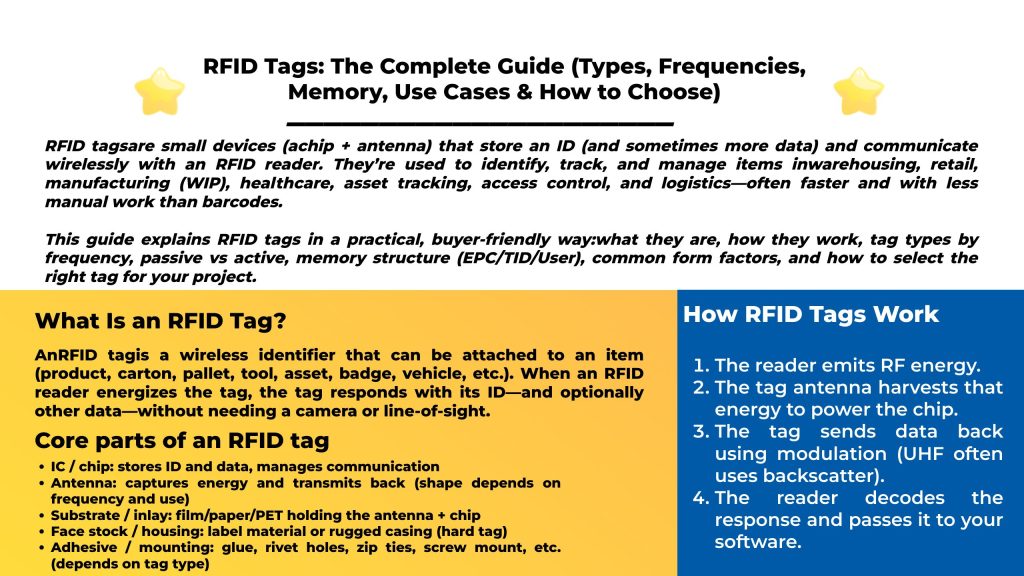
RFID Tags: The Complete Guide (Types, Frequencies, Memory, Use Cases & How to Choose)
RFID tags are electronic identifiers that allow physical products, assets, containers, tools, garments and other objects to communicate wirelessly with an RFID reader. Unlike a barcode, an RFID tag normally does not need to be directly visible to the reader. Depending on the RFID technology and system design, readers can identify individual tags, inventory multiple […]
READ MORE -
Knowledge
Sep 20, 2026
How to Start an RFID Project: From Use Case to Pilot and Deployment
A successful RFID project should not begin by purchasing readers. It should begin with a business problem. Companies often approach RFID projects with a requirement such as: We want to use RFID in our warehouse. That is not yet an RFID requirement. A much more useful project definition would be: We need to verify whether […]
READ MORE -
Knowledge
Sep 20, 2026
RFID Interference Troubleshooting: Causes, Symptoms & Fixes for UHF RFID Systems
An RFID system may work perfectly during initial testing and then behave very differently after it is installed in a warehouse, factory, smart cabinet or production line. Common symptoms include: These problems are frequently described as RFID interference. But that description is often too broad. Not every RFID read problem is RF interference. The real […]
READ MORE -
Knowledge
Sep 17, 2026
RFID Data Center Asset Tracking: Servers, Racks, Audits & Lifecycle
A modern data center may contain thousands of physical IT assets distributed across: Servers, switches, storage appliances and network equipment are also moved, upgraded, replaced and decommissioned throughout their lifecycle. The challenge is not simply knowing how many devices the organization purchased. Data center teams need to know: RFID can provide a physical identification layer […]
READ MORE