

Metal asset tracking is one of the most important applications in RFID, but it is also one of the most technically challenging. Many companies want to use RFID to identify tools, machines, containers, laptops, racks, returnable transport items, and industrial equipment, only to discover that standard RFID labels do not perform well when placed directly on metal.
This is where mount on metal RFID tags become essential. These tags are specifically designed to work on conductive surfaces and help businesses build more reliable RFID systems for asset identification, inventory visibility, maintenance workflows, and traceability.
In this guide, we explain why ordinary RFID tags struggle on metal, how on-metal RFID tags solve that problem, what types are available, and how to choose the right solution for your application.
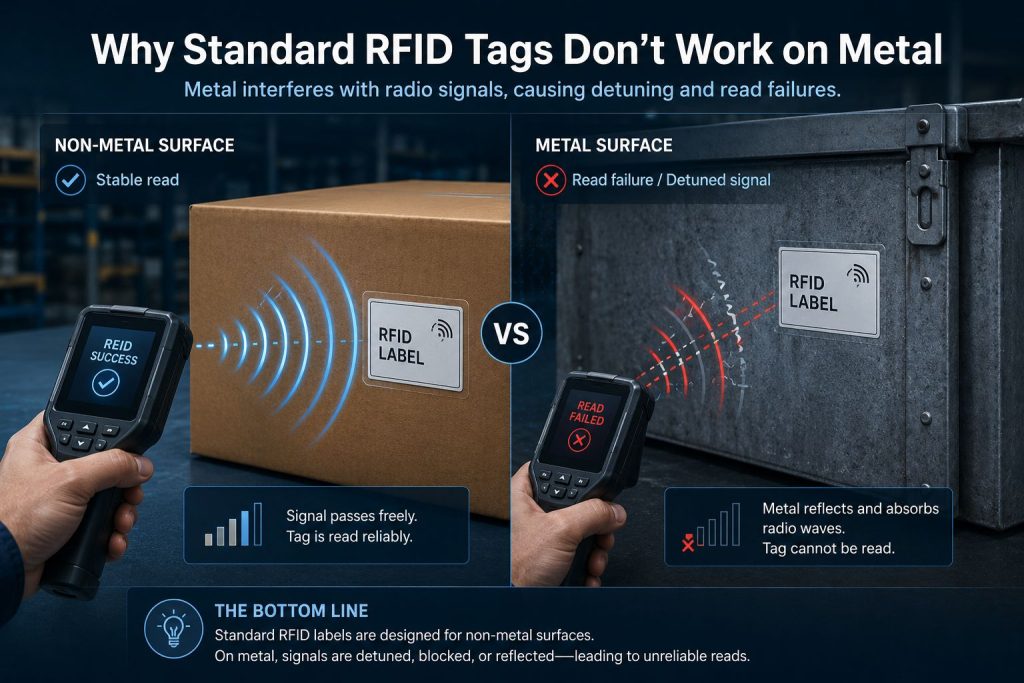
A standard RFID tag is usually designed for materials such as plastic, paper, cardboard, or other non-conductive surfaces. When that same tag is attached directly to metal, the metal interferes with the tag’s antenna behavior.
Metal can reflect and disrupt radio frequency energy. In practical terms, this causes several problems:
This is why a normal RFID label that works well on a carton or plastic bin may fail completely when placed on a steel cabinet, machine frame, or metal tool.
This issue appears in many common industrial and commercial scenarios, including:
If your assets are metal, choosing the wrong tag type can lead to poor read performance, wasted installation time, and unreliable tracking results.
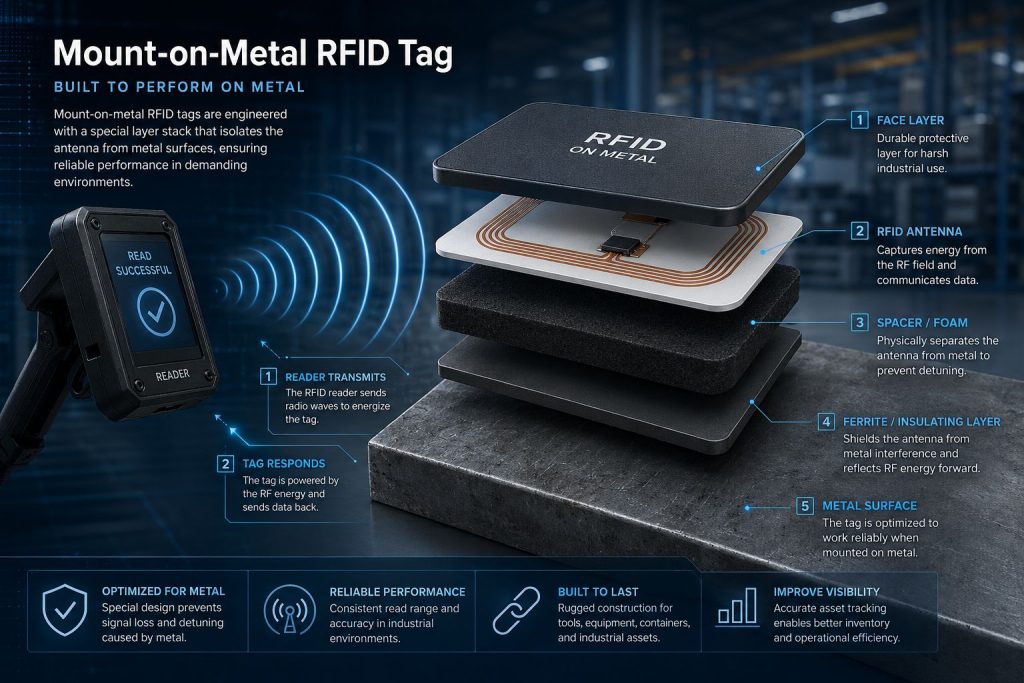
Mount on metal RFID tags are RFID tags engineered specifically for metal surfaces. Their design helps isolate or compensate for the negative effect metal has on RF performance.
Depending on the tag design, this may be achieved through:
These design elements allow the tag to maintain more stable performance when attached directly to metal.
Compared with ordinary RFID tags, mount on metal RFID tags are often:
In many projects, the higher cost of a metal-mount RFID tag is justified because it delivers the read consistency needed for real operational use.
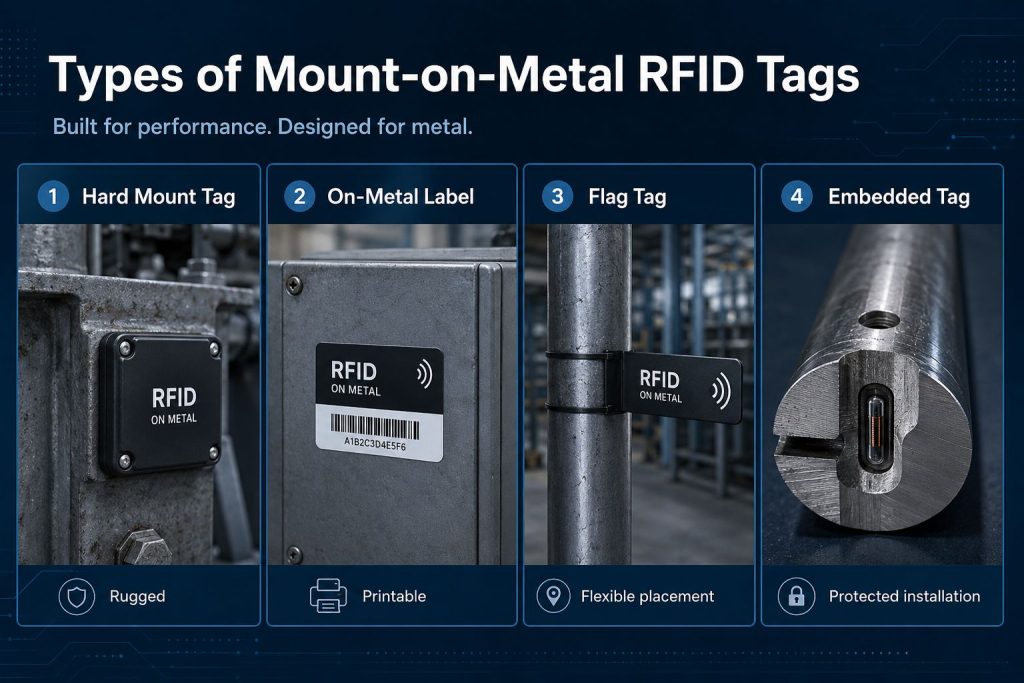
There is no single tag that fits every metal asset. The best choice depends on the size of the asset, installation method, durability requirements, and reading distance.
Hard tags are rugged RFID tags usually enclosed in durable materials such as engineering plastic or other protective housings. They are commonly used in industrial environments where the asset is exposed to vibration, impact, dirt, moisture, or outdoor conditions.
Hard mount RFID tags are often used for:
On-metal RFID labels are thinner than hard tags and are often selected when the application needs a lower-profile tag or printable surface.
These labels are commonly used for:
Flag tags are designed so that the antenna extends away from the metal surface instead of lying flat against it. This helps reduce metal interference while keeping the tag attached to the asset.
Flag tags may be useful for:
Embeddable tags are designed to be installed inside a recess, drilled hole, slot, or protected cavity in the metal asset.
These tags are useful when surface mounting is not ideal or when the tag needs additional protection.
In especially difficult metal environments, or where long read distance is required, semi-passive or active RFID tags may be considered.
These are typically used when:
For most standard metal asset tracking projects, passive on-metal UHF RFID tags remain the first option, but higher-performance tags may be necessary in some demanding deployments.
The main value of on-metal RFID tags is not simply that they can be attached to metal. Their real value is that they allow metal assets to become part of a reliable automated identification system.
A properly selected mount on metal RFID tag helps reduce missed reads and improves identification accuracy for assets that standard labels cannot handle.
With RFID, operators can identify multiple tagged assets more quickly than with manual barcode scanning. This is especially useful for tool cribs, equipment rooms, server racks, and warehouse staging areas.
RFID helps businesses know where equipment is located, whether it has moved, and whether it has passed through a process, checkpoint, or service cycle.
Metal asset tracking is often tied to maintenance, calibration, inspection, and service records. RFID makes it easier to support these workflows with faster data collection.
In many industries, asset loss is not caused by theft alone. Misplacement, poor tracking, delayed returns, and manual recording errors are equally common. RFID helps reduce these issues by improving visibility and accountability.
Selecting the right tag requires more than checking the read range on a datasheet. A strong RFID deployment considers the asset, the environment, and the operating workflow together.
Start by looking at the actual item you want to tag.
Ask questions such as:
A large steel cabinet and a small metal wrench may both be metal assets, but they require very different RFID tag designs.
Read range is important, but it should not be treated as the only selection factor.
Consider:
In many cases, larger tags offer better read performance, while smaller tags are selected when installation space is limited.
Different metal RFID tags support different mounting methods.
Common attachment methods include:
If the asset experiences vibration, outdoor exposure, or repeated handling, a more secure mechanical mounting method is often better than adhesive alone.
The operating environment has a major impact on tag selection.
Important factors include:
A tag that works well in an office may not survive in a factory, warehouse yard, hospital sterilization area, or outdoor logistics environment.
If you need to print human-readable asset IDs, serial numbers, barcodes, or logos, make sure the RFID tag supports your print and encoding workflow.
For example, some on-metal RFID labels are thicker than standard label media, which may affect printer compatibility or settings.
Most asset tracking systems only need a unique EPC identifier, but some projects require additional user memory or specific chip behavior. This should be reviewed at the selection stage rather than after deployment starts.
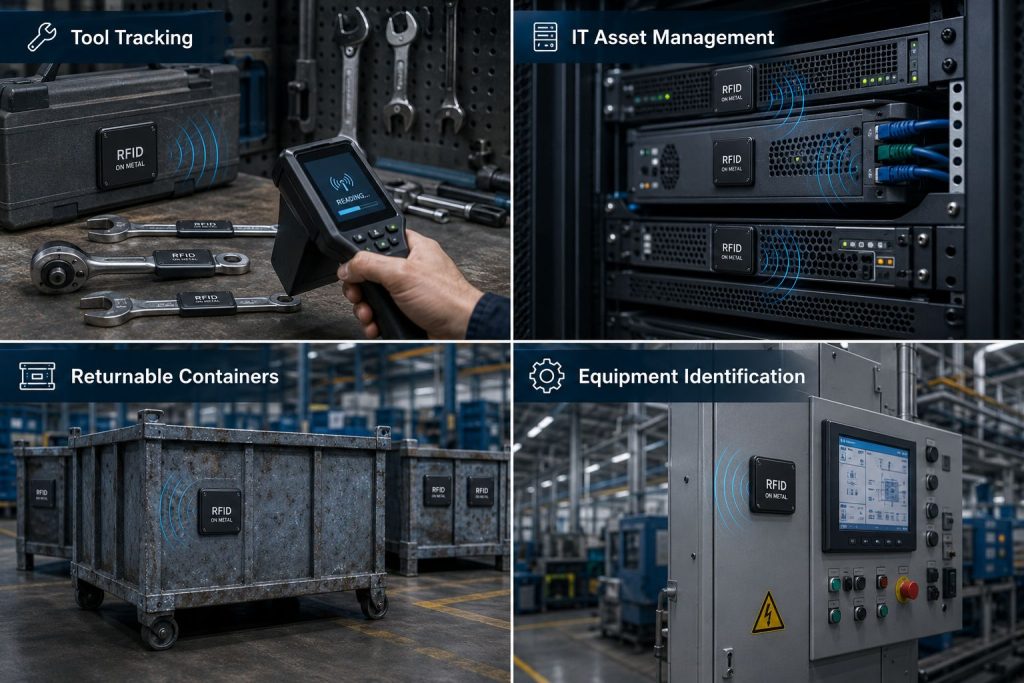
On-metal RFID tags are widely used across many industries because metal assets are common in real operating environments.
Factories, workshops, and service teams often use RFID to track tools, reduce loss, and improve check-in/check-out control.
RFID helps identify and manage machines, mobile equipment, fixtures, and production assets across facilities.
Laptops, servers, storage devices, printers, and network equipment often include metal surfaces that require on-metal labels for proper RFID performance.
Metal containers, racks, cages, carts, and reusable transport assets can be tracked more effectively with durable RFID tags.
Hospitals and medical service providers use RFID for device management, instrument identification, and mobile equipment visibility.
RFID can support part identification, work-in-process tracking, fixture control, and assembly logistics in metal-heavy production environments.
In these sectors, metal is everywhere. Durable RFID tagging can help track assets exposed to harsh conditions and complex field environments.
Even when companies understand that metal affects RFID, implementation mistakes still happen frequently.
This is the most common mistake. A general-purpose RFID label is usually not the right choice for direct metal attachment.
Datasheet values are helpful, but real-world performance depends on the asset, installation position, reader power, antenna type, and surrounding environment.
A tag may perform well electrically but still fail if the attachment method is not suitable for the asset or environment.
Heat, chemicals, moisture, impact, and repeated cleaning can shorten tag life dramatically if the wrong housing or material is selected.
The best way to choose a mount on metal RFID tag is to test it on the actual asset in the actual read environment. Lab assumptions do not always match field performance.
A good RFID project is not only about choosing a tag. It is about matching the tag, reader, antenna, and workflow to the operating environment.
Pilot testing on the actual metal asset is one of the most important steps in any RFID project.
Consistent placement improves repeatability and makes reader setup easier.
Think beyond initial installation. Ask whether the asset is temporary, permanent, reusable, mobile, serviceable, or high-value.
The same tag may behave differently in handheld, fixed-reader, portal, or overhead installations. The full system should be considered from the beginning.
Mount on metal RFID tags are the right solution when standard RFID labels cannot deliver reliable performance on conductive assets. They are designed to overcome the RF challenges created by metal surfaces and allow businesses to track tools, equipment, containers, IT assets, machines, and industrial components more effectively.
The best tag depends on the asset shape, read range requirements, installation method, durability needs, and environment. In most successful projects, the key is not choosing the cheapest tag, but choosing the tag that will work reliably in the real application.
For companies planning RFID deployment in metal-heavy environments, proper tag selection is one of the most important decisions in the entire system design.
Yes, but standard RFID tags often perform poorly on metal. For reliable operation, it is usually necessary to use an RFID tag specifically designed for metal surfaces.
An on-metal RFID tag is designed with structural or antenna features that allow it to function properly near metal. A regular RFID tag is generally intended for non-metal surfaces.
In most cases, yes. However, they offer the performance and durability needed for metal asset tracking, which often makes them more cost-effective in real deployments.
Common industries include manufacturing, logistics, healthcare, IT asset management, automotive, energy, utilities, and industrial maintenance.
Some can. If printing and encoding are required, make sure the label material and thickness are compatible with your printer setup.
Start with the asset itself, then evaluate read range, environment, mounting method, installation space, and durability requirements. Testing on the real asset is strongly recommended.
Need RFID Solutions for Metal Assets?
If you are evaluating RFID tags, readers, or integrated tracking solutions for metal tools, equipment, containers, or industrial assets, Syncotek can help you choose a more suitable RFID approach based on your application environment, reading distance, and deployment goals. Explore our RFID product range to find solutions for industrial identification and asset tracking.
 Knowledge
HF RFID (High-Frequency Radio Frequency Identification) is a widely used RFID technology operating at 13.56 MHz. It’s best known for short-range, controlled reads, strong support for secure credentials, and the fact that NFC is built on the same HF band. If your project needs a tap / close-range user experience—like access control badges, library book tags, healthcare wristbands, or secure ID cards—HF […]
READ MORE Knowledge
An oilfield equipment yard may contain thousands of valuable assets: drilling pipes, industrial valves, pumps, generators, heavy tools, pressure-control equipment, and reusable assemblies. These assets move between storage areas, inspection stations, maintenance facilities, drilling sites, and rental customers. Yet equipment availability is not always easy to determine. A yard supervisor may need to answer several […]
READ MORE Case Show
Card dispensers for Hotel Self-Check-in Kiosk
READ MORE Knowledge
Smart cards are used every day for payments, building access, public transportation, employee identification, hotel rooms, event admission, loyalty programs, and secure authentication. Although they often look like ordinary plastic cards, smart cards contain an integrated circuit that can store, process, or securely exchange digital information. Some smart cards must be inserted into a reader. […]
READ MORE Knowledge
What does OEM mean? OEM most commonly stands for Original Equipment Manufacturer. In business and manufacturing, an OEM is a company that makes a component, subsystem, or product that another company sells (often under its own brand)—or incorporates into a finished product sold to end customers. The key idea OEM describes a role in the supply chain: OEM (maker) → […]
READ MOREIf you are interested in our services or need customized solutions, please feel free to contact us.