

Choosing an RFID tag should not begin with a catalog, chip model, or maximum advertised read distance.
It should begin with the physical object and the workflow.
The right RFID tag for a cardboard carton may fail when attached to a metal tool.
A tag that performs well with a fixed reader and high-gain antenna may provide a very different read range with a handheld reader.
A compact tag may physically fit your product but provide insufficient RF performance.
A rugged industrial tag may offer excellent durability but be unnecessarily expensive for a disposable retail application.
The most useful selection principle is:
Choose the RFID tag from the application, material, required read zone and operating environment — then validate it under real conditions.
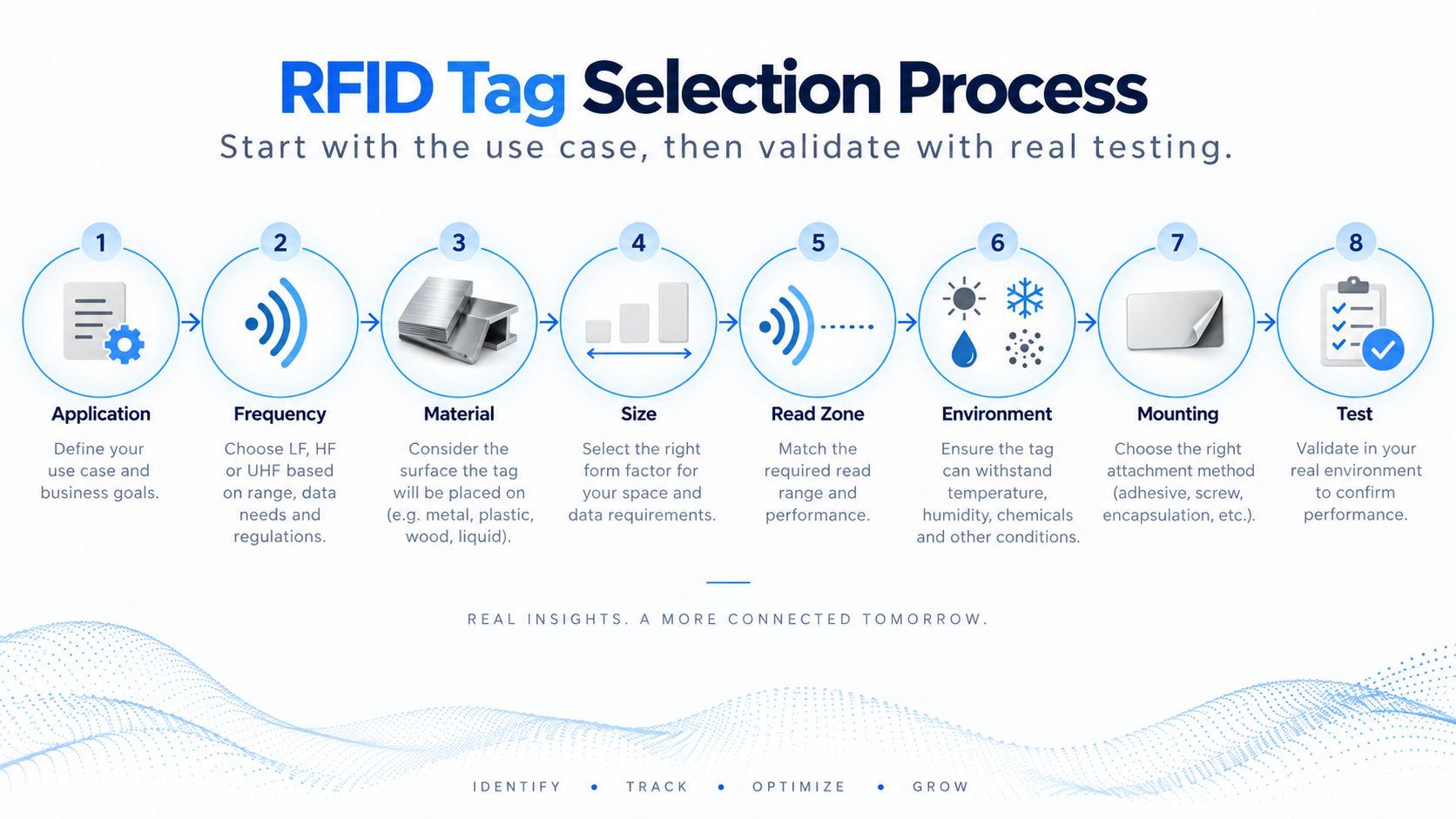
A practical selection process looks like this:
Application
→ RFID Technology
→ Asset Material
→ Tag Size
→ Read Zone
→ Placement
→ Environment
→ Mounting
→ Chip & Memory
→ Regional Frequency
→ Printing & Encoding
→ Sample Testing
This guide focuses primarily on passive UHF / RAIN RFID because it is widely used for inventory, logistics, manufacturing, asset tracking, tool management, retail and other Syncotek applications.
Before comparing RFID tag specifications, answer two questions:
What are you tagging?
and
What event do you need to capture?
This immediately eliminates many unsuitable products.
Typical examples include:
The physical object influences:
Common workflows include:
This matters because the same asset can require different tag performance depending on the workflow.
For example, a laptop used only for handheld annual inventory may not require the same tag performance as a laptop that must be automatically detected through a fixed RFID doorway.
Tag selection is therefore a system-design problem, not an isolated product decision.
RFID covers several different technologies.
| RFID Technology | Typical Strength | Common Applications |
|---|---|---|
| LF RFID | Short-range identification, relatively tolerant near water | Animal ID, industrial identification |
| HF / NFC | Short controlled range and tap interactions | Cards, access, NFC, libraries |
| Passive UHF / RAIN RFID | Longer range, fast inventory, multiple-tag reading | Retail, logistics, manufacturing, assets |
| Active RFID | Powered transmission and location-oriented workflows | RTLS, high-value moving assets |
For many inventory, warehouse, manufacturing and asset-tracking projects, the discussion eventually focuses on passive UHF RFID / RAIN RFID.
These systems commonly use EPC Gen2 / ISO 18000-63-compatible tags and readers.
The main advantages include:
But do not choose UHF simply because it reads farther.
HF, NFC or another technology may be better when the application needs deliberate short-range interaction.
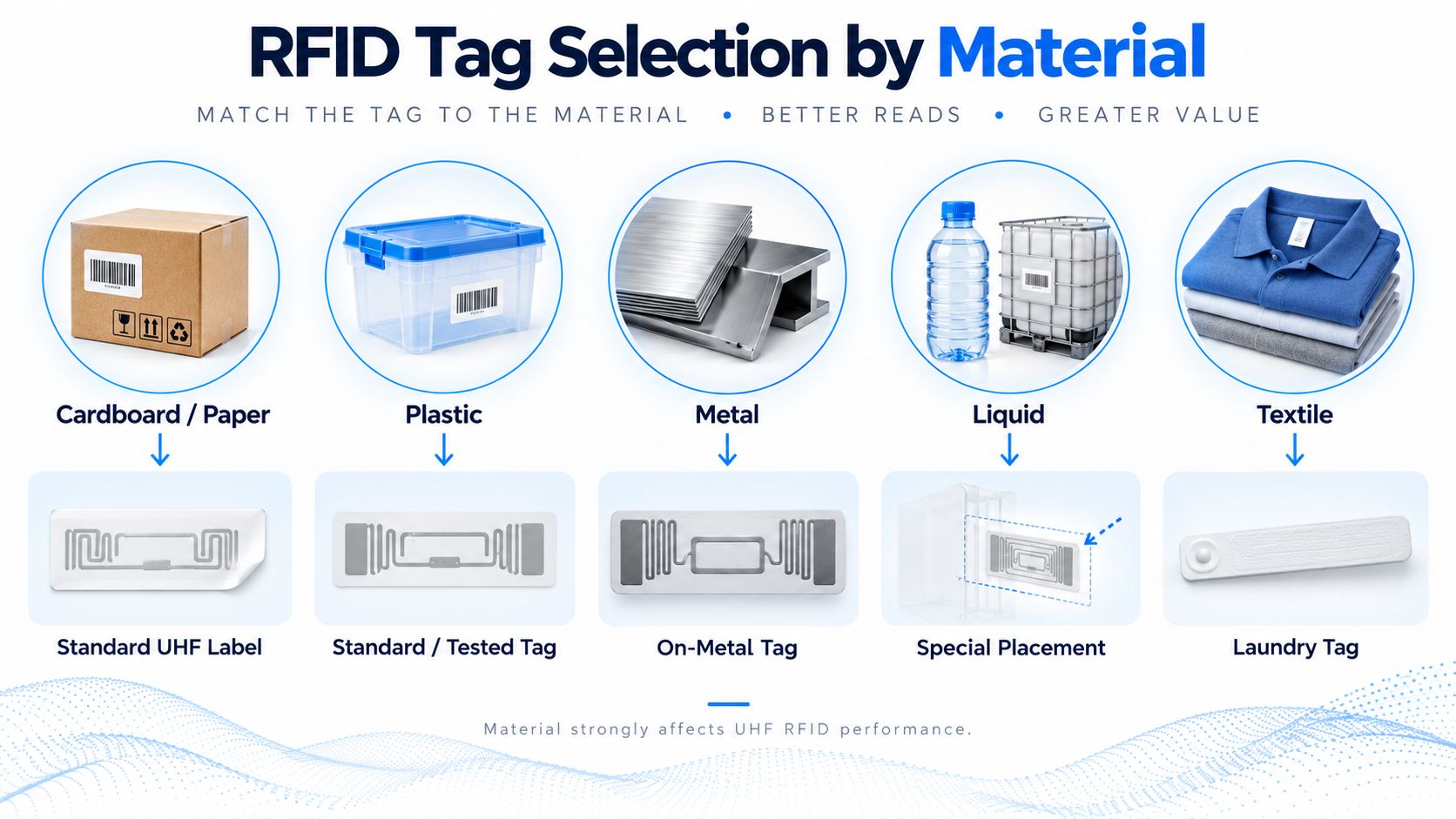
For passive UHF RFID, the tagged material is one of the most important selection factors.
The RF environment around the tag changes after installation.
A tag that performs well in free air may behave completely differently when attached to the actual product.
Cardboard and paper are generally RFID-friendly materials.
Typical applications include:
A standard adhesive UHF RFID label is often a good starting point.
However, always consider what is inside the packaging.
A cardboard carton containing clothing behaves very differently from one containing:
Many plastic products can use conventional UHF tags or labels.
However, test the actual product because performance can still be influenced by:
A tag on an empty plastic container may behave differently after the container is filled.
Metal is one of the most important special cases in UHF RFID.
A conventional UHF RFID label placed directly on metal can become severely detuned.
Possible results include:
Metal assets generally require an on-metal RFID tag specifically designed for conductive surfaces.
Applications include:
See Mount-on-Metal RFID Tags for a detailed explanation of metal-specific tag design and selection.
Water-rich liquids can strongly influence UHF RF performance.
Examples include:
This does not mean UHF RFID cannot be used.
It means placement and tag selection become more important.
Possible approaches include:
Never select a tag for a liquid product using free-air testing alone.
Garments and linen introduce different requirements.
For disposable apparel retail, a normal UHF retail label may be suitable.
For reusable textiles, the tag may need to survive:
These applications require specialized washable RFID tags.
See RFID Laundry Tags for textile-specific tag selection.
Once the material is understood, measure the actual available installation area.
Ask:
Compact tags are attractive because they are easier to hide or install.
But UHF RFID antenna design needs physical space.
Reducing dimensions can affect:
A very small tag may be appropriate for:
but only if it still meets the required operational read zone.
When the physical asset allows it, a larger antenna may provide stronger potential RF performance.
But size alone does not determine performance.
Antenna design, chip matching and asset material still matter.
The correct question is:
What is the smallest tag that reliably meets the workflow requirement?
not:
What is the smallest RFID tag available?
Customers often ask:
What is the longest read range of this RFID tag?
That is usually the wrong first question.
A better question is:
Where should this tag be read reliably?
Different applications require very different read zones.
Short, highly controlled reads.
Typical uses:
Controlled short or medium read zone.
The objective is to identify items inside the cabinet without reading unrelated tags outside it.
The operator moves toward tagged products.
Longer tag performance can help inventory and searching.
Tags need to be detected while passing through a defined physical transition.
The goal is not unlimited range.
It is:
Read everything passing through this door while avoiding unrelated assets nearby.
Longer read distances may be valuable for:
A tag capable of being detected at a very long distance may actually make a controlled application harder.
Excessive range can create:
Select the tag and reader together around the intended read zone.
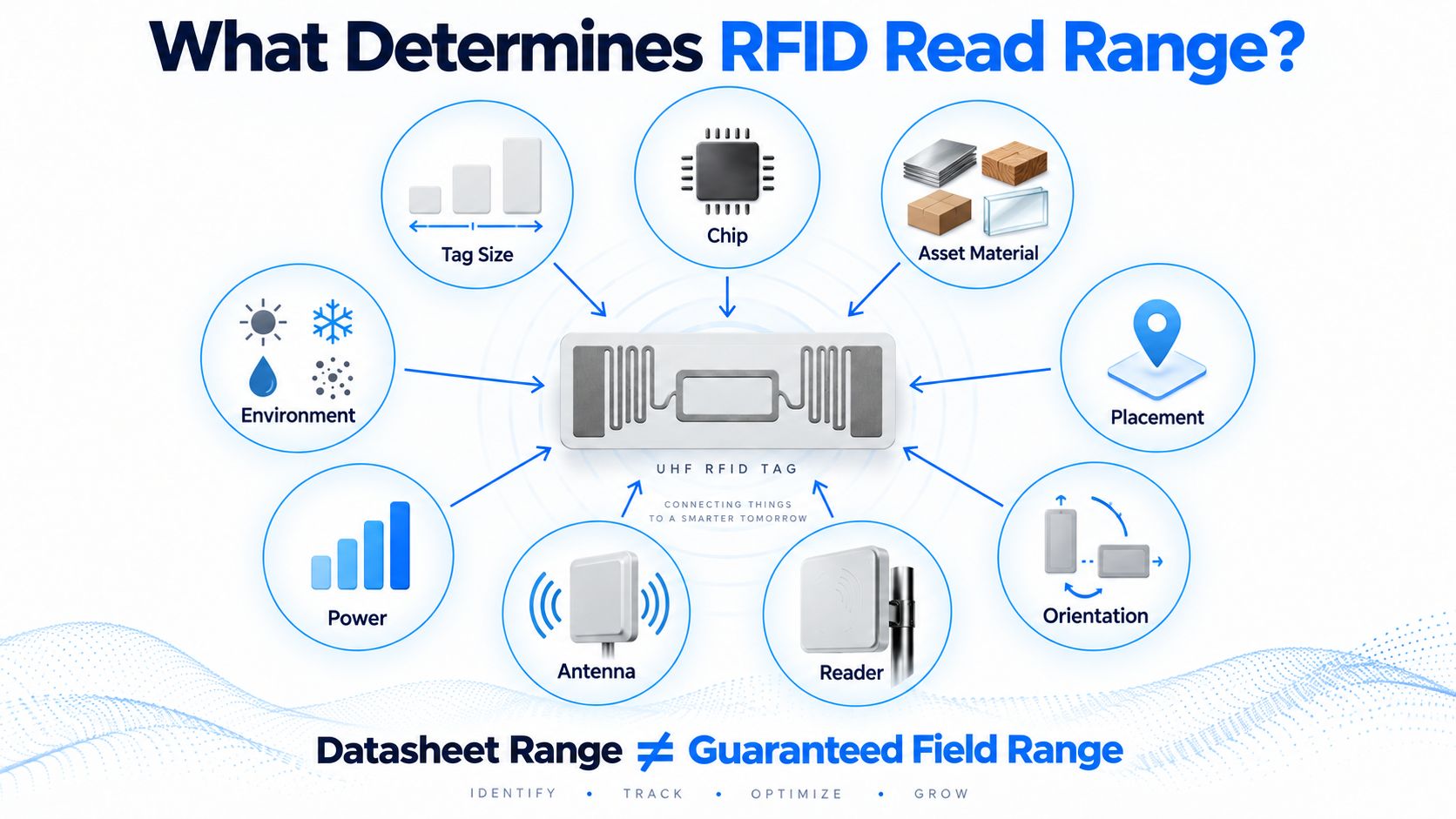
There is no single universal read-distance specification that guarantees field performance.
A more realistic model is:
Practical RFID Read Range = Tag + Asset + Placement + Orientation + Reader + Reader Antenna + Power + Environment
Important variables include:
Antenna dimensions, geometry and efficiency affect how the tag receives RF energy.
Different chips have different:
Metal and water can dramatically change tag behavior.
Moving a tag several centimeters on the same product can change performance.
The relationship between tag antenna and reader antenna polarization affects received energy.
A fixed industrial reader and a handheld reader may produce different field performance.
Important factors include:
Reader power affects the available RF energy but should not simply be set to maximum.
Nearby:
can influence results.
The key engineering principle is:
Datasheet Range ≠ Guaranteed Field Range
Published read distances are useful for comparison, but final tag selection should be based on repeatable performance in the actual system.
Tag placement should be tested before finalizing the product.
UHF RFID tags contain directional antenna structures.
Performance may change when a tag is:
If product orientation will be random, test multiple orientations.
The best location depends on the physical product.
For example, on a carton you might test:
On a laptop, test different locations that do not block the RF field or interfere with normal use.
Once the best position is identified, document it.
Do not allow operators to place tags randomly during production.
A tag-placement SOP should specify:
Consistent placement makes system performance much more predictable.
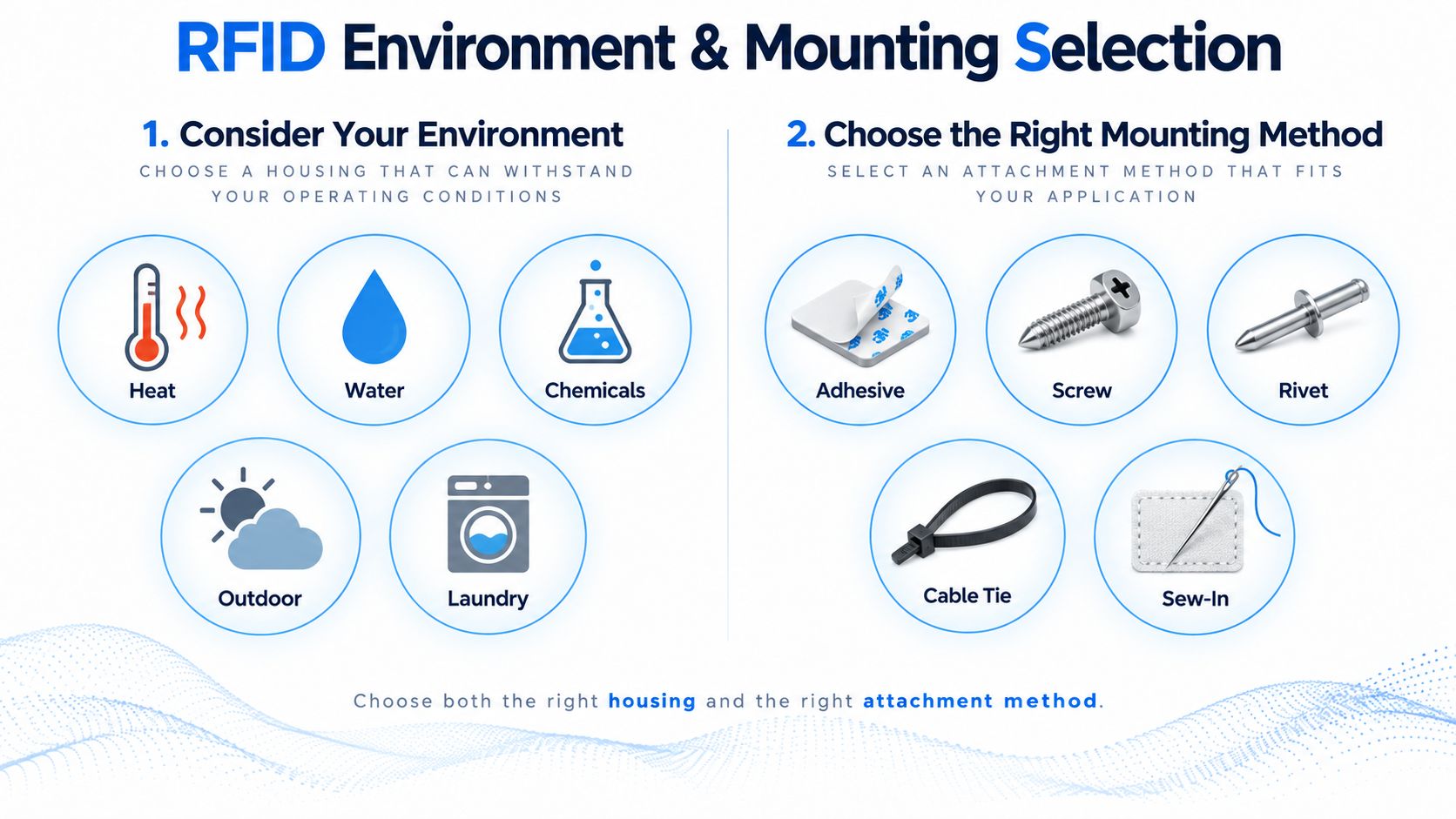
RFID electronics are only one part of tag durability.
The complete tag must survive the environment.
A basic tag may be sufficient for:
Outdoor applications may require resistance to:
Industrial applications may expose tags to:
A standard RFID label may fail because of:
even if the RFID IC itself survives.
High-temperature applications require the complete tag construction to be designed for those conditions.
Syncotek provides high-temperature UHF tag families for demanding metal-asset applications.
Consider both:
mechanical waterproofing
and
RF performance around water
A waterproof tag can still experience reduced UHF read performance when surrounded by water.
These are two different specifications.
Industrial tags may encounter:
Confirm material compatibility.
Laundry applications can involve:
Use specialized laundry tags.
Equipment tags may need to survive:
A rigid industrial hard tag can be more appropriate than an adhesive label.
Even the best-performing RFID tag becomes useless if it falls off.
Attachment is therefore part of tag selection.
Adhesive mounting is convenient for:
Before deployment, evaluate:
Screw mounting is suitable for:
Advantages include:
Riveting can provide durable attachment where permanent installation is acceptable.
Useful for:
Common for:
Some textile tags can be attached using compatible heat-seal processes.
Always follow the tag's specified installation method.
OEM manufacturers may integrate the RFID tag directly inside the product.
This can:
but embedding can also change RF performance.
The final product must be tested after assembly.
There are several RFID product forms.
An inlay is the functional chip-and-antenna core.
It is often used by:
A label adds application layers such as:
Best suited to:
A hard tag may include:
Suitable for:
For a deeper comparison, see RFID Inlays, Tags and Labels: What's the Difference?.
Do not select a tag only because it uses a well-known RFID chip.
The chip should match the application's data requirements.
EPC memory normally stores the primary electronic identity used by the RFID system.
Many asset and inventory projects need only:
Unique EPC
→
Backend Record
The detailed business information remains in the database.
TID provides information associated with the tag IC and can be useful in applications that need stronger tag identification.
Some tags provide additional user memory.
Before paying for more memory, ask:
What data actually needs to live on the RFID tag?
If the answer is:
Product information is already stored in ERP/WMS/CMMS.
then additional user memory may not provide much value.
Gen2-compatible tags may support:
depending on the IC.
More advanced applications may require:
These features depend on the selected RFID IC.
The basic principle is:
Do not pay for RFID memory or security features your workflow does not use.
Two RFID tags using the same IC can still behave very differently.
Why?
Because tag performance also depends on:
A large retail label and a compact PCB on-metal tag can use compatible chip technology while having very different:
See RFID Tag Construction for a detailed explanation.
UHF RFID frequency regulations vary by region.
Common deployment regions include:
UHF RFID systems commonly operate in the European UHF RFID allocation.
UHF RFID commonly operates across the applicable 902–928 MHz band.
Different countries may apply different:
Always select readers and tags for the actual deployment region.
For passive UHF / RAIN RFID applications, EPC Gen2 / ISO 18000-63 compatibility is widely used for interoperability between tags and readers.
Some tags are designed for broad global operation.
Others are tuned more specifically for:
A globally optimized tag can be useful when the same product moves between multiple countries.
However, a regionally optimized tag may provide stronger performance in its intended band.
The decision depends on:
RF performance is not always the only requirement.
You may need to print:
This requires a printable RFID label or printable on-metal design.
If you use an RFID printer encoder, verify:
The RFID tag and printer must be tested as one production system.
For more information, see RFID Printer Guide and How to Program an RFID Tag.
Some retailer and supply-chain RFID programs specify:
In that situation, first follow the customer requirement.
Then compare permitted tags under your actual product conditions.
See RFID Tag Mandates for Suppliers for more information.
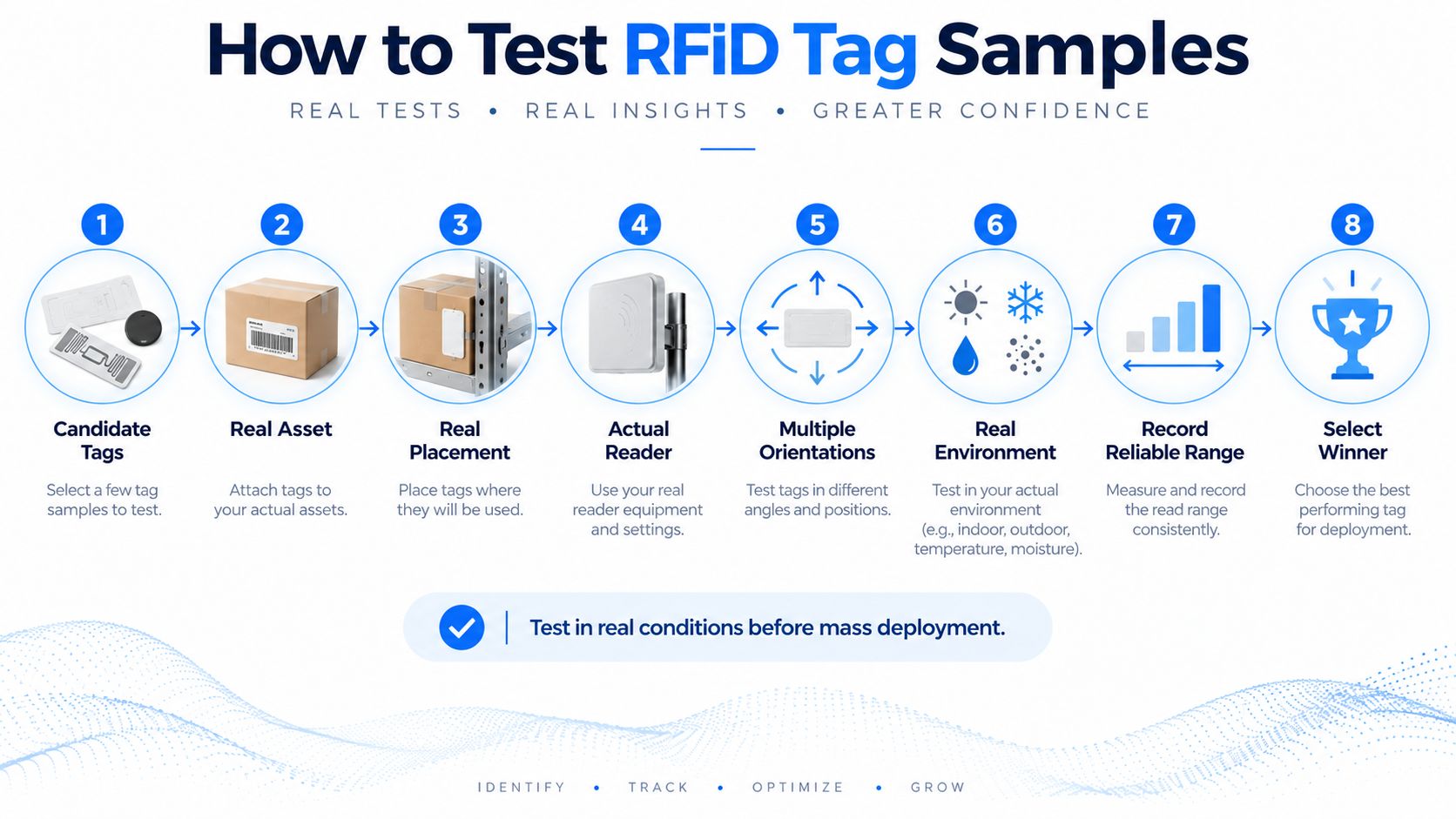
This is one of the most important steps in RFID tag selection.
Do not move directly from:
Datasheet
to
100,000 Tag Order
A better process is:
Start with approximately 3–5 suitable designs rather than one.
Candidate tags should already match:
Do not test only on a table.
Use:
Apply the tag where it will actually be installed.
Test using the equipment planned for deployment.
This might be:
Rotate the product.
Test:
If the tag will be read:
test it there.
Do not record only the longest one-time successful read.
Instead measure:
At what distance and orientation does the tag read reliably and repeatedly?
This is far more useful than a maximum reading record.
The winning tag should balance:
The longest-read tag is not necessarily the best choice.
A simple test matrix makes candidate selection much more objective.
| Candidate | Asset Material | Placement | Orientation | Reader | Reliable Range | Environment | Result |
|---|---|---|---|---|---|---|---|
| Tag A | Metal | Top | Horizontal | Handheld | Test | Indoor | Pass / Fail |
| Tag B | Metal | Side | Vertical | Handheld | Test | Indoor | Pass / Fail |
| Tag C | Metal | Top | Horizontal | Fixed | Test | Indoor | Pass / Fail |
Repeat tests several times.
Do not make a mass-purchase decision based on a single successful read.
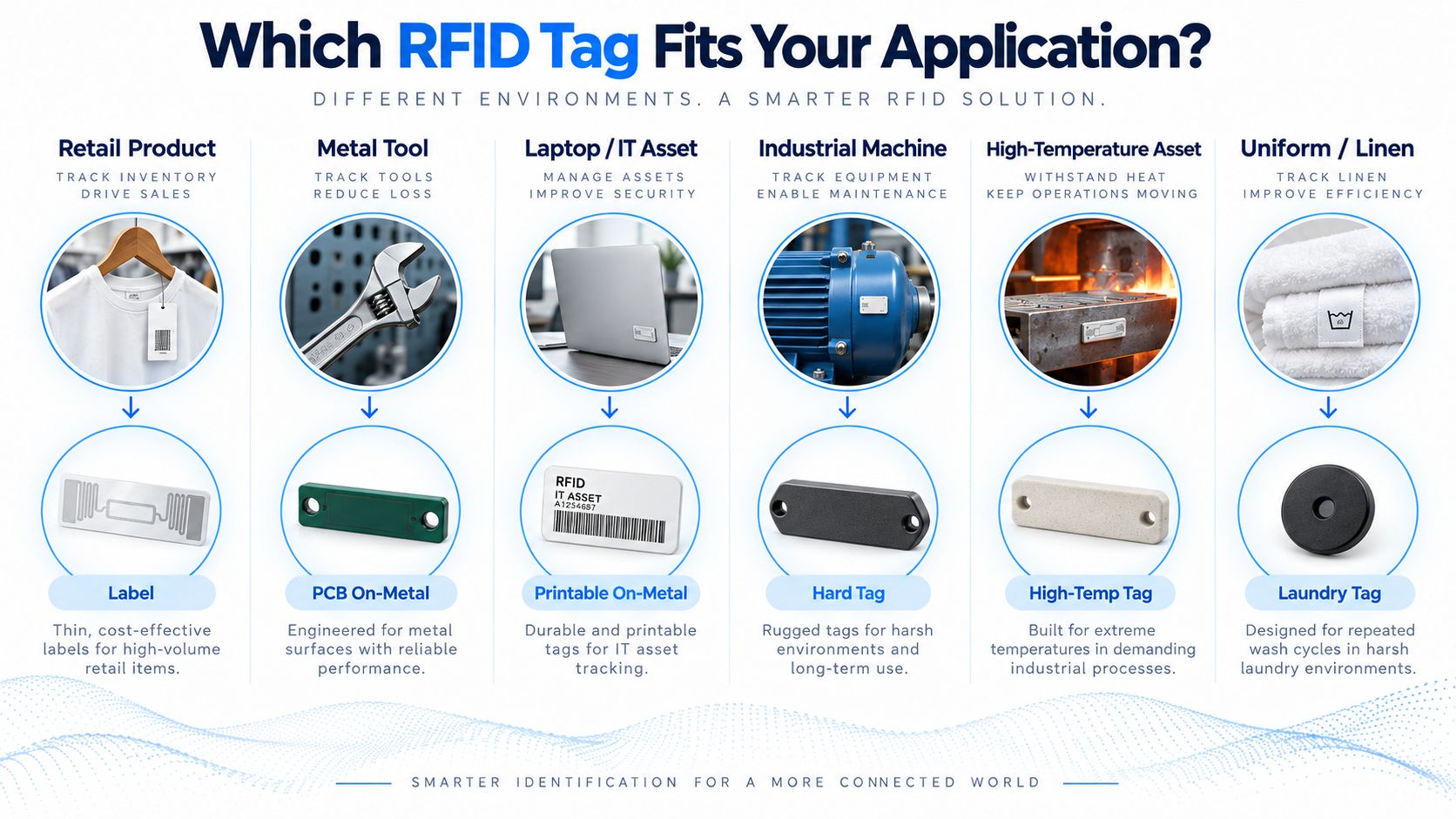
The following table provides practical starting directions.
| Application | Recommended Starting Direction |
|---|---|
| Retail product | Printable UHF RFID label |
| Cardboard carton | Standard adhesive UHF label |
| Metal tool | Compact PCB on-metal RFID tag |
| Laptop / IT equipment | Printable on-metal RFID tag |
| Industrial machine | Rugged hard on-metal RFID tag |
| High-temperature metal asset | High-temperature RFID tag |
| Uniform / linen | Washable RFID laundry tag |
| Reusable plastic tote | Durable UHF hard tag or tested label |
| Pallet | Durable long-range UHF tag |
| Outdoor equipment | Weather-resistant industrial tag |
These are starting points, not automatic final selections.
Every application should still be tested.
Priorities normally include:
A standard UHF smart label is often the starting architecture.
Priorities include:
PCB on-metal tags are particularly useful for tools and small industrial assets.
Requirements often include:
A printable on-metal PET tag can be useful.
Industrial equipment may require:
A durable hard tag is usually a better starting point.
Applications such as:
require specialized high-temperature materials.
Syncotek's high-temperature UHF tag families combine industrial housing and metal-optimized construction for these environments.
These applications require tags designed for:
Use dedicated laundry RFID tags rather than standard labels.
Syncotek's UHF tag portfolio is structured around different materials and operating environments rather than one universal RFID label.
Current families include:
Suitable for:
Suitable for:
Suitable for:
Suitable for demanding industrial metal environments.
Suitable for:
Compact hard-tag construction for repeated industrial textile processing.
The important selection rule remains:
Start with the asset and environment, then narrow the RFID tag family.
RFID tag performance should never be discussed without reader architecture.
Handhelds are commonly used for:
The reader antenna:
A tag used successfully with a fixed reader may produce a shorter practical handheld read distance.
A fixed system can use:
This can provide stronger and more predictable tag performance.
The requirement is completely different.
The best tag may be one that reads reliably at short range inside the cabinet without generating unwanted reads outside it.
Portal applications need tags that remain readable:
This is why the inquiry question:
What read range do you need?
should always be followed by:
Which reader and read point will you use?
Maximum distance is not the same as reliable operating distance.
Design for the actual read zone.
The antenna and tag construction are equally important.
Cardboard, metal, liquids and textiles create different RF environments.
Use an on-metal tag designed for conductive surfaces.
Always test on the actual product.
UHF performance may change substantially near water-rich products.
Make sure the smaller form factor still delivers sufficient RF performance.
A tag that detaches from the asset creates a tracking failure.
Select the tag and reader for the actual deployment region.
Printing and encoding applications need media compatibility testing.
Validate candidate tags first.
Real products rarely remain perfectly aligned.
Published readings are reference values under specific test conditions.
Real performance depends on the complete RFID system.
The fastest way to get an accurate recommendation is to provide complete application information.
Include:
Example:
Specify:
Provide maximum:
Explain the actual workflow instead of simply requesting the longest possible range.
Specify:
This helps determine the frequency region.
Examples:
Examples:
Specify whether you need:
Provide:
Give:
Providing this information makes it much easier to narrow the candidate tags before testing.
Before confirming an RFID tag, check:
Start with the application, tagged material, available size, required read zone, operating environment and attachment method. Then select several candidate tags and test them on the actual product using the intended reader.
There is no single factor, but the tagged material and required read workflow are usually the best starting points.
No. A tag that performs well on cardboard or plastic may perform poorly on metal or near liquids.
Metal changes the electromagnetic behavior of a UHF tag antenna and can severely reduce the performance of ordinary RFID labels. Use tags specifically designed for metal surfaces.
Use an on-metal UHF RFID tag matched to the asset size, environment, attachment method and required reader workflow.
There is no universal liquid tag. Tag type, placement, container geometry and distance from the liquid should be tested on the actual product.
Yes, physical antenna dimensions can influence RF performance, but size is only one factor. Antenna design, chip, material, placement and reader configuration also matter.
The chip influences tag sensitivity and performance, but it does not determine read range alone. Antenna design and the complete tag construction are equally important.
Read range varies significantly by tag, material, reader, antenna, RF power, orientation and environment. Passive UHF / RAIN RFID can support multi-meter reading in suitable applications, but the real deployment should be validated instead of relying on a universal distance.
Use a tag with appropriate mechanical construction and protection for water, UV, temperature and the intended attachment surface.
Specialized high-temperature RFID tags using suitable ceramic, polymer or industrial encapsulation are used where standard tags cannot survive.
Use a washable RFID laundry tag specifically designed for repeated industrial washing and textile attachment.
That depends on the identifier structure. Many inventory and asset-management projects store a unique EPC on the tag and keep detailed data in a backend database.
Only if your application requires data to be stored directly on the tag. Do not select additional memory unless the workflow uses it.
They are optimized for different UHF regulatory regions. The tag and reader should be selected according to the country where the RFID system will operate.
EPC UHF Gen2 / ISO 18000-63 is widely used for modern passive UHF / RAIN RFID implementations.
Yes. Reader output, antenna configuration, polarization and read-zone geometry can significantly change practical tag performance.
Yes. Sample testing on the actual asset and actual reader is strongly recommended before mass deployment.
Starting with several suitable candidates is usually better than committing immediately to one tag. The final number depends on how different the asset materials, sizes and environments are.
Install each candidate in its final position, use the intended reader, test several orientations and real environmental conditions, and record the repeatable reliable read zone rather than a one-time maximum distance.
Syncotek provides passive UHF RFID tags for retail, inventory, tools, fixed assets, IT equipment, industrial machinery, metal assets, high-temperature applications and textile tracking.
Our tag portfolio includes:
To narrow the correct tag family, send us:
We can first narrow several candidate tag families for sample validation on your real asset, rather than selecting a tag only from a catalog distance specification.
Explore the Syncotek UHF RFID Tag range or browse UHF RFID Tags to begin your selection.
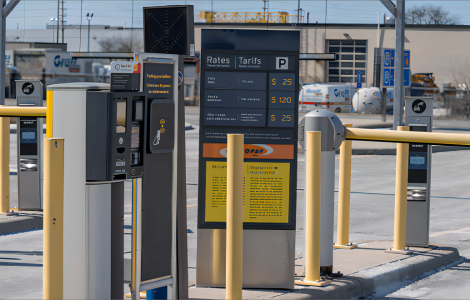 Case Show
Parking System with Syncotek’s Products
READ MORE Knowledge
In RFID systems, read means the reader detects a tag and retrieves data from its memory. Write means the reader changes data stored on the tag (for example, writing a new EPC or user data), sometimes followed by locking that data to prevent future changes. Most commercial RFID deployments use UHF (RAIN RFID) for longer range and fast bulk scanning. The core air-interface […]
READ MORE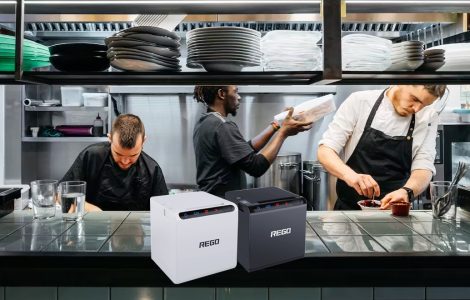 Case Show
Cloud printing is a printing technology based on cloud services, which can be well matched with Internet applications.
READ MORE Knowledge
Active RFID is a type of radio frequency identification technology that uses battery-powered tags to transmit data to RFID readers. Because the tag has its own power source, it can send signals over a much longer distance than a passive RFID tag, which relies on the reader’s signal for energy. That is why Active RFID is commonly […]
READ MORE Guide
Guide
Choosing the right UHF RFID reader is one of the most important decisions in an RFID project. The reader determines how far tags can be detected, how many tags can be inventoried, how stable the system will be in real environments, and how easily RFID data can be connected to your software, kiosk, warehouse system, production line, […]
READ MOREIf you are interested in our services or need customized solutions, please feel free to contact us.