

RFID is no longer limited to experimental pilots or isolated warehouse projects.
Large companies now use RFID to connect physical products, packages, credentials, vehicles, and customer interactions with digital business systems. Depending on the application, RFID can help a company identify an item, confirm its location, validate access, automate inventory counting, track movement, or trigger a transaction.
However, major RFID deployments do not all follow the same model.
A retailer may use passive UHF RFID labels to manage millions of individual products. A logistics company may install RFID sensing infrastructure across vehicles and distribution facilities. A theme park may use wearable contactless credentials, while an automotive company may use NFC cards as digital keys.
This article examines six leading companies using RFID and explains what other businesses can learn from their implementations:
These companies were selected as representative examples rather than ranked strictly by revenue, number of RFID tags, or deployment size.
| Company | Main RFID Application | RFID Format | Primary Business Value |
|---|---|---|---|
| Walmart | Item-level inventory and fresh-food management | Passive UHF RFID | Inventory accuracy, replenishment and reduced manual work |
| Inditex | Unified store and online inventory | Item-level RFID | Product availability and omnichannel fulfillment |
| Amazon | Checkout-free apparel and merchandise stores | Passive UHF RFID | Automated product identification during checkout |
| UPS | Package sensing across logistics operations | RFID-enabled package labels and infrastructure | Package visibility and operational reliability |
| Disney | Guest access, hotel entry and purchases | Contactless wearable credential | One credential for multiple guest interactions |
| Tesla | Vehicle access and key management | NFC key card | Secure, compact backup vehicle credential |
Together, these examples show that RFID can support retail, logistics, entertainment, access control, customer experience, and mobility applications.
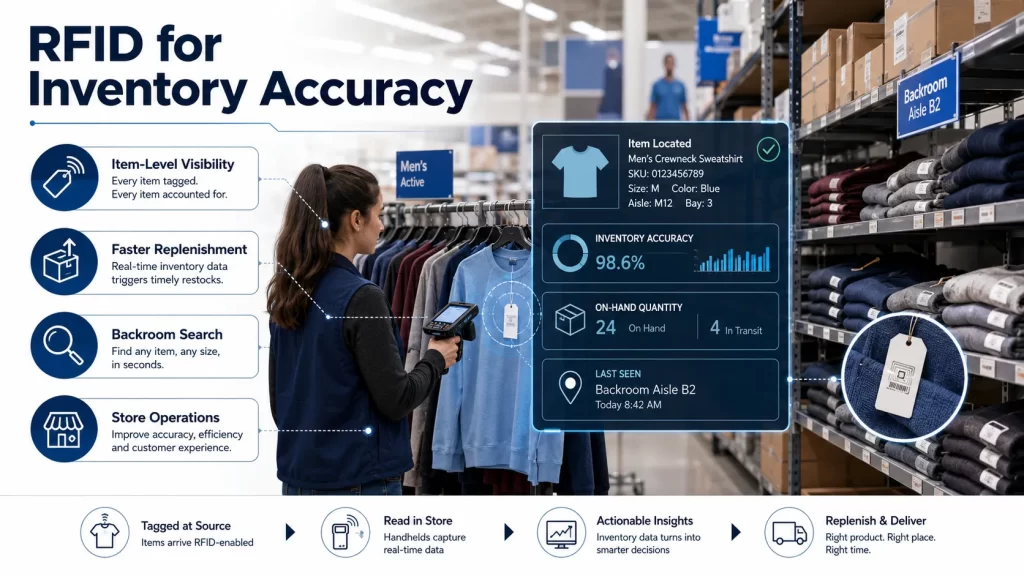
Walmart is one of the most influential companies in the development of item-level RFID adoption.
Its use of RFID has expanded from selected supply-chain and apparel applications into broader store inventory workflows. Walmart now combines RFID data with associate-facing tools to help employees locate products and move merchandise from backrooms to sales floors more efficiently.
In 2025, Walmart described an RFID and augmented-reality workflow that helps associates locate apparel inside stores. The system confirms whether an item is available and visually guides the associate toward its location. Walmart stated that the approach can make product searches significantly faster. (Walmart News)
Walmart has also expanded RFID into fresh-food categories. In October 2025, Walmart and Avery Dennison announced an RFID solution for bakery, meat, and deli products. The system provides item-level identification and digital use-by-date information to support inventory rotation, markdown decisions, freshness, and food-waste reduction. (Walmart News)
RFID can help Walmart associates:
Walmart demonstrates that RFID is most valuable when it is integrated into daily employee workflows.
The tag is only the first layer. The real value comes from combining RFID data with:
A company planning RFID inventory management should therefore define how employees will use the data after an item is detected.
Do not treat RFID as a faster barcode scanner.
Use RFID to create operational decisions, such as:
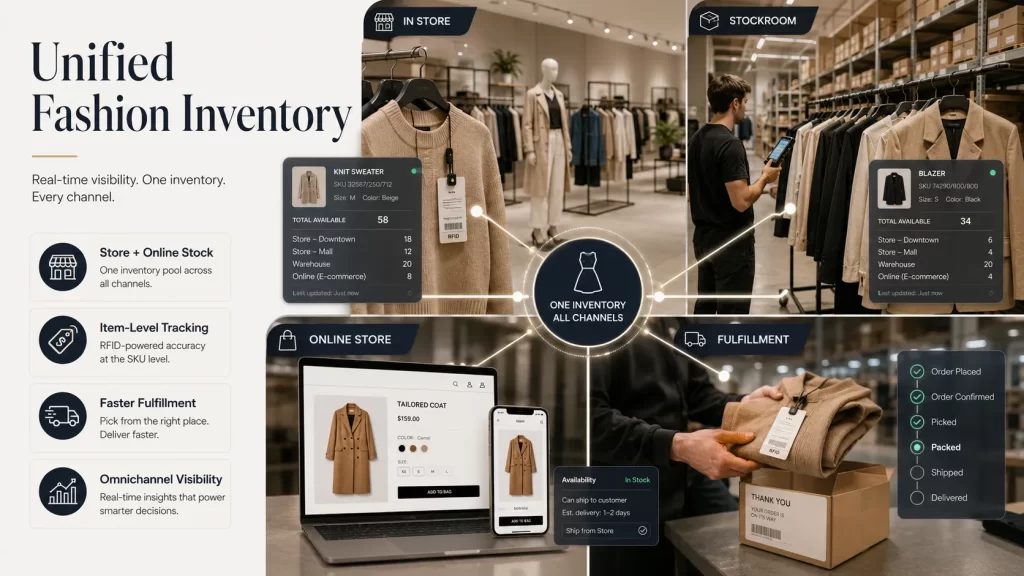
Inditex, the group behind Zara, Pull&Bear, Massimo Dutti, Bershka, Stradivarius, Oysho, Zara Home, and other brands, uses RFID as part of its integrated inventory-management system.
Inditex’s annual reporting explains that RFID and its Integrated Stock Management System merge inventory management across its brands. This allows employees to locate an article regardless of whether it is held in a physical store or another part of the integrated inventory network. (Inditex)
This is particularly important in fashion retail, where businesses must manage:
Each tagged garment can receive an individual digital identity.
RFID data can support:
A traditional inventory system may show that a store has five jackets.
An item-level RFID system can help distinguish:
This changes inventory from a quantity record into an item-level operational system.
The strongest retail RFID projects connect stores and ecommerce rather than managing them as separate inventories.
RFID can help create one shared stock pool that supports:
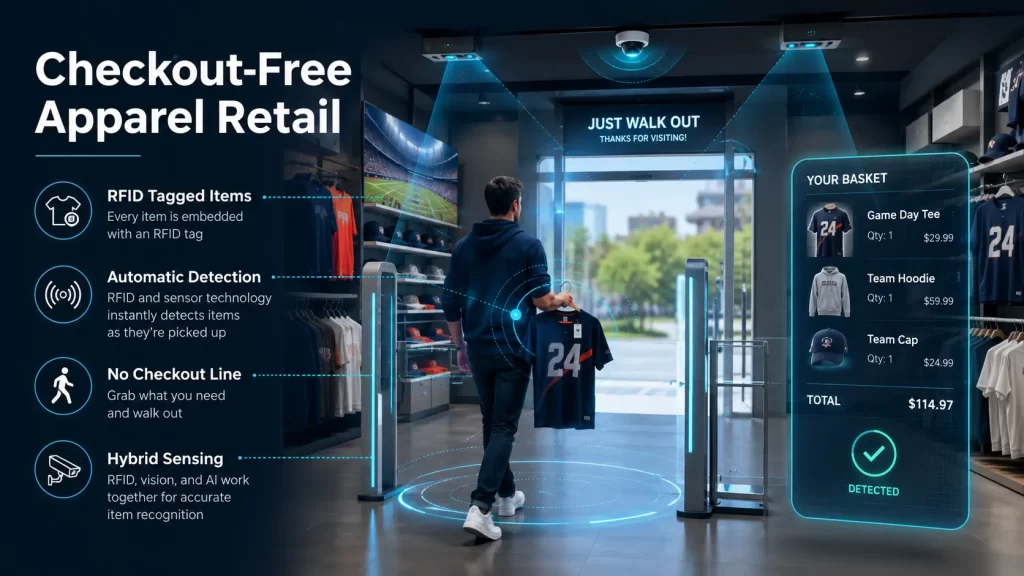
Amazon’s Just Walk Out platform originally used cameras, shelf sensors, computer vision, and sensor fusion for checkout-free shopping.
The company later added RFID capabilities to support apparel, fan merchandise, clothing, and other products that customers may pick up, examine, try on, and return to a rack.
Amazon explained that RFID-enabled Just Walk Out stores allow customers to select tagged merchandise and leave without using a conventional checkout line. The system identifies the merchandise and associates it with the shopping session. (Amazon News)
In 2024, Amazon continued expanding Just Walk Out stores at stadiums and included RFID-enabled stores for clothing, hats, and fan merchandise. (Amazon News)
Packaged food may remain in a fixed shelf position until a customer selects it.
Apparel behaves differently:
An RFID tag gives each garment an individual identity that remains associated with the product as it moves.
A simplified workflow may include:
RFID does not always need to operate alone.
It can be combined with:
Hybrid systems can use each technology for the task it performs best.
RFID provides product identity, while cameras and software provide additional context about shopper movement and transaction activity.
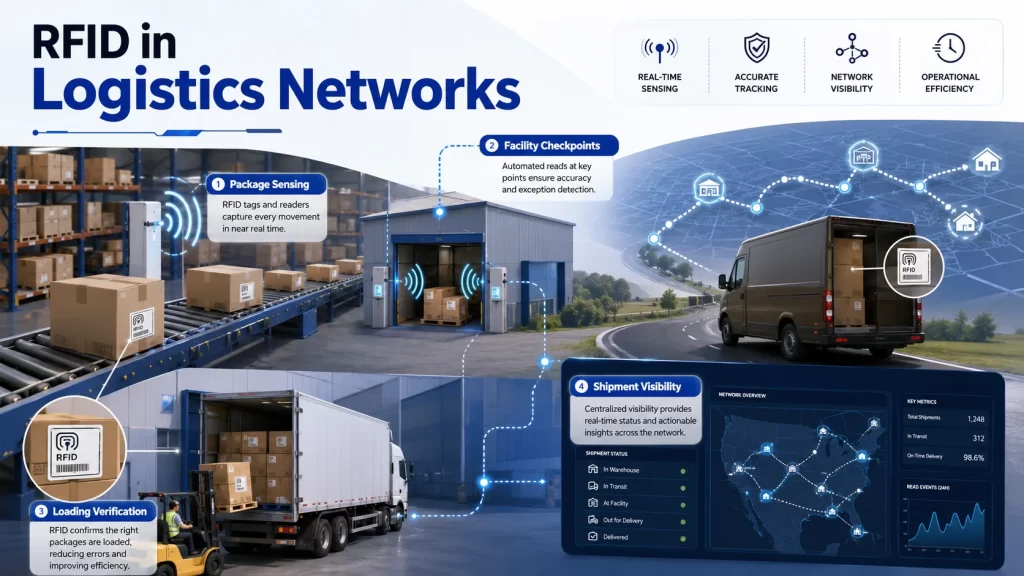
UPS represents one of the most significant recent developments in large-scale logistics RFID.
In April 2026, UPS announced the rollout of RFID package sensing across its U.S. small-package network. The company stated that RFID sensing technology was being used in U.S. package-delivery vehicles, delivery facilities, and packages shipped through more than 5,500 The UPS Store locations, including returns. (About UPS-US)
UPS describes the transition as moving from a network dependent on individual scanning events toward a broader sensing network.
A barcode-based package workflow typically requires:
If the barcode is hidden, damaged, incorrectly positioned, or not scanned, the package may move without generating the expected digital event.
RFID can enable package identification without requiring direct visual alignment.
Depending on the installation, RFID infrastructure can detect packages during:
A large-scale RFID sensing network can help provide:
UPS’s deployment shows how RFID can move beyond warehouse inventory and become part of a national logistics infrastructure.
Large RFID projects should be designed around repeated operational checkpoints.
Instead of trying to calculate an exact coordinate for every package at every moment, a logistics business may create reliable RFID read points at:
This creates a sequence of trusted movement events.
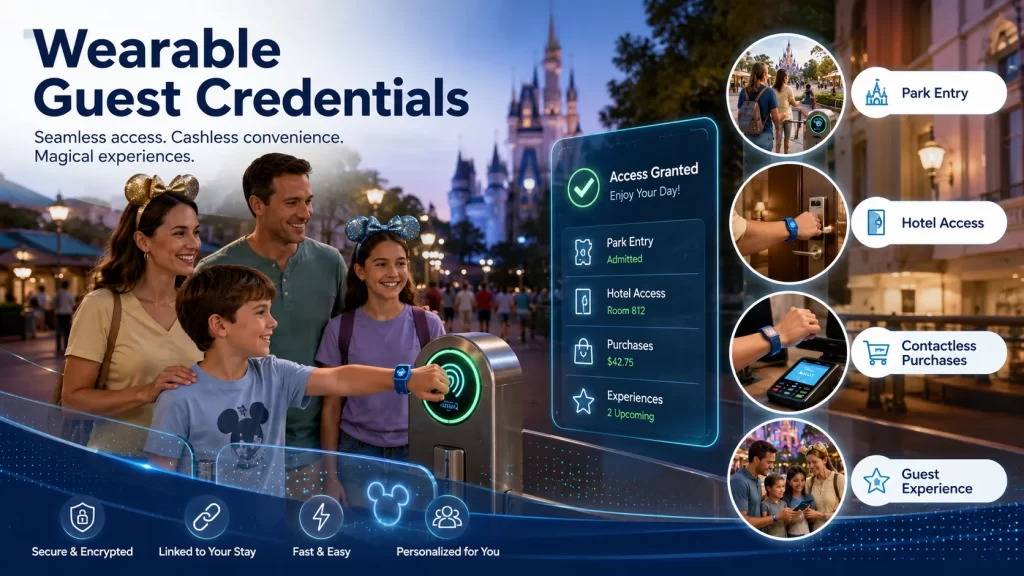
Disney uses contactless wearable credentials to connect multiple parts of the guest experience.
Disney’s current MagicBand and DisneyBand services can support park admission, hotel-room access, and purchases at eligible Walt Disney World locations. (Walt Disney World)
Instead of issuing separate credentials for each interaction, Disney can connect several functions with one wearable device.
Depending on the guest account and entitlements, a Disney wearable credential may support:
A wearable credential is useful because visitors may interact with the system many times throughout the day.
Compared with repeatedly finding a paper ticket or plastic card, a wrist-worn credential can provide:
Disney’s implementation shows that RFID can become part of the customer experience rather than remaining an invisible inventory tool.
Similar concepts can be used for:
Syncotek’s guide to RFID event management explains how RFID credentials can support admission, access control, payments, attendee interaction, and event analytics.
A successful RFID credential should connect multiple useful services without making the user understand the underlying technology.
The interaction should remain simple:
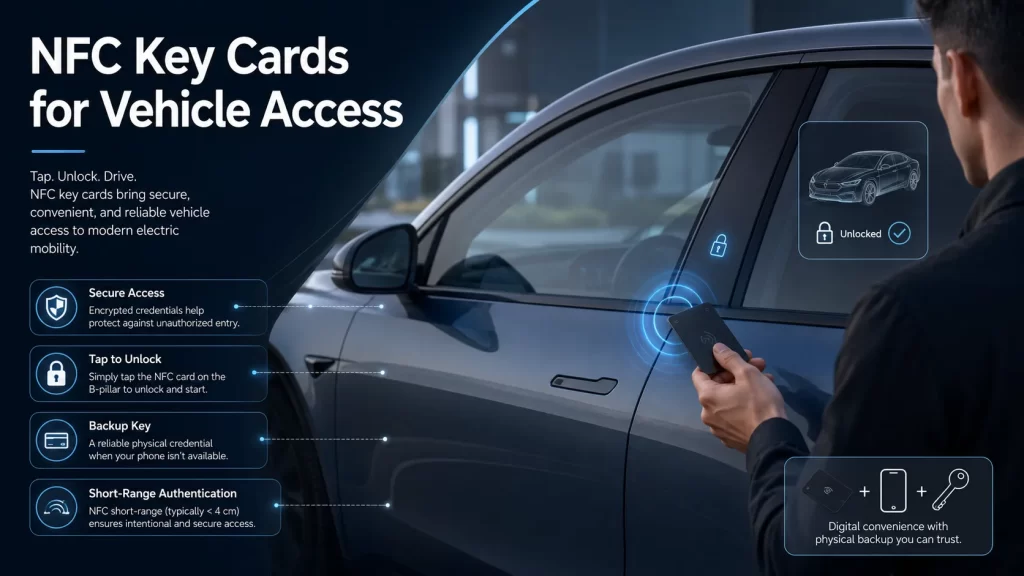
Tesla uses NFC key cards as one of the supported methods for accessing and operating its vehicles.
Tesla’s current support documentation explains that vehicles can support phone keys, key cards, and key fobs. A new key card can be paired by presenting it to the vehicle’s card-reader location and confirming the pairing with an authorized key or owner account. (Tesla)
The key card provides a compact physical credential that can be used when:
A simplified vehicle-key workflow includes:
NFC is suitable for this application because it provides:
The short operating distance helps prevent a vehicle from detecting every credential in a wide surrounding area.
The longest read range is not always the best read range.
For secure, intentional access, a short-range smart-card interaction may be more suitable than long-range UHF RFID.
Syncotek’s guide to smart card technology explains the differences between contact cards, contactless cards, NFC credentials, dual-interface cards, and UHF RFID cards.
Although these companies use RFID differently, their projects share several important characteristics.
Each deployment addresses a specific operational need:
| Company | Business Problem |
|---|---|
| Walmart | Finding and managing individual retail products |
| Inditex | Unifying store and online fashion inventory |
| Amazon | Identifying apparel in checkout-free stores |
| UPS | Capturing package movement across the logistics network |
| Disney | Managing repeated guest interactions with one credential |
| Tesla | Providing a secure physical vehicle key |
The technology follows the workflow rather than determining it.
Each RFID tag or credential represents a unique entity:
This individual identity is what allows RFID data to connect with business software.
RFID reads alone have limited value.
The companies connect RFID with systems such as:
Reliable systems define where an RFID event should happen.
Examples include:
The antenna and reader design must match the required interaction.
Different items require different RFID tags.
A paper apparel hangtag, food label, package label, wearable wristband, and NFC key card require different:
Understanding the difference between RFID inlays, tags, and labels is essential before selecting hardware.
A business does not need the scale of Walmart or UPS to benefit from RFID.
The same principles can be applied to smaller projects.
RFID can support:
RFID can support:
RFID can support:
RFID can support:
RFID can support:
RFID and NFC can support:
Start with a question the system must answer.
Examples:
Decide whether the system needs to identify:
Item-level tracking requires more tags and more detailed data than pallet-level tracking.
Common options include:
Determine where the RFID event should happen.
For UHF systems, consider:
Review Syncotek’s guide on how to select the right RFID antenna before designing a fixed reading station.
Define what should happen after the reader detects a tag.
Examples:
RFID testing should use:
Useful RFID performance indicators include:
A system used by Walmart may not be suitable for a small manufacturing tool room.
The business process should determine the architecture.
Tag performance can change when attached to:
Higher power may create:
Use the lowest power that reliably covers the intended zone.
An RFID reader that produces thousands of tag IDs does not automatically create useful inventory or logistics information.
Start with a focused workflow and measure the result before scaling across more facilities or product categories.
Before launching an RFID project, confirm:
Walmart, Inditex, Amazon, UPS, Disney, and Tesla demonstrate that RFID is not one single application.
The same underlying identification technology can support:
The most successful projects share one principle: RFID is integrated into a complete operational workflow.
A reliable RFID solution requires:
Companies should not begin by asking, “Which RFID reader should we buy?”
A better starting question is:
Which physical event does our business need to identify automatically, and what decision should the system make after that event occurs?
Major RFID users include Walmart, Inditex, Amazon, UPS, Disney, Tesla, and many other companies in retail, logistics, manufacturing, transportation, healthcare, and hospitality.
Walmart uses RFID for item-level inventory, product locating, replenishment, ecommerce picking, and fresh-food inventory workflows.
Amazon uses UHF RFID in selected Just Walk Out stores to identify apparel, fan merchandise, and other soft goods during checkout-free shopping.
UPS uses RFID package sensing across parts of its U.S. logistics network, including vehicles, facilities, and packages shipped through The UPS Store locations.
Zara’s parent company, Inditex, uses RFID as part of an integrated inventory system that connects physical stores and online operations.
Disney uses contactless wearable credentials for functions such as park admission, hotel-room entry, and eligible purchases.
Tesla uses NFC technology in its key cards. NFC is a short-range form of HF RFID used for controlled contactless communication.
Retailers use RFID to improve inventory accuracy, locate products, replenish shelves, fulfill online orders, process returns, and improve product availability.
No. Smaller businesses can use RFID for inventory, tools, rental assets, warehouse operations, access control, manufacturing, and equipment tracking.
A basic system may include RFID tags, readers, antennas, cables, encoding equipment, middleware, and application software. The exact hardware depends on the objects, environment, read distance, and workflow.
Need RFID Hardware for Inventory, Logistics, Access Control, or System Integration?
Syncotek provides RFID readers, reader modules, antennas, tags, labels, handheld terminals, and related system components for retail inventory, warehousing, manufacturing, logistics, asset tracking, event management, and access-control applications.
Whether your project requires item-level UHF RFID, dock-door readers, handheld inventory devices, NFC reader modules, RFID encoding stations, or embedded OEM hardware, Syncotek can help evaluate suitable components based on your tagged items, read distance, installation environment, regional frequency, and software workflow.
Explore Syncotek’s complete RFID products for your RFID project.
 Knowledge
What is an RFID chip? An RFID chip is a small integrated circuit (IC) used in radio-frequency identification systems to store an identifier and/or data and communicate wirelessly with an RFID reader. In everyday conversations, “RFID chip” can mean two different things: RFID tag chip (Tag IC / transponder IC) – the chip inside a […]
READ MORE Knowledge
RFID is often grouped into three main frequency families: LF (Low Frequency), HF (High Frequency), and UHF (Ultra-High Frequency). Picking the right band is one of the biggest decisions in any RFID project because it affects read range, speed, tag cost, phone compatibility, performance near metal/liquids, and system architecture. This guide compares LF vs HF vs UHF in a practical way […]
READ MORE Knowledge
What Is Load Modulation? Load modulation is the uplink method used by most HF RFID and NFC tags to send data back to a reader in the near field. The tag does not generate its own RF carrier. Instead, it changes its electrical load across the tag coil, and that change is coupled back into the reader’s magnetic […]
READ MORE Knowledge
A successful RFID project should not begin by purchasing readers. It should begin with a business problem. Companies often approach RFID projects with a requirement such as: We want to use RFID in our warehouse. That is not yet an RFID requirement. A much more useful project definition would be: We need to verify whether […]
READ MORE Knowledge
Metal asset tracking is one of the most important applications in RFID, but it is also one of the most technically challenging. Many companies want to use RFID to identify tools, machines, containers, laptops, racks, returnable transport items, and industrial equipment, only to discover that standard RFID labels do not perform well when placed directly […]
READ MOREIf you are interested in our services or need customized solutions, please feel free to contact us.