

Rental businesses depend on the same assets moving repeatedly between warehouses, customers, job sites, service areas, vehicles, and return stations.
This continuous movement creates a difficult inventory-management problem. A rental company may own the correct number of assets but still be unable to answer basic operational questions:
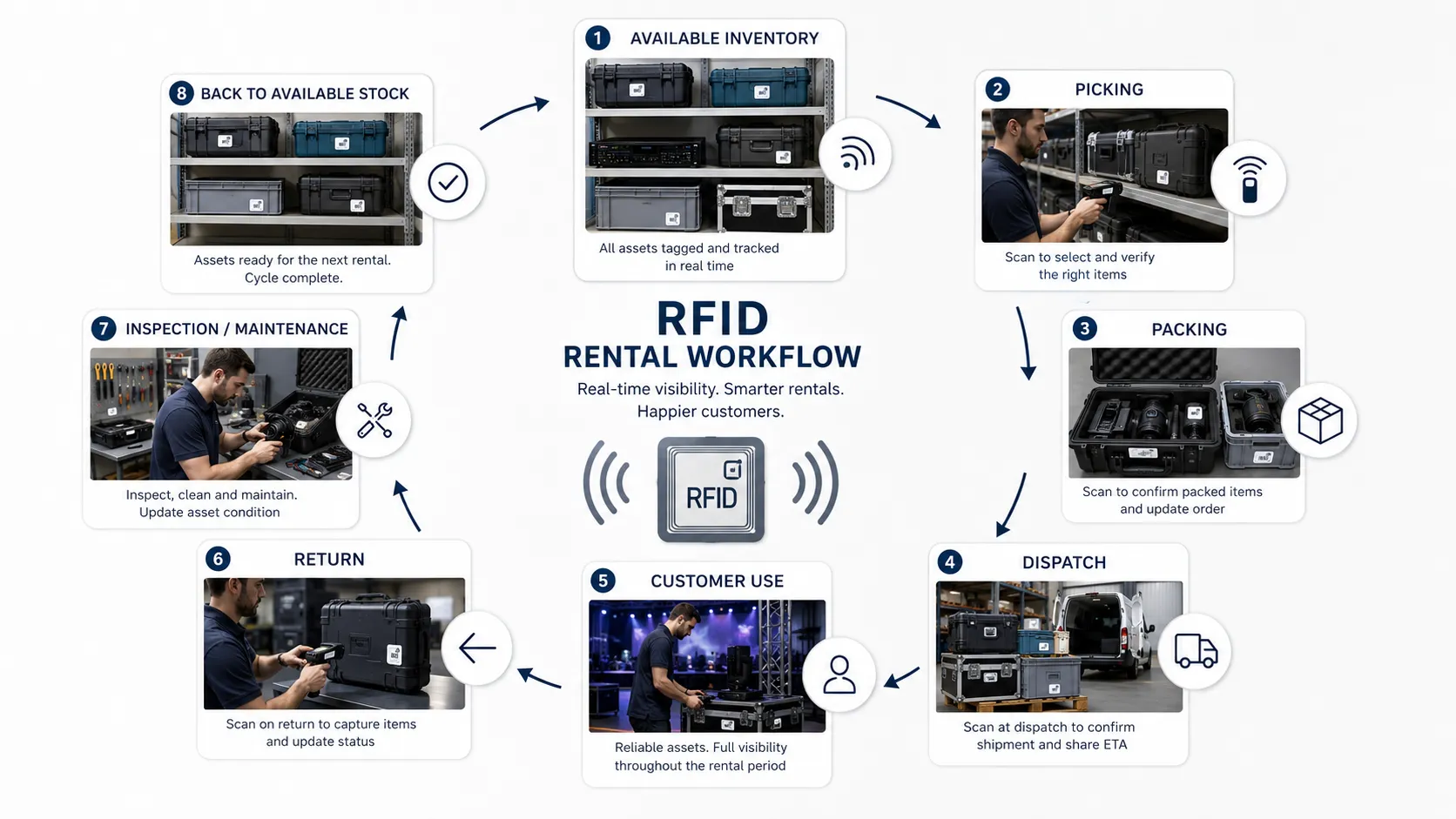
RFID rental inventory management gives each rentable asset a unique electronic identity. RFID tags, readers, antennas, and software can then record when assets are received, prepared, dispatched, returned, inspected, maintained, and placed back into available inventory.
RFID does not replace rental management software. It improves the physical data-capture layer by connecting actual asset movement with digital rental records.
RFID rental inventory management is the use of radio frequency identification technology to identify, track, and manage assets throughout the rental lifecycle.
Each rentable item receives an RFID tag containing a unique identification number. The tag ID is linked to the asset record in rental software or another database.
That record may contain:
RFID readers capture the tag ID when the asset passes through a rental workflow. The software then updates the corresponding record.
This gives the rental company a more reliable view of what is available, reserved, rented, overdue, returned, under inspection, being repaired, or retired.
Traditional inventory is often purchased, stored, sold, and removed from the business.
Rental inventory follows a repeated cycle:
The same asset may complete this cycle dozens or hundreds of times.
This means rental companies must manage not only quantity but also individual asset identity, custody, location, availability dates, condition, maintenance, lifecycle, utilization, and customer responsibility.
A well-designed RFID system can help capture these repeated movements with less manual scanning.
Manual counting is time-consuming, particularly when a rental company manages thousands of tools, garments, cables, containers, instruments, or event assets.
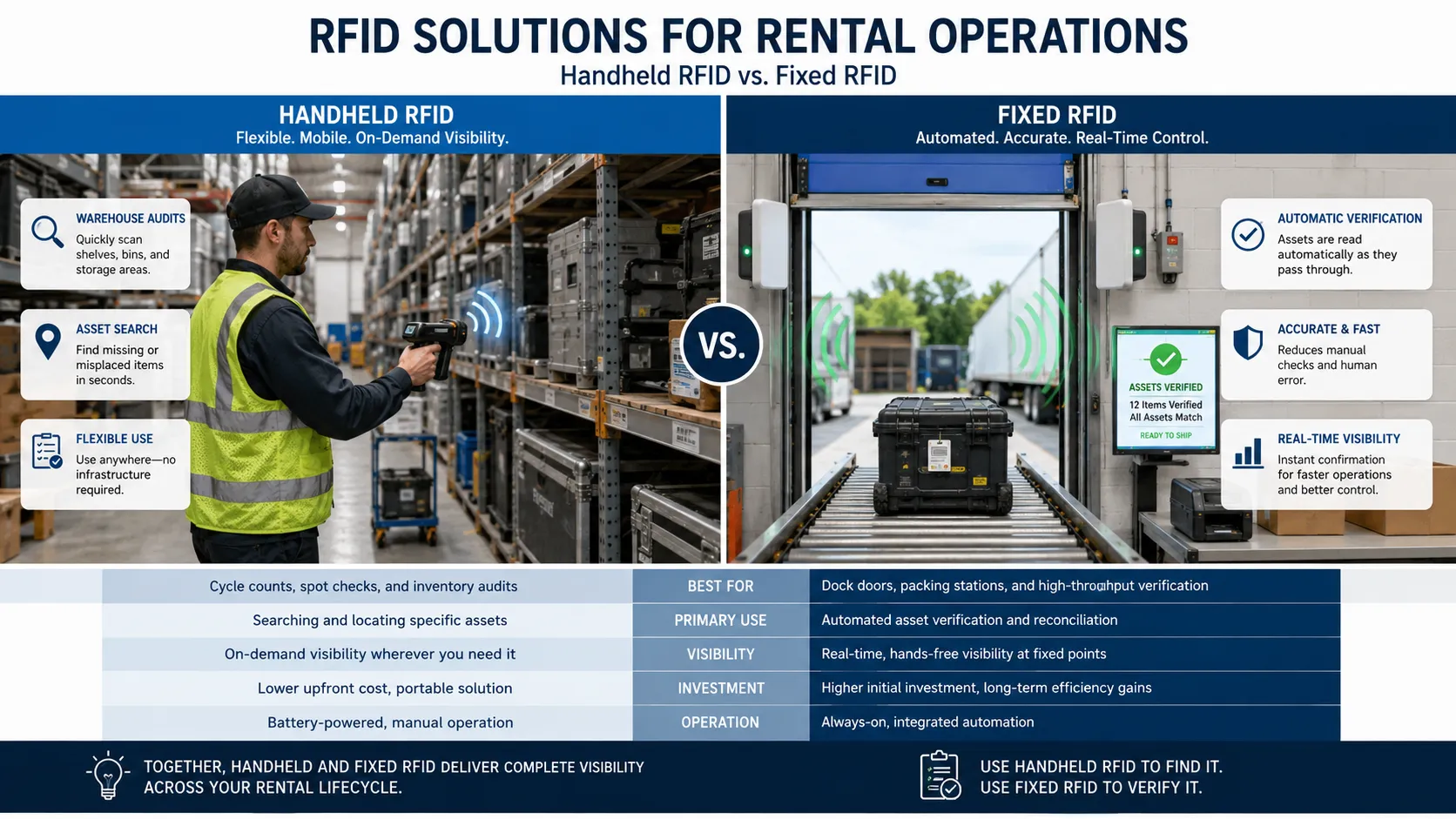
RFID readers can identify tagged items without requiring employees to locate and scan every visible barcode individually. Handheld readers can support warehouse audits, while fixed readers can capture assets moving through doors, dock areas, cages, or processing stations.
Rental availability must be based on physical reality.
A software record may show that an item is available even though it is still with a customer, placed in the wrong warehouse zone, awaiting inspection, damaged, under maintenance, packed for another order, or missing from the expected kit.
RFID helps synchronize physical asset movement with digital status. This allows rental staff and online booking systems to provide more useful information, such as:
Barcode-based rental operations normally require employees to scan each item individually.
RFID can improve the process by allowing several tagged assets to be identified during order picking, kit preparation, packing, dispatch, customer return, warehouse receiving, and inventory auditing.
The system can compare the detected assets with the rental order and immediately identify missing items, incorrect items, unexpected assets, duplicate items, and incomplete kits.
This is particularly valuable for rental orders containing many individual components.
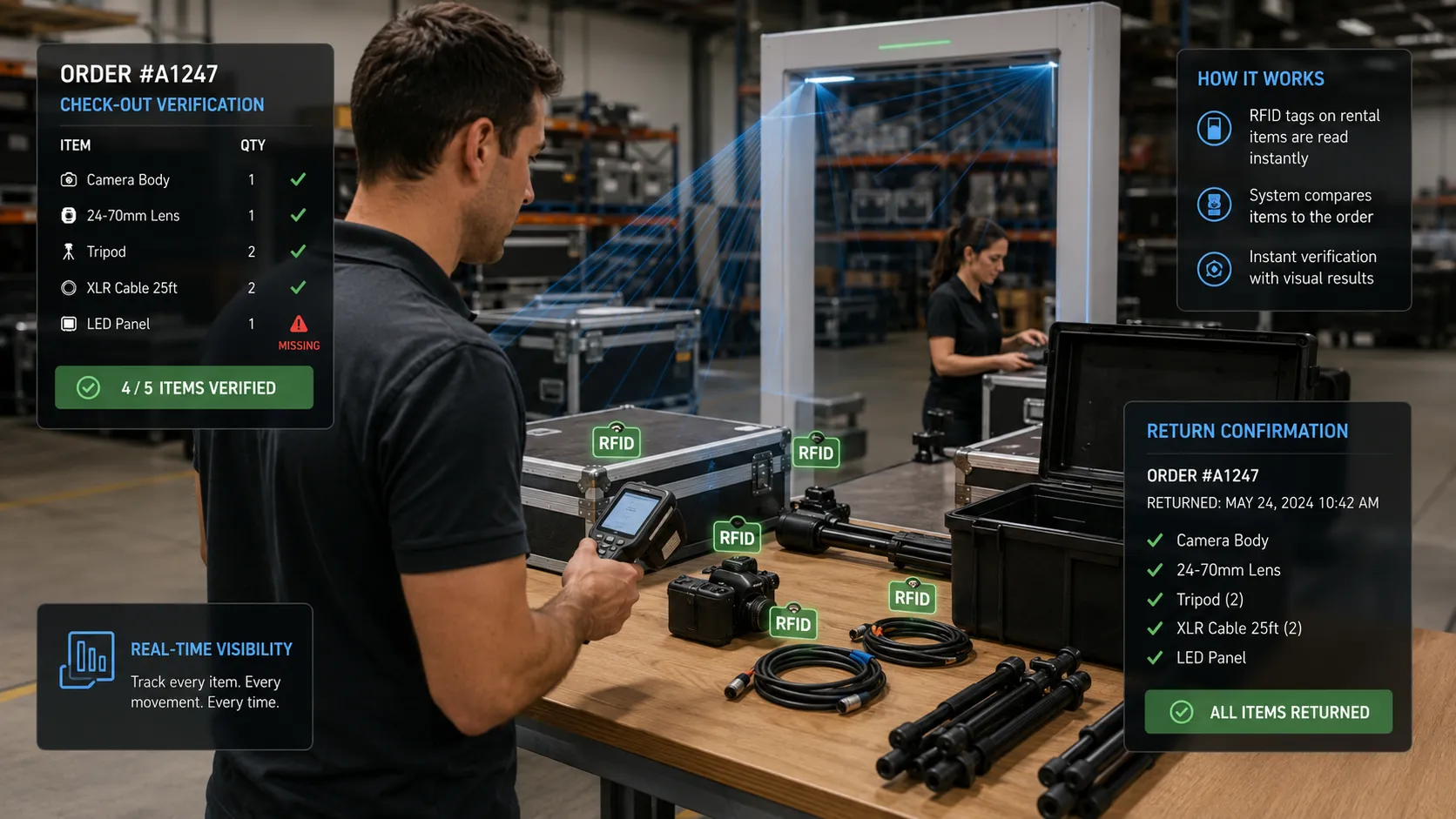
Sending the wrong equipment creates replacement shipping, delayed installation, employee overtime, lost customer confidence, event disruption, and emergency delivery expenses.
Fixed RFID readers installed at packing stations or dock doors can compare the detected assets with the order before dispatch.
Returned rental orders may contain dozens or hundreds of individual components.
RFID can help employees determine whether the full order returned, which items remain missing, whether extra items were returned, which customer had the asset, when the return was received, and where the asset should go next.
The software can automatically change asset status from Rented to another operational status, such as:
An asset should not automatically become available for the next customer merely because it entered the warehouse.
RFID cannot physically prevent an item from being lost, but it can create stronger movement and custody records.
The system may show last-seen location, last rental order, assigned customer, dispatch time, expected return date, return status, employee who processed the order, last warehouse checkpoint, and whether an item left through an authorized exit.
This information makes it easier to investigate missing rental assets and assign responsibility.
Many rental assets must be inspected between customers.
Examples include power tools, measuring equipment, lifting equipment, AV equipment, medical devices, safety equipment, industrial garments, tents, event structures, cables, and electrical accessories.
When an RFID tag is read during return processing, the system can open the corresponding inspection checklist.
The record may include visible damage, missing accessories, stains or contamination, electrical testing, calibration status, safety inspection, cleaning requirements, repair notes, next maintenance date, and remaining service life.
RFID history can show how frequently each rental asset is used.
Rental companies can analyze:
This helps determine whether the company should purchase more units, retire underused assets, move equipment between branches, or improve maintenance turnaround.
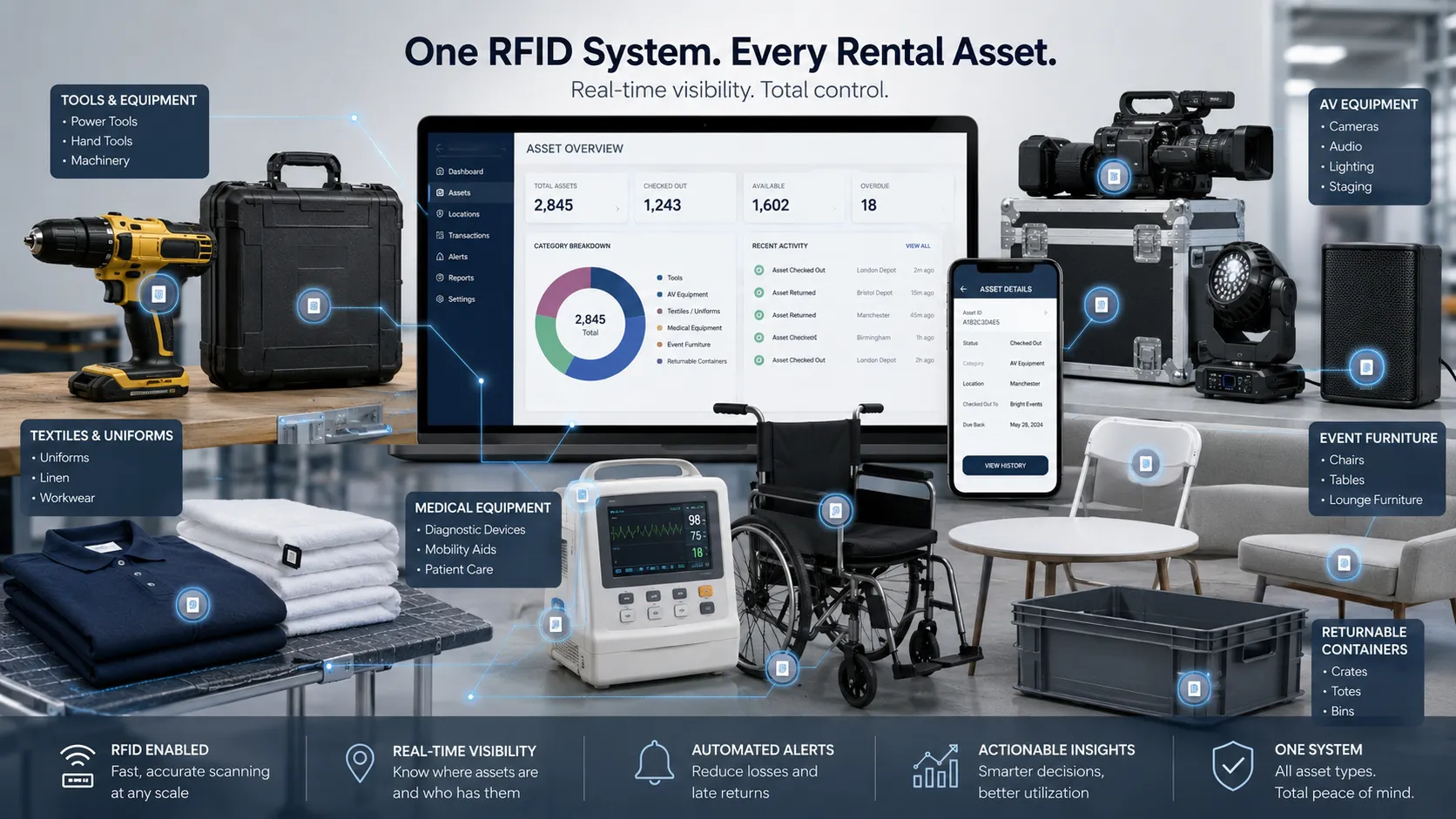
Typical assets include power tools, hand tools, generators, compressors, pumps, testing instruments, construction accessories, safety equipment, and machinery attachments.
RFID can support checkout, return, maintenance, warehouse audits, and job-site preparation. For a deeper look at metal-tool tagging and read-zone design, see RFID tool tracking.
Audio-visual rental orders often contain cameras, lights, speakers, microphones, mixers, projectors, displays, stands, cables, adapters, cases, and power supplies.
RFID can verify that a complete kit is packed and returned. Specialized tags may be needed because many AV assets contain metal, electronics, curved surfaces, or cables.
RFID can track uniforms, workwear, costumes, formalwear, hospitality linen, healthcare linen, table linen, protective garments, and cleanroom clothing.
Washable RFID tags can remain attached throughout repeated rental, cleaning, inspection, and distribution cycles. Syncotek’s RFID laundry tags guide covers washable tag formats, attachment methods, frequency selection, and laundry durability.
Hospitals, home-care providers, and medical-rental businesses may manage wheelchairs, patient monitors, infusion equipment, respiratory devices, medical beds, mobility equipment, rehabilitation equipment, and diagnostic devices.
RFID can improve availability, return verification, cleaning records, maintenance status, and asset assignment.
Rental inventory may include tables, chairs, partitions, tents, decorations, staging systems, exhibition equipment, flooring, catering equipment, and reusable transport cases.
RFID can support order preparation, dispatch validation, site returns, and condition checks.
Large assets may require a hybrid tracking strategy. RFID may be used for gate identification, key management, attachment tracking, maintenance stations, and indoor or yard checkpoints.
GPS or another RTLS technology may provide wider-area location tracking while the equipment is in use. For broader location-technology selection, review what RTLS is and how real-time location systems work.
Companies may rent or pool pallets, crates, bins, totes, cages, cylinders, racks, containers, and reusable packaging.
RFID can record issue, customer custody, return, cleaning, inspection, and redistribution.
Each asset receives an RFID tag suitable for its material, size, shape, environment, expected lifecycle, attachment method, and required read range.
The RFID tag ID is linked to the rental asset record.
The software record may include asset description, serial number, purchase date, value, branch, category, current condition, maintenance schedule, tag ID, replacement cost, and rental rate.
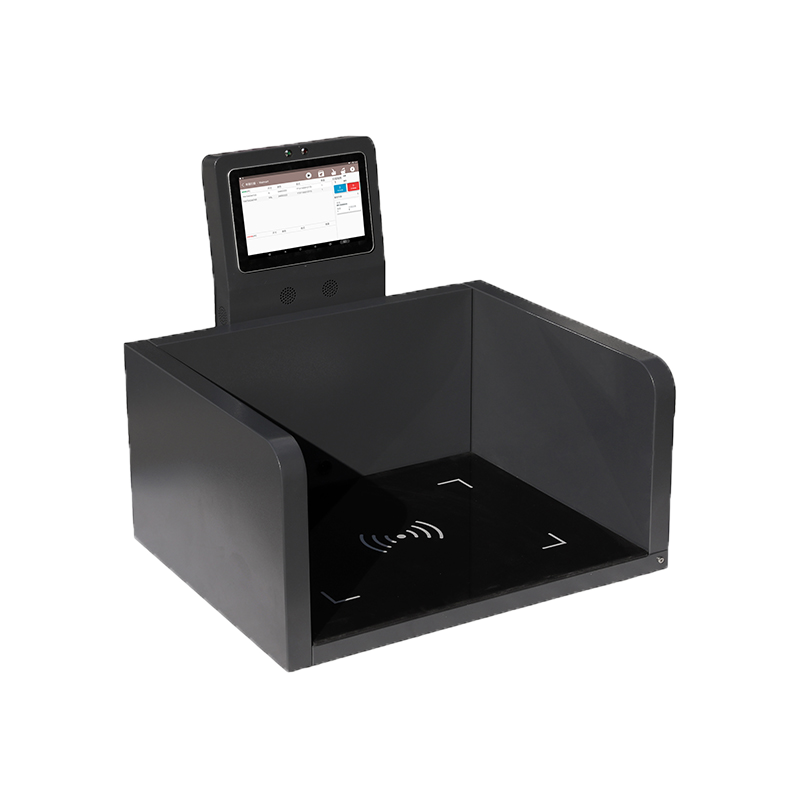
Employees pick the required assets. A handheld reader, smart table, cabinet, or fixed station can detect the selected items and compare them with the rental order.
The software can flag missing or incorrect assets before packing.
At the packing station or dock door, fixed RFID readers can confirm that the detected assets match the customer order.
The system records the order number, customer, dispatched assets, dispatch time, expected return date, and dispatch location.
Once dispatched, the asset status changes to rented or checked out.
The system may associate the asset with a customer, project, event, job site, employee, vehicle, or delivery route.
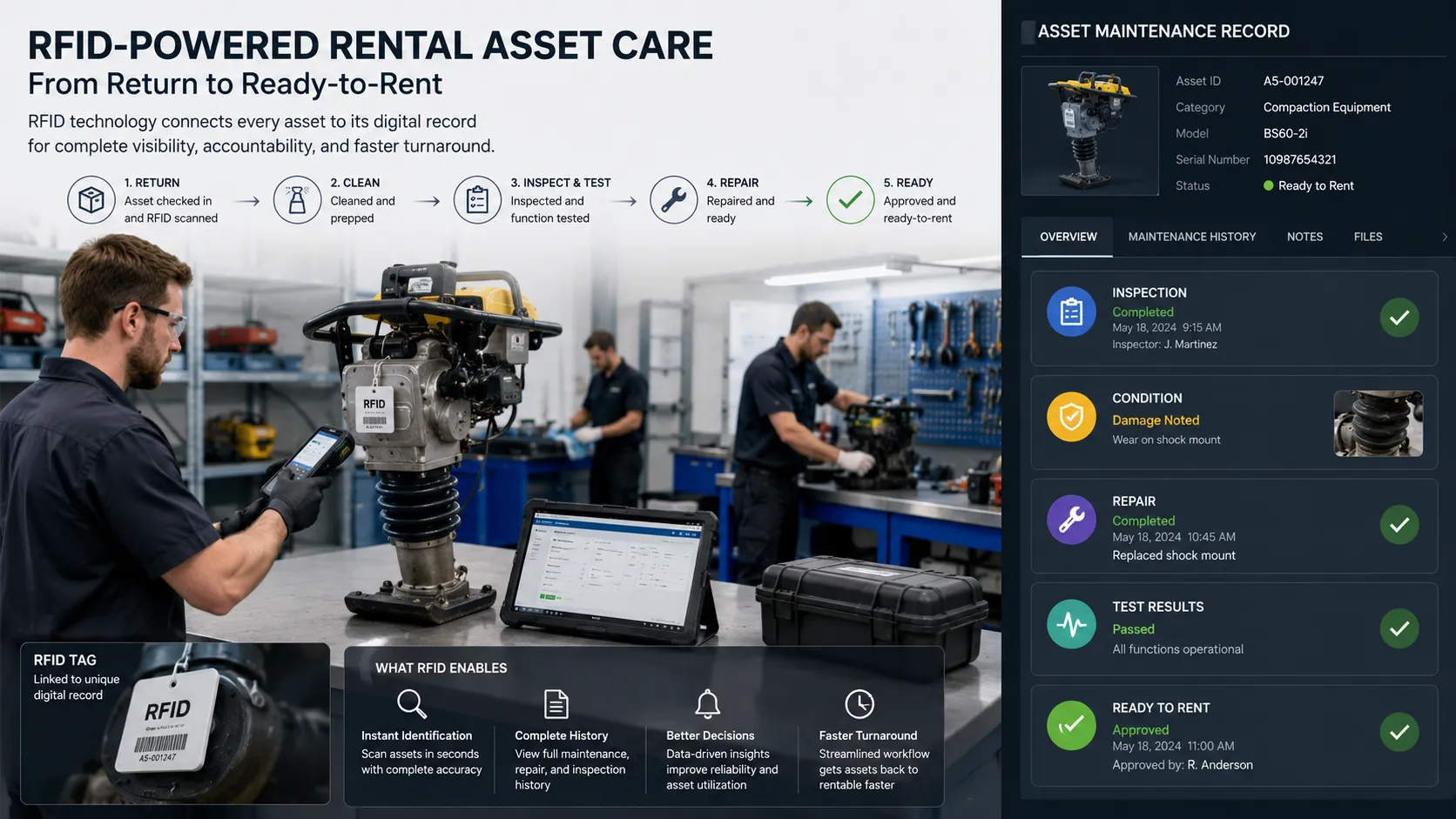
When assets return, RFID readers identify the received items.
The software compares the detected assets with the original rental order and displays returned assets, missing assets, unexpected assets, overdue items, and incomplete kits.
Returned items move through inspection, cleaning, testing, repair, or calibration.
The asset remains unavailable until the required process is complete.
After approval, the system updates the status to available and records the warehouse or storage location.
The next rental order can then use accurate availability data.
The tag must match the rental asset.
Possible formats include printable RFID labels, rugged hard tags, on-metal tags, cable tags, washable textile tags, embedded tags, tamper-evident tags, and reusable card-style tags.
Understanding the difference between RFID inlays, tags, and labels helps avoid using a simple label where a rugged asset tag is required.
Handheld readers are useful for warehouse inventory, asset search, order picking, return processing, exception handling, branch audits, and field operations.
They provide flexibility without requiring fixed infrastructure in every location.
Fixed readers may be installed at dock doors, warehouse entrances, packing stations, return stations, maintenance areas, storage cages, conveyors, and customer pickup points.
They provide more automated data capture.
Antennas determine the shape and boundaries of the read zone.
A rental company may need a narrow zone that reads assets passing through one dock door without detecting equipment stored nearby.
Syncotek’s guide on how to select the right RFID antenna explains antenna gain, polarization, beamwidth, placement, and read-zone control.
Some rental operations need to encode, update, or verify tags.
A desktop or handheld RFID reader and writer can support asset registration, tag replacement, verification, and controlled data updates.
The RFID system must connect detected tag IDs with meaningful rental records.
The software may support reservations, availability, customer records, check-in and check-out, expected return dates, overdue alerts, inspection, damage billing, maintenance, asset utilization, replacement planning, branch transfers, and reporting.
RFID hardware collects physical events; software turns those events into rental decisions.
Many rental assets are made of metal or contain substantial metal components.
Examples include tools, generators, lighting equipment, machinery, staging systems, audio equipment, racks, cases, cylinders, and metal furniture.
Standard RFID labels may perform poorly when placed directly on metal.
These applications may require mount on metal RFID tags with a structure designed to maintain RF performance on conductive surfaces.
Tag selection should be tested on the actual asset because metal shape, tag position, surrounding equipment, and orientation all affect performance.
| Factor | Barcode | RFID |
|---|---|---|
| Reading method | Optical scan | Radio frequency |
| Line of sight | Required | Not always required |
| Reading process | Usually one at a time | Multiple items can be read |
| Hidden tags | Difficult to scan | Can often be read |
| Fast kit verification | Limited | Better suited |
| Initial cost | Lower | Higher |
| Durable asset options | Available | Many rugged formats available |
| Fixed doorway automation | Limited | Supported |
| Best use | Simple and low-volume workflows | High-volume or multi-item rental operations |
RFID does not need to replace every barcode. A hybrid system may use RFID for automated asset identification, barcode or QR code for visual backup, and printed serial numbers for manual verification.
| Factor | Handheld RFID | Fixed RFID |
|---|---|---|
| Best use | Audits, searches, picking, returns | Doors, docks, stations, automated transitions |
| Infrastructure | Lower | Higher |
| Mobility | High | Fixed location |
| Operator involvement | Required | Lower |
| Read-zone consistency | Depends on user | More repeatable |
| Asset locating | Useful for searches | Usually zone or checkpoint based |
| Suitable starting point | Yes | After workflow validation |
Many rental businesses begin with handheld RFID readers and later add fixed infrastructure at the highest-value process points.
RFID identifies the individual asset, but it does not automatically determine whether an asset is damaged.
A strong return workflow combines RFID identification with human or automated inspection.
When an item returns, the employee can open the correct asset record and document photographs, stains, tears, scratches, missing parts, electrical damage, abnormal wear, cleaning charges, repair cost, customer responsibility, and whether the asset remains rentable.
This creates a traceable history for billing, maintenance, customer disputes, and replacement planning.
RFID can improve customer-facing availability when the physical workflow and booking platform are properly integrated.
Instead of showing only Out of Stock, the website may display:
This requires clear status rules. Returned assets should not appear available until they pass inspection and preparation.
RFID may create value through fewer lost assets, faster inventory counts, reduced packing errors, faster order preparation, fewer incomplete returns, more accurate availability, lower emergency shipping costs, improved asset utilization, fewer unnecessary purchases, better maintenance compliance, faster customer service, and stronger damage documentation.
The business case should be measured against actual operating costs rather than assuming that RFID automatically creates savings.
Choose a measurable starting problem, such as slow warehouse counts, incomplete rental kits, unreliable availability data, frequent asset loss, delayed maintenance, or inaccurate online stock information.
Start with assets that are high value, frequently rented, often lost, difficult to count, usually rented as kits, expensive to replace, or important to customer operations.
Document every status and physical transition from available and reserved through dispatch, return, inspection, maintenance, redeployment, and retirement.
Test attachment strength, read range, orientation, metal performance, environmental durability, customer handling, visibility, tamper resistance, and removal risk on real assets.
Potential reading points include storage areas, picking stations, packing tables, dock doors, customer pickup areas, return stations, inspection areas, and maintenance zones.
The software should determine what each RFID event means. For example, a dock-door read connected to an approved order can mark an asset as dispatched, while a return-station read can mark it as awaiting inspection.
The pilot should include real rental orders, mixed asset types, actual employees, realistic packing density, metal equipment, customer returns, incomplete kits, damaged assets, branch transfers, and software exceptions.
Compare inventory time, picking time, packing errors, missing returns, asset loss, maintenance delays, availability accuracy, rental turnaround time, labor requirements, and customer complaints before and after the pilot.
A smaller pilot usually provides better insight than tagging the entire inventory before the workflow is proven.
A low-cost tag that fails on metal, falls off, or cannot survive rental handling creates more cost than it saves.
Returned assets may require inspection, cleaning, testing, or maintenance before the next rental.
Handheld pilots can help determine which transitions actually need fixed automation.
Rental software may need to understand the main case, individual components, required accessories, optional components, and substitute items.
An uncontrolled read zone may detect nearby inventory that is not part of the current order.
A list of RFID tag IDs is not useful unless it connects with orders, customers, status, maintenance, and availability.
Employees must understand how to handle missed reads, damaged tags, unexpected assets, incomplete returns, status exceptions, tag replacement, and manual verification.
Before deployment, confirm:
RFID rental inventory management helps rental companies connect physical assets with reservations, customers, return dates, inspections, maintenance, availability, and lifecycle records.
The technology is especially valuable when businesses manage large inventories, complex equipment kits, reusable assets, frequent customer returns, or high-value items.
A successful system does more than count inventory. It supports the complete rental lifecycle: identify, reserve, pick, verify, dispatch, return, inspect, maintain, and redeploy.
The right implementation depends on selecting suitable RFID tags, designing controlled reading points, integrating rental software, and testing the workflow under real operating conditions.
RFID rental inventory management uses RFID tags, readers, antennas, and software to identify and manage rentable assets throughout reservation, checkout, customer use, return, inspection, maintenance, and redeployment.
Yes. When the RFID tag is linked to the rental order, the software can associate the asset with the customer, dispatch date, and expected return date.
RFID can automate or accelerate identification at dispatch and return stations. The software must still apply the correct business rules and confirm the transaction.
Yes. The system can compare detected tagged components with the required kit list and flag missing or unexpected items.
Yes, but metal assets commonly require on-metal RFID tags or other specially designed tag formats.
Yes. Washable textile RFID tags can support garment, uniform, costume, hospitality linen, and healthcare textile rental workflows.
No. RFID captures physical asset identity and movement. Rental software manages customers, reservations, orders, billing, availability, maintenance, and reporting.
Handheld readers are useful for inventory, order picking, returns, and searches. Fixed readers are useful for dock doors, packing stations, and automated process transitions. Many deployments use both.
RFID identifies the exact returned asset and opens its record. Employees can then document damage, cleaning, repairs, charges, and asset condition.
It does not physically prevent loss, but it improves custody records, last-seen information, return verification, and movement visibility, which can reduce and investigate asset loss.
Syncotek provides RFID readers, antennas, tags, reader modules, handheld devices, and related components for rental equipment, textile inventory, tools, returnable containers, warehouse assets, and industrial tracking applications.
Whether your project requires handheld inventory scanning, dock-door verification, rugged on-metal tags, washable textile tags, or fixed RFID reading stations, Syncotek can help evaluate suitable hardware based on your asset material, rental workflow, read range, operating environment, and software-integration requirements.
Explore Syncotek’s complete RFID products for your rental inventory management project.
 Knowledge
When people compare near-field vs far-field in RFID, they are really comparing two different ways energy and data move between the reader and the tag. In RFID, near-field systems are based on magnetic coupling and are typically associated with LF and HF/NFC, while far-field systems are based on radiated electromagnetic waves and backscatter and are typically associated with UHF RFID. That difference affects range, […]
READ MORE Knowledge
Choosing an RFID tag should not begin with a catalog, chip model, or maximum advertised read distance. It should begin with the physical object and the workflow. The right RFID tag for a cardboard carton may fail when attached to a metal tool. A tag that performs well with a fixed reader and high-gain antenna […]
READ MORE Uncategorized
RFID is no longer limited to experimental pilots or isolated warehouse projects. Large companies now use RFID to connect physical products, packages, credentials, vehicles, and customer interactions with digital business systems. Depending on the application, RFID can help a company identify an item, confirm its location, validate access, automate inventory counting, track movement, or trigger […]
READ MORE Knowledge
BarTender RFID software, BarTender RFID label printing, RFID label software, RFID printer software, RFID label encoding, RFID printer encoder, RFID label design, EPC encoding, RFID barcode label software, RFID serialization RFID projects do not depend only on tags, readers, antennas, and printers. Software also plays a critical role, especially when businesses need to design RFID […]
READ MORE Knowledge
RFID systems generally fall into two big tag categories: passive RFID and active RFID. They solve different problems. If you choose the wrong one, you’ll either overpay (active when passive is enough) or underperform (passive when you truly need real-time long-range visibility). This guide explains the differences in plain English, with practical selection criteria and […]
READ MOREIf you are interested in our services or need customized solutions, please feel free to contact us.