
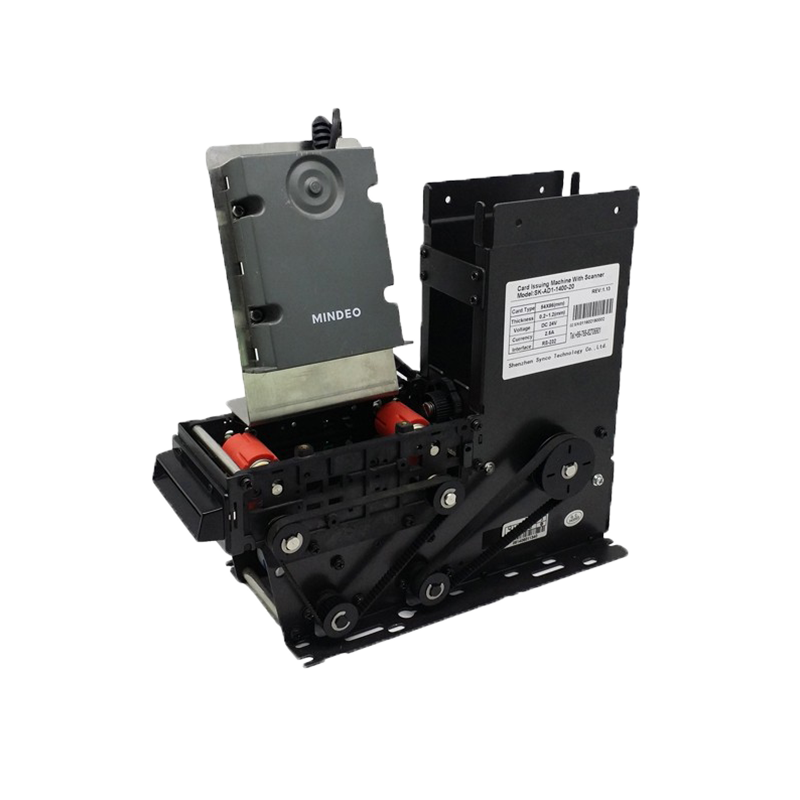
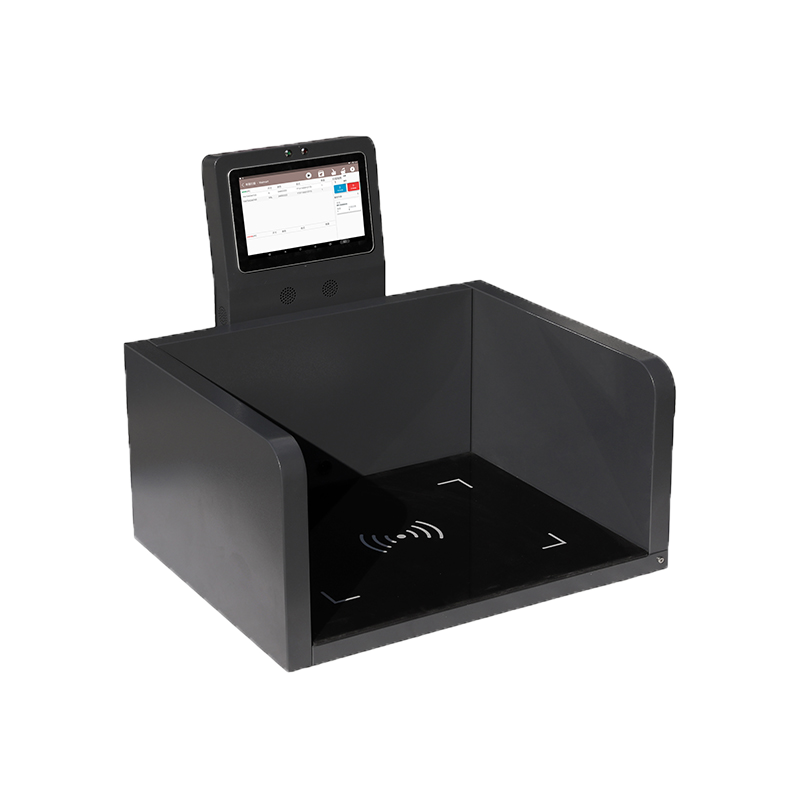
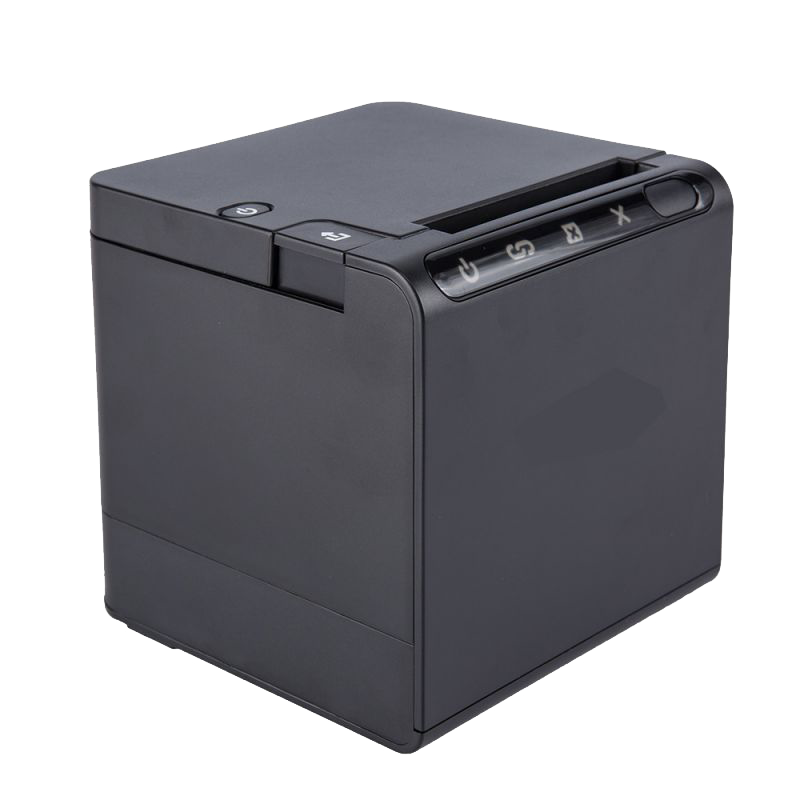
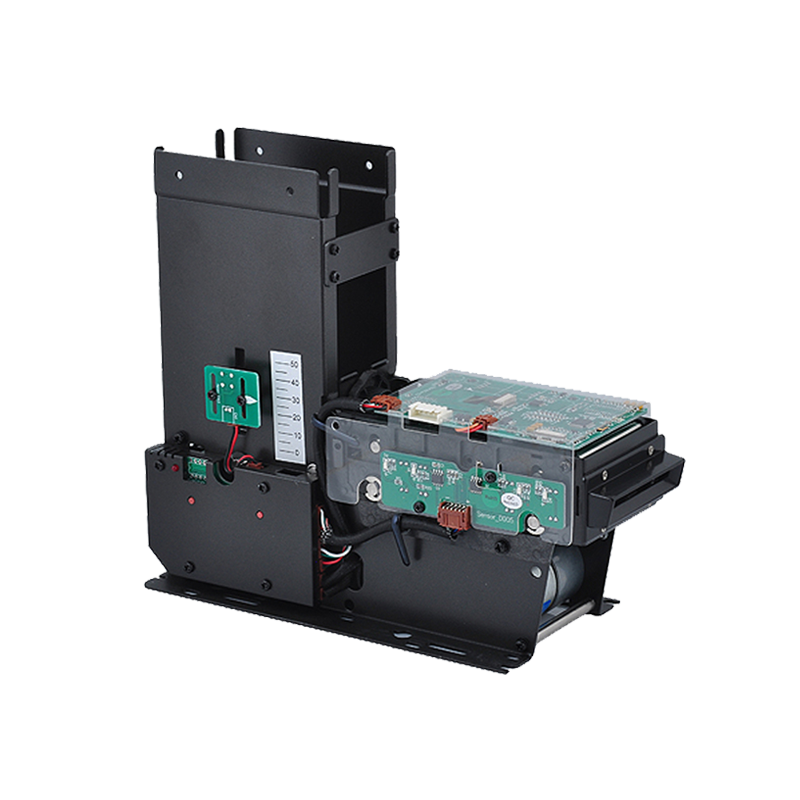

Manufacturing operations depend on accuracy, timing, and visibility. Materials, tools, fixtures, machines, work orders, semi-finished goods, and finished products move through many production stages every day. When these movements are recorded manually, manufacturers often face delayed updates, inventory errors, missing tools, unclear production status, and limited visibility across the shop floor.
RFID technology helps manufacturers identify, track, and manage physical items more efficiently. By using RFID tags, readers, antennas, and software, factories can automatically capture movement data and connect physical production activities with digital systems.
For manufacturers, RFID is not simply a replacement for barcode labels. It is a practical way to improve work-in-process tracking, asset visibility, inventory accuracy, tool management, quality verification, and production efficiency.
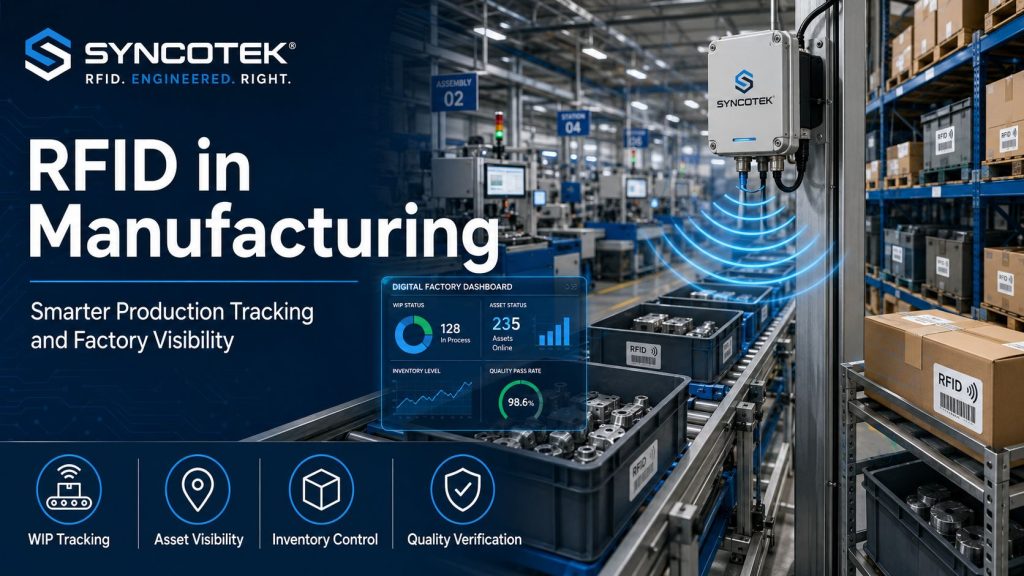
Modern manufacturing environments are becoming more complex. Production lines handle more product variations, shorter lead times, stricter quality requirements, and higher traceability expectations. Traditional manual records and barcode-only workflows may not provide enough speed or visibility for these conditions.
RFID helps solve this by enabling faster and more automated identification. Unlike barcodes, RFID does not always require direct line-of-sight scanning. In many applications, RFID can identify multiple tagged items quickly as they move through receiving, storage, production, inspection, packing, and shipping.
This makes RFID especially useful in factories where teams need to track:
With the right RFID system design, manufacturers can reduce manual scanning, improve data accuracy, and gain better control over production flow.
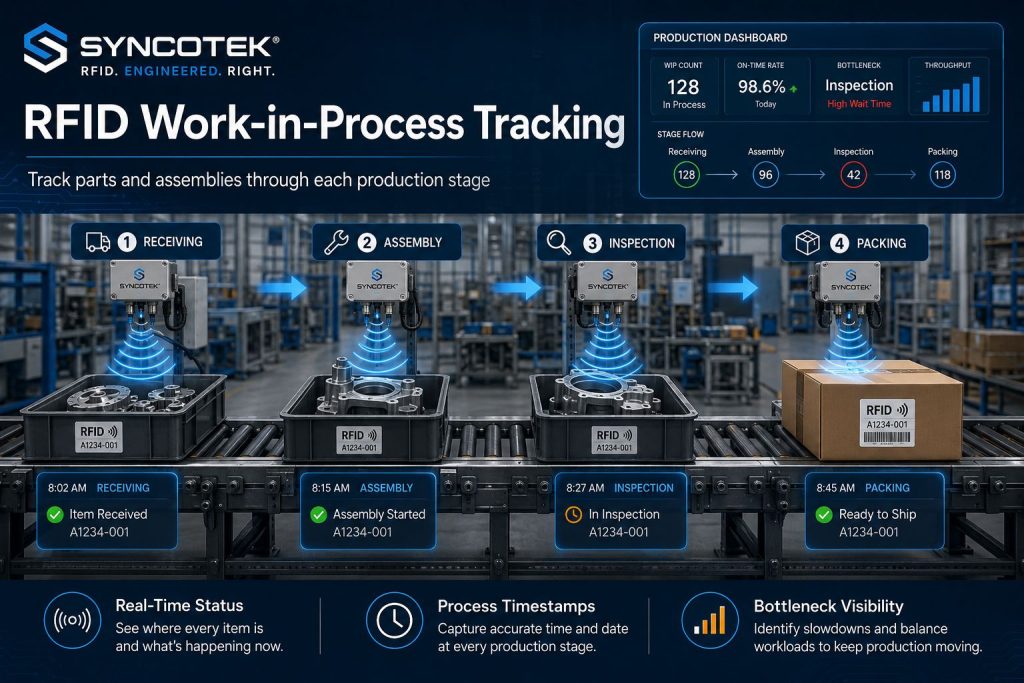
Work-in-process, or WIP, tracking is one of the most important RFID applications in manufacturing. Many production processes require raw materials, parts, and subassemblies to move through multiple stages before becoming finished products.
RFID can help identify each item as it moves from one station to another. Readers installed at key production points can automatically capture tag data and record process movement.
By capturing this information automatically, RFID gives production managers a clearer view of real shop-floor activity.
Factories rely on many important assets, including molds, fixtures, tools, gauges, carts, test equipment, machines, and mobile production assets. If these assets are misplaced, unavailable, or not maintained properly, production may be delayed.
RFID can be used to tag and track these assets more efficiently.
| Asset Type | RFID Value |
|---|---|
| Tools | Reduce loss and improve tool room control |
| Molds and fixtures | Improve location visibility and usage records |
| Gauges and test devices | Support calibration and maintenance tracking |
| Carts and containers | Track movement across production and warehouse areas |
| Machines and equipment | Improve asset identification and lifecycle records |
| Reusable racks and pallets | Support returnable asset management |
For many factories, asset tracking is not only about knowing where something is. It is also about improving availability, utilization, maintenance, compliance, and accountability.
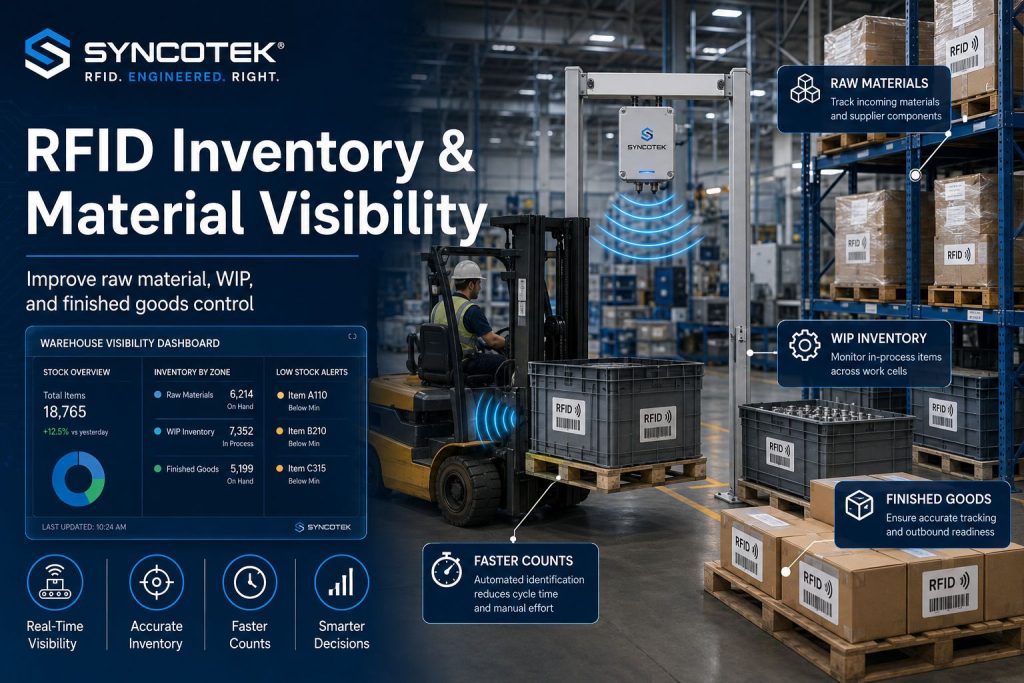
Inventory accuracy is a major challenge in manufacturing. If inventory records are inaccurate, factories may experience production delays, stockouts, excess inventory, or emergency purchasing.
RFID can improve visibility into raw materials, components, WIP inventory, and finished goods. Instead of relying only on manual counting or individual barcode scans, RFID can support faster inventory checks and automated movement records.
When RFID data is connected to business systems, physical inventory becomes easier to monitor and manage.
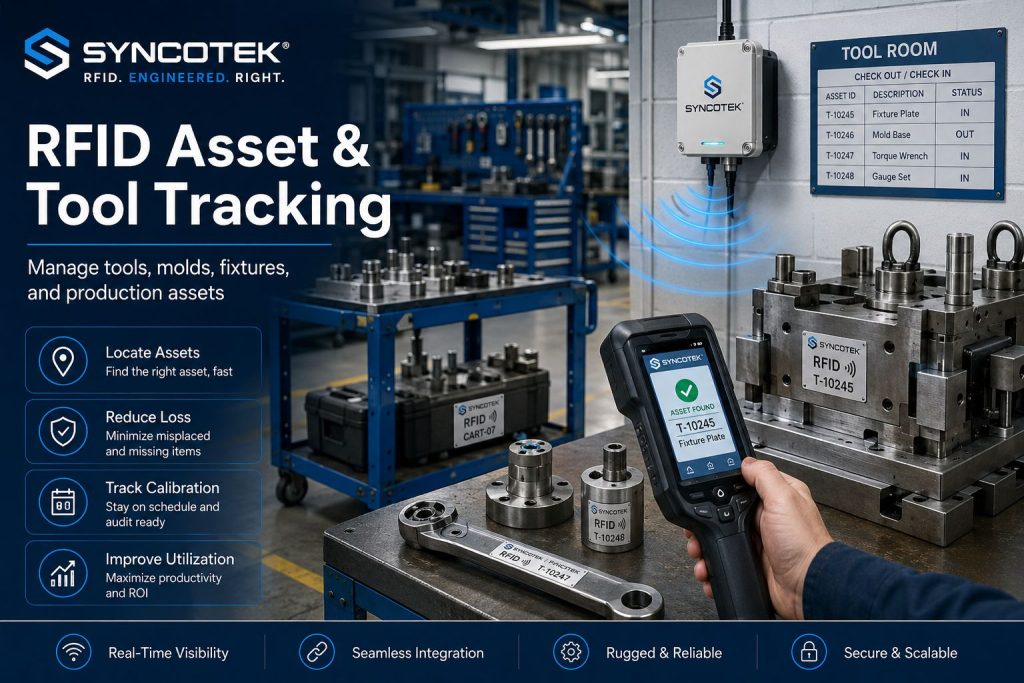
Tool loss is a common problem in manufacturing. Tools may be left at a workstation, moved to another production area, stored incorrectly, or forgotten after maintenance. In some industries, tool accountability is also linked to safety and compliance.
RFID can help factories manage tool check-in, check-out, usage history, maintenance records, and calibration schedules.
For metal tools, standard RFID labels may not perform reliably. On-metal RFID tags or rugged industrial tags are usually required for stable reading performance.
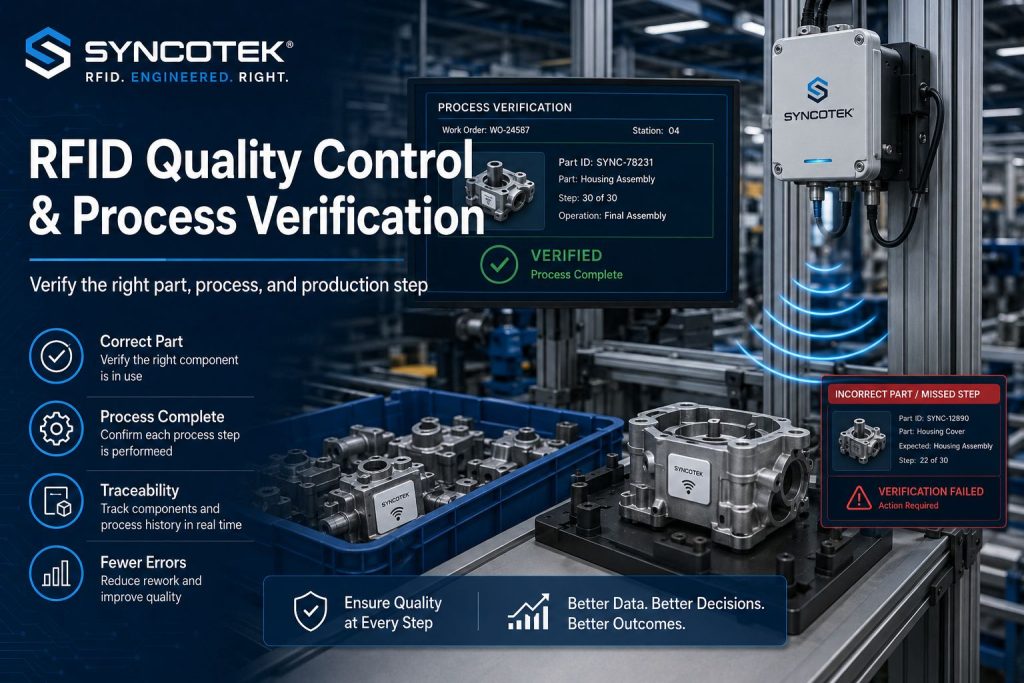
RFID can support quality control by confirming that the right item, tool, material, or component is used at the right production stage.
In manufacturing, process sequence matters. If an item skips a station, uses the wrong part, or enters the wrong line, it can create rework, scrap, or quality risk. RFID can help verify process flow and trigger alerts when something does not match the expected workflow.
This is especially valuable in industries such as automotive, electronics, aerospace, medical devices, industrial equipment, and precision manufacturing.
RFID can also connect manufacturing with warehouse and logistics operations. A tagged item can be tracked from receiving to storage, from production to inspection, and from finished goods to outbound shipping.
This creates a more connected view of factory operations.
For manufacturers with multiple production areas, buildings, or warehouses, RFID can help reduce information gaps between physical movement and digital records.
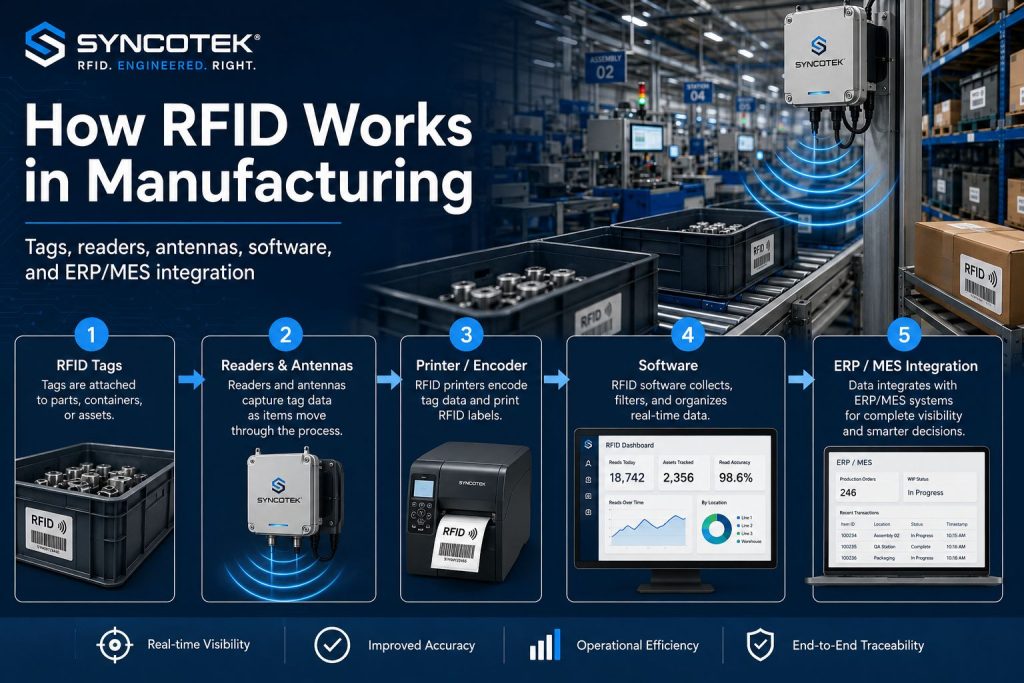
A manufacturing RFID system usually includes tags, readers, antennas, printers or encoders, software, and system integration.
Each part of the system plays an important role.
RFID tags are attached to products, parts, pallets, tools, containers, fixtures, or assets. The right tag depends on the surface, environment, read distance, durability requirement, and lifecycle of the item.
| Tag Type | Typical Use |
|---|---|
| Standard RFID labels | Cartons, packaging, non-metal surfaces |
| Rugged RFID tags | Industrial assets, reusable containers, outdoor items |
| On-metal RFID tags | Tools, machines, metal racks, metal containers |
| High-temperature RFID tags | Heat treatment, painting, industrial processing |
| Embedded RFID tags | Tools, components, protected installations |
| Printable RFID labels | Work orders, cartons, finished goods, compliance labels |
Choosing the right RFID tag is one of the most important steps in a successful manufacturing project.
RFID readers capture data from tags. In factories, readers may be installed at fixed points or used by operators with handheld devices.
Reader selection depends on the workflow. A shipping dock, tool room, conveyor, and production station may each require a different reader setup.
Antennas define the read zone. In manufacturing, antenna design is critical because poor placement can cause missed reads or false reads.
Good antenna planning helps ensure that the system reads the intended tags and avoids reading unrelated tags nearby.
RFID printers and encoders are used to print visible information and encode RFID data into labels or tags. They are useful when factories need to create RFID labels for products, cartons, assets, tools, or production orders.
Printer selection should match label size, RFID inlay type, printing volume, material, and encoding requirements.
RFID hardware creates data, but software makes that data useful. RFID software can collect tag reads, filter duplicate reads, trigger business rules, and send data to ERP, MES, WMS, quality systems, or asset management platforms.
Without software integration, RFID data may remain isolated. With proper integration, it becomes part of the factory’s digital operation.
RFID helps manufacturers see where materials, WIP items, tools, and finished goods are located. This improves decision-making and reduces the time spent searching for items.
Manual scanning and data entry take time and can introduce errors. RFID automates identification and reduces repetitive manual tasks.
RFID can improve the accuracy of raw material, WIP, and finished goods inventory records.
RFID timestamps can help manufacturers understand how items move through production and where bottlenecks occur.
RFID helps track tools, molds, fixtures, gauges, and other production assets, reducing loss and improving utilization.
RFID can help confirm that the correct item follows the correct process and that required production steps are completed.
RFID supports traceability by connecting physical items with digital production, inspection, and shipment records.
Barcodes are still useful in many manufacturing workflows, especially when the label is visible and one-by-one scanning is acceptable. RFID is more suitable when factories need faster, more automated, or non-line-of-sight identification.
| Comparison | Barcode | RFID |
|---|---|---|
| Line of sight | Required | Not always required |
| Bulk reading | Limited | Supported in many applications |
| Reading speed | Slower for many items | Faster for multiple items |
| Manual effort | Higher | Lower |
| Environment tolerance | Depends on label visibility | Can work in more complex environments |
| Cost per label | Lower | Higher |
| Best use | Simple identification | Automated tracking and visibility |
In many factories, RFID and barcodes can work together. Barcodes remain useful for visual identification, while RFID supports automation and bulk tracking.
RFID can help identify incoming materials, pallets, bins, or components and update inventory records more quickly.
RFID improves material visibility and helps teams locate components before production begins.
RFID can track WIP items, record movement through stations, and support process verification.
RFID can manage tools, gauges, molds, fixtures, and calibration-sensitive assets.
RFID can link inspection results to specific products, batches, or work orders.
RFID can support inventory counting, staging, packing, and shipment preparation.
RFID portals or fixed readers can help verify that the right goods are shipped.
Start with a specific operational problem. Do not begin with the technology alone.
Examples include:
A clear problem makes system design easier.
Do not try to RFID-enable the entire factory at once. Start with a focused use case such as WIP tracking, tool tracking, returnable container tracking, or finished goods verification.
Tag selection should consider:
For metal assets, use on-metal RFID tags or rugged industrial tags.
Reader and antenna placement should match the real workflow. The system should read the intended tags at the right time and avoid false reads from nearby items.
Factory environments often include metal, liquids, machines, motors, reflections, and movement. Testing in the actual environment is necessary before full deployment.
RFID data becomes valuable when connected to ERP, MES, WMS, quality, or maintenance systems.
RFID works best when operators understand tag placement, movement rules, exception handling, and daily operation procedures.
A tag that works in a simple test may not perform the same way on metal, near machinery, on moving items, or in harsh environments.
Manufacturing environments often include metal tools, racks, containers, machines, and parts. Standard RFID labels may fail on metal surfaces.
Incorrect reader and antenna placement can cause missed reads, duplicate reads, or reads from the wrong area.
RFID success depends on tags, readers, antennas, software, data rules, integration, and process design.
A focused pilot usually works better than a large deployment without a clear use case.
| Manufacturing Type | RFID Applications |
|---|---|
| Automotive manufacturing | WIP tracking, parts sequencing, tool tracking, returnable containers |
| Electronics manufacturing | Component tracking, test fixture tracking, production lot traceability |
| Aerospace manufacturing | Tool accountability, high-value asset tracking, compliance records |
| Medical device manufacturing | Process verification, traceability, calibration tracking |
| Metal fabrication | On-metal asset tracking, tool tracking, rack and WIP tracking |
| Food and beverage manufacturing | Batch tracking, reusable container tracking, warehouse visibility |
| Industrial equipment manufacturing | Production flow tracking, parts management, finished goods tracking |
RFID in manufacturing helps factories move from delayed manual records to faster and more reliable production visibility. It can support work-in-process tracking, inventory control, tool management, asset tracking, quality verification, and finished goods visibility.
The most successful RFID manufacturing projects do not start with a generic tag or reader. They start with a clear operational problem, then match RFID tags, readers, antennas, software, and integration to the real production environment.
For manufacturers facing missing tools, unclear WIP status, inventory uncertainty, production bottlenecks, or traceability pressure, RFID can become a practical foundation for smarter factory operations.
RFID is used for work-in-process tracking, inventory management, asset tracking, tool tracking, quality verification, production traceability, and finished goods tracking.
RFID tags can identify materials, parts, or assemblies as they move through production stages. Readers capture movement data and timestamps, helping manufacturers understand production status and identify delays.
RFID can replace barcodes in some workflows, but many factories use both. Barcodes are useful for visible, low-cost identification, while RFID is better for automated, bulk, or non-line-of-sight tracking.
The best RFID tag depends on the asset and environment. Manufacturing applications may require standard RFID labels, rugged tags, on-metal tags, high-temperature tags, or embedded tags.
Yes. RFID is commonly used to track tools, molds, fixtures, gauges, and other production assets. This helps reduce loss and improve tool room management.
Yes, but the right tag must be selected. Standard RFID labels may not work reliably on metal, so on-metal RFID tags or rugged industrial tags are often required.
RFID data can integrate with ERP, MES, WMS, maintenance systems, quality systems, and asset management platforms.
Need RFID Solutions for Your Manufacturing Workflow?
Syncotek provides RFID hardware and identification solutions for manufacturing environments, including work-in-process tracking, tool management, asset tracking, inventory visibility, and industrial production control.
Whether your application involves metal assets, harsh factory environments, tool rooms, production lines, or warehouse read zones, Syncotek can help you evaluate suitable RFID tags, readers, antennas, and system components for more reliable factory visibility.
 Knowledge
Tools are essential assets in many industries. Manufacturing plants, construction companies, hospitals, repair teams, rental businesses, warehouses, and maintenance departments all depend on tools being available, traceable, and properly maintained. However, tool management is often difficult. Tools may be misplaced, borrowed without record, left at job sites, stored in the wrong cabinet, sent for maintenance […]
READ MORE Knowledge
What is an RFID chip? An RFID chip is a small integrated circuit (IC) used in radio-frequency identification systems to store an identifier and/or data and communicate wirelessly with an RFID reader. In everyday conversations, “RFID chip” can mean two different things: RFID tag chip (Tag IC / transponder IC) – the chip inside a […]
READ MORE Knowledge
RFID—Radio Frequency Identification—is a wireless technology that identifies objects using radio waves. An RFID system can detect items without line-of-sight, often in bulk, and can automate tracking across warehouses, factories, retail stores, hospitals, and security systems. This guide explains what RFID is, how it works, RFID frequencies (LF/HF/NFC/UHF/RAIN), tags and readers, passive vs active vs […]
READ MORE Knowledge
Learn the real differences between RFID and NFC—frequencies, range, security, smartphone compatibility, data models, and use cases. See when to choose UHF RFID (RAIN) vs. NFC, and how Syncotek readers fit your project.
READ MORE Industry Info
How to Choose Frequency for Your Access Control System
READ MOREIf you are interested in our services or need customized solutions, please feel free to contact us.