

RFID food traceability uses radio frequency identification to identify tagged cartons, pallets, reusable crates or individual products as they pass through defined supply chain checkpoints. A UHF RFID reader captures a tag identifier without requiring a direct optical scan; business software links that identifier to product, lot, shipment and location records. When those records are maintained consistently, food companies can search for affected inventory during a recall and see where a specific lot was last recorded.
RFID identifies objects; it does not, by itself, establish a food's origin, verify its safety, measure its temperature or satisfy a regulatory recordkeeping requirement. Those outcomes depend on accurate lot-to-object associations, event capture, suitable sensing equipment where needed, and the traceability processes behind the system.
For food producers, distributors and system integrators, the most practical starting point is often case-, pallet- or reusable-crate-level identification. This guide explains where to capture RFID reads, how RFID identifiers relate to food lot records, what the U.S. FDA's FSMA 204 rule actually requires, and how to select the reader, antenna and tag hardware for real operating conditions.
Food traceability is the ability to follow a food product or lot through relevant stages of production, transformation, storage, shipment and receiving. RFID can improve the automatic identification part of that process: a reader detects a tagged physical object, while software records the event and associates it with traceability information.
A basic food RFID system includes:
The tracking unit matters as much as the tag technology. Not every supply chain needs an RFID tag on every consumer package.
| Tracking level | What is tagged | Typical purpose | Important limitation |
|---|---|---|---|
| Item | Individual retail product or package | Item-specific inventory or identification where justified | Higher tag volumes and more challenging packaging conditions |
| Case or carton | A shipping carton containing one or more product lots | Receiving, shipment checking and carton-level lot association | Reading the carton tag does not independently verify every item inside |
| Pallet or logistics unit | A pallet or transport unit | Dock-door and shipment movement visibility | The contents must be maintained in a reliable aggregation or packing record |
| Reusable crate or tote | The transport container itself | Crate circulation, deposit/return and loss control | A reusable crate ID is not the food lot ID; contents change with each trip |
For example, a uniquely tagged reusable crate may carry tomatoes from a packing facility to a distributor and then return empty. Its crate identifier remains the same across trips, while the software must update the associated product and batch for each load. Tracking the crate without updating the content record is container tracking, not complete food lot traceability.
A useful deployment places RFID reads at handover points, where the business needs confirmation that tagged goods entered, left or changed custody. The network does not need to identify every item continuously while it is travelling on a truck.
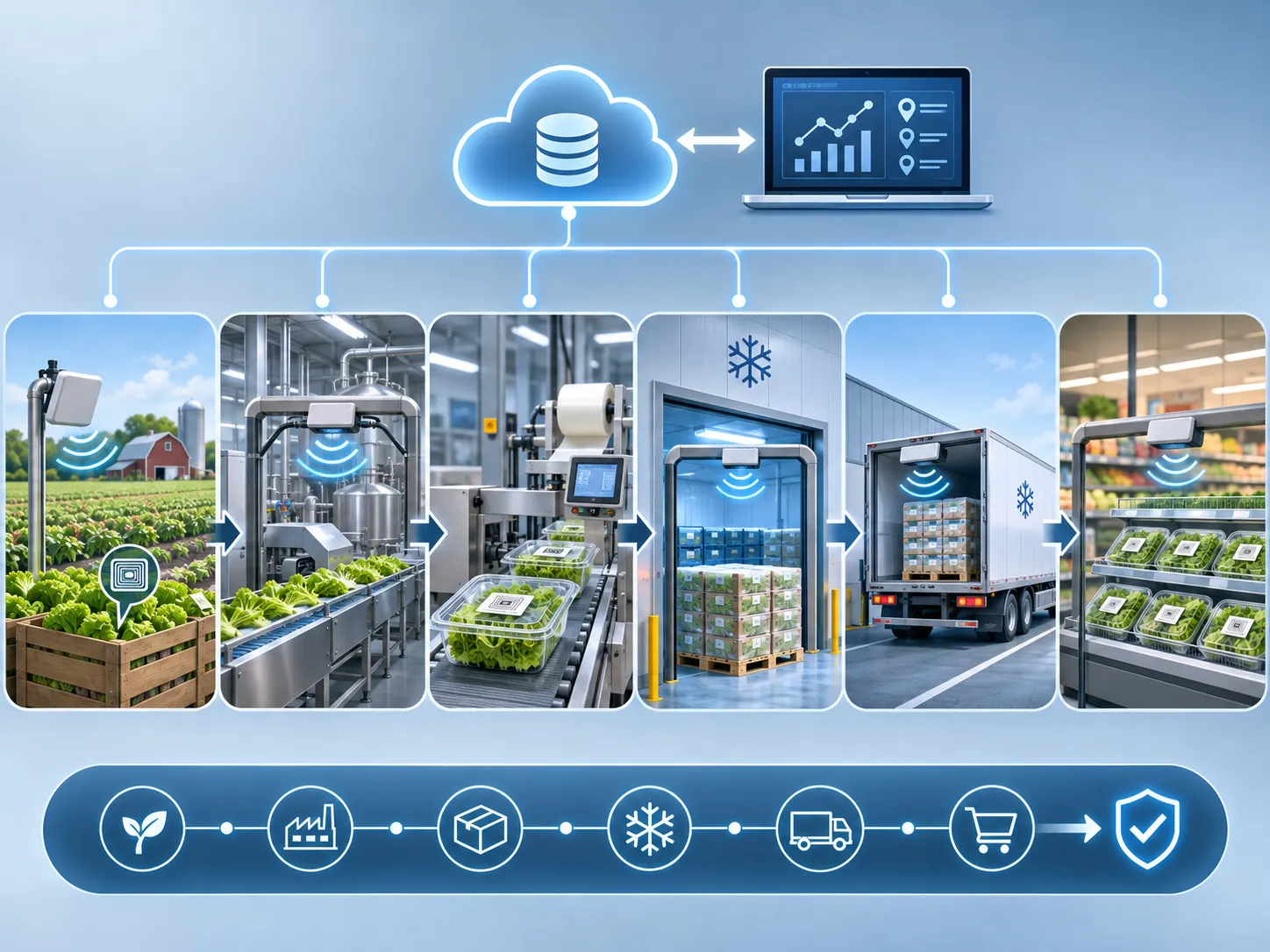
At the grower or collection point, a farm or packhouse may assign a harvest or receiving record to bins and crates. RFID can identify reusable carriers or consolidated units as they move into sorting and packing. The actual harvest information—such as source, date, commodity, quantity and applicable lot references—must be recorded in the operating system.
When food is sorted, packed, mixed or processed, the software needs to preserve the connection between input materials and output lots. A finished carton may receive a label encoding a unique identifier, while the packing system records the appropriate product and lot attributes.
If several incoming lots are combined into a new output lot, a traceability system must establish the correct transformation relationship. A radio read alone cannot infer which source ingredients were used.
Fixed readers at controlled receiving points, or handheld readers used for stock checks, can capture tagged logistics units entering a facility. The WMS can match captured identifiers to expected shipment records, confirm quantities at the appropriate level and flag exceptions.
A standard passive UHF tag does not measure temperature. A separate temperature recorder, sensor, or appropriately supported sensor-enabled RFID device is required when temperature observations are part of the project. Those measurements must be tied to the relevant load, time and location in the data system.
At staging areas, conveyor checkpoints or dock doors, RFID can identify tagged cases, pallets and returnable transport items. The application compares read results with the expected dispatch record, then records shipment events or requests a manual check when a mismatch occurs.
For detailed design of warehouse workflows, see Syncotek's RFID Inventory Management System guide. This food traceability guide focuses specifically on the connection between logistics identification, lot records and recall readiness.
A receiving location may scan incoming cases or reusable crates and associate them with the delivery record. If partners share standardized product and event identifiers, the receiving record can become another link in an end-to-end traceability chain. Without that shared data, RFID events at one site may remain isolated from the next organization.
Food supply chains present varied surfaces, packaging materials and environmental exposure. The ideal tag for a corrugated carton may not be the ideal tag for a washable plastic crate or metal returnable rack.
A UHF label can be applied during packing or shipping and associated with a case identifier, GTIN or other records required by the business. For source-encoding programs, the inlay position, label size, roll format and printer compatibility should be evaluated before large-scale deployment.
A RFID printer encoder can support print-and-encode workflows where visible text or barcodes must correspond to the electronic tag data. The encoding process should include a read-back or verification step appropriate to the application.
Reusable plastic food crates are attractive tracking objects because they repeatedly pass through packing, dispatch, receiving, cleaning and return points. Their tags may need to survive impacts, wet handling and repeated washing. Tag attachment must be robust without creating an unsuitable surface for food-hygiene procedures.
When a crate carries different product lots over time, the application must maintain a new crate-to-contents association for each shipment or load. A durable RFID tag solves the identity problem; it does not eliminate the need for accurate inventory records.
Pallet-level tracking is useful for dock-door and transport visibility, but depends on reliable aggregation data. A pallet read should be linked to a verified list of cases or lots before the software claims that the underlying stock is present.
A general industrial RFID tag should not automatically be treated as food-contact approved, sanitary-design compliant, freezer-qualified or washable at any temperature. Select the exact model based on its published materials and test results, and have the food business verify its applicable hygiene and regulatory requirements. In many workflows, tagging an outer carton or logistics carrier is preferable to attaching a tag directly to food-contact surfaces.
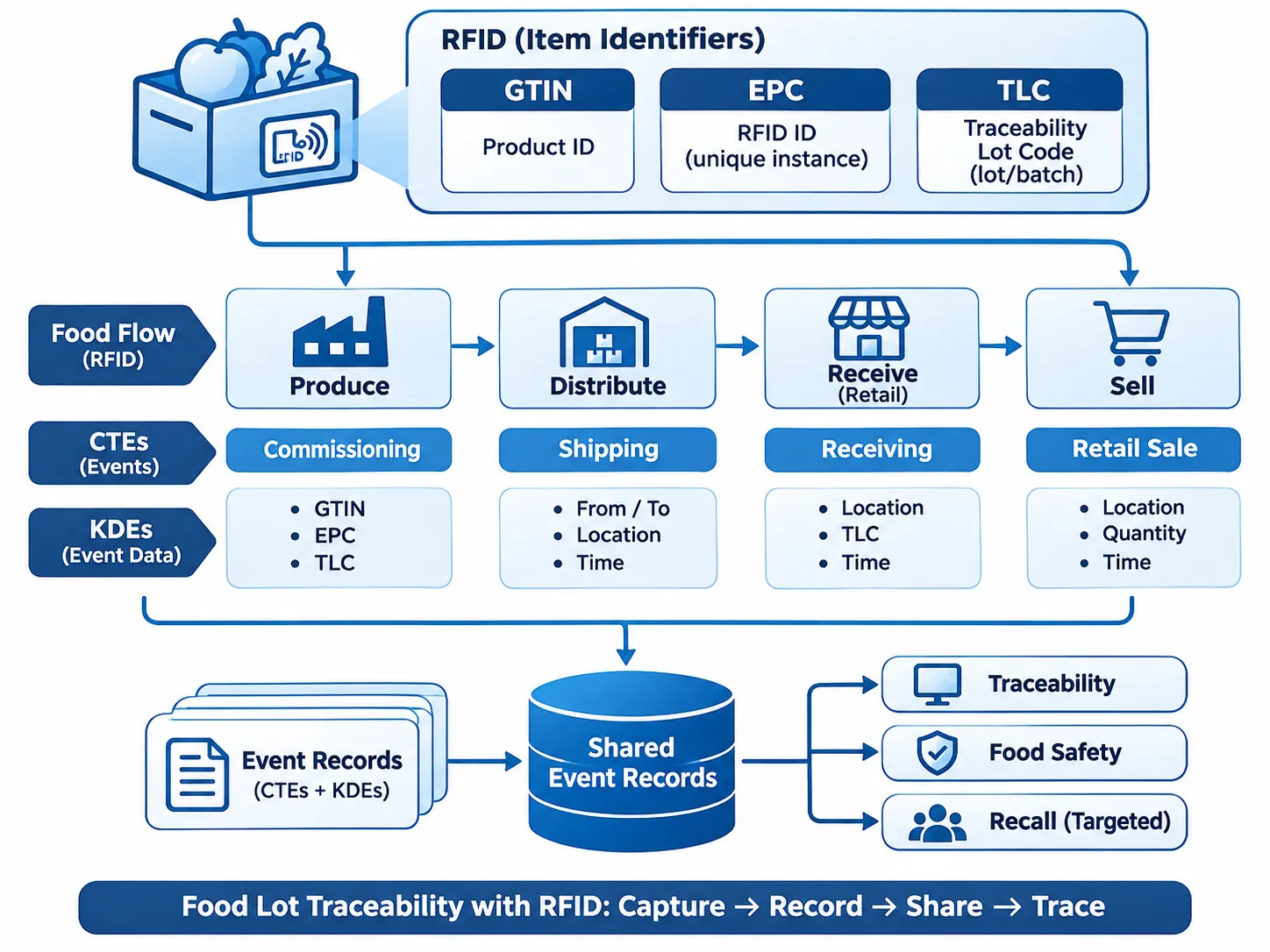
Effective traceability requires a clear distinction between physical-object identifiers and food-lot or event records. These concepts are related but are not interchangeable.
| Term | Meaning | Role in the system |
|---|---|---|
| GTIN | Global Trade Item Number | Identifies a trade item type or product configuration |
| EPC | Electronic Product Code | Identifies an RFID-tagged entity according to an assigned encoding scheme; a serialized EPC can distinguish specific instances |
| TID | Tag Identifier memory information | Identifies chip characteristics and, for some chips, a serialized identity; not a substitute for the food lot record |
| Batch or lot number | Business identifier for a batch of product | Groups food with shared production or processing history |
| TLC | Traceability Lot Code as defined in FDA's Food Traceability Rule | Connects required records for a traceability lot of a covered food |
| CTE | Critical Tracking Event | A type of event defined by the FDA rule, such as shipping, receiving or transformation, where applicable |
| KDE | Key Data Element | Information required to be kept in association with an applicable CTE |
| EPCIS | Electronic Product Code Information Services | A GS1 standard for capturing and exchanging visibility events across systems and partners |
Consider a hypothetical packing facility. It prepares a lot of fresh produce identified in its traceability system as LOT-2026-1105-A and assigns unique RFID identifiers to the finished shipping cases.
A case read at the packing line can be linked to its product identity and lot record. A later read at the outbound dock can be linked to a shipment. When the receiving partner captures the case identifier, the system can associate that event with the same product and lot relationship, provided the required data is accessible and consistent.
The RFID chip does not need to contain the complete food traceability history. Depending on the selected GS1 encoding scheme, chip capabilities and industry program, some attributes may be encoded on the tag, while other records remain in ERP, WMS or an event repository. A unique EPC and a lot code should not be assumed to be the same value.
GS1 EPCIS enables the sharing of visibility information, commonly described as the what, when, where, why and how of supply chain events. It is data-carrier neutral: information can originate from RAIN RFID, barcodes or other capture methods.
For example, software may convert a tag inventory result into a shipping or receiving event associated with a business location, timestamp, object identity and appropriate transaction context. EPCIS describes the structure for sharing visibility events; the reader itself does not automatically generate a complete traceability record.
See GS1's explanation of EPC and EPCIS and the GS1 US guidance on encoding foodservice attribute data.
Produce packhouses often manage short shelf lives, changing consignments and reusable handling equipment. RFID can support case or crate identification at sorting, packing and dispatch points. Records must still carry product origin, lot and related details relevant to the operation.
RFID can help identify shipping cartons, cold-room stock and reusable carriers in these supply chains. Tag performance should be tested against high-moisture products, foil-backed packaging, closely packed loads and the expected storage environment. Specific food-safety records must be maintained independently of the tag reads.
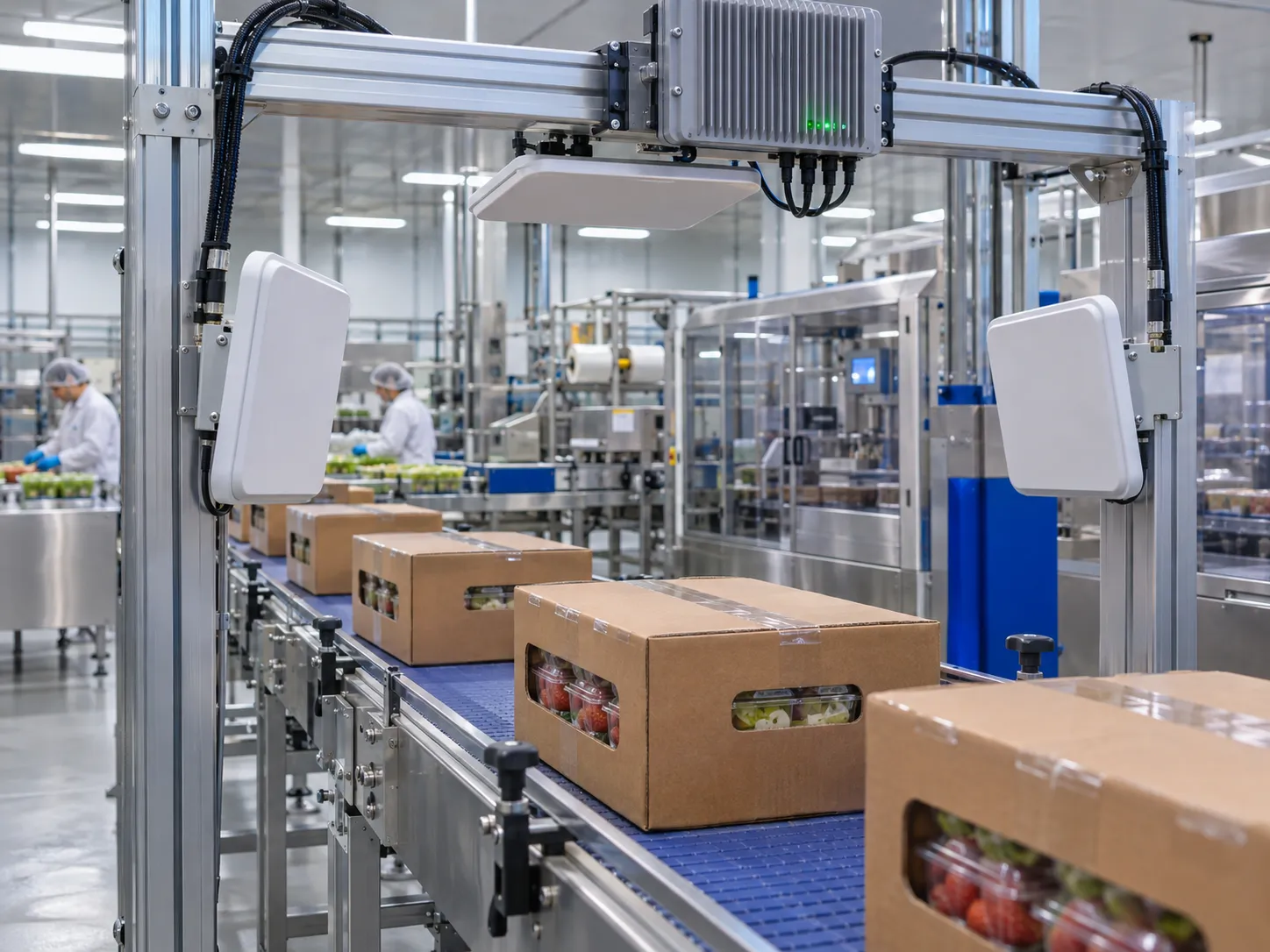
At an automated line, a fixed reader with suitable antennas can capture tagged cartons when they pass a trigger point. Software can then connect the reads to production-order and lot records, with rejection or exception logic controlled by the plant's automation and application systems.
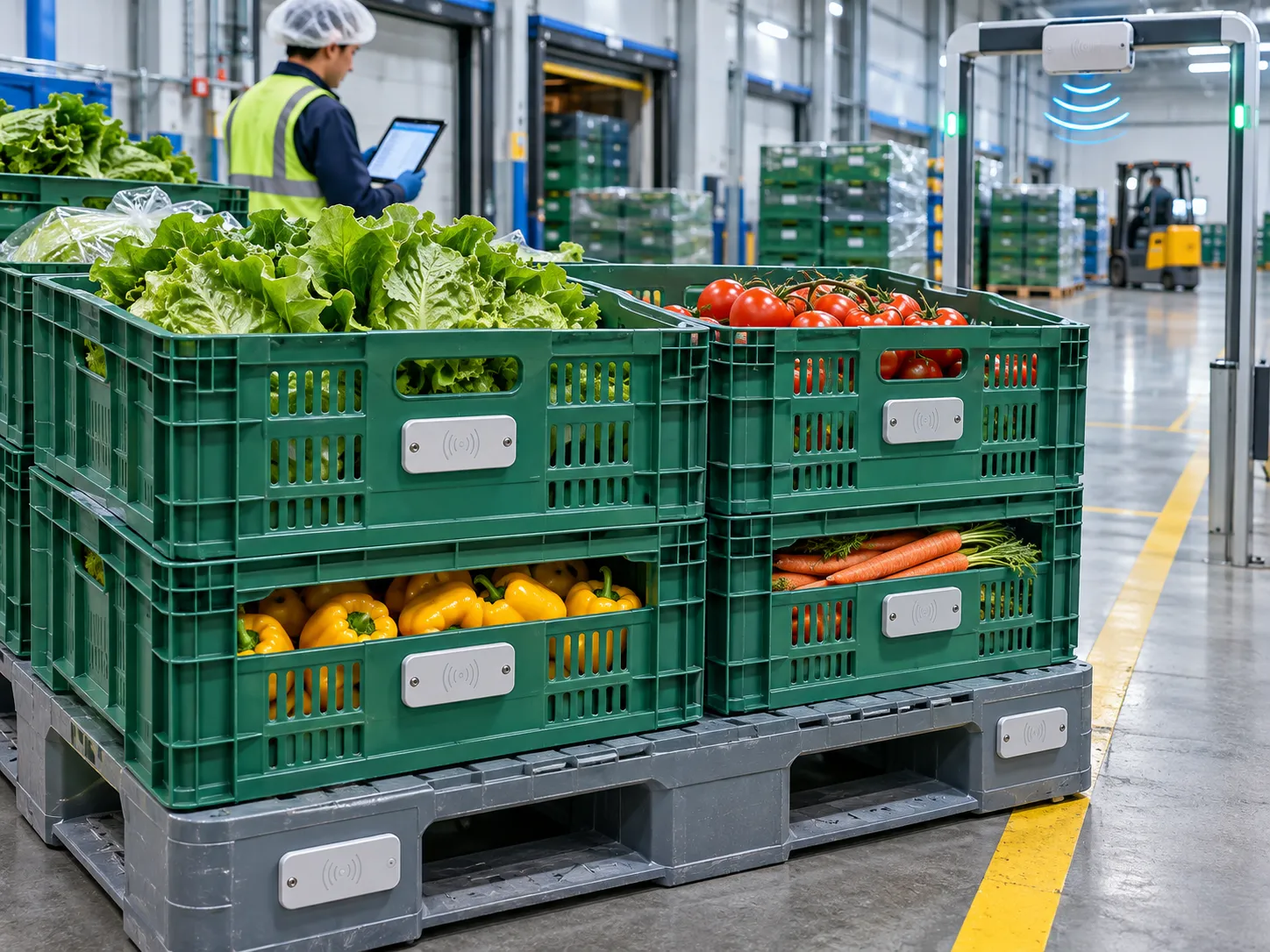
RFID-tagged trays, totes and crates can be recorded when issued and returned, helping a distributor identify overdue containers and analyze reuse cycles. This use case is operationally distinct from item-level traceability, but it can be linked to product-lot records when the contents of each shipment are known.
A published Avery Dennison case study about Reynolds Catering Supplies describes a UHF RFID system for returnable food delivery crates. Readers at entry and exit points recorded movements, and two same-encoded RFID labels per tray provided redundancy against damage during handling or washing. This is a third-party deployment, not a Syncotek customer case or a performance guarantee.
Cases can be identified at receiving, staging or shipping checkpoints and compared with expected orders. For an individual reader deployment, the result is a read event. Shipment acceptance, stock reconciliation and recalls depend on the integrated business system using that event correctly.
RFID is not a universal replacement for optical labels. Many food chains benefit from combining these methods.
| Consideration | Passive UHF RFID | Barcode or QR code |
|---|---|---|
| Line of sight | Generally not required within a valid RF read zone | Optical visibility is required |
| Multiple-object capture | Can identify multiple tags in a configured zone | Usually requires each visible code to be scanned or imaged |
| Wet or metal packaging | May require specialized tags and RF testing | Not subject to RF detuning, but code visibility and label quality matter |
| Visible information for staff | Usually requires companion printed information | Can be read by staff or conventional scanners |
| Data integration | Tag identities must map to lot and shipment records | Scanned codes must also map to the appropriate records |
| Typical deployment cost | Includes tags, readers, antennas, integration and pilot testing | Often lower for simple manual capture workflows |
For example, a distributor may use a barcode or QR code to identify individual produce cartons and a UHF RFID tag on the pallet or reusable container to automate dock-door tracking. The choice should reflect the actual volume, read process, data requirements and economics.
Water-rich goods, metal, foil and dense packaging can make RFID deployment more difficult. These effects depend on tag design, placement, orientation, antenna configuration and the specific goods being read.
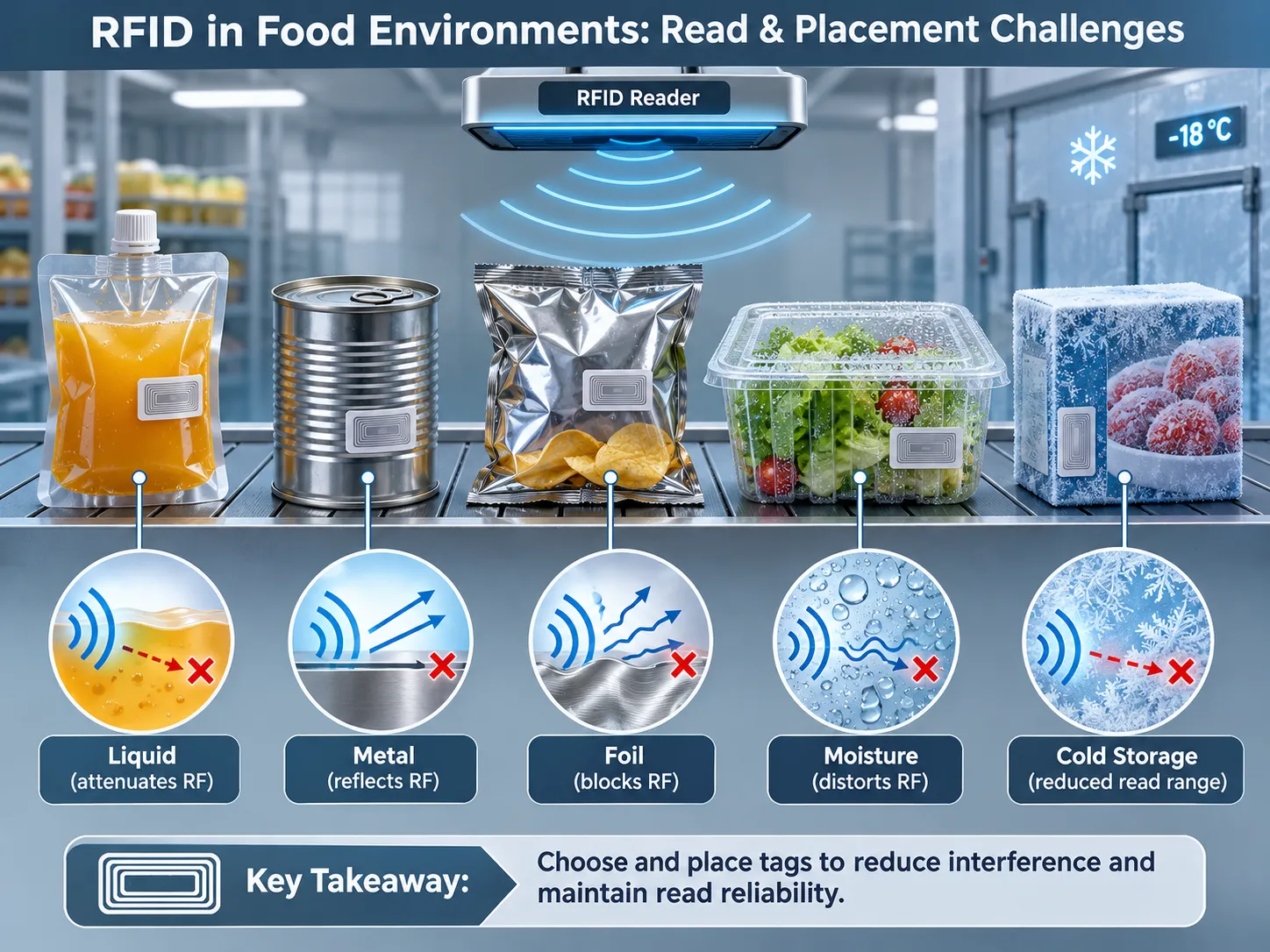
Water-rich products can absorb or detune UHF energy, especially when tags are positioned directly against the material. A carton that reads well when empty may perform differently when filled. Test with the actual product, fill level and orientation.
Metal can reflect or shield RF energy, while metalized films can alter tag performance. Tag designs and standoffs suited to the package may help, but they require site validation. Do not assume that a carton label will reliably identify every can or pouch inside.
Low-temperature environments introduce tag-material, adhesive, electronics and condensation considerations. Cold temperature alone does not establish a fixed reduction in RFID read range; the result depends on the entire installation. Verify both the tag's specified operating conditions and actual performance after exposure to the relevant cold and wet processes.
Many tagged cartons on a pallet can create a dense read environment. Antenna polarization, reader settings, tag orientation, RF reflections and nearby stock may affect which tags are identified. Control the read zone and use event filtering so a shipment is not accepted based on unrelated reads from the next lane.
A pilot should use the actual cartons, crates, wrapped pallets, shipping speeds and equipment layouts. Test intended reads as well as unwanted reads from adjacent locations. Record results for multiple tag orientations, pallet compositions and representative operating conditions rather than treating a laboratory read-range claim as a guaranteed onsite result.
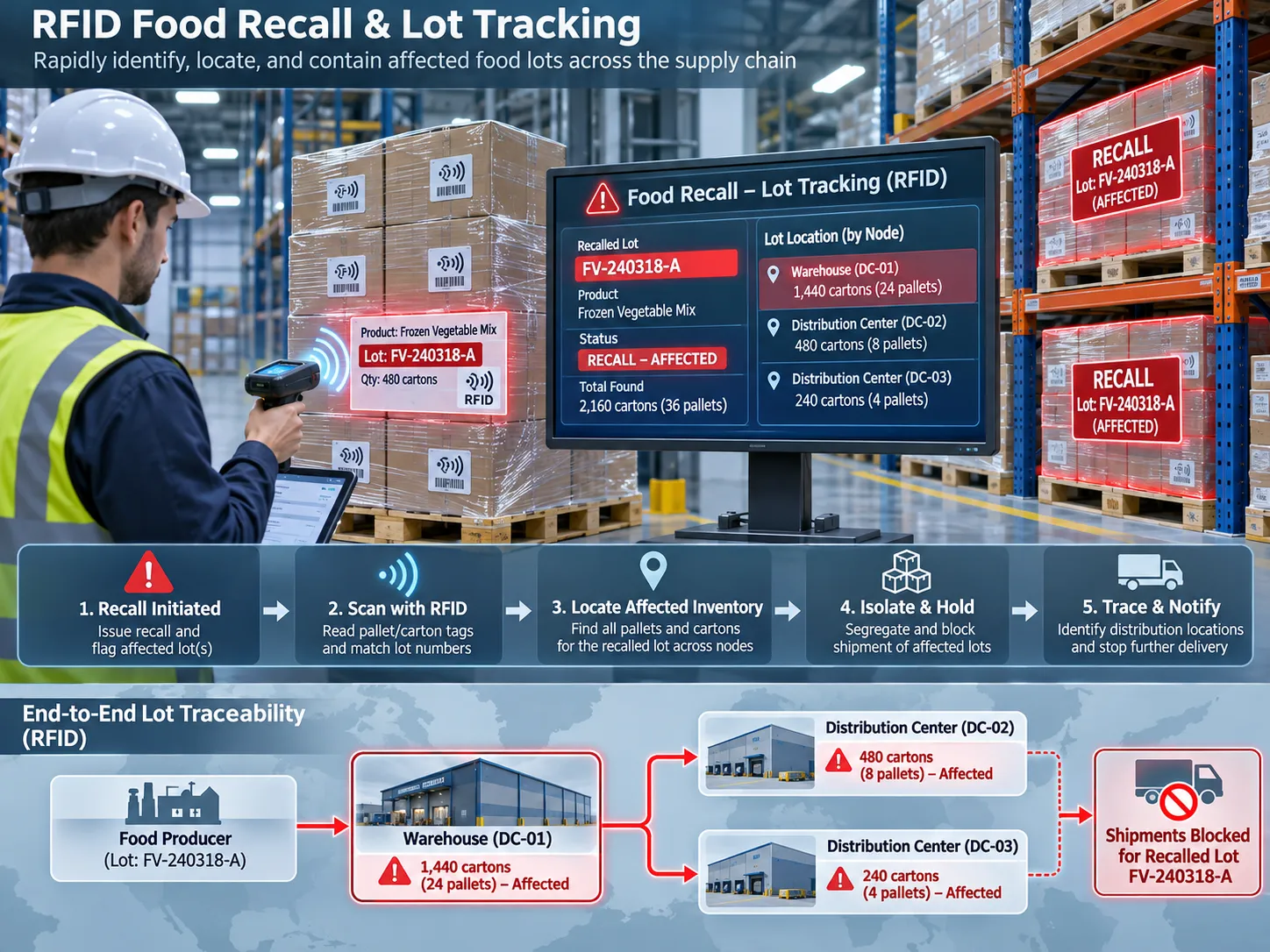
RFID can make a recall search faster to execute when tagged-object identities have been correctly linked to food lots and the supply chain's shipment and receiving records are accessible.
The following scenario is illustrative, not a real incident or a verified system-performance result.
LOT-2026-1105-A requires investigation or recall.A pallet tag can support this workflow only if its child-case or lot associations are accurate. A tag that identifies the pallet without a reliable contents record cannot establish which food lots are inside.
RFID events can also support stock rotation by helping staff identify tagged cases associated with expiry or best-before records. FIFO and FEFO decisions require correct product and date information in the inventory system. A passive tag read does not independently measure freshness or determine whether food is safe to consume.
The U.S. FDA's Food Traceability Rule under Section 204 of the Food Safety Modernization Act establishes additional recordkeeping requirements for persons who manufacture, process, pack or hold certain foods on the Food Traceability List (FTL), subject to the rule's scope and exemptions. It does not impose the same requirements on every food or every food business.
The rule centers on Key Data Elements (KDEs) associated with specified Critical Tracking Events (CTEs), including certain harvesting, cooling, initial packing, receiving, shipping and transformation events as applicable. It also uses a Traceability Lot Code (TLC) to connect records for the relevant lot. Not every activity triggers assignment of a new TLC; the FDA defines specific assignment points such as initial packing of certain raw agricultural commodities, first land-based receiving for relevant seafood, and transformation.
See the FDA Food Traceability Rule overview and the FDA's Traceability Lot Code guidance.
No. The FDA does not require a particular tracking technology. Records may be maintained in permissible paper or electronic formats as long as the applicable recordkeeping requirements are met. RFID, barcodes, QR codes, electronic databases and other methods may support a traceability program; none automatically establishes compliance.
Likewise, GS1 identifiers and EPCIS event data can support interoperable records, but the FDA does not require every company to use GS1 as its sole technology or data standard. The organization subject to the rule remains responsible for its required records and procedures. The FDA's Food Traceability Rule FAQ addresses both technology choice and data standards.
The original compliance date was January 20, 2026. The FDA proposed extending that date by 30 months to July 20, 2028. Subsequently, the Continuing Appropriations Act of 2026 directed the FDA not to enforce the rule before July 20, 2028, and the agency has said it intends to follow that directive. The proposal and the statutory non-enforcement instruction should not be confused with a final amendment to the compliance date.
The FDA announced a public meeting on November 6, 2026, focused on lot-level traceability implementation and potential flexibilities. In October 2026 it also issued draft enforcement-discretion guidance for certain smaller retail food establishments and restaurants; the guidance was still a draft, not a blanket exemption for all operators.
Businesses should consult the latest FDA information and relevant legal or compliance advisers when assessing how the rule applies to their foods and operations.
An appropriately designed RFID system can help capture object identities, event timestamps and checkpoint locations that support associated business records. It cannot supply missing production records, correct inaccurate lot assignments or replace a required traceability plan. The architecture should be designed from the applicable traceability events and data requirements backward to the appropriate read points.
Syncotek's UHF hardware portfolio can provide the identification and data-capture layer at food processing lines, logistics checkpoints and inventory operations. The correct device depends on the read zone and workflow rather than a single maximum-range figure.
| Food-industry workflow | Reader category to evaluate | Main design considerations |
|---|---|---|
| Packaging or conveyor checkpoint | Fixed UHF reader with external antennas | Triggering, antenna angle, metal structures, tag orientation, throughput |
| Dock-door pallet or crate reads | Fixed reader with multiple antennas | Zone boundary, nearby dock lanes, pallet density, site layout |
| Compact receiving doorway | Integrated UHF reader | Built-in antenna coverage, network and power interfaces |
| Cold-room or inventory audit | UHF handheld reader | Mobile workflow, gloves, environmental suitability, software integration |
| RFID labeling and commissioning | RFID printer encoder or desktop reader/writer | Media and inlay compatibility, EPC assignment, read-back verification |
| OEM packing or logistics machinery | Embedded UHF module | Host interface, antenna, power, SDK, enclosure and region configuration |
A multi-antenna fixed reader is useful when the system must cover a defined conveyor or pallet passage. Syncotek's SR-RU471B UHF Fixed Reader is based on an Impinj E710 platform and provides four external SMA antenna ports, along with several interface options described on its product page. It is a candidate for engineered read points, not a guarantee of a particular carton read rate.
Browse the UHF Fixed Reader range for other configurations.
A UHF RFID Handheld Reader can support staff-led searches of tagged food cartons or reusable crates at storage locations. The SR-RU666 handheld is one example of a configurable terminal with UHF RFID capabilities. Confirm environmental suitability, software functions and regional frequency configuration for the exact version.
An integrated UHF RFID reader combines the antenna and reader in a compact unit for suitable checkpoints. UHF RFID modules support OEM designers developing custom traceability stations, label machines and industrial readers. Neither hardware category replaces the inventory, lot-mapping or recall logic of the application.
The antenna pattern, polarization, mounting position and cable arrangement matter as much as reader power. Review Syncotek's UHF antenna categories and UHF tag range as starting points, then validate a specific model against the food packaging material, cleaning process, temperature exposure and site RF limits.
Some readers may support compatible sensor-enabled RFID tags, but ordinary passive UHF labels do not measure temperature. Never assume a sensor tag or sensor function is available for a particular hardware configuration without confirming the supported protocol and product specifications.
Decide whether the project identifies a retail unit, carton, pallet or reusable container. Map the required product identity, batch/lot code, source, transformation, quantity and shipment records. Determine which trade partners need the information and in what format.
Define the identifier-creation and encoding rules. A serialized case EPC, pallet reference and reusable crate ID must be linked to the correct records without confusing the physical carrier with the food lot. Establish procedures for reusing crates and rebuilding pallet aggregations.
Choose receiving, packing, staging, shipping and return points based on business events. Use reader triggers, mounting positions and software rules to control the effective read zone. Avoid buying readers solely to maximize detection range.
Test wet products, metalized packages, dense pallets and different tag positions under normal operating conditions. Include the actual conveyor speed, adjacent stock and facility materials. For cold or washdown environments, verify equipment protection and tag durability under the intended conditions.
Record the event identity, time, location and associated business process. Ensure read events are matched to the correct products, lots, shipments and counterparties. Reconcile errors and make exception-handling responsibilities clear to operators.
| Pilot indicator | What to verify |
|---|---|
| Correct object identification | Expected tags are correctly detected in the intended read zone |
| Unwanted reads | Nearby stock is not incorrectly assigned to the event |
| Lot association integrity | Each physical identifier is linked to the correct current product/lot record |
| Event accuracy | Receipts, shipments and transfers are assigned to the correct location and time |
| Integration reliability | Events reach the correct WMS/ERP record; duplicates and outages are handled |
| Tag durability | Tags remain attached and readable during expected handling, cold exposure or washing |
| Operational time and cost | Measure changes against the existing workflow without assuming a universal ROI |
The project team should agree on test sample sizes, acceptance thresholds and recovery procedures in advance. A successful reader demonstration is not the same as a validated end-to-end traceability program.
RFID automates the identification of tagged cases, pallets or containers at selected points. When those identifiers are accurately linked to food-lot and shipment records, the resulting events can support searches, reconciliation and recall investigation. RFID alone does not create or validate all required traceability data.
It can contribute to end-to-end visibility when participating organizations capture and share consistent identifiers and business events. The system still depends on correct source, processing, lot, shipment and receipt records, and some partners may use barcodes or QR codes rather than RFID.
No. The FDA's Food Traceability Rule is technology neutral and applies only to foods and activities within its stated scope, subject to exemptions. Covered organizations must maintain the required traceability records, but RFID is not mandated.
No. A conventional passive identification tag reports an identifier, not a temperature history. Temperature monitoring requires a compatible sensor-enabled tag, data logger or separate sensor system, plus the software needed to associate measurements with the correct load.
Yes, when the selected tag is suitable for the crate surface, mounting and handling requirements. If crates are washed repeatedly, validate adhesion, durability and readability after realistic cleaning cycles. Update each crate's product and lot association whenever its contents change.
Performance depends on the specific tag, product, package and reader installation. Liquids can attenuate UHF energy, and metals may reflect or shield it. Test on the actual filled packaging rather than relying on a general read-range claim.
Only if the pallet's contents have been correctly identified and the aggregation record is kept current. The pallet tag identifies the pallet or logistics unit; it does not independently prove which cartons and lots are present.
Neither method is always better. RFID can support non-line-of-sight and multi-tag identification at controlled checkpoints, while barcodes and QR codes remain economical and useful for visible item or carton labeling. Hybrid systems can combine the strengths of both.
Provide the tagged object, packaging materials, tag count per read cycle, required read distance, conveyor speed, available installation space, regional frequency, environmental conditions, current ERP/WMS interface, and expected project volume. These inputs help define a realistic pilot configuration.
A reliable food traceability system starts with the business records and the objects being tracked. Tags, readers and antennas capture identities; ERP, WMS and traceability applications connect those identities to food lots, movements and recall workflows. The right solution balances read-zone reliability, tag durability, data quality and total project cost.
Syncotek offers UHF RFID readers, modules, antennas and tags for integrators and OEM equipment developers. For a food manufacturing or logistics project, share your application details through Syncotek's contact page so the hardware can be evaluated against the actual workflow.
Useful details for a technical discussion include the type of food and packaging, carton and pallet dimensions, tags per shipment unit, reader locations, conveyor or forklift speed, temperature and washdown exposure, frequency region, required interfaces, ERP/WMS software, pilot quantity and target deployment scale.
 Knowledge
An oilfield equipment yard may contain thousands of valuable assets: drilling pipes, industrial valves, pumps, generators, heavy tools, pressure-control equipment, and reusable assemblies. These assets move between storage areas, inspection stations, maintenance facilities, drilling sites, and rental customers. Yet equipment availability is not always easy to determine. A yard supervisor may need to answer several […]
READ MORE Knowledge
Manufacturing operations depend on accuracy, timing, and visibility. Materials, tools, fixtures, machines, work orders, semi-finished goods, and finished products move through many production stages every day. When these movements are recorded manually, manufacturers often face delayed updates, inventory errors, missing tools, unclear production status, and limited visibility across the shop floor. RFID technology helps manufacturers […]
READ MORE Knowledge
Accurate cattle identification is essential for modern livestock management. Farms, ranches, feedlots, dairy operations, veterinary teams, and livestock markets all need reliable ways to identify individual animals, record movement, manage health data, and support traceability from farm to market. Traditional visual ear tags are simple and widely used, but they rely on manual reading. Workers […]
READ MORE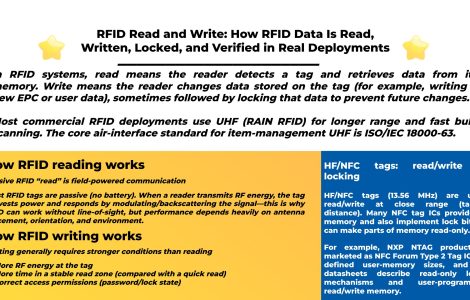 Knowledge
In RFID systems, read means the reader detects a tag and retrieves data from its memory. Write means the reader changes data stored on the tag (for example, writing a new EPC or user data), sometimes followed by locking that data to prevent future changes. Most commercial RFID deployments use UHF (RAIN RFID) for longer range and fast bulk scanning. The core air-interface […]
READ MORE Knowledge
RFID can make warehouse inventory counting faster, automate selected receiving and shipping checkpoints, and reduce repetitive manual scanning. But does that mean every warehouse should replace barcodes with RFID? Not necessarily. Radio Frequency Identification (RFID) offers significant operational advantages, particularly in warehouses with frequent inventory movements, large item populations, and demanding verification processes. However, these […]
READ MOREIf you are interested in our services or need customized solutions, please feel free to contact us.