

An oilfield equipment yard may contain thousands of valuable assets: drilling pipes, industrial valves, pumps, generators, heavy tools, pressure-control equipment, and reusable assemblies.
These assets move between storage areas, inspection stations, maintenance facilities, drilling sites, and rental customers.
Yet equipment availability is not always easy to determine.
A yard supervisor may need to answer several questions:
Traditional asset management often relies on handwritten records, spreadsheets, visible asset numbers, barcode scanning, and manual inspections.
These methods can become inefficient when assets are numerous, physically large, exposed to harsh environments, or repeatedly transferred between locations.
RFID yard management provides a way to connect physical equipment identification with digital asset records and movement history.
By combining industrial RFID tags, handheld readers, fixed read points, and asset management software, oil and gas operators can improve the visibility of equipment entering, leaving, and moving through an equipment yard.
However, successful deployment requires more than attaching an RFID label to a pipe.
The tag must work reliably on metal, withstand the operating environment, remain securely attached, and produce useful identification events at the right locations.
This guide explains how RFID yard management works, which equipment can be tracked, how to design a reliable system, and what to consider when selecting RFID hardware for oil and gas operations.
RFID yard management is the use of Radio Frequency Identification technology to identify, inventory, and record the movement of equipment stored or handled in an industrial yard.
In the oil and gas sector, this commonly involves an equipment yard or laydown yard where assets are received, inspected, stored, prepared for deployment, dispatched, returned, or sent for maintenance.
Typical assets include:
Each tagged asset is associated with a digital asset record.
When an RFID reader detects the tag, the system can record information such as:
Asset ID + Read Point + Timestamp + Business Event
For example:
Asset: Valve VLV-1048
Event: Arrived at Receiving Gate
Location: Gate A
Status: Awaiting Inspection
The asset management system can then associate that event with inspection records, equipment availability, ownership, and movement history.
The objective is not simply to collect RFID tag numbers.
It is to make equipment information easier to access and maintain throughout the asset lifecycle.
Oilfield equipment yards present challenges that are different from conventional retail warehouses.
Pipes, valves, drilling tools, and mechanical equipment are frequently made from steel or other conductive materials.
These assets may be:
Normal RFID labels may not perform reliably when attached directly to metal.
A single asset may travel through:
Receiving → Inspection → Storage → Dispatch → Job Site → Return → Maintenance
Each transition creates another opportunity for records to become outdated.
Engraved serial numbers and printed labels may be:
Workers may spend considerable time locating and confirming individual assets.
For some equipment, physical availability alone is not sufficient.
A valve may be present in the yard but unavailable for deployment because it requires inspection.
A pressure-control assembly may be awaiting maintenance or certification review.
An effective system must distinguish:
Physically Present
from:
Approved for Use
Equipment can move before spreadsheets or enterprise systems are updated.
This creates discrepancies between the physical yard and the recorded inventory.
RFID can reduce some of these manual identification steps, provided the read events are correctly integrated with business software.
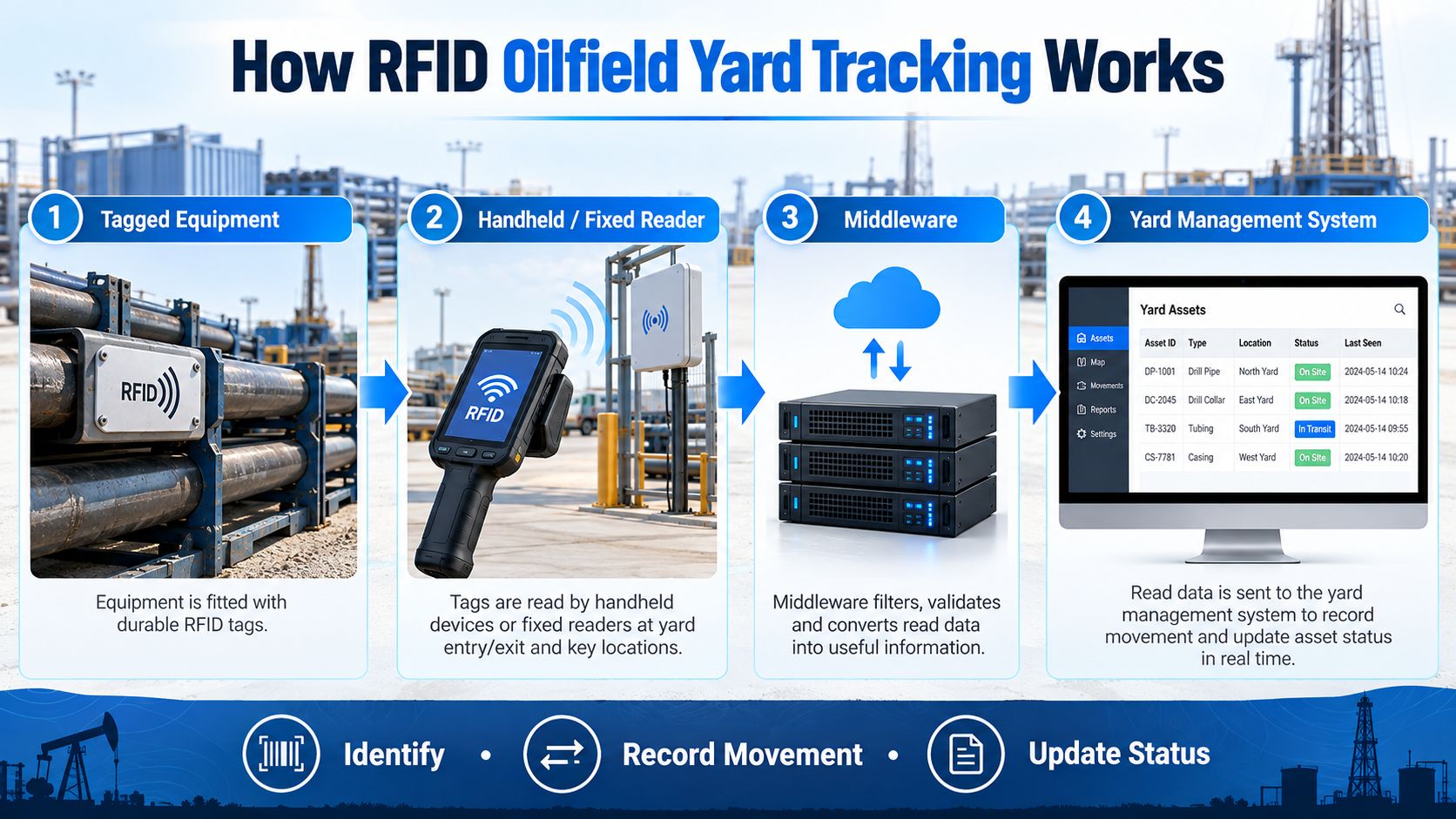
A typical passive UHF RFID yard-management system contains four layers.
Each selected asset receives an RFID tag suitable for its material, dimensions, and working conditions.
The tag contains an electronic identifier that can be associated with an asset record.
For example:
EPC: Unique RFID Identifier
Asset Record:
The RFID tag normally does not need to store the entire equipment history.
An RFID reader identifies tags within its effective reading zone.
Two common approaches are:
Handheld RFID
Used by operators for inventory, searching, inspection identification, and exception handling.
Fixed RFID
Installed at selected gates, entrances, and transfer points to automate equipment identification.
RFID readers generate raw identification observations.
Middleware can process these observations by:
For example:
Raw Read
EPC 3008... detected at Reader 04
becomes:
Business Event
Asset VLV-1048 detected at Dispatch Gate D
The enterprise application maintains equipment records, which may include:
The resulting workflow is:
Identify → Record Movement → Update Status
RFID provides the physical identification layer. Yard management software provides the business logic.
RFID can support many equipment categories, but the correct tagging method varies significantly.
| Equipment Type | Typical Tracking Requirement | RFID Considerations |
|---|---|---|
| Steel pipes and tubulars | Inventory, movement, identification | Curved metal surfaces, stacking, mechanical protection |
| Industrial valves | Asset identification, inspection, maintenance | Metal mounting, vibration, oil exposure |
| Pumps and generators | Location and service history | Outdoor exposure, mounting security |
| Oilfield tools | Issue, return, inventory | Compact tags, impact resistance |
| Equipment skids | Movement and asset assignment | Fixed mounting area, durable housing |
| Metal containers | Receiving, dispatch, return | On-metal tags, gate detection |
| Rental equipment | Check-out, return, utilization | Asset association and transaction history |
| Drilling assemblies | Identification and traceability | Application-specific mechanical engineering |
Not all of these applications require the same RFID tag.
A large generator may provide sufficient space for a rugged hard tag.
A small metal tool may require a compact PCB tag.
Drill-pipe identification can involve substantially more demanding engineering than ordinary surface-mounted yard asset tagging.
Standard industrial on-metal RFID tags should not automatically be considered suitable for downhole drilling environments.
Specialized embedded solutions may be required for high-pressure, high-temperature, or mechanically demanding applications.
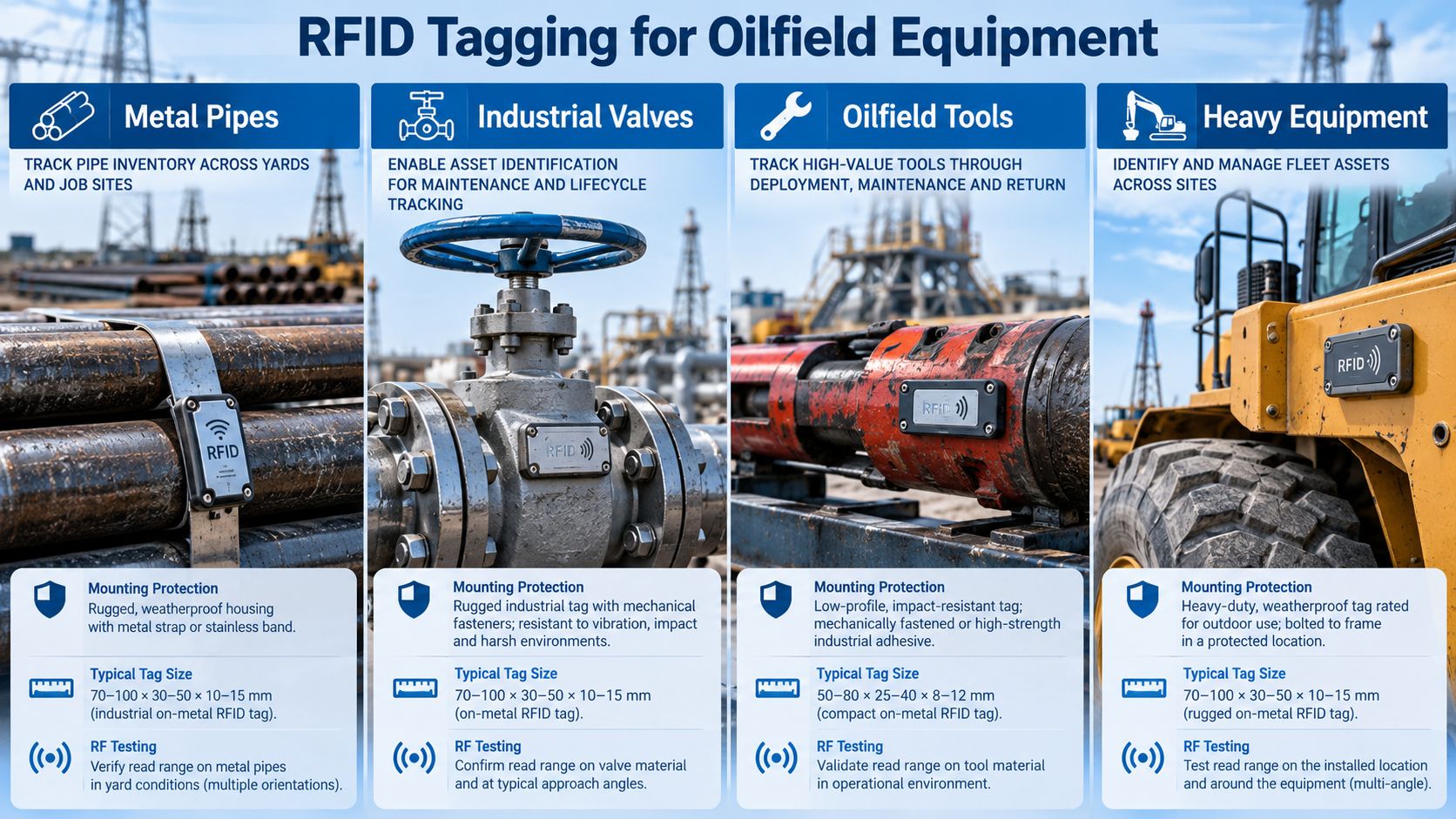
The RFID tag is one of the most important components in an oilfield yard project.
Most oil and gas equipment contains substantial amounts of metal.
Metal can alter an RFID antenna's electrical characteristics, significantly reducing the performance of conventional UHF labels.
For this reason, dedicated on-metal UHF RFID tags are often the appropriate starting point.
Steel pipes create several challenges.
The pipe surface is curved, equipment may be stacked tightly, and the tag can be exposed to impact during handling.
Potential installation approaches include:
The selected method must not compromise the pipe's mechanical integrity or interfere with its intended use.
For example, any attachment involving drilling, welding, or modification of a pressure-containing or safety-critical component requires approval under the applicable engineering procedures.
RFID performance must also be tested when pipes are stacked in realistic configurations.
Industrial valves often provide a comparatively accessible external surface for identification.
Possible mounting locations include approved brackets, noncritical external surfaces, or protected mounting points.
Important considerations include:
A tag attached to a flat test plate may not behave identically on a complex valve body.
Tools may have limited mounting space.
The tag should not interfere with:
Compact on-metal RFID tags can be evaluated where sufficient mounting space exists.
For tools exposed to heavy impact or abrasion, protecting the tag may be more important than maximizing read distance.
Generators, pumps, compressors, and equipment skids may allow larger industrial RFID tags.
These installations should prioritize:
For product selection, see Syncotek Mount-on-Metal UHF RFID Tags.
A successful tag should meet three requirements:
RF Performance + Mechanical Durability + Environmental Suitability
The tag must be designed to operate on conductive surfaces.
Different tag constructions may use specialized antennas, dielectric layers, PCB structures, ceramic materials, or protective housings.
Outdoor equipment may encounter:
Relevant properties may include IP protection rating, material resistance, temperature range, and chemical compatibility.
An IP67 or IP68 rating is useful information, but an IP rating alone does not establish chemical resistance, mechanical durability, or hazardous-area suitability.
An RFID tag is only useful while it remains attached to the asset.
Mounting methods may include:
The correct method depends on the asset and its operating conditions.
Published read distance should be treated as a reference test result.
Actual performance depends on:
Always validate the selected tag on the real equipment.
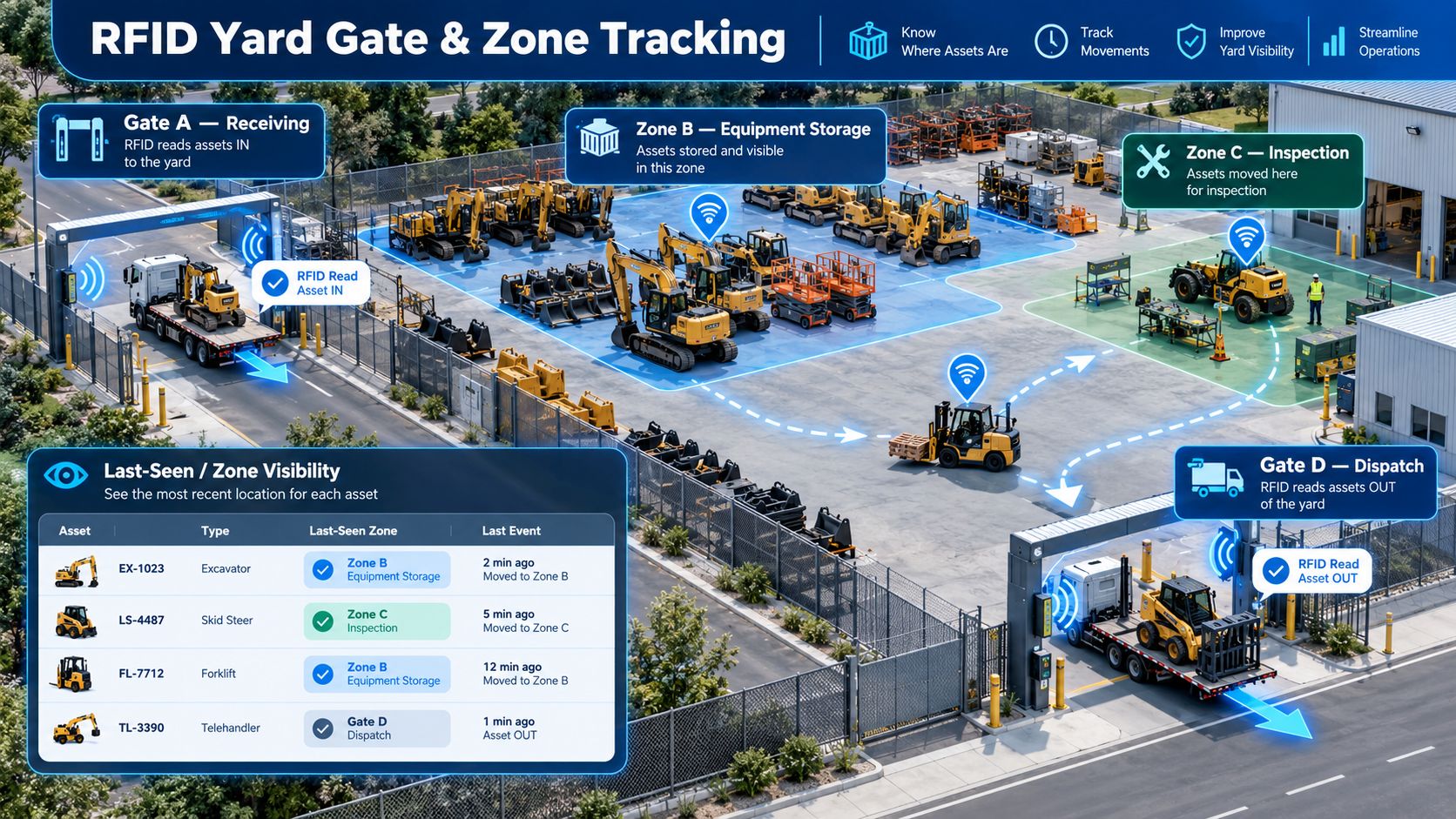
One of the most practical RFID yard-management architectures combines fixed gate readers with logical yard zones.
For example, a facility may define:
Gate A — Receiving
Zone B — Equipment Storage
Zone C — Inspection
Gate D — Dispatch
RFID identification events can help update the recorded movement of tagged assets through these locations.
When equipment arrives, the receiving process may capture:
The system can compare the observed asset against expected inbound records.
If an unexpected RFID identity is detected, the operator can investigate before completing the receiving transaction.
Equipment may be assigned to a logical storage zone.
A handheld reader can support periodic inventory within that zone.
A fixed reader may also record movement through selected transitions.
However, the system should distinguish between:
Assigned Storage Location
and:
Most Recent Confirmed RFID Observation
Those values may not always be identical.
Equipment entering an inspection area can be identified through RFID.
The system can associate the asset with:
The actual inspection result is still recorded through the responsible inspection workflow.
A fixed RFID checkpoint can identify tagged assets passing through the outgoing gate.
Middleware can compare the detected identifiers with the expected dispatch list.
For example:
Expected Equipment:
Valve VLV-1048
Pump PMP-2032
Tool Assembly TLS-4051
Detected Equipment:
VLV-1048
PMP-2032
The missing item can be flagged for investigation before the shipment is confirmed.
A single RFID antenna detecting a tag does not necessarily prove whether equipment is entering or leaving.
Direction may require additional context from:
A reliable gate system should validate the actual direction-detection workflow during pilot testing.
This distinction is particularly important.
A passive UHF RFID tag normally does not transmit continuous GPS coordinates.
A fixed gate reader can establish:
Last detected at Gate D
A handheld inventory can establish:
Detected during inventory in Zone B
A suitably designed controlled read area may support ongoing presence visibility.
But none of these automatically provides continuously updated precise coordinates across a large outdoor yard.
For many oilfield equipment operations, checkpoint and zone visibility may already solve the business problem.
If continuous positioning is required, other location technologies or a more specialized infrastructure should be evaluated.
For more detail, see Can RFID Provide Real-Time Location?.
Oilfield equipment is frequently transferred between:
A structured RFID workflow can help associate these transfers with digital records.
A typical process may include:
The system can then maintain the equipment's recorded assignment.
When equipment returns:
RFID helps reduce repetitive identity entry.
It does not replace the authorization, inspection, or financial controls used by rental and equipment-management businesses.
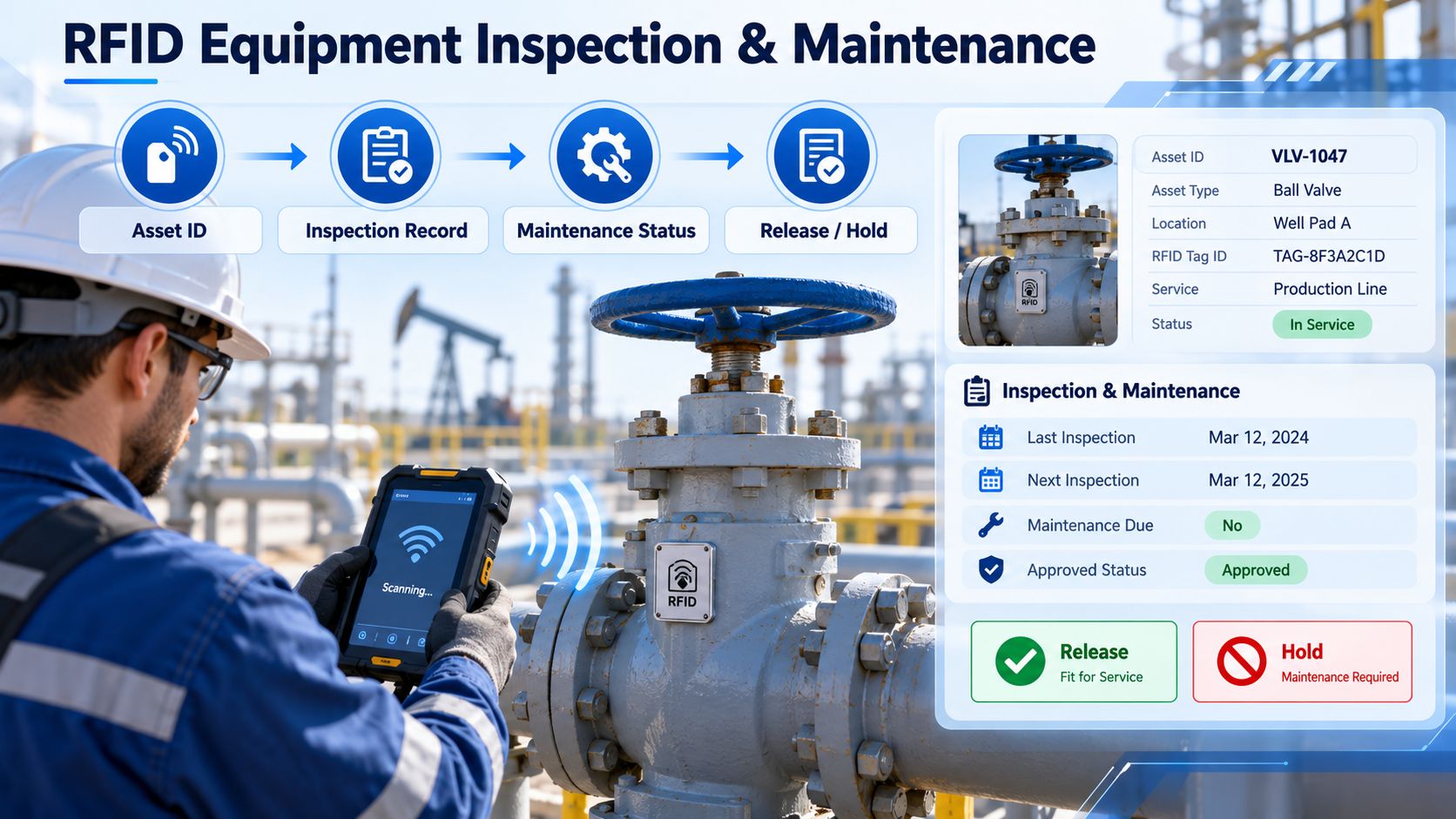
In oil and gas operations, an asset's inspection and maintenance status can be as important as its physical location.
For example, two valves may look identical.
One may have completed its required inspection.
The other may be awaiting maintenance or a certification review.
An RFID scan can retrieve the correct asset record and help prevent confusion between similar equipment.
A typical workflow is:
RFID Asset ID
→ Inspection Record
→ Maintenance Status
→ Release / Hold Decision
The RFID identifier is linked to the corresponding equipment record.
That record may contain:
The inspection system may store:
RFID makes it easier to retrieve the correct record, but the inspection must still be carried out by the appropriate personnel.
Maintenance information may include:
After the relevant inspection and maintenance requirements have been satisfied, authorized personnel may update the equipment's operational status.
Possible statuses include:
Available
Awaiting Inspection
Under Maintenance
On Hold
Approved for Deployment
Out of Service
Important: Reading an RFID tag does not verify that equipment is safe or certified. An RFID identification event must not be treated as a substitute for physical inspection, valid documentation, or authorized approval.
Once asset movements are recorded consistently, the system can support operational analysis.
Useful metrics may include:
How long has an asset remained in a particular storage or inspection area?
How long does it take between equipment return and availability for another deployment?
How many tagged assets were recorded through relevant checkpoints during a defined period?
How much time is an asset assigned to jobs compared with time available in the yard?
Utilization calculations require reliable business records. RFID observations alone do not prove whether equipment is actively being used.
How long do employees spend locating specific assets before and after the RFID project?
These measurements can help identify process bottlenecks and support investment decisions.
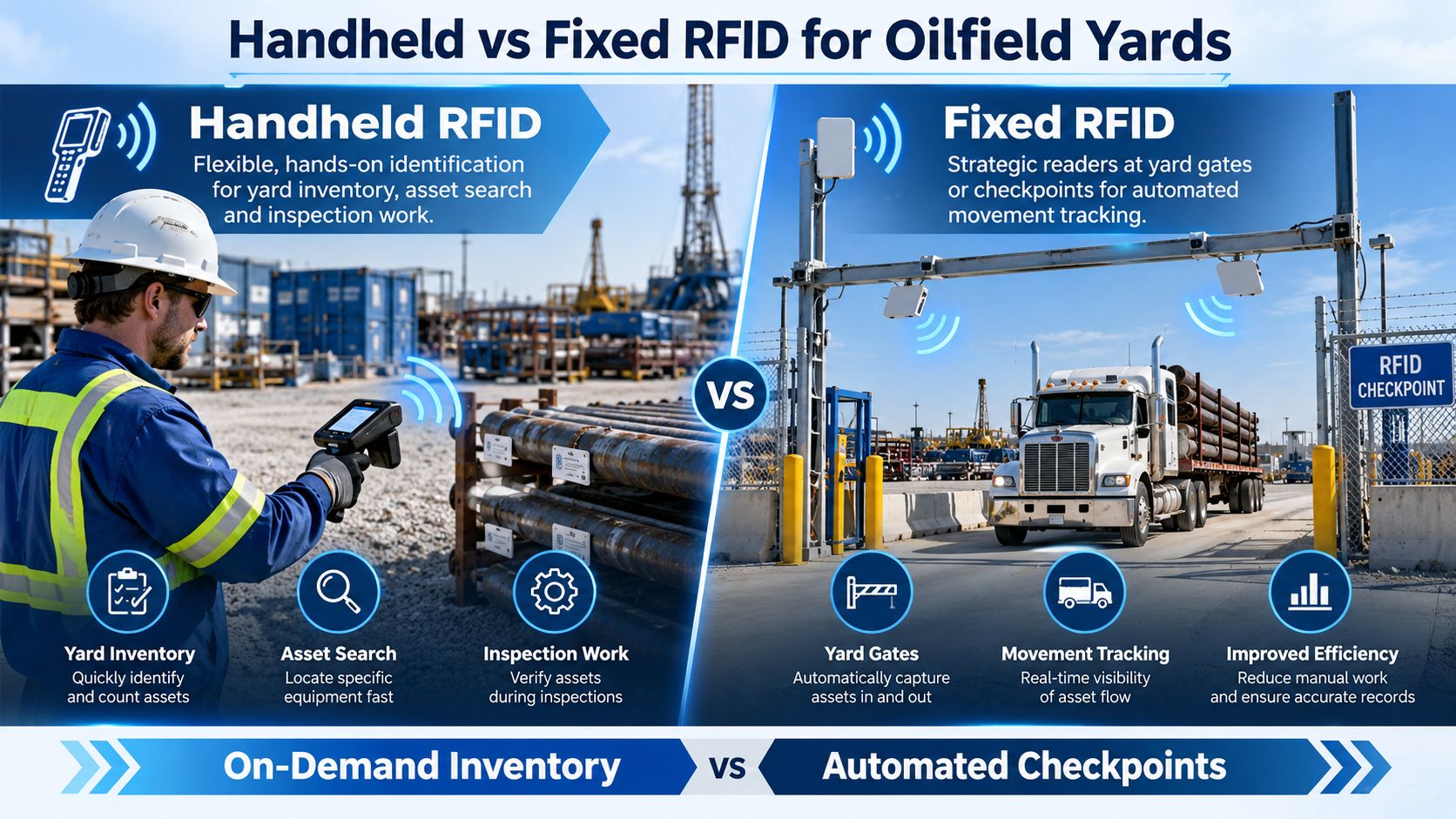
Oilfield RFID projects often benefit from combining mobile and fixed identification.
The two reader types perform different functions.
A handheld UHF reader is useful when workers need to move throughout the equipment yard.
Typical applications include:
For example, an employee may search for a particular tagged valve among several equipment rows.
The handheld reader can assist with identification and proximity-based searching.
A handheld inventory also provides a practical way to begin RFID adoption without installing a large fixed-reader network.
Fixed readers are installed at selected locations such as:
These systems can automatically detect compatible tags entering the designed read zone.
A fixed system may require:
| Requirement | Handheld RFID | Fixed RFID |
|---|---|---|
| Equipment inventory | Strong | Depends on coverage |
| Asset searching | Strong | Limited to installed read points |
| Automatic gate events | Limited | Strong |
| Inspection identification | Strong | Possible |
| Mobile yard operations | Strong | Fixed infrastructure |
| Continuous checkpoint operation | Not the primary purpose | Strong |
| Permanent installation | Not required | Required |
| Initial infrastructure | Usually lower | Usually higher |
A common practical starting point is:
Handheld RFID
for on-demand inventory and identification.
Plus:
Fixed RFID
at high-value entrance and exit checkpoints.
This provides a balance between deployment flexibility and automation.
Outdoor industrial environments require additional planning.
Tag enclosures, reader installations, cable connectors, and mounting methods must be suitable for the expected weather.
Contamination may affect visible identification and the mechanical attachment of tags.
Chemical compatibility should be assessed from the actual substances and exposure conditions.
Pipes and heavy equipment may collide during lifting and handling.
Tags should be positioned to avoid direct impact whenever practical.
Both operating and storage temperatures must be checked against the relevant component specifications.
A brief temperature shock test does not automatically establish suitability for continuous operation at that temperature.
Large metallic equipment can reflect UHF signals and change antenna coverage.
This may cause:
Longer reading distances are not always desirable.
For example, a gate reader should detect equipment passing through its intended gate rather than reading parked assets elsewhere in the yard.
The objective is:
Reliable identification at the required location.
Not simply maximum RF range.
For additional guidance, see RFID Interference Troubleshooting.
RFID equipment selection in oil and gas environments must consider potential explosive atmospheres.
Some oilfield, petroleum, gas-processing, and maintenance areas may be classified as hazardous because flammable gases, vapors, or combustible dust could be present.
The applicable requirements depend on the country and site.
Examples of relevant classification and protection frameworks include:
Not necessarily.
Hazardous-area requirements depend on the facility's actual documented area classification.
Some equipment yards may contain designated non-hazardous areas.
Other locations may require specially approved electrical and electronic equipment.
The appropriate classification must be determined by qualified personnel.
A standard industrial RFID reader must not be assumed suitable for a classified hazardous area.
Before selecting hardware, confirm:
This applies to handheld devices and fixed installations according to the relevant requirements.
An IP67 or IP68 enclosure rating is not equivalent to ATEX or IECEx approval.
Likewise, ordinary industrial compliance markings should not be treated as proof of suitability for explosive atmospheres.
For example, the US OSHA hazardous-location requirements specify that electrical equipment and wiring in classified locations must be appropriate for the identified hazards.
Reference: OSHA 29 CFR 1910.307 — Hazardous (Classified) Locations.
Before deployment, obtain the relevant certification and installation documentation for the exact hardware configuration.
Syncotek's standard handheld and fixed-reader products should not be represented as certified for hazardous-area use unless appropriate product-specific approval has been confirmed.
Barcode and RFID can both support industrial asset identification.
Neither technology is universally better.
| Factor | Barcode / QR Code | Passive UHF RFID |
|---|---|---|
| Optical visibility | Required | Usually not required |
| Individual identification | Strong | Strong |
| Bulk inventory | Individual scanning common | Multiple-tag reading possible |
| Manual operation | Usually required | Can be automated |
| Outdoor readability | Depends on label condition | Depends on RF and tag durability |
| Metal compatibility | No RF detuning issue | Requires suitable tags |
| Equipment cost | Generally lower | Generally higher |
| Automatic gate reading | Requires suitable optical setup | Strong candidate |
| Tag maintenance | Visual label durability matters | Mechanical and RF durability matter |
Barcode may be appropriate when:
RFID becomes more valuable when:
Some projects may use a combined:
RFID + Printed Serial / Barcode
labeling strategy.
This provides electronic identification while retaining a visible fallback identification method where the equipment and tag construction permit it.
RFID is most useful when the physical identification layer connects to the systems already used by the business.
Typical integration targets include:
ERP — Enterprise Resource Planning
Supports business processes such as purchasing, asset ownership, inventory, and financial transactions.
CMMS — Computerized Maintenance Management System
Supports inspection schedules, maintenance work orders, and service records.
EAM — Enterprise Asset Management
Supports equipment lifecycle information, asset status, and operational history.
Yard Management Software
Supports physical movement, storage zones, receiving, dispatch, and equipment availability.
RFID Tag
→ Unique Electronic Identity
RFID Reader
→ Identification Observation
Middleware
→ Filtering / Location Mapping / Event Processing
Asset Management Platform
→ Equipment Record / Location / Status / Maintenance
For most standard asset-identification projects, the RFID tag does not need to contain:
A common architecture is:
Unique RFID ID → Backend Asset Record
This makes it easier to update and control operational information.
Specialized applications may require additional on-tag memory, but that should be determined from the actual workflow.
A focused pilot is usually more useful than attempting to tag every asset immediately.
A practical pilot could include:
Choose a measurable problem.
Examples:
Use real equipment rather than generic test objects.
Include different:
Compare suitable on-metal tag constructions.
Confirm:
Decide where RFID identification creates a useful business event.
Measure the intended read zone.
Include realistic equipment arrangements and movement.
Confirm that the system correctly maps:
Tag → Asset → Location → Business Event
Include:
Compare the pilot against the original process.
Expand only after the hardware and business workflow produce repeatable results.
Useful measurements include:
| KPI | What to Measure |
|---|---|
| Asset identification rate | Percentage of expected identities captured |
| Inventory time | Time required to complete equivalent yard inventory |
| Gate event capture | Expected movements correctly recorded |
| Stray-read rate | Unintended reads outside the defined business event |
| Asset search time | Time required to find selected equipment |
| Data accuracy | Correct mapping between asset and RFID identity |
| Tag retention | Tags remaining securely attached after handling |
| Event latency | Time between detection and valid system update |
| Maintenance workflow | Correct retrieval of inspection and work-order records |
No fixed improvement percentage should be assumed before testing.
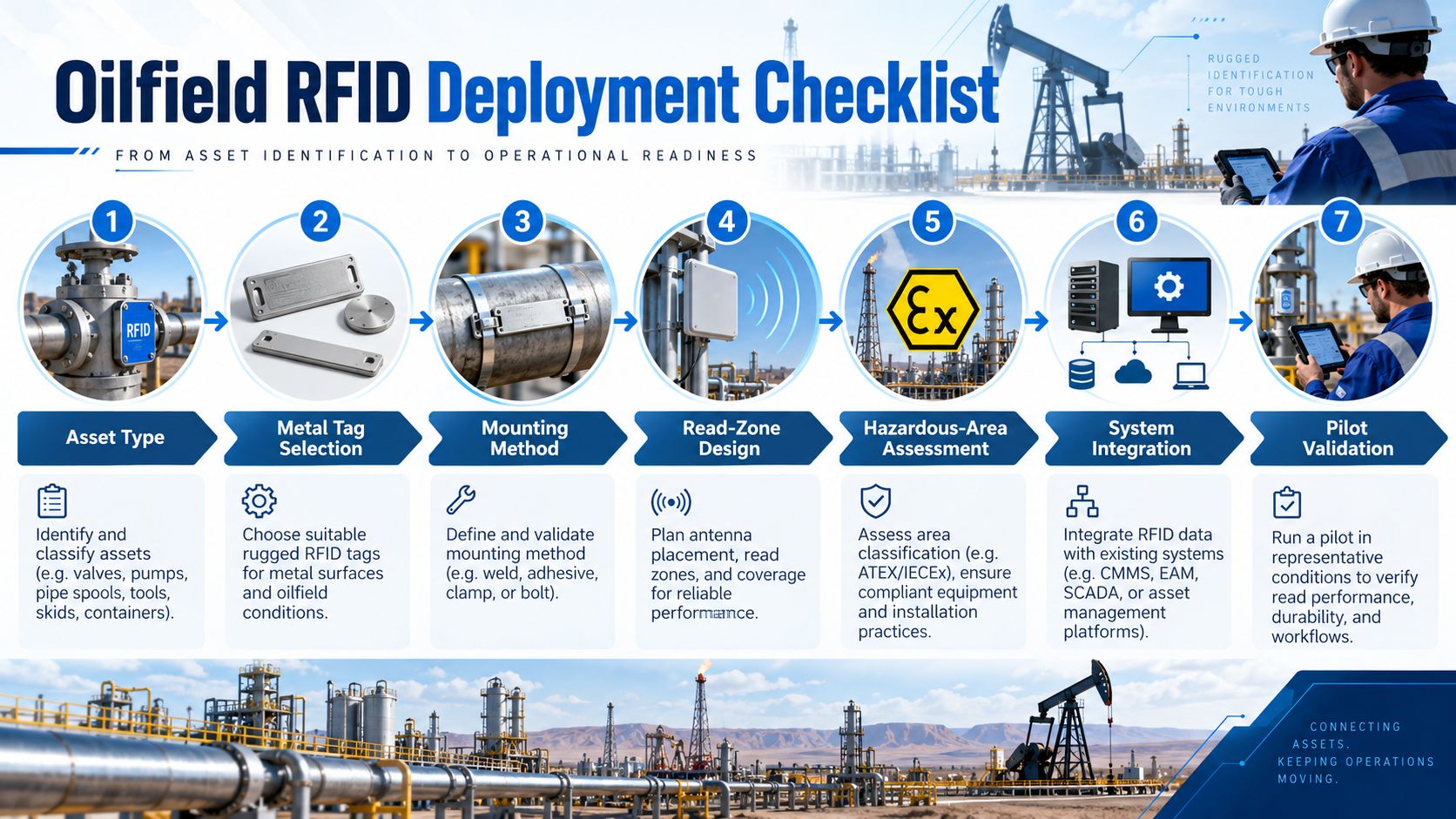
Before deploying RFID across an oil and gas equipment yard, confirm the following.
Conventional labels may perform poorly when attached directly to steel.
A tag must also fit the equipment and survive its operating conditions.
The tag may become damaged or detached during normal equipment handling.
A reader observation does not automatically provide precise current coordinates.
This can increase unintended reads from nearby stored equipment.
Physical presence does not mean the asset is approved for deployment.
Duplicate or unrelated reads should not automatically become business transactions.
Outdoor industrial suitability does not establish explosion-protection compliance.
A tag that performs well on a laboratory metal plate may behave differently on a curved pipe or complex valve.
RFID provides identification data. Operational software and properly defined processes are still required.
RFID yard management uses RFID tags, readers, and asset software to identify equipment, record movement through yard checkpoints, support inventory, and connect assets with operational records.
Yes. RFID can support outdoor industrial asset identification when suitable tags, reader installations, mounting methods, and environmental protections are selected.
Yes, but steel surfaces require appropriate RFID tag design. Curvature, stacking, nearby metal, and mounting conditions must be tested.
Yes, specialized RFID solutions exist for drill-pipe identification. Standard surface-mounted industrial tags should not automatically be considered suitable for downhole operation.
A rugged on-metal UHF RFID tag may be suitable for many surface-identification applications. The exact tag must be selected according to mounting area, temperature, mechanical exposure, and read requirements.
Handheld readers support flexible inventory, equipment search, and inspection identification. Fixed readers support automatic identification at selected gates and checkpoints.
Yes. Properly designed RFID checkpoints can capture equipment identities during gate movements. Direction may require additional sensors or event logic.
Ordinary passive UHF RFID tags do not provide GPS coordinates. They typically support inventory, presence, checkpoint, and last-seen identification.
RFID can link an asset to inspection and maintenance records stored in business software. It does not perform the inspection or certify the equipment.
The connected asset management system can identify overdue equipment when reliable maintenance schedules and status records are maintained.
Not automatically. Suitability for hazardous areas must be verified from the exact equipment certification and the site's classification requirements.
No. IP67 addresses particular ingress-protection conditions. It does not establish resistance to every chemical, continuous high temperature, heavy impact, or explosive atmosphere.
The distance depends on the tag, reader, antenna, metal geometry, mounting location, regional RF rules, and environment. Real-world testing is required.
Yes, through suitable middleware, APIs, or integration interfaces. The exact architecture depends on the existing software and available integration capabilities.
Yes. RFID identification events can support equipment check-out, return, inventory, and assignment records when integrated with rental management software.
RFID is particularly attractive for bulk inventory and automatic checkpoints. Barcode may remain suitable for lower-volume workflows requiring deliberate individual identification.
Start with one equipment category, a defined workflow, suitable on-metal tags, a limited number of readers, and measurable pilot KPIs.
Syncotek provides passive UHF RFID hardware for industrial asset identification, manufacturing, equipment inventory, metal tools, and automated read-point applications.
For oilfield yard-management projects, hardware should be selected according to the actual equipment and deployment environment.
For steel equipment and industrial tools, suitable on-metal tag construction is essential.
A compact PCB-based on-metal tag family for tool and industrial asset identification.
Available configurations provide different dimensions for different mounting spaces.
TUA-S Industrial On-Metal RFID Tag
An industrial asset-identification tag family using a ceramic-based construction with a protective shell.
The published product family includes IP67-rated configurations for indoor and outdoor asset-management applications.
Selection must still account for environmental exposure, mounting conditions, and operational requirements.
SR-RU666 UHF RFID Handheld Reader
An Android-based UHF RFID handheld platform that can support mobile inventory, asset identification, and inspection workflows.
For oilfield applications, the exact hardware configuration and operating-area requirements must be reviewed before selection.
A four-antenna-port UHF RFID fixed reader based on the Impinj E710 platform.
It can be evaluated for controlled yard gates and equipment-movement checkpoints in locations where its environmental and electrical suitability has been confirmed.
A complete fixed installation may also require external antennas, mounting hardware, RF cables, sensors, networking, and middleware integration.
Standard product availability does not imply approval for hazardous or explosive atmospheres.
To help narrow the appropriate hardware, provide:
| Project Requirement | Example Information |
|---|---|
| Equipment type | Steel pipes, valves, pumps, tools |
| Equipment material | Carbon steel, stainless steel, painted metal |
| Mounting area | Available dimensions and surface geometry |
| Environment | Outdoor, rain, dust, oil, temperature |
| RFID workflow | Handheld inventory, gate reading, or both |
| Read zone | Target identification distance and gate dimensions |
| Hazardous-area status | Site classification and applicable certifications |
| Deployment region | Country and required operating frequency |
| Existing software | ERP, CMMS, EAM, or custom asset system |
| Pilot quantity | Number of tags and reader locations to test |
For example:
Application: Outdoor Valve Storage Yard
Assets: 1,500 Industrial Valves
Material: Carbon Steel
Tracking Method: Handheld Inventory + Dispatch Gate
System: Existing Asset Management Software
Initial Pilot: 100 Tagged Valves
Operating Area: Classification to be confirmed
These requirements help determine whether a compact tag, durable industrial tag, handheld reader, or fixed-reader architecture should be evaluated.
Request RFID Tag Samples or an Equipment Quotation
For additional information about industrial RFID hardware, tag selection, and system design, explore these Syncotek resources:
RFID yard management can help oil and gas companies improve the identification and visibility of valuable equipment throughout receiving, storage, inspection, dispatch, return, and maintenance workflows.
Its greatest value is not simply that an RFID reader can identify a metal asset.
The real value comes from connecting that identity with:
Equipment Location → Movement History → Inspection Status → Maintenance Records → Operational Decisions
However, oilfield environments also introduce important engineering requirements.
Tags must be selected for the equipment material and mounting conditions. Readers must be installed at meaningful identification points. Enterprise software must interpret the readings correctly. Hazardous-area requirements must be assessed before deploying electrical equipment.
For many projects, the most practical starting point is a combination of rugged on-metal UHF RFID tags, handheld inventory readers, and carefully selected fixed checkpoints.
Start with a representative pilot, measure actual performance, and expand only when the identification workflow is reliable and operationally valuable.
The best RFID yard-management system is not necessarily the system with the longest read distance or the most readers. It is the system that reliably identifies the right equipment, at the right process point, and provides the information needed to manage that equipment effectively.
 Company Events
Holiday Notice for Chinese New Year 2024
READ MORE Knowledge
Near-field coupling is the communication method used by LF (125/134 kHz) and HF (13.56 MHz, including NFC) RFID systems. Instead of “radiating” like a long-range radio link, near-field RFID works more like a transformer: a reader coil creates a magnetic field, and the tag coil couples to that field to power up and exchange data. This is why LF/HF/NFC are typically short-range, […]
READ MORE Knowledge
What Is Backscatter in RFID? Backscatter is the communication method used by most passive UHF RFID tags to send data back to a reader without generating their own RF carrier. Instead of transmitting like an active radio, the tag uses the reader’s signal as both its power source and its communication medium, then changes how that signal is […]
READ MORE Knowledge
Medical device inventory is more complex than ordinary warehouse stock. A manufacturer may need to manage thousands of SKUs across raw materials, work-in-process, finished devices, warehouse locations, distributors, field inventory, hospital consignment stock, returns, and recalls. Many products also carry additional identification requirements involving: lot or batch number serial number expiration date manufacturing date UDI […]
READ MORE Knowledge
The RFID system auto-identifies vehicles' weight, calculates net weight, and provides real-time monitoring for optimized efficiency.
READ MOREIf you are interested in our services or need customized solutions, please feel free to contact us.