
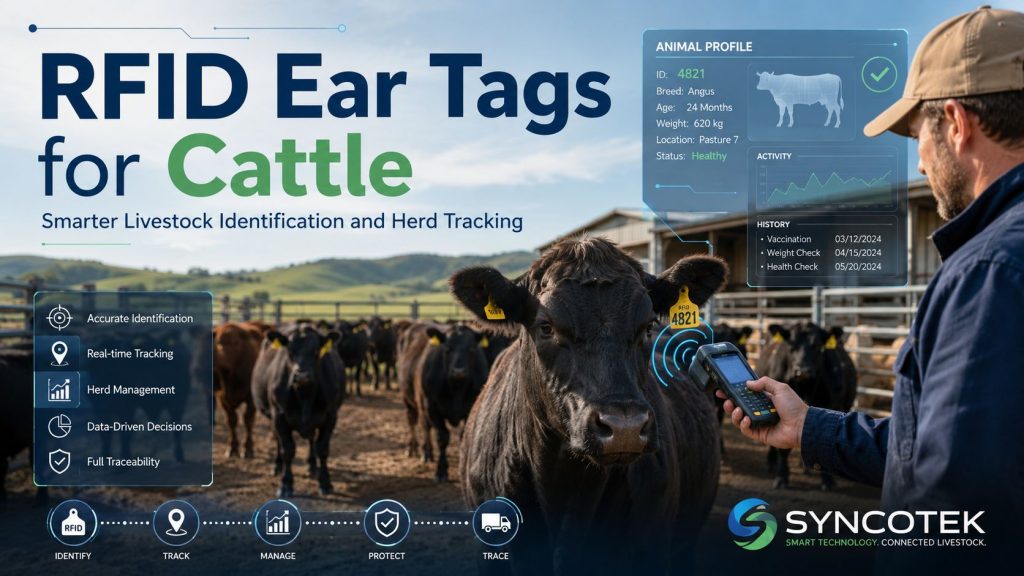
Accurate cattle identification is essential for modern livestock management. Farms, ranches, feedlots, dairy operations, veterinary teams, and livestock markets all need reliable ways to identify individual animals, record movement, manage health data, and support traceability from farm to market.
Traditional visual ear tags are simple and widely used, but they rely on manual reading. Workers must visually inspect the animal, write down the number, and then enter or verify the record. This process can be slow, labor-intensive, and prone to human error, especially when managing large herds.
RFID ear tags for cattle provide a more efficient method. Each RFID ear tag carries a unique electronic identification number that can be read by a compatible RFID reader. This allows cattle to be identified faster and linked to digital records such as health history, breeding status, weight data, movement records, and ownership information.
In many livestock traceability systems, electronic identification is becoming increasingly important. In the United States, USDA APHIS updated animal disease traceability requirements so that official ear tags applied on or after November 5, 2024, must be both visually and electronically readable for covered interstate movement of cattle and bison.
For cattle producers and livestock system integrators, RFID ear tags are not only an identification tool. They are part of a broader digital livestock management system.
RFID ear tags for cattle are electronic identification tags designed to be attached to an animal’s ear. Each tag contains an RFID transponder with a unique ID number. When a compatible RFID reader is brought within range, the reader captures the ID and sends it to software or a livestock management system.
A typical cattle RFID ear tag includes:
The RFID part provides electronic identification, while the visual printed number allows workers to identify the animal manually when needed.
This combination is important because cattle identification often needs both visual readability and electronic readability. Official animal identification systems in different regions may require specific numbering formats, approved devices, or compliance with standards such as ISO 11784/11785. ICAR is the registration authority for ISO 11784 and ISO 11785 RFID animal identification devices, and maintains device registries for conformance.
RFID allows workers to identify cattle without manually reading every visual tag. This can be especially useful when animals are moving through a chute, scale, gate, raceway, feeding station, or milking area.
Instead of writing numbers by hand, the operator can scan the tag and automatically connect the animal ID with digital records.
RFID ear tags make it easier to manage individual animal data.
Common records linked to RFID IDs include:
This helps producers manage animals as individuals rather than relying only on group-level records.
Traceability is one of the biggest reasons RFID cattle tags are used. When each animal has a unique electronic ID, it becomes easier to track movement across farms, markets, feedlots, veterinary locations, and processing systems.
This is important for:
RFID can reduce transcription errors and make trace-back work faster when compared with manual records.
Manual identification can lead to mistakes, especially when numbers are difficult to read, animals move quickly, tags are dirty, or workers must record many animals in a short time.
RFID scanning helps reduce:
RFID ear tags can be connected with herd management software, weighing systems, feeding systems, milking systems, breeding systems, veterinary records, or livestock market platforms.
This allows animal data to move from physical identification into digital management workflows.
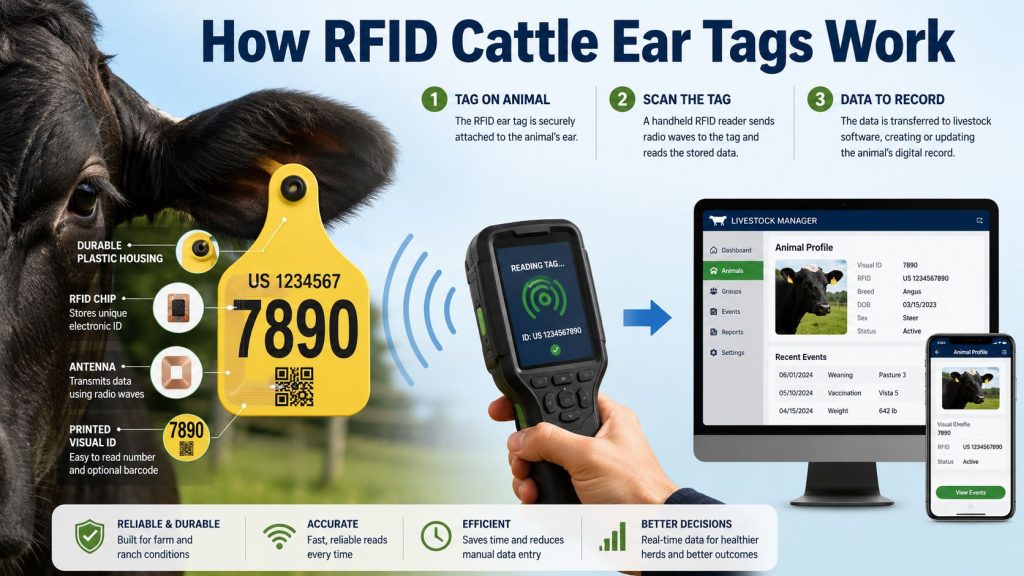
A cattle RFID ear tag stores a unique electronic identification code. When an RFID reader sends radio frequency energy to the tag, the tag responds with its stored ID.
A basic livestock RFID workflow includes:
The exact read range depends on the RFID frequency, tag design, reader power, antenna design, tag orientation, animal movement, and installation environment.
For larger deployments, RFID cattle identification can be connected with other RFID products such as fixed readers, handheld readers, antennas, cables, and software platforms.
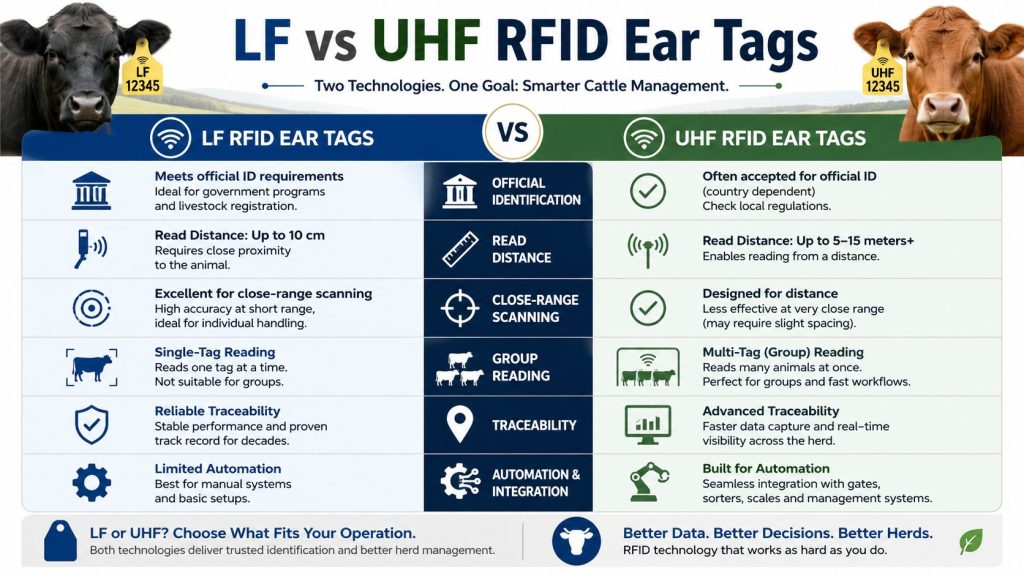
Not all RFID ear tags use the same frequency. Different frequency bands support different livestock identification needs.
Low Frequency RFID is widely used in official livestock identification systems. LF tags commonly support FDX or HDX technology and are often associated with ISO 11784/11785 animal identification systems. USDA’s official animal identification device standards state that low-frequency EID ear tags must conform with ISO 11784/11785.
Ultra High Frequency RFID can provide longer read distance and can be useful for livestock automation scenarios where animals need to be read at a greater distance or in groups. A Canadian livestock comparison document notes that passive UHF read range under ideal conditions can be much longer than LF, while also noting that LF is the established format for animal identification standards.
High Frequency RFID is less common for mainstream cattle traceability than LF, but it may appear in some specialized identification or close-range data interaction applications.
For most cattle identification projects, the main practical comparison is usually LF for official individual animal ID and UHF for longer-range or automated livestock tracking scenarios.
Visual ear tags remain useful because they allow workers to identify animals without a scanner. However, visual tags alone require manual reading and data entry.
| Factor | Visual Ear Tag | RFID Ear Tag |
|---|---|---|
| Read method | Human visual reading | Electronic scanning |
| Data capture | Manual | Digital |
| Speed | Slower for large herds | Faster in many workflows |
| Error risk | Higher | Lower |
| Software integration | Manual entry required | Can connect directly to records |
| Traceability support | Limited | Stronger |
| Works without reader | Yes | Visual number still helps |
| Best use | Simple field identification | Digital livestock management and traceability |
In practice, many RFID cattle ear tags include both a visible printed number and an electronic ID. This gives producers both field readability and digital identification.
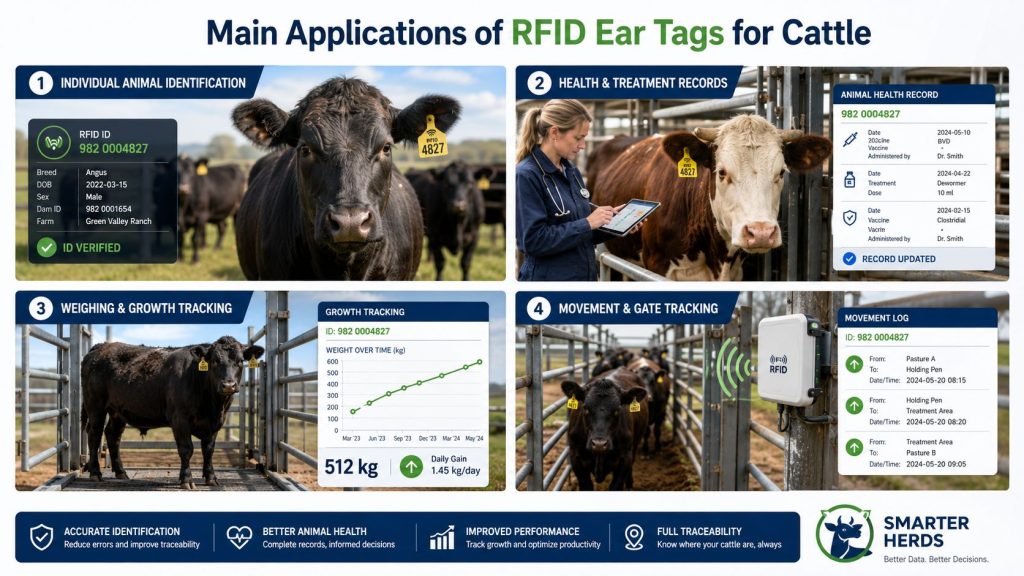
Each animal can be assigned a unique electronic ID. This allows the farm to track the animal throughout its life cycle.
RFID identification can support:
RFID scanning makes herd inventory faster and more accurate. Instead of checking animals manually one by one, workers can scan animals through a controlled reading point.
This is useful for:
For broader inventory workflows, the same RFID principles used in livestock can also support RFID inventory management in warehouses, farms, feed supply operations, and agricultural logistics.
RFID makes it easier to link health actions to the correct animal.
This can include:
When a tag is scanned, the system can show the correct animal record and reduce the risk of applying treatment data to the wrong animal.
RFID ear tags can be used with livestock scales and weighing systems. When an animal enters the scale, the RFID reader captures the animal ID and the system records the weight.
This helps producers monitor:
RFID cattle tags can support breeding records by linking each animal to reproductive data.
Examples include:
This is especially useful in dairy farms, breeding farms, and operations managing large numbers of animals.
Fixed RFID readers and antennas can be installed at gates, alleys, chutes, barns, feeding stations, or milking entrances to automatically record animal movement.
This helps farms understand:
For fixed reading points, reader and antenna setup is critical. The principles used in how to select the right RFID antenna also apply to cattle RFID systems, because read-zone shape, antenna angle, and tag orientation can strongly affect performance.
Dairy farms often need frequent identification because animals move through milking parlors, feeding systems, health checks, and breeding programs.
RFID ear tags can support:
For dairy operations, RFID identification helps connect the animal with daily operational data.
Beef cattle operations often use RFID for herd inventory, movement records, traceability, weighing, and market preparation.
RFID can support:
For larger ranches and feedlots, RFID can reduce manual work and improve record consistency.
Feedlots process many animals and need accurate identification at high speed. RFID can help improve animal flow management and link each animal to health, weight, feeding, and movement data.
Common feedlot RFID applications include:
Because feedlot environments are often fast-moving and dusty, tag durability and reader placement are important.
Before choosing an RFID ear tag, confirm local or export-market requirements. Some markets require approved official identification devices, specific numbering formats, or ISO-compliant RFID technology.
For example, USDA APHIS provides electronic ID tags through State Veterinarian offices in the United States, but official requirements and availability depend on the program and state distribution process.
Select LF, UHF, or another RFID type based on the purpose.
| Requirement | Recommended Direction |
|---|---|
| Official animal identification | LF / ISO-based EID is commonly used |
| Close-range individual reading | LF RFID ear tag |
| Longer-range gate or group reading | UHF RFID ear tag may be considered |
| Integration with existing livestock readers | Match current reader frequency |
| Smart ranch automation | UHF or hybrid system may be evaluated |
The right frequency depends on regulation, reader infrastructure, read distance, and software integration.
Cattle ear tags must survive harsh farm conditions.
Important durability factors include:
A weak tag can fall out, break, or become unreadable, which creates identification gaps.
A cattle ear tag should be durable, but it should also be suitable for animal welfare. The tag should be lightweight, smooth, and designed to reduce irritation.
Consider:
Proper application is important. Incorrect placement can increase the risk of infection, tearing, or tag loss.
Even with RFID, visual readability is still important. Workers may need to identify an animal quickly without scanning.
Check:
RFID ear tags must be compatible with the reader and livestock management software.
Check:
For automated cattle reading, system components such as readers, antennas, and RFID cables, connectors, and adapters should also be selected carefully to reduce signal loss and installation problems.
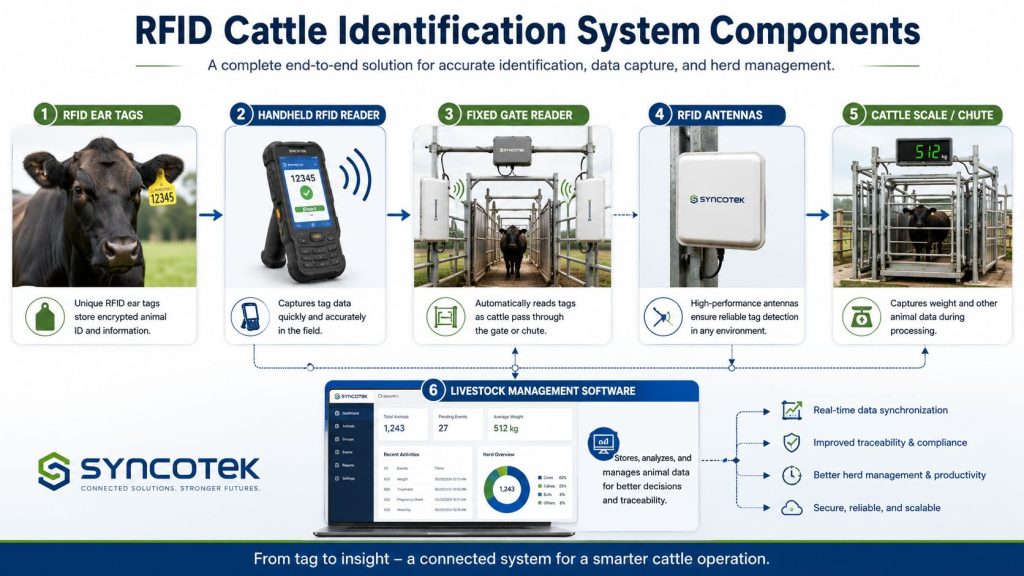
A complete livestock RFID system may include more than ear tags.
The tag provides the unique animal ID. It must match the required frequency, durability, and compliance needs.
Handheld readers are useful for:
Fixed readers are installed at specific points such as:
Antennas define the read zone. In cattle applications, antenna placement should account for animal movement, tag orientation, animal body position, metal gates, and environmental conditions.
Software connects RFID data with useful records.
It may support:
Official identification requirements vary by country and region. A tag that works technically may not be accepted for official movement or compliance use.
A UHF reader cannot read an LF tag unless the device is specifically designed for multi-frequency support. Always match tag and reader frequency.
In fixed cattle reading, poor antenna placement can cause missed reads or false reads. Metal gates, animal movement, and tag orientation can all affect performance.
Cattle tags must survive outdoor conditions, mud, impact, rubbing, and long-term use. Durability is not optional.
RFID is powerful, but visual number readability is still useful for field work and backup identification.
Workers should know how to apply tags, scan animals, sync records, and handle exceptions.
To improve cattle RFID system reliability, follow these practices:
RFID is one layer of modern livestock technology. It can work together with digital weighing, automatic feeding, milking systems, health monitoring, farm management software, and traceability platforms.
In the future, cattle identification may also combine RFID with other technologies such as sensors, computer vision, and biometric identification. Recent research has explored vision-based livestock identification as an alternative or complement to RFID, while noting that RFID ear tags remain widely used in current livestock systems.
For practical livestock management today, RFID ear tags remain one of the most widely deployable ways to connect each animal with digital data.
RFID ear tags for cattle help improve animal identification, herd management, traceability, health records, movement tracking, and farm operation efficiency. Compared with manual visual identification, RFID provides faster digital data capture and reduces the risk of record errors.
The right cattle RFID solution depends on the application. LF RFID ear tags are commonly used for official animal identification and close-range individual scanning. UHF RFID ear tags may be considered for longer-range livestock tracking, automation, and group movement detection. In all cases, tag durability, animal comfort, reader compatibility, software integration, and compliance requirements should be reviewed before deployment.
For farms, ranches, feedlots, dairy operations, and livestock system integrators, RFID ear tags are a practical foundation for smarter livestock management.
RFID ear tags for cattle are electronic identification tags attached to an animal’s ear. Each tag contains a unique electronic ID that can be read by a compatible RFID reader.
Yes. Visual tags are read by people, while RFID ear tags can be scanned electronically. Many RFID cattle tags also include a visible printed number for backup identification.
Low Frequency RFID is commonly used for official animal identification systems, especially ISO 11784/11785-based EID tags. UHF RFID may be used for longer-range or automation-focused livestock tracking applications.
Yes. RFID can link each animal to movement, health, ownership, and management records, making traceability faster and more accurate than manual recordkeeping.
No. The reader must support the same frequency and protocol as the RFID ear tag. Always confirm compatibility before purchasing tags or readers.
Yes. RFID ear tags can be used in dairy farms, beef cattle operations, feedlots, breeding farms, markets, and livestock movement systems.
Requirements depend on the country, region, animal type, and movement situation. In the United States, APHIS updated rules so that covered cattle and bison moving interstate need official identification that is both visually and electronically readable when official eartags are used.
Need RFID Solutions for Livestock Identification or Smart Farm Systems?
Syncotek provides RFID hardware and system components for identification, tracking, inventory, and industrial data capture applications. For livestock RFID projects, the right solution depends on tag frequency, reader compatibility, read distance, installation environment, and software integration.
Whether you are planning cattle identification, gate reading, weighing station integration, or agricultural asset tracking, Syncotek can help you evaluate RFID components for a more reliable deployment.
 Industry Info
How to Choose Frequency for Your Access Control System
READ MORE Knowledge
Large events require thousands of physical interactions to happen accurately and quickly. Attendees must receive valid credentials, enter through the correct gates, access the areas included in their ticket, attend sessions, purchase food or merchandise, interact with sponsors, and leave the venue safely. At the same time, organizers need visibility into: ticket validation attendee arrival […]
READ MORE Knowledge
An RFID tag may look like a simple adhesive label, plastic block, textile patch, card, or small industrial component. Inside, however, several electrical and mechanical elements work together to receive radio-frequency energy, process commands, store data, and communicate with an RFID reader. At its most basic level, a passive RFID tag contains: RFID Chip + […]
READ MORE Knowledge
RFID is often grouped into three main frequency families: LF (Low Frequency), HF (High Frequency), and UHF (Ultra-High Frequency). Picking the right band is one of the biggest decisions in any RFID project because it affects read range, speed, tag cost, phone compatibility, performance near metal/liquids, and system architecture. This guide compares LF vs HF vs UHF in a practical way […]
READ MORE Knowledge
RFID can make warehouse inventory counting faster, automate selected receiving and shipping checkpoints, and reduce repetitive manual scanning. But does that mean every warehouse should replace barcodes with RFID? Not necessarily. Radio Frequency Identification (RFID) offers significant operational advantages, particularly in warehouses with frequent inventory movements, large item populations, and demanding verification processes. However, these […]
READ MOREIf you are interested in our services or need customized solutions, please feel free to contact us.