

Medical device inventory is more complex than ordinary warehouse stock.
A manufacturer may need to manage thousands of SKUs across raw materials, work-in-process, finished devices, warehouse locations, distributors, field inventory, hospital consignment stock, returns, and recalls.
Many products also carry additional identification requirements involving:
High-value products such as implants and surgical devices make inventory accuracy even more important. A missing product is not simply an inventory discrepancy; it can also create shipment delays, excess field inventory, expired stock, reconciliation work, and traceability problems.
RFID provides medical device manufacturers with an additional automatic-identification layer.
Instead of visually scanning every barcode individually, compatible RFID readers can identify tagged products automatically at controlled points throughout manufacturing, warehousing, distribution, and hospital inventory workflows.
A practical architecture may look like:
Medical Device → RFID Identity → Reader → Middleware → MES / WMS / ERP → Inventory & Traceability Record
RFID does not replace medical-device regulations, UDI requirements, quality systems, or product databases.
Its main value is enabling faster and more automated capture of the physical product identity that those systems rely on.
Medical device manufacturers face inventory challenges that are less common in ordinary consumer-goods operations.
A product family may contain many combinations of:
Orthopedic implants, for example, may require many sizes to be available even though only one is ultimately used.
Some medical devices must be managed individually rather than simply as a quantity of identical products.
This creates the need to distinguish:
Product A, Serial 100001
from
Product A, Serial 100002
RFID can provide an electronic serialized identity for this purpose.
Medical-device manufacturers may need to associate products with:
The RFID identifier can act as a key that connects the physical product with these records.
Many sterile products, implants, consumables, and packaged medical devices have expiration dates.
Poor inventory visibility can result in:
RFID does not determine expiration by itself, but its unique identifier can be linked with expiration information stored in the manufacturer's backend system.
Some medical products represent substantial inventory value while sitting:
The manufacturer may therefore need visibility far beyond its own facility.
When a device is returned or affected by a corrective action or recall, the manufacturer needs reliable product identification.
FDA notes that medical-device tracking requirements apply to certain devices when the agency orders a manufacturer to establish a tracking system. The purpose is to enable affected devices in commercial distribution to be located efficiently when needed; these requirements do not automatically apply to every medical device.
RFID can support an identification architecture, but it should not be presented as automatically satisfying those requirements.
A basic medical-device RFID system contains several layers.
The medical device or its packaging receives a suitable RFID tag.
The tag may contain an EPC or another unique electronic identifier.
It does not necessarily need to contain:
A more scalable architecture often uses the RFID identifier as a database key.
The reader captures the RFID identifier.
Possible hardware includes:
The antenna defines where tags can be detected.
For example:
Middleware converts raw tag reads into meaningful events.
Typical functions include:
RFID events can then feed:
RFID is most valuable when it becomes part of these operational systems rather than remaining a standalone reader application.
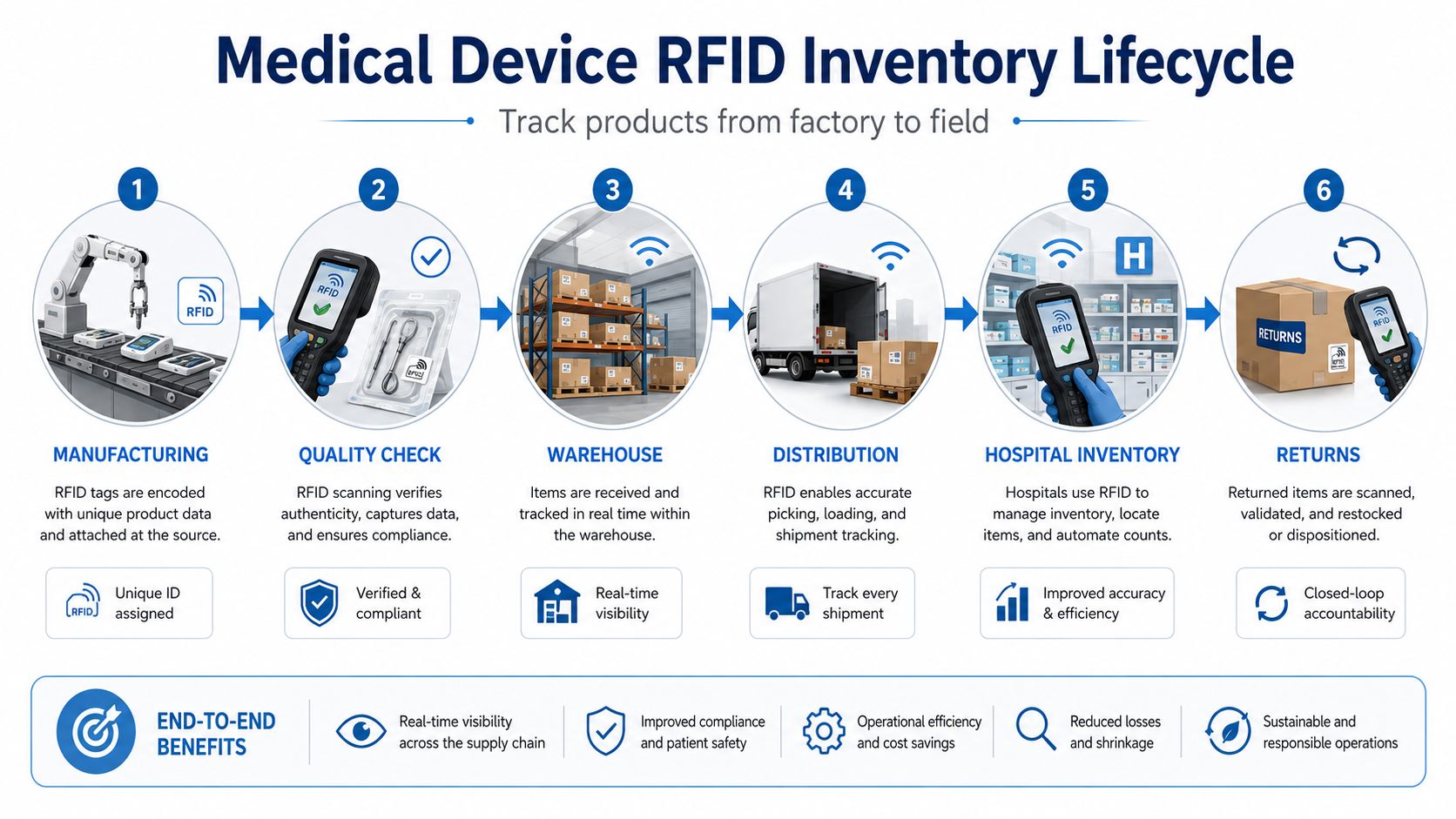
Medical device RFID can remain useful across several stages of the product lifecycle.
RFID may identify:
The identity can be linked with production records inside an MES or manufacturing database.
After manufacturing, RFID can help associate the physical product with:
RFID itself does not determine whether a medical device passes quality requirements.
It identifies the item so the manufacturing system can retrieve and update the appropriate records.
RFID can support:
A handheld reader is useful for mobile inventory, while fixed readers can automate selected transition points.
RFID can support:
Products moving through an RFID portal can be compared with the expected shipment before dispatch.
Manufacturer-owned inventory may continue to exist outside the manufacturer's own warehouse.
This is particularly important for consignment models.
RFID can help provide visibility into which tagged products remain available at a hospital location.
Returned products can be electronically identified and matched with the corresponding:
The item can then be routed to the correct inspection, return-to-stock, quarantine, investigation, or disposal workflow.
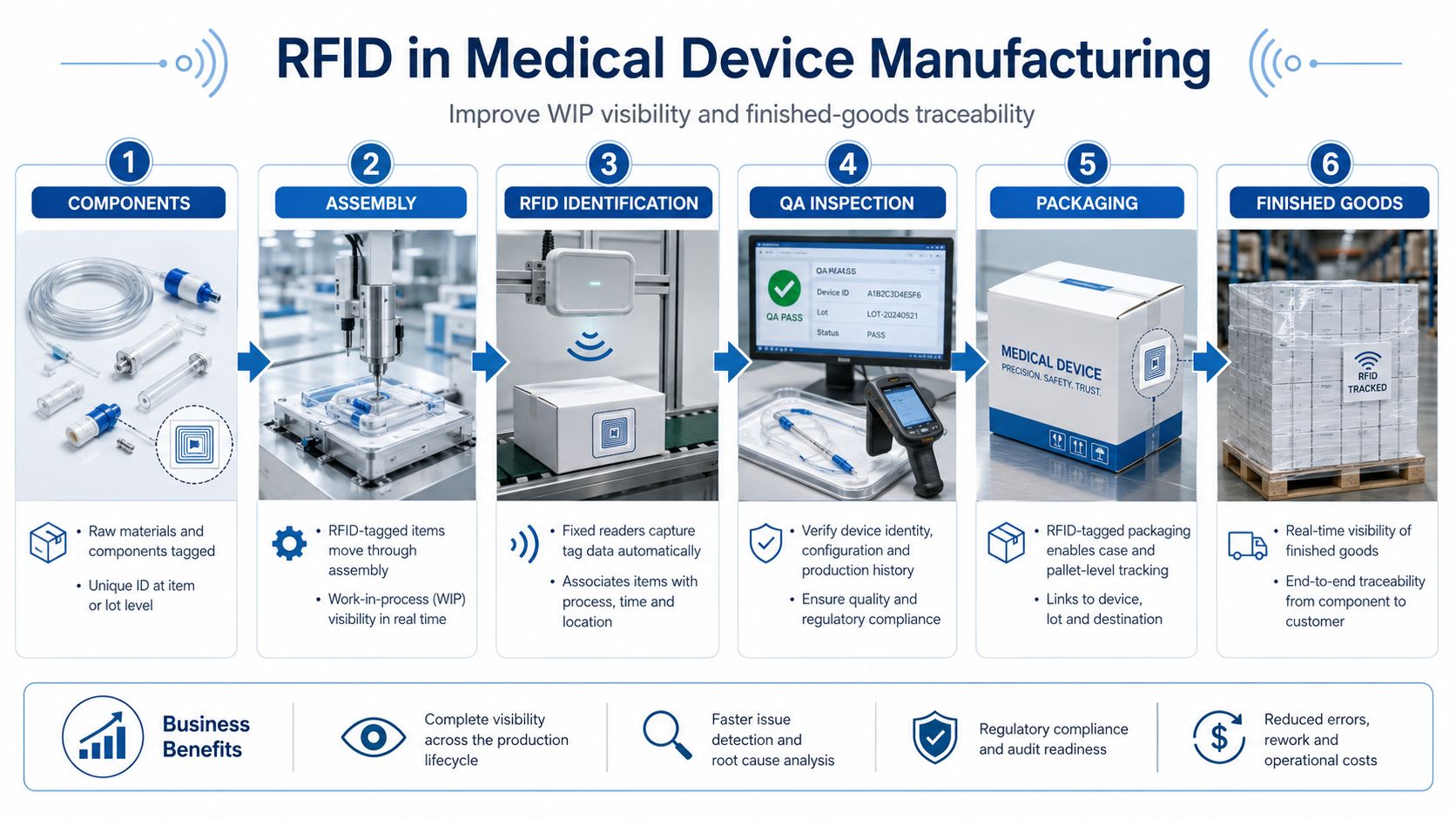
RFID can provide a persistent electronic identity as a product moves through manufacturing.
A simplified workflow is:
Components → Assembly → RFID Identification → QA → Packaging → Finished Goods
RFID may be applied at:
The correct granularity depends on the manufacturing process.
Not every component needs an RFID tag.
The system should tag the level where automatic identification creates measurable operational value.
RFID readers installed at defined production stations can record when a tagged item moves through the process.
This can provide visibility into:
For a broader manufacturing overview, see Syncotek's guide to RFID in Manufacturing.
A useful architecture is:
RFID EPC
→
Device Record
→
Work Order
→
Manufacturing History
This keeps detailed process data in the manufacturing system instead of trying to store all manufacturing information directly on the RFID chip.
A reader can identify the device being inspected.
The quality system can then retrieve the correct:
The inspection result remains inside the quality or manufacturing system.
RFID provides reliable physical-to-digital association.
Once QA release and packaging are complete, the same identifier can continue into warehouse inventory.
This creates continuity between:
Manufacturing Identity
and
Inventory Identity
reducing the need to create disconnected identification systems at every stage.
Finished-goods warehouses are one of the strongest applications for passive UHF RFID.
Medical device manufacturers may manage:
RFID can support several common warehouse workflows.
Finished products can be automatically or manually registered when they enter the warehouse.
Handheld UHF RFID readers can identify many tagged products during one inventory process.
This can make more frequent inventory counts practical.
If a particular serialized product is required, a handheld reader can assist with searching where supported by the system.
Staff can verify that the selected product belongs to the correct:
Items can be assigned to a staging zone before shipment.
A fixed portal can compare physical RFID identities against the shipment record.
This converts warehouse inventory from periodic counting into a more event-driven system.
Medical implants are particularly interesting for RFID because they combine:
Examples can include:
The RFID tag is commonly associated with the external sterile package or another appropriate packaging layer rather than arbitrarily attached directly to the implant.
The exact tagging architecture depends on:
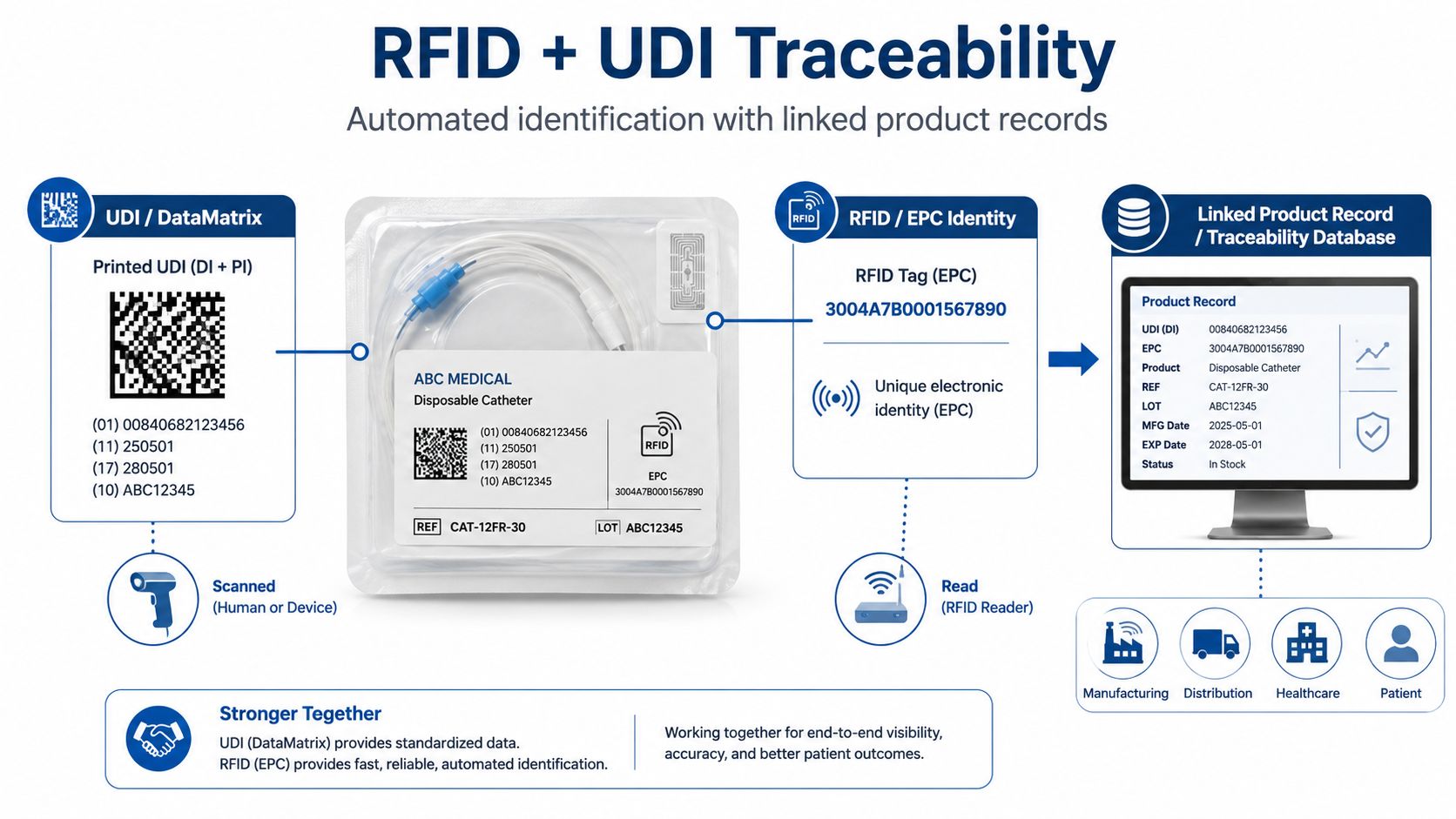
RFID and UDI are related to product identification, but they are not the same thing.
This distinction is important.
FDA's Unique Device Identification system is designed to adequately identify medical devices throughout distribution and use.
For applicable devices, the UDI rule generally requires device labelers to place a UDI on device labels and packages, subject to exceptions or alternatives, and submit required device information to GUDID.
A UDI generally consists of:
The fixed portion identifying the:
When applicable, this variable portion may include:
FDA also requires the UDI on applicable labels and packages in both easily readable plain text and machine-readable AIDC form.
Attaching an RFID tag to a medical device does not automatically satisfy UDI requirements.
The manufacturer must separately determine:
RFID should therefore be treated as part of the inventory and traceability architecture rather than a blanket substitute for regulatory labeling.
A medical-device package might contain:
Printed UDI / DataMatrix
and
RFID Electronic Identity
Both can connect to the same backend product record.
The barcode can provide deliberate optical identification.
RFID can provide automated inventory identification.
A backend system can link both identifiers with:
Commercial healthcare inventory systems already combine RAIN RFID-generated inventory events with UDI data such as serial and expiration information in backend applications.
Barcode or DataMatrix is strong for:
UHF RFID is strong for:
The strongest architecture does not force one technology to solve every identification problem.
A common mistake is trying to store every piece of medical-device information directly inside RFID memory.
This is usually unnecessary.
A cleaner architecture is:
RFID EPC
↓
Backend Product Record
↓
This provides several advantages.
If product status changes, the backend can be updated without rewriting the RFID tag.
Sensitive or controlled information remains in a secured application rather than openly stored on the tag.
Backend systems can hold substantially more information than normal RFID tag memory.
ERP, MES, WMS, and traceability applications can use the same product identity.
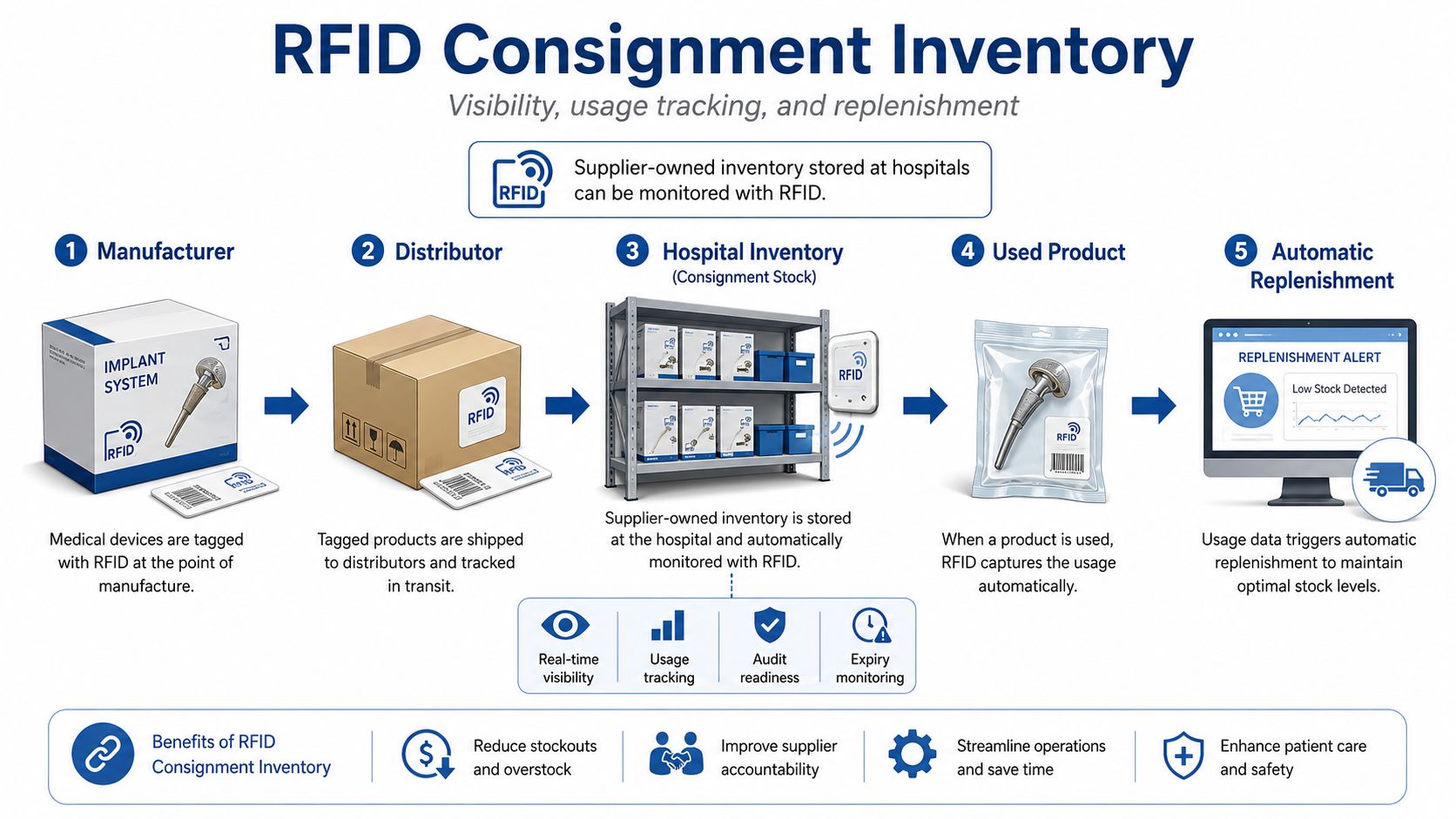
Consignment inventory is one of the strongest medical-device RFID use cases.
In a typical consignment model:
Manufacturer owns the inventory
↓
Products are stored at the hospital
↓
Hospital uses products when needed
↓
Usage is reported
↓
Manufacturer replenishes inventory
This creates a difficult inventory-management problem.
The manufacturer may have significant inventory value stored outside its own warehouse.
Without accurate inventory visibility, manufacturers may struggle with:
RFID-enabled cabinets, shelves, readers, or periodic handheld inventory can provide information about:
The software can combine RFID events with:
and generate replenishment actions.
A smart cabinet may include:
Tagged Medical Devices
↓
UHF Antennas
↓
RFID Reader / Module
↓
Cabinet Controller
↓
Inventory System
The same architecture discussed in Syncotek's RFID in Healthcare guide can therefore also support manufacturer-owned consignment inventory.
This is particularly relevant to medical-device OEMs and system integrators building their own cabinet hardware.
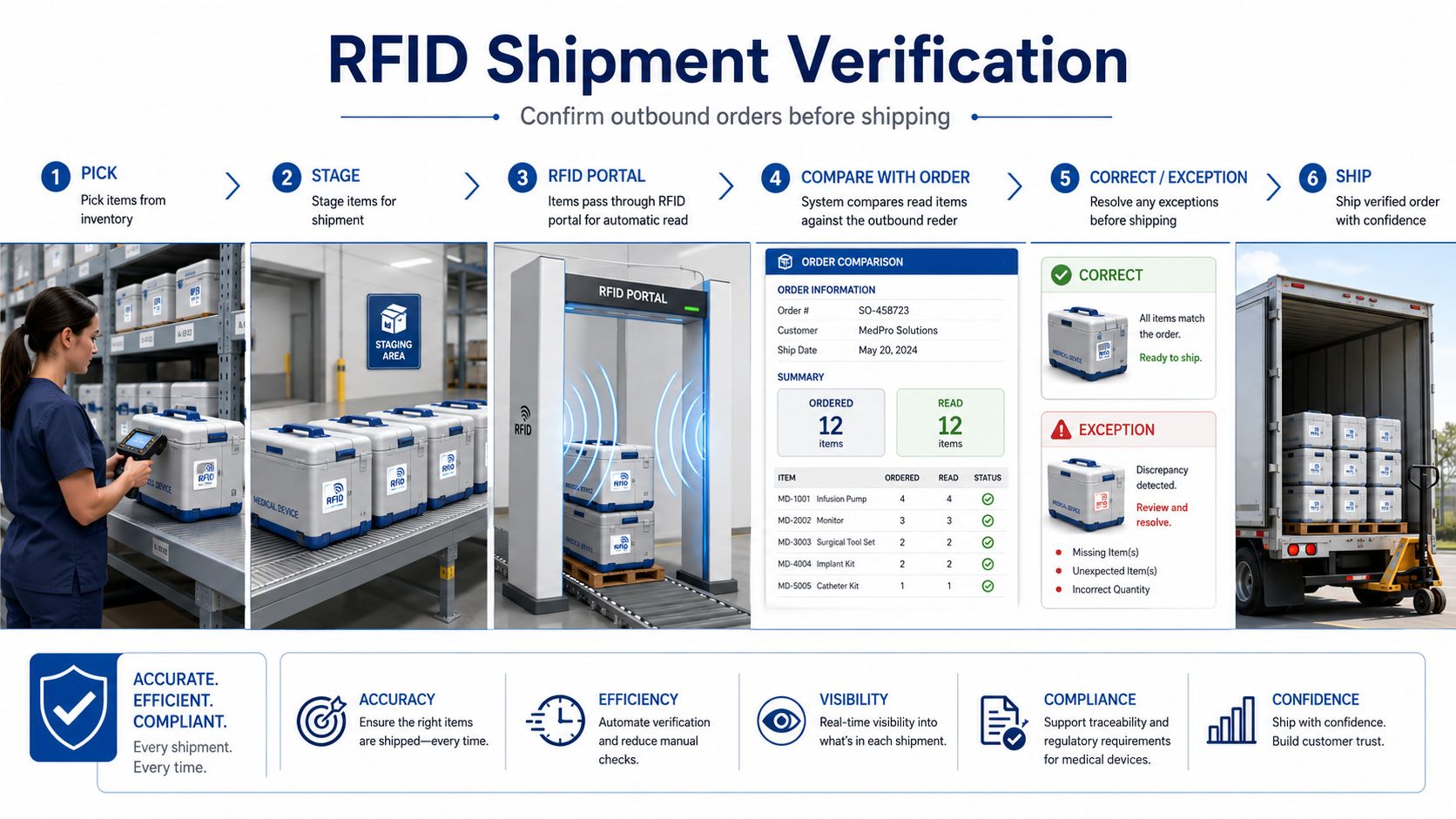
RFID can also reduce outbound shipment errors.
A simplified workflow is:
Pick → Stage → RFID Portal → Compare → Resolve Exceptions → Ship
Products are selected for the outbound order.
Items are moved to a controlled shipment staging area.
Tagged products pass through a fixed read zone.
A portal may contain:
Middleware compares detected EPCs with the expected shipment.
Possible results include:
Expected Item + Detected = Correct
Expected Item + Not Detected = Missing
Unexpected EPC Detected = Exception
The order can be stopped before shipment so staff can investigate:
Only after the physical RFID inventory matches the expected order does the workflow confirm the shipment.
For medical-device manufacturers managing serialized inventory, this can provide an additional automated verification layer before products leave the facility.
Returned medical devices require controlled processing.
RFID can identify the returned unit and retrieve its digital record.
The system can then determine the appropriate status:
The key benefit is maintaining the same identity across outbound and return workflows.
RFID can also support product identification when a recall or field action occurs.
If the backend associates RFID identities with:
staff can search inventory for affected devices more efficiently.
However, this does not mean every medical device must legally be RFID tracked.
FDA's formal medical-device tracking requirement applies to certain devices when FDA orders tracking, and manufacturers subject to those requirements must maintain the required tracking system and SOPs.
RFID may support such a system where appropriate, but regulatory requirements must be evaluated separately.
Medical-device RFID must be designed carefully when sterilization is involved.
There are two very different situations.
An RFID tag may be applied after sterilization or positioned on packaging in a way validated by the manufacturer.
This can simplify tag selection because the tag may not need to survive the actual sterilization process.
Reusable devices or containers may require an RFID tag to remain attached throughout:
A standard adhesive UHF label should not automatically be used for this purpose.
Tag selection must evaluate:
Specialized high-temperature or industrial RFID tags may be required, and the complete implementation must be validated for the manufacturer's actual medical-device process.
Tag selection should start with the product, not with read-range marketing claims.
Determine whether the tag is attached to:
UHF RF behavior changes significantly around metal and liquids.
Standard UHF labels usually perform poorly when attached directly to metal.
Applications may require a specialized mount-on-metal RFID tag.
Decide whether the identity belongs to:
The tagging level should match the inventory requirement.
A desktop commissioning station and warehouse portal need very different tag performance.
Do not maximize read range automatically.
Select the tag for the intended read zone.
Determine whether the tag needs to survive:
Possible methods include:
For long-life assets, mechanical attachment may be more reliable than ordinary pressure-sensitive adhesive.
For a deeper explanation of how tag structure changes performance, see RFID Tag Construction.
Different inventory stages require different reader formats.
Best suited to:
Advantages include mobility and relatively simple deployment.
Suitable for automated checkpoints such as:
The reader can connect to several antennas to create a controlled read zone.
Useful for:
An embedded module can be integrated into:
This is particularly relevant for medical-equipment OEMs that need RFID functionality inside their own hardware rather than a separate finished reader.
Antenna selection influences:
A shipment portal may require multiple directional antennas.
A smart cabinet requires short, highly controlled coverage.
A desktop station may require a near-field antenna.
The correct antenna is determined by the read zone.
Medical device manufacturers producing RFID labels internally may use an RFID printer encoder.
A typical process is:
Product Master
↓
Generate EPC / Unique Identity
↓
Print Visible Label
↓
Encode RFID
↓
Read Back
↓
Verify
↓
Apply to Product
Visible data may include:
The RFID identity should then map to the same product record.
For more detail, see Syncotek's RFID Printer Guide and How to Program an RFID Tag.
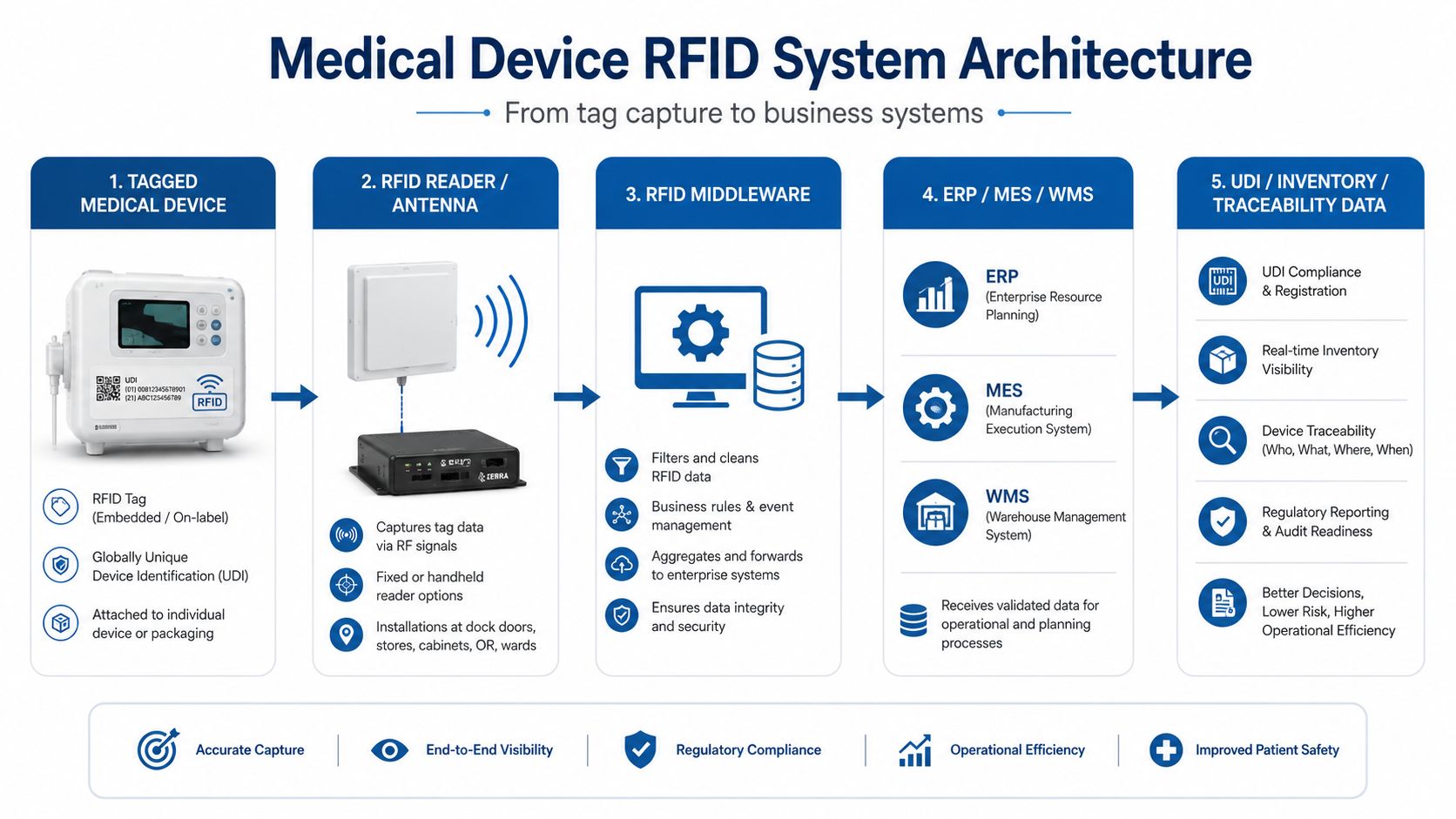
The RFID reader is only one layer of a complete medical-device inventory system.
A scalable architecture can be represented as:
Tagged Medical Device
↓
RFID Reader & Antenna
↓
RFID Middleware
↓
ERP / MES / WMS
↓
UDI / Inventory / Traceability Data
The physical item contains a unique RFID identity.
Hardware captures the identity at:
Middleware:
MES can use RFID identity for:
WMS can use RFID for:
ERP can manage:
The product record can connect the electronic RFID identity with:
The software—not the RFID tag by itself—creates traceability.
RFID should not be positioned as a universal replacement for medical-device barcode identification.
| Factor | Barcode / DataMatrix | Passive UHF RFID |
|---|---|---|
| Identification | Optical | Radio frequency |
| Line of sight | Required | Usually not required |
| Reading method | Normally deliberate | Manual or automatic |
| Bulk inventory | Limited | Strong |
| UDI labeling | Widely used | Must be evaluated separately |
| Portal detection | Limited | Strong |
| Cost | Lower | Higher |
| Printed information | Yes | Usually combined with label |
| Inventory automation | Moderate | Strong |
Barcode/DataMatrix is ideal for:
RFID is strong for:
Many medical-device manufacturers can benefit from using both.
Medical device manufacturers usually do not need precise real-time coordinates for every product.
They often need to know:
These are inventory and event questions.
Passive UHF RFID is well suited to these workflows.
RTLS is more appropriate when the question becomes:
Where exactly is this moving asset right now?
That distinction can avoid unnecessary infrastructure and cost.
The greatest value appears when RFID becomes part of normal enterprise workflows.
Use RFID identity to connect a physical device with:
Use RFID events for:
Use the product identity to connect physical movement with:
Middleware acts between the reader and enterprise systems.
A good middleware layer prevents ERP or WMS from receiving thousands of meaningless duplicate tag reads.
Instead it can create events such as:
Device entered Finished Goods
Device moved to Shipping
Unexpected EPC at Portal
Consignment Item Removed
These business events are much more useful than raw RF data.
It does not.
UDI requirements must be evaluated separately.
Use the RFID tag mainly as an identifier unless there is a specific need for additional tag memory.
Keep detailed records in controlled backend systems.
A low-cost tag that performs poorly on the product can create larger operational costs.
Many medical devices contain metal.
Test the RFID tag on the real packaged product.
Only use tags designed and validated for the required sterilization process.
Serialized item tracking requires controlled identity generation.
Duplicate EPCs can create serious inventory errors.
Test tags on:
Passive UHF does not automatically provide continuous precise coordinates.
A reader that produces tag IDs without updating business systems creates limited operational value.
Excessive RF power can generate stray reads and overlapping zones.
Define and control the intended read area.
RFID will identify discrepancies.
Staff need to know what happens when the system detects:
Before deploying RFID, confirm:
RFID gives medical device manufacturers a practical way to connect physical inventory with digital manufacturing, warehouse, distribution, and field-inventory systems.
Its value extends beyond simple stock counting.
A well-designed system can support:
The most important principle is to treat RFID as one layer of the larger identification architecture.
UDI defines regulated medical-device identification requirements.
Barcode and DataMatrix provide effective optical identification.
RFID provides automated electronic identification.
MES, WMS and ERP manage the business process.
Together, these systems can provide much stronger physical-to-digital inventory visibility than any one technology working alone.
RFID can identify components, work-in-process, packaged devices, and finished products and connect those physical identities with MES, WMS, ERP, and traceability records.
Yes. Passive UHF RFID is well suited to warehouse inventory, field inventory, shipment verification, and consignment stock when the correct tags and readers are used.
No. RFID does not automatically replace FDA UDI requirements. UDI compliance and RFID inventory architecture should be evaluated separately.
Yes. An RFID EPC or other electronic identifier can be mapped in a backend database to UDI, lot, serial number, expiration date, and other product information.
RFID can support inventory of appropriately packaged implants and surgical products. Tag placement and construction must be validated for the particular product and packaging.
It refers to using RFID to improve visibility of supplier-owned products stored at customer or hospital locations until they are used.
It can help manufacturers identify what inventory remains at each location, what has been removed, what is approaching expiration, and what needs replenishment.
Yes, but conventional UHF labels may perform poorly directly on metal. Specialized on-metal tags or validated packaging-level tag placement may be required.
Only RFID tags specifically designed and validated for the required temperature, pressure, moisture, chemical exposure, and sterilization cycles should be used.
Yes. It is particularly useful for cycle counting, receiving, picking, shipment verification, and other inventory workflows.
Neither is universally better. Barcode/DataMatrix is strong for UDI and deliberate optical scanning, while UHF RFID is strong for bulk inventory and automated data capture. Many systems use both.
Depending on the application, they may use handheld readers, desktop readers, fixed readers, external antennas, or embedded UHF reader modules.
RFID can help identify tagged products and connect them with lot, serial, customer, distribution, and inventory records, improving the operational ability to find affected stock.
Reader middleware converts tag reads into inventory events and passes validated data to ERP, MES, WMS, or traceability applications through APIs, SDKs, database interfaces, or other supported integrations.
No. FDA medical-device tracking under 21 CFR Part 821 is a specific regulatory requirement applicable to certain devices when ordered by FDA. RFID is one possible technology that may support a broader tracking architecture.
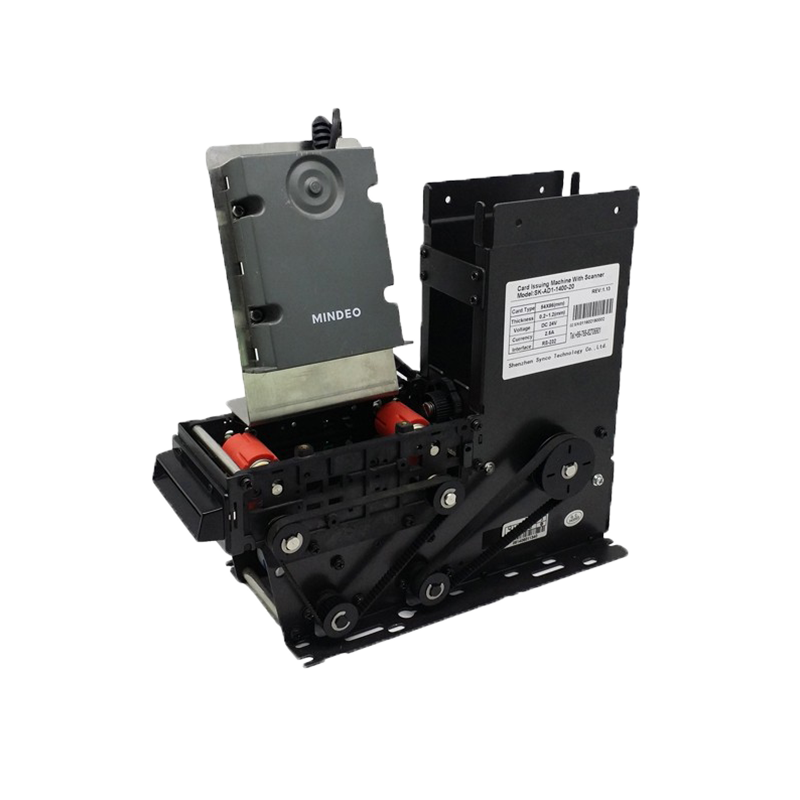
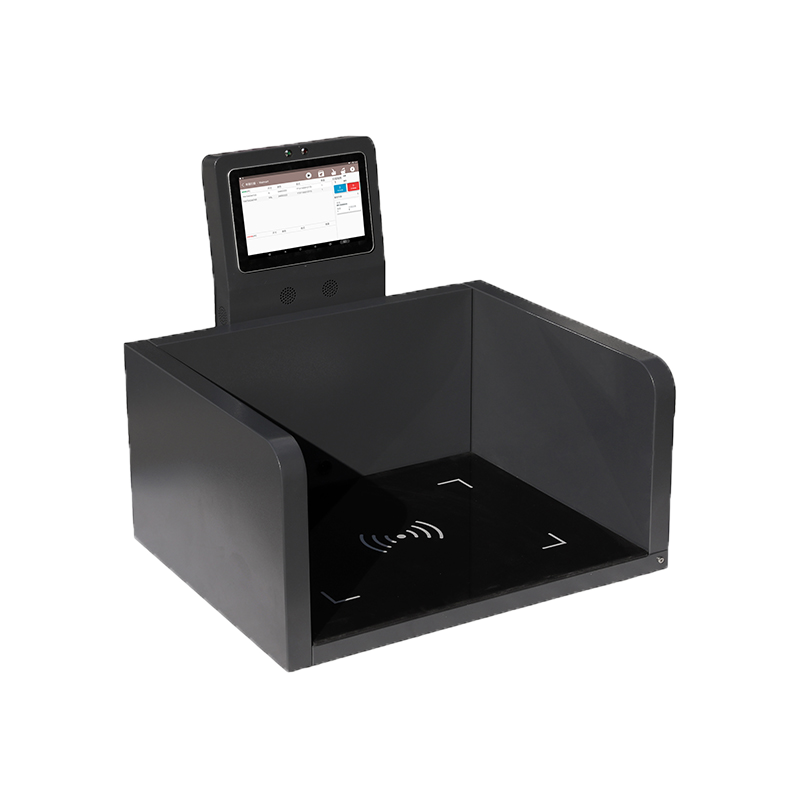
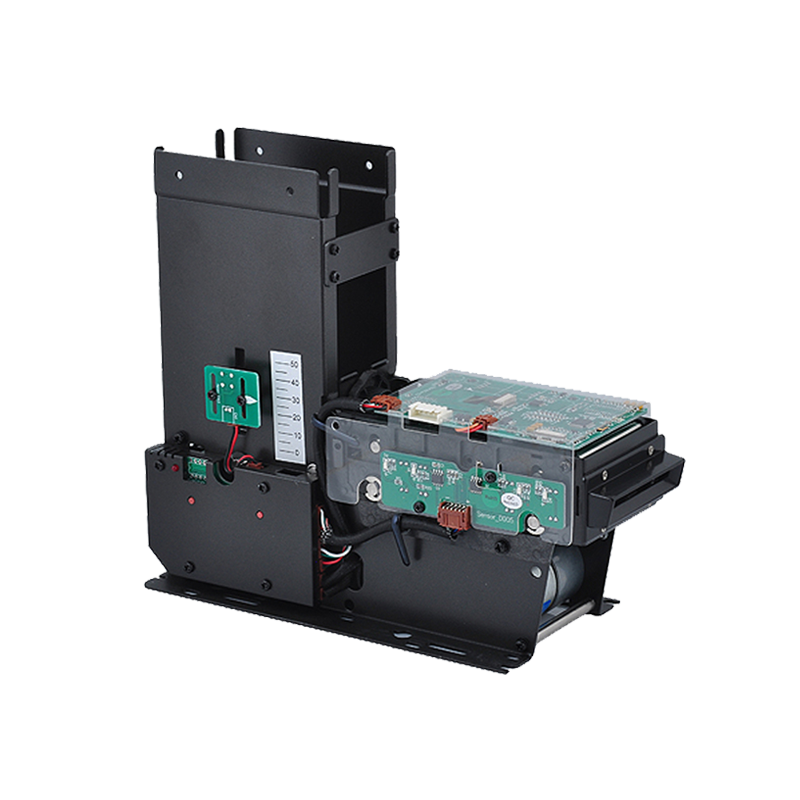
Syncotek provides RFID hardware for medical-device manufacturers, healthcare system integrators, warehouse solution providers, smart-cabinet manufacturers, and OEM equipment developers.
Our RFID portfolio includes:
These products can support identification at:
Syncotek does not replace a manufacturer's UDI program, quality-management system, ERP, MES, WMS, or regulatory compliance process. Our role is to provide the RFID identification and data-capture hardware layer that connects physical medical-device inventory with those systems.
Explore the complete Syncotek RFID product portfolio or review our RFID readers, modules, antennas and tags to plan your medical-device inventory and traceability infrastructure.
 Knowledge
Metal asset tracking is one of the most important applications in RFID, but it is also one of the most technically challenging. Many companies want to use RFID to identify tools, machines, containers, laptops, racks, returnable transport items, and industrial equipment, only to discover that standard RFID labels do not perform well when placed directly […]
READ MORE Knowledge
Barcode scanners are used in retail checkout, warehouses, manufacturing lines, hospitals, ticketing systems, self-service kiosks, parcel handling, access control, and inventory management. Although 1D and 2D barcode scanners may look similar, they differ in the symbols they can decode, the way they capture information, their ability to scan mobile screens, and the amount of data […]
READ MORE Knowledge
HF RFID (High-Frequency Radio Frequency Identification) is a widely used RFID technology operating at 13.56 MHz. It’s best known for short-range, controlled reads, strong support for secure credentials, and the fact that NFC is built on the same HF band. If your project needs a tap / close-range user experience—like access control badges, library book tags, healthcare wristbands, or secure ID cards—HF […]
READ MORE Knowledge
BarTender RFID software, BarTender RFID label printing, RFID label software, RFID printer software, RFID label encoding, RFID printer encoder, RFID label design, EPC encoding, RFID barcode label software, RFID serialization RFID projects do not depend only on tags, readers, antennas, and printers. Software also plays a critical role, especially when businesses need to design RFID […]
READ MORE Knowledge
When businesses start planning an RFID project, they often focus on readers, antennas, and software first. However, one of the most important decisions is the RFID item attached to the object being tracked. This is where terminology can become confusing. Many people use RFID inlay, RFID tag, and RFID label interchangeably. In some conversations, this may not cause a […]
READ MOREIf you are interested in our services or need customized solutions, please feel free to contact us.