

Choosing a UHF RFID fixed reader should not begin with one question:
How far can this reader read?
Maximum read distance is only one small part of a fixed RFID system.
A reader that performs well at a warehouse dock door may be unnecessarily complex for a single workstation. A four-port reader can outperform a sixteen-port reader when the antenna layout is better designed. Maximum RF power can actually create problems if the real application requires a tightly controlled read zone.
The better approach is:
Define the RFID workflow first, then select the reader.
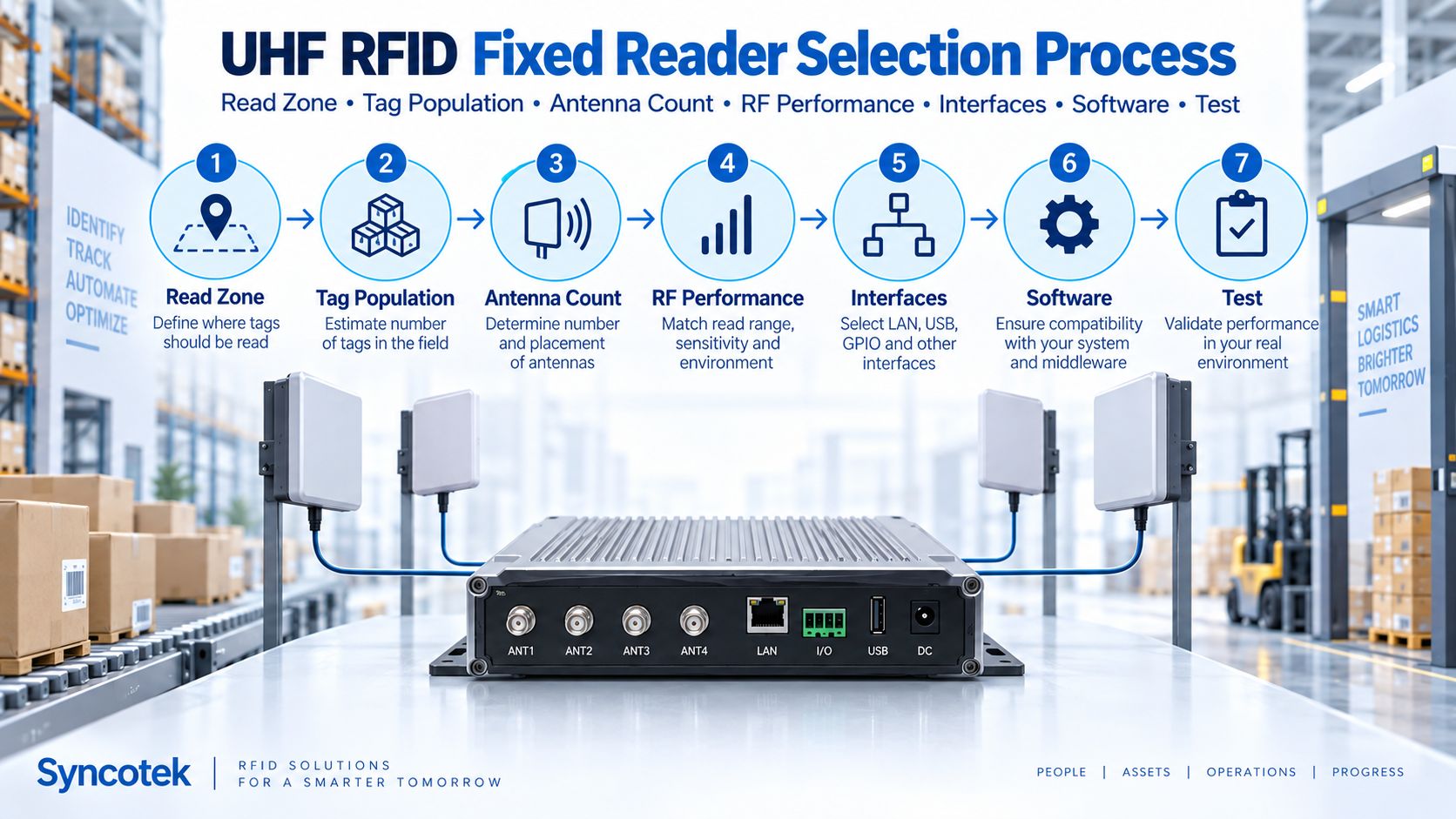
A practical fixed-reader selection process should consider:
Read Zone
→ Tag Population
→ Antenna Count
→ RF Performance
→ Interfaces
→ Automation
→ Software Integration
→ Real-World Testing
For modern passive UHF RFID systems, EPC UHF Gen2 is the dominant air-interface architecture. GS1 describes Gen2 as the standard used for passive UHF RFID implementations and maintains it in close alignment with ISO/IEC 18000-63.
The reader is therefore only one part of a larger system:
RFID Tags → Antennas → Fixed Reader → Edge / Middleware → WMS / ERP / MES
Understanding how these layers work together is more important than selecting the reader with the largest specification numbers.
A fixed UHF RFID reader is an RFID reader installed permanently at a defined location.
Unlike a handheld reader, the reader does not move with the operator.
Unlike an integrated reader, a conventional fixed reader normally connects to one or more external RFID antennas.
Typical fixed-reader applications include:
A fixed reader performs several core functions:
A complete installation may also include:
The correct architecture depends on where tags should be detected and what should happen after they are read.
The most important question in fixed RFID reader selection is not:
What is the reader's maximum range?
It is:
Where should tags be detected, and where should they not be detected?
This defines the read zone.
The objective might be:
Identify tagged pallets passing through Door 3.
The system should identify pallets moving through that doorway without continuously reading inventory stored nearby.
The objective may be:
Identify every tagged carton as it crosses one specific inspection point.
The read zone may therefore be relatively narrow and carefully triggered.
The requirement is even more controlled:
Identify products inside Cabinet A without reading products inside Cabinet B.
In this application, maximum reader power can make the system worse.
The requirement may be:
Identify the workpiece currently at Station 6.
Again, the system needs a precise RF zone rather than maximum range.
In other applications, wider coverage may genuinely be useful.
The reader, antenna gain, antenna count and tag construction all need to support that larger zone.
The key principle is:
Design the read zone before selecting the reader.
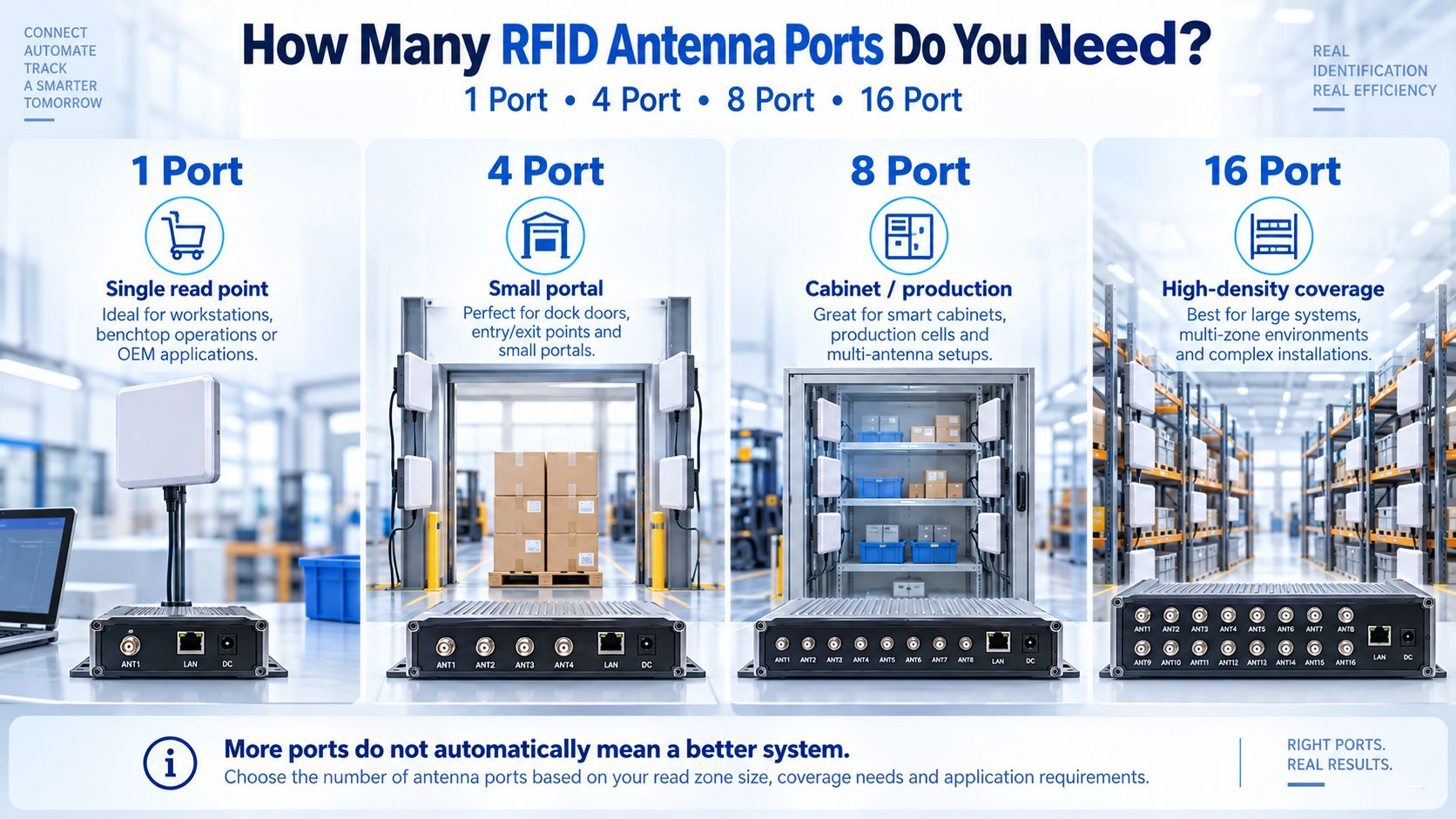
Antenna-port count is one of the most visible differences between fixed RFID readers.
Readers may support:
Syncotek's current fixed-reader lineup is structured around 4-, 8- and 16-port architectures for applications ranging from compact dock-door systems to high-density RFID infrastructure.
The correct number depends on the required physical coverage.
A single antenna may be sufficient for:
If only one RF zone is needed, additional ports may provide little value.
Four ports are a common architecture for:
For example, a dock door might use:
This provides substantial design flexibility without unnecessary complexity.
Eight ports are useful when the application contains more physical zones.
Examples include:
A smart cabinet may place antennas on several shelves so the system can identify which section contains each tagged product.
Sixteen-port systems are intended for high-density installations.
Examples include:
Syncotek currently offers 16-port architectures specifically for dense antenna networks and complex multi-zone installations.
This is an important engineering principle.
A properly designed:
4-port reader + 4 correctly positioned antennas
can outperform:
16-port reader + poor antenna placement
More ports also mean more considerations:
Select the antenna count from the physical system design.
Do not select 16 ports simply because sixteen is larger than four.
RF output power describes how much RF energy the reader sends toward the antenna.
Industrial UHF RFID readers commonly provide adjustable power.
Selected Syncotek fixed-reader families support RF output up to 33 dBm.
It can be tempting to assume:
Higher power = better reader.
That is not correct.
Higher power can be useful when:
Lower power may be preferable for:
Excessive power may produce:
For example, if Cabinet A starts detecting tags in Cabinet B, increasing power further will not solve the problem.
The system needs better RF control.
The correct principle is:
Use enough RF power to create the required read zone — not the maximum available power by default.
Transmit power describes:
Reader → Tag
Receive sensitivity relates to:
Tag → Reader
This distinction is important.
Passive UHF RFID communication relies on backscatter.
The reader transmits RF energy toward the tag.
The tag changes its antenna reflection characteristics to send information back.
The reader must then detect that relatively weak returned signal.
A reader with strong receive performance can detect weaker tag responses under suitable conditions.
However, receive sensitivity does not operate independently.
Practical performance also depends on:
Therefore:
Better sensitivity does not automatically guarantee better field performance.
The entire RF system matters.
Another specification commonly advertised by RFID reader manufacturers is:
tags per second
High throughput can be important, but only in applications that actually contain large tag populations.
Consider two projects.
Possible tag population:
50 items.
Extremely high theoretical throughput may not be a critical differentiator.
Possible tag population:
hundreds of tagged products moving quickly.
Reader inventory performance becomes much more important.
A better evaluation is:
Required Throughput = Tag Population + Dwell Time + Movement Speed + RF Conditions
Ask:
The theoretical maximum tag rate alone does not answer these questions.
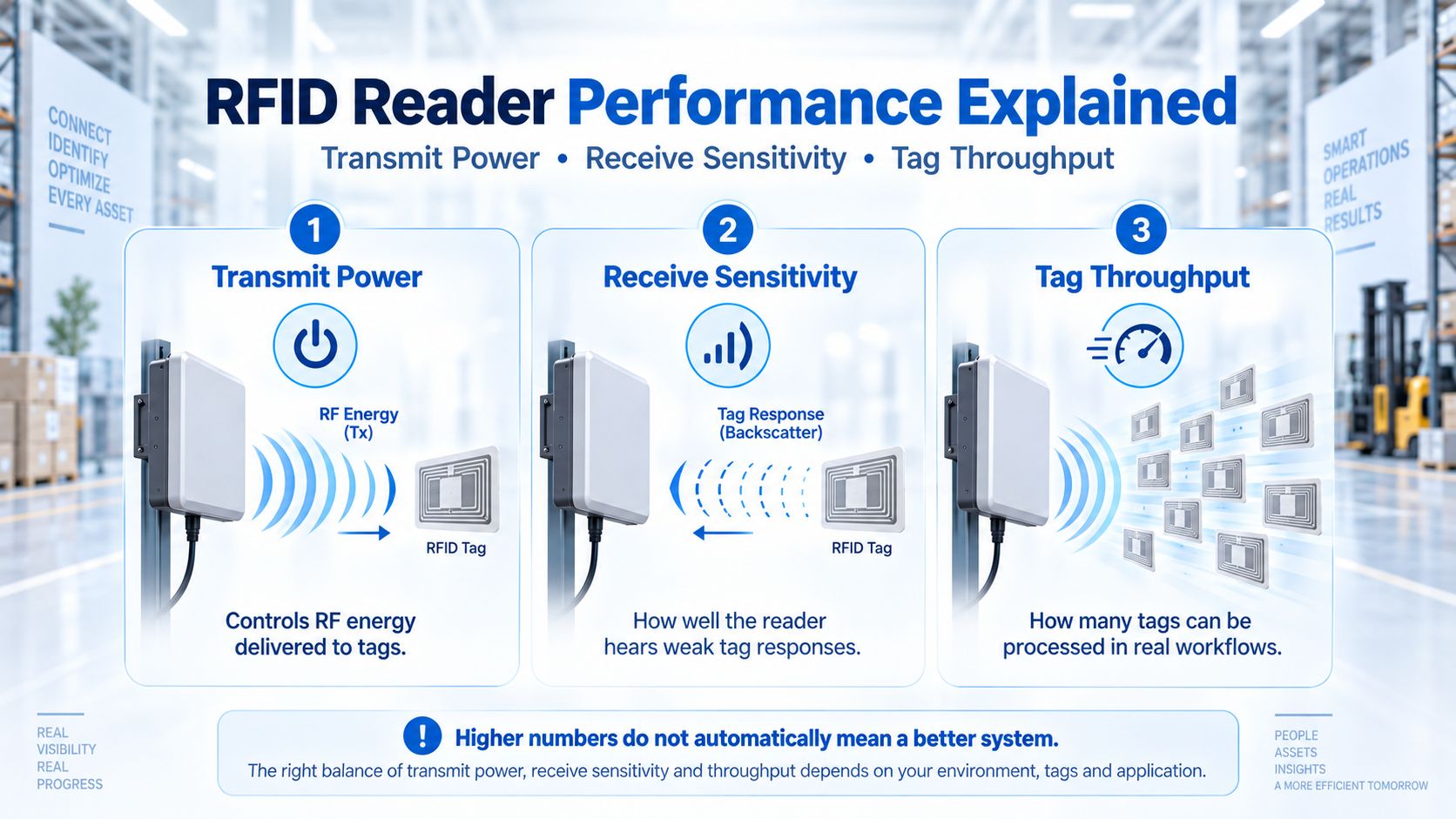
These three specifications solve different parts of the RFID problem.
| Parameter | What It Describes | Why It Matters |
|---|---|---|
| Transmit Power | Energy delivered toward tags | Helps energize tags and shape read distance |
| Receive Sensitivity | Ability to detect weak tag responses | Influences return-link performance |
| Tag Throughput | Ability to inventory many tags efficiently | Important in dense and moving populations |
Do not select a reader using only one specification.
The best reader is the one that delivers reliable performance in the actual deployment.
The fixed reader does not create the final read zone by itself.
The external antennas do.
Important antenna characteristics include:
Useful when tag orientation varies.
Typical applications:
Can provide strong performance when tag orientation is highly controlled.
Typical applications may include:
Useful where the RFID system needs short, tightly controlled coverage.
Examples:
Can support stronger directional coverage.
Suitable for:
But higher gain is not automatically better for every installation.
For detailed antenna guidance, see How to Select the Right RFID Antenna.
A useful model is:
Reader RF Output
↓
Cable Loss
↓
Antenna Gain
↓
RF Field
↓
RFID Tag
The tag response then returns through:
Tag Backscatter
↓
Reader Antenna
↓
RF Cable
↓
Reader Receiver
This means cable selection matters.
An unnecessarily long, high-loss cable can reduce usable RF performance.
For more detail, see RFID Cables, Connectors and Adapters.
You can also review the complete system-level relationship in RFID System Architecture: Components, Data Flow and Hardware Selection.
A fixed RFID reader is part of a larger automation system.
The reader therefore needs to communicate with:
Common interfaces include:
Syncotek fixed-reader families include combinations of USB, serial communication and Ethernet, with SDK/OEM support for integration.
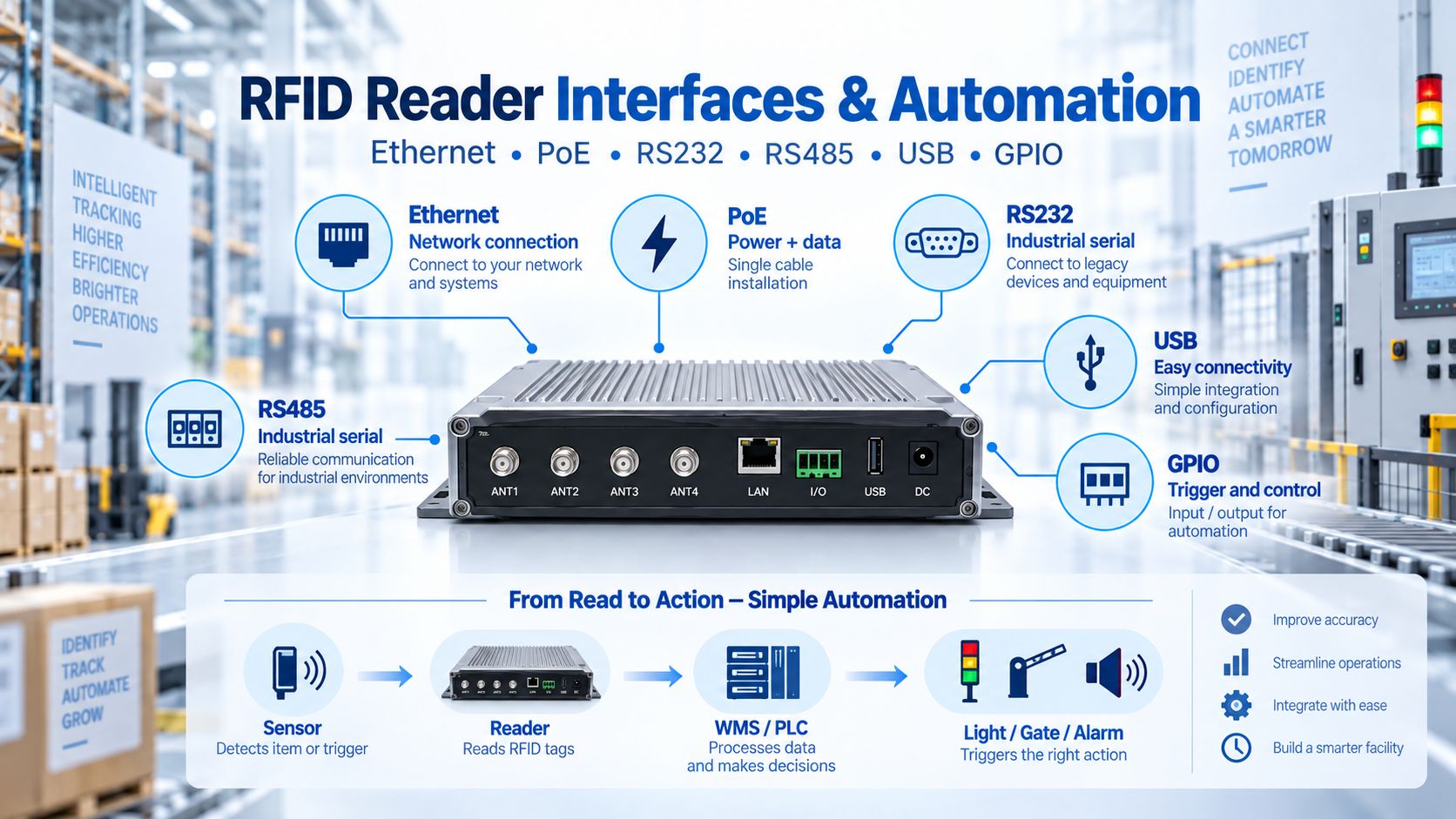
Ethernet is commonly used for industrial fixed-reader installations.
Advantages include:
Warehouse readers often use Ethernet because readers remain permanently installed.
RS232 is useful for:
RS485 is common in industrial automation where:
are important.
USB is convenient for:
GPIO is extremely useful in automated RFID installations.
It allows the reader to exchange digital signals with physical equipment.
Inputs may come from:
Outputs may control:
A portal might operate as:
Pallet Approaches
↓
Photoelectric Sensor Activates
↓
RFID Reader Starts Inventory
↓
Tags Captured
↓
WMS Verifies Shipment
↓
If Correct:
Green Light + Continue
If Incorrect:
Red Light + Stop / Alert
This is very different from a reader that simply scans continuously.
The value comes from connecting RFID with the actual physical workflow.
PoE means Power over Ethernet.
It allows both network communication and electrical power to use one Ethernet connection.
This can simplify fixed installations where running separate power cables is difficult.
Potential applications include:
PoE can reduce installation complexity, but power architecture should still be checked against:
Syncotek's integrated-reader product families include PoE/RJ45 options alongside industrial serial interfaces.
Hardware specifications receive most of the attention during purchasing.
Software support is often equally important.
Before purchasing a fixed RFID reader, determine:
A high-performance reader that takes months to integrate can be a worse choice than hardware with slightly lower theoretical specifications but strong SDK support.
Syncotek currently positions SDK support and OEM integration as core capabilities across its fixed reader and reader-module portfolio.
Traditional RFID architecture often looked like:
RFID Reader
→
Middleware Server
→
Enterprise Application
Modern systems can move more processing toward the edge.
For example:
RFID Reader / Edge Controller
→ Filter Duplicate Reads
→ Apply Zone Logic
→ Generate Business Event
→ API
→ WMS
The important principle is not whether the processing runs on a reader, gateway or server.
The important principle is:
Do not send meaningless raw RFID observations directly into business software.
Enterprise systems need events such as:
Pallet 10018 entered Shipping Zone.
not:
EPC 3008... detected 137 times.
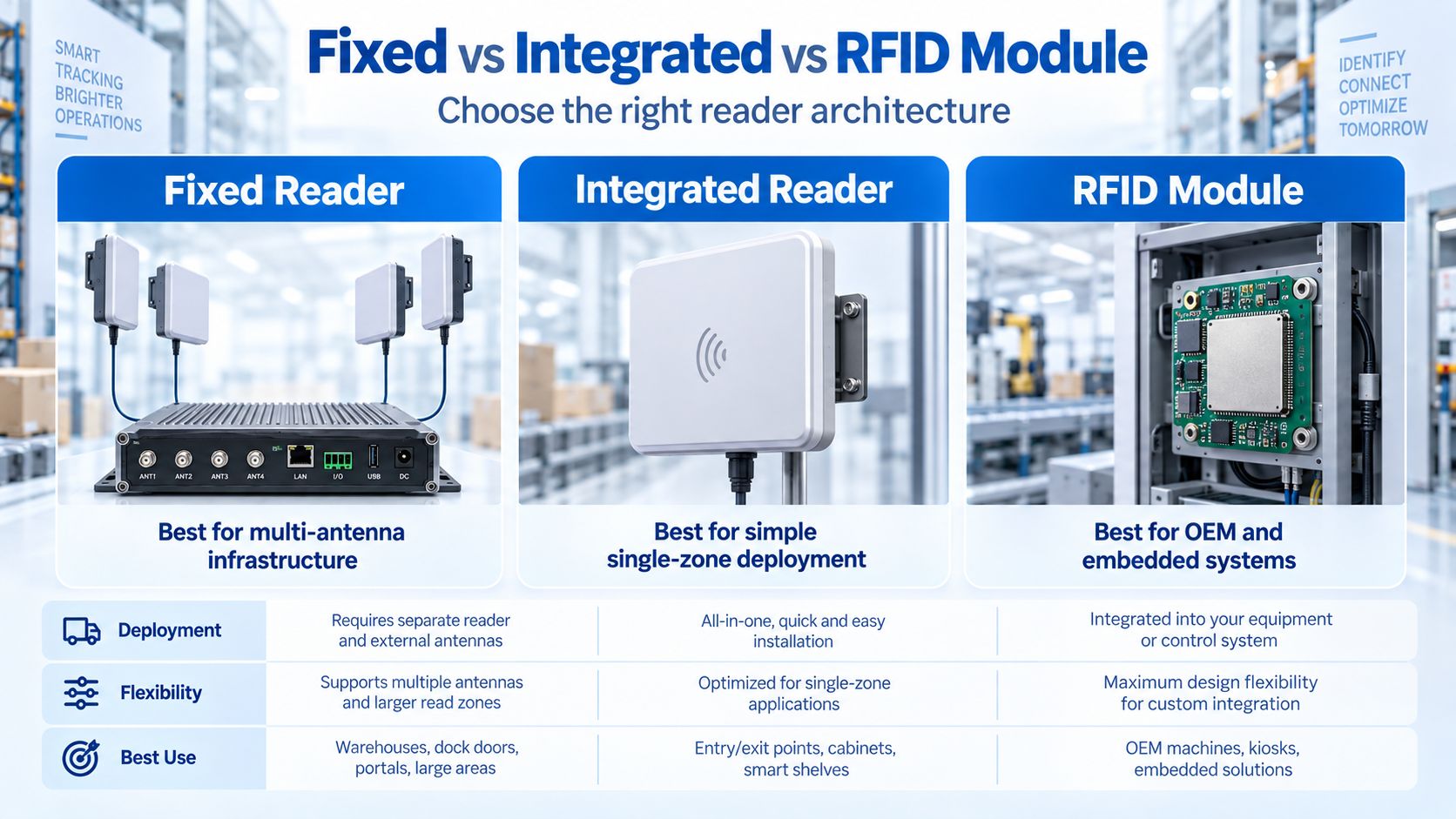
Not every RFID project should use a finished fixed reader.
Sometimes an integrated reader or UHF module is a better architecture.
| Architecture | Main Advantage | Typical Applications |
|---|---|---|
| Fixed Reader | Multi-antenna flexibility | Warehouse, portal, production line |
| Integrated Reader | Simple all-in-one installation | Access point, gate, single zone |
| UHF Reader Module | Maximum OEM integration flexibility | Cabinet, machine, printer, kiosk |
Choose a fixed reader when you need:
Examples:
An integrated reader combines:
Reader + Antenna
in one enclosure.
This reduces:
Suitable applications include:
Syncotek's integrated-reader range currently combines built-in antennas with UHF reader electronics and includes configurations with Ethernet/PoE and serial interfaces.
A module is intended to be embedded inside another product.
Applications include:
The OEM controls:
Syncotek's current UHF module portfolio includes architectures from single-port devices through 4-, 8- and 16-antenna configurations, with RF power options reaching 33 dBm on selected models.
A practical starting framework is:
| Reader Architecture | Typical Application |
|---|---|
| 4 Port | Dock door, small portal, workstation |
| 8 Port | Smart cabinet, shelves, production cell |
| 16 Port | High-density cabinet, large multi-zone system |
Warehouse dock door:
Antenna 1
left
Antenna 2
right
Antenna 3
upper coverage
Antenna 4
lower or opposite coverage
Smart inventory cabinet:
or:
Large automated storage system:
Again:
More ports do not automatically equal better performance.
Select ports according to the physical antenna architecture.
Different use cases prioritize different reader capabilities.
Typical priorities:
Optional:
Important factors include:
Priorities:
Eight or sixteen antenna ports may be useful when many cabinet zones need independent coverage.
Important requirements can include:
A useful system may combine:
Fixed Reader
for issue/return doorway
Handheld Reader
for inventory and asset searching.
See RFID Tool Tracking for the complete workflow.
An integrated reader may sometimes be more suitable than a separate fixed reader because:
Always select architecture from the application, not from one preferred product type.
Warehouse systems commonly need automatic events around:
A typical receiving portal can operate as:
Tagged Pallet
→ Doorway
→ Reader Antennas
→ Fixed Reader
→ Middleware
→ WMS Receiving Event
At shipping:
Expected Order
vs
Detected EPCs
can be compared automatically.
This is one reason fixed readers are particularly valuable in logistics applications.
Manufacturing RFID systems may use fixed readers at:
The reader identifies the workpiece.
The MES then retrieves:
RFID should not be presented as automatically determining product quality.
It ensures that the correct physical product is connected with the correct manufacturing record.
See RFID in Manufacturing for a broader workflow guide.
Smart cabinets are particularly interesting because antenna count becomes a major design variable.
A cabinet may need to distinguish:
This can require:
depending on cabinet design.
The goal is usually:
Detect everything inside this controlled cabinet while preventing cross-reads from outside.
Therefore:
RF control is more important than maximum read distance.
Many buyers compare readers using only:
A better comparison should include:
| Selection Factor | What to Check |
|---|---|
| Antenna Ports | Does it support the required physical zones? |
| RF Power | Is power adjustable for the target read zone? |
| Receive Performance | Can weak tag responses be captured reliably? |
| Tag Throughput | Is it sufficient for the tag population and speed? |
| Frequency | Does it match the deployment region? |
| Ethernet | Is network integration required? |
| Serial Interfaces | Is PLC / industrial integration required? |
| GPIO | Are sensors, lights or gates involved? |
| PoE | Would one-cable installation help? |
| SDK / API | Can the reader integrate with your software? |
| Operating Environment | Indoor, outdoor, cabinet or industrial? |
| Antenna Expansion | Is future zone expansion expected? |
| OEM Support | Is customization required? |
This produces a much more useful engineering comparison.
Published reader distance should be treated as a reference, not a universal guarantee.
Practical read performance depends on:
Reader
RF Power
RF Cable
Reader Antenna
RFID Tag
Asset Material
Tag Placement
Orientation
Environment
A reader advertised as "long range" cannot compensate for:
The complete RFID system must be tested.
Define the read zone first.
Unused ports add cost without improving performance.
Trying to cover too many physical zones with too few antennas may create poor RF geometry.
Tune RF power to the workflow.
RFID communication must work in both directions.
The reader and antenna do not operate independently.
Automated portals often work better with physical triggers.
Tag orientation must be considered.
Integration cost can exceed hardware cost.
The reader must be configured for the actual deployment country.
Do not overengineer simple single-zone applications.
OEM devices often benefit from an embedded architecture.
Datasheets cannot reproduce your warehouse.
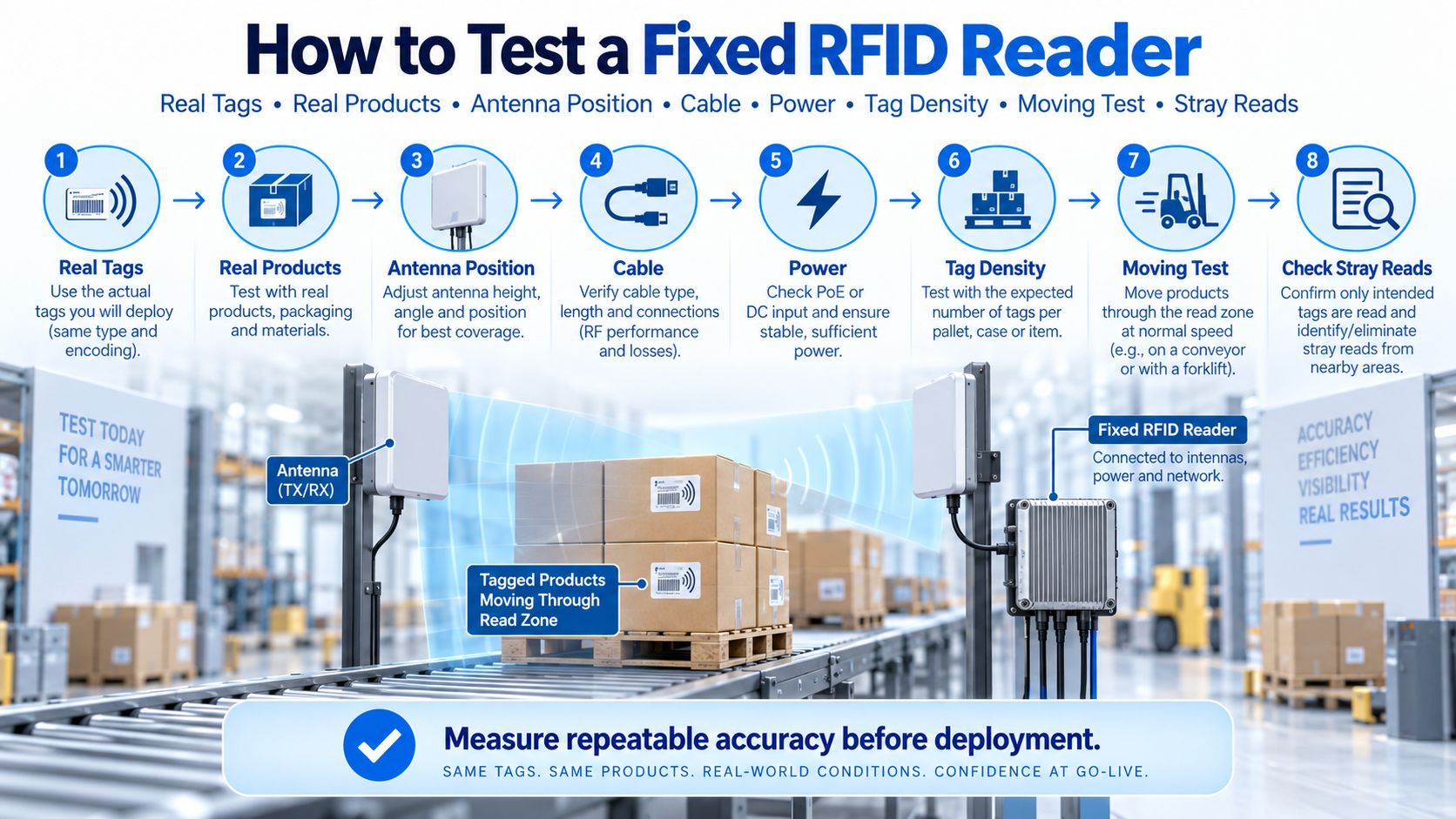
A fixed reader should be validated in conditions that match the final deployment.
Do not test with random laboratory labels if the final project will use:
Test the actual:
Material changes RF performance.
Match:
to the planned installation.
Cable length and construction affect system loss.
Test several levels.
Find the lowest practical setting that still delivers reliable coverage.
Do not test one tag if production will contain 300 tags.
Reproduce realistic:
If products will move:
reproduce that motion and speed.
This is one of the most important tests.
Verify that the system does not unintentionally detect:
Do not base deployment on one successful test.
Measure repeatable performance.
The correct objective is:
Reliable Operational Read Zone
not:
Longest One-Time Read
A basic test sheet can look like this:
| Test | Power | Antenna | Tag Count | Speed | Intended Read | Stray Reads | Result |
|---|---|---|---|---|---|---|---|
| Test 1 | Low | A1-A2 | 20 | Static | Pass | None | Pass |
| Test 2 | Medium | A1-A4 | 100 | Moving | Pass | 2 nearby | Adjust |
| Test 3 | Tuned | A1-A4 | 100 | Moving | Pass | None | Pass |
This is much more useful than comparing catalog specifications alone.
To receive a useful recommendation, provide more than:
We need a long-range RFID reader.
A good inquiry should include:
Examples:
Required to select the appropriate UHF region.
Explain:
Specify the real operational range.
If known.
Otherwise provide the physical layout.
For example:
How many tags may be present at once?
If moving, provide approximate speed.
Examples:
Do you need:
Is separate power available?
Examples:
Describe how your software will communicate with the reader.
Provide:
This information allows the reader architecture to be narrowed before hardware testing begins.
Before confirming a reader, verify:
A fixed RFID reader is permanently installed RFID infrastructure used to communicate with passive UHF tags through one or more antennas.
It depends on the physical read zones. Four ports are common for smaller portals, while eight or sixteen can be useful for cabinets and complex multi-zone systems.
Not automatically. The correct reader is the one with enough antenna ports for the physical design. Unused ports provide no RF benefit.
No. Excessive power can create stray reads and overlapping zones. Reader power should be tuned to the intended read area.
It describes the reader's ability to detect weak returned tag signals. Practical performance still depends on tags, antennas, cables and the environment.
It describes reader inventory throughput under defined conditions. Real-world results depend on tag population, dwell time, movement, tag orientation and RF conditions.
Most conventional fixed readers use external antennas. Integrated readers contain a built-in antenna.
A fixed reader offers flexible external antenna placement and multi-zone coverage. An integrated reader combines the reader and antenna into one enclosure for simpler installation.
A fixed reader is a finished device. An RFID module is designed to be embedded into OEM equipment such as cabinets, printers, kiosks and machines.
GPIO connects the reader with sensors, switches, lights, relays, gates and other automation hardware.
Power over Ethernet allows compatible readers to receive both network connectivity and electrical power through Ethernet infrastructure.
Requirements vary, but common interfaces include Ethernet, RS232, RS485, USB and GPIO.
A multi-port fixed reader with suitable external antennas, Ethernet and often GPIO/trigger support is a common starting architecture.
Depending on shelf count and zone design, a fixed reader or embedded module with several antenna ports may be appropriate.
Fixed readers or embedded UHF modules are common. PLC/serial integration, GPIO, antenna architecture and continuous-operation requirements should be considered.
An embedded UHF RFID module often provides the greatest integration flexibility.
There is no universal distance. Performance depends on reader power, antennas, cables, tag sensitivity, object material, tag orientation, environment and regional regulations.
Modern passive UHF deployments commonly use EPC UHF Gen2, which is maintained in close alignment with ISO/IEC 18000-63.
Use the real tags, products, antenna positions, RF cables and expected tag density. Test realistic movement and verify both intended reads and stray reads.
Yes. A pilot installation is strongly recommended before large-scale deployment.
Syncotek provides UHF RFID hardware for system integrators, software companies, warehouse automation providers, manufacturers and OEM equipment developers.
Our fixed RFID infrastructure includes:
Selected Syncotek fixed-reader families support:
The correct reader depends on your actual read zone.
For example:
Dock Door
→ 4-port fixed reader may be sufficient
Multi-Shelf Smart Cabinet
→ 8 or 16 antenna architecture may be more suitable
Simple Single-Zone Gate
→ integrated reader may reduce installation complexity
Custom Machine or OEM Product
→ embedded UHF module may provide better design flexibility
Instead of selecting hardware from maximum range alone, send us your:
We can narrow the appropriate reader architecture for pilot testing.
Explore Syncotek UHF RFID Fixed Readers or browse the complete Syncotek RFID product portfolio for your RFID infrastructure project.
 Knowledge
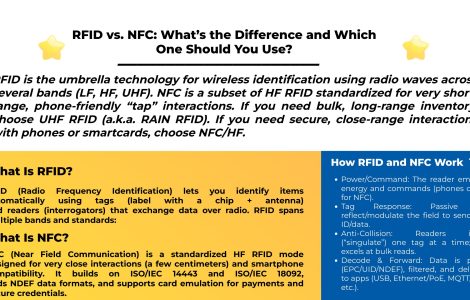
Learn the real differences between RFID and NFC—frequencies, range, security, smartphone compatibility, data models, and use cases. See when to choose UHF RFID (RAIN) vs. NFC, and how Syncotek readers fit your project.
READ MORE Knowledge
Industrial laundries, hospitals, hotels, uniform rental companies, nursing facilities, and textile service providers process large volumes of garments and linens every day. These textile items move continuously between customers, collection points, sorting areas, washing machines, dryers, ironing systems, storage rooms, and distribution vehicles. Without reliable identification, it can be difficult to know how many items […]
READ MORE Knowledge
Large events require thousands of physical interactions to happen accurately and quickly. Attendees must receive valid credentials, enter through the correct gates, access the areas included in their ticket, attend sessions, purchase food or merchandise, interact with sponsors, and leave the venue safely. At the same time, organizers need visibility into: ticket validation attendee arrival […]
READ MORE Knowledge
RAIN RFID systems have been built around EPC UHF Gen2 for many years, but today's deployments are becoming more demanding. Modern applications may need to identify: hundreds of items moving through a dock door small RFID tags attached to difficult products densely packed inventory items containing metal or liquids specific tag populations without inventorying everything […]
READ MORE Knowledge
A successful RFID project should not begin by purchasing readers. It should begin with a business problem. Companies often approach RFID projects with a requirement such as: We want to use RFID in our warehouse. That is not yet an RFID requirement. A much more useful project definition would be: We need to verify whether […]
READ MOREIf you are interested in our services or need customized solutions, please feel free to contact us.