

Reusable totes, bins, crates and returnable containers are easy to overlook because they are not usually the products being sold.
But in many warehouses and manufacturing supply chains, they are valuable operational assets.
A company may own 5,000 reusable totes and still struggle to answer basic questions:
When these movements are managed with spreadsheets, manual barcode scans or periodic counts, the digital record can quickly fall behind the physical flow.
RFID tote tracking gives every suitable reusable container a persistent electronic identity.
A typical architecture is:
Reusable Tote
→ RFID Tag
→ Handheld or Fixed RFID Reader
→ Middleware
→ WMS / ERP / RTI Management Platform
→ Tote Status and Movement History
The important point is that RFID tracks the container itself.
If a business also needs to know what is currently inside the tote, software must associate the tote identity with the products, order, work order or batch being carried.
That distinction is fundamental to designing a reliable RFID tote tracking system.
RFID tote tracking uses an RFID tag attached to a reusable tote, bin, crate or similar transport asset to give each container a unique electronic identity.
The system can then record RFID read events as the tote moves through locations such as:
A tote record may contain or reference information such as:
The RFID tag itself does not need to store all of this information.
In most systems, the tag stores or represents a unique identifier while detailed operational data is maintained in the backend system.
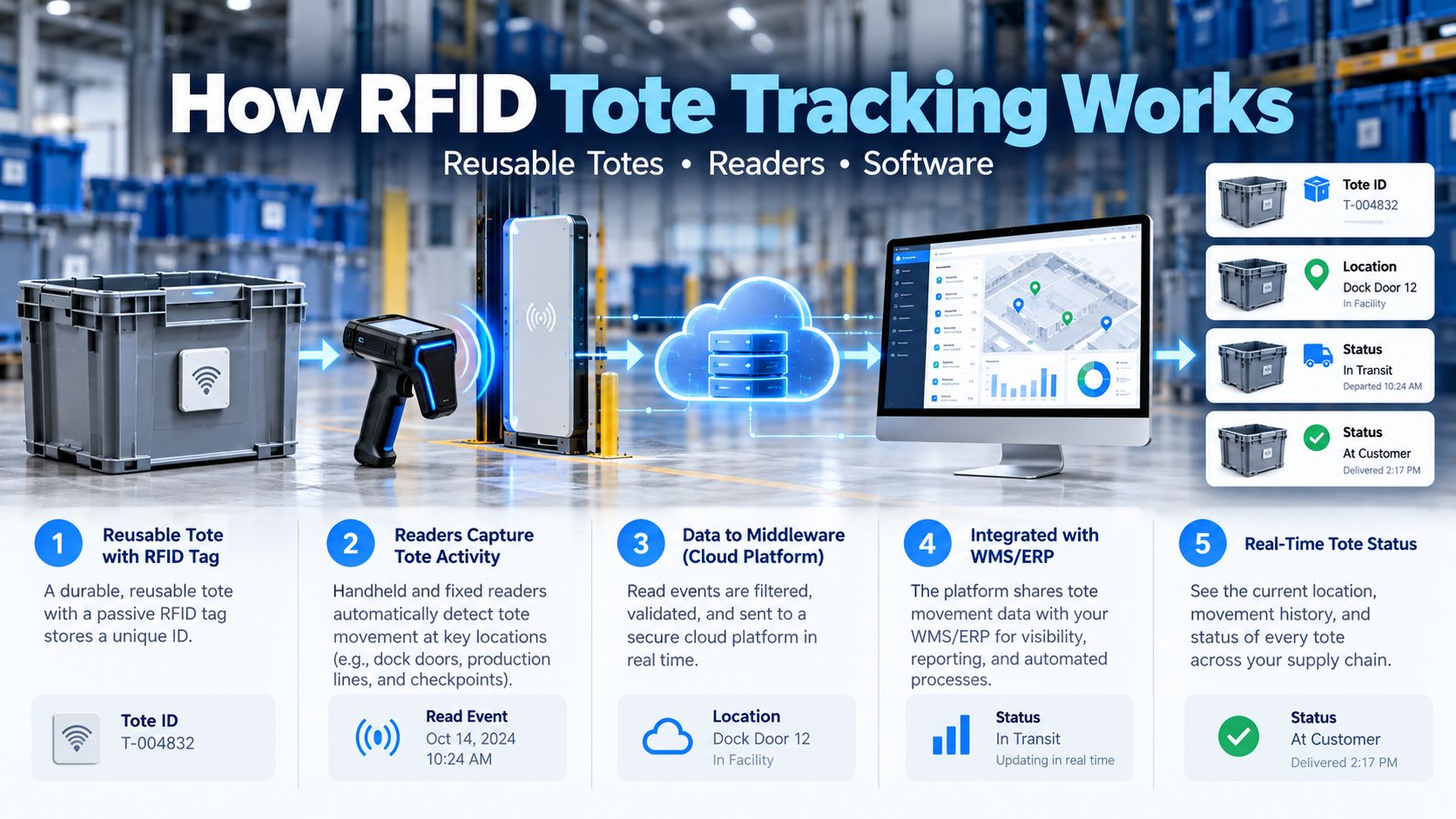
A basic system can be divided into five layers.
The physical asset may be:
A passive UHF / RAIN RFID tag is attached to the tote.
Its main purpose is to provide a persistent electronic identity.
The tag may be captured using:
The appropriate reader depends on the workflow.
Raw RFID observations are converted into meaningful events.
For example:
EPC detected by Reader 08
becomes:
Tote T004832 entered Receiving Dock 12
The business application determines what the event means operationally.
For example:
Tote T004832
Status: Returned
Location: Plant A
Condition: Pending Inspection
Contents: Empty
This separation between RFID identification and business logic is important.
RFID identifies the physical tote.
Software manages its operational state.
Tote tracking and inventory tracking are related, but they are not the same problem.
| Tote Tracking | Inventory Tracking |
|---|---|
| Tracks the reusable container | Tracks goods or products |
| Container identity remains persistent | Product identity may change every shipment |
| Focuses on return and availability | Focuses on stock quantity and movement |
| Can track full and empty states | Normally focuses on goods present |
| Example: Tote T1008 | Example: Part SKU A102 |
| Asset may circulate for years | Product may leave the supply chain after sale |
A tote can carry many different products during its life.
For example:
Cycle 1
Tote T1008
→ Part A × 50
After unloading:
Tote T1008
→ Empty
Next cycle:
Tote T1008
→ Part B × 30
The tote identity remains unchanged.
The contents association changes.
This is why returnable-container tracking should not be designed simply as another SKU inventory process.
Several terms are used for reusable logistics assets.
Usually a reusable plastic container used to move goods between:
Often used for smaller parts, components or warehouse storage.
Usually larger and potentially more rugged, especially in food, automotive and industrial supply chains.
Often used for:
A reusable load carrier for cartons, crates or other goods.
A wheeled reusable transport asset used in:
RTI commonly means Returnable Transport Item.
It is the broader category that can include:
GS1 defines GRAI specifically for returnable assets such as reusable trays, crates, pallets and similar transport equipment that are used and returned for reuse.
So while this guide uses "tote tracking" as the main term, the same architecture can apply to many RTI and reusable-packaging projects.
A tote should be tracked through its entire operating cycle, not only while it contains products.
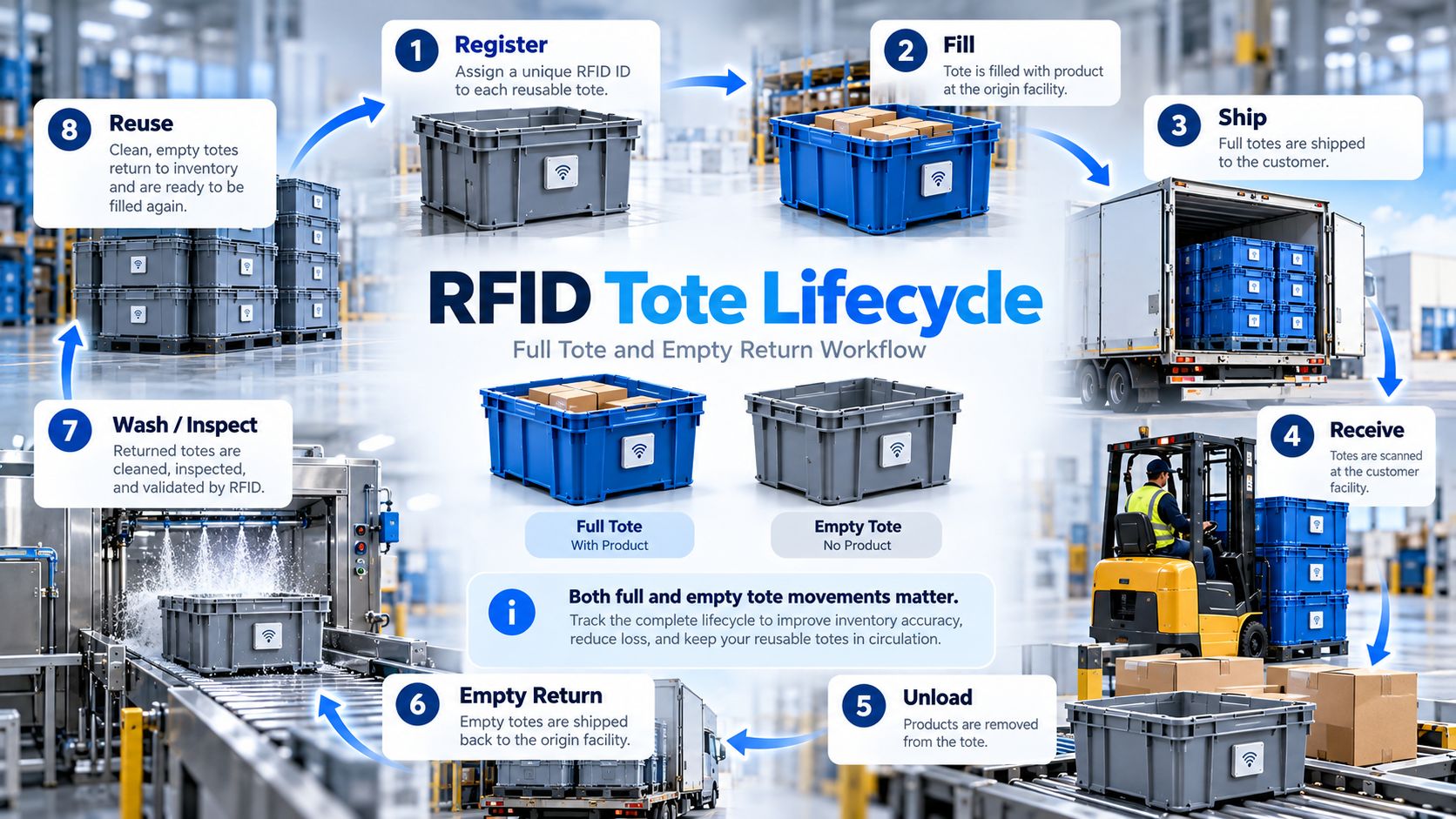
A typical lifecycle is:
Register
→ Store
→ Fill
→ Ship
→ Receive
→ Unload
→ Empty Return
→ Wash / Inspect
→ Available
→ Reuse
Every stage matters.
A new reusable container enters the tote pool.
The business assigns:
The empty tote is available for use.
Products or components are assigned to the tote.
The filled tote leaves the warehouse, factory or supplier.
The receiving facility identifies the tote electronically.
Products are removed.
The container itself must now return.
Some totes require:
before reuse.
The same container starts another cycle.
A good RFID tote tracking system therefore manages both:
Product Flow
and
Empty Container Return Flow
The empty return process is one of the biggest differences between reusable-container management and conventional inventory tracking.
A full tote may be associated with:
For example:
Tote T0084
→ Work Order WO-1258
→ Part A × 40
After unloading:
Tote T0084
→ Contents = Empty
But the tote is still valuable.
The organization still needs to know:
This creates an important rule:
A reusable tote should remain visible even when it contains no inventory.
If the system stops tracking the asset as soon as products are removed, it is not really managing the tote lifecycle.
RFID can reduce manual container counting at receiving points.
A typical workflow is:
Truck Arrives
→ Forklift Moves Totes Through RFID Read Zone
→ Reader Detects Tote IDs
→ System Compares Expected vs Detected
→ Receiving Record Updated
For example:
Expected:
80 totes
Detected:
78 totes
Exception:
2 missing
The system can immediately flag the discrepancy for investigation instead of discovering it during a later inventory count.
A shipping process may look like:
Empty Tote Selected
→ Products Loaded
→ Tote Associated With Shipment
→ Tote Passes Shipping RFID Portal
→ System Verifies Tote
→ Dispatch Event Recorded
The system can know:
This becomes especially useful when reusable containers circulate outside the company's own facility.
Return logistics is often where reusable packaging management becomes difficult.
A typical process is:
Customer / Supplier Holds Empty Tote
↓
Tote Returned
↓
RFID Read at Receiving
↓
Status = Returned
↓
Inspection / Cleaning
↓
Available
The system can automatically separate:
Without this workflow, companies may continue buying new totes even though large quantities of existing containers are simply sitting at another partner's location.
Many reusable-tote systems operate across several organizations or facilities.
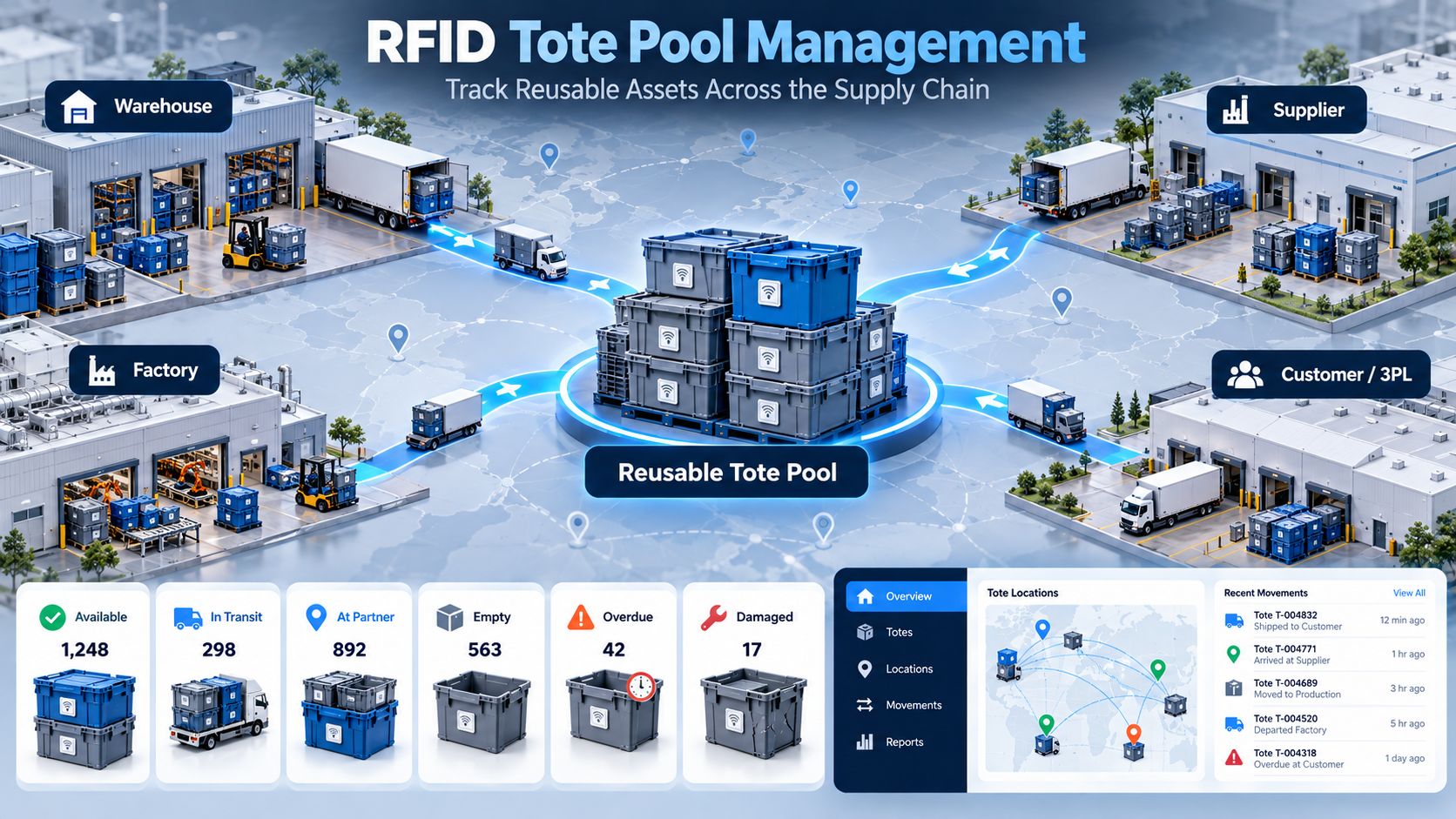
A typical network may include:
Warehouse
↔ Supplier
↔ Factory
↔ 3PL
↔ Customer
Instead of thinking only in terms of individual tote locations, the business can manage the whole asset pool.
For example:
| Location / Status | Quantity |
|---|---|
| Available at Plant A | 840 |
| At Supplier A | 325 |
| At Supplier B | 180 |
| In Transit | 240 |
| Empty at Customer | 420 |
| Overdue | 62 |
| Damaged | 17 |
This provides a much better operational picture than:
We own approximately 5,000 totes.
A reusable-container shortage can create downstream problems such as:
In some operations, the problem is not that there are too few totes overall.
The problem is that the totes are in the wrong places.
RFID data can support better rebalancing decisions.
Consider:
Plant A:
800 empty totes available
Plant B:
40 available
Plant B needs:
300 tomorrow
The business can move empty totes before Plant B runs out.
This changes RFID tote tracking from:
Where did our tote go?
to:
How should we position the tote pool to support tomorrow's operation?
That is a much more valuable use of the data.
Organizations using GS1 identification standards should understand GRAI.
GRAI means:
Global Returnable Asset Identifier
It is designed for reusable assets such as:
and can support asset identification and tracking between companies.
A serialized GRAI can identify an individual physical asset.
For example:
Reusable Tote Type
plus
Individual Serial Number
This allows the business to distinguish:
Tote 0001
from:
Tote 0002
even if the two containers look identical.
GS1 also supports encoding identification keys such as GRAI for returnable assets into EPC/RFID tags.
GRAI and SSCC solve different identification problems.
Identifies the returnable asset itself.
Example:
Plastic Tote #00182
The same GRAI can remain associated with that tote across many reuse cycles.
SSCC means:
Serial Shipping Container Code
GS1 uses the SSCC to identify a logistic unit assembled for transport or storage, such as a case, pallet or other shipment unit.
The important difference is:
GRAI
→ persistent identity of the reusable asset
SSCC
→ identity of a logistics unit in a particular transport/storage context
A reusable tote may therefore have a persistent GRAI as an asset while shipment or logistics processes use SSCC where appropriate.
The exact implementation should follow the organization's GS1 and trading-partner requirements.
Plastic reusable totes are generally more RFID-friendly than metal containers, but that does not mean every RFID tag will perform equally well.
Factors include:
For long-life applications, a durable UHF hard tag may provide advantages over a thin disposable label.
The tag should match the lifecycle of the container.
If a tote is expected to survive thousands of handling events, the RFID attachment should not be the weakest part of the asset.
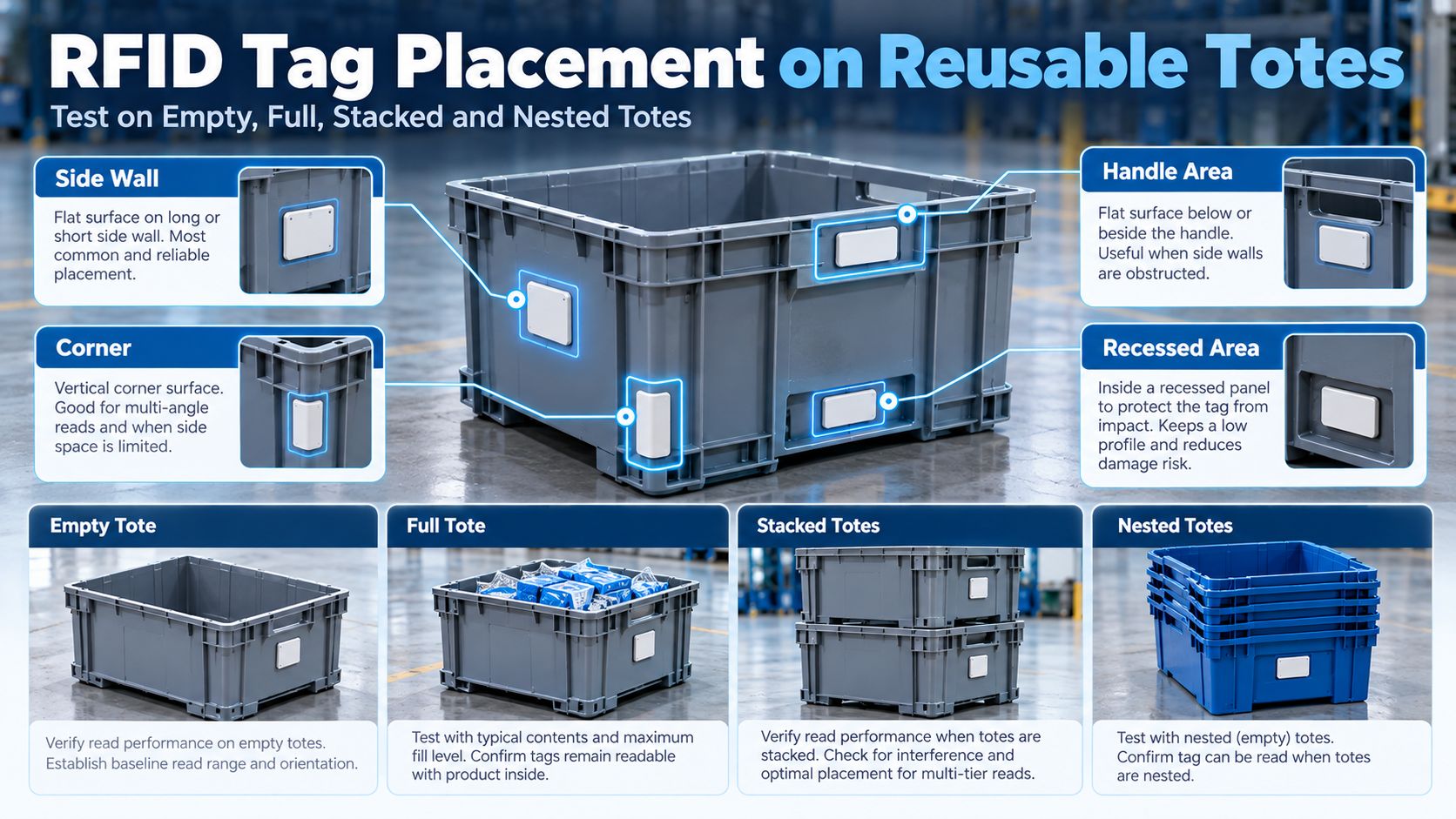
Possible tag positions include:
Often a good starting point because it provides:
Can provide useful multi-angle visibility depending on tag design.
Useful when normal side-wall space is limited.
A recessed mounting area can help protect the RFID tag from:
Mechanical protection can be just as important as RF performance.
Measure the baseline performance with an empty container.
Contents can substantially change RF performance.
A tote filled with:
may behave differently from one containing:
Containers may be transported in stacks.
Confirm tags remain readable in the expected configuration.
Many reusable plastic totes are nested inside one another during empty return.
This changes:
A tag position that works perfectly on one isolated tote may perform differently when 20 empty totes are nested together.
Therefore:
Test the final tote configuration, not just one empty tote on a table.
Plastic and metal containers require different tag strategies.
Standard or rugged UHF tag designs can often be evaluated.
A conventional UHF tag mounted directly on metal may become detuned.
Use a tag specifically designed for conductive surfaces.
For metal reusable containers, see:
For the complete selection process:
How to Choose the Right RFID Tag
Different reader architectures solve different problems.
Best suited to:
Example:
Operator walks through storage area
→ Handheld inventories totes
→ System compares expected vs found
Best suited to automatic movements such as:
Useful when a simple read point needs:
Reader + Antenna
in one compact device.
Useful for OEM systems such as:
For fixed-reader selection, see:
How to Choose a UHF RFID Fixed Reader
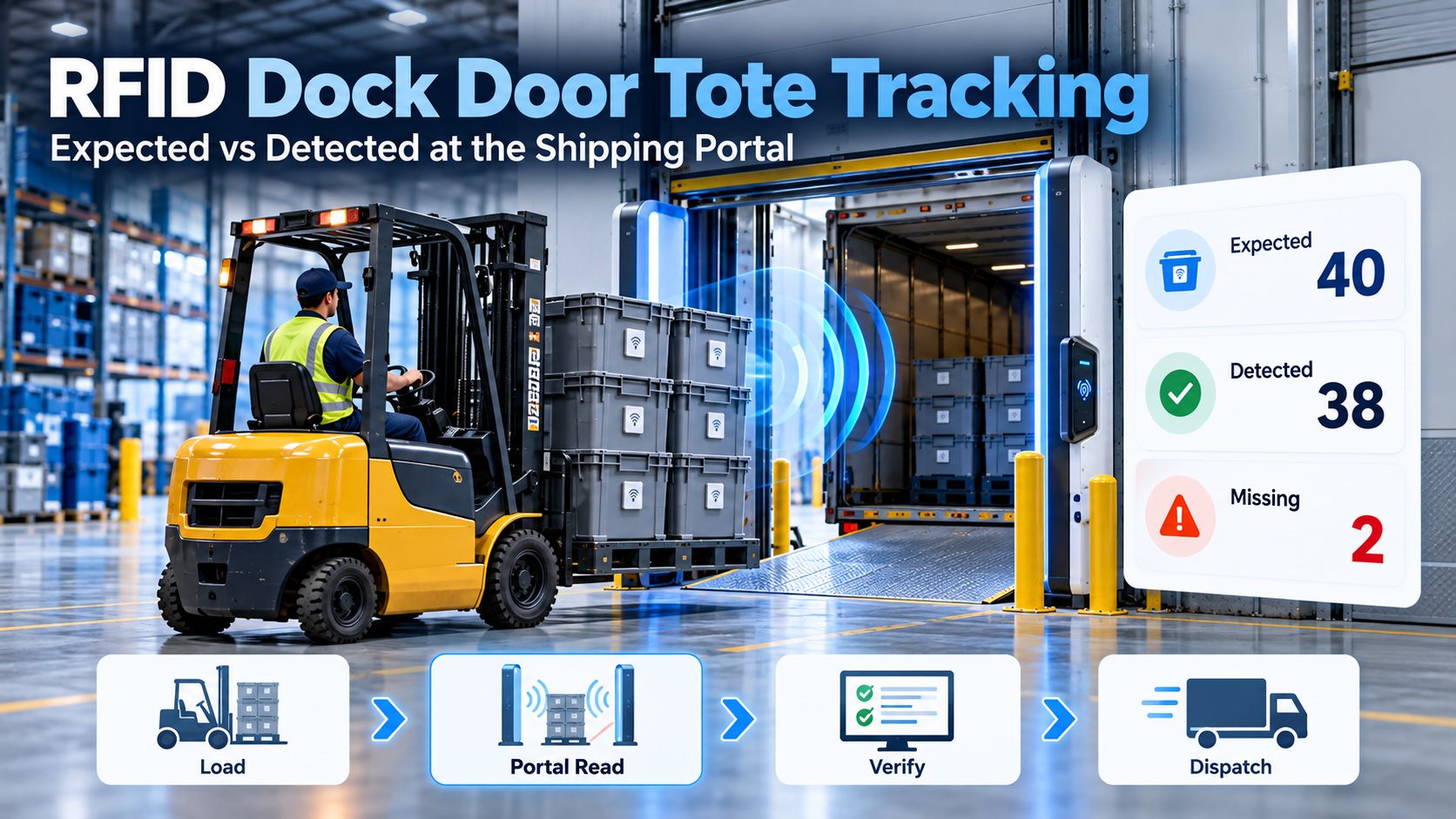
Dock doors are one of the highest-value locations for reusable-container RFID.
The read point captures an important physical transition:
Inside Facility
→
Outside Facility
or the reverse.
A shipping workflow can be:
Load Totes
→ Forklift Approaches Door
→ RFID Portal Reads Tags
→ Expected vs Detected Comparison
→ Dispatch
Example:
Expected:
40
Detected:
38
Missing:
2
The business can stop or investigate the shipment before it leaves.
RAIN RFID has been deployed commercially for large reusable-transport-item pools at dock doors, including systems that automatically register reusable trays and pallets as they enter and leave facilities.
The goal is not:
Read every RFID tag as far away as possible.
The goal is:
Read the totes passing through this dock door without reading unrelated totes nearby.
Important factors include:
This is a controlled read-zone problem.
If the portal detects totes waiting 5 meters away, simply increasing power will make the system worse.
For troubleshooting these issues, see:
RFID Interference and Read Problems
Conveyors provide another natural RFID read point.
A workflow may look like:
Photoelectric Sensor Detects Tote
→ Reader Activated
→ Tote ID Captured
→ System Retrieves Routing Instruction
→ PLC / Conveyor Controller
→ Tote Routed
This can support:
Unlike a dock door, conveyor systems often have:
That can make antenna placement easier, but throughput and timing become more important.
Reusable bins and totes are not only logistics assets.
They can also act as physical production carriers.
For example:
Tote T0075
↓
Associated with:
Work Order WO-1746
↓
Contains:
Component A × 30
↓
Moves to:
Production Station 4
The tote provides the persistent physical identity while software temporarily associates it with:
After the materials are consumed:
Association Closed
and the tote is available for another production cycle.
This architecture is particularly useful for:
For broader manufacturing workflows, see:
Automotive supply chains frequently rely on reusable containers.
A typical loop is:
Supplier
→ components loaded into tote
→ OEM / Tier Facility
→ components unloaded
→ empty tote
→ supplier return
The reusable container itself may become a bottleneck if:
RAIN RFID has been deployed in automotive returnable-container workflows specifically to improve container visibility and return management.
The technology does not eliminate the need for business rules.
It makes the physical asset movements easier to capture.
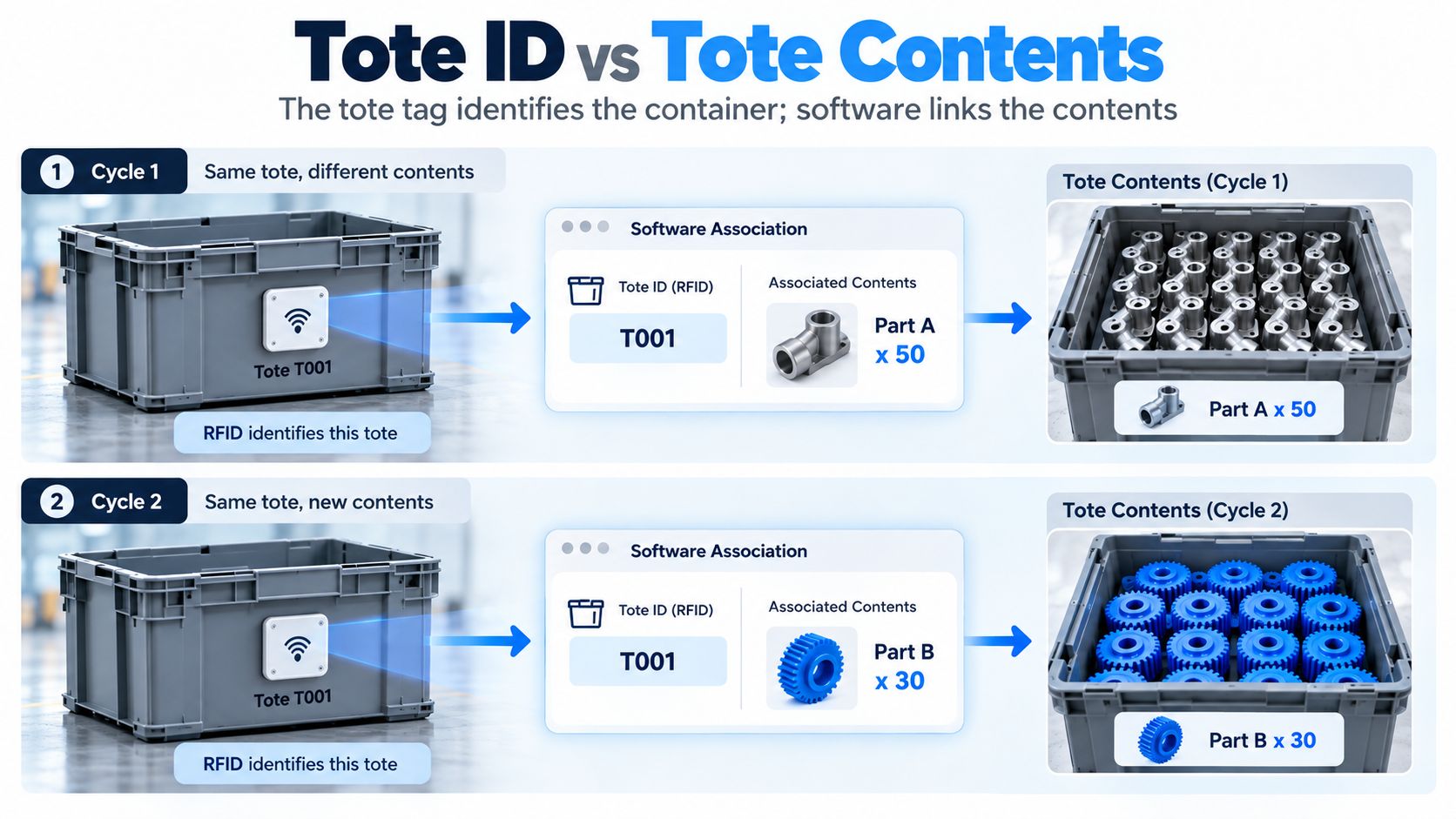
This is one of the most important concepts in RFID tote tracking.
The RFID tag attached to a tote identifies:
The tote.
It does not automatically know:
What is currently inside the tote.
A software association is required.
Tote T001
↓
Software Association
↓
Part A × 50
After unloading:
association is closed.
The same:
Tote T001
can now be associated with:
Part B × 30
The physical RFID tag does not need to change.
The business relationship changes in software.
Several approaches are possible.
Scan:
and create the relationship.
If individual products are also RFID-tagged:
Read Tote
Read Item Tags
→ Associate the item population with the tote.
A production system may assign:
Tote T020
to:
Work Order WO-8502
and therefore infer expected contents.
The WMS associates the tote with a shipment or order.
The correct method depends on the application.
No.
An RFID tag attached to a tote normally identifies the container itself.
To know its contents, the system must:
This distinction prevents one of the most common RFID project misunderstandings.
The term "real-time tracking" should be used carefully.
Passive UHF RFID can provide different levels of visibility depending on reader infrastructure.
Provides:
On-Demand Inventory
The tote is visible when an operator scans the area.
Provides:
Checkpoint / Last-Seen Visibility
Example:
Tote T4082
Last seen:
Dock Door 4
15:32
Provides:
Near-Real-Time Process Visibility
as totes move through known checkpoints.
If the requirement is:
Show the tote's exact moving coordinates continuously.
then a dedicated RTLS architecture may be required.
A passive UHF tag alone should not be described as a GPS-like tracker.
A reusable tote can accumulate valuable lifecycle information over time.
For example:
Tote T00521
Cycles:
428
Last Inspection:
2026-09-12
Current Condition:
Good
Last Wash:
2026-09-21
Current Status:
Available
This allows the business to move beyond simple location tracking.
A complete:
Outbound
→ Return
may represent one usage cycle.
The company can monitor:
Durable totes may require:
Serialized asset identification can help associate these records with the individual physical tote.
GS1 specifically notes that serialized GRAI can support lifecycle information such as maintenance and repair records for returnable assets.
A tote can eventually move to:
Retired
rather than simply disappearing from inventory.
This prevents inaccurate pool-size records.
In closed-loop or multi-partner supply chains, a tote can move outside the owner's direct control.
RFID can provide evidence such as:
Tote T0684
Last Seen:
Supplier B
Date:
September 10
Status:
Not Returned
This does not automatically prove liability.
But it provides better operational evidence than:
We think Supplier B may still have some containers.
A returnable-asset system can therefore support clearer reconciliation between:
GRAI is specifically designed to support returnable-asset identification across collaborative business relationships.
Barcode remains a valid technology for returnable-container management.
| Factor | Barcode | Passive UHF RFID |
|---|---|---|
| Unique tote ID | Yes | Yes |
| Equipment cost | Lower | Higher |
| Line of sight | Required | Usually not required |
| Individual scan | Usually required | Multiple tags can be inventoried |
| Automated dock door | More difficult | Strong |
| Bulk tote audit | Slower | Strong |
| Printed backup | Native | Can coexist with RFID |
| Read-zone engineering | Minimal | Required |
Barcode may be more appropriate when:
RFID is stronger when:
The correct choice depends on the workflow, not technology hype.
The empty return process is part of the asset lifecycle.
Define:
Available
Filled
In Transit
At Partner
Empty
Returned
Inspection
Damaged
Retired
before building software.
The content relationship requires software.
More power can create:
Empty-return configurations can change RF performance.
Test realistic shipment density.
Standardize one validated mounting position.
The system needs to distinguish:
Passive RFID typically provides inventory, checkpoint and zone visibility unless additional location infrastructure is deployed.
Damaged assets should not automatically return to the available pool.
Do not tag 100,000 totes before validating the complete workflow.
A good pilot should be small enough to troubleshoot but realistic enough to expose actual operational problems.
A practical pilot could include:
Evaluate:
Establish baseline reading performance.
Use the actual products.
Reproduce the final transport configuration.
Measure how quickly the tote pool can be audited.
Use real:
Verify the reader does not incorrectly capture unrelated totes.
Send pilot totes out and bring them back empty.
This is essential.
Confirm:
Tote ID
↔
Contents / Shipment / Work Order
works correctly.
Examples include:
Avoid generic statements such as:
RFID reduces tote costs by 50%.
The economics depend on the actual tote pool.
A better model is:
Reduced Tote Loss
Reduced Emergency Packaging Purchases
Reduced Manual Counting
Higher Tote Utilization
Fewer Reconciliation Disputes
Faster Receiving / Shipping
minus
RFID Tags + Readers + Installation + Software Integration
If durable containers are expensive, recovering even a relatively small percentage can matter.
Better visibility may reduce unnecessary purchasing by showing that enough totes already exist but are poorly distributed.
Automatic or handheld RFID inventory can reduce repetitive counting.
Dock-door identification can eliminate some manual tote scans.
Knowing where empty totes are located helps move them to locations that need them.
Before deployment, confirm:
RFID tote tracking assigns a unique RFID identity to each reusable tote, bin or crate so its movements, status and lifecycle can be captured electronically.
Yes. Reusable plastic bins are a common RFID asset-tracking application.
Yes. RFID can identify reusable crates and record movements through warehouses, factories and supply chains.
RTI generally means Returnable Transport Item, such as a tote, crate, tray, pallet, stillage or roll cage designed to circulate through repeated logistics cycles.
GRAI is the GS1 Global Returnable Asset Identifier used to identify reusable assets such as crates, pallets, trays and other returnable transport equipment.
Yes. GS1 identification keys for returnable assets can be represented in EPC/RFID implementations.
GRAI identifies a returnable asset itself. SSCC identifies a logistics unit established for transport or storage.
No. The tote RFID tag normally identifies the container. The system must associate the tote with its products, order, batch or work order.
Keep the RFID identity active after unloading and capture the tote again when it returns through receiving or another designated RFID read point.
Yes. Fixed or handheld read events can record when a tote enters or leaves facilities and which partner last received it.
Not automatically. Passive UHF RFID typically provides inventory, checkpoint, last-seen or zone visibility. Continuous precise coordinates may require a dedicated RTLS architecture.
The correct tag depends on tote material, size, contents, stacking, nesting, environment and required read distance. Durable UHF hard tags are often a useful starting point for long-life reusable totes.
Use an RFID tag specifically designed for metal surfaces.
Typical positions include the side wall, corner, handle area or a recessed protected region. Final placement should be validated on the actual tote.
Yes, but performance depends on tag position, tote contents, orientation and stack geometry. Test the actual stacked configuration.
It can, but nesting changes tag spacing and RF geometry. Nested empty totes must be included in pilot testing.
Handheld readers are useful for audits, searches and exception handling. Fixed readers are stronger for automatic dock-door, conveyor and transition-point tracking.
Yes. Software can use outbound and return events to maintain individual tote cycle histories.
Yes. A serialized tote identity can be associated with inspection, damage, repair and retirement status in the backend system.
Yes. Visibility into available, empty, in-transit and partner-held totes can help organizations decide where reusable containers need to be repositioned.
Compare project cost with measurable benefits such as fewer lost containers, lower emergency packaging purchases, reduced counting labor, better tote utilization and faster receiving or shipping.
Syncotek provides passive UHF RFID hardware for reusable-container, warehouse, manufacturing and return-logistics projects.
Our RFID portfolio includes:
A typical reusable-tote project may use:
Durable UHF Tote Tag
Handheld Reader
for pool inventory and exception handling.
More automated operations can add:
Fixed Reader + Antennas
at:
For an RFID tote tracking pilot, useful project information includes:
For example:
Tote Material: HDPE
Dimensions: 600 × 400 × 300 mm
Contents: Automotive Parts
Read Point: Dock Door
Empty / Full: Both
Nested Return: Yes
Quantity: 8,000
From this information, suitable RFID tag and reader architectures can be narrowed for real-world validation.
Continue with:
How to Choose the Right RFID Tag
How to Choose a UHF RFID Fixed Reader
RFID Interference Troubleshooting
The goal of RFID tote tracking is not simply to know that a tote exists.
It is to maintain a reliable digital identity for each reusable container across fill, shipment, receiving, empty return, inspection and reuse, so the tote pool remains available where the operation actually needs it.
 Knowledge
UHF RFID systems use radio waves to communicate between readers, antennas, and passive RFID tags. In a small installation with one reader, radio-frequency interference may be relatively easy to control. In a warehouse, factory, retail store, distribution center, or event venue with several readers operating at the same time, the RF environment becomes more complicated. […]
READ MORE Knowledge
Choosing an RFID tag should not begin with a catalog, chip model, or maximum advertised read distance. It should begin with the physical object and the workflow. The right RFID tag for a cardboard carton may fail when attached to a metal tool. A tag that performs well with a fixed reader and high-gain antenna […]
READ MORE Knowledge
An RFID system may work perfectly during initial testing and then behave very differently after it is installed in a warehouse, factory, smart cabinet or production line. Common symptoms include: tags read intermittently expected read distance becomes shorter several tags on a pallet are consistently missed tags outside the intended area are detected a system […]
READ MORE Knowledge
A modern data center may contain thousands of physical IT assets distributed across: rooms cages rows racks storage areas staging zones repair areas multiple facilities Servers, switches, storage appliances and network equipment are also moved, upgraded, replaced and decommissioned throughout their lifecycle. The challenge is not simply knowing how many devices the organization purchased. Data […]
READ MORE Knowledge
Medical device inventory is more complex than ordinary warehouse stock. A manufacturer may need to manage thousands of SKUs across raw materials, work-in-process, finished devices, warehouse locations, distributors, field inventory, hospital consignment stock, returns, and recalls. Many products also carry additional identification requirements involving: lot or batch number serial number expiration date manufacturing date UDI […]
READ MOREIf you are interested in our services or need customized solutions, please feel free to contact us.