

Businesses often know how many assets they purchased but have much less visibility into where those assets are, who is using them, whether they are available, when they were last inspected, or whether they still exist.
The problem appears across many industries.
A manufacturer may need to manage thousands of tools and fixtures.
An IT department may need to audit laptops, monitors, servers and network equipment.
A hospital may need visibility into medical devices and reusable equipment.
A logistics company may manage pallets, totes, bins and returnable containers.
A rental company needs to know what has been issued, returned, repaired or retired.
Traditional spreadsheets and barcode systems can manage these assets, but as the asset population grows, manual scanning and reconciliation can become increasingly time-consuming.
RAIN RFID asset tracking provides another approach.
By attaching a passive UHF RFID tag to each suitable asset, businesses can identify items electronically using handheld or fixed RFID readers without having to visually locate and scan every tag individually.
A typical system looks like:
Asset → RAIN RFID Tag → Reader → Middleware → Asset Management System
RAIN RFID can support:
However, one distinction is important:
RAIN RFID asset tracking is not automatically the same as a precise real-time location system.
Passive UHF RFID is especially strong for inventory, presence detection, checkpoint tracking and fast asset identification.
If the application requires continuous high-precision coordinates, a dedicated RTLS technology such as UWB, BLE, active RFID or another location system may be more appropriate.
RFID asset tracking uses electronic RFID identifiers to connect physical assets with digital asset records.
Instead of recording only:
Laptop — Quantity: 150
an asset-management system can track individual serialized items:
Laptop LT-10045 — Assigned to Engineering — Floor 2 — In Use
A typical asset record may contain:
The RFID tag provides the physical item with a unique electronic identity.
The detailed information does not have to be stored entirely on the RFID tag.
A more scalable architecture is:
RFID EPC / Unique ID
↓
Asset Database
↓
Asset Details and History
This makes the tag a persistent physical-to-digital link.
RAIN RFID refers to passive UHF RFID technology commonly used for automated identification of products and assets.
In a passive RAIN RFID system, the tag does not require a battery for normal communication.
The reader transmits RF energy.
The tag receives that energy and uses its antenna and IC to respond through backscatter.
The simplified communication process is:
RFID Reader
→ RF Energy and Command
→ Passive UHF Tag
→ Backscatter Response
→ RFID Reader
RAIN RFID is widely used where organizations need to identify large numbers of physical objects efficiently.
Typical applications include:
For a deeper explanation of the RF communication mechanism, see What Is RFID Backscatter?.
In many modern asset-tracking discussions, the terms RAIN RFID and passive UHF RFID refer to the same general technology ecosystem.
Typical enterprise RAIN RFID systems use passive UHF tags compatible with EPC Gen2 / ISO 18000-63 architectures.
The important practical point is not the terminology.
It is that this technology provides:
These characteristics make it particularly useful for large asset populations.
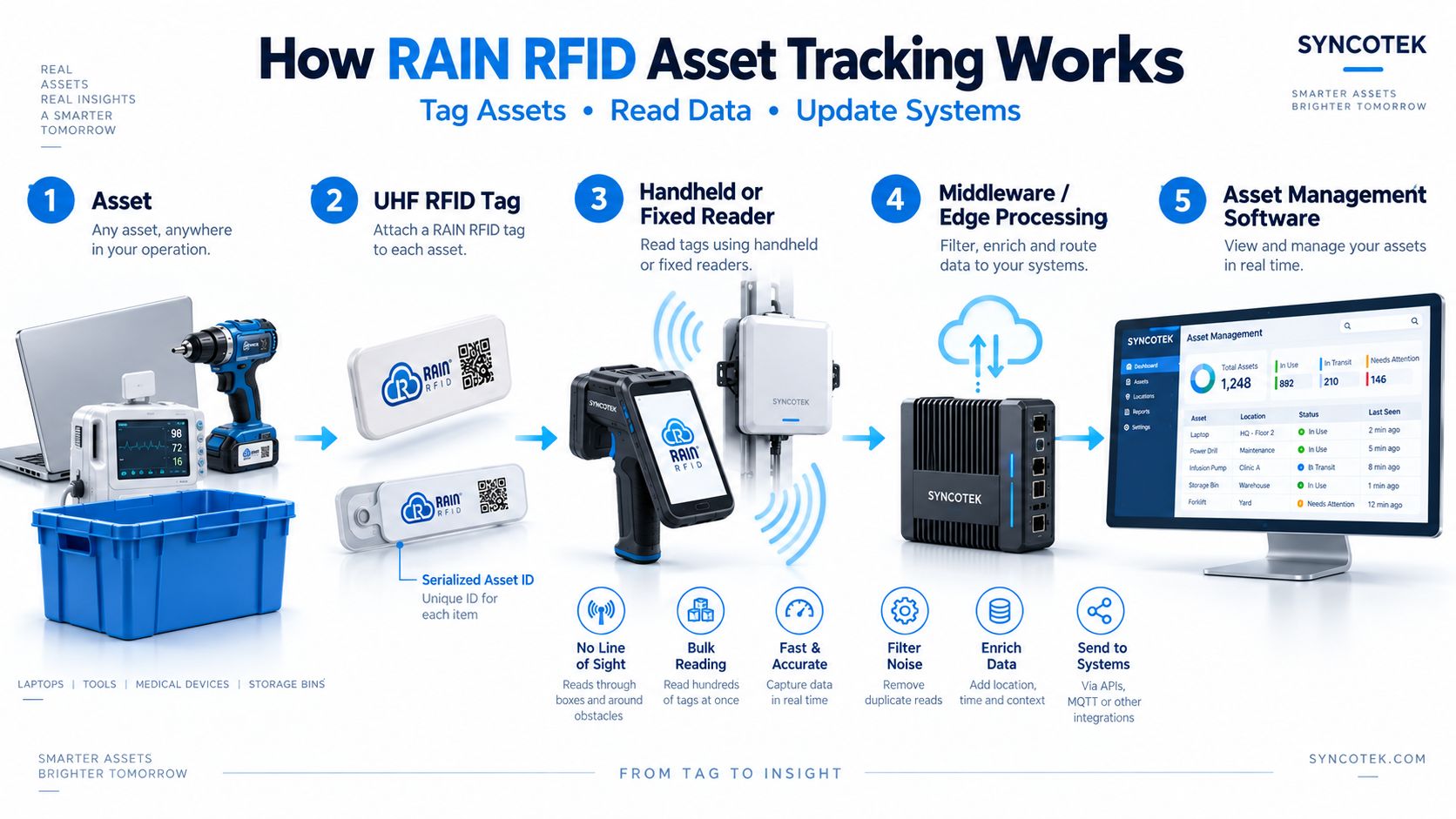
A RAIN RFID asset-tracking system can be divided into five layers.
The process starts with the real physical asset.
Examples include:
Each asset receives a unique RFID identity.
The selected tag may be:
The correct construction depends on the asset material and environment.
Compatible readers capture the tag identity.
The two most common formats for asset tracking are:
Handhelds are ideal for mobile audits and searching.
Fixed readers automate identification at selected locations.
The reader may detect the same tag repeatedly.
Middleware converts those raw RFID reads into useful events by:
Instead of sending:
EPC XYZ read 43 times
to the asset system, middleware can generate:
Asset LT-10045 detected at Equipment Room Door at 10:26.
The software maintains:
RFID provides the identification events.
The application determines how those events affect the business workflow.
RAIN RFID is especially valuable when the existing asset-management problem is caused by the amount of manual identification required.
Barcode scanners require the code to be visible.
The operator typically needs to:
RAIN RFID normally does not require direct optical line of sight.
The reader only needs an appropriate RF relationship with the tag.
This can make audits substantially easier when labels are:
A handheld UHF RFID reader can identify many compatible tags during an inventory sweep.
Instead of:
Find → Scan → Find → Scan
the workflow becomes:
Walk Through Area → Capture Tagged Assets → Reconcile Inventory
This is one of the strongest reasons to use RAIN RFID for large asset populations.
Passive UHF tags normally do not require a battery.
This provides several advantages for asset identification:
For organizations tracking thousands of assets, eliminating battery maintenance can be important.
Every asset can receive a unique RFID identity.
For example:
Power Drill 001
and
Power Drill 002
can both be the same product model while remaining individually identifiable.
This supports:
RAIN RFID supports both manual and automated workflows.
A business can begin with a handheld reader and later add:
This makes incremental deployment possible.
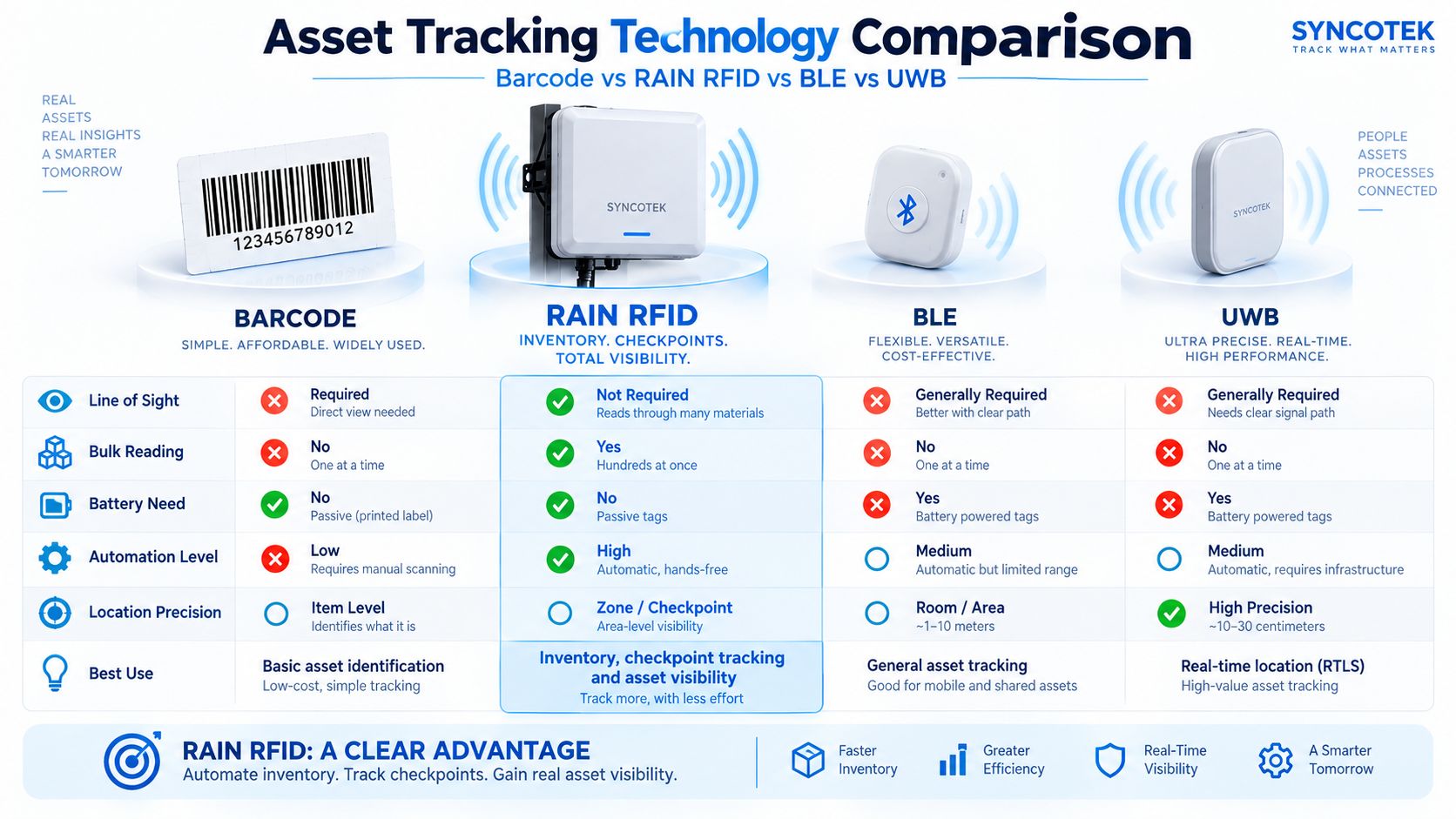
There is no universal asset-tracking technology.
The correct technology depends primarily on what "tracking" means in your application.
| Technology | Primary Strength | Battery | Bulk Identification | Typical Location Capability | Best Fit |
|---|---|---|---|---|---|
| Barcode | Low-cost deliberate identification | No | No | Scan location | Small/manual asset systems |
| RAIN RFID | Inventory and automated identification | No | Strong | Presence / zone / checkpoint | Large asset populations |
| BLE | Wireless beacon-based visibility | Usually yes | Not RFID-style bulk inventory | Area / room-level depending on design | Mobile asset location |
| UWB | Precision ranging | Yes | Not RFID-style bulk inventory | High-precision positioning | High-value RTLS |
| Active RFID | Long-range powered identification | Yes | Depends on system | Frequent location updates | RTLS / specialized tracking |
The important question is:
Do you need to identify assets efficiently, or do you need continuous location coordinates?
These are different problems.
Barcode may be the better choice when:
A barcode system can remain highly effective for many smaller operations.
RAIN RFID becomes attractive when:
BLE may be appropriate when assets need to transmit periodically and approximate room or zone-level location is more important than fast inventory counting.
UWB becomes attractive when the core requirement is:
Where exactly is this asset right now?
Examples include high-value moving assets where precise real-time positioning justifies the additional infrastructure and powered tags.
This distinction deserves special attention.
Typical questions:
Typical questions:
Therefore:
RAIN RFID is strong for automatic asset identification, inventory, presence detection and checkpoint tracking.
It should not automatically be treated as a precision real-time location system.
For a deeper comparison, see Syncotek's guide to Real-Time Location Systems.
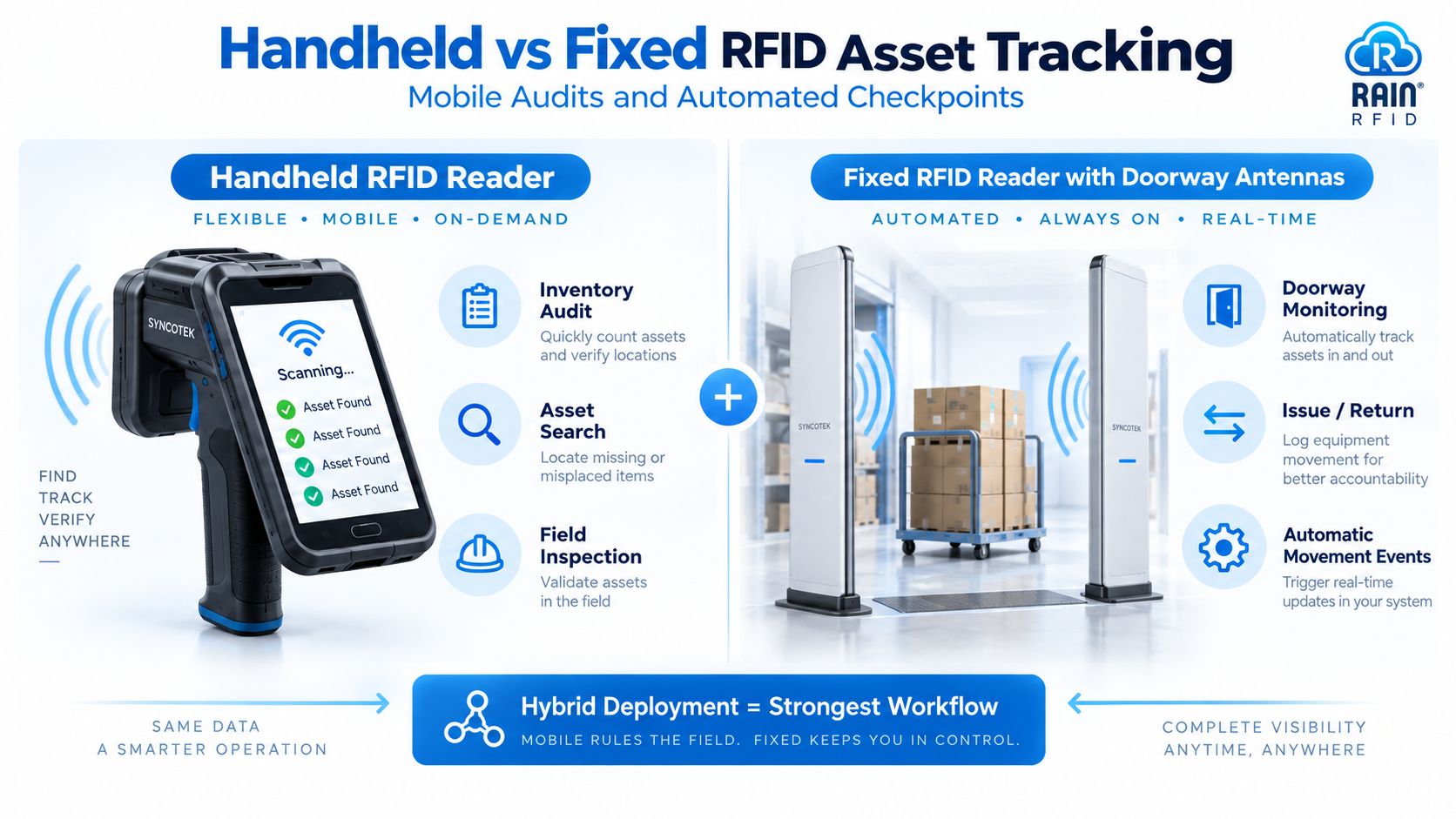
Most enterprise asset projects eventually use one or both reader architectures.
A handheld moves with the operator.
It is particularly useful for:
The operator walks through the area while the handheld inventories tags.
Software compares:
Expected Assets
vs
Detected Assets
and can identify:
items.
The user selects a specific EPC or asset record.
The handheld can provide increasing signal feedback as the user approaches the tagged item.
This can dramatically reduce time spent manually searching storage rooms and equipment areas.
However, this is still RF signal-assisted searching, not precise coordinate positioning.
A fixed reader remains installed at a controlled location.
Applications include:
An asset passing through a controlled portal can trigger a movement event.
For example:
Asset LT-10045
→ Passed Door 2
→ 15:32
→ Equipment Room to Production
A controlled RFID point can support:
Unlike handheld inventory, fixed RFID does not require an employee to perform every identification action.
This enables automatic movement capture.
For many organizations, the strongest architecture combines:
Fixed Readers
for important movement points
Handheld Readers
for audits, searching and exceptions.
Fixed infrastructure automates predictable workflows.
Handheld devices provide flexibility everywhere else.
The reader is only half of the RFID system.
Tag selection can determine whether the project succeeds.
The first question should be:
What is the tag attached to?
Possible materials include:
Conventional UHF RFID labels generally perform poorly when attached directly to metal.
Metal changes the RF behavior of the tag antenna.
Assets such as:
may require specialized mount-on-metal RFID tags.
Smaller tags can be easier to install, but reducing antenna dimensions can also affect RF performance.
The smallest tag is not automatically the best tag.
Required read distance depends on the workflow.
A desktop station may need only short-range identification.
A doorway portal may require several meters.
Always test the selected tag on the actual asset.
Evaluate exposure to:
Options can include:
A long-life industrial asset may require stronger mechanical attachment than an office laptop.
For more detail on why physical tag structure affects RFID performance, see RFID Tag Construction.
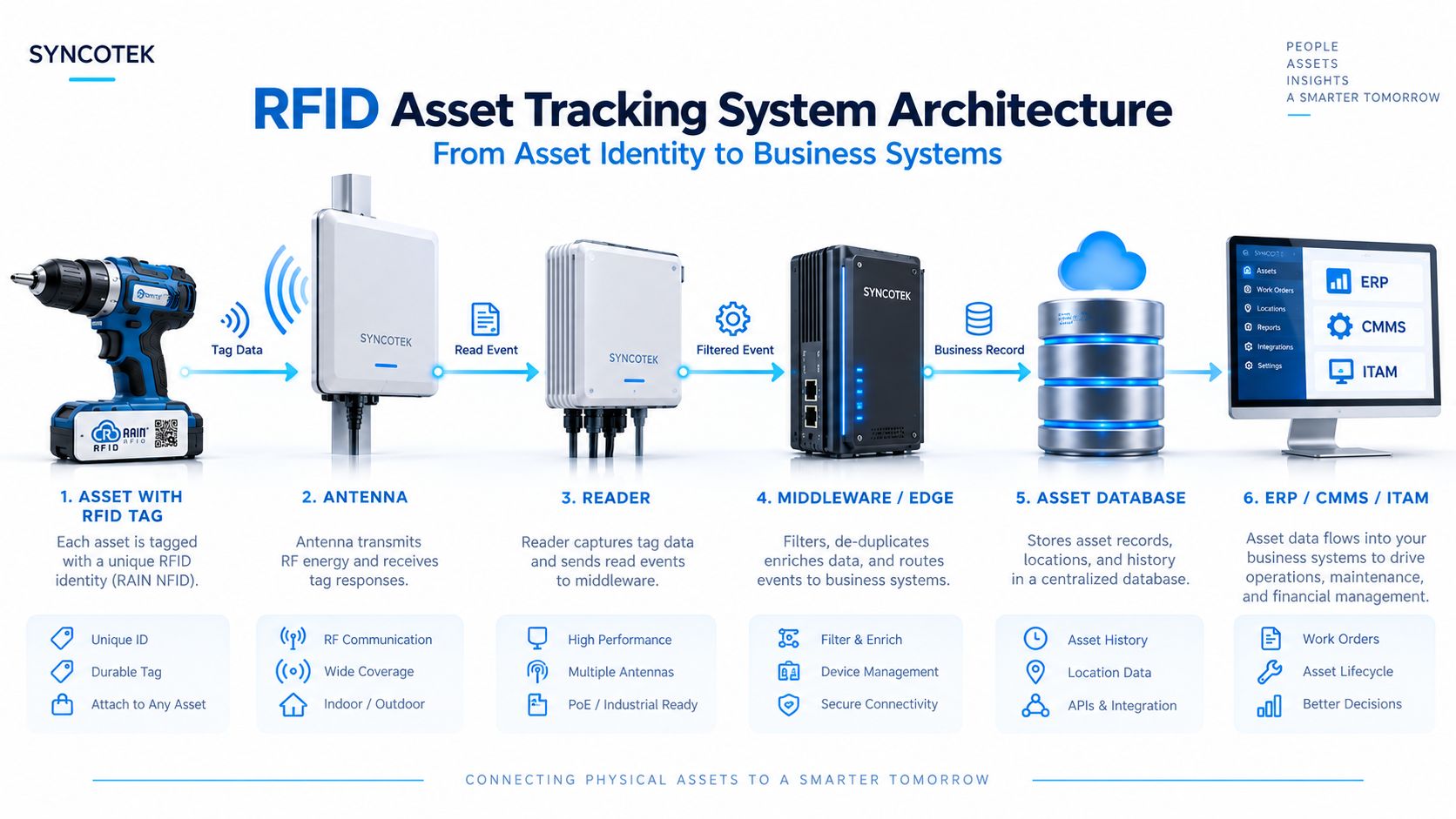
A scalable enterprise architecture can be represented as:
Asset
↓
RFID Tag
↓
Reader Antenna
↓
RFID Reader
↓
Middleware / Edge
↓
Asset Database
↓
ERP / CMMS / ITAM
This architecture separates physical identification from business data.
The tag provides:
Reader antennas create controlled RFID read zones.
The reader:
Middleware converts raw RFID observations into business events.
Examples:
Asset Detected at Tool Room
Asset Left Warehouse
Unexpected Asset Found
The database stores:
Asset data may connect with:
Financial and operational asset information.
Computerized Maintenance Management System for:
IT Asset Management for:
For a complete hardware and data-layer explanation, see RFID System Architecture: Components, Data Flow and Hardware Selection.
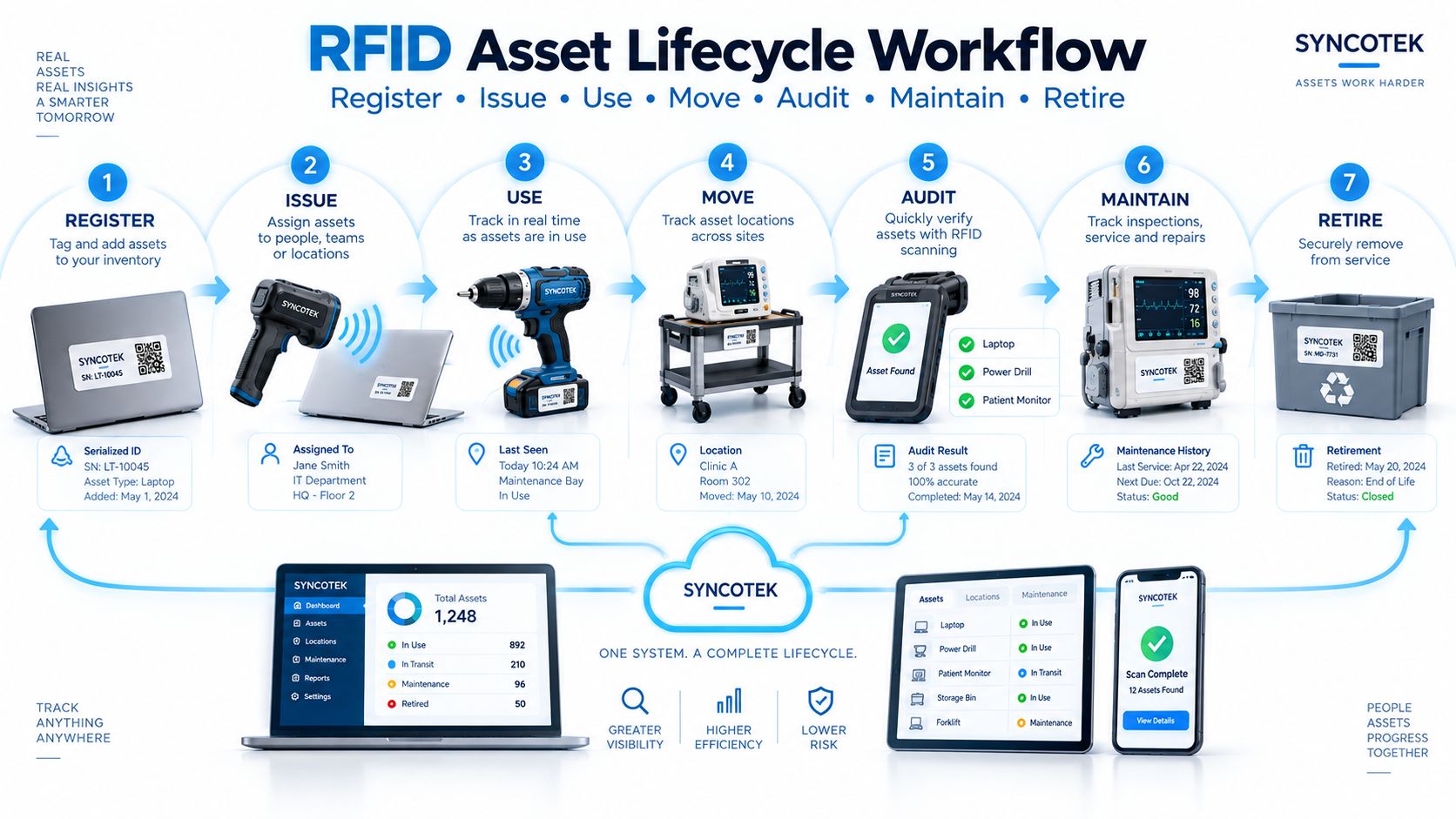
RFID can support much more than periodic inventory.
A complete asset lifecycle may contain several stages.
The new asset is added to the system.
Typical process:
Asset Record
→ Generate RFID Identity
→ Encode / Register Tag
→ Attach
→ Verify
The asset can then be linked with:
The asset is assigned to:
Example:
Laptop LT-10045
→ Jane Smith
→ Engineering
The asset remains active in the organization.
RFID can support periodic inventory and movement events during this stage.
The asset changes:
Fixed read points can capture selected transitions automatically.
Staff periodically verify physical assets.
A handheld reader can compare:
Expected
vs
Found
without scanning every barcode individually.
The RFID identity connects the physical equipment with:
When an asset reaches end of life, its status can be updated to:
This preserves lifecycle history.
IT environments contain large quantities of serialized equipment.
Examples include:
Common problems include:
RAIN RFID can improve physical inventory efficiency.
Most electronic equipment contains significant amounts of metal.
Therefore:
must be tested carefully.
A standard UHF label applied randomly to a laptop may provide poor performance.
Use specialized designs where necessary.
Factories and maintenance organizations frequently manage high-value tools.
Examples:
RFID can help answer:
See Syncotek's detailed RFID Tool Tracking guide for this application.
Hospitals may manage:
RAIN RFID can support:
It should not automatically be described as precise hospital RTLS.
For healthcare applications, see RFID in Healthcare.
Returnable assets are especially suitable for RFID because they circulate repeatedly.
Examples include:
Without item-level identification, businesses may know how many containers they purchased but not:
RAIN RFID can create a persistent serialized identity for every returnable asset.
Rental inventory creates similar requirements.
The business needs to manage:
RFID can reduce time spent on:
For more detail, see Syncotek's guide to Managing Rental Inventory with RFID.
One practical RAIN RFID advantage is the ability to assist with item searches.
Suppose the asset system shows:
Oscilloscope OS-105 — Expected in Lab Storage
but staff cannot see it.
With barcode, the barcode helps only after the item has already been found.
With RFID, the operator can select the asset's EPC and walk through the area.
The handheld can provide feedback based on received tag signal.
The user can narrow the search area until the item is found.
This is useful for:
The feature should still be considered proximity-assisted search, not high-precision RTLS.
Fixed read points add automation.
A portal can contain:
A simplified workflow is:
Asset Approaches Doorway
↓
Sensor Triggers Reader
↓
RFID Tags Identified
↓
Middleware Determines Event
↓
Asset System Updated
For example:
Tool Kit TK-105 moved from Tool Room to Production Line A.
Portal performance depends heavily on:
The goal should not be maximum read range.
The goal should be:
Read assets passing through this checkpoint without reading unrelated assets nearby.
RFID hardware alone does not create an asset-management system.
The application layer normally manages:
RFID readers generate identification events that feed that software.
Syncotek's role is primarily the RFID hardware and data-capture layer, not replacing the customer's CMMS, ITAM, ERP or asset-management software.
RFID can also connect physical equipment with maintenance records.
Example:
Technician Reads RFID Tag
↓
Asset Identified
↓
CMMS Opens Correct Equipment Record
↓
Inspection Completed
↓
Maintenance History Updated
This is particularly useful where assets require:
RFID itself does not determine whether equipment needs maintenance.
It ensures that the correct physical asset is connected with the correct maintenance record.
RAIN RFID provides excellent asset identification and checkpoint visibility but does not automatically generate continuous coordinates.
The cheapest tag can become expensive if it fails on the actual asset.
Metal can severely affect conventional UHF tags.
Use a suitable on-metal design.
Always test:
Start with:
What event do we need to capture?
not:
Which reader should we buy?
More power may create:
Tune the read zone.
RFID asset tracking works best when individual assets have persistent unique identities.
A business system does not need hundreds of duplicate tag observations.
Use middleware or edge logic.
Start with a manageable asset group and validate the workflow.
Laptop, plastic tote and steel machine may require completely different tags.
An RFID tag that falls off the asset is no longer useful regardless of RF performance.
Define what staff should do when:
A pilot should answer whether RFID creates measurable operational value before the organization scales the deployment.
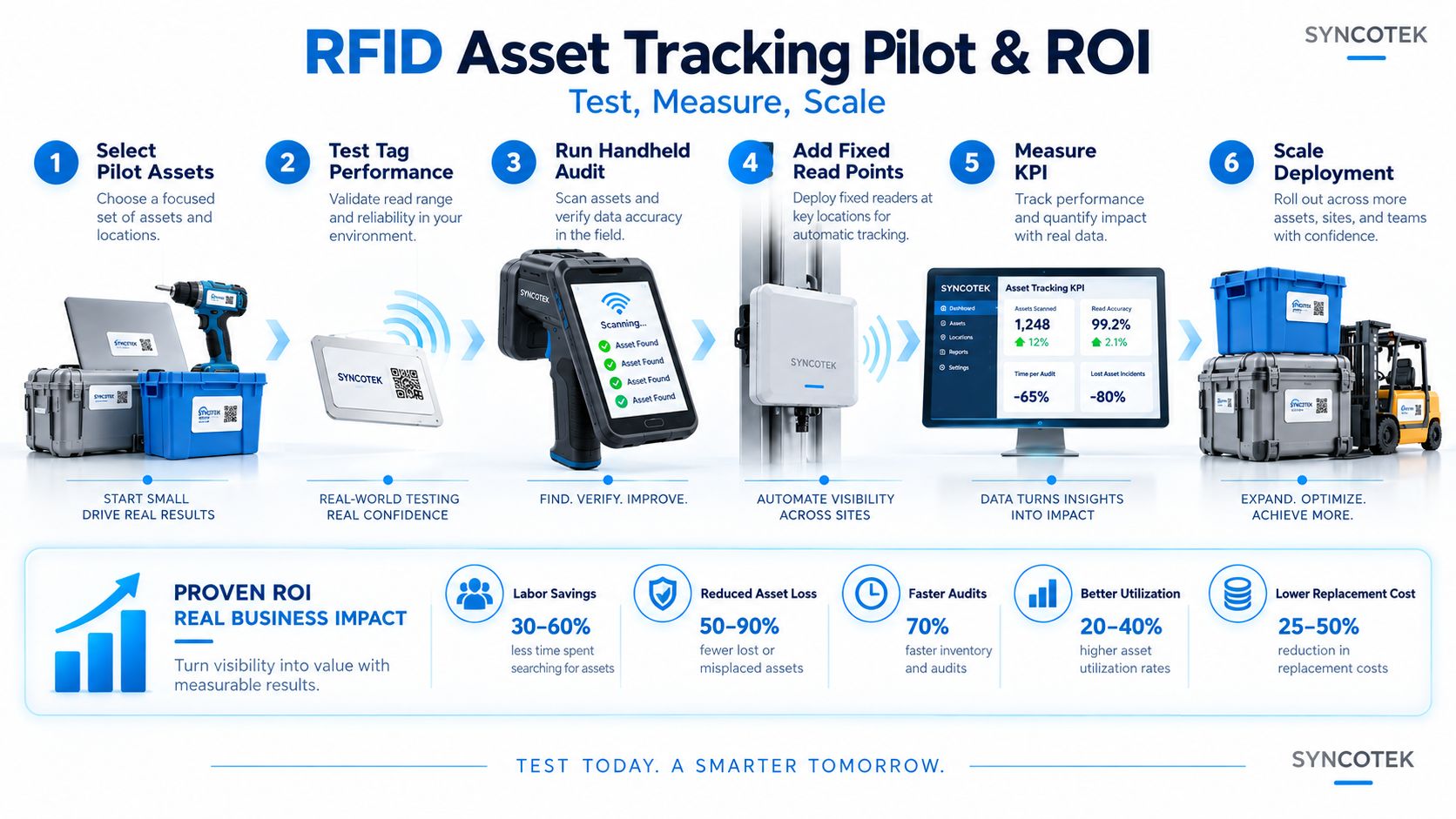
Choose a focused group.
For example:
Avoid starting with every asset in the company.
Compare candidate tags on real assets.
Evaluate:
A handheld pilot requires less fixed infrastructure.
Measure:
Once the mobile workflow is validated, identify high-value automation points.
Examples:
Useful KPIs include:
Expand only after the pilot proves:
This lowers deployment risk.
Avoid relying on generic promises such as:
RFID saves X%.
Your ROI should be based on your operation.
A practical model is:
Annual Labor Savings
Reduced Asset Loss
Reduced Replacement Purchases
Faster Audits
Improved Asset Utilization
Reduced Search Time
minus
RFID Tags + Readers + Installation + Software Integration + Support
Calculate how many hours are currently spent on:
Estimate annual:
Poor visibility can cause departments to purchase equipment that already exists but cannot be found.
Better inventory visibility may reduce unnecessary purchases.
Asset visibility may make it easier to redistribute underused equipment.
If audits become faster, the organization may perform them more frequently.
More frequent audits can identify discrepancies sooner.
RAIN RFID is not automatically justified for every asset-management application.
Barcode may remain better if:
BLE or UWB may be more appropriate if:
Technology should be selected around the business requirement.
Before starting an RFID asset project, confirm:
RAIN RFID asset tracking uses passive UHF RFID tags, readers and software to identify and manage physical assets without requiring optical line-of-sight scanning.
RAIN RFID generally refers to the passive UHF RFID ecosystem commonly used for EPC Gen2 / ISO 18000-63 applications.
Yes. Passive UHF RFID is widely suited to asset inventory, identification, presence detection, checkpoint movement and handheld asset searching.
Not automatically. Passive RAIN RFID normally provides presence, read-zone, checkpoint or last-seen visibility. Precise real-time positioning may require RTLS technologies such as UWB.
Passive RAIN RFID tags normally do not require a battery for standard communication.
Barcode is less expensive and works well for manual deliberate scanning. RFID becomes more attractive when organizations need faster audits, non-line-of-sight identification, bulk reading or automated checkpoints.
RAIN RFID is strongest for inventory and automatic identification. UWB is designed for high-precision real-time location and normally uses powered tags.
BLE generally uses battery-powered beacons for periodic wireless visibility. Passive RAIN RFID uses battery-free tags and is especially effective for inventory and checkpoint identification.
Use a UHF RFID tag specifically designed for metal surfaces and test it on the actual asset.
There is no universal distance. Read performance depends on tag antenna, asset material, reader power, reader antenna, orientation, interference and environment.
Yes. RFID can support laptop inventory and audits, but tag placement and on-metal performance should be tested because laptops contain substantial metal.
Yes. RFID is suitable for tool-room inventory, issue/return, searching, inspection and lifecycle management.
Yes. Passive UHF RFID can support hospital equipment inventory and checkpoint visibility. Precise continuous location may require an RTLS architecture.
A handheld UHF RFID reader can assist with proximity-based searching for a selected RFID tag within the expected area.
Handheld readers are best for mobile audits and searching. Fixed readers are best for automated checkpoints. Many larger systems use both.
A system normally requires software that maps RFID identities to asset records and manages locations, ownership, status, history and exceptions. Middleware may also be used to filter RFID events.
Yes. RFID events can be integrated with ERP, CMMS, ITAM or asset-management systems through middleware, APIs, SDKs or other supported interfaces.
Yes. Reusable totes, pallets, bins, crates and other returnable assets are strong RFID candidates because the tags can remain with the assets across repeated cycles.
RFID can identify the correct physical asset and connect technicians with inspection, calibration and maintenance records stored in a CMMS or other backend system.
Begin with a focused asset group, test tags on real assets, run handheld inventory first, measure operational results, then add fixed automation where it creates measurable value.
Compare deployment costs with measurable savings from audit labor, reduced searching, fewer lost assets, lower unnecessary replacement purchases and improved utilization.
Syncotek provides RFID hardware for asset-management solution providers, system integrators, software companies, manufacturers and OEM equipment developers.
Our RFID portfolio includes:
These products can support applications such as:
Syncotek focuses on the RFID identification and data-capture layer.
We do not replace the customer's ERP, CMMS, ITAM or asset-management software. Instead, our RFID tags, readers, modules and antennas provide the physical identification events those systems need.
Explore the complete Syncotek RFID product portfolio to build an asset-tracking architecture around your actual asset materials, inventory volume, read zones, automation requirements and software environment.
 Knowledge
When people compare near-field vs far-field in RFID, they are really comparing two different ways energy and data move between the reader and the tag. In RFID, near-field systems are based on magnetic coupling and are typically associated with LF and HF/NFC, while far-field systems are based on radiated electromagnetic waves and backscatter and are typically associated with UHF RFID. That difference affects range, […]
READ MORE Knowledge
What is RFID software? RFID software is the layer that turns RFID hardware signals (readers, antennas, tags, sensors) into usable data and workflows—inventory updates, asset movements, shipping/receiving events, access logs, and analytics. In most real deployments, RFID systems require middleware: software that sits between RFID interrogators (readers) and enterprise applications (WMS/ERP/MES/POS). It manages/configures devices and processes raw tag data by filtering duplicates […]
READ MORE Knowledge
Programming an RFID tag means writing useful data into the tag’s memory so that the tag can identify a product, carton, pallet, asset, tool, document, or other tracked item in an RFID system. Many RFID tags are supplied with pre-programmed data, but real projects often require custom encoding. For example, a business may need to […]
READ MORE Knowledge
The RFID system auto-identifies vehicles' weight, calculates net weight, and provides real-time monitoring for optimized efficiency.
READ MORE Knowledge
Conferences, exhibitions, trade shows, corporate events, training programs, and large public venues all need accurate attendee data. Event organizers want to know who arrived, where attendees went, which sessions attracted the most visitors, how long people stayed in certain areas, and whether sponsors or exhibitors received meaningful engagement. Traditional event attendance tracking often relies on […]
READ MOREIf you are interested in our services or need customized solutions, please feel free to contact us.