
Tools are essential assets in many industries. Manufacturing plants, construction companies, hospitals, repair teams, rental businesses, warehouses, and maintenance departments all depend on tools being available, traceable, and properly maintained.
However, tool management is often difficult. Tools may be misplaced, borrowed without record, left at job sites, stored in the wrong cabinet, sent for maintenance without update, or replaced too frequently because no one knows where they are. In busy environments, manual tool logs and barcode checks may not provide enough visibility.
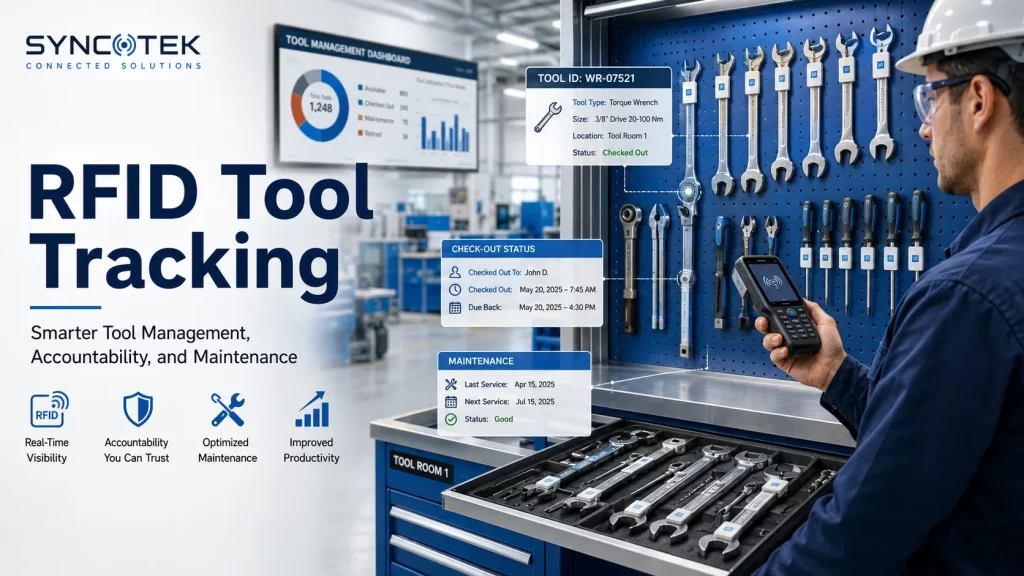
RFID tool tracking helps solve these problems by using RFID tags, readers, antennas, and software to identify, locate, and manage tools more efficiently. Each tool is attached with an RFID tag, and the system records tool movement, usage history, last-seen location, check-in/check-out activity, and maintenance status.
For Syncotek, RFID tool tracking is not only about finding missing tools. It is about helping companies build a more reliable tool management process with better accountability, inventory visibility, and operational control.
RFID tool tracking is a tool management method that uses radio frequency identification technology to identify and monitor tools automatically.
A typical RFID tool tracking system includes:
When a tagged tool is scanned or detected by an RFID reader, the system captures the tool ID and updates the tool record. Depending on the system setup, it can show whether the tool is available, checked out, missing, under maintenance, assigned to a user, or located in a specific area.
RFID tool tracking is closely related to RFID inventory management, but it focuses more on reusable tools, equipment, and high-value operational assets rather than disposable stock.
Tool loss and poor tool visibility can create real business costs.
Common tool management problems include:
RFID helps improve tool management by creating a digital link between each physical tool and its management record.
RFID can help teams count tools faster than manual checking. Instead of visually checking every tool or scanning each barcode one by one, workers can use RFID readers to identify tagged tools more efficiently.
This is useful for:
For many tool rooms, RFID makes inventory checks more frequent and less labor-intensive.
Missing tools can delay work and increase replacement cost. RFID tracking helps companies know when a tool was last seen, where it was detected, and who may have accessed the tool area.
RFID tool tracking can help identify:
Better visibility reduces unnecessary replacement purchases and improves tool accountability.
In many companies, tools are shared by multiple workers, shifts, departments, or job sites. Without a clear record, it can be difficult to know who used a tool and when it was returned.
RFID tool tracking can connect tool movement with:
When tool access is connected with user records, managers can improve responsibility and reduce disputes.
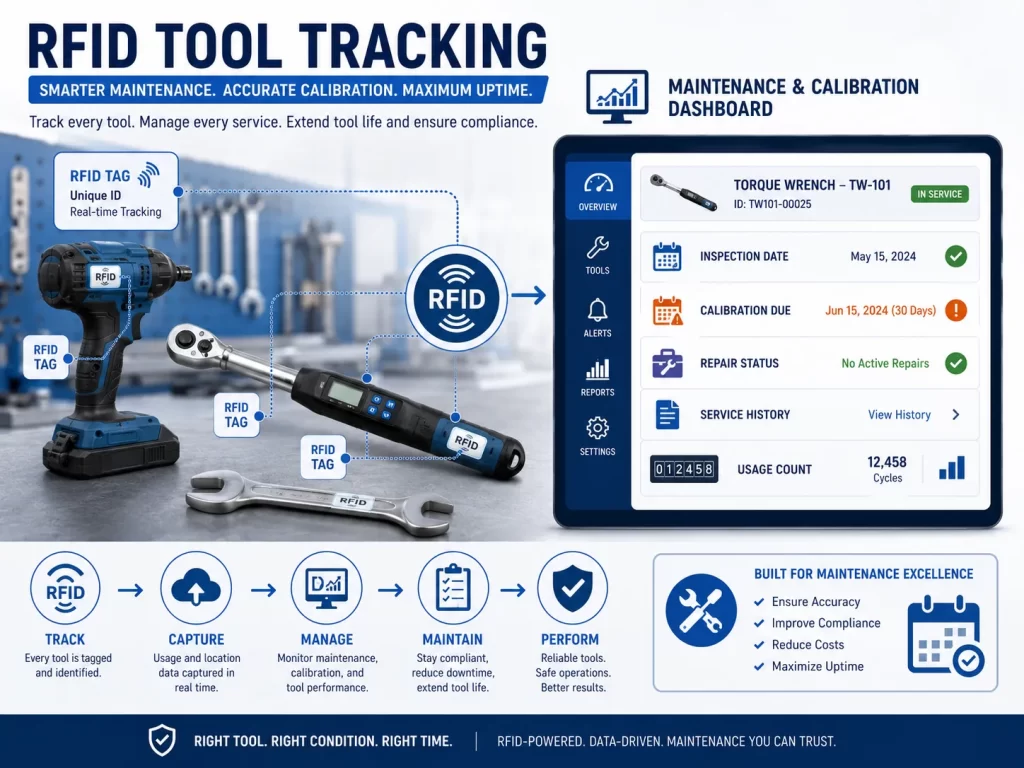
Some tools need regular maintenance, calibration, sterilization, inspection, or replacement. If maintenance is missed, the tool may become unsafe, inaccurate, or unreliable.
RFID can help track:
This is especially important for torque tools, measuring instruments, medical instruments, molds, fixtures, and high-value industrial tools.
RFID usage data can help companies understand which tools are used frequently and which tools are rarely used.
This helps answer questions such as:
With better data, purchasing decisions become more accurate.
Manufacturing environments use many tools, fixtures, molds, gauges, jigs, and production assets. If the wrong tool is used or a required tool is missing, production can be delayed.
RFID tool tracking can support:
For broader factory visibility, RFID tool tracking can be part of a larger RFID in manufacturing system.
Construction companies often move tools between warehouses, vehicles, trailers, and job sites. Tools may be shared across teams and exposed to harsh environments.
RFID can help track:
Tool loss on construction sites can be expensive. RFID helps improve visibility before and after each job.
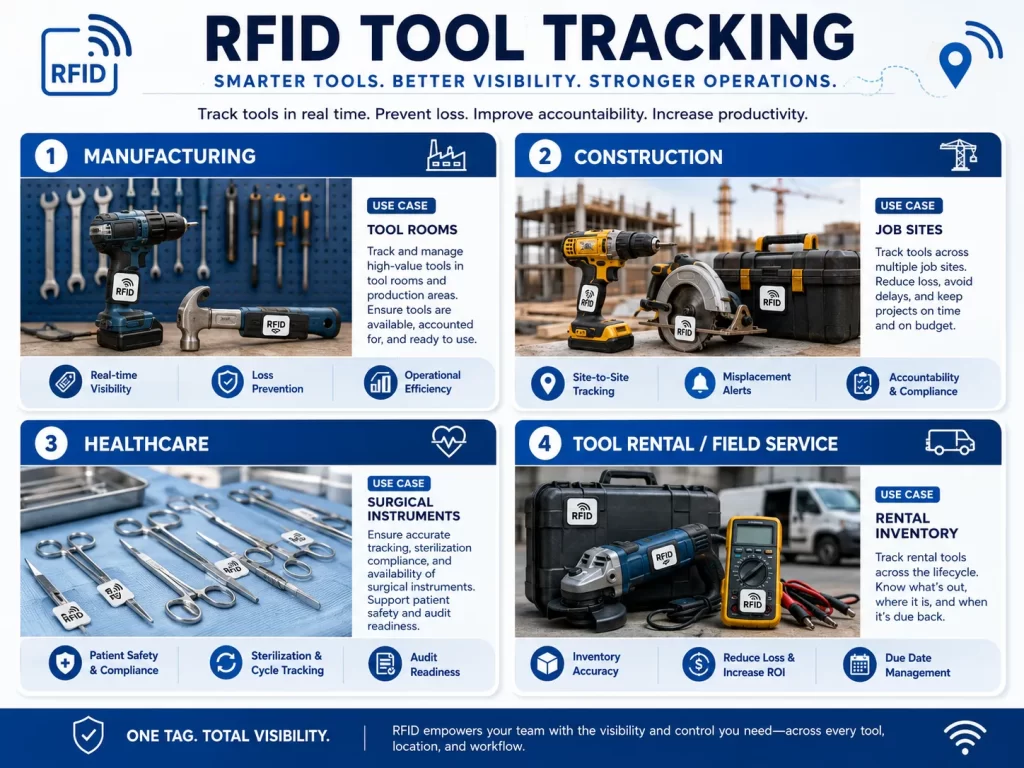
Hospitals and healthcare facilities use many specialized tools and instruments that must be available, clean, and properly managed.
RFID tool tracking can support:
For tools that face sterilization, autoclave, pressure washing, or high-temperature conditions, tag durability must be carefully evaluated.
Tool rental companies need to know which tools are available, rented, returned, damaged, or overdue.
RFID can help manage:
This can reduce manual paperwork and improve rental inventory accuracy.
Maintenance teams and field service technicians often carry tools across different sites. RFID can help track tool kits, vehicle inventory, and field assets.
Typical applications include:
RFID can help confirm that the right tools are available before a technician leaves for a job.
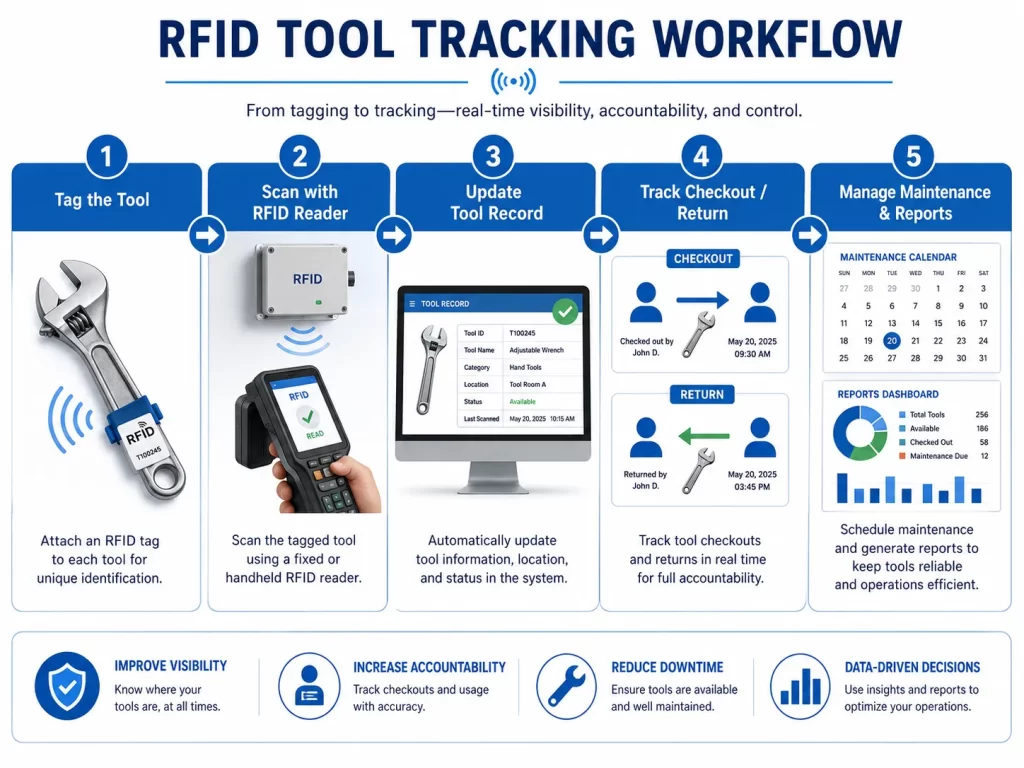
A basic RFID tool tracking workflow includes:
The system can be simple or advanced depending on the application. A small tool room may only need handheld scanning. A large manufacturing plant may need fixed readers, smart cabinets, access control, and software integration.
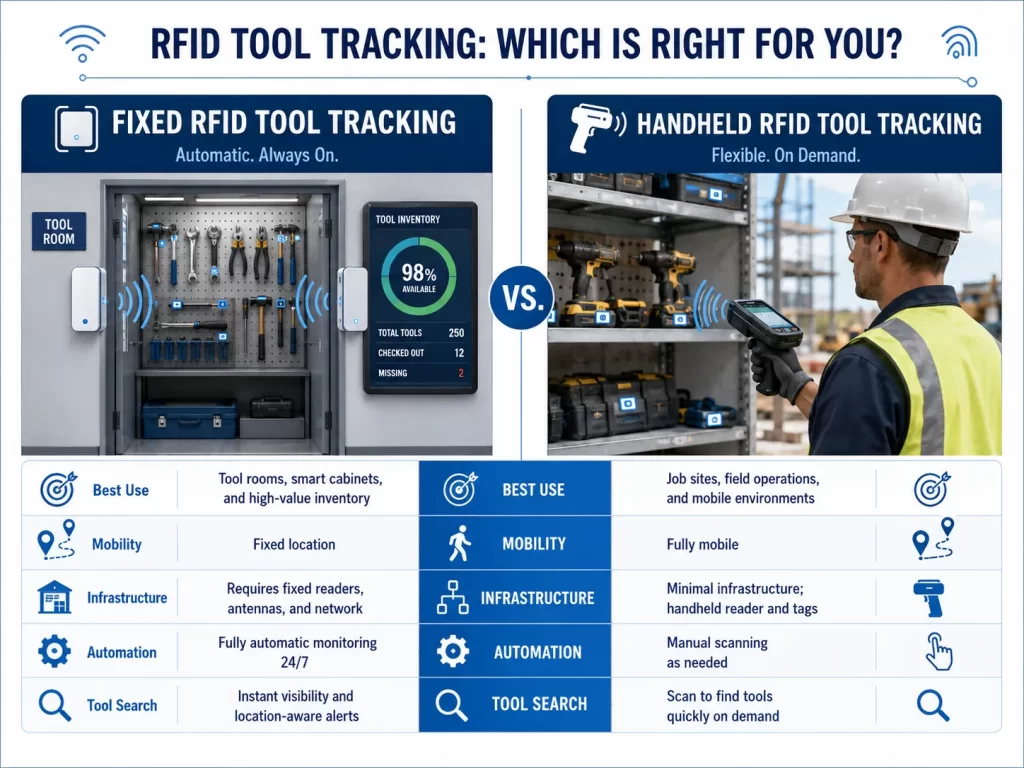
A fixed RFID tool tracking system uses installed readers and antennas to monitor tools automatically at selected locations.
Fixed read points may be installed in:
Fixed systems can continuously monitor tools or scan at specific times. Some systems can also trigger scans when doors open, drawers close, or tools pass through a checkpoint.
Fixed systems are useful when the tool area is controlled and the business needs continuous visibility.
A handheld RFID tool tracking system uses portable RFID readers operated by workers.
Workers can scan tool rooms, shelves, cabinets, vehicles, trailers, or job sites to identify tagged tools.
Some handheld RFID readers can include a locating or proximity search function that helps workers move closer to a tagged tool based on signal strength.
Handheld systems are useful when the tool area is not fixed or when workers need mobility.
| Factor | Fixed RFID System | Handheld RFID System |
|---|---|---|
| Best use | Tool rooms, cabinets, controlled areas | Mobile audits, job sites, field searches |
| Data capture | Automated or triggered | Operator-driven |
| Infrastructure | Higher | Lower |
| Read consistency | More consistent | Depends on operator |
| Tool locating | Area-level or checkpoint-based | Good for searching missing tools |
| Suitable for | High-value controlled tools | Flexible inventory and field use |
| Common setup | Readers, antennas, sensors, software | Handheld reader and software |
Many companies use both. Fixed readers monitor key tool areas, while handheld readers handle audits, exceptions, and field searches.
Tag selection is one of the most important parts of tool tracking. Tools vary in size, shape, material, usage environment, and attachment options.
Before choosing RFID tags for tools, consider:
A tag that works on a cardboard box may fail on a metal wrench, drill, surgical instrument, or industrial mold.
Many tools are made of metal or contain metal parts. Metal can affect RFID performance, especially in UHF RFID applications.
For metal tools, standard RFID labels may not perform reliably. In most cases, specialized mount on metal RFID tags are required.
On-metal RFID tags are designed to work when attached to metal surfaces. They may use a spacer, special antenna structure, foam layer, ceramic design, or rugged housing to improve performance.
Testing is important because tool shape, size, and tag placement can affect read performance.
Different tools require different attachment methods.
Common attachment methods include:
For frequently handled tools, standard adhesive may not be enough. Rugged tools may require mechanical mounting, epoxy, or embedded tags.
The tag must stay attached throughout the tool’s working life.
RFID tags identify each tool. The tag must match the tool material, environment, read range, and attachment method.
For more information about tag structure and format selection, see Syncotek’s guide on RFID inlays, tags, and labels.
RFID readers capture tag data. Tool tracking systems may use handheld readers, fixed readers, desktop readers, or integrated cabinet readers.
Common reader types include:
Antennas define the read zone. In tool tracking, the read zone should be controlled carefully to avoid reading tools outside the intended area.
For example, a tool cabinet should detect tools inside the cabinet, not tools on a nearby bench. A tool room doorway should detect tools entering or leaving, not tools stored several meters away.
For read-zone planning, review Syncotek’s guide on how to select the right RFID antenna.
Fixed RFID systems often require antenna cables, connectors, mounting brackets, sensors, and other accessories.
Poor cable selection or loose connectors can reduce read performance and make troubleshooting difficult. For system installation guidance, see RFID cables, connectors, and adapters.
Software connects RFID reads with tool records.
Tool tracking software may support:
Without software, RFID read data remains difficult to use. The value comes from linking tag reads to actionable tool records.
An RFID tool tracking system can provide data such as:
This data helps companies move from reactive tool searching to proactive tool management.
Tool tracking can be combined with access control.
For example, a tool room may require workers to scan an ID card before entering. When a tool is removed, the system can associate that tool movement with the worker’s access record.
This can help answer:
This improves accountability for high-value or restricted tools.
RFID can help companies manage tool maintenance more systematically.
Maintenance-related tool data may include:
This is useful for industries where tool accuracy, cleanliness, or safety matters.
Examples include:
RFID tool tracking can create return on investment in several ways.
When tools are lost less often, companies spend less money replacing them.
Workers spend less time looking for missing tools and more time doing productive work.
Usage data helps companies avoid buying unnecessary duplicate tools.
When required tools are available and maintained, jobs and production tasks can proceed more smoothly.
Maintenance reminders reduce the risk of using unsafe, inaccurate, or overdue tools.
Digital usage records reduce confusion and help teams manage shared tools more responsibly.
Small tools may not have enough space for a large RFID tag. This is common with surgical instruments, small hand tools, and precision tools.
Possible solutions include:
Metal tools require on-metal RFID tags or special tag designs. Standard labels may not work reliably.
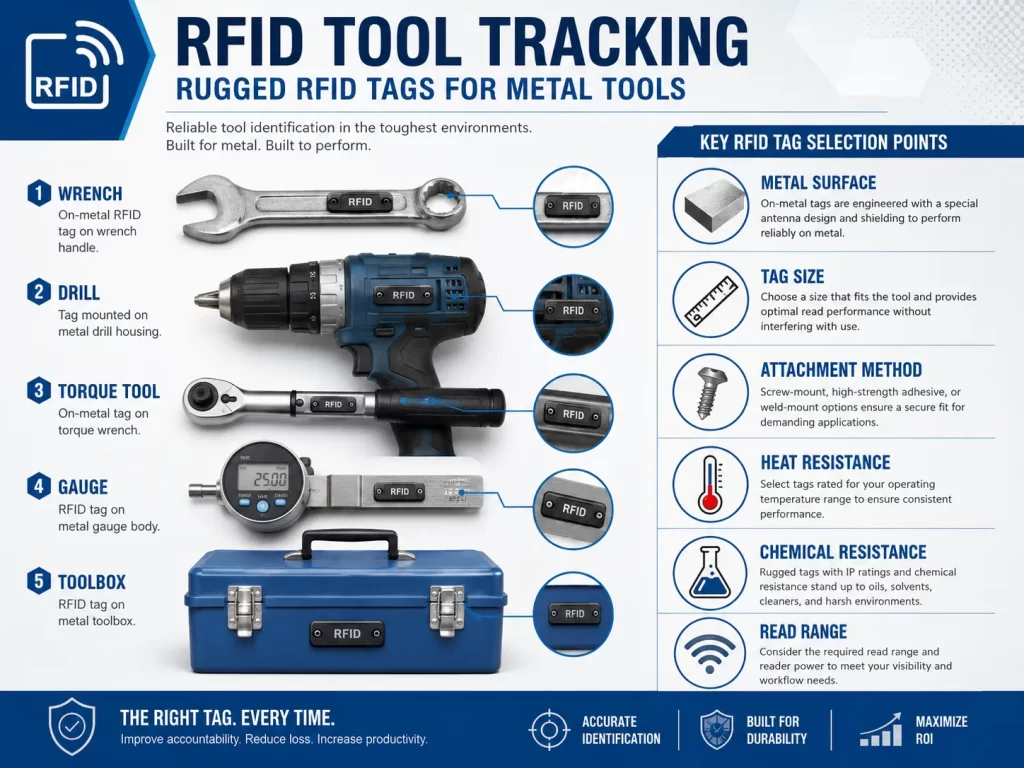
Tools may face impact, oil, dust, chemicals, vibration, or outdoor use. The RFID tag must be durable enough for the environment.
Some tools are exposed to autoclaves, sterilization, heat treatment, or pressure washing. These applications require high-temperature or washable RFID tags.
The tag must remain attached through repeated handling. Weak adhesive may fail quickly on oily, curved, or rough surfaces.
RFID systems can sometimes read nearby tools unintentionally. Proper antenna placement, shielding, reader power adjustment, and software filtering help reduce this problem.
For difficult read-zone environments, RFID shielding and blocking materials can help control signal coverage.
Start by identifying the tool management challenge.
Examples:
A clear problem makes the RFID system easier to design.
List the tools that need to be tracked and their working conditions.
Check:
Choose tags based on the tool surface, environment, and read range. For metal tools, use on-metal RFID tags. For high-temperature tools, use heat-resistant tags. For frequently handled tools, use rugged tags and strong attachment methods.
Decide whether the system should be fixed, handheld, or hybrid.
A fixed system works well for controlled rooms and cabinets. A handheld system works well for mobile audits and field searches. A hybrid system can support both automatic monitoring and manual exception handling.
Plan where RFID reads should happen.
Common read points include:
The system should read the intended tools and avoid unrelated nearby tools.
RFID tool tracking becomes valuable when read data is connected to useful records.
Software should show:
Before full rollout, test with real tools and real working conditions.
Test:
Testing helps prevent costly deployment problems.
Tool material, size, and environment should determine the tag choice.
Standard RFID labels may fail on metal tools. Use metal-compatible tags when needed.
Even a good RFID tag will fail if it falls off the tool.
Reading nearby tools may create inaccurate records. Controlled read zones are important.
Handheld scanning is useful, but fixed read points may be needed for consistent tool room visibility.
Tool tracking becomes more valuable when it includes maintenance and calibration records, not just location.
Users should understand how to check tools in and out, scan tools, handle exceptions, and report missing tags.
To improve RFID tool tracking performance:
A successful RFID tool tracking project should improve tool visibility, reduce loss, and make tool management easier for daily operations.
RFID tool tracking helps companies manage tools more accurately and efficiently. By attaching RFID tags to tools and using readers, antennas, and software, businesses can monitor tool location, usage, maintenance, checkout history, and accountability.
The right RFID tool tracking system depends on the tools being tracked, the environment, the required read range, and the management workflow. Fixed RFID systems are useful for tool rooms, cabinets, and controlled areas. Handheld RFID systems are useful for audits, field searches, and mobile operations. Many companies benefit from a hybrid approach.
For metal tools, harsh environments, high temperatures, or frequent handling, tag selection and attachment method are critical. With proper planning and testing, RFID can help reduce tool loss, improve maintenance control, and create a more reliable tool management process.
RFID tool tracking uses RFID tags, readers, antennas, and software to identify, locate, and manage tools. It helps companies track tool location, usage, checkout status, and maintenance records.
RFID can track hand tools, power tools, molds, fixtures, gauges, surgical instruments, rental tools, maintenance tools, and industrial equipment accessories.
Yes, but metal tools usually require on-metal RFID tags or specially designed rugged tags. Standard RFID labels may not work reliably on metal surfaces.
UHF RFID is commonly used for tool tracking because it can support longer read ranges and faster inventory scanning. However, the best frequency depends on the application and environment.
Fixed readers are suitable for tool rooms, cabinets, and controlled areas. Handheld readers are useful for audits, mobile searches, and job site checks. Many systems use both.
Yes, if the RFID system is connected with user access records, check-in/check-out workflow, or staff ID authentication, it can associate tool movement with a user.
Yes. RFID can link tools to maintenance records, calibration schedules, inspection history, repair status, and usage frequency.
The biggest challenges are usually tag selection, metal interference, attachment reliability, harsh environments, and read-zone control.
Need RFID Solutions for Tool Tracking and Asset Management?
Syncotek provides RFID tags, readers, antennas, labels, and system components for tool tracking, asset management, manufacturing, logistics, healthcare, construction, and industrial identification applications.
Whether you need to track metal tools, tool rooms, cabinets, field equipment, surgical instruments, or maintenance assets, Syncotek can help you evaluate suitable RFID components based on your tool material, read range, environment, attachment method, and deployment workflow.
 Knowledge
Near-field coupling is the communication method used by LF (125/134 kHz) and HF (13.56 MHz, including NFC) RFID systems. Instead of “radiating” like a long-range radio link, near-field RFID works more like a transformer: a reader coil creates a magnetic field, and the tag coil couples to that field to power up and exchange data. This is why LF/HF/NFC are typically short-range, […]
READ MORE Company Events
Our new website offers streamlined access and insights into our latest products, solutions and services to better serve customers globally.
READ MORE Knowledge
Retail inventory changes constantly. Products arrive from distribution centers, move from stockrooms to sales floors, are picked for online orders, transferred between locations, returned by customers, purchased in stores, misplaced, or occasionally lost. Traditional inventory systems can record these transactions, but the digital record is only useful when it accurately reflects what is physically present. […]
READ MORE Knowledge
An RFID reader and writer is a device that can both read data from RFID tags and write new data into compatible RFID tags. In many RFID projects, this type of device is also called an RFID reader-writer, RFID read-write device, or simply an RFID writer. The “read” function allows the device to detect RFID tags and collect stored information […]
READ MORE Knowledge
In an RFID system, the antenna is one of the most important components that determines how well tags can be read. The reader generates RF energy, but the antenna controls how that energy is transmitted into the read zone and how tag responses are received. Many RFID projects focus heavily on tags and readers, while […]
READ MOREIf you are interested in our services or need customized solutions, please feel free to contact us.