Two passive UHF RFID tags can look almost identical but behave very differently.
One may provide excellent inventory performance on retail products. Another may offer larger user memory for manufacturing. A third may support advanced privacy functions. A fourth may combine RAIN RFID with NFC or provide battery-assisted sensor capabilities.
Part of that difference comes from the RFID tag IC inside the tag.
Modern RAIN RFID tag chips influence characteristics such as sensitivity, EPC memory, user memory, TID structure, write performance, privacy, authentication and optional protocol features.
But there is an equally important principle:
RFID tag performance is not determined by the chip alone.
A complete tag is a system:
RFID Tag IC + Antenna + RF Matching + Substrate + Physical Construction + Tagged Material
Therefore, choosing a UHF RFID tag should never become a simple comparison of chip model numbers.
This guide focuses specifically on passive UHF / RAIN RFID tag ICs and explains what parameters such as sensitivity, EPC memory, TID, Gen2X and security actually mean in real RFID projects.
For a broader explanation covering both tag chips and reader chips, see the Syncotek RFID Chip guide at /rfid-chip/.
A UHF RFID tag IC is the integrated circuit mounted at the center of a passive RAIN RFID tag or inlay.
It performs functions such as receiving RF energy, interpreting reader commands, managing memory, controlling the backscatter response and supporting optional security or application features.
A simplified passive UHF RFID tag is:
RFID Tag IC
RFID Antenna
Substrate / Finished Construction
The chip is not the entire RFID tag.
This distinction matters because the terms "RFID chip," "RFID tag" and "RFID inlay" are often incorrectly used interchangeably.
The IC contains the electronic intelligence.
The antenna captures RF energy and communicates with the reader.
The finished tag construction determines how the entire assembly interacts with the real object and environment.
For the physical structure of RFID tags, see /rfid-tag-construction/.
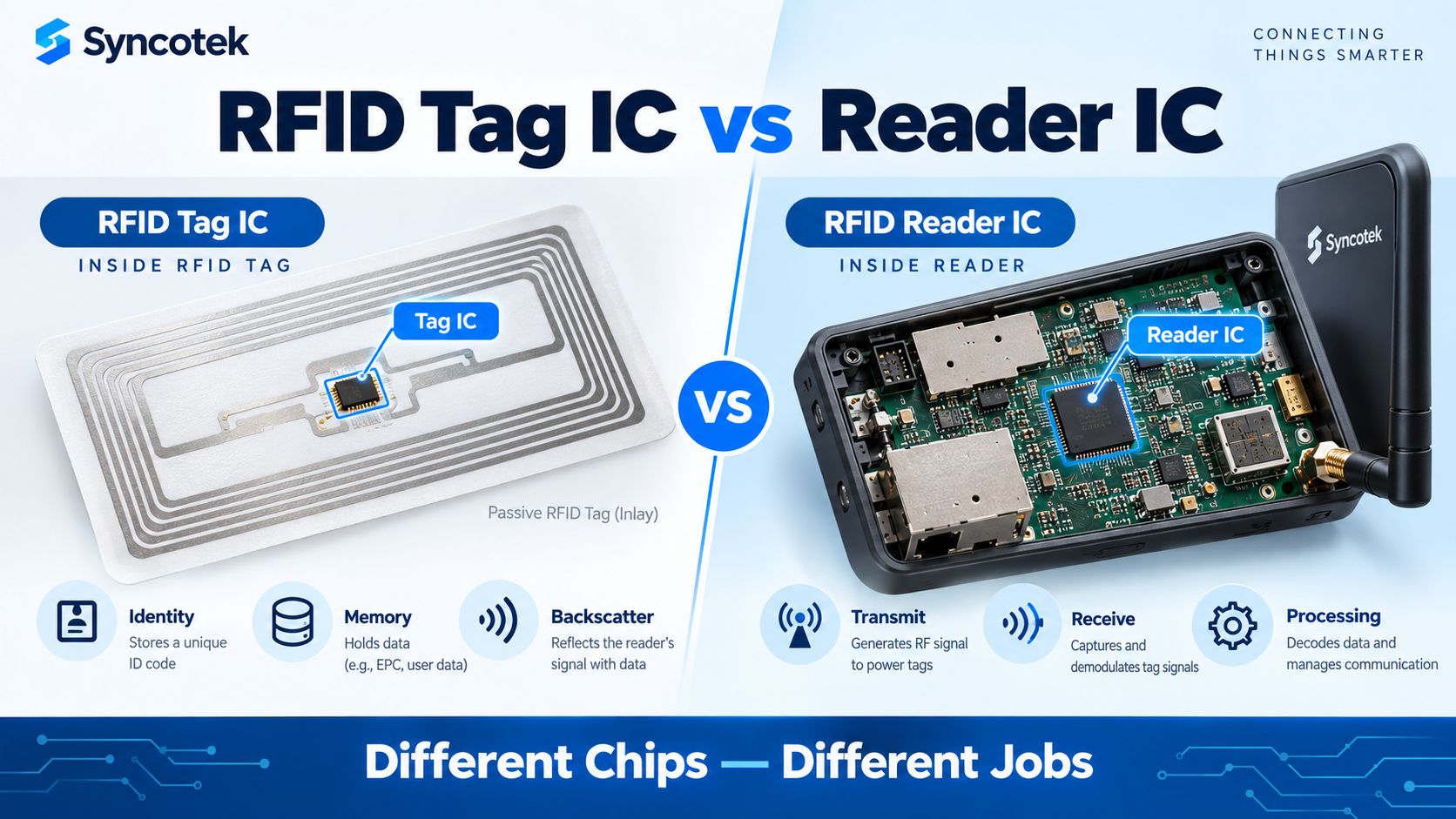
One of the most common terminology mistakes is confusing the chip inside an RFID tag with the chip inside an RFID reader.
They perform completely different jobs.
| Component | Located Inside | Primary Role | Examples |
|---|---|---|---|
| Tag / Endpoint IC | RFID tag or inlay | Identity, memory, backscatter, tag-side protocol | Impinj M830, NXP UCODE X |
| Reader IC | RFID reader or module | RF transmit, receive, demodulation and reader communication | Impinj E510, E710 |
For example:
Impinj M830
is a tag or endpoint IC.
Impinj E710
is a reader IC.
The M830 may sit inside a thin passive label.
The E710 may sit inside a fixed reader, embedded module or other reader hardware.
Impinj itself uses the term endpoint IC for its M700/M800 tag chips, while its E-series products are reader ICs.
The tag IC can influence several important characteristics.
The most important are:
RF sensitivity, which influences how little power the IC needs before it can operate.
Memory configuration, including EPC and optional User memory.
Write performance, which affects encoding processes.
TID structure, which helps identify the IC manufacturer and model.
Supported commands and protocol features, including privacy and security functions.
Advanced functions, such as Gen2X, sensing interfaces or multi-frequency support on specialized ICs.
However, the IC does not independently determine read range, metal performance, waterproofing, temperature durability or mechanical strength.
Those characteristics depend on the complete tag.
Sensitivity is one of the most frequently compared UHF RFID IC specifications.
It is normally expressed in dBm.
For example, current Impinj M830/M850 specifications list read sensitivity around −25.5 dBm, while NXP UCODE 9 specifies approximately −24 dBm. Newer NXP UCODE X specifies still lower power requirements at approximately −26.2 dBm read sensitivity.
A more negative value generally means the chip can operate with less RF power reaching it.
But:
−25.5 dBm does not mean 25.5 meters of read distance.
dBm is a power measurement.
It cannot be directly converted into real-world RFID read distance without considering the complete system.
Practical tag performance depends on:
Chip Sensitivity
Antenna Efficiency
Chip/Antenna Matching
Tag Size
Tagged Material
Reader
Reader Antenna
Environment
Higher IC sensitivity can provide more RF design margin.
That may help engineers develop:
smaller tags, tags for harder-to-read products, globally tuned inlays, or products that operate with less RF energy available at the tag.
For example, NXP explicitly positions UCODE X's lower power requirements as useful for smaller inlay designs and difficult item-tagging applications.
But it still does not eliminate the need for a good antenna.
A highly sensitive chip connected to an inefficient antenna can perform worse than a less sensitive chip connected to a well-designed antenna.
RFID projects often focus only on whether a tag can be read.
Encoding applications must also consider whether it can be written reliably.
Reading and writing are not equally demanding.
A tag may be readable at a certain position but unable to accept a reliable write command from the same distance.
This matters for:
RFID printer-encoders, manufacturing encoding stations, commissioning systems, supplier tagging operations and high-speed production lines.
For example, NXP currently specifies approximately −24 dBm read sensitivity and −22 dBm write sensitivity for UCODE 9. UCODE X improves those figures to approximately −26.2 dBm read and −23 dBm write sensitivity.
Therefore, a project involving encoding should validate:
Read
and:
Write + Verification
under real operating conditions.
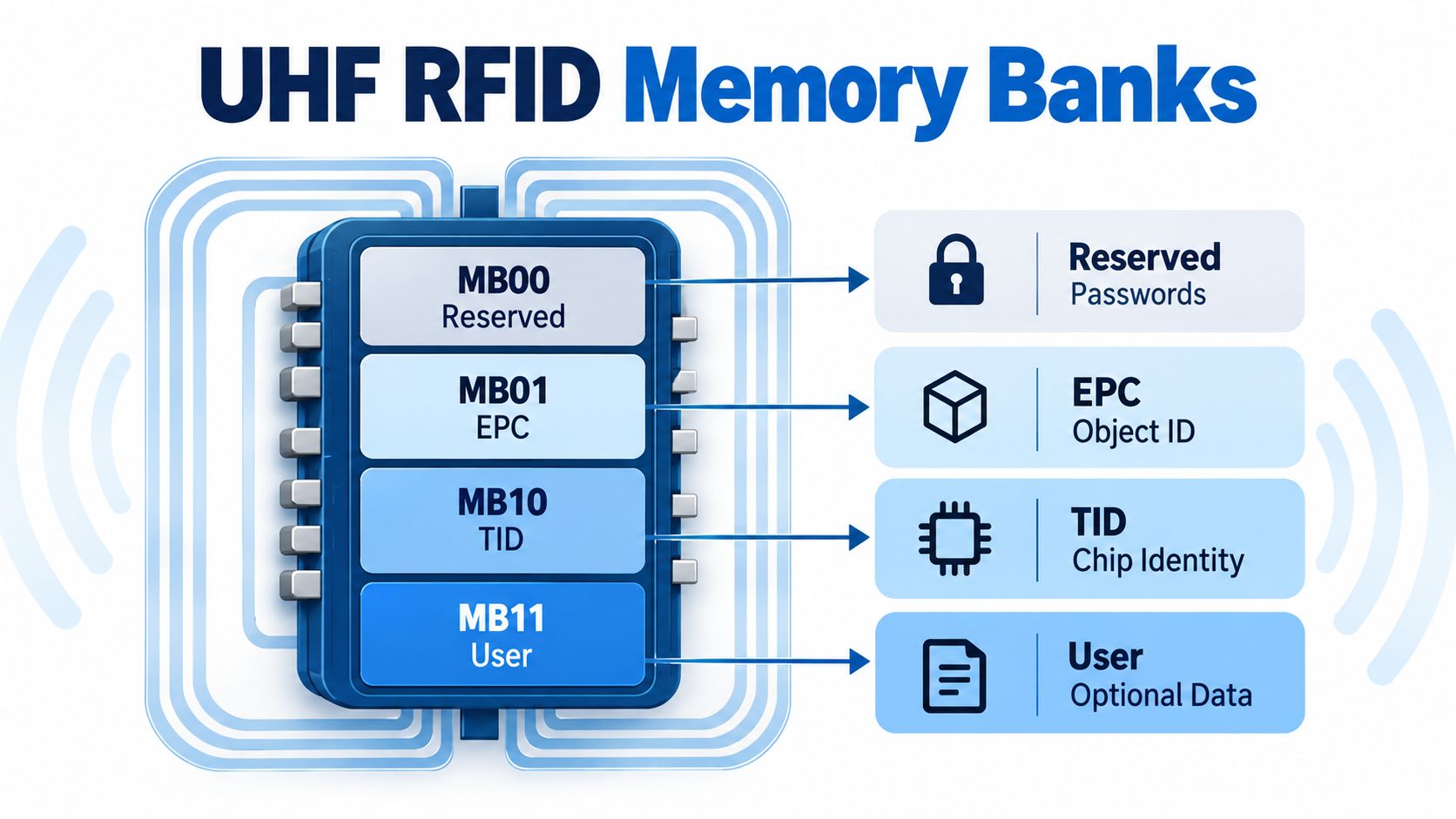
GS1 Gen2 RAIN RFID tags logically organize memory into four main banks.
| Memory Bank | Name | Main Purpose |
|---|---|---|
| MB00 | Reserved | Access and Kill passwords |
| MB01 | EPC | Object / item identity |
| MB10 | TID | Tag IC identity and capabilities |
| MB11 | User | Optional application data |
Understanding these banks is more useful than simply asking:
How much memory does the chip have?
Different memory areas serve different purposes.
Reserved memory generally contains:
Kill Password
and:
Access Password
The Kill command can permanently silence a compatible tag when correctly authorized.
The Access password can be used with secured-state and memory-protection functions.
These features are part of the tag's control architecture rather than normal inventory data.
EPC memory normally contains the identifier used by the business application.
Examples might represent:
a product, asset, carton, pallet, reusable container or another business object.
In many normal inventory systems, EPC is the most important writable memory area.
It acts as the connection between:
Physical RFID Tag
and:
Backend Business Record
TID means:
Tag Identification
TID describes the RFID IC itself.
For E2-class TIDs under the current GS1 structure, TID includes fields such as the Mask Designer Identifier and Tag Model Number.
This makes TID valuable when an application needs to determine:
which manufacturer's silicon is inside a tag, which IC model it is, and which optional capabilities may be supported.
User memory is optional.
Some mass-market tag ICs provide no user memory.
Others provide a small amount.
Specialized industrial chips may provide hundreds or thousands of bits.
The correct amount depends on the application.
More memory is not automatically better.
For ordinary item identification, a relatively compact EPC may be sufficient.
For example, the current Impinj M800 family illustrates two different memory strategies:
| IC | EPC Memory | User Memory |
|---|---|---|
| M830 | 128 bits | 0 |
| M850 | 96 bits | 32 bits |
Both use the same M800 platform but target different data requirements.
The important question is:
What identity must actually be encoded?
not:
Which chip has the biggest memory number?
User memory becomes more valuable when information needs to remain directly with the item.
Possible examples include industrial process data, maintenance information, local production status, extended item attributes or data needed when backend access may be unavailable.
However, many RFID projects work better with:
EPC / Unique ID
↓
Backend Database
↓
Product
Serial
Owner
Status
Location
History
This avoids repeatedly rewriting business information into the tag.
Some modern RAIN RFID ICs specifically target data-rich industrial applications.
NXP's UCODE Nxm, introduced in 2026, provides up to 880 bits of configurable shared memory, with configurations supporting up to 496 bits of EPC memory or up to 752 bits of User memory. NXP positions it for Industrial IoT, manufacturing, healthcare, aviation and Digital Product Passport applications.
Impinj's M700 family also includes extended-memory variants such as M780 and M781. Impinj documentation lists M780 with up to 496-bit EPC and 128-bit User memory, while M781 uses a 128-bit EPC and 512-bit User-memory configuration.
This illustrates why chip selection increasingly depends on data architecture, not only read performance.
TID is one of the most useful but misunderstood areas of RAIN RFID.
A simplified concept is:
EPC
identifies the object.
TID
identifies characteristics of the tag IC.
For an E2-format TID, GS1 defines information including:
Class Identifier
→ TID structure
MDID
→ Mask Designer / IC manufacturer
TMN
→ Tag Model Number
optional extended information
→ serial number and capabilities
GS1 also provides a TID Decoder specifically for interpreting these values.
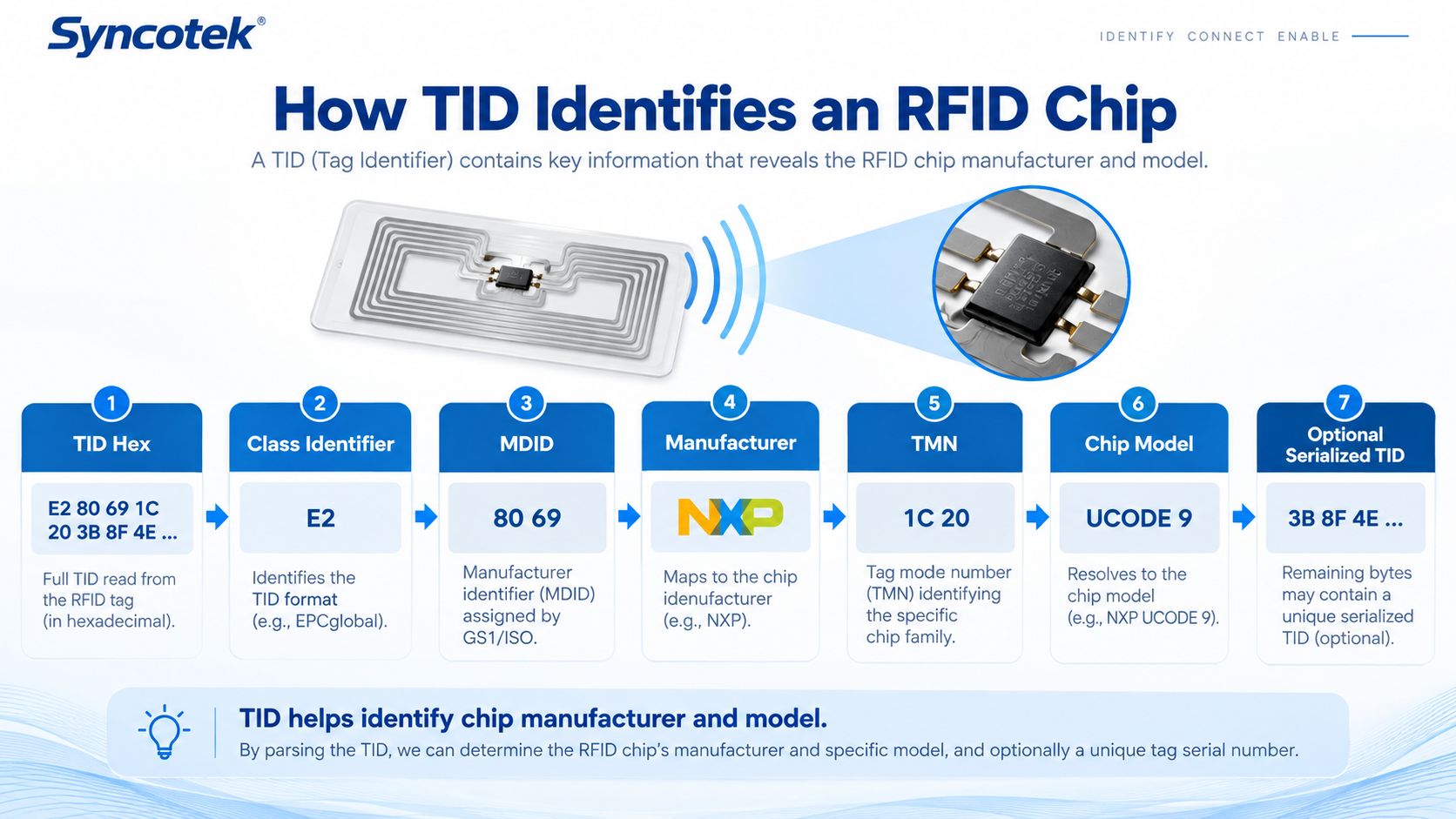
A simplified decoding process is:
TID Hex
↓
Class Identifier
↓
MDID
↓
IC Manufacturer
↓
TMN
↓
Chip Model / Family
↓
Optional Extended TID
For example, software that retrieves a tag's TID can decode the MDID to identify the silicon manufacturer.
The TMN then identifies a specific chip design assigned by that manufacturer.
This is useful for:
chip qualification, tag verification, mixed-tag environments, supplier compliance and applications that require specific IC features.
TID and EPC should not be confused.
| EPC | TID |
|---|---|
| Usually identifies the tagged business object | Describes the RFID tag IC |
| Commonly written during encoding | Factory programmed |
| Can change depending on application | Generally locked/permanent |
| Used by inventory applications | Useful for chip identification |
| Example: Asset 1028 | Example: Manufacturer + IC model |
If an RFID label is moved from one item to another, the EPC may be reprogrammed where the workflow permits.
The underlying TID still describes the same physical chip.
This requires a careful answer.
Historically, not every Gen2 tag implementation provided the same serialized-TID structure.
The basic TID always provides information about the tag technology and IC model, but unique tag-level serialization depended on implementation.
GS1 Gen2v3 strengthens this requirement: current conformance requirements specify support for a serialized TID using a unique serial number under the relevant TID formats.
Therefore, the safe rule is:
Do not assume every historical RFID tag has the same globally unique serialized-TID behavior. Check the chip and protocol version.
Some applications want to confirm:
Does this EPC belong to the expected physical RFID IC?
Reading TID alongside EPC can provide an additional verification layer.
This can be useful for:
supplier compliance, counterfeit-resistance workflows, tag qualification and other applications where simply reading a programmable EPC is not enough.
Newer endpoint ICs also provide faster mechanisms for combined EPC/TID workflows.
For example, Impinj FastID is designed to reduce the number of reader operations required when applications need TID-related identification.
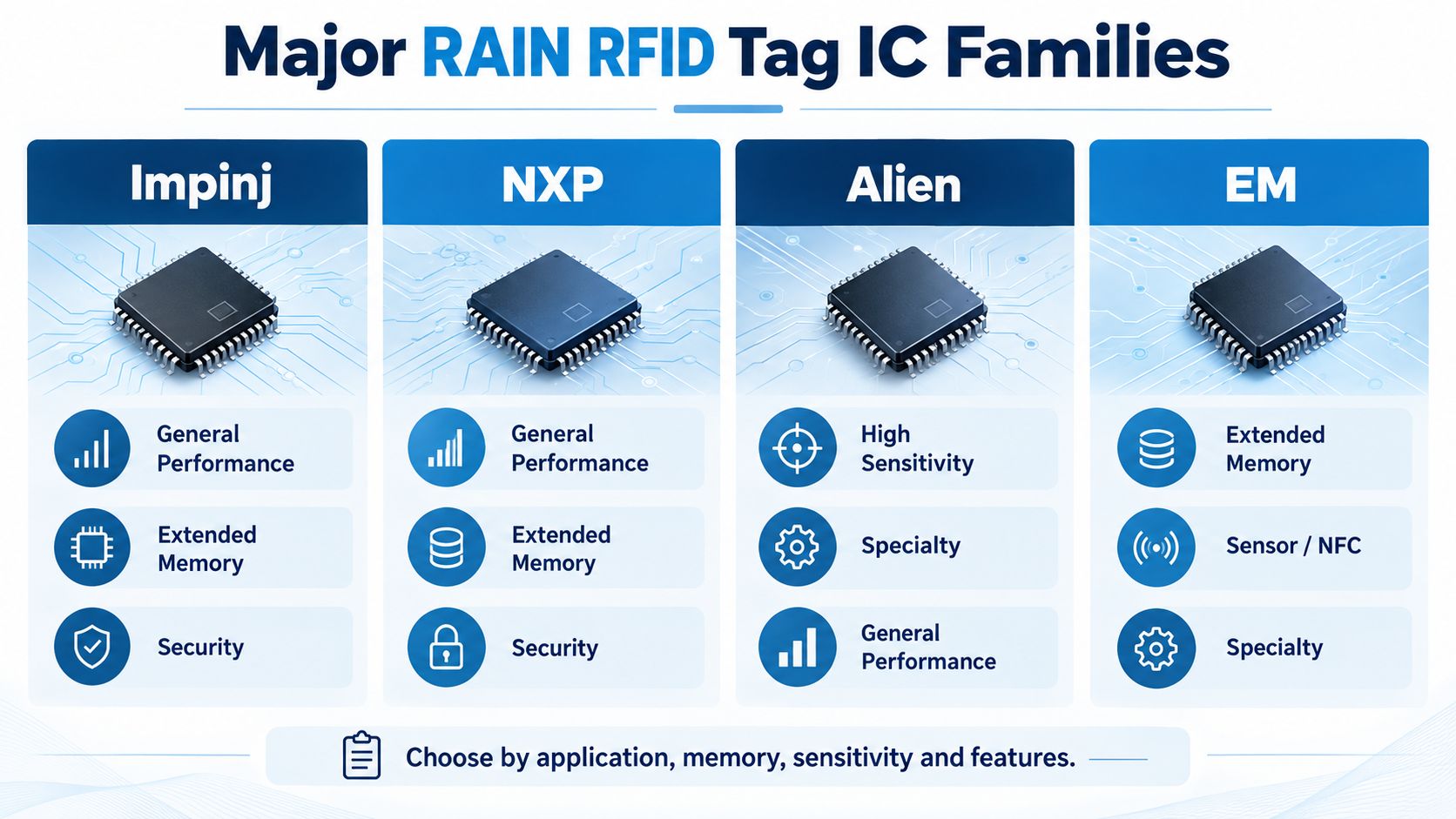
There is no single "best RFID chip."
Current IC families emphasize different combinations of:
performance, memory, privacy, security and specialized functionality.
The most useful way to compare them is by application rather than by brand reputation.
The M800 family currently includes:
M830
and:
M850
Impinj positions M800 as a next-generation universal endpoint-IC platform for large-volume retail and supply-chain applications.
Key characteristics include strong sensitivity, AutoTune V3, FastID, Protected Mode, Gen2X performance/protection features and improved readability for small or challenging tags.
The memory difference is straightforward:
M830:
128-bit EPC, no User memory.
M850:
96-bit EPC, 32-bit User memory.
This makes M800 especially relevant when applications prioritize:
high-volume inventory, small tag designs, retail, logistics and modern Gen2X capabilities.
For a deeper explanation of Gen2X, see /impinj-gen2x-rain-rfid/.
M700 remains a broad family covering both mainstream and higher-memory applications.
Current Impinj documentation includes products such as:
M730, M750, M770, M775, M780 and M781.
The important point is not memorizing every model number.
The family illustrates how one silicon platform can offer:
different EPC size, different User memory, and different application positioning.
For example, extended-memory M780/M781 products are useful where a project needs more than a basic item identifier.
UCODE 9 remains a major mass-market RAIN RFID IC.
NXP specifies:
approximately −24 dBm read sensitivity, −22 dBm write sensitivity, fast encoding, Self-Adjust and Memory Safeguard functionality.
It is particularly relevant for:
retail, logistics and high-volume inventory.
UCODE X represents a newer performance-oriented direction.
NXP currently lists approximately:
−26.2 dBm read sensitivity
and:
−23 dBm write sensitivity.
NXP positions it for smaller inlays and applications in:
retail, supply-chain logistics, shipment services and healthcare.
This makes UCODE X especially interesting when RF efficiency and compact inlay design are important.
UCODE Nxm was introduced in 2026 for more data-intensive applications.
Its major differentiator is configurable high-capacity memory.
NXP currently specifies:
880 bits total shared configurable memory
with multiple memory maps, plus Memory Safeguard and Untraceable privacy capabilities.
Likely use cases include:
industrial manufacturing, product lifecycle data, aviation, healthcare and Digital Product Passport applications.
This does not mean DPP requires large on-tag memory.
Many DPP architectures still use the tag as an identifier pointing to cloud information.
But Nxm creates another architecture option when selected data should remain with the item.
Alien Technology continues to offer its Higgs passive UHF IC family.
Its current product matrix includes products such as:
Higgs-EC, Higgs-9 and Higgs-10 alongside older families.
Higgs-9 is especially associated with larger-memory applications.
Alien's product portfolio therefore remains relevant where projects require:
general passive UHF identification or extended-memory configurations.
When comparing Alien against Impinj or NXP, however, the correct comparison should be made between specific IC models, not simply:
Alien vs Impinj.
EM Microelectronic is particularly interesting for specialized RFID architectures.
EM4325 supports both passive and battery-assisted passive operation.
It provides approximately 4 kbits of nonvolatile memory and includes auxiliary-interface capabilities suitable for specialized industrial and sensor-oriented applications.
This is fundamentally different from a low-cost retail inventory IC.
EM4425 combines:
RAIN RFID
HF / NFC
on the same IC, with shared memory.
This means a finished tag can support:
long-range inventory through RAIN RFID
and:
smartphone/near-field interaction through NFC.
EM also includes authentication and tamper-related features in the platform.
That makes this class of IC interesting for:
product authentication, consumer engagement, lifecycle information and combined B2B/B2C applications.
The more useful comparison is by application category.
| IC Requirement | Typical Application Direction |
|---|---|
| High-performance general-purpose | Retail, logistics, inventory |
| Very low power / small antenna | Compact item-level tagging |
| Extended EPC | Longer serialized identifiers |
| User memory | Industrial and manufacturing |
| Gen2X | Advanced RAIN reader/tag ecosystem |
| Privacy / authentication | Brand and consumer applications |
| RAIN + NFC | Supply-chain + smartphone interaction |
| BAP / sensor interface | Specialized monitoring |
| High-memory data carrier | Industrial, DPP, lifecycle data |
A chip should therefore be chosen from the business and RF requirements, not a preferred brand name.
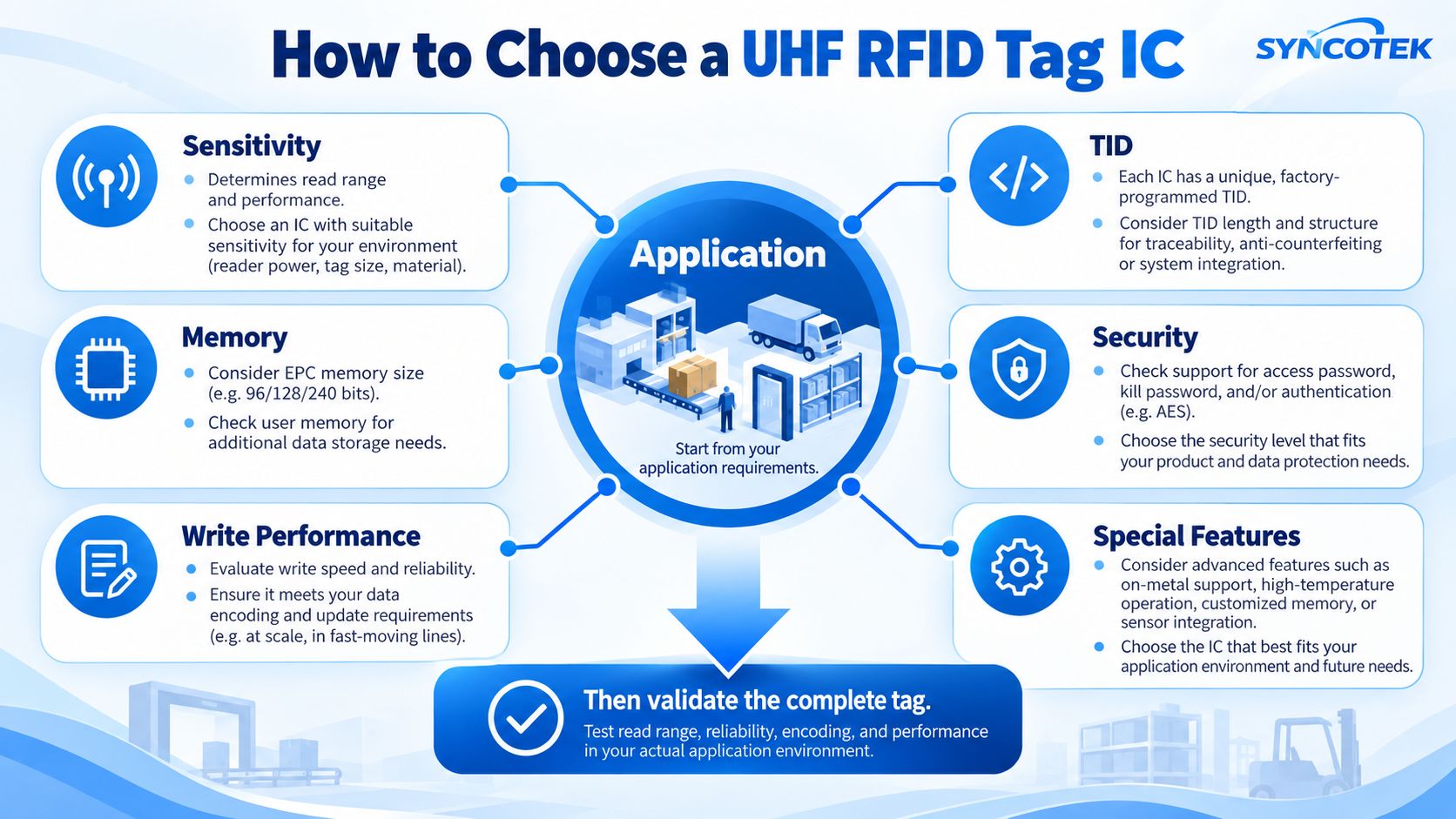
A useful selection process begins with:
Application
and then evaluates:
Sensitivity
→ Memory
→ Write Performance
→ TID
→ Security
→ Special Features
→ Antenna Compatibility
→ Finished Tag Validation
Ask what the tag must actually do.
Retail inventory and industrial manufacturing may both use passive UHF RFID, but their data and durability requirements can be completely different.
Determine:
Do not select extended EPC memory unless it is actually required.
Ask:
Must application data live on the tag?
If not, a simpler backend-centric architecture may be better.
Sensitivity becomes important when:
But do not evaluate sensitivity independently of antenna design.
This matters when tags must be encoded:
If the application requires:
TID requirements should be part of the IC selection.
Different ICs may support different combinations of:
Access / Kill, memory locking, authentication, privacy modes and manufacturer-specific protection features.
Do not assume all Gen2 chips offer identical security.
Examples include:
Gen2X, NFC, sensors, BAP, high-capacity memory or special authentication.
Only pay for these features when the project actually uses them.
Tag ICs have RF impedance characteristics that the antenna design must match.
Replacing IC A with IC B on the same antenna is not automatically a drop-in RF-equivalent change.
Some chip families are intentionally designed to simplify antenna migration, but this should be verified from the manufacturer's reference design and RF data.
The final decision must be made on:
Finished Tag + Real Item + Real Reader + Real Environment
not on the IC datasheet alone.
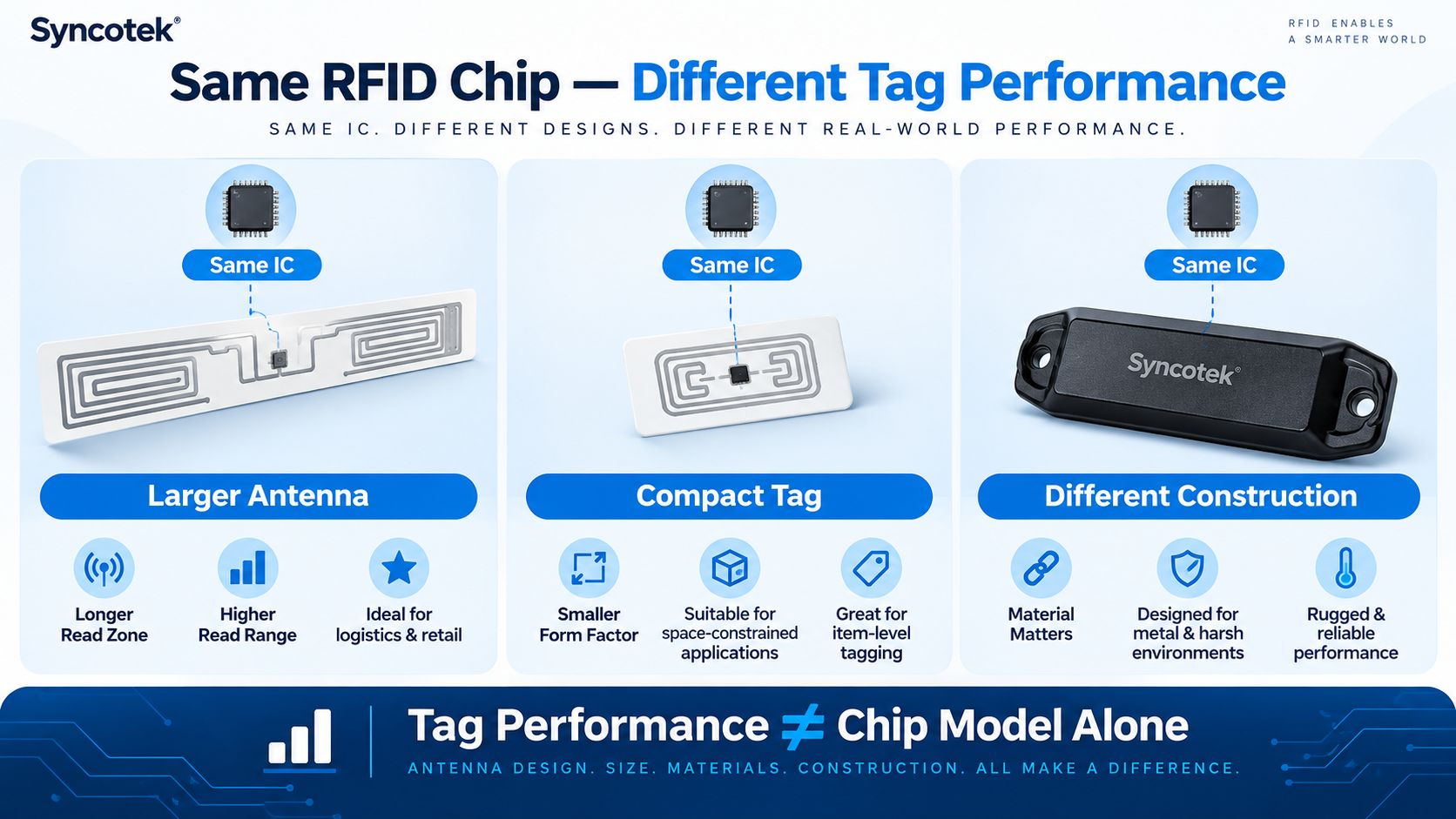
Imagine three RFID tags using the same underlying IC.
Large antenna.
Optimized for:
It may provide a comparatively large read zone.
Same chip.
Much smaller antenna.
It may fit:
but offer different RF performance.
Same chip.
Completely different construction:
Its performance on a steel machine can be dramatically different from either thin label.
The lesson is:
Same Chip ≠ Same RFID Tag Performance
No.
It influences available performance, but it does not determine read range by itself.
A better model is:
Tag Read Performance
=
IC Sensitivity
Antenna Efficiency
RF Matching
Tag Dimensions
Material Interaction
Placement
Reader Architecture
Environment
This is why comparing tags solely from:
M830
vs
UCODE X
is not sufficient.
You must compare finished tags.
No.
A chip does not turn an ordinary label into an on-metal tag.
Metal compatibility comes mainly from complete RF construction, including antenna design, dielectric spacing and ground-plane behavior.
If a project involves:
tools, machines, servers or metal containers,
select a finished RFID tag designed for metal.
See /mount-on-metal-rfid-tags/.
Not by itself.
Temperature capability can be limited by:
the IC, adhesive, substrate, antenna bonding, encapsulation and housing.
A chip may tolerate a particular semiconductor temperature range while the finished label adhesive fails far earlier.
For high-temperature applications, always evaluate the finished-tag specification.
No.
Memory capacity and RF sensitivity are separate characteristics.
A high-memory chip does not automatically read farther.
In some applications, increasing the amount of data transferred may actually increase transaction time.
Choose memory according to the data requirement.
Potentially.
Longer responses require more air-interface data.
The operational effect depends on:
This is another reason not to encode unnecessarily long identifiers.
Gen2X adds another dimension to modern IC selection.
Impinj M800 supports Gen2X capabilities such as:
performance enhancement, FastID, Protected Mode and memory/encoding integrity features.
However:
Gen2X is a reader + tag + firmware ecosystem capability.
Installing a Gen2X-capable tag does not mean every existing reader automatically gains every Gen2X enhancement.
For the complete architecture, see /impinj-gen2x-rain-rfid/.
Security requirements vary widely.
A simple carton-tracking project may need little more than controlled EPC encoding.
Other projects may require:
These should be treated as project requirements, not generic RFID properties.
For example, Impinj M800 includes Gen2X protection capabilities and Protected Mode, while EM4425 adds AES-based NFC authentication and digital-signature functionality in its dual-frequency architecture.
Therefore:
Never claim “RFID tags are encrypted” without identifying the specific IC and security mechanism.
There is no universal answer, but typical priorities include:
high sensitivity, compact inlay design, fast inventory, reliable mass production and low cost.
This is the type of market targeted by:
Impinj M800, NXP UCODE 9 / UCODE X and similar high-volume RAIN ICs.
The finished inlay remains more important to the buyer than the chip alone.
Manufacturing may add requirements such as:
User memory, repeated writing, long data retention, process data, TID verification and industrial tag construction.
Depending on architecture, higher-memory products such as:
Impinj M780/M781 or NXP UCODE Nxm may become relevant.
However, many WIP systems only need a simple tag ID linked to MES.
More memory should not be selected automatically.
DPP is another area where architecture matters.
A Digital Product Passport does not necessarily require storing the complete passport on the RFID chip.
A common model is:
RFID / NFC Identifier
→ Backend URL / Resolver
→ Digital Product Record
But if selected lifecycle information must remain on the item itself, larger configurable-memory chips such as UCODE Nxm provide another option. NXP explicitly positions Nxm for DPP and industrial lifecycle applications.
Dual-frequency RAIN + NFC architectures may also be attractive when both enterprise inventory and smartphone consumer interaction are required.
Ordinary passive inventory ICs are not automatically sensor chips.
If an application requires:
a specialized IC should be evaluated.
EM4325 is an example of a UHF IC supporting passive or battery-assisted passive architectures, substantial memory and auxiliary interfaces for specialized monitoring applications.
The complete sensor tag still requires more than the IC itself.
Many end users do not need to begin an RFID project by choosing the bare IC.
If you simply need:
a warehouse label, apparel tag, tote tag or metal asset tag,
the more important decision is usually:
Which finished RFID tag reliably works on my item and with my reader?
The chip model becomes especially important when the project has specific requirements involving:
memory, TID, Gen2X, security, authentication, DPP, encoding speed, customer mandates or approved-component lists.
For most buyers:
Finished Tag Selection
comes before:
Bare IC Optimization
See /how-to-choose-rfid-tag/.
Tag manufacturers, converters and OEM developers need to evaluate ICs more deeply because they influence the actual tag design.
Typical engineering considerations include:
antenna impedance, die attachment, RF tuning, memory configuration, encoding, protocol support, wafer availability, supply continuity and customer qualification.
This is where comparing IC-level datasheets becomes genuinely important.
The most common mistake is selecting an RFID chip from a specification table without considering the complete tag.
Other frequent errors include choosing the IC only by sensitivity, choosing the IC only by memory size, assuming the same chip always produces the same read range, confusing Tag ICs with Reader ICs, assuming a high-sensitivity chip automatically solves metal tagging, treating TID as the business EPC, ignoring write performance, assuming every Gen2 chip supports identical security features, and basing a new project on old comparison tables without checking whether the IC is still current.
One current example of why freshness matters is NXP UCODE 9xm: NXP now marks that specific product as End of Life, while newer UCODE Nxm provides a current high-memory migration path.
Before specifying a chip, confirm:
| Question | Why It Matters |
|---|---|
| What object is being tagged? | Determines the overall RF challenge |
| Which frequency / protocol? | Defines interoperability |
| How much EPC memory? | Prevents overspecification |
| Is User memory required? | Influences IC family |
| What read sensitivity is required? | Influences RF margin |
| Will tags be encoded at speed? | Makes write sensitivity important |
| Is TID verification required? | Influences workflow |
| Is serialized TID required? | Important for qualification/security |
| Are privacy features needed? | Narrows chip options |
| Is authentication required? | May require specialized IC |
| Is Gen2X required? | Requires compatible ecosystem |
| Is NFC also required? | May favor dual-frequency IC |
| Are sensors required? | Requires specialty architecture |
| Is the item metal or liquid? | Finished tag construction becomes critical |
| What reader will be used? | Complete system must be validated |
| Has the finished tag been tested? | Datasheet performance is not field performance |
A UHF RFID tag chip is the integrated circuit inside a passive UHF / RAIN RFID tag. It manages tag memory, protocol communication and backscatter response.
No. A finished RFID tag contains an IC plus an antenna and physical construction.
A tag IC sits inside the RFID tag and responds to reader commands. A reader IC sits inside the reader and manages RF transmission, reception and tag communication.
There is no universal best IC. The correct choice depends on sensitivity, memory, write performance, security, TID requirements, advanced features and the finished tag design.
Both offer strong current RAIN RFID platforms. Compare specific models and application requirements rather than brand names.
Sensitivity indicates the RF power level required for the IC to operate under defined conditions. A more negative read-sensitivity figure generally means lower required power.
No. Real tag range also depends heavily on the antenna, RF matching, material, placement, reader and environment.
It describes RF power at the IC, not meters of read distance.
Write sensitivity is the RF power level required for reliable write operations. It is especially important for printer/encoder and production programming applications.
They are Reserved, EPC, TID and optional User memory.
EPC memory normally contains the identifier used to represent the tagged item or business object.
TID is factory-programmed Tag Identification memory describing the IC manufacturer, model and supported capabilities.
EPC usually identifies the object. TID identifies characteristics of the RFID IC.
Yes. MDID identifies the chip manufacturer and TMN identifies the manufacturer's tag IC model.
Not every historical tag used the same serialized-TID implementation. Current Gen2v3 conformance requirements include serialized TID requirements for relevant tags.
Normally no. TID describes permanent IC characteristics and is factory programmed and locked.
No. Additional memory is useful only when the application needs data stored directly on the tag.
No. Memory capacity and RF sensitivity are separate characteristics.
Absolutely. Antenna design, dimensions, construction and tagged material can produce very different real-world performance.
Impinj M800 and selected M700-generation endpoint ICs support Gen2X capabilities. The reader and firmware must also support the required Gen2X feature.
No. Metal compatibility primarily depends on the finished tag's antenna and physical RF construction.
Examples of current higher-memory platforms include NXP UCODE Nxm and selected Impinj M700 extended-memory ICs.
Yes. EM Microelectronic's em|echo-V / EM4425 combines RAIN RFID and NFC/HF functionality on one IC with shared memory.
Specialized RFID IC architectures can support sensors or external sensing, but an ordinary inventory tag IC should not be assumed to provide temperature measurement.
End users should usually choose the finished RFID tag according to their object, material, read zone and environment, and only specify the IC when memory, security, TID or advanced features create a specific requirement.
Syncotek provides passive UHF RFID tags and RFID hardware for retail, logistics, manufacturing, asset tracking, tools, metal equipment, reusable containers and other industrial applications.
The right RFID solution should be evaluated as:
Tag IC
Antenna
Tag Construction
Tagged Object
Reader
For a deeper understanding of RFID tag ICs, memory, antenna design, encoding, and hardware selection, explore these related Syncotek guides:
The key principle is simple:
Choose the RFID tag IC for the required electronic capabilities, then validate the complete RFID tag for the actual physical application.
A high-performance RFID chip can expand design possibilities, but reliable results depend on antenna matching, tag construction, mounting materials, reader configuration and environmental conditions.
For successful deployment, always evaluate the complete RFID tag and system architecture, not the chip model alone.
 Knowledge
A modern data center may contain thousands of physical IT assets distributed across: rooms cages rows racks storage areas staging zones repair areas multiple facilities Servers, switches, storage appliances and network equipment are also moved, upgraded, replaced and decommissioned throughout their lifecycle. The challenge is not simply knowing how many devices the organization purchased. Data […]
READ MORE Knowledge
Conferences, exhibitions, trade shows, corporate events, training programs, and large public venues all need accurate attendee data. Event organizers want to know who arrived, where attendees went, which sessions attracted the most visitors, how long people stayed in certain areas, and whether sponsors or exhibitors received meaningful engagement. Traditional event attendance tracking often relies on […]
READ MORE Knowledge
What Is Load Modulation? Load modulation is the uplink method used by most HF RFID and NFC tags to send data back to a reader in the near field. The tag does not generate its own RF carrier. Instead, it changes its electrical load across the tag coil, and that change is coupled back into the reader’s magnetic […]
READ MORE Knowledge
Hospitals manage thousands of physical items every day. Infusion pumps move between departments. Surgical supplies enter and leave operating rooms. Medical consumables are stored across multiple locations. Staff search for wheelchairs, monitors, portable diagnostic equipment, linen, medications, and other resources while maintaining strict operational and documentation requirements. Many of these workflows still depend on: manual […]
READ MORE Case Show
Cloud printing is a printing technology based on cloud services, which can be well matched with Internet applications.
READ MOREIf you are interested in our services or need customized solutions, please feel free to contact us.