
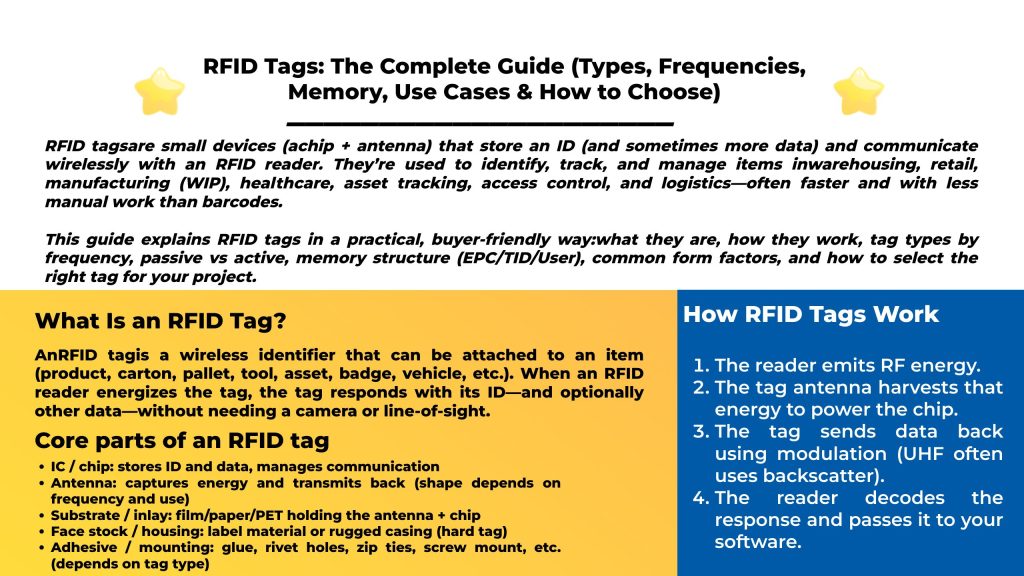
RFID tags are electronic identifiers that allow physical products, assets, containers, tools, garments and other objects to communicate wirelessly with an RFID reader.
Unlike a barcode, an RFID tag normally does not need to be directly visible to the reader. Depending on the RFID technology and system design, readers can identify individual tags, inventory multiple tagged items, detect assets at controlled checkpoints, or automate data capture inside warehouses, factories, hospitals, retail stores and other environments.
A basic RFID system follows this path:
Physical Item → RFID Tag → RFID Reader → Software → Business Record
The tag provides the physical identity.
The reader captures that identity.
Software connects it with information such as:
However, RFID tags are not all the same.
A thin retail RFID label, washable laundry tag, NFC card, compact on-metal tool tag and battery-powered active RFID tag can all be called "RFID tags" while having completely different:
This guide explains what RFID tags are, how they work, why businesses use them, the main RFID tag types, memory structure, common applications, limitations and how different tags fit into a complete RFID system.
An RFID tag is a device that uses radio frequency identification technology to give a physical object an electronic identity.
It normally contains at least:
RFID Chip + Antenna
The finished product may then add:
depending on the application.
RFID tags can identify objects such as:
The exact information stored on the tag depends on the technology and application.
In many commercial UHF RFID systems, the most important information on the tag is simply a unique electronic identifier.
Detailed business information remains in the backend database.
The operating principle depends on the RFID technology, but passive RFID provides the easiest example.
The RFID reader transmits a radio-frequency signal through its antenna.
The tag antenna interacts with the reader's field.
For a passive tag, this RF energy powers the RFID chip.
The chip determines how it should respond.
Depending on the protocol and command, the reader may request:
Passive UHF RFID tags normally communicate using backscatter.
Instead of generating their own independent radio carrier, they modify how the reader's RF signal is reflected back.
The reader converts the RF response into digital data.
The reader may send the data to:
The business system then determines what that RFID observation means.
For example:
EPC detected at Shipping Door
can become:
Pallet P102 left the warehouse at 15:42.
The RFID tag provides identification.
The application provides business meaning.
RFID tags are useful when a business needs to reduce the amount of manual identification required in a physical process.
Barcode scanning normally requires the operator to see the code.
A UHF RFID tag can often be detected without direct optical visibility.
That can be valuable when labels are:
This does not mean RFID works through every material.
Metal, liquids and other environmental factors can still significantly affect RF performance.
One of the strongest advantages of passive UHF RFID is the ability to inventory multiple compatible tags.
Instead of:
Find → Scan → Find → Scan
an inventory workflow can become:
Enter Area → Read Tagged Items → Compare With Expected Inventory
This is especially valuable for:
RFID can identify every individual item separately.
Instead of:
Product A × 100
the system can manage:
Product A — Item 00001
Product A — Item 00002
Product A — Item 00003
This is useful for:
RFID does not always require a person holding a scanner.
A fixed RFID reader can create an automatic identification point at:
For example:
Tagged Pallet
→ RFID Portal
→ Shipment Verification
→ WMS Event
This is one of the major differences between RFID and conventional barcode systems.
Many industrial RFID tags are designed to remain attached to assets for years.
Applications include:
The electronic identity can remain connected with the asset throughout its lifecycle.
A handheld UHF RFID reader can help staff perform faster physical inventory because tags do not normally need to be presented individually to an optical scanner.
This is particularly useful when organizations manage hundreds or thousands of assets.
RFID is powerful, but it is not automatically better for every identification task.
| RFID Tag Advantage | Important Consideration |
|---|---|
| No optical line of sight in many applications | RF performance still depends on material and environment |
| Multiple UHF tags can be inventoried | Read-zone design is required |
| Unique item-level identity | Requires RFID reader infrastructure |
| Automated checkpoints are possible | Higher system cost than basic barcode |
| Reusable industrial tags are available | Tag construction must match the environment |
| Memory can be read or written on many tags | Backend databases are usually still required |
| Tags can support automated inventory | RFID does not automatically provide precise RTLS |
| Many form factors are available | There is no universal tag for every material |
The correct question is not:
Is RFID better than barcode?
It is:
Which technology fits this workflow?
RFID tags can be classified according to how they receive power.
Passive RFID tags do not contain a battery for normal communication.
They receive energy from the RFID reader.
Advantages include:
Passive RFID is widely used for:
Passive tags include LF, HF and UHF technologies.
Active RFID tags contain their own battery.
They can actively transmit signals rather than relying entirely on reader-generated energy.
They are generally:
Active RFID is commonly used when the project requires:
Battery-assisted passive, or BAP, tags combine elements of passive and battery-powered designs.
A battery can support:
while communication may still use passive-style backscatter architecture depending on the tag.
BAP tags are used in more specialized projects rather than ordinary low-cost inventory labeling.
Another important classification is operating frequency.
Typical operating frequencies are around 125 kHz or 134.2 kHz.
LF systems normally provide:
Common uses include:
HF RFID commonly operates at 13.56 MHz.
Applications include:
NFC belongs to the HF RFID family.
NFC is designed for very short-range interaction.
Its main advantage is deliberate interaction.
Typical workflow:
Phone / NFC Reader
→ Tap
→ NFC Tag
This makes NFC suitable for:
Passive UHF RFID operates in regional UHF bands, with deployments commonly falling within the broader 860–960 MHz range.
UHF is particularly well suited to:
Its main strengths include:
For many industrial and inventory projects, UHF / RAIN RFID is the most commercially important RFID tag category.
| Technology | Typical Interaction | Main Strength | Common Applications |
|---|---|---|---|
| LF | Very short range | Controlled identification | Animal ID, industrial ID |
| HF | Short range | Cards and near-field identification | Libraries, access |
| NFC | Tap | Smartphone interaction | Access, digital experiences |
| Passive UHF | Short to multi-meter depending on system | Fast inventory and automation | Retail, warehouse, assets |
| Active RFID | Long-range powered transmission | Location-oriented applications | RTLS, specialized assets |
Read distance should always be treated as application-dependent rather than a guaranteed universal number.
The physical construction of an RFID tag has a major effect on performance.
At the simplest level:
RFID Chip + Antenna + Substrate
A finished tag can also include:
Adhesive + Face Stock + Spacer + Housing + Encapsulation
The RFID IC manages:
The antenna interacts with RF energy.
Its:
have a major influence on practical performance.
The substrate supports the chip and antenna structure.
Labels may use pressure-sensitive adhesive to attach the tag to:
Different surfaces may require different adhesive systems.
On-metal RFID tags may include structures that separate or electromagnetically adapt the RFID antenna to the conductive surface.
Industrial hard tags may use:
to protect RFID electronics.
This is why two tags using similar RFID chips can perform completely differently.
The complete mechanical and RF construction matters.
These terms are often used interchangeably, but they describe different product forms.
An inlay is normally the functional RFID core:
Chip + Antenna + Supporting Substrate
It may be supplied to label converters or embedded into another product.
An RFID label usually adds:
It can combine:
RFID + Barcode + Human-Readable Printing
RFID labels are common in:
A hard tag uses a more durable physical structure.
Typical applications include:
Hard tags can provide:
The correct form factor depends on the asset and working environment.
Best suited to:
Designed for conductive surfaces such as:
Compact PCB-based UHF designs are useful for:
Used for:
Designed for applications where standard:
cannot survive the process temperature.
Designed to survive:
Typical uses include:
Typically associated with HF/NFC applications such as:
Used in:
Technology may be HF/NFC or UHF depending on the workflow.
Passive UHF RFID tags commonly organize memory into several banks.
EPC memory normally contains the primary electronic identifier used by the application.
Example:
RFID EPC
→ Product / Asset Record
EPC is usually the most important memory area for inventory and asset applications.
TID means Tag Identifier.
It provides information associated with the RFID IC.
Depending on the chip, it can help applications distinguish or validate RFID tags.
Some RFID chips provide additional user memory.
This can be used when information must remain directly on the tag.
However, many applications do not require large user memory.
Reserved memory can contain supported values such as:
depending on the RFID chip and protocol.
A common misconception is that the RFID tag should contain the complete product or asset record.
Usually, this is unnecessary.
A more scalable architecture is:
RFID Tag
EPC / Unique Identifier
↓
Backend Database
↓
Product
Serial Number
Owner
Location
Status
Maintenance
Shipment
Lifecycle History
This architecture has several advantages.
Business information can change without rewriting every tag.
A database can hold far more information than RFID tag memory.
Sensitive business information can remain inside controlled systems.
The same RFID identity can connect to:
The RFID tag should primarily identify the physical item.
The backend system should manage the business record.
RFID and barcode solve similar identification problems but use different technologies.
| Feature | RFID | Barcode / QR |
|---|---|---|
| Identification method | Radio frequency | Optical |
| Line of sight | Usually not required | Required |
| Bulk identification | Strong with UHF | Normally one at a time |
| Tag cost | Higher | Lower |
| Reader infrastructure | More complex | Simple |
| Automated checkpoints | Strong | Limited |
| Visible information | Requires printing layer | Native |
| Smartphone support | Technology-dependent | Strong |
Barcode remains an excellent solution when:
RFID becomes attractive when:
Many systems use both.
NFC is part of RFID technology.
The key difference is interaction style.
Best when the user intentionally:
Taps
a phone or reader.
Best when the system needs:
Inventory / Bulk Reading / Automatic Identification
Therefore:
NFC is ideal for deliberate interaction.
UHF is ideal for many automatic identification workflows.
Neither is universally better.
RFID tags now support a wide range of physical identification workflows.
RFID tags can identify:
Applications include:
UHF RFID labels are widely used for item-level inventory.
Potential workflows include:
RFID can identify:
The tag connects the physical item to the production record.
Assets such as:
can receive persistent serialized RFID identities.
Compact on-metal tags can support:
RFID can support appropriate workflows involving:
Technology must be selected according to the specific healthcare workflow.
Washable RFID tags can remain with textile items through:
Issue → Use → Laundry → Clean Storage → Reissue
Reusable:
are strong candidates because the RFID tag can remain with the asset across multiple cycles.
On-metal RFID tags can identify:
and support faster physical audits.
There is no single universal RFID tag read range.
Practical performance depends on the complete system.
A better model is:
Read Performance = RFID Tag + Asset Material + Placement + Orientation + Reader + Antenna + Power + Environment
Important factors include:
LF, HF and UHF have fundamentally different operating characteristics.
A larger UHF antenna can offer more RF design potential, but physical size alone does not determine performance.
Chip characteristics influence how much RF energy is needed for operation.
Metal and water-rich materials can significantly affect UHF performance.
Higher power may increase available RF energy, but excessive power can also create unwanted reads.
Important factors include:
Tag and reader antenna geometry affects coupling.
RF reflections, shelving, products and other readers can affect the result.
Published distance should therefore be treated as a reference, not a guaranteed deployment result.
Metal is one of the most common causes of UHF RFID performance problems.
A conventional UHF label applied directly to metal may become detuned.
Applications involving:
usually need an RFID tag specifically designed for metal.
On-metal tags may use:
Do not solve a metal-tagging problem simply by increasing reader power.
Start with the correct tag architecture.
Water absorbs UHF RF energy.
Applications involving:
should be tested carefully.
Possible improvements include:
Again:
Test on the actual product.
This page provides the overall framework, while detailed selection should be treated as its own engineering task.
The basic sequence is:
Application
→ Frequency
→ Material
→ Available Size
→ Required Read Zone
→ Environment
→ Mounting
→ Memory
→ Reader
→ Sample Testing
Do not select RFID tags only from:
The tag must match the complete system.
Ask:
What am I tagging?
Cardboard?
Plastic?
Metal?
Textile?
Liquid-filled packaging?
Ask:
What event do I need to capture?
Inventory?
Doorway movement?
Tool issue?
Laundry processing?
Shipping verification?
Ask:
Where should this RFID tag be detected?
and:
Where should it not be detected?
Consider:
Options may include:
Before mass deployment:
Measure:
Reliable Operational Performance
not:
Longest One-Time Read
The most common problems usually come from treating RFID tags as generic stickers.
Avoid:
RFID tag selection should always include real-world validation.
Likely causes include:
Test under real operating conditions.
Use an appropriate on-metal RFID tag.
Then verify:
Check:
The problem may be excessive read-zone coverage.
Possible causes:
Longer range is not always better.
Possible factors include:
A pallet must be tested as a complete loaded object.
Not every RFID tag provides the same security features.
Some tags support:
Others are primarily simple identifiers.
Therefore:
RFID tag = secure encrypted credential
is not a universal rule.
Security depends on:
For sensitive applications, select RFID technology specifically designed for the required security level.
Not automatically.
This is an important distinction.
A passive RFID tag attached to an asset can support:
But:
Passive RFID Tag ≠ Precise Real-Time Location System
If continuous location is required, the system may need:
The required visibility should be defined before selecting technology.
A standard RFID identification tag does not automatically measure temperature.
Temperature monitoring requires a tag or device with:
The same applies to:
Do not assume every RFID tag is also a sensor.
The tag is only the physical identity layer.
A complete UHF RFID system may include:
Tagged Item
↓
RFID Tag
↓
Reader Antenna
↓
RFID Reader
↓
Edge / Middleware
↓
ERP / WMS / MES / Asset System
If one layer is poorly designed, the entire RFID project can underperform.
For example:
A high-performance reader cannot compensate for a standard label attached incorrectly to metal.
Likewise, the best RFID tag cannot solve an incorrectly positioned antenna.
RFID performance should always be evaluated as a complete system.
Syncotek provides passive UHF RFID tag architectures designed around different materials and operating environments.
Suitable for:
Suitable for:
Suitable where assets require both:
Typical applications include:
Designed for environments where ordinary tag materials are unsuitable.
Designed for:
Compact durable RFID tags designed for repeated industrial textile-processing environments.
The correct family should always be selected from the:
Object + Material + Environment + Reader Workflow
rather than from a catalog read-distance number alone.
Before approving an RFID tag for production, confirm:
An RFID tag is an electronic identifier containing an RFID chip and antenna. It communicates wirelessly with a compatible RFID reader and can be attached to products, assets, containers, tools, garments and other objects.
The answer depends on the RFID technology. Passive tags receive energy from the reader field and respond electronically. Passive UHF tags typically communicate through backscatter.
Passive RFID tags do not. Active RFID tags contain batteries. Battery-assisted passive tags use a battery for selected functions while retaining passive-style communication in applicable designs.
It depends on the technology. Passive UHF tags commonly store an EPC or other identifier, TID information and optional user memory.
Usually not. A common architecture stores a unique identifier on the tag and keeps detailed product or asset information in the backend database.
RFID tags can be classified by frequency, including LF, HF/NFC and UHF, and by power architecture, including passive, active and battery-assisted passive.
A UHF RFID tag operates in the ultra-high-frequency RFID range and is widely used for inventory, logistics, retail, manufacturing and asset tracking.
RAIN RFID generally refers to passive UHF RFID technology used in modern EPC-based inventory and identification applications.
A passive RFID tag has no internal battery for normal operation. It receives energy from the RFID reader.
An active RFID tag contains its own battery and can actively transmit signals.
RFID tag is the broader term. An RFID label is typically a thin, adhesive-backed and often printable form of RFID tag.
An inlay is generally the chip-and-antenna core on a supporting substrate. A finished tag adds the construction required for actual deployment.
RFID normally does not require optical line of sight, but RF performance can still be affected by materials, placement and the environment.
Passive UHF RFID systems can inventory multiple compatible tags within a properly designed read zone.
There is no universal distance. Range depends on frequency, tag design, reader, antenna, power, material, orientation and environment.
Standard UHF labels may perform poorly directly on metal. Use RFID tags designed specifically for metal surfaces.
They can, but water-rich materials affect UHF RF performance. The tag and placement need to be tested on the actual product.
Some RFID tags are designed for long-term reusable assets, while inexpensive labels may be intended for single-use packaging. It depends on tag construction and application.
Many RFID technologies support writable memory. The exact memory and write capability depend on the RFID chip and protocol.
Many RFID labels can be printed and encoded using an RFID printer encoder.
Most smartphones support NFC rather than passive UHF supply-chain RFID. A smartphone cannot normally replace a dedicated UHF RFID reader.
Security depends on the tag type and chip. Some support passwords, locking or advanced authentication, while others primarily provide identification.
A passive RFID tag alone does not provide precise real-time coordinates. Location capability depends on the reader infrastructure and overall tracking architecture.
Only RFID tags or sensor devices specifically designed with temperature-sensing capability can do so.
Passive RFID electronics can remain usable for many years, but practical lifetime depends on housing, adhesive, temperature, chemicals, UV, washing, impact and mechanical wear.
Start with the object and material, then evaluate frequency, size, read zone, environment, mounting, memory, reader architecture and regional frequency. Test several candidate tags on the real product before mass deployment.
Syncotek provides passive UHF RFID hardware for inventory, assets, tools, manufacturing, logistics, metal equipment and textile applications.
Our RFID hardware portfolio includes:
The right RFID project does not begin with:
Which tag has the longest read range?
It begins with:
What are you tagging, where should it be identified, and under what operating conditions?
If you provide:
the appropriate RFID tag family can be narrowed for sample testing.
For deeper technical information, continue with our dedicated guides covering:
Passive RFID Tags
Passive RFID vs Active RFID
RFID Tag Construction
RFID Inlays vs Tags vs Labels
How to Choose an RFID Tag
Mount-on-Metal RFID Tags
RFID Laundry Tags
RFID System Architecture
The purpose of an RFID tag is simple:
give a physical object a reliable digital identity.
Everything else — inventory, automation, traceability, asset management and business visibility — depends on how that identity is integrated into the complete RFID system.
 Knowledge
Barcode scanners are used in retail checkout, warehouses, manufacturing lines, hospitals, ticketing systems, self-service kiosks, parcel handling, access control, and inventory management. Although 1D and 2D barcode scanners may look similar, they differ in the symbols they can decode, the way they capture information, their ability to scan mobile screens, and the amount of data […]
READ MORE Knowledge
Active RFID is a type of radio frequency identification technology that uses battery-powered tags to transmit data to RFID readers. Because the tag has its own power source, it can send signals over a much longer distance than a passive RFID tag, which relies on the reader’s signal for energy. That is why Active RFID is commonly […]
READ MORE Knowledge
Manufacturing operations depend on accuracy, timing, and visibility. Materials, tools, fixtures, machines, work orders, semi-finished goods, and finished products move through many production stages every day. When these movements are recorded manually, manufacturers often face delayed updates, inventory errors, missing tools, unclear production status, and limited visibility across the shop floor. RFID technology helps manufacturers […]
READ MORE Knowledge
What is a handheld barcode scanner? A handheld barcode scanner (also called a barcode reader) is an optical device that reads printed (or on-screen) barcodes and sends the decoded data to a computer, POS system, mobile device, or industrial controller. Typical scanners include a light source, optics/sensor, and decoder circuitry to interpret the barcode pattern and output the […]
READ MORE Knowledge
Reusable totes, bins, crates and returnable containers are easy to overlook because they are not usually the products being sold. But in many warehouses and manufacturing supply chains, they are valuable operational assets. A company may own 5,000 reusable totes and still struggle to answer basic questions: How many are currently available? How many are […]
READ MOREIf you are interested in our services or need customized solutions, please feel free to contact us.