

Smart cards are used every day for payments, building access, public transportation, employee identification, hotel rooms, event admission, loyalty programs, and secure authentication.
Although they often look like ordinary plastic cards, smart cards contain an integrated circuit that can store, process, or securely exchange digital information.
Some smart cards must be inserted into a reader. Others communicate wirelessly when placed near a contactless reader. More advanced cards can support both interfaces, run cryptographic operations, separate multiple applications, and authenticate the cardholder or system.
However, the term smart card is frequently used too broadly. A magnetic stripe card, a basic 125 kHz proximity card, an NFC card, a contact chip card, and a secure microprocessor card do not provide the same functions or security level.
For Syncotek RFID projects, the correct card should be selected according to:
This guide explains what a smart card is, how it works, the main card types, and how to select a suitable card and reader.
A smart card is a physical card containing an embedded integrated circuit that can store digital data and, depending on the chip, process commands or perform security operations.
The card may communicate with a reader through:
Smart cards are commonly manufactured in identification-card formats, although the underlying technology can also be incorporated into key fobs, wristbands, mobile devices, USB tokens, passports, tickets, and other credentials.
The ISO/IEC 7816 family defines important characteristics and command structures for integrated-circuit cards with contacts, while ISO/IEC 14443 covers proximity contactless cards and communication with compatible readers.
A smart card may contain several electronic and physical components.
The integrated circuit stores data and controls communication with the reader.
Depending on the card type, the chip may include:
A contact smart card has a visible metallic contact plate on the card surface.
When the card is inserted into a compatible reader, the contacts provide:
A contactless smart card includes an antenna embedded inside the card body.
The reader creates an RF field that powers the passive card and enables communication. NFC and many contactless smart-card systems operate at 13.56 MHz over a short distance.
The chip and antenna are normally laminated inside a card structure made from materials such as PVC, PET, PET-G, polycarbonate, or other application-specific substrates.
The card body may also include:
The exact communication process depends on whether the card is contact, contactless, or dual-interface.
A contact smart card must be inserted into a reader so that the card’s metallic contacts align with the reader contacts.
The general process is:
EMV contact payment cards use this physical interface when the card is inserted or dipped into a payment terminal.
A contactless smart card does not need direct electrical contact with the reader.
The general process is:
NFC uses a 13.56 MHz carrier and is designed for short-range communication, typically requiring the card or device to be placed within a few centimeters of the reader.
A dual-interface smart card supports both contact and contactless communication through one chip and one logical card platform.
The same applications and secure information can be accessed through:
This is useful when an organization needs compatibility with existing contact readers while also supporting faster tap-based operation.
Dual-interface readers can read both ISO/IEC 7816 contact cards and 13.56 MHz contactless cards or NFC credentials.
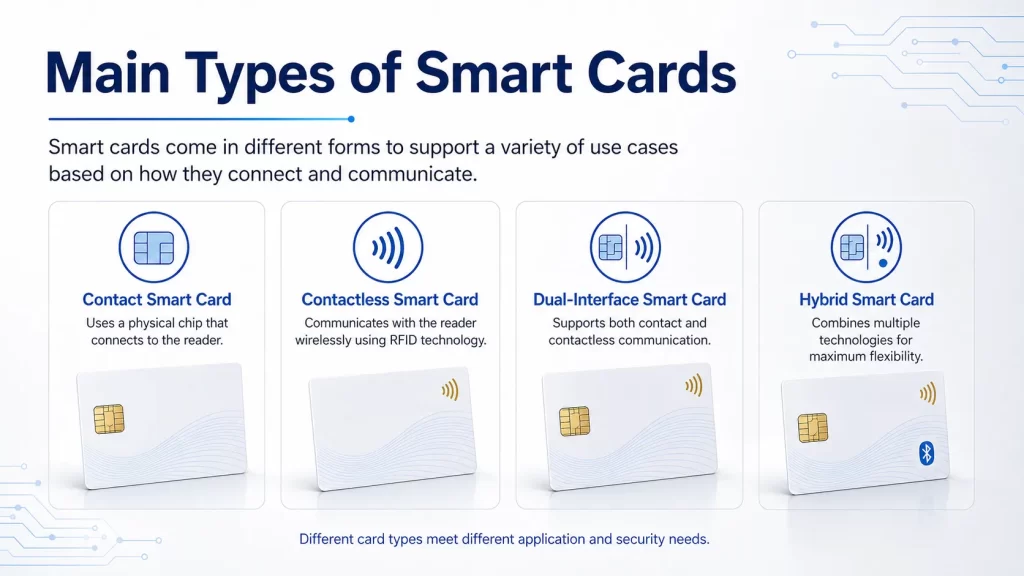
Smart cards can be categorized according to both their communication interface and their chip capability.
Contact smart cards have a visible metallic chip module and must be inserted into a compatible reader.
Contactless smart cards communicate wirelessly with compatible readers.
Dual-interface cards combine contact and contactless communication in one integrated chip.
A hybrid card contains two or more independent chips or technologies inside one card.
For example, one card may contain:
A hybrid card is different from a dual-interface card. A dual-interface card normally uses one chip that communicates through two interfaces, while a hybrid card contains separate electronic systems that may not share data or security logic.
Another important distinction is the capability of the integrated circuit.
A memory card primarily stores and retrieves information.
It may support:
Memory cards are typically simpler and less expensive than microprocessor cards.
A memory card should not automatically be considered suitable for high-security identity or payment applications.
A microprocessor smart card contains a processor capable of executing commands and security operations.
It may include:
Microprocessor cards can provide significantly stronger application isolation and security than simple identifier or memory cards.
NXP’s MIFARE DESFire family, for example, supports multi-application contactless card deployments for identity, access control, loyalty, micropayment, and transportation, with products supporting cryptographic functions such as AES.
The terms smart card and RFID card are related, but they are not always interchangeable.
An RFID card is any card-shaped credential that communicates using RFID technology.
An RFID card may contain:
A smart card normally implies that the card contains an integrated circuit capable of storing structured data and, in more advanced cases, processing commands and security functions.
A basic 125 kHz proximity card that only transmits a fixed identifier may be described commercially as an RFID card, but it does not offer the same capabilities as a secure microprocessor smart card.
A magnetic stripe card stores information magnetically on a stripe attached to the card.
| Feature | Magnetic Stripe Card | Smart Card |
|---|---|---|
| Data storage | Magnetic stripe | Integrated circuit |
| Processing ability | None | Possible with microprocessor cards |
| Contactless use | No | Available |
| Security potential | Limited | Can support authentication and cryptography |
| Data protection | Easy to copy in basic systems | Depends on chip and system design |
| Multi-application support | Limited | Supported by advanced cards |
| Physical wear | Stripe and reader wear | Contactless cards have little mechanical wear |
A smart card can also include a magnetic stripe for compatibility with older systems.
NFC is a specific short-range contactless communication technology operating at 13.56 MHz.
An NFC card is therefore a type of contactless RFID card.
However:
NFC is commonly used in mobile payments, transportation, access control, identity verification, smart posters, device pairing, and other tap-based applications.
The term proximity card often refers to legacy LF access credentials operating around 125 kHz.
These cards commonly transmit a fixed credential number to an access reader.
Typical characteristics include:
Modern HF smart cards can provide stronger authentication, read/write capability, and support for several applications on the same credential.
HID describes its 13.56 MHz iCLASS smart-card technology as providing read/write capability and application support for access control, network login, cashless vending, time and attendance, event management, and biometric identification.
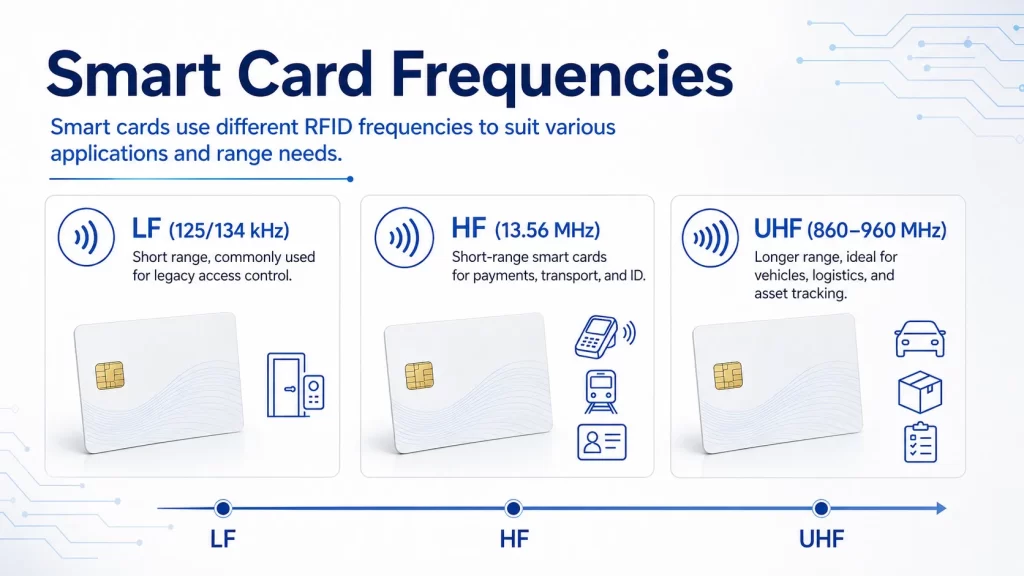
Contactless cards can operate at different RFID frequencies.
LF credentials commonly operate at approximately 125 kHz or 134.2 kHz.
LF should not be selected solely because it is inexpensive. Organizations should consider whether the security level is appropriate.
HF smart cards normally operate at 13.56 MHz.
They are the most common choice for advanced contactless cards.
HF cards generally provide controlled short-range interaction, making them suitable for deliberate tap-based use.
UHF cards normally operate within regional UHF RFID bands.
They can offer substantially longer read distances than LF or HF cards when used with suitable UHF readers and antennas.
A UHF card should not be assumed to work with an NFC or 13.56 MHz smart-card reader.
A dual-frequency card contains two RFID technologies.
Examples include:
A dual-frequency card can support different workflows with one physical credential.
For example:
Dual-frequency cards may use two independent chips and antennas or a specialized multi-frequency design. System integrators should confirm exactly which memory, identifier, and security functions are available through each interface.
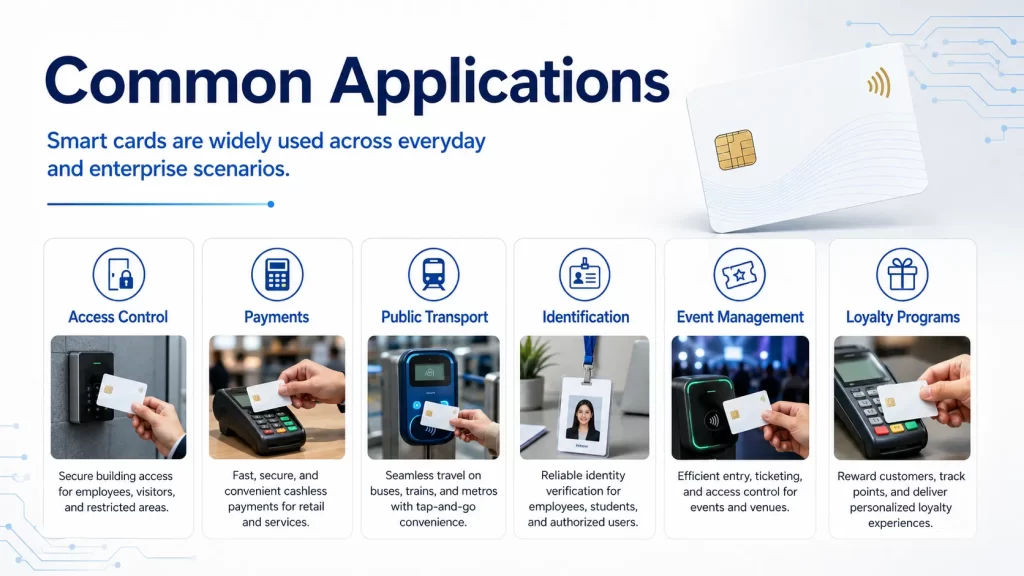
Smart cards can authenticate employees, residents, visitors, contractors, or members at:
A secure access-control system should validate more than a visible card number. It may use mutual authentication, secure keys, backend permissions, access schedules, and audit logs.
Smart cards can support:
A card reader connects the credential with the computer or identity-management system.
Payment smart cards may support:
EMV contactless payment systems generate transaction-specific security data rather than relying only on static magnetic-stripe information.
Contactless cards are widely used for:
Fast tap-based operation is particularly important where many passengers pass through gates.
Smart cards, RFID badges, and wristbands can support:
For a complete implementation overview, see Syncotek’s guide to RFID event management.
Smart cards can be used for:
One smart card may support several applications:
Multi-application cards require careful planning so applications, keys, memory, and permissions remain separated.
Secure microprocessor cards can support:
These applications typically require stronger security, formal certification, and controlled card issuance.
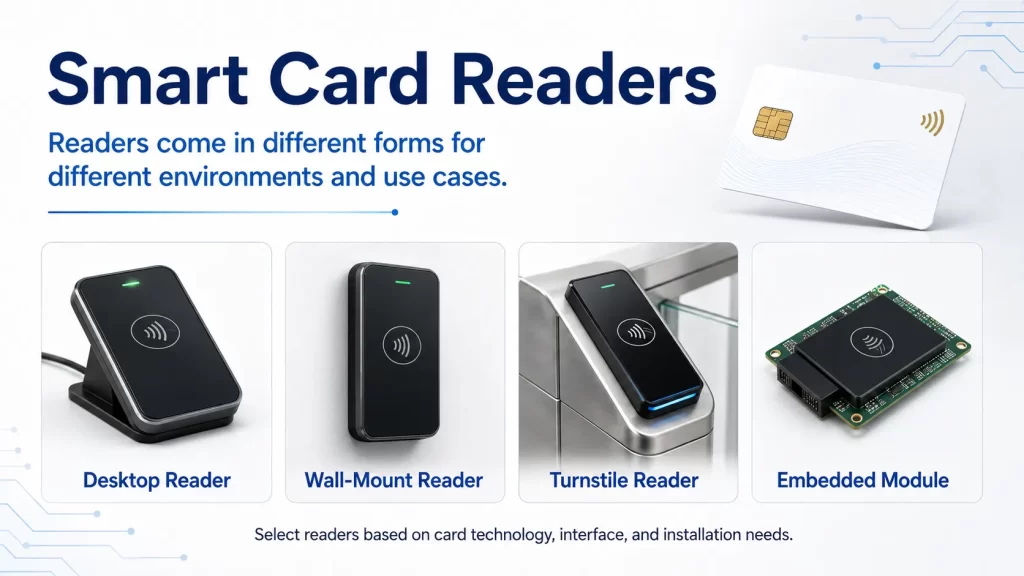
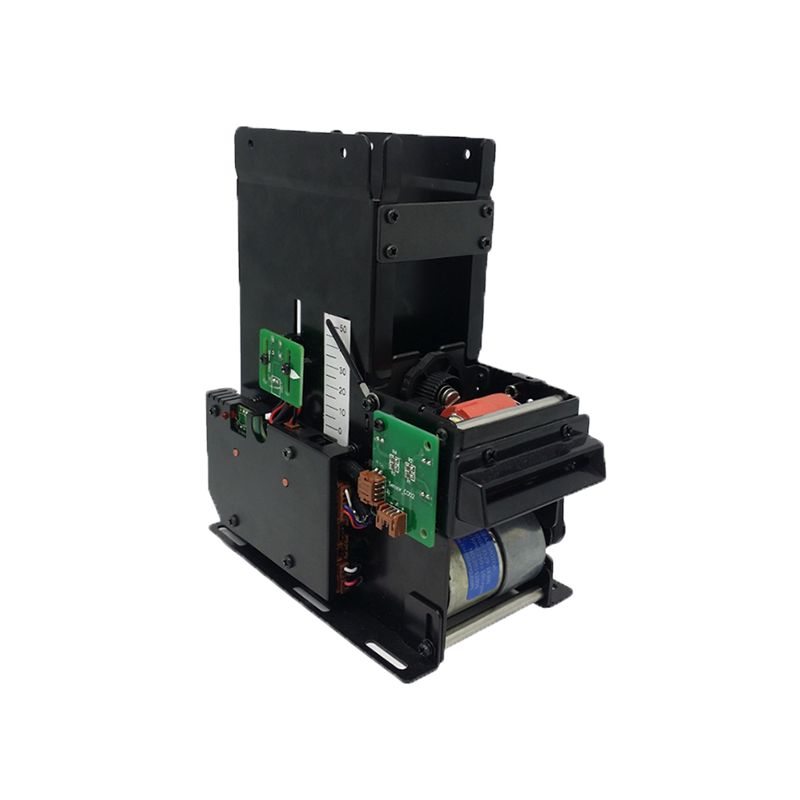
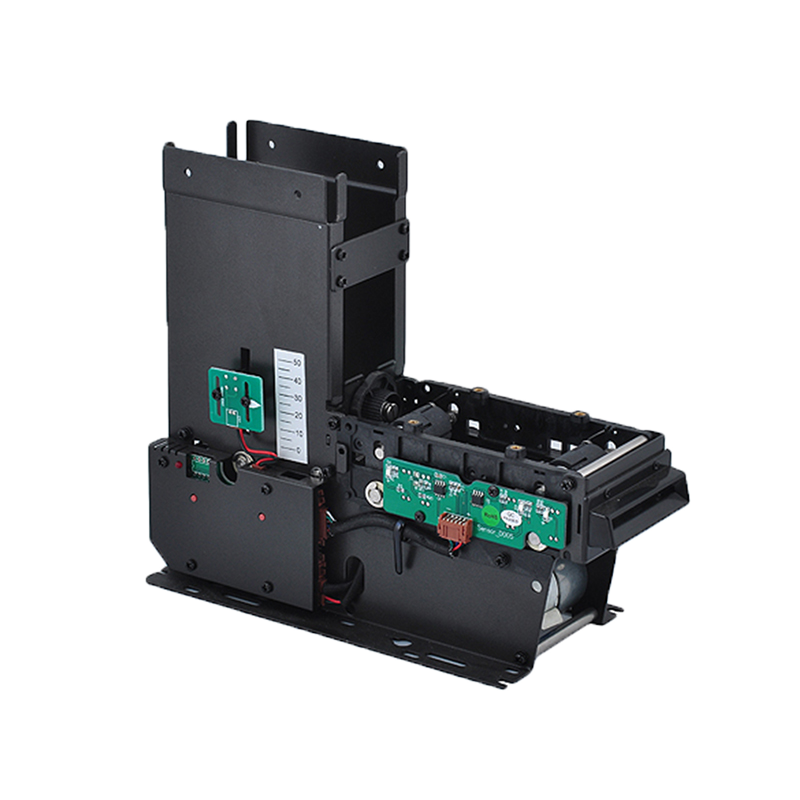
A smart card reader provides the communication interface between the card and the application.
Contact readers require the user to insert the card.
Common formats include:
Contactless readers communicate with HF, NFC, LF, or UHF cards, depending on the reader design.
Reader compatibility must be checked at several levels:
A reader that detects the card’s frequency may still be unable to access a protected application without the correct keys and software.
Dual-interface readers support contact and contactless smart cards in one device.
They are useful for:
Many contactless readers can both read and write compatible card memory.
A suitable RFID reader and writer may be used for:
Writing secure microprocessor smart cards may require more than a basic RFID encoding application. It can involve secure keys, application configuration, security modules, card operating systems, and controlled issuance software.
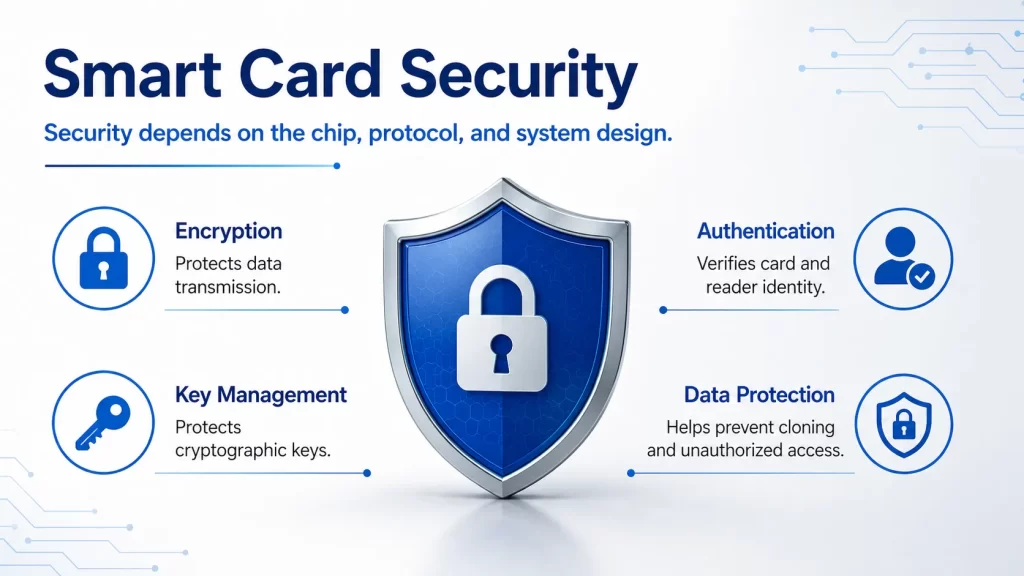
A smart card is not automatically secure merely because it contains a chip.
Security depends on:
Some cards only transmit a fixed identifier.
If the system makes an access decision based entirely on that identifier, copying or emulating the credential may be possible.
These cards may be acceptable for low-risk applications but are generally less suitable for high-security areas.
Secure memory cards may use:
They provide more control than simple identifier cards but may still have limitations compared with microprocessor cards.
Advanced smart cards may support:
NXP’s DESFire product family includes secure contactless ICs designed for multi-application identity, transportation, access, loyalty, and micropayment systems.
Even a secure card can be undermined by an insecure backend.
The complete system should protect:
Start by identifying what the card must do.
Examples include:
Select contact when:
Select contactless when:
Select dual interface when:
Choose:
The card and reader must use compatible frequencies and protocols.
Ask:
Do not select the cheapest card before defining the risk level.
Consider:
Test the card with the actual:
Smart cards may require:
For high-volume card printing and encoding, a card printer or RFID-capable encoding workflow may be required.
Test:
A fixed-ID proximity card and a cryptographic microprocessor card may look similar but provide very different security.
Two cards operating at 13.56 MHz may use different protocols, memory structures, and security systems.
A new card must work with current readers or the organization must plan a reader migration.
Longer range can be useful for vehicles or hands-free identification, but it may create unwanted reads at pedestrian doors.
Strong cryptography is ineffective if keys are shared, exposed, poorly stored, or never rotated.
In many systems, the card only needs a secure identifier or application credential. Sensitive personal information can remain in a protected backend database.
The organization needs procedures for:
Before selecting a smart card, confirm:
A smart card is a card-shaped credential containing an integrated circuit that can store data, process commands, or perform secure authentication.
Smart cards can be classified by interface:
They can also be classified by capability:
Contactless smart cards may use LF, HF, NFC, UHF, or a combination of frequencies. Each technology provides a different balance of read distance, security, cost, memory, and compatibility.
The best smart card is not simply the card with the most memory or the longest read range. It is the card that matches the application’s:
For a reliable deployment, the card, reader, security keys, software, and backend must be designed and tested as one complete credential system.
A smart card is a physical card containing an integrated circuit that can store data and, depending on the chip, process commands or perform security operations.
Not always. Contactless smart cards use RFID technology, but some RFID cards only transmit a basic identifier and do not provide advanced smart-card processing or security.
A contact card must be inserted into a reader so its metallic contacts can communicate electrically. A contactless card communicates wirelessly through an embedded antenna.
A dual-interface smart card uses one chip that supports both contact and contactless communication.
A hybrid smart card contains two or more separate chips or credential technologies inside the same physical card.
It can be. NFC cards operate at 13.56 MHz and may be simple memory tags or advanced secure microprocessor cards.
No. Security varies from a static identifier to advanced cryptographic authentication. The chip, reader, backend, and key-management process determine the actual security.
A microprocessor smart card contains a processor, operating system, memory, and often cryptographic functions. It can execute commands and support secure applications.
Yes. Advanced smart cards can support access control, payment, transportation, identification, loyalty, and other applications on the same credential when properly configured.
Many smartphones can read compatible NFC cards or tags. They cannot normally read LF proximity cards, UHF cards, or contact smart cards without additional hardware.
Many smart cards use 13.56 MHz HF or NFC technology. Legacy proximity cards may use approximately 125 kHz, while UHF cards use regional UHF RFID bands.
A smart card reader is a device that communicates with contact, contactless, or dual-interface cards and transfers card data to an application or backend system.
Need Smart Card Readers, RFID Cards, or Credential Integration Hardware?
Syncotek provides RFID readers, reader modules, antennas, cards, tags, handheld devices, and related system components for access control, employee identification, event management, parking, membership, ticketing, and industrial identification applications.
Whether your project requires HF smart-card readers, NFC-compatible devices, long-range UHF cards, dual-frequency credentials, desktop reader-writers, or embedded RFID modules, Syncotek can help evaluate suitable hardware based on your frequency, read distance, card technology, security requirements, and software workflow.
Explore Syncotek’s complete RFID products for your smart-card and identification project.
 Knowledge
What is load modulation? Load modulation is the method most HF RFID (13.56 MHz) and NFC tags use to send data back to a reader in the near field. Instead of actively transmitting RF power, the tag switches an electrical load (often a resistor or transistor network) across its antenna coil. That change in tag current is coupled back through mutual inductance and becomes a […]
READ MORE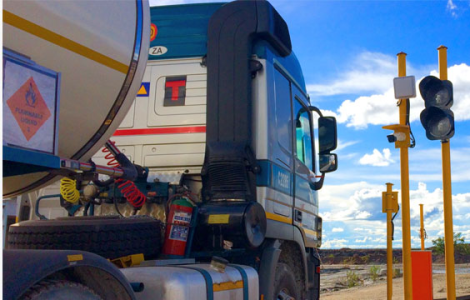 Case Show
The RFID system auto-identifies vehicles' weight, calculates net weight, and provides real-time monitoring for optimized efficiency.
READ MORE Knowledge
In RFID systems, read means the reader detects a tag and retrieves data from its memory. Write means the reader changes data stored on the tag (for example, writing a new EPC or user data), sometimes followed by locking that data to prevent future changes. Most commercial RFID deployments use UHF (RAIN RFID) for longer range and fast bulk scanning. The core air-interface […]
READ MORE Knowledge
RFID is often grouped into three main frequency families: LF (Low Frequency), HF (High Frequency), and UHF (Ultra-High Frequency). Picking the right band is one of the biggest decisions in any RFID project because it affects read range, speed, tag cost, phone compatibility, performance near metal/liquids, and system architecture. This guide compares LF vs HF vs UHF in a practical way […]
READ MORE Knowledge
The RFID system auto-identifies vehicles' weight, calculates net weight, and provides real-time monitoring for optimized efficiency.
READ MOREIf you are interested in our services or need customized solutions, please feel free to contact us.