

Lockout tagout (LOTO) equipment is used during maintenance and servicing to help prevent the unexpected energization, startup, or release of stored energy from machinery. In a large factory, however, the devices used in an energy control program can be spread across maintenance rooms, production areas, electrical workshops, utility rooms, and mobile service carts.
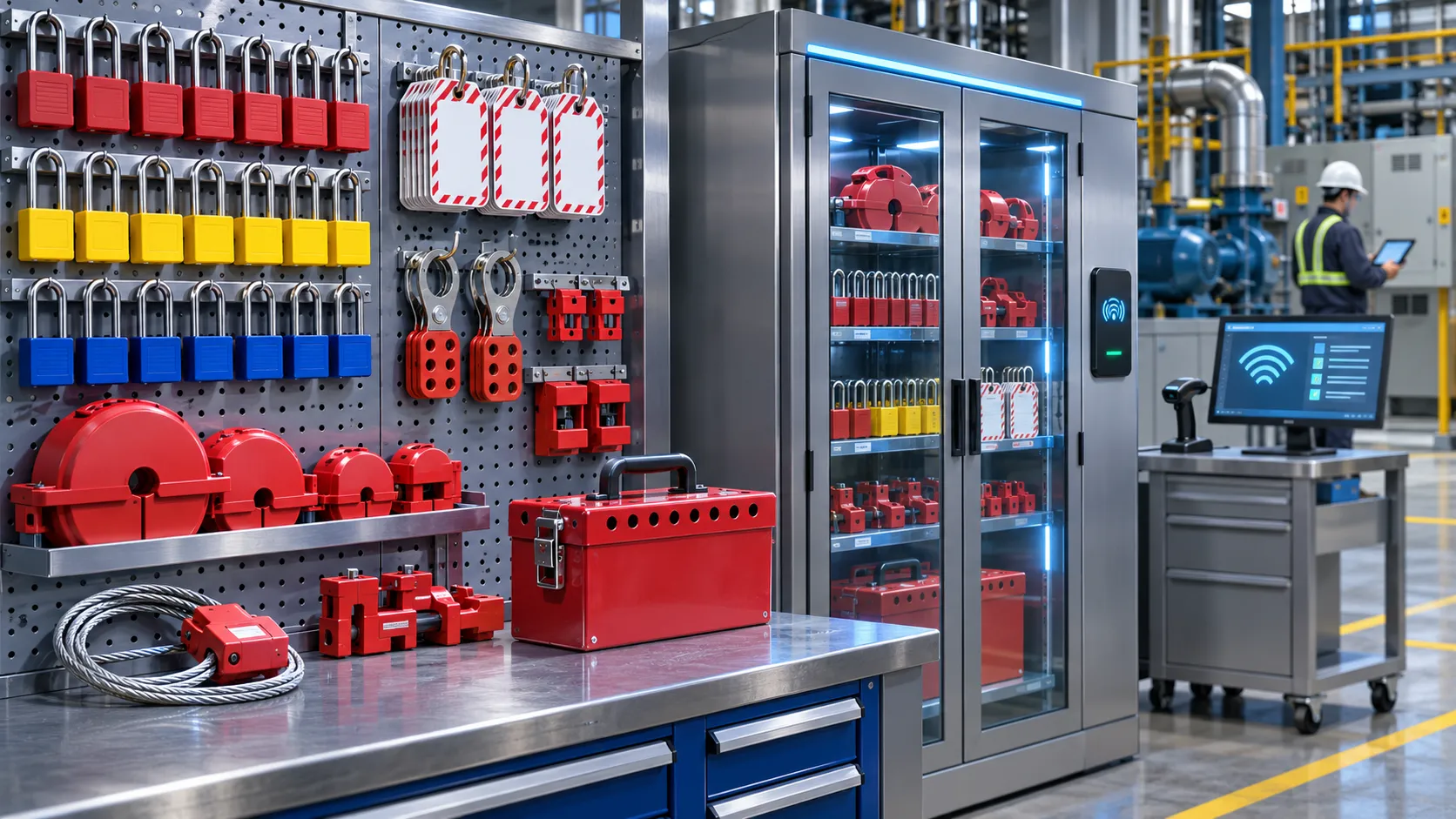
Safety padlocks, lockout hasps, valve lockouts, circuit-breaker lockouts, cable lockouts, group lock boxes, and complete LOTO kits all need to be available when authorized employees need them. When these assets are managed through handwritten logs or occasional visual checks, teams may struggle to confirm what is in stock, what has been issued, which kits are incomplete, and where missing equipment was last recorded.
RFID tracking can add a digital inventory and asset-management layer to LOTO equipment. By assigning RFID identities to individual devices, kits, storage containers, or cabinets, a facility can improve inventory visibility, record issue-and-return events, and make routine equipment checks more efficient.
RFID does not perform lockout/tagout, isolate hazardous energy, verify a zero-energy state, or replace an employer's energy control procedures. It supports the management of the physical equipment used within a LOTO program. This distinction is essential when designing a safe and useful solution.
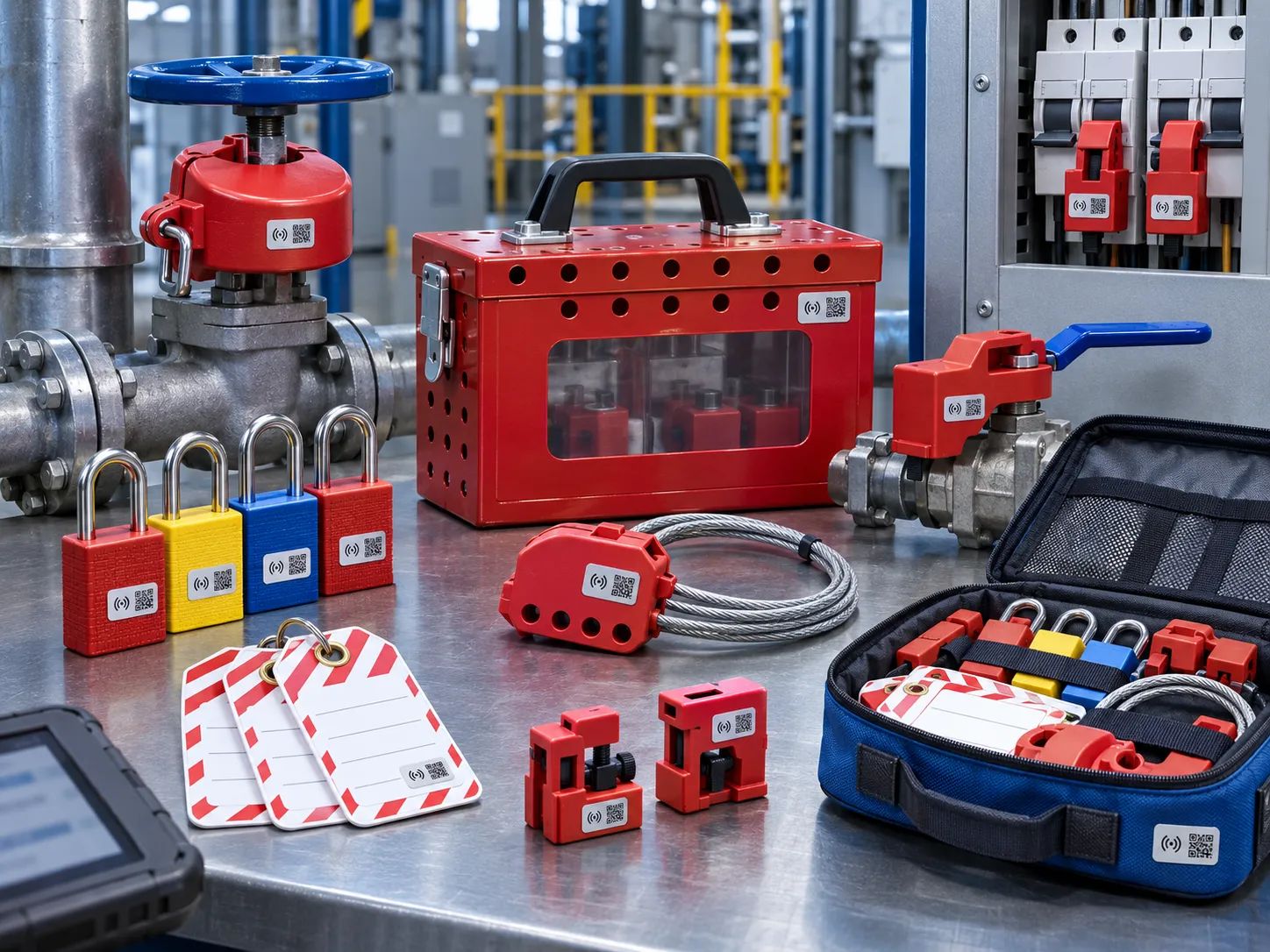
RFID tracking for lockout tagout equipment is an asset-management approach that uses radio frequency identification to identify and inventory LOTO devices and their storage units. Each tracked item or kit is associated with an RFID tag ID. Handheld readers, fixed readers, or RFID-enabled cabinets capture those IDs and send the read events to a management application.
The application can associate an RFID identity with an equipment record, such as its category, model, serial number, storage location, assigned department, current status, and issue history. Depending on the system design, it can also record who checked out an item, when it was returned, and whether a kit was found complete during an inventory check.
The RFID layer is designed to answer equipment-management questions:
These records help maintenance and EHS teams manage equipment availability and accountability. They do not confirm that a machine has been properly isolated or that an employee has completed a safe lockout procedure.
A facility's LOTO inventory may include several types of devices and kits:
Not every item needs to be tagged individually. The right tracking level depends on the size, value, handling frequency, physical form, and management requirements of the equipment.
For example, a facility may assign individual RFID identities to reusable safety padlocks and group lock boxes, while tracking small accessories as part of a complete kit. Another project may need to track only the kit case or storage compartment. The inventory model should reflect how the equipment is actually issued, used, inspected, and returned.
LOTO equipment is often distributed across multiple departments and maintenance locations. The challenge is not simply counting locks. It is maintaining a reliable record of which equipment is available, where it belongs, and whether it has been returned to the correct storage point.
A large plant may keep LOTO equipment in a central EHS room, electrical maintenance workshop, production-line cabinet, utility area, or mobile maintenance trolley. A single spreadsheet may not reflect movements between these locations in real time.
A location-based RFID inventory process can help teams check the contents of selected cabinets, storage areas, and mobile units.
When employees borrow equipment from a shared storage room, a paper log depends on consistent manual entry. Missing signatures, incomplete descriptions, and delayed updates can make it difficult to determine who received a particular item.
An RFID-enabled cabinet or tool-management device can connect item identification with a configured user and issue-and-return workflow. The available authentication and management functions depend on the selected hardware and software configuration.
A complete LOTO kit may contain a padlock, hasp, cable, valve lockout, breaker lockout, and warning tags. If components are stored separately or returned to the wrong compartment, a visual check may take time.
RFID can help identify tagged components or kit containers during an inventory process. For very small components, tracking the kit, tray, or compartment may be more practical than attaching a tag to every part.
Maintenance and EHS teams may need to review equipment availability, assignment history, storage status, and internal inspection records. A digital inventory can make it easier to retrieve asset information and identify missing or unreturned items.
However, an RFID inventory report is not an OSHA LOTO procedure inspection record. The two serve different purposes and must be maintained separately where required.
If an authorized employee cannot find the required lockout device or kit, maintenance preparation may be delayed while the team searches storage areas or contacts other departments. Handheld RFID inventory can support a targeted search of tagged equipment in defined locations.
A typical system combines RFID tags, readers, storage equipment, and asset-management software. The exact design depends on whether the facility needs periodic inventory, controlled issue and return, automatic cabinet checks, or movement records at selected locations.
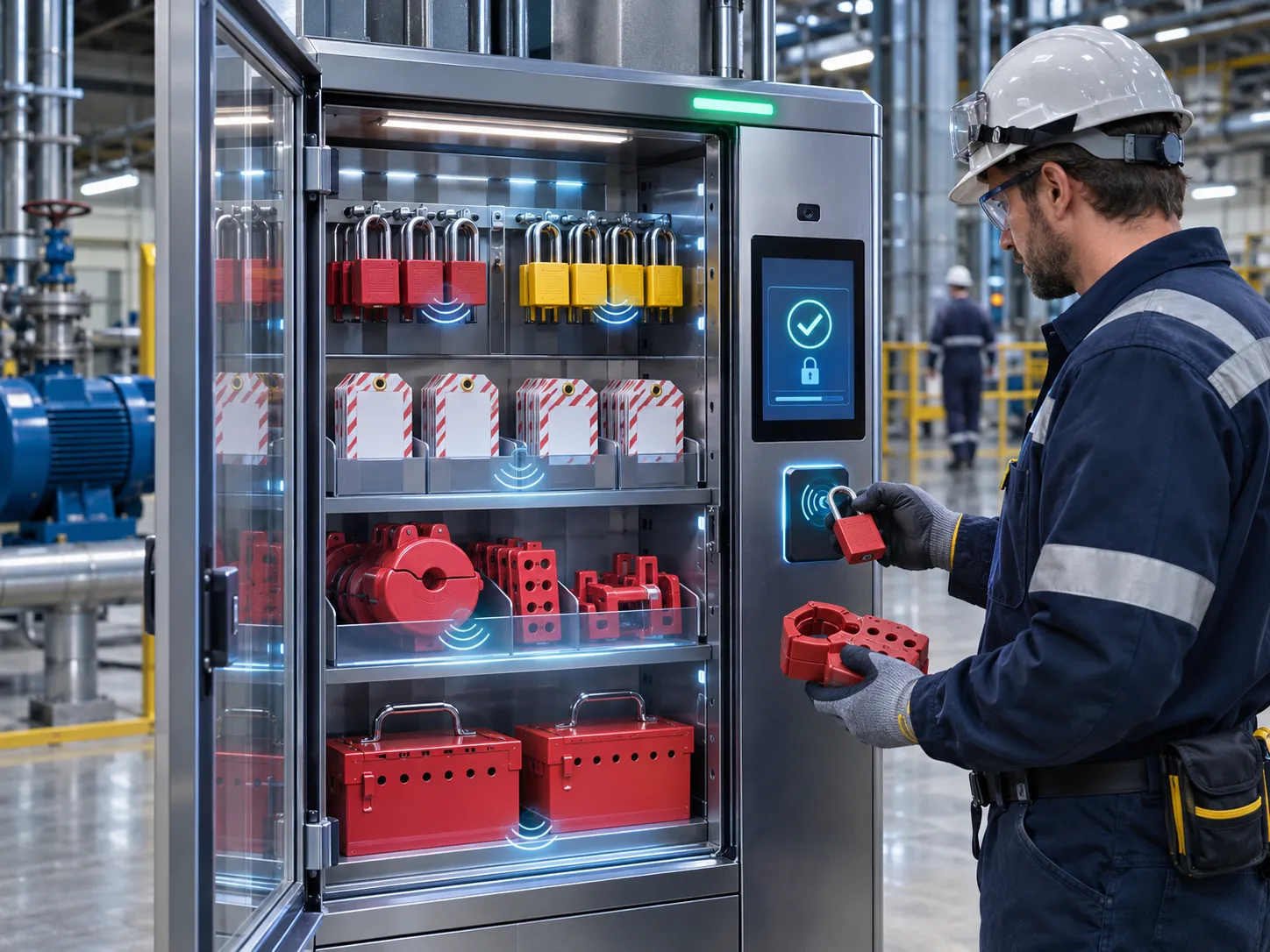
The facility creates an asset record for each item or kit included in the project. The record may include an internal asset number, equipment category, manufacturer, model, serial number, department, storage location, and current status.
An RFID tag ID is then associated with the record. The RFID identifier acts as a key that allows the software to retrieve the correct asset information.
Tag selection depends on the device's material, available mounting space, handling conditions, and required read performance.
For non-metallic surfaces, a suitable general-purpose UHF tag may be considered. Metal surfaces usually require a tag designed for on-metal use. Small devices may be better tracked through a tagged case, kit tray, or storage compartment if an individual tag would interfere with normal use.
The tag must not obstruct warning information, cover required employee-identification details, interfere with the lock's mechanical function, weaken a device, or change how the LOTO equipment is attached to an energy-isolating device.
A reader captures the IDs of tagged equipment within its read zone. The read point may be:
The reader identifies tags; the management application determines how each read event should affect the asset record.
For controlled storage, the application can associate an equipment issue or return with a user, time, and storage location. This requires an appropriate workflow and user-identification method.
A cabinet may support user login and borrowing or return functions, while a handheld-first system may require an employee to select or scan the relevant transaction in the application. These capabilities are not identical across all RFID readers and cabinets.
The system compares the RFID IDs detected during an inventory check with the expected asset list. It can identify items that are present, absent, assigned, or not associated with the selected storage location.
An exception should trigger a defined follow-up process. For example, an item missing from a cabinet inventory may be checked in another approved storage area before it is classified as lost.
The management application can retain issue-and-return events, inventory results, user associations, location records, and condition-check information. The available history depends on the software and integration design.
RFID read events should be interpreted carefully. A tag detected at a doorway indicates that the tag was read in that zone; it does not necessarily prove that the associated equipment was used for a particular maintenance task or that a LOTO procedure was correctly performed.
Different facilities need different levels of automation. A small maintenance team may only need handheld inventory, while a large plant with controlled storage may benefit from smart cabinets and fixed read points.
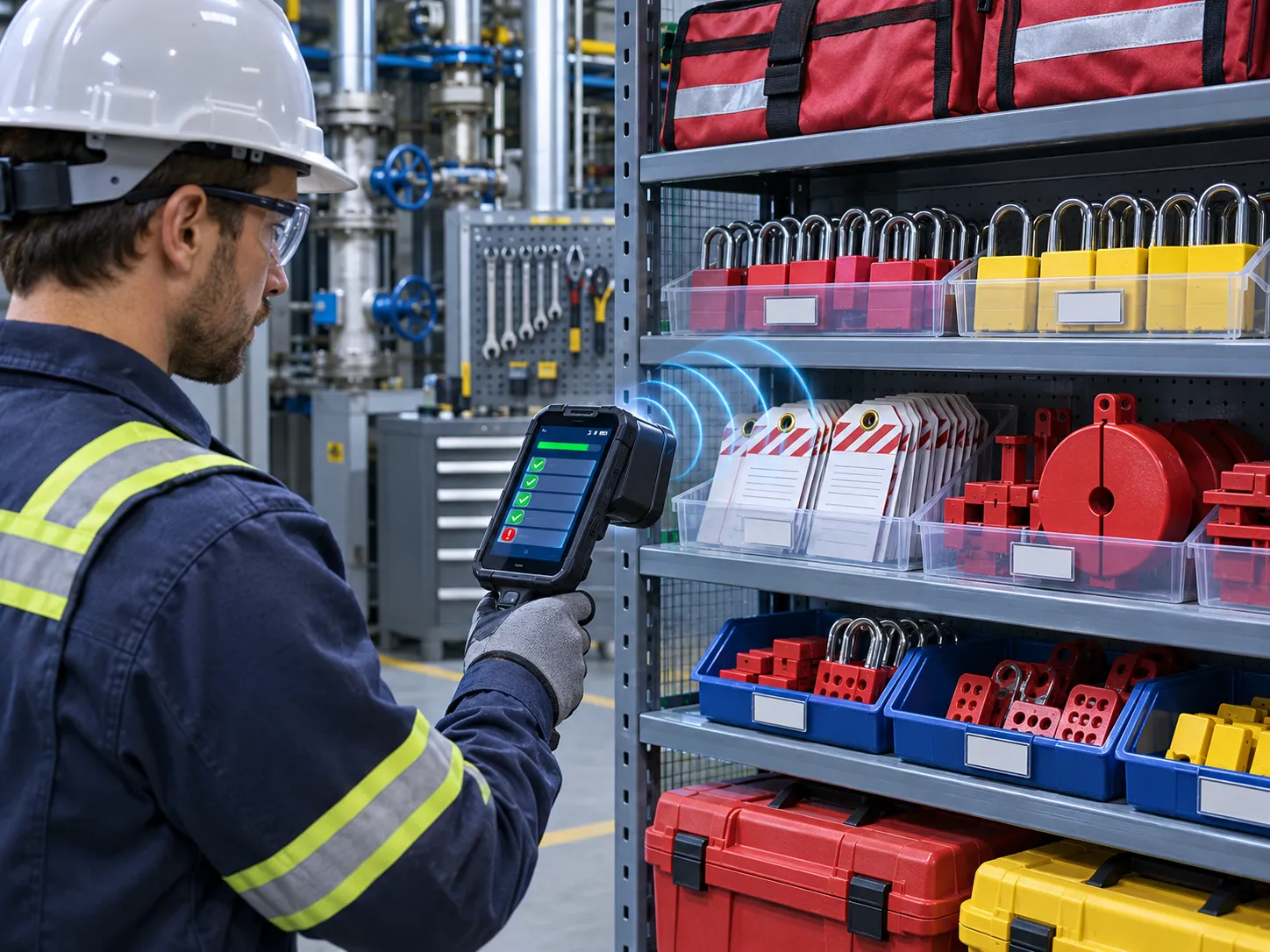
A handheld reader is a practical starting point when LOTO equipment is distributed across several rooms, cabinets, and maintenance areas. An operator can scan a defined area, compare detected tags with the expected inventory, and investigate missing or misplaced items.
Syncotek's SR-RU666 UHF RFID Handheld Reader is an Android 11 handheld platform with UHF RFID options based on Impinj E710 or E510, NFC, and optional barcode scanning. It can be evaluated for mobile inventory, exception checks, and equipment searches.
The handheld approach generally requires less fixed infrastructure than a fully automated installation. It does, however, depend on staff performing the inventory or search process.
An RFID smart cabinet is useful when LOTO equipment is stored in a defined enclosure and the facility wants faster cabinet inventory and a managed issue-and-return workflow.
Syncotek's RUX-TM105B RFID Smart Tool Cabinet supports UHF EPC Class 1 Gen 2 / ISO 18000-6C identification, an industrial touchscreen, HF RFID card and face-recognition login options, and management functions covering registration, handover, borrowing, return, and approval.
Its published specification lists eight circular antennas and whole-cabinet inventory in approximately five seconds. These are product specifications, not a guaranteed result for every LOTO equipment mix. Actual performance should be tested with the selected tags, item placement, cabinet loading, and software workflow.
The RUX-TM105B is an industrial RFID smart tool cabinet that may be evaluated as a hardware platform for LOTO equipment storage. It should not be described as a certified LOTO safety cabinet or as a device that performs energy isolation.
A mobile trolley can bring tagged equipment closer to a maintenance area or production line. This can be useful when LOTO kits and related maintenance tools move between work locations during a shift.
Syncotek's SR-RUX252 RFID Intelligent Tool Trolley is an eight-drawer RFID tool-management device. Its product page lists automated tool lending and return records, daily and monthly checking, and RFID inventory of more than 400 tagged items in approximately three to five seconds under the stated product conditions.
For a LOTO project, the trolley may be evaluated for tagged equipment or kits stored in its drawers. The customer should verify the physical dimensions, tag attachment method, item arrangement, and required software workflow before selecting it.
Fixed readers and external antennas can be installed at selected locations when the facility needs a defined read point. Examples include a maintenance-room entrance, a storage station, or a controlled equipment handover area.
Syncotek's SR-RU471B Fixed UHF RFID Reader can be evaluated for customized multi-antenna read points. Antenna placement, read-zone boundaries, reader triggers, and nearby tagged objects should be tested to reduce unintended reads.
A fixed checkpoint can record that tagged equipment was detected at a location. It should not be treated as a precise real-time location system unless the complete architecture has been designed and validated for that purpose.
Some LOTO devices contain metal bodies, metal components, or mounting surfaces that can affect UHF RFID performance. Standard labels may not be suitable for direct attachment to these surfaces.
Syncotek's TUA-PCB UHF On-Metal Tag is an FR4-based tag family designed for metal-surface applications. The product page lists EPC Class 1 Gen 2 / ISO 18000-6C, regional UHF frequency options, IP65 protection, and multiple sizes.
Not every padlock or lockout accessory should receive an on-metal tag. Tag attachment should be selected according to the actual device geometry and must not interfere with its intended safety function.
An RFID asset-management system for LOTO equipment has several functional layers. Keeping the responsibilities of each layer clear helps prevent the tracking application from being mistaken for a safety-control system.
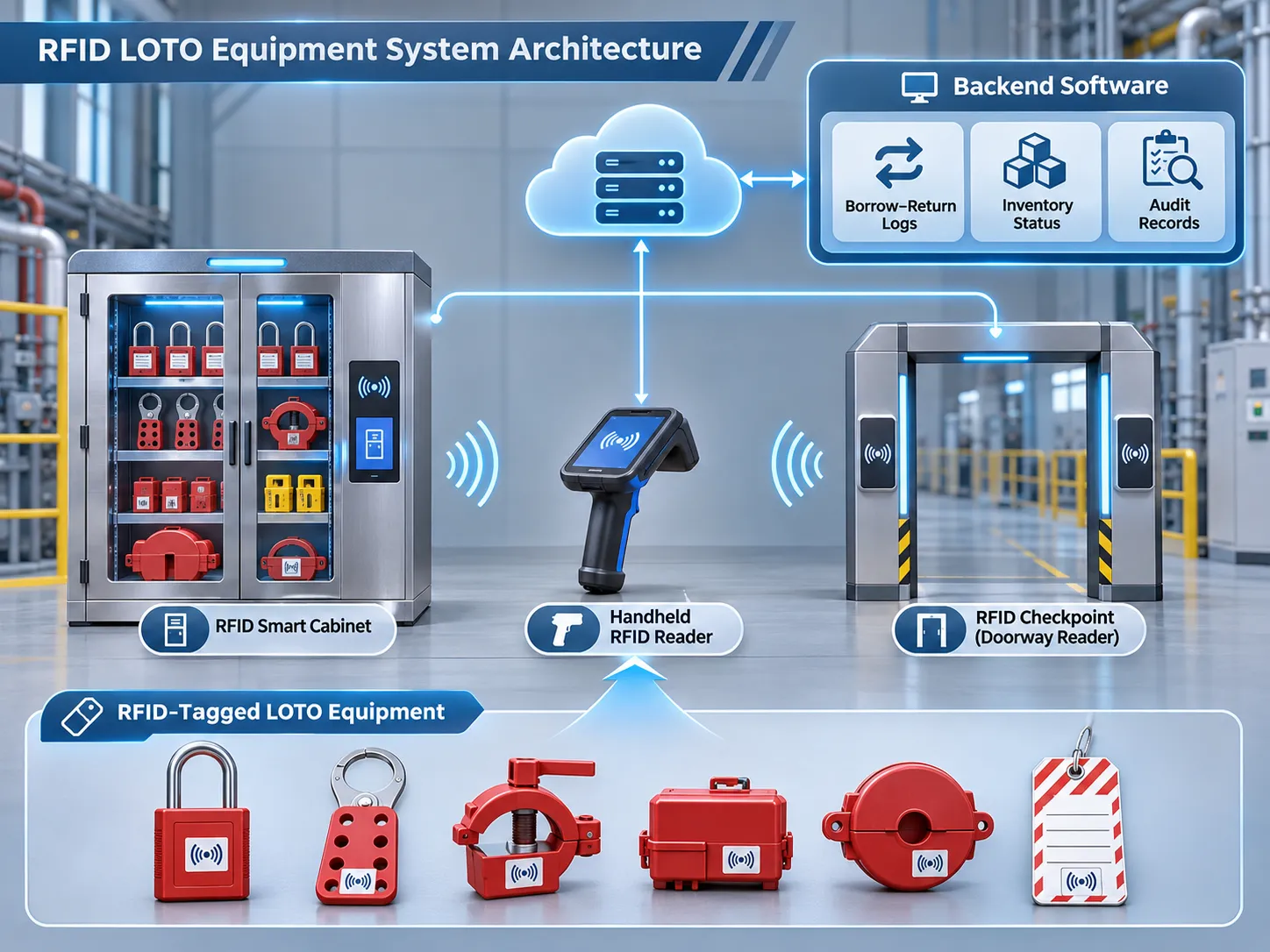
Each tracked asset, kit, case, or storage unit receives an RFID identity. The tag type and attachment method are selected according to material, size, environment, and handling conditions.
Handheld readers, smart cabinets, tool trolleys, and fixed readers capture the tag IDs. Each device serves a different role:
The application maps RFID IDs to equipment records and manages inventory status, user associations, storage locations, and issue-and-return history.
The application may be an existing enterprise asset-management platform, a maintenance management system, or a project-specific application. Integration functions depend on the selected hardware, available SDKs or interfaces, and software scope.
Reports can help maintenance and EHS teams review inventory differences, outstanding returns, equipment assignments, and internal condition-check records. Where required, the asset-management application can exchange relevant information with existing maintenance or enterprise systems.
The system should keep asset inventory records separate from the employer's formal energy-control procedures, employee training records, and required periodic inspections.
The value of RFID depends on how it fits into daily equipment-management tasks. A project should define the workflow before choosing a reader or cabinet.
An employee identifies themselves through the configured cabinet or application workflow. The system records the equipment issued and associates the transaction with the user and time.
When the equipment is returned, the system captures the returned item IDs and updates the inventory status. If an expected item is missing, the application can flag the discrepancy for follow-up.
The system records equipment custody. It does not authorize the employee to perform a lockout task or determine whether the employee is qualified to do so.
At the beginning or end of a shift, a maintenance team can inventory the contents of a cabinet, trolley, or designated storage area. The application compares the detected IDs with the expected list and highlights missing or misplaced assets.
A kit can be represented as a parent asset with a defined list of expected components. RFID identification can help verify which tagged components are present when the kit is checked.
For small accessories that are difficult to tag individually, the project may track a tagged case, tray, or compartment and use a separate manual checklist for the contents. The method should be chosen according to the level of component-level traceability required.
If a device is not found in its expected storage location, an operator can use a handheld reader to check other defined storage areas. A previous read event may help narrow the search, but passive UHF RFID should not be assumed to provide continuous, room-wide positioning.
Asset records can help teams prepare internal equipment inventories by showing registered items, recorded locations, outstanding issues, and return history.
Formal LOTO program inspections and employee training documentation remain separate responsibilities. RFID inventory data may support administrative preparation, but it does not replace the records or activities required by applicable safety regulations.
LOTO equipment includes small devices, mixed materials, metal components, and multi-part kits. A reliable RFID project must account for these physical characteristics before deployment.
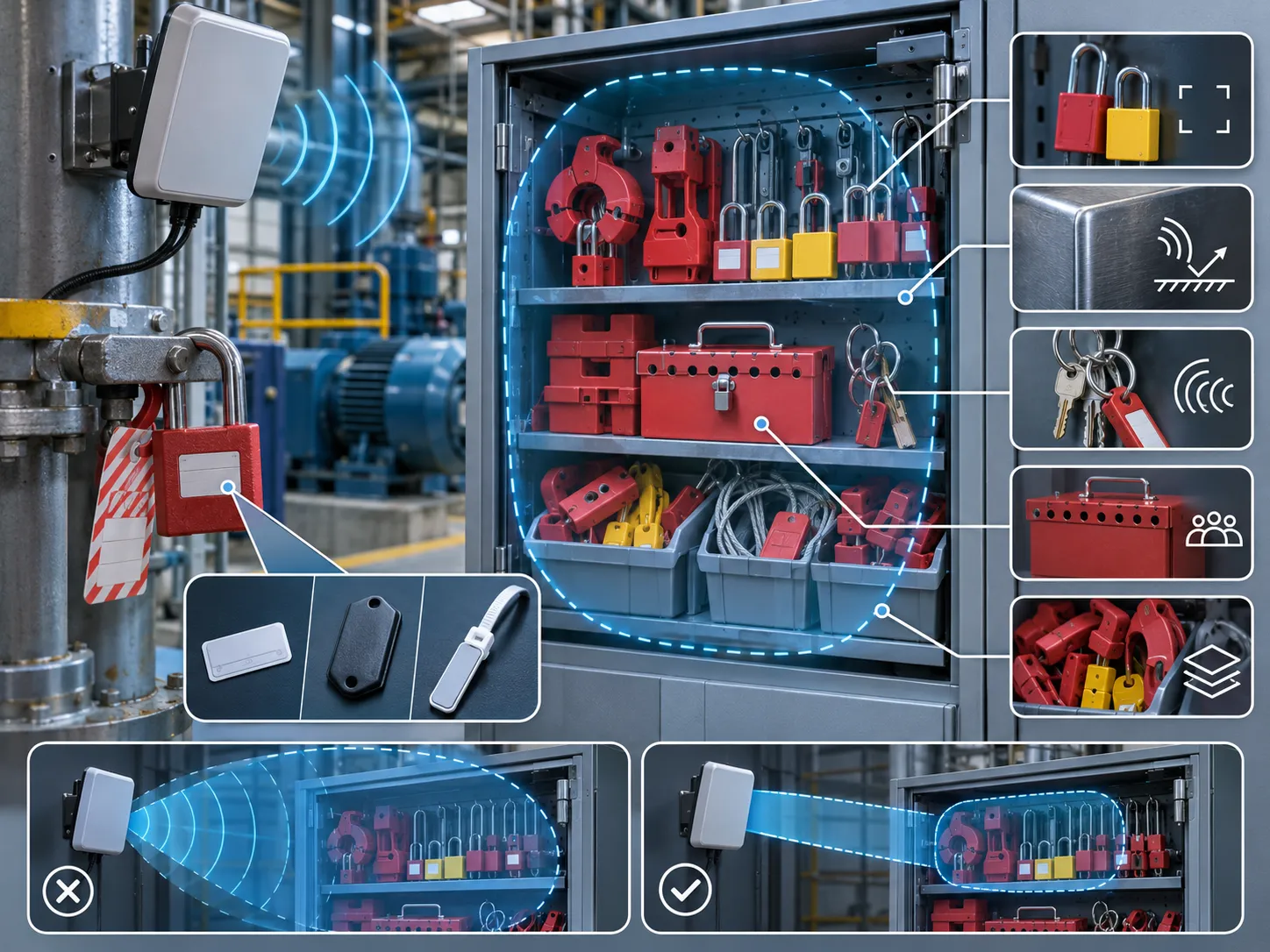
Metal can detune or shield a conventional UHF RFID tag. For a metal-bodied device, an on-metal tag or another validated mounting arrangement may be required.
The tag should be tested on the actual LOTO device, not only on a sample metal plate. Surface curvature, nearby metal parts, tag orientation, and the distance from the reader antenna can all affect performance.
Some lockout accessories are too small to accept a durable RFID tag without affecting handling or operation. In these cases, tracking a kit, tray, case, or storage compartment may be more appropriate.
The project should decide whether it needs individual-device identity or only kit-level accountability. These are different requirements and should not be treated as equivalent.
A tag must remain attached during normal storage and handling. Adhesive, mechanical fastening, tag holders, or embedded options may be considered according to the device material and manufacturer guidance.
Do not drill, cut, modify, or attach hardware in a way that changes the locking geometry, weakens the device, obstructs a warning label, or interferes with the equipment's intended use. Any modification should be approved by the relevant equipment manufacturer and the facility's safety authority.
A cabinet containing many tagged devices may produce repeated reads or unintended reads from nearby assets if the read zone is not controlled. Antenna placement, reader power, tag orientation, shielding, and software filtering should be evaluated together.
A cabinet inventory test should use the actual number and arrangement of devices expected in daily operation.
A lockout kit may include a padlock, key, hasp, tag, and accessory. Tracking every component separately may add complexity. A project can instead define the padlock or kit case as the primary tracked asset and use a checklist for the associated parts.
If individual key accountability is required, it needs a specific physical and software design. RFID identification alone does not prove that the correct key was used or that the lock was applied correctly.
RFID and barcode systems can both support LOTO equipment inventory. The better option depends on the quantity of assets, storage layout, item handling, and required inventory speed.
| Evaluation factor | RFID | Barcode |
|---|---|---|
| Identification method | Radio communication with compatible tags | Optical reading of printed codes |
| Line of sight | Not normally required within a suitable read zone | Code must be visible to the scanner |
| Multiple-item inventory | Can identify multiple tagged items in one read session | Usually requires individual scans |
| Tag attachment | Requires compatible RFID tags and suitable placement | Requires a durable printed label |
| Metal compatibility | May require on-metal tags and RF testing | Metal does not inherently prevent optical scanning |
| Cabinet inventory | Can support automatic multi-item inventory in a suitable cabinet | Usually requires item-by-item scanning |
| Initial investment | May require readers, antennas, tags, and integration | Often lower for simple manual inventory |
| Best fit | Larger inventories, controlled storage, frequent counts, and automated read points | Small inventories and simple manual check-in/check-out |
A barcode process may be sufficient for a small maintenance team with a limited number of devices. RFID becomes more attractive when the facility needs to identify multiple tagged items quickly, automate cabinet inventory, or connect equipment movement with defined read points.
A hybrid approach is also possible. RFID can manage cabinets and kits, while barcode or manual checks handle small accessories that are difficult to tag.
RFID equipment tracking must remain separate from the safety functions of a LOTO program.
OSHA 29 CFR 1910.147 addresses the control of hazardous energy during applicable servicing and maintenance activities. The standard requires an employer energy-control program that includes procedures, employee training, and periodic inspections. It also addresses the use of appropriate lockout or tagout devices on energy-isolating devices.
An RFID inventory system does not perform these functions.
A reader or software record cannot disconnect electrical power, close and secure a valve, block mechanical movement, release stored pressure, or otherwise render equipment inoperative.
The required physical energy-isolation and control measures must be performed under the employer's established procedures by authorized employees.
An RFID tag attached to a padlock is an identifier for inventory purposes. It is not a lock and does not provide physical restraint.
Likewise, an RFID record that shows a lock as assigned to an employee does not prove that the employee has applied that lock to the correct energy-isolating device.
A successful RFID read cannot confirm that all hazardous energy sources have been isolated, that stored energy has been controlled, or that the required verification has been completed.
Those actions must follow the applicable energy-control procedure.
The employer remains responsible for the required energy-control procedures, employee training, and periodic inspections. Under OSHA 29 CFR 1910.147(c)(6), the periodic inspection of the energy-control procedure must be conducted at least annually, subject to the standard's requirements.
An RFID inventory report may help locate equipment records, but it is not a substitute for the required inspection, certification, or training documentation.
For regulatory details, refer to the official OSHA 29 CFR 1910.147 standard and OSHA's Energy Control Program guidance.
A successful project starts with the equipment and workflow, not with a particular reader model. A focused pilot can establish whether RFID is suitable for the actual devices and storage conditions.
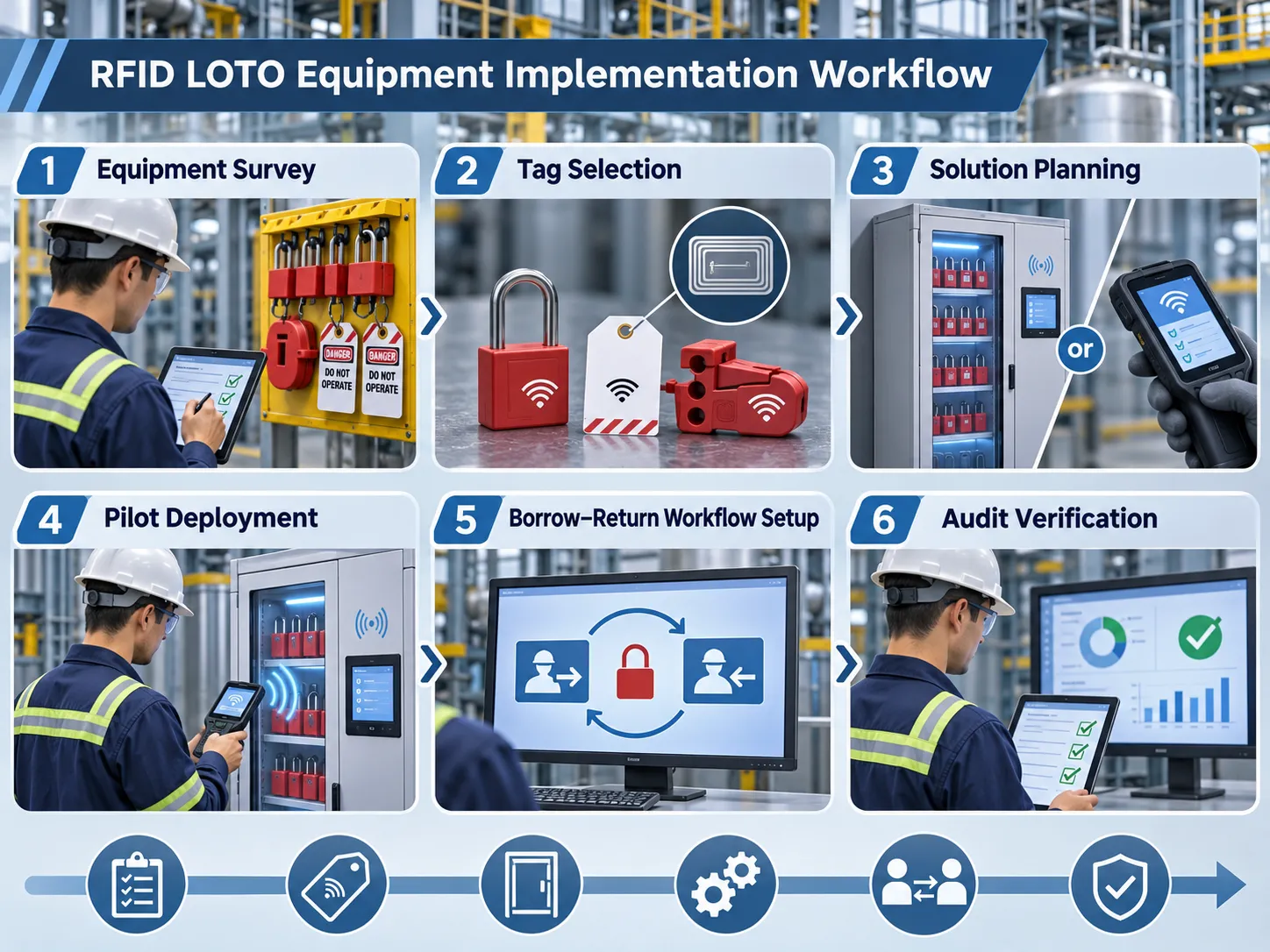
List the LOTO equipment to be managed. Record the equipment category, quantity, material, dimensions, storage method, and current issue-and-return process.
Separate individual devices from kits and shared storage assets. Identify which equipment requires individual traceability and which can be managed at kit or compartment level.
Decide which functions are needed:
Do not assume every requirement is included in a reader or cabinet. Confirm which functions are provided by the hardware and which need to be developed or integrated in software.
Select representative plastic, metal, and mixed-material devices. Test tag size, mounting position, attachment durability, read performance, and compatibility with the device's intended function.
If a device cannot be tagged safely, consider tracking its kit, tray, case, or storage compartment instead.
Choose a handheld reader, smart cabinet, tool trolley, fixed reader, or hybrid arrangement according to the workflow.
For example, a central maintenance room may use a smart cabinet for controlled storage and a handheld reader for exception checks. A production area with mobile teams may evaluate an RFID tool trolley. A fixed reader may be added where a defined read event is needed.
Define the asset ID structure, user roles, storage locations, issue-and-return states, exception rules, and reporting requirements.
If the system must connect with a CMMS, EAM, ERP, or an existing LOTO management platform, confirm the required data fields, interfaces, and integration responsibilities before implementation.
Use real LOTO devices, actual storage cabinets, and normal employee workflows. Test full and partially loaded cabinets, mixed materials, repeated reads, missing items, unreturned equipment, and nearby tagged assets.
The pilot should verify both RFID performance and the usability of the issue-and-return process.
Compare the pilot results with the project's original requirements. Confirm whether inventory accuracy, issue-and-return records, search time, and exception handling meet the facility's acceptance criteria.
Expand to additional departments only after the tag design, read zones, user workflow, and software integration have been validated.
A pilot should use measurable equipment-management indicators. These metrics evaluate the RFID inventory workflow; they do not measure whether the facility's LOTO safety procedures are compliant.
| Metric | What to measure | Why it matters |
|---|---|---|
| Asset registration coverage | Percentage of in-scope devices or kits with a valid asset record and RFID identity | Shows how much of the inventory is included |
| Inventory accuracy | Agreement between detected RFID IDs and the verified physical inventory | Measures identification reliability |
| Issue-and-return traceability | Percentage of applicable transactions with complete user and time records | Evaluates accountability |
| Kit completeness | Agreement between expected and detected tagged kit components | Identifies incomplete kits |
| Inventory time | Time required to complete a defined cabinet or area check | Measures operational efficiency |
| Exception resolution time | Time required to investigate missing, misplaced, or unreturned assets | Evaluates the search workflow |
| Unwanted read rate | Frequency of tags outside the intended zone appearing in the result | Measures read-zone control |
| User adoption | Percentage of required transactions completed through the configured process | Shows whether the workflow is practical |
The facility should define its acceptance thresholds before the pilot. Results should be based on repeated tests with representative equipment, not a single demonstration using a small group of tags.
Yes, if a suitable RFID tag can be attached without interfering with the padlock's intended function. The tag and mounting method should be tested on the actual lock. If individual tagging is impractical, the facility may track the lockout kit, case, or storage compartment instead.
Potentially. The feasibility depends on the device material, size, geometry, and available mounting surface. Metal components may require on-metal RFID tags. Any tag attachment must preserve the device's intended mechanical function.
An RFID smart cabinet can support equipment inventory and configured issue-and-return workflows. Syncotek's RUX-TM105B product page lists user identification, registration, handover, borrowing, return, and approval functions. The exact workflow for LOTO equipment should be confirmed against the selected cabinet and management software.
Not necessarily. Individual tagging provides more detailed asset identity, but very small accessories may be difficult to tag reliably. A project can track individual high-value devices and manage smaller components as part of a tagged kit, tray, or compartment.
It can associate an issue or return event with a user when the system includes user identification and the required application workflow. A tag read by itself does not identify the person holding the device. User authentication and transaction logic must be part of the solution.
No. RFID inventory only identifies tagged equipment within a read zone. It cannot verify energy isolation, the application of a personal lock, or a zero-energy condition. Those steps must be completed under the employer's LOTO procedures.
No. RFID inventory checks the presence and recorded status of equipment. OSHA's periodic inspection requirement concerns the energy-control procedure and the responsibilities defined by the standard. The facility must maintain the required safety inspections and certifications separately.
The choice depends on the storage method and workflow. A handheld reader is useful for mobile inventory and exception checks. A smart cabinet supports controlled storage and cabinet-level inventory. A tool trolley supports mobile, drawer-based storage. Fixed readers can create read points at selected locations.
It can be designed for suitable RFID cabinets, but the cabinet's antenna arrangement, shielding, tag placement, and read-zone behavior must be evaluated. A cabinet designed for RFID inventory is different from placing a general-purpose reader next to an ordinary metal cabinet.
It can be integrated when the reader or cabinet platform and the asset-management application provide suitable interfaces. The project should define how asset IDs, user records, issue-and-return events, locations, and condition-check information will be exchanged.
Syncotek provides RFID hardware that can be evaluated for industrial tool and asset-management workflows, including handheld readers, smart cabinets, intelligent tool trolleys, fixed readers, and on-metal UHF tags.
Relevant hardware and solution pages include:
For a project evaluation, share the types and quantities of LOTO equipment, device materials, storage locations, required issue-and-return workflow, individual-item or kit-level tracking requirements, target country, and existing software environment.
Syncotek can help evaluate the RFID identification and hardware architecture. The complete LOTO program, physical energy-isolation procedures, employee training, safety inspections, and any required compliance records remain the responsibility of the employer and its qualified safety personnel.
Contact Syncotek to discuss an RFID equipment inventory or smart-cabinet project.
 Knowledge
What Is Backscatter in RFID? Backscatter is the communication method used by most passive UHF RFID tags to send data back to a reader without generating their own RF carrier. Instead of transmitting like an active radio, the tag uses the reader’s signal as both its power source and its communication medium, then changes how that signal is […]
READ MORE Knowledge
Automotive manufacturers manage thousands of components, work-in-progress (WIP) units, reusable containers, tools, and finished vehicles across complex production and logistics networks. As product variants increase and production schedules become more demanding, teams need reliable ways to identify items, confirm process steps, and make tracking data available to the right systems. Radio frequency identification (RFID) can […]
READ MORE Knowledge
Manufacturing operations depend on accuracy, timing, and visibility. Materials, tools, fixtures, machines, work orders, semi-finished goods, and finished products move through many production stages every day. When these movements are recorded manually, manufacturers often face delayed updates, inventory errors, missing tools, unclear production status, and limited visibility across the shop floor. RFID technology helps manufacturers […]
READ MORE Knowledge
Metal asset tracking is one of the most important applications in RFID, but it is also one of the most technically challenging. Many companies want to use RFID to identify tools, machines, containers, laptops, racks, returnable transport items, and industrial equipment, only to discover that standard RFID labels do not perform well when placed directly […]
READ MORE Knowledge
UHF RFID systems use radio waves to communicate between readers, antennas, and passive RFID tags. In a small installation with one reader, radio-frequency interference may be relatively easy to control. In a warehouse, factory, retail store, distribution center, or event venue with several readers operating at the same time, the RF environment becomes more complicated. […]
READ MOREIf you are interested in our services or need customized solutions, please feel free to contact us.