

Automotive manufacturers manage thousands of components, work-in-progress (WIP) units, reusable containers, tools, and finished vehicles across complex production and logistics networks. As product variants increase and production schedules become more demanding, teams need reliable ways to identify items, confirm process steps, and make tracking data available to the right systems.
Radio frequency identification (RFID) can support these workflows by identifying tagged objects without requiring a direct line of sight. When RFID tags, readers, antennas, and software are designed around a specific process, manufacturers can automate identification at receiving points, workstations, conveyors, storage areas, and shipping gates.
This guide explains where RFID fits in automotive manufacturing, how to design a practical system, and what to consider when selecting RFID readers, antennas, and tags.
An RFID system uses radio communication to identify tagged objects. A typical industrial installation includes four main elements:
In many automotive use cases, passive UHF RFID is considered because it can identify multiple tagged items and support reads over a configurable area. The right frequency, tag type, reader, and antenna depend on local regulations, the physical environment, and the required workflow.
RFID and barcodes are complementary technologies rather than universal substitutes.
Consideration RFID Barcode
Line of sight Usually not required Usually required
Reading multiple items Possible when tags and reader settings support the use case Usually requires scanning each visible code or using an imaging workflow
Physical condition Can work when the tag is not optically visible, within RF limits Dirt, damage, or poor visibility can affect scanning
Metal and liquid environments Require careful tag and antenna selection; performance can be affected Not affected by RF detuning, but labels must remain visible and readable
Data collection Can automate identification at defined read points Often depends on operator or scanner actions
A manufacturer may use RFID for automatic tracking at production checkpoints and retain barcodes for human-readable identification, service processes, or fallback workflows.
Automotive production relies on a large number of components, from engine and transmission assemblies to wiring harnesses, electronic modules, seats, and trim parts. RFID can associate a tagged item or container with a part number, supplier, lot, delivery, or production order.
At receiving, a read point can help identify tagged cartons or returnable containers. At line-side storage, readers or handheld devices can support inventory checks and material replenishment. At assembly, a read event can help confirm that the expected component or carrier has arrived at the relevant station.
The tag should normally carry a unique identifier, while detailed information---such as supplier, lot, inspection status, and order association---can remain in the connected business system. This keeps records easier to update and govern.
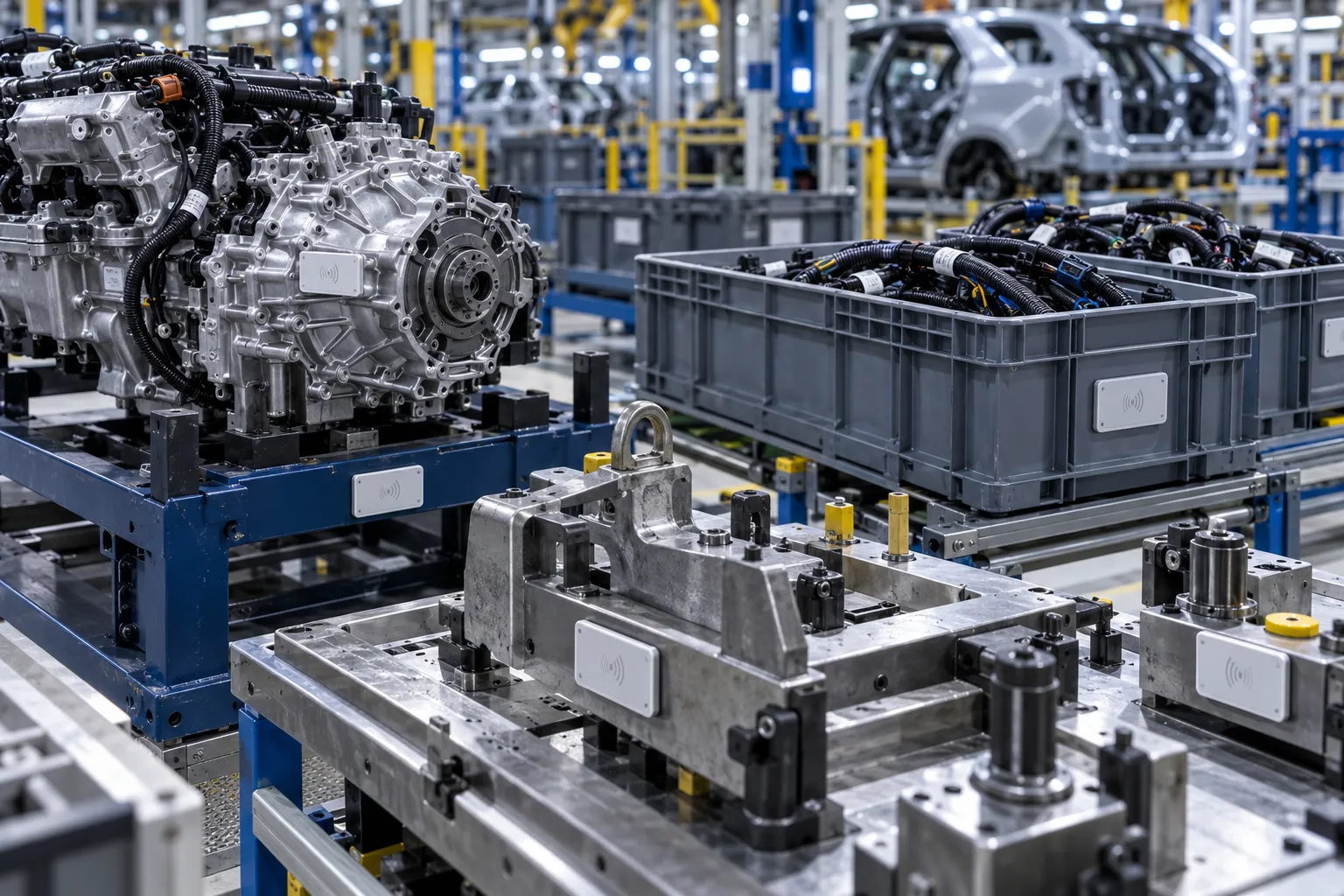
A vehicle body or production carrier can be associated with a unique RFID identifier so that its movement between defined stations is recorded. When the carrier passes a read point, the system can record an event such as arrival, departure, or transfer to the next process.
This can help production teams answer questions such as:
RFID does not independently prove that a manufacturing operation was completed correctly. The application should combine read events with station logic, machine signals, operator confirmation, or quality-system records where needed.
Automotive assembly often depends on delivering the correct part at the right time and, in some processes, in the required sequence. RFID can support identification of pallets, containers, kits, or components as they move through staging and delivery points.
A practical workflow may compare the tag identifier with the expected order or sequence in the production system. If the item matches, the system can record the event or authorize the next step. If it does not match, the system can raise an exception for review.
The reliability of this process depends on well-defined read zones, correct data mapping, and appropriate exception handling---not only on the reader's maximum stated range.
RFID can help connect physical items with digital production records. A tag identifier may link to supplier batches, inspection results, assembly events, rework history, or quality documentation.
For traceability, define which events need to be captured and which system is the source of truth. For example, the RFID layer may report that a tagged carrier passed a station, while the MES records whether the process parameters met the required limits.
This distinction is important: an RFID read confirms that a tag was detected in a particular read zone under the system's configured conditions. It does not, by itself, verify the quality of a part or prove that a specific operation was performed.
Reusable bins, racks, pallets, and specialized transport fixtures move repeatedly between suppliers, warehouses, and production areas. RFID can help record dispatch, receipt, staging, and return events.
A container-tracking project should define whether tags will be mounted on plastic, metal, or mixed-material surfaces, how containers are stacked, and where reads will take place. If several tagged containers pass through a doorway together, antenna placement and reader configuration must be tested under realistic conditions.
Dedicated fixtures, jigs, carts, and tools can be tagged to support location checks, maintenance records, assignment, and utilization reporting. Where the tagged asset is metal, a purpose-designed on-metal tag may be necessary.
The business process should also define how the system handles assets that are temporarily removed from the normal flow, such as tools sent for repair or fixtures stored outside the main production area.
RFID may be used at defined checkpoints in finished-vehicle handling, shipping preparation, or yard logistics. A reader at a gate or lane can detect an appropriately tagged vehicle, carrier, or logistics unit and send an event to the yard or dispatch system.
Vehicle identification requirements vary by project. The tag location, vehicle movement speed, read-zone width, weather exposure, and possible nearby tags should all be considered before selecting the hardware.

An automotive RFID installation should be designed around business events, not simply around where it is convenient to mount a reader. Start by identifying the objects to be tracked, the points where their identity must be captured, and the system that will use each event.
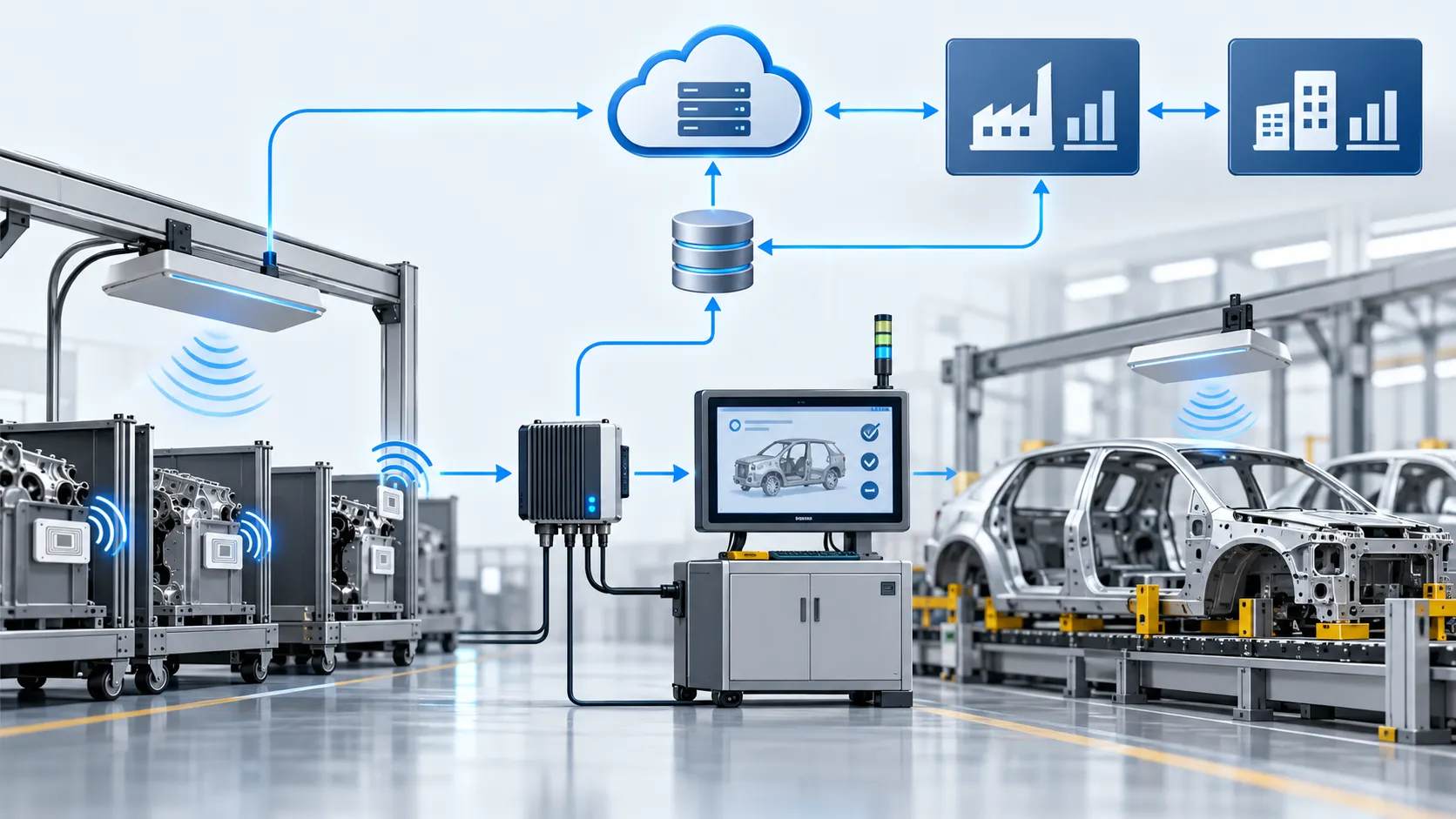
Common read-point locations include:
The best arrangement depends on the physical process. A fixed reader with external antennas can be suitable where several antennas are needed to cover a conveyor or multiple zones. An integrated reader can simplify installation at a compact checkpoint where its built-in antenna provides appropriate coverage. A handheld reader can be useful for cycle counts, maintenance, and exception investigation.
A typical data path is:
Integration may use Ethernet, serial communication, GPIO signals, SDKs, APIs, or a gateway, depending on the reader and application design. Confirm the supported interfaces and development resources for the selected model before finalizing the architecture.
The application should account for duplicate reads, missed reads, network interruptions, time synchronization, and recovery after a device or system restart. It should also distinguish a raw read from a confirmed business event.
The correct hardware depends on the required read zone, tagged object, installation conditions, and integration method. There is no single reader or tag that is best for every automotive process.
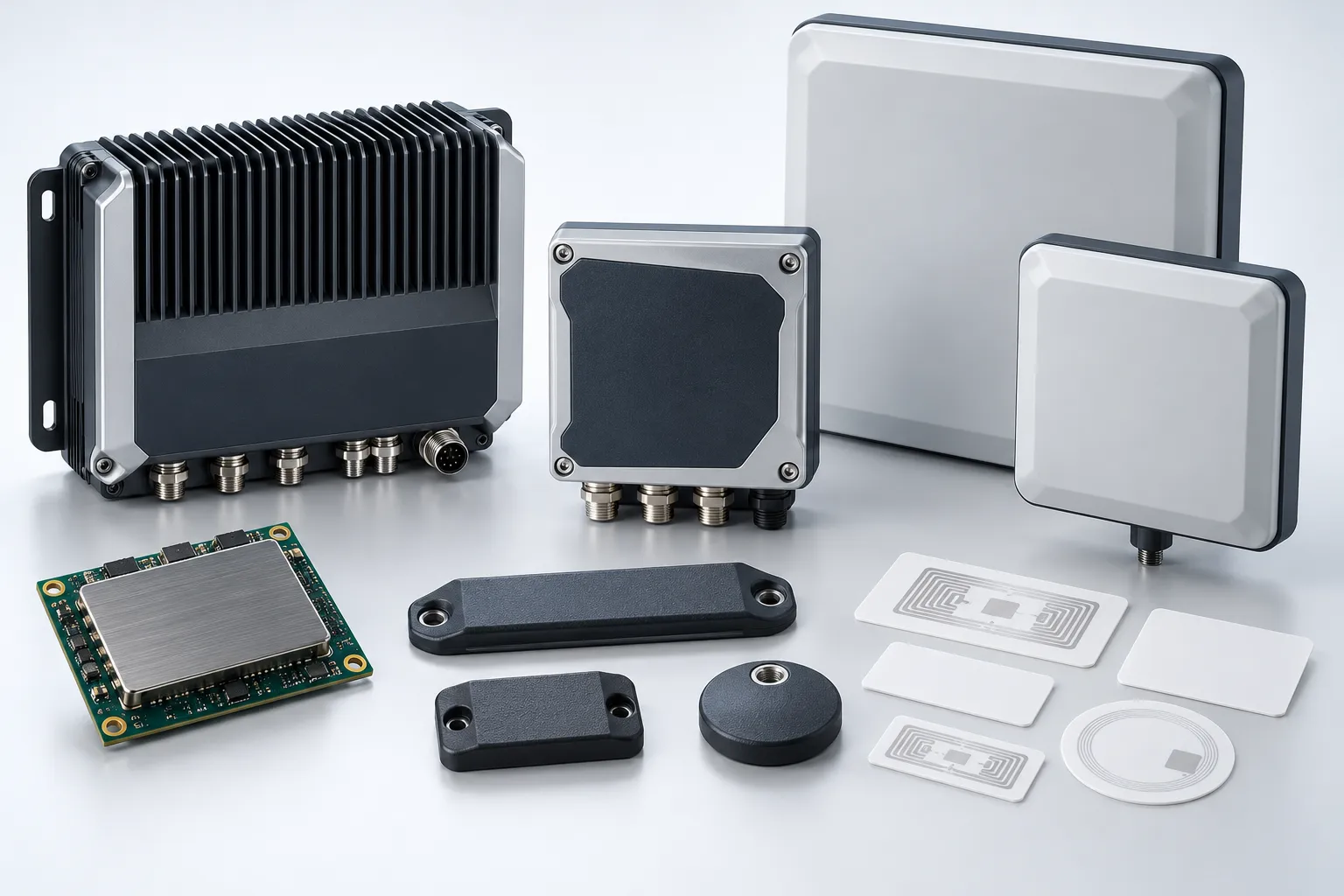
Device type Typical fit Main selection questions
UHF fixed reader Production lines, conveyors, multi-antenna read points, and industrial stations How many antennas are needed? Which interfaces, trigger modes, and environmental protections are required?
UHF integrated reader Compact checkpoints, portals, doors, and locations where a built-in antenna is suitable Does the antenna coverage fit the required zone? How will the device connect to the control system?
UHF RFID module OEM equipment, custom terminals, printers, kiosks, and embedded industrial devices What are the power, antenna, interface, firmware, SDK, and enclosure requirements?
Handheld RFID reader Inventory checks, maintenance, mobile verification, and exception handling Is the device ergonomic for the workflow? Which operating system and network connection are needed?
Explore Syncotek's RFID reader portfolio, including UHF fixed readers, UHF integrated readers, and UHF modules.
Automotive manufacturing uses a wide range of surfaces and operating conditions. A tag that performs well on a plastic tote may not perform the same way when attached directly to a metal fixture or engine component.
Before choosing a tag, confirm:
For metal assets, review purpose-designed on-metal RFID tag options and test the tag on the actual object. For fixed-reader installations, also evaluate the UHF antenna against the required read zone.
Published read-range figures are measured under particular test conditions and should not be treated as guaranteed performance in a factory. Actual results can change with tag design, antenna gain and polarization, reader power, mounting material, orientation, nearby metal, liquids, interference, and the number of tags in the field.
For automotive projects, validate the complete combination of reader, antenna, tag, mounting location, and software settings. Test both expected reads and unwanted reads. The objective is not simply to maximize range; it is to capture the right tags at the right process point while minimizing cross-reads from nearby areas.
UHF RFID frequency allocations and permitted radio parameters vary by market. Confirm the destination country's regulations and select compatible reader and tag configurations. Do not assume that one frequency configuration is suitable for every plant or export market.

Metal surfaces can detune conventional tags and reflect radio waves, creating uneven coverage. Use tags designed for the mounting surface where necessary, and test antenna placement with the actual components, fixtures, and conveyor structures in place.
A missed read may result from poor tag orientation, a blocked or weak coverage area, unsuitable settings, or a tag that is not compatible with its mounting surface. An unwanted read may occur when a nearby tag is inside the antenna's effective field.
Mitigation options include repositioning antennas, adjusting reader power, narrowing the read zone, using triggers, improving tag placement, and applying software filters. Each change should be verified through repeated tests under representative production conditions.
When many tags are present together, the reader's inventory performance, antenna arrangement, air-interface protocol, and application processing all matter. Movement speed and the time available at each checkpoint should be included in the test plan.
Even a reliable radio-frequency read can create poor business results if the tag-to-item mapping is wrong or the same event is processed repeatedly. Use clear identifier rules, time-stamped events, duplicate handling, exception logging, and recovery procedures. Assign ownership for maintaining tag records and production-system mappings.
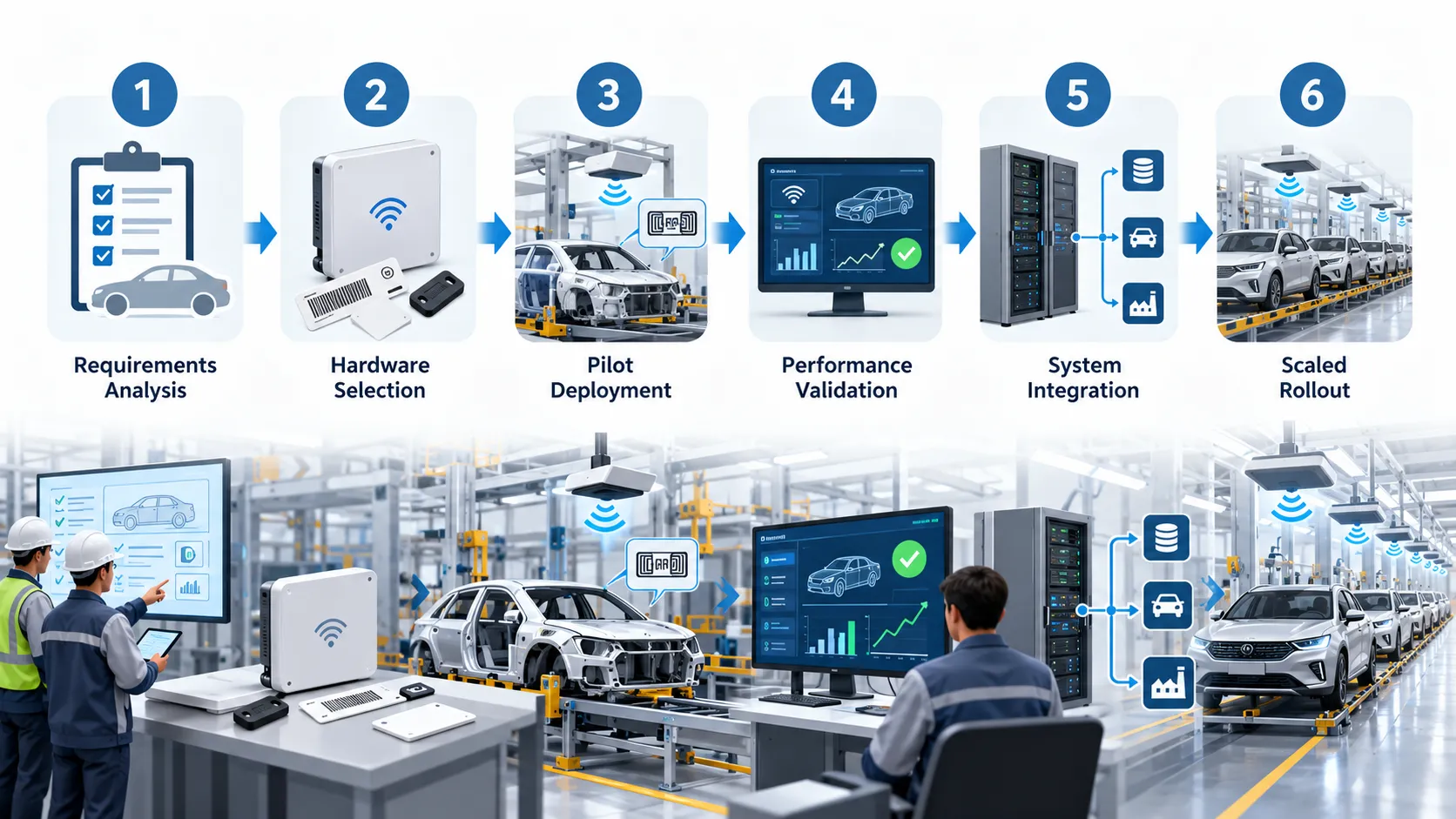
A phased implementation helps validate technical performance and business value before a system is expanded across a factory.
Choose a specific process and define what the system must identify, where events must be captured, and which decisions will use the data. Establish measurable acceptance criteria, such as correct item identification at defined checkpoints or reliable recording of container movements.
Document the movement of parts, carriers, containers, or vehicles. Mark each required read point and note speed, orientation, spacing, metal structures, environmental conditions, and nearby tags that should not be read.
Choose tags for the actual mounting surface and operating conditions. Select fixed, integrated, or embedded readers according to the required coverage, antenna count, interfaces, and installation constraints. Check regional frequency requirements and the availability of SDKs or integration documentation.
Test the proposed setup with real parts, actual fixtures, representative tag populations, and normal production movement. Record missed reads, unwanted reads, response timing, and any variation between operating conditions.
Connect the reader events to the target application. Confirm that the right item is associated with the right process step, that duplicate events are handled, and that exceptions are visible to operators. Test communication interruptions and recovery behavior.
After the pilot meets the agreed acceptance criteria, document the validated reader settings, antenna positions, tag mounting rules, and integration configuration. Establish procedures for replacing tags, maintaining devices, and checking performance when the production layout changes.
RFID can identify and track parts, work-in-progress, vehicle carriers, reusable containers, tools, and finished-vehicle logistics units. It can also associate read events with production and quality records.
Yes, when suitable tags and readers are installed and validated for the process. The design should account for tag orientation, movement speed, surrounding metal, nearby tags, and the read zone required at each station.
It can, but conventional RFID inlays may perform poorly when mounted directly on metal. A purpose-designed on-metal tag or an appropriate mounting arrangement should be evaluated on the actual component.
The choice depends on the application. UHF is often considered for longer-range identification, conveyor checkpoints, and multiple-tag inventory. HF may suit certain close-range, controlled-position, or application-specific workflows. Compare read distance, tag size, environment, standards, and integration requirements before selecting a frequency.
Depending on the model and architecture, readers can communicate through Ethernet, serial interfaces, GPIO, SDKs, APIs, or an intermediate gateway. The software layer typically validates and maps read events before sending them to MES, ERP, WMS, or other systems.
Provide the item to be tagged, mounting material, read distance, item speed, number of tags in the read zone, installation environment, destination market, required interfaces, target software, and expected project quantity. Photos or a layout of the proposed read point can help clarify the installation.
An effective automotive RFID system starts with the process and the objects being tracked. Tag selection, reader type, antenna placement, software logic, and integration all need to work together in the actual environment.
Syncotek provides UHF RFID modules, integrated readers, fixed readers, antennas, tags, and OEM/ODM options for different system architectures. Review the RFID product portfolio or contact Syncotek to discuss your application.
When requesting a recommendation, include the target object, mounting surface, read-point layout, required read distance, movement speed, operating environment, interface requirements, destination country, and estimated quantity. These details help narrow the hardware options and define a practical pilot test.
 Knowledge
What Is Backscatter in RFID? Backscatter is the communication method used by most passive UHF RFID tags to send data back to a reader without generating their own RF carrier. Instead of transmitting like an active radio, the tag uses the reader’s signal as both its power source and its communication medium, then changes how that signal is […]
READ MORE Knowledge
Medical device inventory is more complex than ordinary warehouse stock. A manufacturer may need to manage thousands of SKUs across raw materials, work-in-process, finished devices, warehouse locations, distributors, field inventory, hospital consignment stock, returns, and recalls. Many products also carry additional identification requirements involving: lot or batch number serial number expiration date manufacturing date UDI […]
READ MORE Knowledge
The RFID system auto-identifies vehicles' weight, calculates net weight, and provides real-time monitoring for optimized efficiency.
READ MORE Knowledge
Retail inventory changes constantly. Products arrive from distribution centers, move from stockrooms to sales floors, are picked for online orders, transferred between locations, returned by customers, purchased in stores, misplaced, or occasionally lost. Traditional inventory systems can record these transactions, but the digital record is only useful when it accurately reflects what is physically present. […]
READ MORETwo passive UHF RFID tags can look almost identical but behave very differently. One may provide excellent inventory performance on retail products. Another may offer larger user memory for manufacturing. A third may support advanced privacy functions. A fourth may combine RAIN RFID with NFC or provide battery-assisted sensor capabilities. Part of that difference comes […]
READ MOREIf you are interested in our services or need customized solutions, please feel free to contact us.