

RFID can make warehouse inventory counting faster, automate selected receiving and shipping checkpoints, and reduce repetitive manual scanning.
But does that mean every warehouse should replace barcodes with RFID?
Not necessarily.
Radio Frequency Identification (RFID) offers significant operational advantages, particularly in warehouses with frequent inventory movements, large item populations, and demanding verification processes.
However, these benefits come with additional costs, radio-frequency engineering requirements, software integration, and operational changes.
A small warehouse that performs occasional inventory checks may gain little from RFID. A large distribution center processing thousands of tagged items daily may find that RFID solves expensive workflow problems.
The real question is not simply whether RFID technology works.
It is:
Does RFID solve enough measurable problems in your warehouse to justify its total implementation and operating costs?
This guide examines the advantages, limitations, costs, and return on investment of RFID warehouse inventory tracking, including when barcode or hybrid systems may be more appropriate.
RFID is usually worth evaluating when a warehouse needs frequent bulk inventory counts, automated identification at receiving or shipping checkpoints, or serialized tracking of large numbers of items.
Barcode may remain more economical when inventory volumes are low, items are already handled individually, and scanning costs are minimal.
| Evaluation Factor | RFID Advantage | Potential Limitation |
|---|---|---|
| Inventory counting | Read multiple tagged items | Requires compatible tags and readers |
| Line of sight | Optical visibility is not normally required | RF signals can be affected by materials |
| Labor | Reduces repetitive scanning | New workflows and training required |
| Receiving and shipping | Supports automated checkpoints | Read-zone engineering required |
| Serialized tracking | Identifies individual tagged objects | Requires correct EPC-to-item mapping |
| Infrastructure | Supports handheld and fixed architecture | Greater initial investment |
| Location visibility | Checkpoint and last-seen information | Not automatically precise RTLS |
| Software integration | Can support WMS and ERP | Middleware and event logic are necessary |
| Scalability | Strong for large tag populations | Deployment costs increase with coverage |
The decision should be based on warehouse operations, not generic claims about RFID being faster or more accurate.
A warehouse RFID system typically uses passive UHF / RAIN RFID technology.
A basic architecture includes:
RFID-Tagged Inventory
→ Handheld Reader / Fixed Reader / RFID Tunnel
→ Middleware or Edge Software
→ Warehouse Management System (WMS)
→ Inventory and Operational Records
Each tagged object carries an electronic identifier, commonly stored in EPC memory.
When the tag enters a compatible RFID reader's effective read zone, its identity can be captured without requiring optical line-of-sight scanning.
The reader then reports that identification to the connected application.
However, there is an important distinction:
Reading an RFID tag is not the same as completing an inventory transaction.
For example, a reader detecting EPC TOTE-00125 does not automatically establish whether the tote is:
The warehouse software must interpret the event according to the business workflow.
This is why RFID projects require both appropriate hardware and software integration.
For the broader system architecture, see RFID Inventory Management and Tracking Solutions.
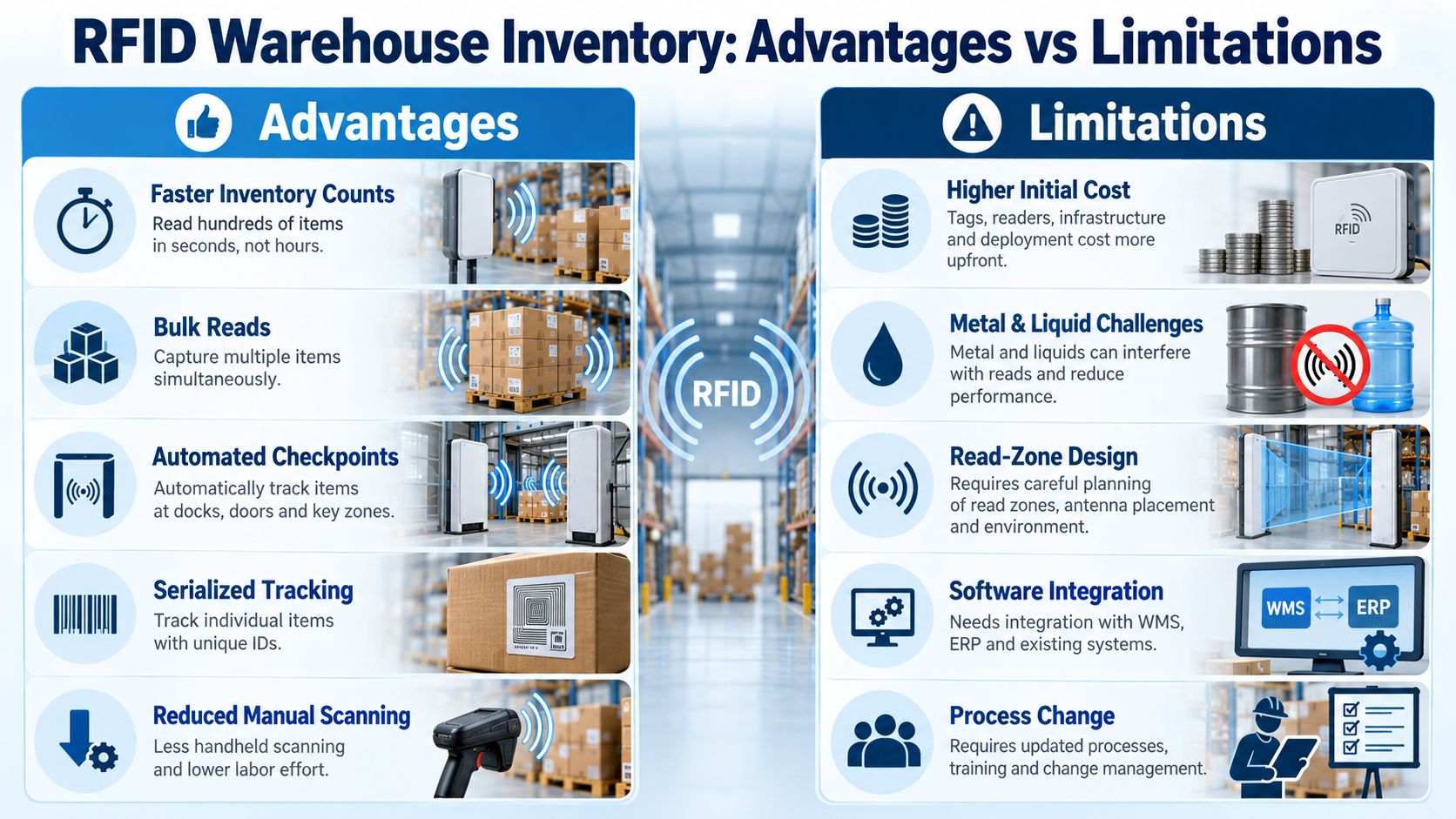
The main RFID advantages are operational rather than theoretical.
Traditional barcode inventory often requires employees to locate and scan individual labels.
RFID can identify multiple compatible tags during a reader inventory operation.
This is valuable for:
For example, an operator using a handheld UHF RFID reader may walk through a storage aisle and collect many tag identities without handling every item.
The practical benefit is reduced scanning labor.
However, actual inventory speed depends on tag density, warehouse layout, product material, reader settings, and whether exception handling is required.
RFID can reduce repetitive manual identification at defined process points.
Instead of requiring a worker to scan each carton individually, a fixed RFID portal may identify tagged cartons as they pass through a warehouse doorway.
Potential applications include:
This becomes particularly valuable when item identification is repeated throughout the workday.
Unlike conventional printed barcodes, passive UHF RFID tags do not usually need direct optical visibility to be read.
Tags may be detected through suitable nonconductive packaging.
For example, some tagged products inside cardboard cartons may be readable without opening the carton.
However, non-line-of-sight capability does not mean RFID can read every product through every material.
Metal containers, liquid-rich products, tightly packed goods, and antenna orientation can all affect performance.
RFID provides opportunities to capture product movement automatically.
A warehouse receiving workflow may look like:
Inbound Pallet
→ RFID Read Point
→ Tag IDs Captured
→ Compare Against Advance Shipping Notice (ASN)
→ Receiving Exception Report
Instead of depending entirely on a manual count, the system can compare detected identifiers with the expected shipment records.
The same principle can be applied during outbound verification.
For example:
Expected shipment:
100 serialized tagged items.
RFID captures:
98 expected identities.
The connected software can flag the remaining two as unresolved rather than automatically confirming a complete shipment.
This improves verification when the RF system and business rules are properly designed.
An RFID tag can carry a unique electronic identifier associated with an individual product or asset.
Instead of tracking only:
SKU A — 1,000 Units
an item-level RFID system may distinguish:
Item A-0001
Item A-0002
Item A-0003
and so on.
This can support:
The actual business information remains in the WMS, ERP, or another connected application.
RFID can make periodic audits less dependent on individually handling products.
A handheld inventory process can produce:
Expected
→ Inventory identities in the system
Detected
→ RFID identities physically observed
Exceptions
→ Missing, unexpected, or unidentified tags
The warehouse team can focus on investigating differences rather than manually counting every item.
This can create measurable value when audits are frequent or labor-intensive.
RFID does not require every warehouse to install a permanent reader network.
A project can begin with:
Fixed readers can be added later at high-value checkpoints.
RFID tunnels may also be introduced for controlled carton verification.
This flexibility makes phased implementation possible.
RFID's benefits do not eliminate its engineering and operating limitations.
Compared with barcode-only workflows, RFID may require additional spending on:
The initial investment becomes more significant when RFID is deployed across many warehouse zones.
An individual disposable RFID label may be economical in a high-volume program, but the total tagging budget can become substantial when many items require individual tags.
Tag costs also vary significantly.
A simple adhesive retail inlay is not equivalent to:
The correct tagging level is therefore one of the most important cost decisions.
Metal and water-rich materials can change UHF RFID performance.
Potential problems include:
A conventional RFID label placed directly on metal may perform poorly.
Metal products often require purpose-designed on-metal RFID tags.
Liquid-rich products may require different tag placement or read-zone designs.
Read more in RFID Interference Troubleshooting: Causes and Solutions.
RFID does not guarantee perfect data capture.
A missed read occurs when an expected tag is not detected.
A stray read occurs when a tag outside the intended business process is detected.
For example, a dock-door reader may accidentally detect tagged pallets waiting nearby.
If the software interprets all observations as shipment events, inventory records may become incorrect.
The objective is therefore not to read as many tags as possible.
It is to read the correct tags at the correct process point.
RFID readers produce electronic observations.
WMS software manages business operations.
The integration layer must connect them correctly.
For example:
Raw Reader Observation
EPC detected by Antenna 2.
Business Event
Carton associated with Order 1582 passed Shipping Door 4.
These are not equivalent records.
The system may require:
Integration work can represent a significant part of the total project cost.
RFID often changes how workers perform daily tasks.
Warehouse employees may need to learn:
A technically functional RFID system can still underperform if it introduces confusing or unnecessarily complicated processes.
A passive UHF RFID tag does not continuously report its physical coordinates.
A handheld reader provides on-demand observations.
A fixed portal provides checkpoint events.
A controlled cabinet or specialized infrastructure may provide ongoing presence information.
These are different from continuous high-precision real-time location.
Warehouse managers should define the required visibility level before choosing their RFID infrastructure.
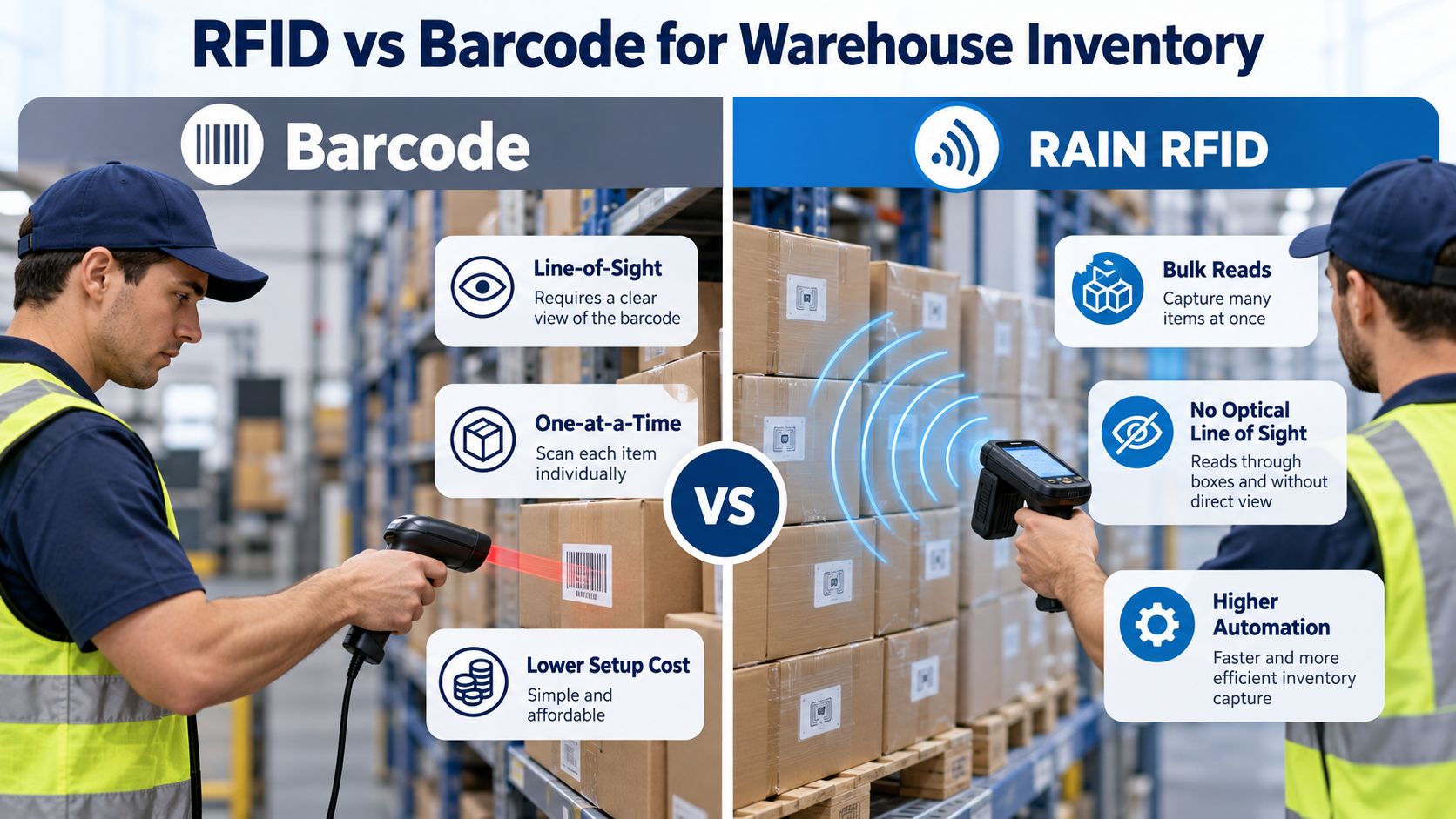
RFID and barcode are both valid technologies.
The better choice depends on the workflow.
| Factor | Barcode | Passive UHF RFID |
|---|---|---|
| Label cost | Generally lower | Generally higher |
| Optical line of sight | Required | Usually not required |
| Individual identification | Strong | Strong |
| Bulk inventory | Typically requires separate scans | Multiple tags can be read |
| Manual scanning | Common | Can be reduced |
| Automated doorway identification | More difficult | Strong candidate |
| Metal and liquid effects | No RF-related reading problem | Requires RF engineering |
| Implementation complexity | Generally lower | Often higher |
| Smartphone scanning | Common | Dedicated UHF hardware generally needed |
| Serialized identity | Supported | Supported |
| WMS integration | Supported | Supported |
Barcode may be sufficient when:
For example, a small spare-parts warehouse with modest inventory turnover may not justify a fixed RFID infrastructure.
RFID becomes more attractive when:
Many warehouses do not need to choose only one technology.
For example:
RFID
for high-volume inventory, returnable assets, and automated checkpoints.
Barcode
for low-volume stock, non-tagged goods, and deliberate manual verification.
A hybrid architecture can be a practical way to control investment while improving the most expensive workflows.
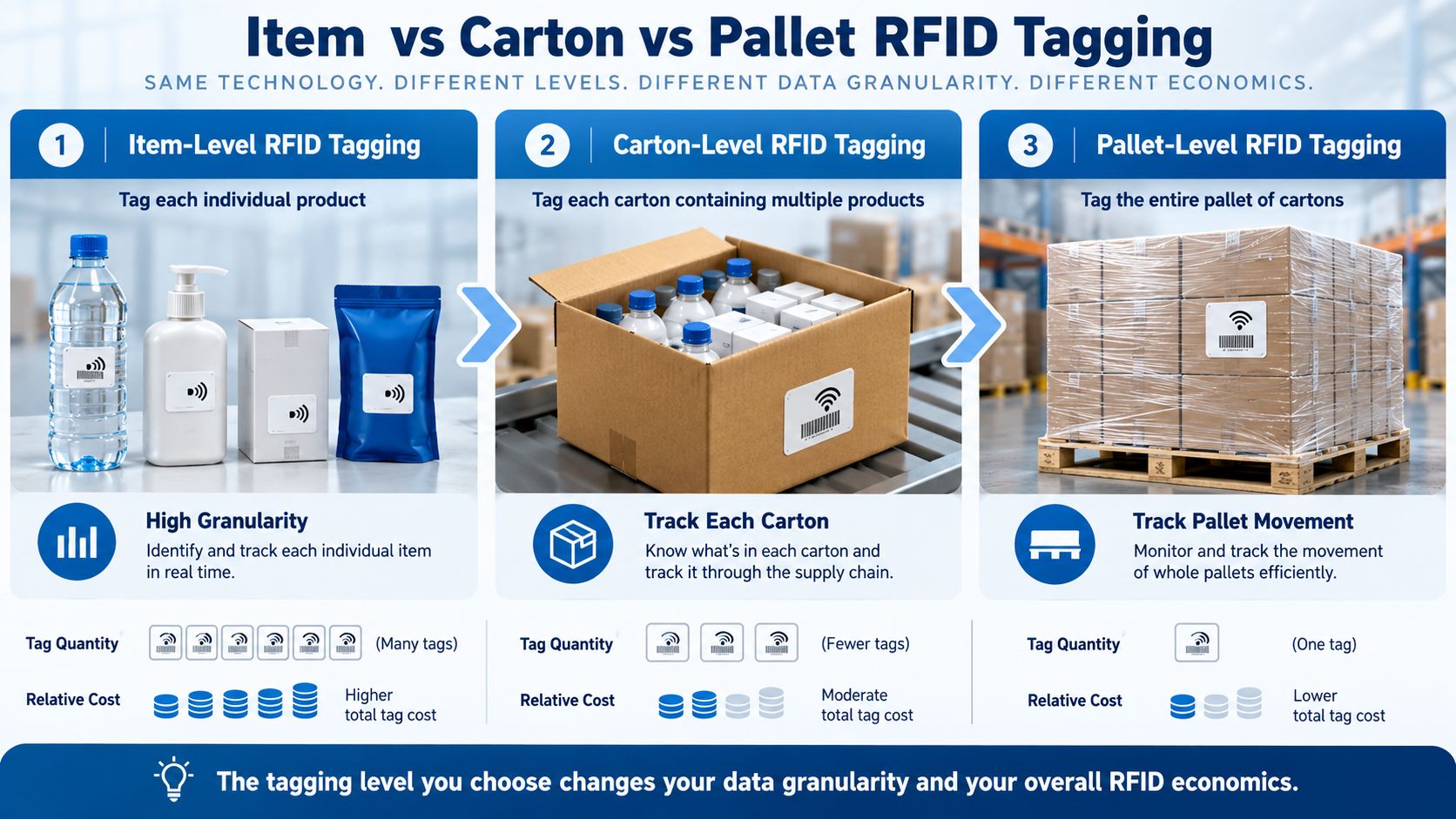
The tagging level has a direct effect on:
Each individual product receives an RFID tag.
For example:
Carton A contains 40 individually tagged products.
The system may identify those 40 serialized items when reader conditions support reliable capture.
Best for:
Main tradeoff:
More tags and greater tagging/encoding effort.
Each carton receives an RFID tag.
For example:
Carton C1008 contains 40 products.
The tag identifies:
Carton C1008
The WMS may associate that carton with its contents.
But the RFID tag does not independently verify every individual item inside.
Best for:
Main tradeoff:
Visibility is usually limited to carton identity unless individual contents are also tracked.
A single pallet receives an RFID tag.
The system may identify:
Pallet P0502
The WMS can associate the pallet with multiple cartons.
Best for:
Main tradeoff:
The RFID read identifies the pallet, not automatically every item inside it.
Suppose a warehouse moves most of its inventory as sealed cartons.
Tagging each carton may solve its receiving and shipping verification problem without the additional cost of item-level tagging.
However, if the warehouse needs to verify the exact serialized products inside cartons, carton-only RFID identification may not be enough.
The correct question is:
What is the smallest tracking unit the business actually needs to identify independently?
This decision should be made before choosing tags and readers.
For reusable bins and containers, see RFID Tote Tracking and Returnable Container Management.
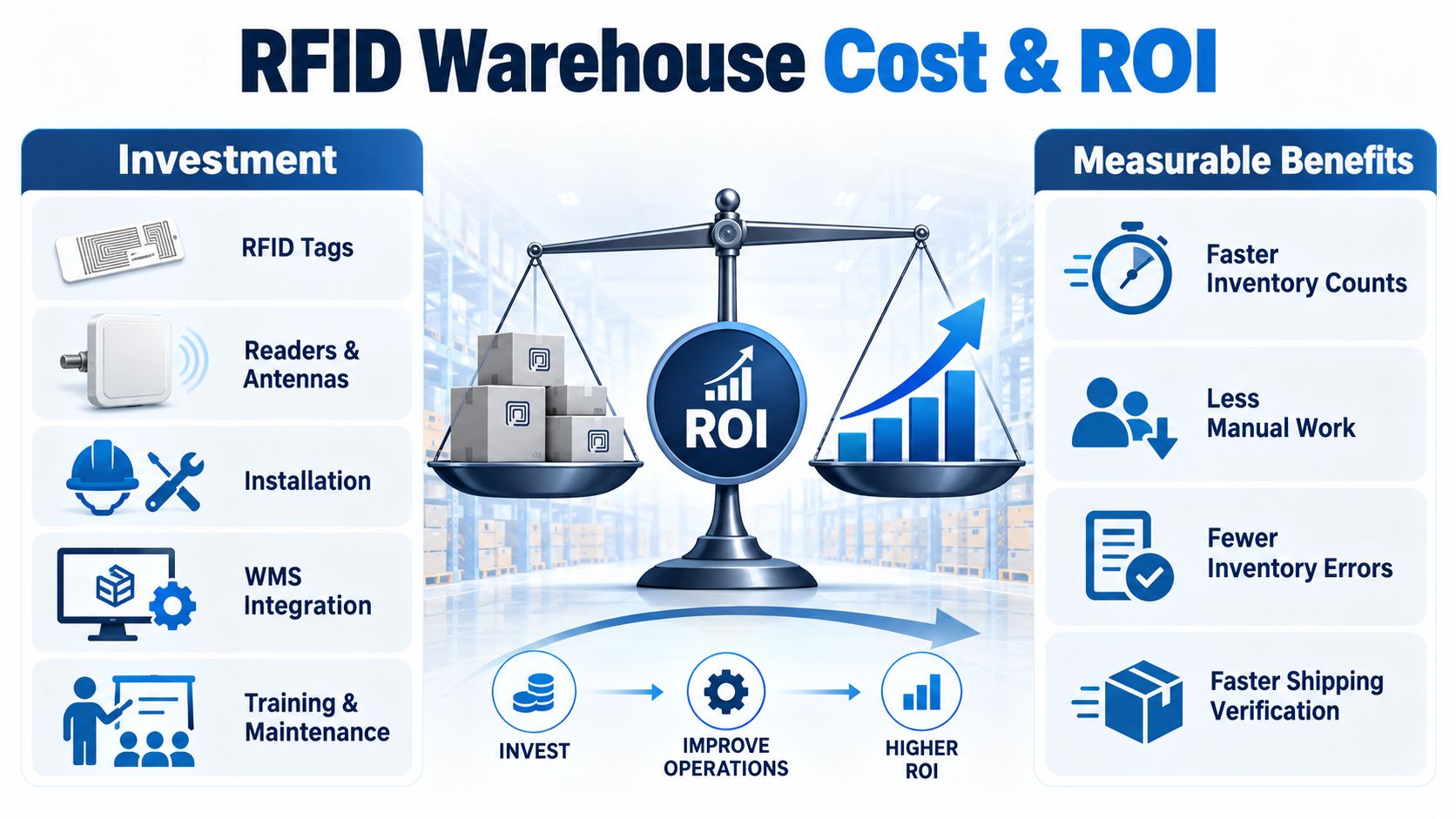
There is no universal price for an RFID warehouse inventory system.
A handheld-only inventory deployment and a multi-door automated warehouse have very different costs.
The most useful approach is to divide the budget into initial and ongoing expenses.
| Cost Category | What It Includes |
|---|---|
| RFID tags | Labels, hard tags, encoding and attachment |
| Handheld readers | Mobile terminals and accessories |
| Fixed readers | Readers installed at controlled checkpoints |
| Antennas | External antennas, cables and mounting |
| RFID tunnels | Enclosed carton-scanning equipment where required |
| Network and installation | Cabling, power, infrastructure and commissioning |
| Software integration | Middleware, WMS, ERP interfaces and event processing |
| Training | Operators, IT staff and process owners |
Potential ongoing costs include:
The relevant cost model is:
Total Cost of Ownership = Initial Investment + Operating Costs Across the Evaluation Period
A warehouse should not compare only the price of an RFID label with the price of a printed barcode.
RFID ROI should come from measurable operational changes.
Potential benefits include:
Compare the labor time required for equivalent inventory-counting tasks.
Measure how much manual identification and verification work can be removed.
Measure actual reductions in discrepancy handling, rework, claims or reshipment expenses.
Compare the time spent locating items before and after implementation.
For returnable containers, improved tracking may reduce unnecessary replacement purchases.
However, avoid counting the same operational savings twice.
For example, if faster inventory counting is already included in labor savings, it should not be added again under a separate efficiency category.
Annual Net Benefit = Annual Measurable Savings − Annual Incremental Operating Costs
Payback Period = Initial Investment ÷ Annual Net Benefit
This simplified payback calculation applies when annual net benefit is positive and reasonably stable.
If annual net benefit is zero or negative, the project does not achieve payback under that model.
A full investment assessment may also consider cash-flow timing, asset life, replacement costs, discount rates and residual value.
Avoid treating the following as certain financial savings without evidence:
These outcomes need to be measured during actual operations or a representative pilot.
The strongest candidates typically combine significant manual work with an RFID-compatible physical workflow.
| Warehouse Scenario | Starting Recommendation | Reason |
|---|---|---|
| Large apparel distribution center | RFID | Frequent high-volume item inventory |
| Automated shipping validation | RFID | Valuable checkpoint events |
| Reusable totes and containers | RFID | Persistent asset identity and return flow |
| High-value serialized equipment | RFID | Asset audits and accountability |
| Small low-turnover warehouse | Barcode | Lower complexity and investment |
| Low-value disposable goods | Evaluate carefully | Tagging economics may be unfavorable |
| Metal-heavy inventory | RFID pilot first | Tag choice and RF performance need testing |
| Liquid-rich products | RFID pilot first | Materials can reduce RF reliability |
| Mixed warehouse | Hybrid | Different workflows may need different technologies |
A warehouse performing frequent counts across large numbers of tagged items is a strong candidate for handheld RAIN RFID.
The advantage is reduced repetitive scanning.
A warehouse processing a large volume of tagged pallets or cartons may benefit from fixed readers at receiving or shipping points.
The advantage is automated identification at meaningful process transitions.
If inventory is counted occasionally and existing barcode scanning is quick and reliable, the cost of implementing RFID may exceed the operational benefit.
Warehouses containing large quantities of metal or water-rich products require realistic RF tests before committing to a large deployment.
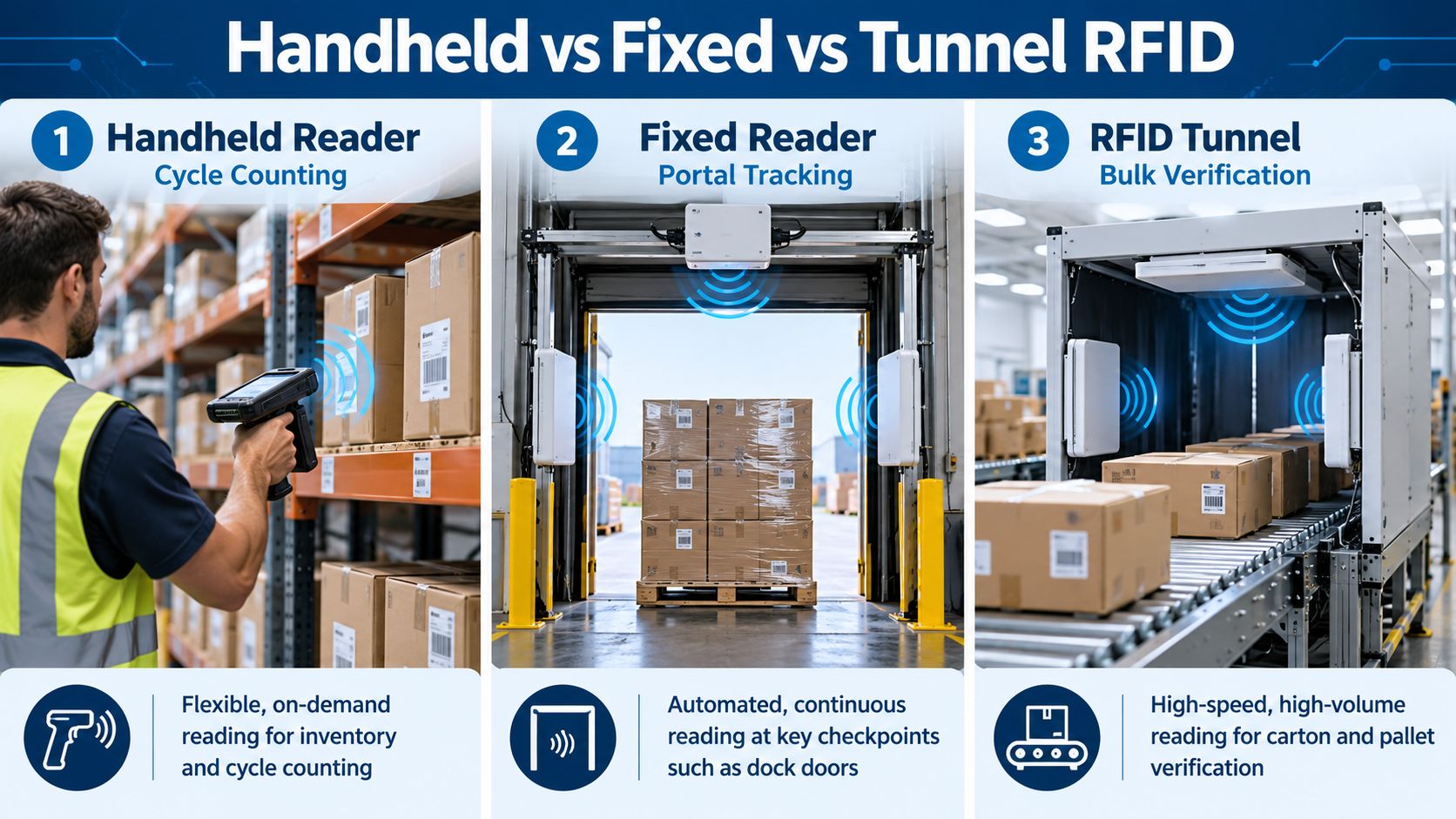
Choosing RFID does not automatically mean choosing one type of reader.
Different warehouse workflows call for different architectures.
Handheld UHF readers are useful for:
A handheld deployment can be a practical starting point when permanent read points are unnecessary.
Syncotek's SR-RU666 UHF RFID Handheld Reader is an example of hardware intended for mobile UHF inventory workflows.
Fixed RFID readers are useful for:
They can operate with external antennas positioned around the required read zone.
Syncotek's SR-RU471B UHF Fixed Reader is a four-antenna-port reader based on an Impinj E710 platform, intended for multi-antenna identification and integration applications.
The actual number of readers and antennas should be determined from the physical read-zone requirements.
An RFID tunnel is a dedicated read area designed for identifying tagged goods passing through a controlled scanning zone.
Potential applications include:
Syncotek's SR-RUX237 RFID Tunnel is an automated tunnel architecture intended for carton scanning.
However, a tunnel does not guarantee that every tagged item inside every carton will be detected.
Actual performance depends on tag placement, packaging, contents, tag population and test conditions.
For more equipment options, see RFID Tunnel Reader Systems.
| Requirement | Reader Architecture |
|---|---|
| Inventory counting across aisles | Handheld RFID |
| Searching for missing assets | Handheld RFID |
| Receiving door automation | Fixed RFID |
| Shipping checkpoint | Fixed RFID |
| Compact single read point | Integrated RFID reader |
| Controlled carton scanning | RFID tunnel |
| Mixed inventory and shipping workflow | Handheld + Fixed / Tunnel |
The goal should be to select the simplest architecture that reliably captures the required business events.
For technical reader selection, see How to Choose a UHF RFID Fixed Reader.
One of the most common misconceptions is that an RFID system provides perfect inventory accuracy.
It does not.
RFID performance should be evaluated across the full process.
Can the reader detect the expected tag reliably under realistic conditions?
Does the reader detect only the tags associated with the intended process?
Does the system interpret RFID observations correctly?
Does the business software associate those events with the correct products, orders and quantities?
For example:
A portal might successfully read 100 RFID tags.
But if 10 of them belong to a pallet waiting near the doorway, the resulting inventory transaction could still be wrong.
This is why:
More RFID Reads ≠ More Accurate Inventory Automatically
A well-designed system needs:
This depends on the infrastructure.
Provides on-demand inventory visibility.
Provides checkpoint or last-seen visibility.
May provide continuing presence information.
Designed for location updates and, depending on technology, position estimates or coordinates.
A conventional passive UHF RFID deployment should not automatically be marketed as a complete RTLS.
A warehouse that only needs to verify shipping-door movement may not need continuous positioning.
For a detailed explanation, see Can RFID Provide Real-Time Location?.
A pilot should test both the RF technology and the business process.
Start with one high-value workflow rather than attempting to automate an entire warehouse immediately.
Examples:
Record baseline metrics such as:
Determine whether the business needs:
Test tags on the actual products.
Include realistic packaging and nearby materials.
See How to Choose the Right RFID Tag.
Identify:
Where tags must be read
and equally important:
Where tags must not be read.
Choose handheld, fixed, integrated or tunnel equipment based on the workflow.
Ensure the system can:
Include:
Compare performance against the original process.
Expand only when the pilot demonstrates reliable operation and sufficient business value.
For a complete implementation roadmap, see How to Start an RFID Project.
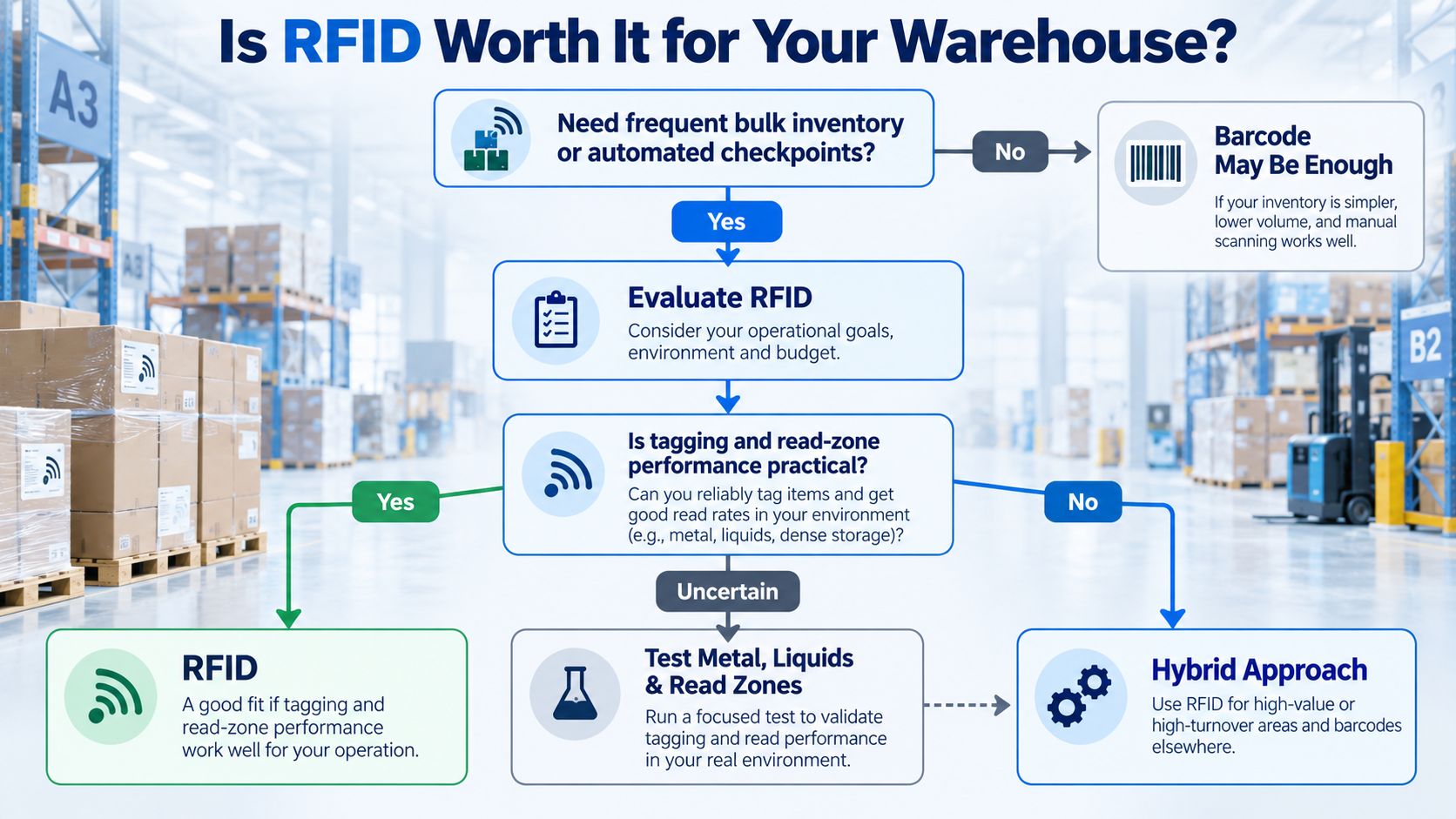
Use the following decision process before investing.
No
Barcode may be sufficient.
Yes
Evaluate RFID.
Yes
Proceed to a pilot.
Uncertain
Test tag placement, metal, liquids and read-zone performance.
Yes
Evaluate item-level RFID tagging costs.
No
Consider carton, pallet or reusable-container tagging.
Yes
Test the end-to-end transaction workflow.
Not Yet
Include middleware and integration development in the project budget.
Yes
Plan a phased rollout.
No
Reconsider the RFID scope, improve the design or retain barcode workflows.
The objective is not to choose RFID at all costs.
It is to select the most effective identification system for the warehouse.
RFID should solve a measurable operational requirement.
Item, carton and pallet tagging have very different economics.
Tag performance must be validated on the actual product.
The physical environment is part of the RF system.
Excessive power can cause unintended reads.
Readers provide identification data; software implements the business process.
Exceptions, damaged tags and unusual inventory conditions still require procedures.
The relevant measure is operational labor and business improvement, not a specification-sheet read rate.
A hybrid rollout may produce better economics.
Technical feasibility on a test bench does not establish warehouse-wide reliability.
Before committing to a full deployment, confirm:
The main advantages include faster bulk inventory, reduced manual scanning, automated checkpoints, serialized identification and improved reconciliation workflows.
Disadvantages include higher initial costs, tag expenses, RF challenges involving metal and liquids, software integration, read-zone planning and employee training.
RFID is often better for frequent bulk inventory and automated identification. Barcode may be more economical for low-volume operations where deliberate individual scanning already works well.
The cost depends on tag quantity, tag type, readers, antennas, installation, integration, software and the scope of deployment. A handheld-only system and an automated multi-door warehouse should not be compared using one generic price.
RFID can reduce repetitive manual scanning, but it does not eliminate all human work. Exception handling, audit reconciliation and operational checks remain important.
Yes. Passive UHF / RAIN RFID readers are designed to inventory multiple compatible tags. Actual performance depends on tag population, materials, orientation and reader configuration.
Sometimes. Tagged items may be readable through suitable packaging, but reliability depends on the products, packaging, RF environment and tag placement. Full-carton testing is essential.
Yes, using suitable tag designs, often purpose-built on-metal RFID tags, followed by actual application testing.
Yes. An RFID tag can identify a pallet and associate it with a warehouse record. It does not automatically identify every product carried by that pallet unless those contents are separately identified or associated through software.
No. Read failures, stray reads, incorrect tag associations and software-event errors are possible. Accuracy must be measured and managed through the complete workflow.
Yes, if the reader, middleware and WMS integration are designed appropriately. The exact implementation depends on supported interfaces and business rules.
Not automatically. Passive RFID commonly supports inventory, checkpoint and last-seen visibility. Continuous precise positioning requires a suitable location architecture.
It depends on the value of the workflow improvement. Small warehouses with infrequent counts and efficient barcode processes may not benefit enough to justify the additional investment.
Compare measured annual operational savings against recurring costs and the initial implementation investment. A pilot is usually the most reliable way to estimate actual financial benefits.
Use handheld readers for flexible inventory and asset searching. Fixed readers are more suitable for automatic checkpoints such as receiving doors, shipping portals and conveyors.
RFID tunnels are useful when tagged cartons or items need to pass through a controlled scanning point for bulk identification or verification. Real packaging and throughput requirements must be tested.
Not every warehouse requires the same RFID equipment.
Syncotek provides passive UHF RFID hardware for warehouse inventory, logistics, manufacturing, reusable assets and other industrial identification applications.
The hardware portfolio includes:
| Warehouse Requirement | Syncotek Hardware Starting Point |
|---|---|
| Mobile cycle counting | SR-RU666 UHF Handheld |
| Dock-door or multi-antenna checkpoint | SR-RU471B UHF Fixed Reader |
| Controlled carton scanning | SR-RUX237 RFID Tunnel |
| Compact fixed checkpoint | UHF Integrated Reader |
| Metal equipment tagging | On-Metal UHF RFID Tag |
| Carton or item tagging | Compatible UHF RFID Label |
Hardware specifications and practical RFID performance depend on the selected configuration and application.
To evaluate an RFID pilot, the most useful information includes:
Warehouse Type: Distribution / Manufacturing / Retail / 3PL
Inventory Type: Products / Cartons / Pallets / Containers
Tagged Material: Cardboard / Plastic / Metal / Liquid-Rich Goods
Tracking Level: Item / Carton / Pallet / Asset
Inventory Volume: Total tagged population and daily throughput
Read Workflow: Handheld Inventory / Receiving / Shipping / Conveyor
Read Zone: Distance and physical dimensions
Software: Existing WMS / ERP / Custom Application
Deployment Country: Frequency-region requirements
Pilot Quantity: Initial test quantity
These details help narrow the appropriate RFID tag, reader and antenna architecture before committing to full-scale deployment.
Explore Syncotek's RFID Warehouse Inventory Management System
Request an RFID Hardware Quotation
For deeper technical information, explore these Syncotek resources:
RFID can improve warehouse inventory operations by reducing repetitive scanning, supporting bulk inventory, enabling automated checkpoints and providing serialized identification.
But its value depends on the physical products, operating processes, reader infrastructure and connected software.
For high-volume warehouses with frequent inventory movement, the operational benefits may justify the additional investment.
For smaller operations with efficient barcode workflows, maintaining barcode or introducing RFID only at selected high-value checkpoints may be the more sensible choice.
The best warehouse RFID strategy begins with a measurable inventory problem, validates the complete system in a real pilot, and expands only when the results justify the cost.
That approach helps ensure RFID becomes a practical operational improvement rather than another layer of technology to maintain.
 Knowledge
The RFID system auto-identifies vehicles' weight, calculates net weight, and provides real-time monitoring for optimized efficiency.
READ MORE Knowledge
The RFID system auto-identifies vehicles' weight, calculates net weight, and provides real-time monitoring for optimized efficiency.
READ MORE Knowledge
Can an RFID tag tell you exactly where an asset is right now? The correct answer is: Sometimes — but it depends completely on the RFID architecture. Not every RFID tracking system is a real-time locating system. A passive UHF RFID system may tell you: Asset A was detected at Warehouse Door 3 at 14:42. […]
READ MORE Knowledge
An RFID system is more than an RFID reader and a tag. A complete industrial RFID deployment may contain: RFID tags reader antennas RFID readers RF cables and connectors embedded reader modules handheld devices middleware or edge applications RFID printer encoders sensors and triggers network infrastructure ERP, WMS, MES, or other business applications The exact […]
READ MORE Knowledge
HF RFID (High-Frequency Radio Frequency Identification) is a widely used RFID technology operating at 13.56 MHz. It’s best known for short-range, controlled reads, strong support for secure credentials, and the fact that NFC is built on the same HF band. If your project needs a tap / close-range user experience—like access control badges, library book tags, healthcare wristbands, or secure ID cards—HF […]
READ MOREIf you are interested in our services or need customized solutions, please feel free to contact us.