

A successful RFID project should not begin by purchasing readers.
It should begin with a business problem.
Companies often approach RFID projects with a requirement such as:
We want to use RFID in our warehouse.
That is not yet an RFID requirement.
A much more useful project definition would be:
We need to verify whether the 80–120 tagged cartons on each pallet match the shipping order before the pallet leaves Door 3.
Now the engineering team can begin asking meaningful questions:
This is the difference between buying RFID hardware and designing an RFID system.
A practical RFID implementation roadmap looks like:
Business Problem
→ Workflow
→ Success Metrics
→ Site Survey
→ Technology Selection
→ Tag Selection
→ Read-Zone Design
→ Reader & Antenna Architecture
→ Software Integration
→ Proof of Concept
→ Pilot
→ Measure
→ Optimize
→ Rollout
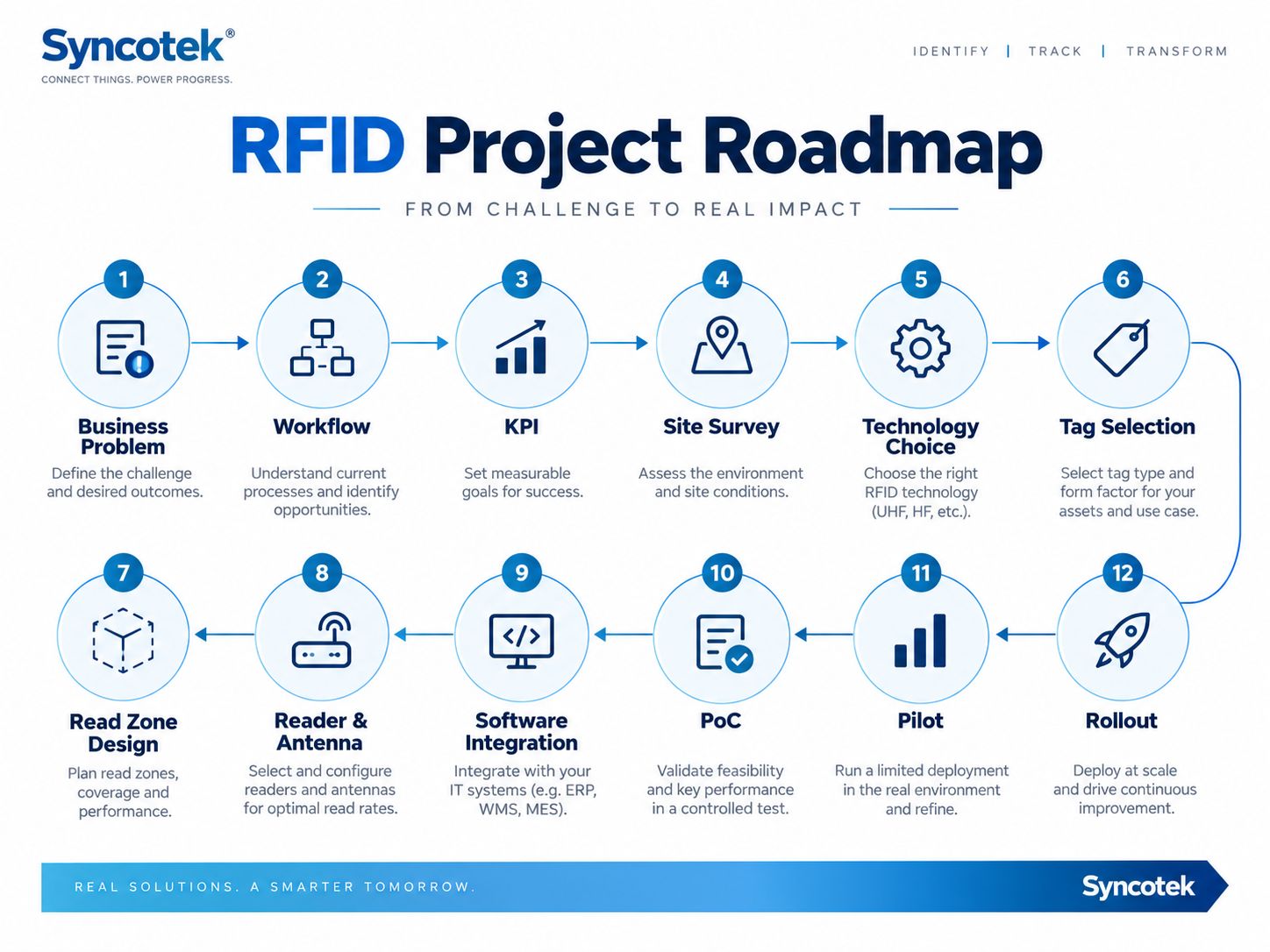
The purpose of this guide is to explain how to move through those stages without committing too early to the wrong tags, readers or system architecture.
Do not begin with:
Which RFID reader should we buy?
Begin with:
What business problem are we trying to solve?
Typical RFID project problems include:
The business problem determines whether RFID is appropriate and what type of RFID system should be designed.
Instead of:
Inventory is slow.
Write:
Ten employees currently require six hours to complete the weekly warehouse count.
Instead of:
We lose tools.
Write:
The maintenance department spends an average of 25 minutes locating missing tools before each shift.
Instead of:
We want automatic shipping.
Write:
Every pallet must be verified against the WMS order before leaving the shipping doorway.
These definitions can later become pilot KPIs.
RFID becomes much easier to design once you define the exact physical event.
Common event types include:
Question:
Which tagged items are currently present?
Applications:
Question:
Which tagged items crossed this checkpoint?
Applications:
Question:
Which employee took or returned this asset?
Applications:
Question:
Which workpiece arrived at this station?
Applications:
Question:
Do the physical products match the shipping order?
Question:
Which item was added to or removed from the cabinet?
The clearer this event is, the easier it becomes to design:
Before RFID, document how the process works today.
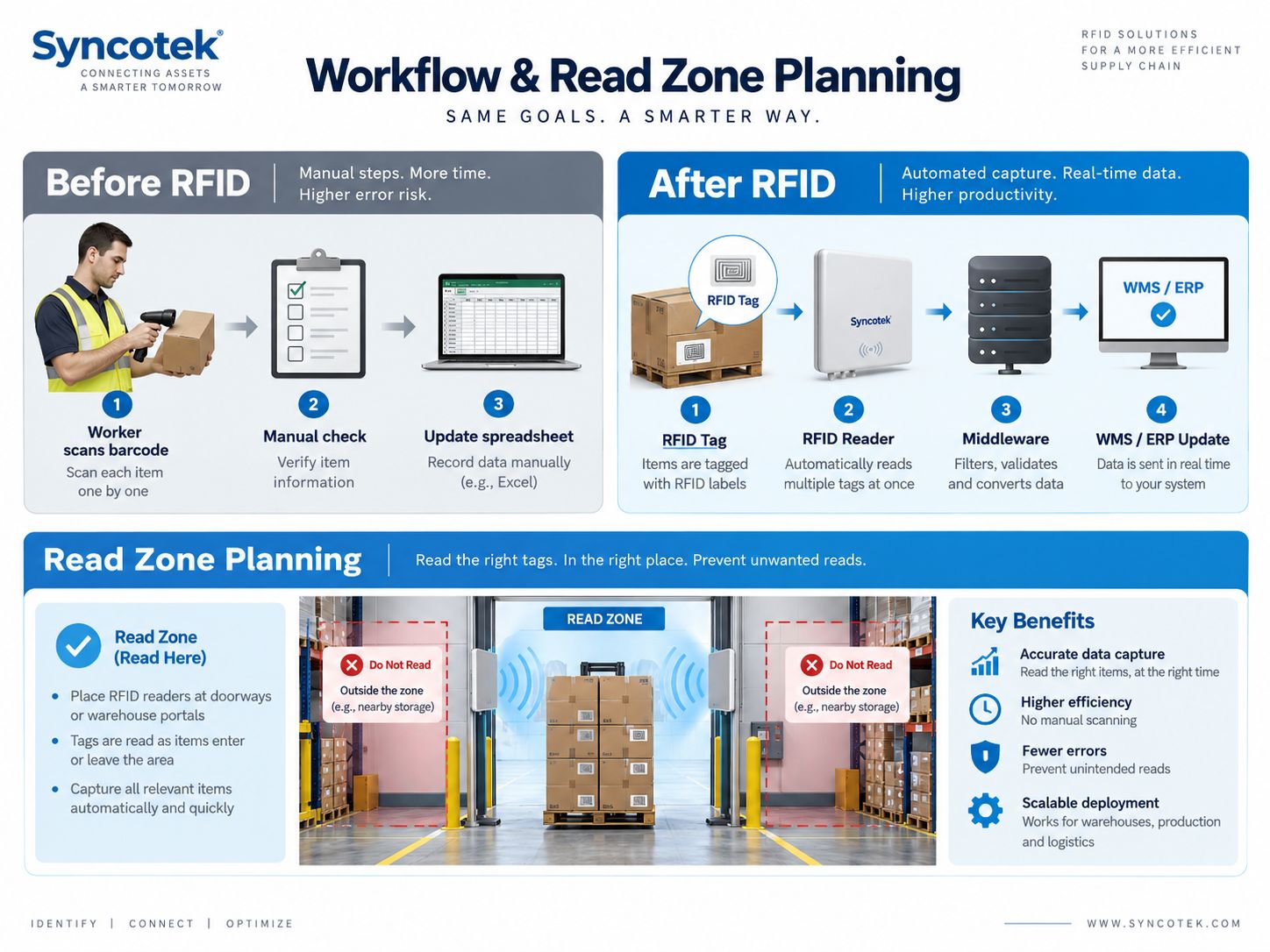
For example:
Worker
→ Find barcode
→ Scan item
→ Check paperwork
→ Enter data
→ Reconcile differences
Now ask:
Which part of this process actually causes the problem?
Perhaps barcode identification itself is not the problem.
Maybe the problem is that employees need to scan 500 items individually.
In that case RFID bulk identification could create value.
But if an employee already needs to physically inspect every product individually, replacing the barcode with RFID might create very little benefit.
A potential future architecture might be:
Tagged Product
→ RFID Read Point
→ Reader
→ Middleware
→ WMS
→ Business Action
The goal is not simply:
Read RFID tags.
The goal might be:
Automatically receive a pallet into inventory.
or:
Stop a shipment when an unexpected item is detected.
RFID creates value when the physical read triggers a useful business process.
One of the most common RFID pilot mistakes is defining success as:
The reader detected the RFID tag.
That proves only that RF communication is possible.
A business pilot needs measurable KPIs.
Examples include:
| KPI | Current State | Pilot Target |
|---|---|---|
| Inventory time | 6 hours | Significantly reduced |
| Manual scans | 500 per batch | Reduce repetitive scans |
| Missing-asset search | 25 minutes | Reduce search time |
| Shipping discrepancies | Current baseline | Reduce verified errors |
| Read-zone control | Manual | Read intended zone reliably |
| Stray reads | N/A | Minimize unintended reads |
Do not select arbitrary numbers merely because they sound impressive.
Create targets from:
RFID is a radio-frequency system.
The physical environment matters.
Before purchasing large quantities of hardware, inspect the actual deployment area.
Look for:
Metal can change RFID antenna behavior and reflect RF energy.
It can affect both:
Water-rich products can absorb or alter UHF RF energy.
Metal warehouse shelving can create:
Tags outside the intended process may still be detectable.
This is why read-zone control matters as much as read distance.
Determine whether the reader location has:
These practical details can influence the hardware architecture.
A professional RFID project should include the possibility that RFID is not the best answer.
Different technologies solve different identification problems.
| Requirement | Possible Starting Technology |
|---|---|
| Low-cost deliberate scanning | Barcode |
| Smartphone tap interaction | NFC |
| Bulk inventory | Passive UHF / RAIN RFID |
| Automatic checkpoint identification | Passive UHF / RAIN RFID |
| High-precision real-time coordinates | UWB / dedicated RTLS |
| Beacon-based location | BLE |
For example, if a warehouse employee handles each product individually and the barcode is already easy to scan, RFID may not produce enough improvement.
If the problem is:
Count 2,000 items without handling each one individually.
RAIN RFID becomes much more attractive.
The technology should follow the business requirement.
RFID includes several frequency ranges.
Common categories include:
For many Syncotek applications involving:
the project often uses passive UHF RFID.
Modern passive UHF systems commonly use the EPC Gen2 / ISO 18000-63 ecosystem.
However, frequency should still be chosen from the use case rather than automatically selecting UHF for every RFID project.
Do not design the entire reader infrastructure and leave the tag until the end.
The tagged item is part of the RF system.
A useful model is:
Tagged Item = Physical Product + RFID Tag + Tag Placement
All three affect performance.
Important tag-selection factors include:
For the detailed tag-selection process, see How to Choose the Right RFID Tag.
Do not test only:
Tag on table
Test:
Tag on actual product
For example:
The physical product can completely change tag performance.
One of the most important questions in the entire project is:
Where should RFID tags be read?
But equally important is:
Where should RFID tags not be read?
For a warehouse doorway:
Tags passing through the doorway.
This means:
Maximum range is not the objective.
The objective is:
Reliable identification inside the intended process zone.
Suppose the business requirement is:
Verify pallets passing through Door 3.
The read zone might need to cover:
but avoid:
Reader power, antenna location and trigger logic should be designed around this requirement.
Only after the read zone is understood should the team finalize the reader architecture.
Possible reader types include:
Suitable for:
Suitable for:
Suitable for:
Suitable for:
For detailed fixed-reader selection, see How to Choose a UHF RFID Fixed Reader.
The antenna determines the RF coverage pattern.
Important factors include:
For antenna selection, see How to Select the Right RFID Antenna.
An RFID project is usually more than:
Tag + Reader
A fixed installation may also require:
For RF cabling, see RFID Cables, Connectors and Adapters.
A practical workflow could be:
Photoelectric Sensor
→ Detect pallet
→ Trigger RFID reader
→ Read tags
→ Middleware verifies order
→ WMS result
→ Green light / Red light
This produces a controlled business event instead of simply leaving the reader active continuously.
RFID readers can generate huge numbers of raw observations.
The enterprise application usually does not need all of them.
A complete RFID project architecture may look like this:
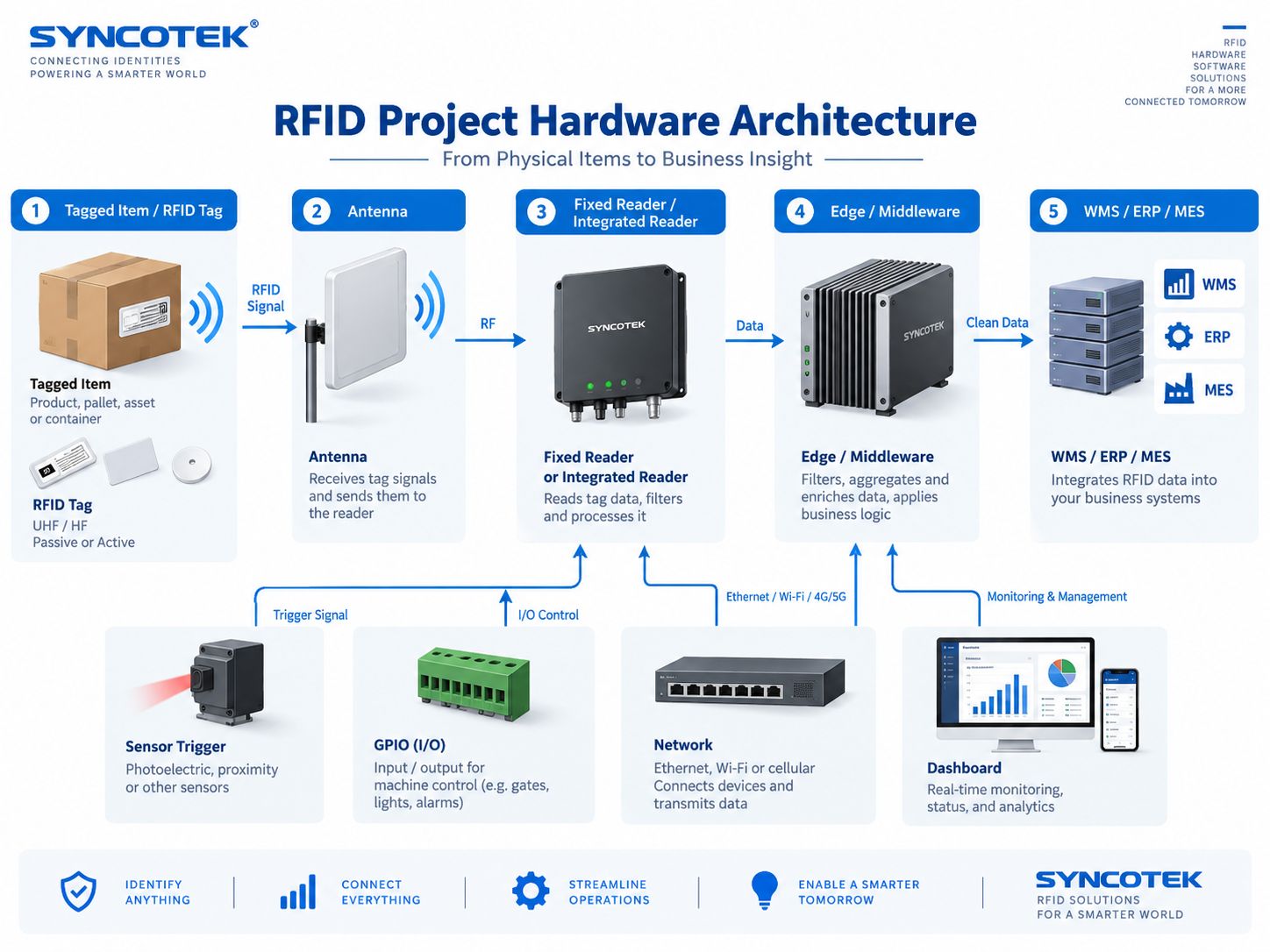
Tagged Item
→ RFID Antenna
→ Reader
→ Edge / Middleware
→ WMS / ERP / MES
The middleware or edge layer can perform:
For example, raw data might contain repeated EPC reads.
The business system should receive:
Pallet P102 entered Receiving Door 3 at 14:32.
That is a useful business event.
For a deeper explanation, see RFID System Architecture.
Do not complete all RFID hardware installation before asking:
How do we connect this to the WMS?
Software architecture should be defined during project planning.
Questions include:
Possible enterprise systems include:
A Proof of Concept, or PoC, should answer one primary question:
Can this RFID use case work technically?
It should not attempt to reproduce the entire future deployment.
A good PoC is focused.
For example:
Can this RFID tag be reliably detected on our metal asset using the proposed reader architecture?
or:
Can 80–120 tagged cartons be identified while the pallet moves through a simulated portal?
A PoC may use:
The purpose is technical feasibility.
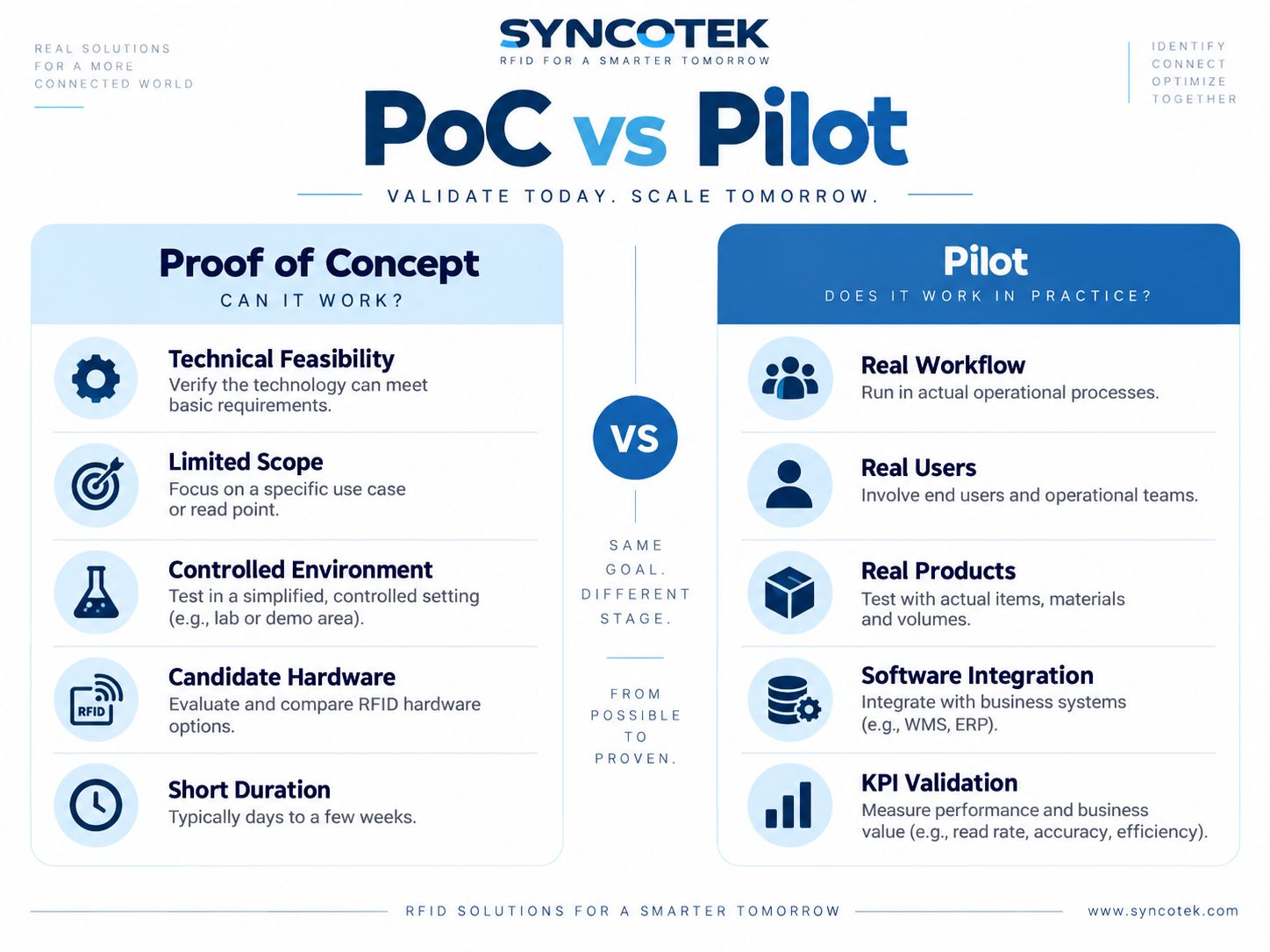
These two stages should not be treated as the same thing.
| Proof of Concept | Pilot |
|---|---|
| Tests technical feasibility | Tests operational feasibility |
| Limited scope | Real workflow |
| Controlled environment | Real operating environment |
| Engineering-focused | Business + engineering |
| Candidate hardware | Near-final hardware |
| Can RFID work? | Can our RFID solution work reliably? |
Can the technology identify these tags?
Can the entire process work reliably with real products, employees, software and exceptions?
This distinction can prevent projects from scaling too early.
A pilot should use:
Do not make the pilot artificially easy.
If production cartons are tightly stacked, test tightly stacked cartons.
If pallets move by forklift, test forklifts.
If textiles are wet, test wet textiles.
If products pass at speed, test realistic movement speed.
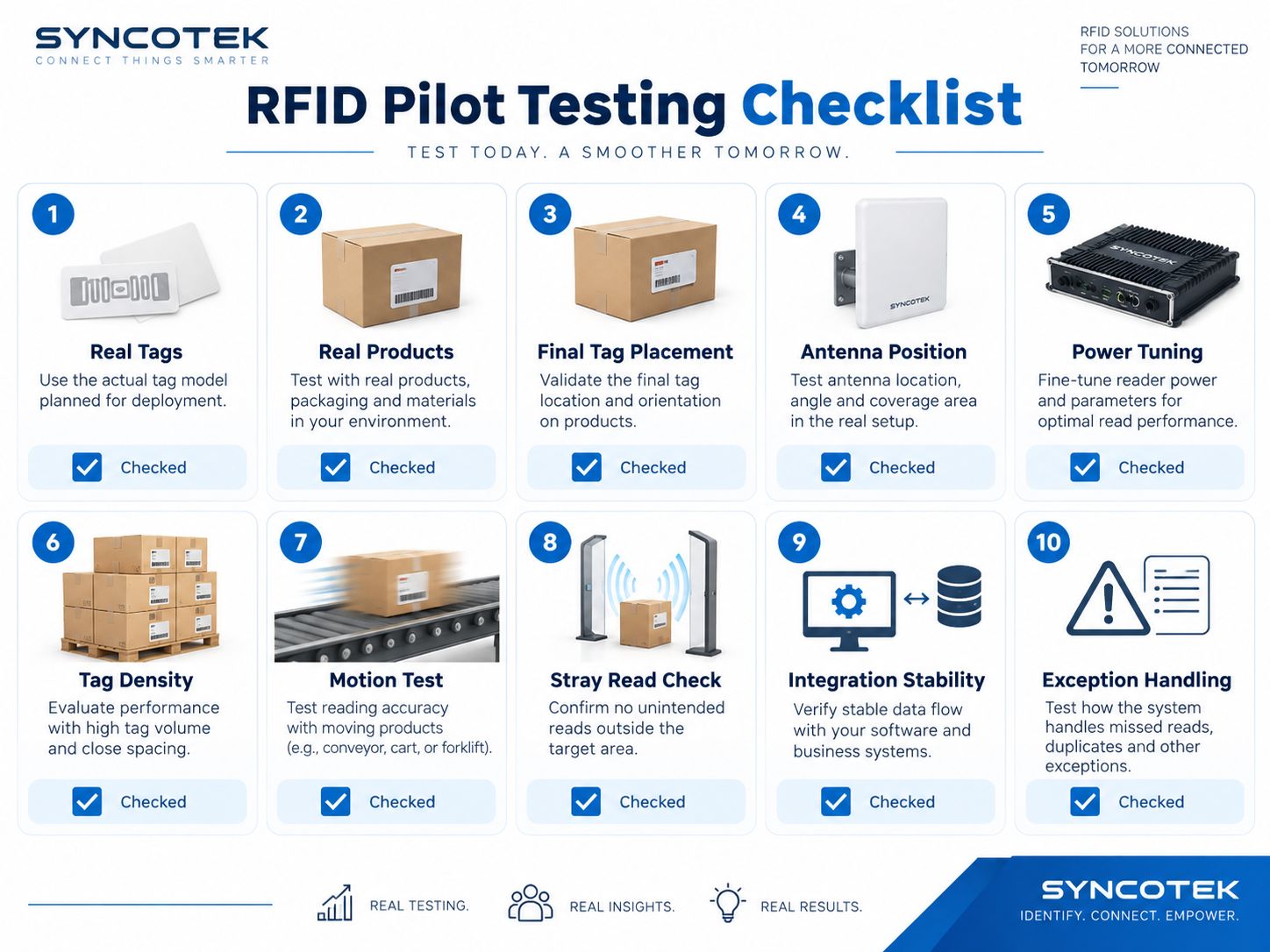
A useful pilot should validate at least the following.
Use the actual tag model planned for deployment.
Use the final:
Validate:
Test the intended:
Tune rather than automatically using maximum power.
Test the actual expected number of tags.
Use:
where applicable.
Confirm that nearby unintended tags are not generating incorrect events.
Verify stable data flow into the business system.
Test:
A project that works only when everything is perfect is not ready for deployment.
Create intentional failures.
Examples:
What happens?
Does the operator have a fallback process?
Can the system identify the discrepancy?
Does the workflow:
the exception?
Does the system:
Can the reader or edge system continue temporarily?
Can the system distinguish the intended read zone?
These tests often expose more important problems than basic read-distance tests.
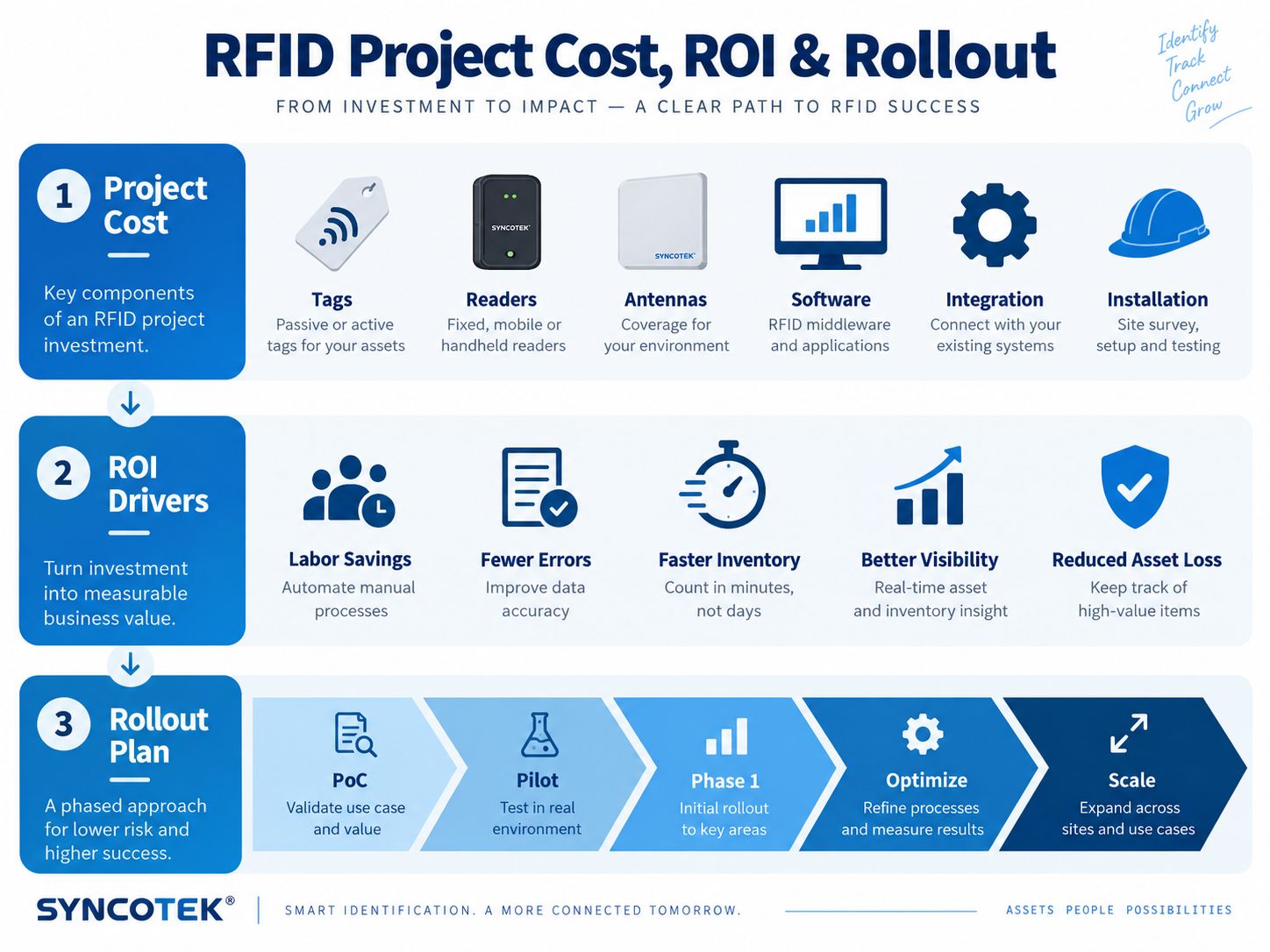
RFID project cost should not be calculated as:
Reader + Tags
The real project cost may include:
The lowest-cost reader does not necessarily produce the lowest-cost project.
Avoid generic statements such as:
RFID reduces costs by 80%.
Every project has different economics.
A better ROI model is:
Labor Savings
Fewer Process Errors
Reduced Asset Loss
Faster Inventory
Reduced Overstock
Higher Throughput
minus
Hardware + Tags + Software + Integration + Deployment
Measure existing time spent on:
Measure costs associated with:
For asset projects, consider:
Better visibility may help reduce:
The ROI model should use the organization's own baseline data.
A pilot may contain:
The final system may contain:
These are different architectural problems.
Before scaling, ask:
Do not discover these questions after purchasing hundreds of devices.
A safer RFID deployment sequence is:
PoC
→ Pilot
→ Phase 1
→ Measure
→ Optimize
→ Phase 2
→ Scale
This reduces risk.
For example:
One warehouse receiving door.
Measure:
All receiving doors.
Shipping.
Additional warehouses.
Each stage generates new information that can improve the next rollout.
RFID is not only an IT project.
It is also not only an RF engineering project.
A successful team often includes:
| Role | Responsibility |
|---|---|
| Business Owner | Defines problem and ROI |
| Operations | Defines real workflow |
| RFID Engineer / Integrator | Designs RF system |
| IT | Network and infrastructure |
| Software Team | Integration and data |
| End Users | Validate daily workflow |
| Procurement | Hardware and supply |
The engineering system may work perfectly and still fail operationally if employees cannot use it efficiently.
Operations should therefore be involved from the beginning.
Start with the business event.
The tagged item is part of the RF system.
Design for the required read zone.
Free-air tests are not enough.
A pilot without measurable targets cannot objectively succeed or fail.
Technical feasibility does not prove operational success.
Create business events first.
Both can substantially change UHF performance.
Reading more tags is not always better.
If production items move, pilot moving items.
Automation should improve the process, not simply add another task.
Every deployment needs a plan for failed reads and unexpected items.
Integration and installation can be significant parts of project cost.
Validate one manageable process first.
Before moving from planning to deployment, confirm:
Start by defining the business problem and the physical event you want RFID to capture. Then document the workflow, set measurable KPIs, survey the site, choose RFID technology, test candidate tags, design the read zone and build a proof of concept before a full pilot.
Do not begin by buying large quantities of hardware. First define the use case and select several candidate tags and reader/antenna components for technical testing.
An RFID PoC is a limited technical test used to determine whether the proposed RFID technology can work for the target use case.
A pilot tests a near-final RFID solution inside a real operating workflow using actual products, users, software and business processes.
A PoC asks whether the RFID technology can work technically. A pilot asks whether the complete system can work reliably and economically in the real operation.
They should be evaluated as part of one RF system. However, the physical tagged item and candidate tag should be understood early because tag performance strongly influences reader and antenna requirements.
Consider the tagged material, size, environment, read zone, attachment method, frequency and reader architecture. Then test several samples on the actual product.
Define the read zone, tag population, antenna count, product movement, interfaces and software requirements before selecting the reader.
There is no universal number. It depends on read-zone geometry, antenna beam patterns, tag orientation and application requirements.
Not always. Excessive power can generate stray reads and cross-zone detection. Tune RF power to the intended read zone.
Depending on the project, the system may require reader SDKs, middleware, edge processing, databases and integration with WMS, ERP, MES, CMMS or another business application.
Technically possible in some systems, but enterprise software usually benefits from filtered business events rather than large volumes of duplicate raw tag reads.
There is no universal duration. The pilot should run long enough to include realistic operating conditions, user behavior, product variations and exception scenarios.
Typical measures include read reliability, stray reads, inventory time, labor, workflow speed, software stability, exception handling and business KPIs.
Compare the total project cost with measurable operational benefits such as labor savings, fewer errors, reduced loss, faster inventory and improved throughput.
No. Barcode remains highly effective for low-cost deliberate scanning. RFID creates more value when bulk identification, non-line-of-sight reading or automatic checkpoints solve a real process problem.
Passive UHF / RAIN RFID is particularly suitable for inventory, logistics, assets, manufacturing, retail and checkpoint identification where multiple items need to be identified efficiently.
Passive UHF RFID can provide inventory, presence and checkpoint visibility. Continuous high-precision location may require an RTLS technology such as UWB or another location architecture.
No. A successful PoC should normally be followed by a real operational pilot before phased scaling.
Syncotek provides RFID hardware for companies, system integrators, software developers and OEM manufacturers planning RFID proof-of-concept and pilot projects.
Our RFID portfolio includes:
A typical pilot does not require purchasing the final full-scale hardware quantity.
Instead, you can first define:
From this information, the RFID hardware architecture can be narrowed to a manageable set of components for sample testing and pilot validation.
For detailed component selection, continue with:
How to Choose a UHF RFID Fixed Reader
or explore the complete Syncotek RFID Product Portfolio.
The most successful RFID deployments normally do not begin with the largest hardware order.
They begin with a clearly defined problem, a focused technical test, a measurable pilot and a controlled path to scale.
 Uncategorized
Businesses often know what assets they own but cannot always answer a more urgent question: Where are those assets right now? A hospital may need to locate a mobile medical device. A factory may need to find a tool, container, forklift, or work-in-process item. A warehouse may need to know whether a pallet has entered […]
READ MORE Knowledge
What is a handheld barcode scanner? A handheld barcode scanner (also called a barcode reader) is an optical device that reads printed (or on-screen) barcodes and sends the decoded data to a computer, POS system, mobile device, or industrial controller. Typical scanners include a light source, optics/sensor, and decoder circuitry to interpret the barcode pattern and output the […]
READ MORE Knowledge
What is backscatter (in RFID)? Backscatter is the communication method used by most passive UHF RFID tags to send data back to a reader without generating their own RF carrier. Instead of transmitting like a radio, the tag changes its electrical load/impedance, which changes how much of the reader’s RF signal is reflected back. ISO’s UHF air-interface standard explicitly describes this as a passive-backscatter RFID […]
READ MORE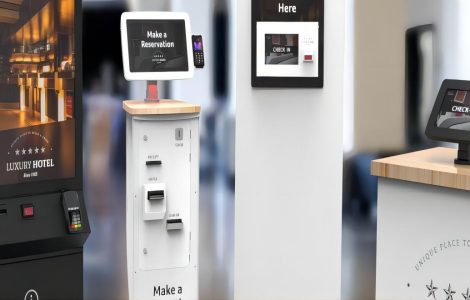 Case Show
Card dispensers for Hotel Self-Check-in Kiosk
READ MORE Knowledge
The RFID system auto-identifies vehicles' weight, calculates net weight, and provides real-time monitoring for optimized efficiency.
READ MOREIf you are interested in our services or need customized solutions, please feel free to contact us.