

Hospitals manage thousands of physical items every day.
Infusion pumps move between departments. Surgical supplies enter and leave operating rooms. Medical consumables are stored across multiple locations. Staff search for wheelchairs, monitors, portable diagnostic equipment, linen, medications, and other resources while maintaining strict operational and documentation requirements.
Many of these workflows still depend on:
RFID can add another layer of automatic identification to these processes.
By attaching an RFID tag to a medical asset, supply package, linen item, container, or other suitable object, healthcare organizations can identify the item electronically without relying exclusively on line-of-sight barcode scanning.
Depending on the RFID technology and system architecture, RFID can support:
The U.S. FDA specifically identifies inventory control, equipment tracking, personnel tracking, medication and medical-device verification, patient monitoring, and electronic medical record-related data as examples of RFID use in healthcare environments.
However, healthcare RFID requires careful system design.
A passive UHF RFID inventory tag is not the same as a real-time location system. A normal RFID tag does not automatically measure temperature. RFID does not replace regulatory device identification requirements, and installing an RFID reader does not automatically make a healthcare workflow compliant with privacy, medical-device, or electromagnetic compatibility requirements.
The correct technology must be selected according to the actual healthcare workflow.
RFID in healthcare refers to the use of radio frequency identification technology to identify and manage physical items, credentials, equipment, supplies, and selected operational events within hospitals and medical organizations.
A healthcare RFID system typically contains:
Different applications may use different RFID technologies.
For example:
There is no single RFID technology that is ideal for every hospital application.
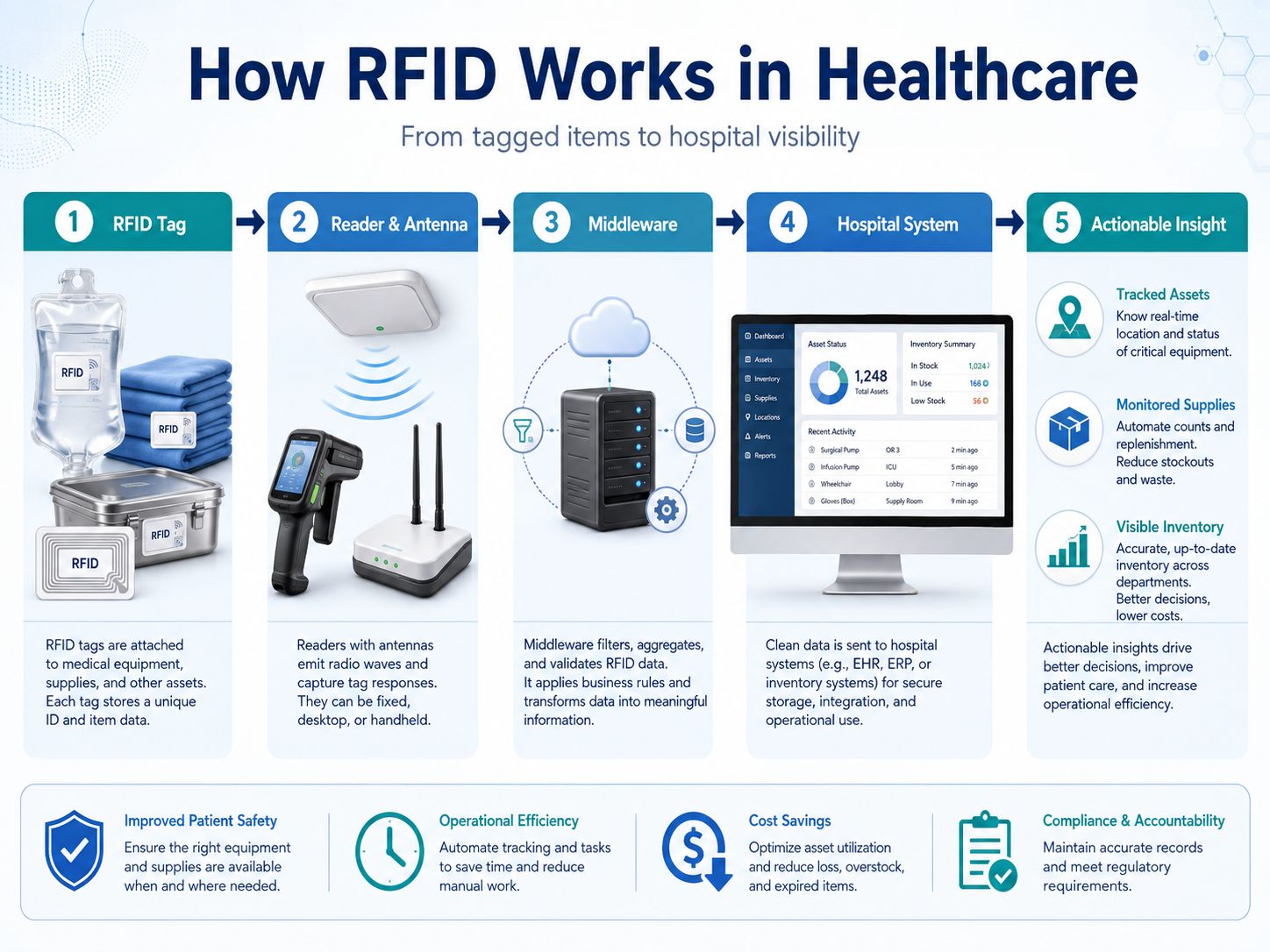
A basic healthcare RFID workflow can be divided into five stages.
The physical item receives a compatible RFID tag.
Examples include:
The tag contains an identifier that connects the physical object with the correct digital record.
For many passive UHF applications, the identifier may be stored in EPC memory while additional chip information is available through TID or other supported memory areas.
The RFID reader communicates with compatible tags.
Readers may be:
The antenna configuration defines the practical RF detection zone.
For example, a healthcare organization may install RFID reading capability at:
Raw RFID data is not automatically useful.
A fixed reader may detect the same tag many times.
Middleware or application logic can:
This converts raw RF events into operational information.
Useful RFID events can then be passed to systems such as:
The exact integration depends on the organization.
The final purpose is not simply to generate tag reads.
RFID should help the organization answer questions such as:
The business action is what creates value from RFID.
RFID is useful when a healthcare workflow contains repetitive identification tasks that can be automated.
Potential benefits include:
Passive UHF RFID can identify multiple compatible tags during one inventory process.
This can reduce the need to scan each visible barcode individually.
Equipment can be associated with departments, storage locations, issue points, or RFID checkpoints.
This can reduce time spent searching for assets.
Because RFID inventory can be faster, staff may be able to check inventory more frequently.
This can help identify discrepancies earlier.
RFID inventory data can be used to create low-stock alerts or replenishment workflows.
Serialized identities can provide better visibility into the movement of selected:
Automated identification can reduce some repetitive manual inventory and recordkeeping tasks.
Healthcare RFID should nevertheless support staff workflows rather than simply adding another disconnected technology layer.
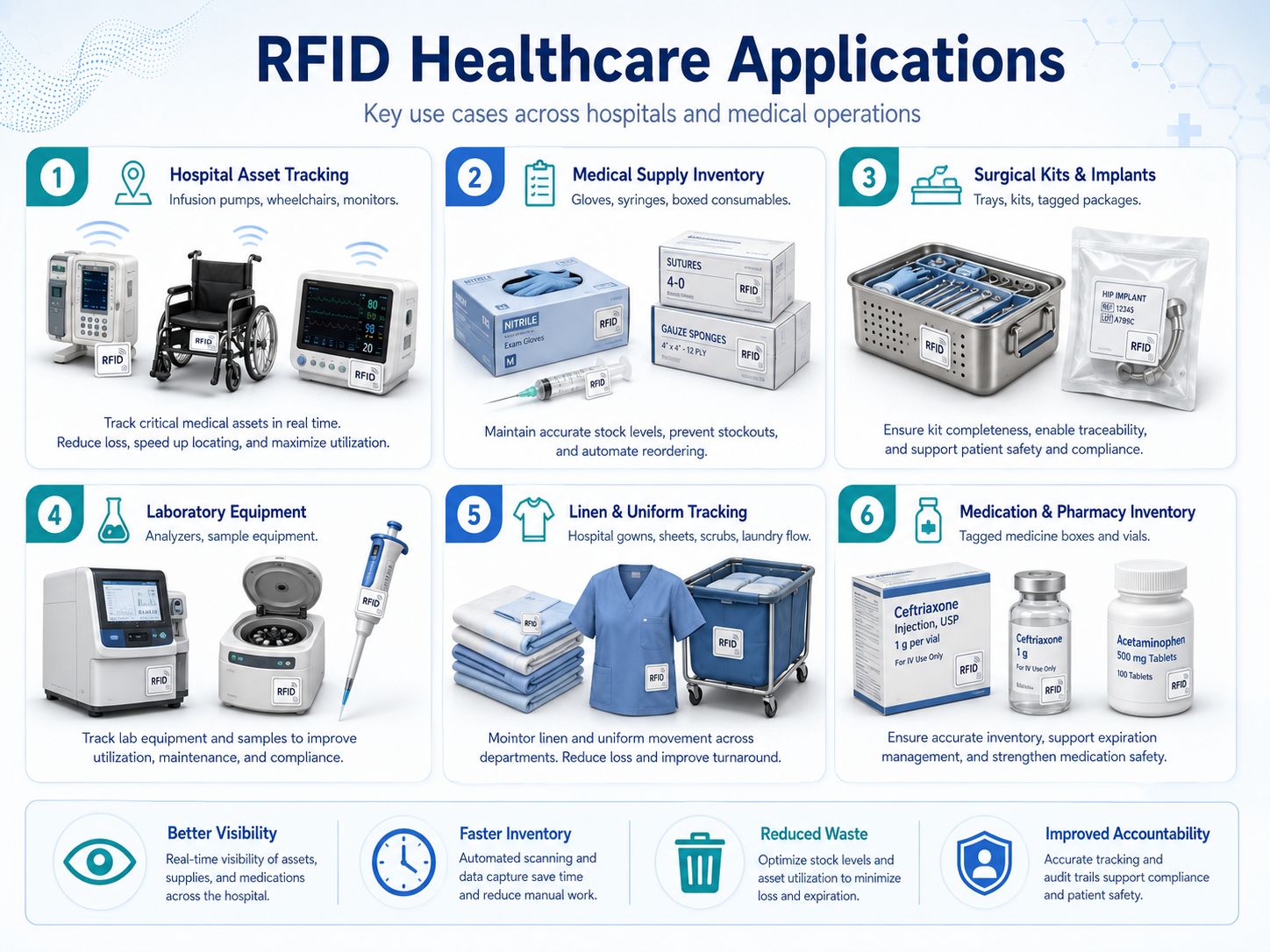
RFID can support many different healthcare operations.
Hospitals manage large numbers of mobile assets, including:
An RFID identifier allows the asset-management system to distinguish one piece of equipment from another.
Depending on reader infrastructure, RFID may help record:
It is important to distinguish this from precise RTLS.
Passive UHF RFID typically provides checkpoint, zone, portal, or inventory visibility rather than continuous room-level coordinates by itself.
If a hospital needs continuously updated real-time positioning, an active RFID, BLE, UWB, Wi-Fi-based RTLS, or another dedicated location architecture may be more appropriate.
Medical supplies can include:
RFID can support:
The value is particularly strong where hospitals manage many high-value items or supplies that must remain continuously available.
Operating rooms consume large quantities of specialized products.
RFID may be used for suitable:
A well-designed system can help answer:
Smart RFID cabinets are particularly relevant to these applications.
RFID can help identify portable or shared laboratory equipment such as:
Possible workflows include:
Laboratory systems requiring direct sample identification must be designed carefully around the sample type, container, workflow, regulatory requirements, and appropriate identification technology.
Hospital textile operations can involve very large numbers of:
Specialized washable UHF RFID tags can remain attached throughout repeated laundry cycles.
A textile workflow may track:
Issue → Use → Collection → Laundry → Sorting → Return → Redistribution
Syncotek's dedicated guide to RFID Laundry Tags explains tag construction, industrial washing, reader infrastructure, and textile tracking in more detail.
Syncotek also offers UHF fabric laundry-tag products designed specifically for repeated industrial washing rather than ordinary paper RFID labels.
RFID can also support selected medication and pharmaceutical inventory processes.
Possible uses include:
However, RFID identification should not be confused with clinical medication decision-making.
A basic RFID tag does not independently determine:
Those decisions depend on clinical systems, medication-management processes, healthcare professionals, and applicable regulations.
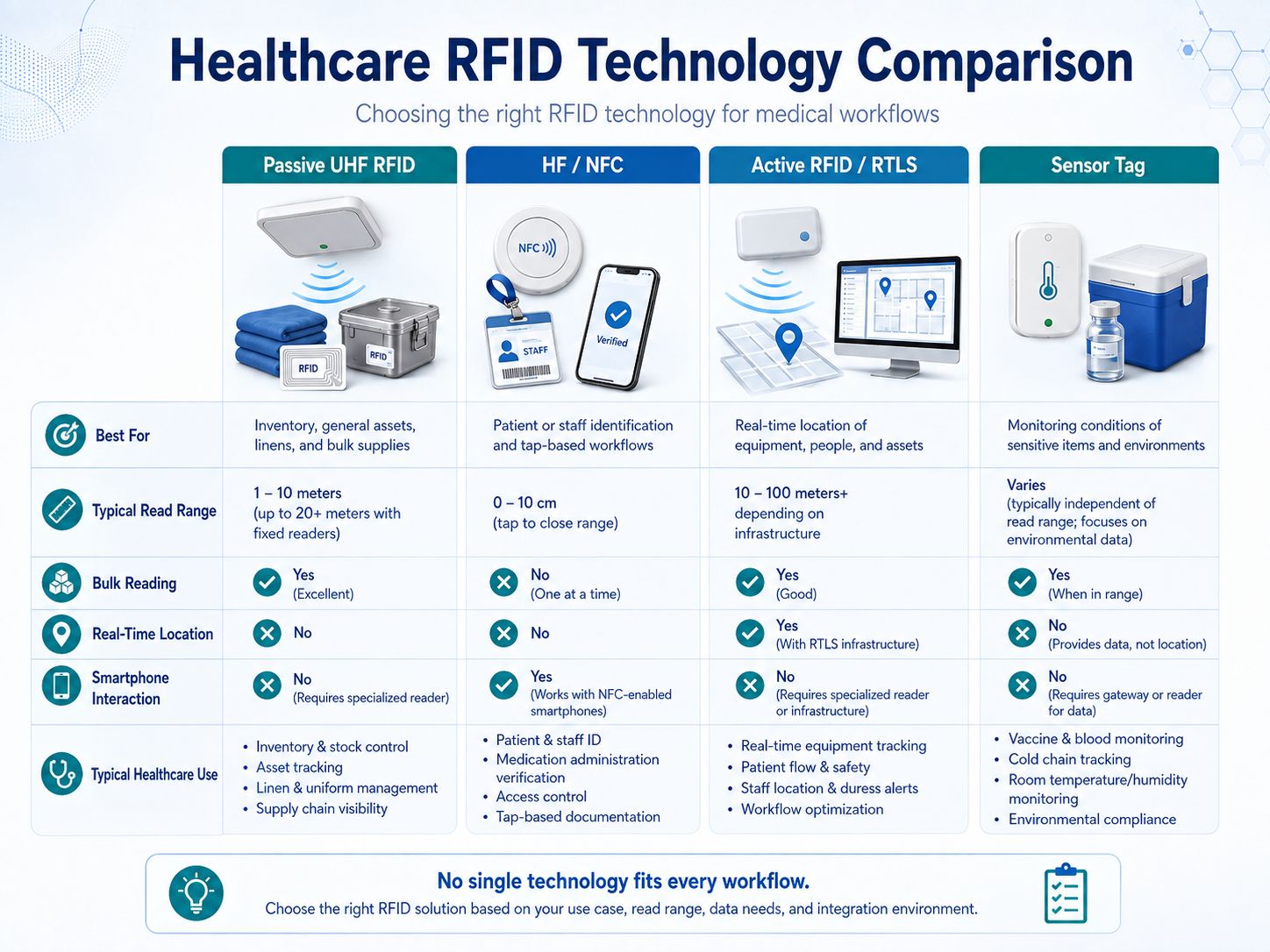
Healthcare organizations often use several different RFID read points rather than one reader covering the entire hospital.
A simplified architecture might include:
Staff use handheld RFID readers to:
Selected equipment may be associated with a department or detected when passing a controlled checkpoint.
RFID cabinets or controlled supply areas can track high-value products.
Tagged inventory can be counted and monitored for replenishment.
Products arriving at the hospital can be verified before being added to inventory.
This creates a sequence of trusted operational events rather than attempting to read every item everywhere at all times.
The term "RFID tracking" is frequently used too broadly.
There are at least two very different objectives.
Passive UHF RFID is strong when the organization wants to know:
This can use:
A true RTLS is designed to determine or estimate the current location of an asset or person continuously or at frequent intervals.
RTLS may use:
Therefore:
Passive UHF RFID asset tracking is not automatically the same thing as RTLS.
The best technology depends on the required location precision, update frequency, battery requirements, infrastructure, and budget.
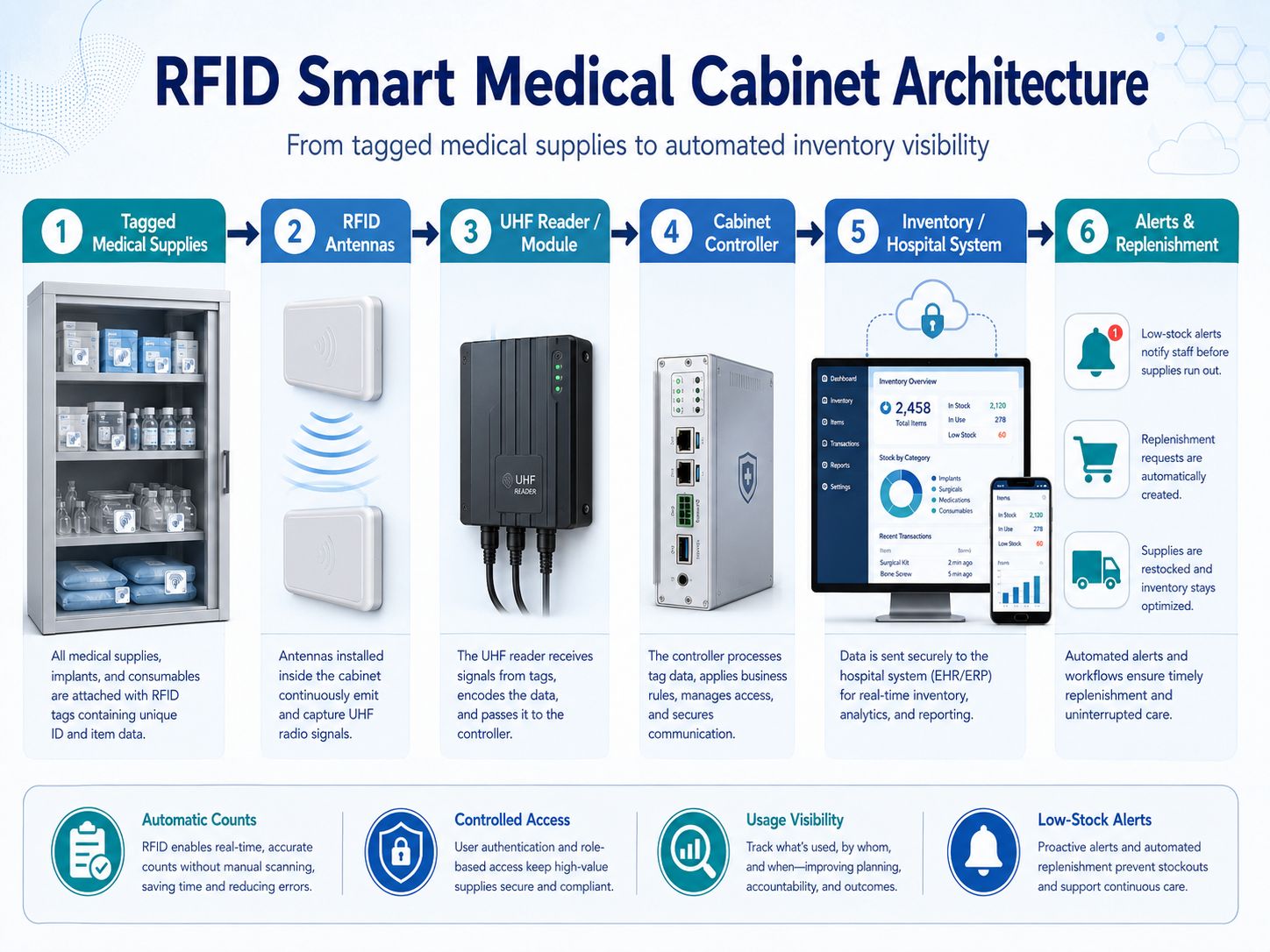
Healthcare RFID systems may combine several frequency bands and technologies.
| Technology | Typical Healthcare Role | Read Behavior | Best Strength |
|---|---|---|---|
| Passive UHF RFID | Supplies, inventory, assets, linen | From short controlled zones to several meters | Fast identification of many items |
| HF / NFC | Staff ID, cards, deliberate tap workflows | Very short range | Controlled intentional interaction |
| Active RFID / RTLS | Equipment or personnel location | Long range with powered tags/infrastructure | Frequent location updates |
| RFID Sensor / Logger | Environmental monitoring | Depends on technology | Captures condition data |
Passive UHF tags do not require a battery for normal communication.
Advantages include:
Typical healthcare use cases include:
HF/NFC operates at shorter range and is suitable when deliberate presentation is desirable.
Applications may include:
The short range can be beneficial where the system should identify one intentional credential rather than many nearby tags.
Active tags contain their own power source.
This allows them to transmit periodically and support architectures designed for:
The tradeoffs include:
A normal RFID tag primarily identifies an item.
If a healthcare organization wants to monitor:
it needs a tag, sensor logger, or device designed specifically for that function.
Do not assume that a standard UHF inventory label measures temperature simply because it uses RFID.
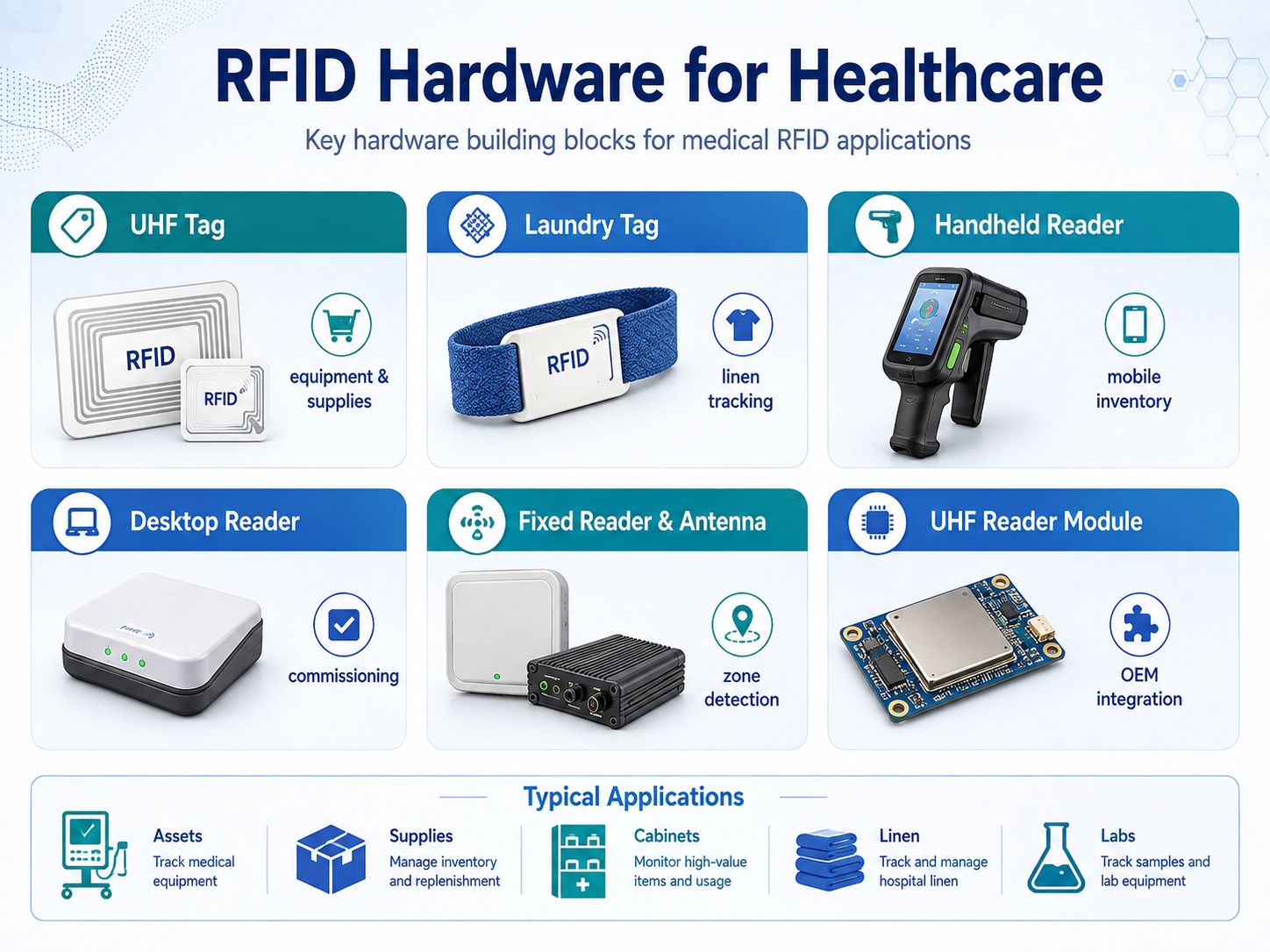
Smart cabinets are one of the strongest examples of RFID automation in healthcare.
RAIN RFID cabinets have been deployed in hospitals to automate management of high-value surgical supplies and improve inventory records while reducing manual administrative work.
A typical RFID smart cabinet includes several layers.
Each suitable product receives an RFID identity.
Examples may include:
The tag must be selected for the product, packaging, required read performance, and applicable healthcare requirements.
Antennas installed inside or around the cabinet create a controlled read zone.
Unlike an open warehouse reader, the objective is normally to identify products inside a specific cabinet while minimizing reads from nearby shelves or adjacent cabinets.
Important factors include:
The reader communicates with the tagged supplies.
A custom smart cabinet may integrate a compact UHF reader module directly into the equipment.
This is especially relevant to OEMs and medical-equipment system integrators.
Syncotek's embedded UHF reader modules are designed for integration into applications including smart cabinets, kiosks, printers, handheld terminals, and custom industrial devices.
The controller can combine RFID events with:
The cabinet can send events to an inventory or hospital supply system.
The software can determine:
Business rules can generate:
RFID provides the identification layer.
The application software determines what should happen after an item is detected.
"Surgical instrument RFID" can describe several very different applications.
For example:
An RFID label may be attached to the packaging rather than the instrument.
The tray or container may be tagged to identify the complete kit.
This is much more demanding.
Individual surgical instruments may undergo:
A standard adhesive UHF label is generally not appropriate for such conditions.
Instrument-level tagging requires RFID products specifically designed and validated for the required sterilization environment, attachment method, materials, and medical workflow.
Do not select an RFID tag based only on frequency or claimed read range.
Hospital textiles represent a very different RFID environment.
A laundry tag needs to survive:
A conventional RFID smart label would normally not survive these processes.
Specialized textile tags can be:
RFID can then support:
For large hospitals and outsourced laundries, RFID can create item-level visibility across thousands of reusable textile items.
Healthcare RFID should also be understood in relation to the Unique Device Identification system.
In the United States, FDA UDI requirements generally require applicable device labelers to include a UDI on labels and packages and provide it in:
FDA defines AIDC broadly as a technology that conveys the UDI or device identifier so it can be entered into an electronic record or computer system through an automated process.
The key distinction is:
RFID does not automatically replace the required UDI implementation.
A healthcare RFID project must separately evaluate:
Barcode and 2D Data Matrix remain extremely important in healthcare.
RFID can complement those identifiers by adding capabilities such as:
UDI is not only a manufacturing-label issue.
FDA emphasizes that capturing UDI information in electronic health information can improve device identification, recall management, postmarket surveillance, and patient safety.
As of April 23, 2026, FDA also notes that CMS proposed a Promoting Interoperability measure under which eligible hospitals would attest whether they use certified EHR technology to capture the complete UDI for implantable medical devices subject to UDI requirements. This is a proposal rather than a universal finalized RFID requirement, but it demonstrates the growing importance of reliable medical-device identity inside hospital information systems.
RFID can participate in automated identification workflows, but system integrators must still ensure that the correct required identifiers are captured and exchanged.
Healthcare organizations generally should not frame RFID and barcode as an either/or decision.
They perform different functions.
| Factor | Barcode / 2D Code | RFID |
|---|---|---|
| Reading method | Optical | Radio frequency |
| Line of sight | Required | Usually not required |
| One-at-a-time confirmation | Excellent | Possible |
| Bulk inventory | Limited | Strong with UHF |
| Smartphone compatibility | Strong for QR | Depends on RFID technology |
| Cost | Low | Higher |
| Automated cabinets | Limited | Strong use case |
| Item location/checkpoints | Manual scan | Can be automated |
| Printed human-readable data | Easy | Usually combined with printed label |
A hybrid healthcare workflow may use:
UDI / DataMatrix for point-of-use confirmation
and
RFID for inventory automation
This allows each technology to perform the task it is best suited for.
RFID can also be used in patient-related workflows, but the architecture requires greater privacy and safety consideration.
Potential forms include:
Possible uses include:
Patient identity should normally be connected with a secure backend rather than placing unnecessary sensitive personal information directly into an openly readable RFID tag.
These two concepts should also be separated.
Answers:
Who is this credential associated with?
HF/NFC or another controlled technology may be appropriate.
Answers:
Where is this person?
This typically requires RTLS infrastructure rather than simply issuing a passive RFID wristband.
Any patient-tracking system must also consider:
Healthcare data is sensitive.
RFID system design should therefore follow data-minimization principles.
Instead of placing a patient's complete information directly on a tag, a healthcare system can use:
RFID Identifier
↓
Secure Backend Record
The system can then apply:
RFID technology by itself should not be described as "HIPAA compliant."
Compliance depends on the complete information system, organizational policies, implementation, security controls, and applicable legal requirements.
RFID reader deployment in healthcare requires another consideration that may be less important in a normal warehouse:
electromagnetic compatibility, or EMC.
RFID readers are RF transmitters.
The FDA states that although it is not aware of adverse events associated with RFID, there is concern about potential electromagnetic interference with electronic medical devices such as pacemakers, implantable cardioverter defibrillators, and other equipment.
FDA therefore recommends healthcare facilities assess and manage their electromagnetic environment, including radio transmitters and critical medical-device areas.
FDA also currently recognizes an AIM consensus standard addressing assessment of electromagnetic immunity of medical electrical equipment and systems to RFID readers.
For an RFID project near sensitive medical equipment, system integrators should evaluate:
Maximum reader power should not automatically be used everywhere.
Use the RF level necessary to create the required read zone.
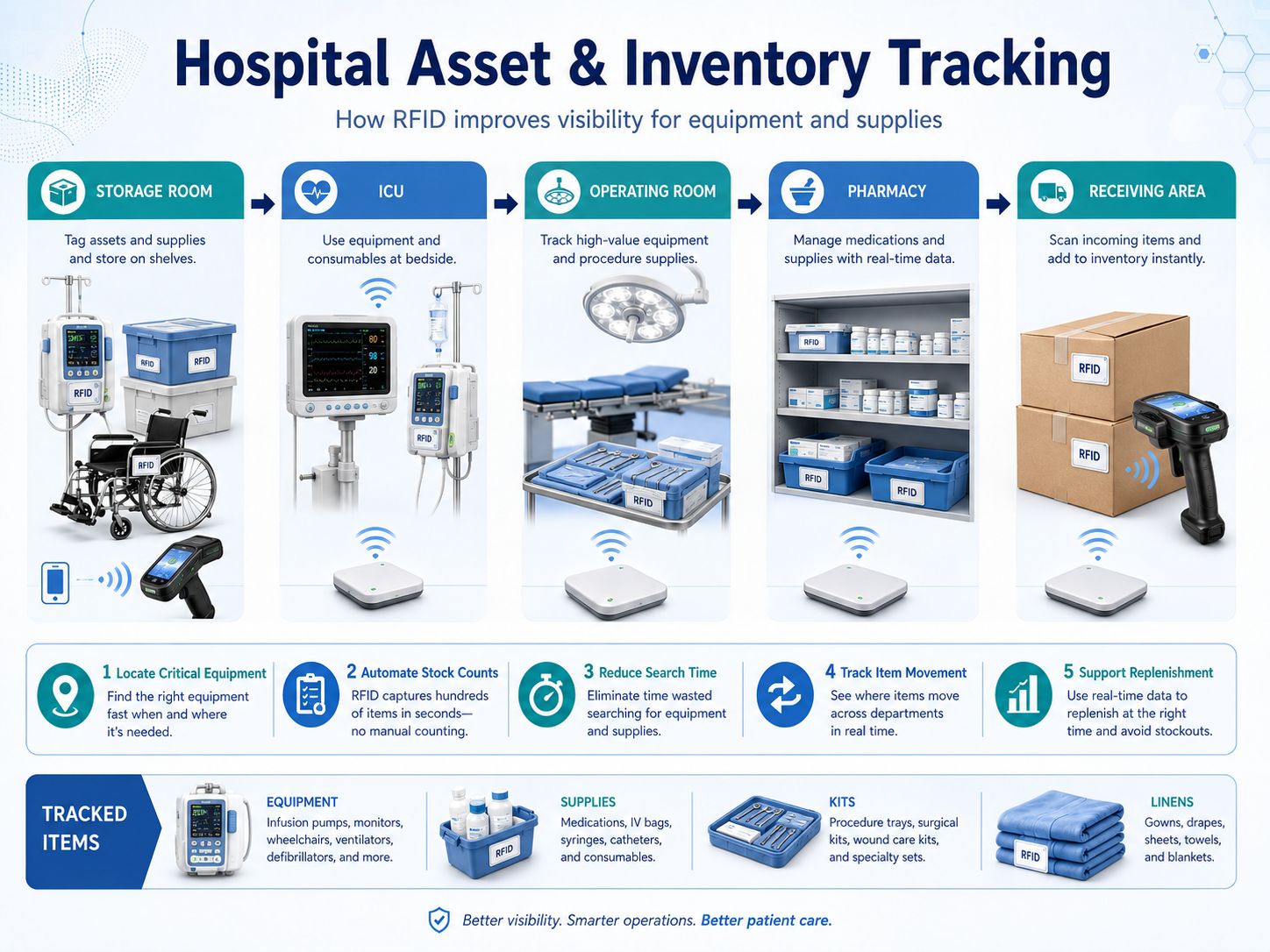
A healthcare RFID system can use several hardware types depending on the workflow.
UHF tags can identify:
Tag selection must consider:
For rugged equipment, a paper label may not be appropriate.
Syncotek provides industrial UHF tag formats with options designed for asset and on-metal applications.
Specialized tags can support:
The selected tag must be validated for the required wash process and textile application.
Handheld readers are useful for:
A handheld is often an effective way to start an RFID pilot because it does not require fixed infrastructure throughout the facility.
Desktop readers can support:
They may be used at:
Fixed readers can automate identification at:
The antenna architecture should be designed around a defined zone.
A healthcare installation generally benefits more from a precise read zone than from the longest possible advertised distance.
Reader modules are particularly relevant to OEM equipment developers.
A compact UHF module can be embedded into:
Syncotek's UHF modules are designed for OEM integration and support EPC C1G2 / ISO 18000-6C architectures across different antenna-port configurations.
This allows the system integrator to build RFID capability directly into the finished healthcare equipment instead of mounting a separate external reader.
Healthcare tag selection should start with the physical object and environment.
Is it:
Tag performance changes with material.
A disposable supply package may only need a low-cost label.
A reusable asset may require a durable hard tag.
If yes, identify the exact process.
Examples may include:
Do not assume an industrial tag automatically survives a medical sterilization process.
Metal can detune conventional UHF labels.
Use an appropriate mount-on-metal RFID tag or another tested tag design.
Liquids can reduce UHF performance.
Test the tag on the actual product in realistic storage conditions.
Do not simply maximize range.
Define whether the workflow requires:
Match the tag construction to:
Applications involving higher-value or sensitive items may require stronger control over:
Passive UHF provides excellent inventory and checkpoint identification but does not automatically provide continuous real-time coordinates.
Tag construction must match the actual sterilization process.
Both can significantly affect UHF performance.
Test on real medical products.
RFID identification and UDI compliance are separate design considerations.
Use secure backend architecture and data minimization.
Excessive power can create:
Tune the system for the required zone.
Healthcare contains sensitive electronic equipment.
RF reader placement and power need to be evaluated appropriately.
Inventory, patient cards, RTLS, and temperature monitoring may require different technologies.
First determine:
Then select hardware.
Before deploying a healthcare RFID system, confirm:
RFID in healthcare is the use of radio frequency identification to identify and manage medical assets, supplies, linen, credentials, and selected operational events.
Common applications include equipment tracking, supply inventory, smart cabinets, hospital linen, receiving, replenishment, staff identification, and selected patient or RTLS workflows.
Yes. Passive UHF RFID can support equipment inventory and checkpoint or zone visibility. More precise continuous location normally requires a dedicated RTLS architecture.
RFID-related technologies can support patient identification and location applications, but patient tracking generally requires an appropriate RTLS architecture plus privacy, security, and clinical workflow controls.
Healthcare can use several technologies. Passive UHF is common for inventory and assets, HF/NFC for short-range identification, and active RFID or other RTLS technologies for real-time location.
Yes, particularly for inventory, supplies, linen, equipment identification, and automated cabinets when properly engineered.
Yes, but the tag must match the workflow. Instruments exposed to sterilization require specialized tags validated for the required temperature, chemicals, pressure, attachment, and medical process.
Do not assume they can. A tag must be specifically designed and tested for the applicable sterilization cycle.
Washable RFID tags can identify individual linen and uniform items throughout collection, washing, sorting, storage, and redistribution.
RFID can identify serialized inventory and support software that monitors expiration information where the relevant data is correctly associated with each item or batch.
They solve different problems. Barcode and DataMatrix are excellent for deliberate point-of-use identification, while UHF RFID can automate inventory and bulk data capture. Hybrid systems often make sense.
No. RFID should not automatically be treated as a replacement for medical-device UDI requirements. Applicable regulatory and AIDC requirements must be evaluated separately.
RFID is widely used in healthcare, but RF transmitters can create electromagnetic compatibility concerns with certain electronic medical devices. Reader power, antenna location, medical-device guidance, and applicable EMC standards should be evaluated.
No. Standard identification tags do not automatically measure temperature. Temperature monitoring requires a sensor-enabled RFID tag, data logger, or another dedicated sensing device.
Depending on the application, a system may include RFID tags, handheld readers, fixed readers, antennas, desktop readers, embedded reader modules, middleware, and inventory or healthcare software.
Tagged supplies are detected by RFID antennas connected to a reader or embedded module. Software determines which products are present or removed and can update inventory, create alerts, and trigger replenishment.
Syncotek provides RFID hardware for healthcare system integrators, medical-equipment OEMs, smart-cabinet manufacturers, inventory solution providers, laundries, and organizations developing automatic-identification systems.
The Syncotek RFID portfolio includes:
These components can support the physical identification and data-capture layer for applications such as:
Syncotek does not replace a hospital information system, clinical platform, UDI compliance program, or RTLS software platform. Instead, our RFID hardware can provide the reader, tag, antenna, and embedded module infrastructure required to capture physical-item identities and pass them into the appropriate application.
Explore the complete Syncotek RFID product portfolio or review our RFID readers, modules, antennas and tags for your healthcare RFID integration project.
 Knowledge
Rental businesses depend on the same assets moving repeatedly between warehouses, customers, job sites, service areas, vehicles, and return stations. This continuous movement creates a difficult inventory-management problem. A rental company may own the correct number of assets but still be unable to answer basic operational questions: Which items are available right now? Which customer […]
READ MORE Knowledge
UHF RFID systems use radio waves to communicate between readers, antennas, and passive RFID tags. In a small installation with one reader, radio-frequency interference may be relatively easy to control. In a warehouse, factory, retail store, distribution center, or event venue with several readers operating at the same time, the RF environment becomes more complicated. […]
READ MORE Uncategorized
Businesses often know what assets they own but cannot always answer a more urgent question: Where are those assets right now? A hospital may need to locate a mobile medical device. A factory may need to find a tool, container, forklift, or work-in-process item. A warehouse may need to know whether a pallet has entered […]
READ MORE Knowledge
A modern data center may contain thousands of physical IT assets distributed across: rooms cages rows racks storage areas staging zones repair areas multiple facilities Servers, switches, storage appliances and network equipment are also moved, upgraded, replaced and decommissioned throughout their lifecycle. The challenge is not simply knowing how many devices the organization purchased. Data […]
READ MORE Knowledge
Large events require thousands of physical interactions to happen accurately and quickly. Attendees must receive valid credentials, enter through the correct gates, access the areas included in their ticket, attend sessions, purchase food or merchandise, interact with sponsors, and leave the venue safely. At the same time, organizers need visibility into: ticket validation attendee arrival […]
READ MOREIf you are interested in our services or need customized solutions, please feel free to contact us.