

Retail inventory changes constantly.
Products arrive from distribution centers, move from stockrooms to sales floors, are picked for online orders, transferred between locations, returned by customers, purchased in stores, misplaced, or occasionally lost.
Traditional inventory systems can record these transactions, but the digital record is only useful when it accurately reflects what is physically present.
This is where RFID retail inventory management can create significant operational value.
By attaching a unique RFID tag to individual products, retailers can identify items using radio frequency rather than scanning every barcode one by one. Handheld and fixed RFID readers can capture tagged items in stores, stockrooms, receiving areas, fulfillment zones, and other defined read points.
The result is a more dynamic view of inventory that can support:
For retailers, RFID is not simply a faster method of counting products. A well-designed RFID system connects physical merchandise with inventory software so teams can make better operational decisions based on more current item-level data.
RFID retail inventory management uses RFID tags, readers, antennas, and software to identify and manage individual products throughout retail operations.
A typical UHF RFID system includes:
Each RFID tag normally contains a unique electronic identifier.
Instead of simply knowing that a store should have 20 units of a product, RFID can help the system distinguish individual tagged items and record when those products are received, counted, moved, picked, returned, or sold.
This creates item-level visibility.
For example, a retailer may know that:
The value comes from connecting the physical status of each item with the retailer's digital inventory system.
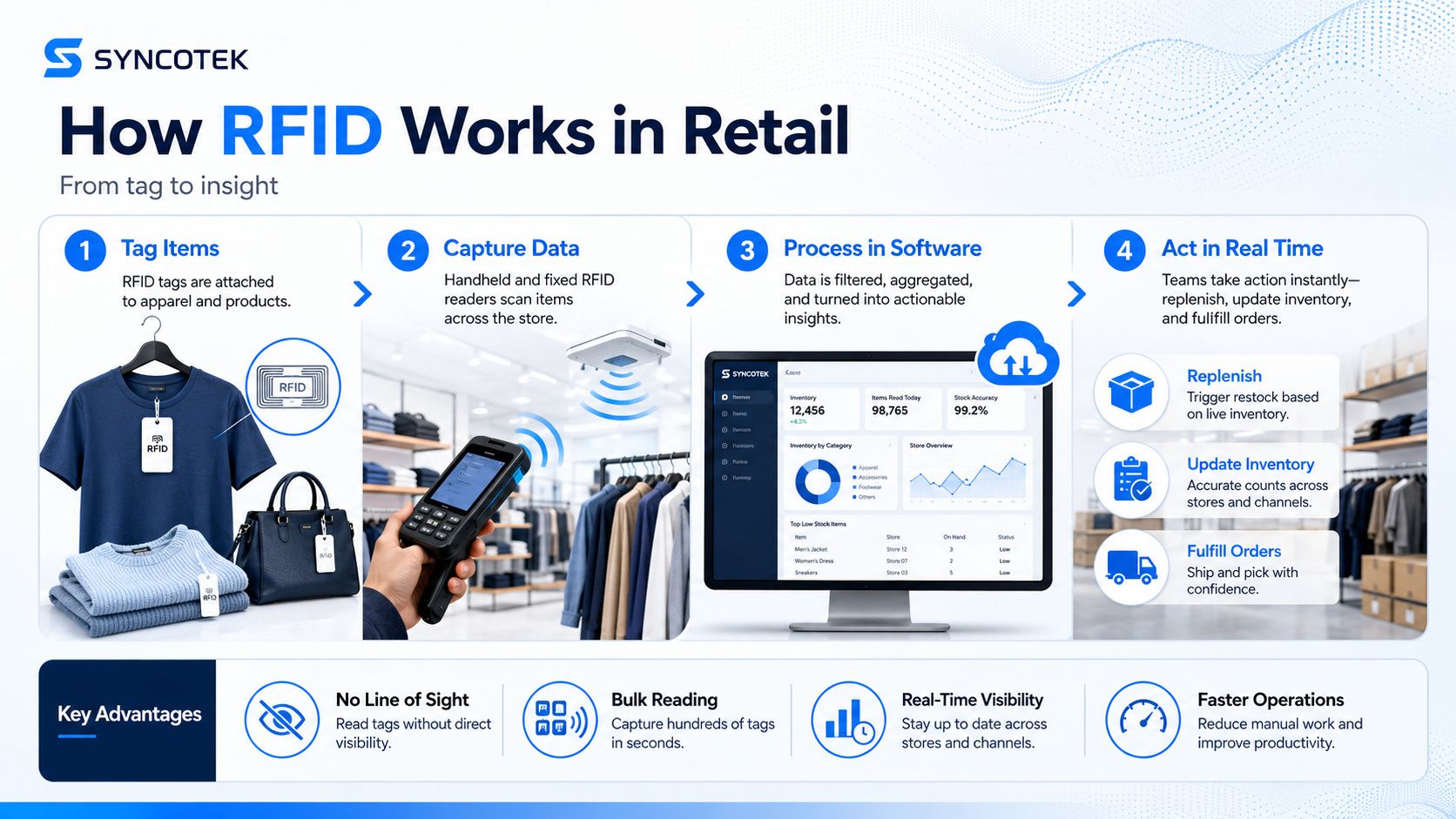
A retail RFID workflow can be understood in four main stages.
RFID tags can be attached during manufacturing, packaging, distribution, or store receiving.
Common retail tag formats include:
The RFID tag is associated with the product record, such as SKU, GTIN, style, size, color, or serial number.
For a detailed explanation of the different constructions, see Syncotek's guide to RFID inlays, tags, and labels.
RFID readers identify tags within their configured read zone.
A handheld reader can be used by store employees for:
Fixed readers can be installed at locations such as:
Unlike barcode scanning, RFID usually does not require the operator to visually locate and scan every individual label.
Raw RFID reads must be converted into useful business events.
Middleware or application software can:
This step is essential because simply collecting thousands of RFID tag reads does not automatically create a useful inventory system.
Once RFID data reaches the retail system, it can trigger actions such as:
RFID becomes valuable when identification data leads directly to an operational decision.
Retail inventory problems often result from a gap between system inventory and physical inventory.
A system may indicate that a product is available even though it is:
This can affect both store operations and ecommerce.
For example, an online customer may order an item because the website shows one unit available. If the item cannot actually be found in the store, the order may need to be cancelled.
RFID helps reduce this gap by allowing inventory to be checked more frequently and at item level.
Better visibility can support:
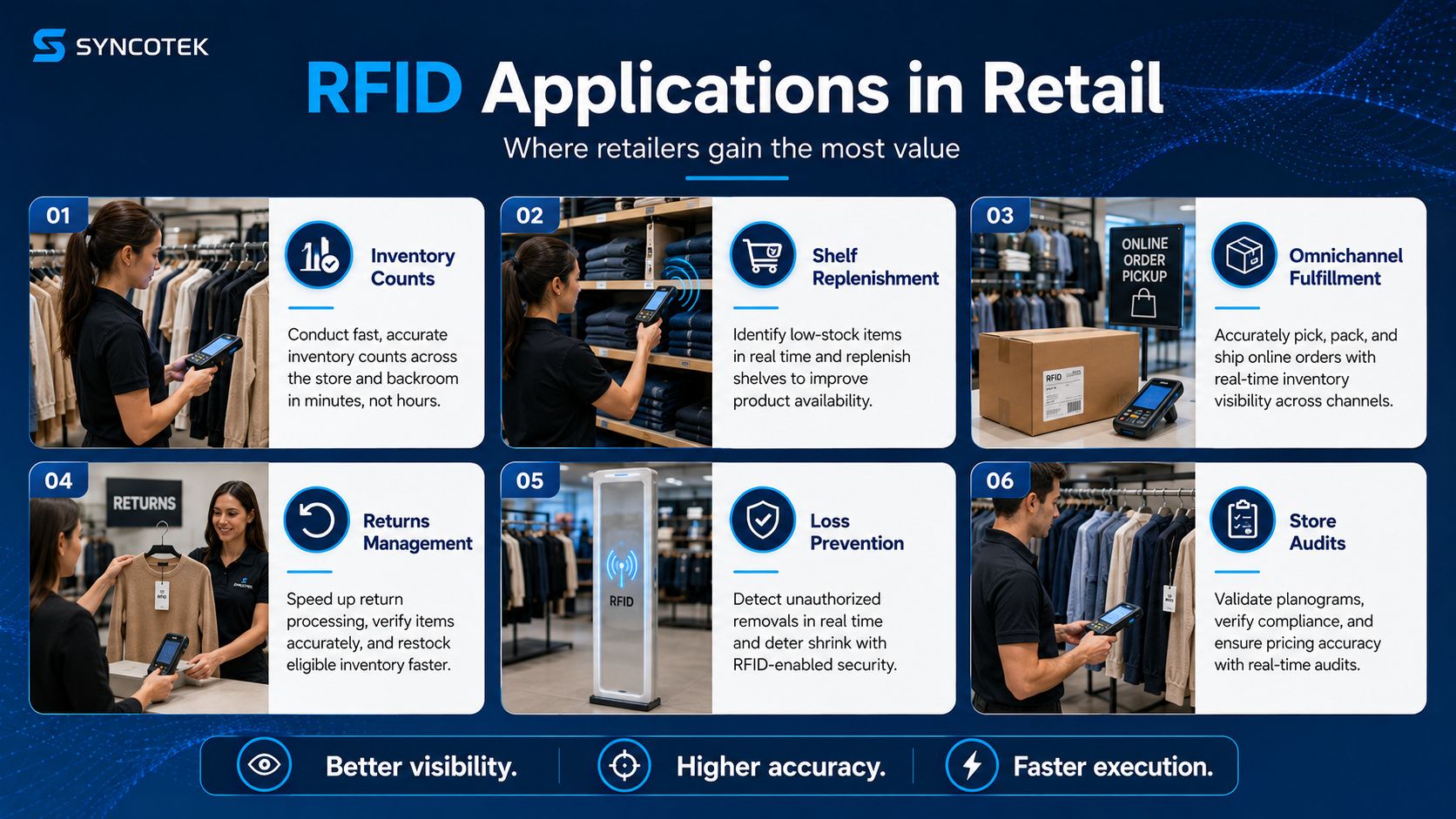
RFID can support multiple processes throughout the retail lifecycle.
One of the most common retail RFID applications is cycle counting.
Employees can walk through the store or stockroom with a handheld RFID reader and capture many tagged products without scanning every visible barcode individually.
This makes it practical to perform inventory counts more frequently.
More frequent counts can help identify discrepancies earlier instead of waiting for a monthly, quarterly, or annual physical inventory.
A retailer may have inventory in the store but still experience an empty shelf because products remain in the stockroom.
RFID can help identify this situation by connecting stockroom inventory with sales-floor visibility.
The system can generate replenishment tasks when:
This helps move available products closer to customers.
Finding one specific style, size, color, or serialized item can take considerable time.
A handheld RFID reader can help staff search for a particular tag by providing feedback as the operator moves closer to the item.
This can be useful for:
Modern retail inventory may serve both physical and digital channels.
The same store may handle:
These workflows depend heavily on accurate inventory.
RFID can improve confidence that the product shown as available in a particular location can actually be found and fulfilled.
For a broader overview of inventory RFID, see Syncotek's guide to RFID inventory management and tracking.
RFID can be used when merchandise arrives at a store or distribution location.
Tagged cartons or items can be compared against expected shipment records to identify:
This can improve the quality of inventory data before products even reach the sales floor.
Customer returns create another inventory-status transition.
RFID can help identify the exact returned item and connect it with the product record.
The retailer can then determine whether the item should be:
RFID should not automatically make every returned product immediately available. The software should apply the retailer's condition and inspection rules.
RFID can also support loss-prevention workflows.
When item-level RFID identification is connected with controlled store exits or other detection zones, the system may help identify unexpected product movement.
RFID data can also help retailers analyze:
RFID should be considered part of a broader loss-prevention strategy rather than a replacement for all security technologies.
RFID can support operational audits such as:
Faster data collection can allow stores to conduct smaller audits more frequently.
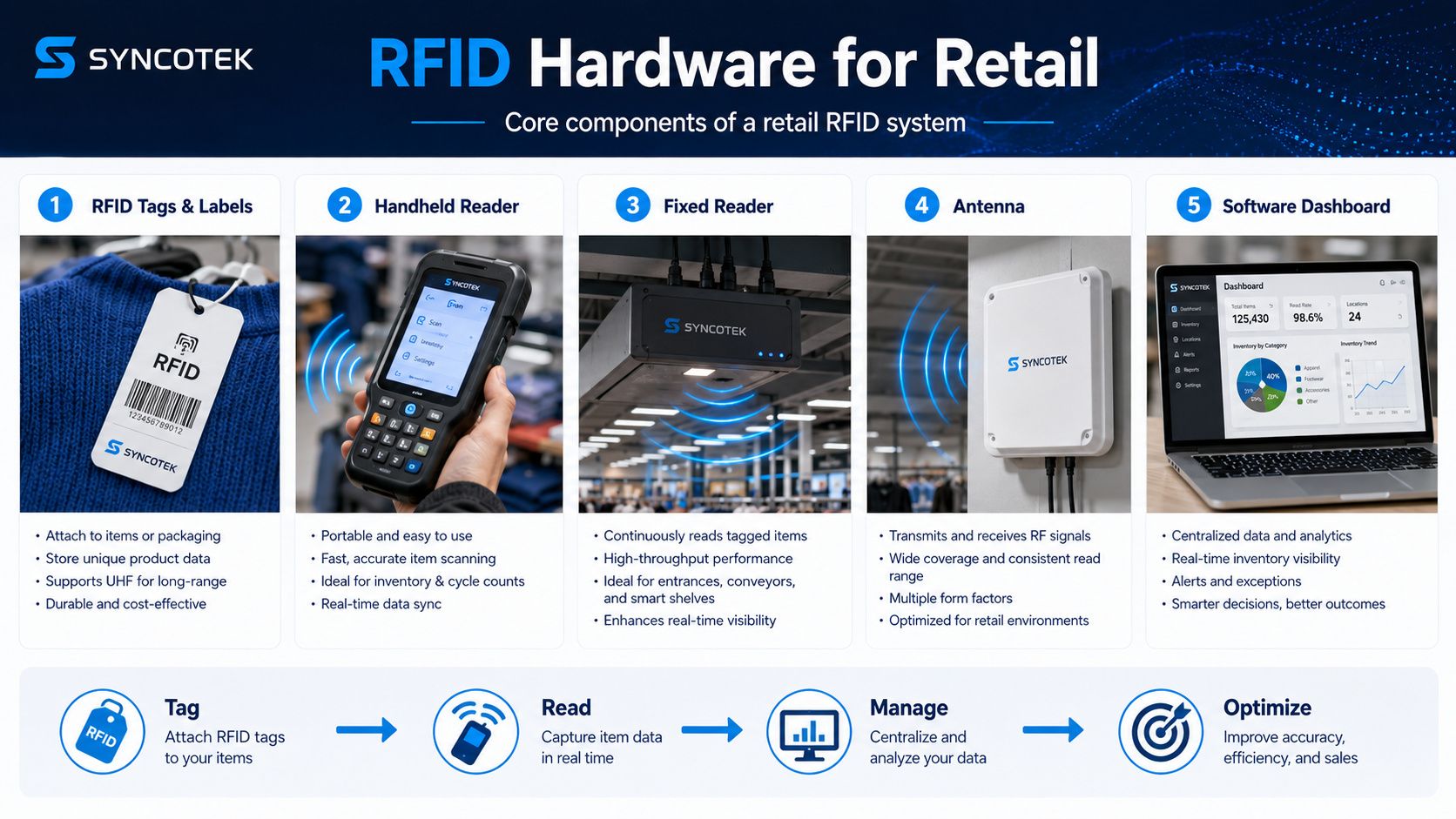
The correct hardware architecture depends on the retailer's workflow.
A small store may only need RFID tags and handheld readers, while a larger deployment may combine handheld devices with fixed infrastructure.
The RFID tag must match the product and operating environment.
Important factors include:
Apparel is well suited to UHF RFID because clothing generally does not create the same RF challenges as metal or liquid-filled products.
Common formats include:
Jewelry, cosmetics, accessories, and other small products may require compact tag designs.
Smaller tags can have different read-performance characteristics, so tag size should not be selected only for appearance.
Standard UHF labels can perform poorly when placed directly on metal.
Products such as:
may require specialized RFID tag designs.
For these applications, review Syncotek's guide to mount-on-metal RFID tags.
Handheld RFID readers are commonly the easiest entry point for retail deployments.
They are suitable for:
Advantages include:
Handheld systems are especially useful during pilot projects because they allow retailers to validate tagging and inventory processes before installing larger fixed systems.
Fixed readers automate data capture at predefined locations.
They can support:
Fixed RFID reduces the need for employees to manually initiate every read, but read-zone design becomes more important.
A poorly controlled reader may capture items that are physically nearby but not actually moving through the intended process.
The antenna determines where RF energy is transmitted and where tag responses can be received.
Retail antenna selection should consider:
Maximum read range is not always desirable.
A doorway reader should identify items passing through that doorway without repeatedly capturing merchandise on nearby racks.
For more information, see Syncotek's guide on how to select an RFID antenna.
RFID hardware must communicate with the systems that operate the retail business.
Potential integrations include:
Software integration may be more important than the reader itself because this determines how RFID events change business records.
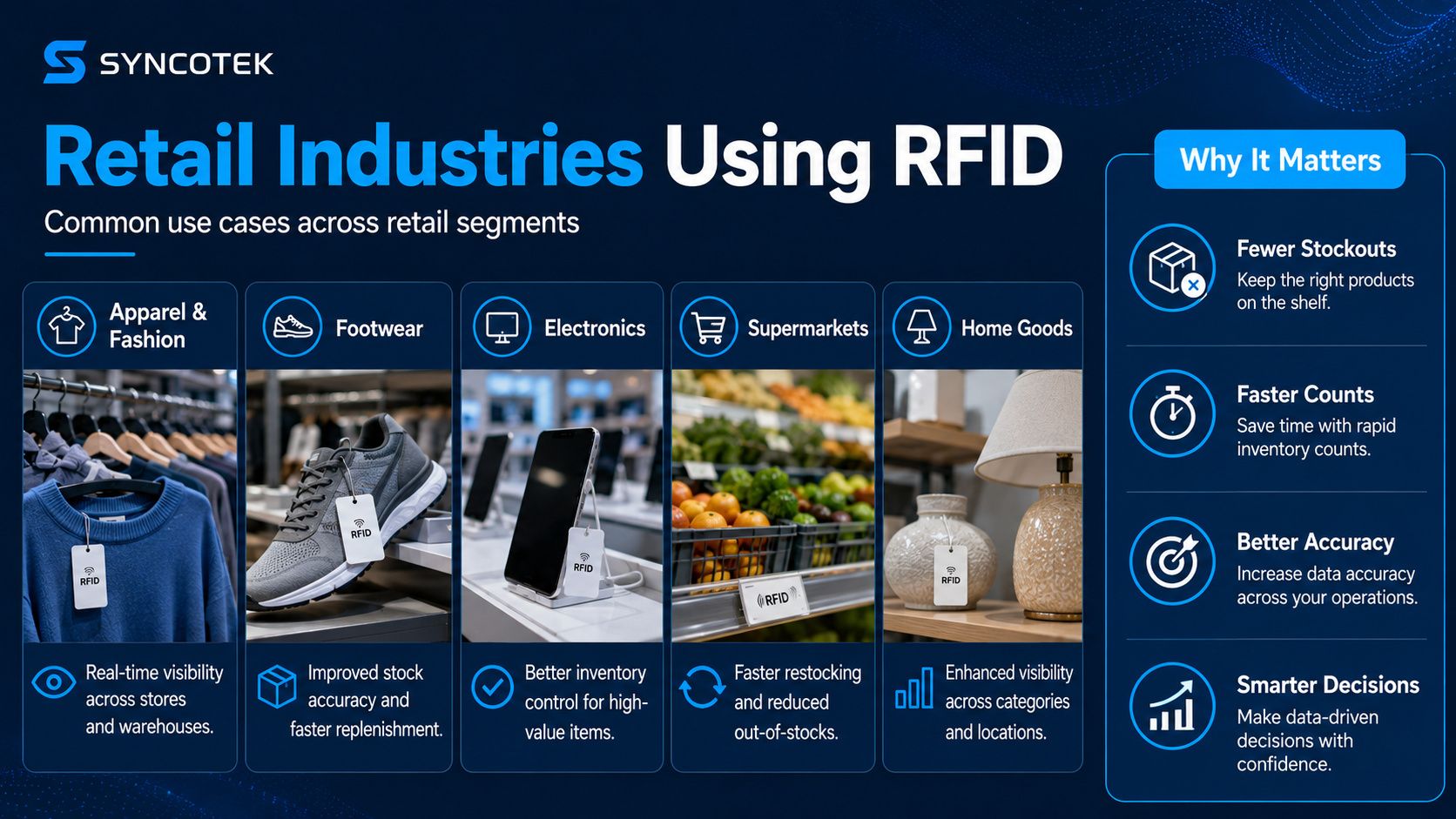
RFID can be applied across many retail categories, but the tag design and workflow should be adapted to the product.
Typical applications include:
Apparel remains one of the most natural environments for passive UHF RFID.
Shoes can be tracked individually or by box.
RFID can help distinguish:
RFID can support:
Metal inside electronic products can affect tag performance, so testing is essential.
Potential RFID applications include:
Food and beverages often contain liquids, which can affect UHF RFID performance. Tag placement must therefore be validated carefully.
Retailers may use RFID for:
Product materials vary significantly, so one RFID label may not be suitable for every category.
Cosmetics can be attractive RFID candidates because stores often manage large numbers of small SKUs.
However, products containing liquids, metalized packaging, or compact containers may require specialized tag designs.
Barcodes remain extremely important in retail.
RFID does not have to replace them.
The two technologies can work together.
| Factor | RFID | Barcode |
|---|---|---|
| Reading method | Radio frequency | Optical |
| Line of sight | Usually not required | Required |
| Items per read | Multiple tags possible | Usually one code at a time |
| Label cost | Higher | Lower |
| Inventory counting | Very efficient | More manual |
| POS compatibility | Depends on system | Extremely widespread |
| Item locating | Strong with suitable software | Limited |
| Mobile interaction | Limited | QR and 2D codes are strong |
| Best role | Inventory visibility and automation | Product identification and transactional scanning |
A retailer may use:
The best system does not necessarily use one identification technology everywhere.
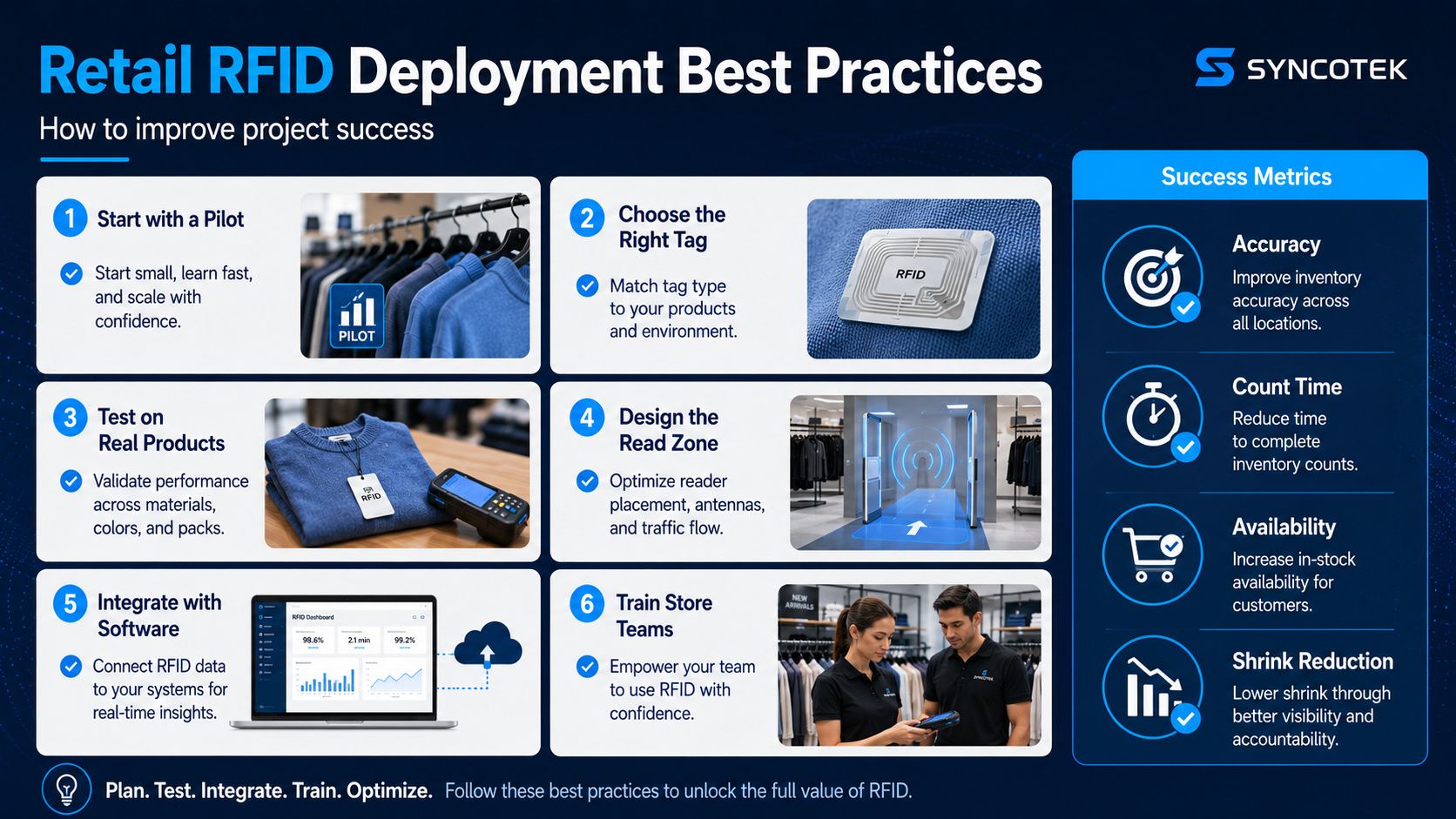
Successful RFID deployment requires more than attaching tags and purchasing readers.
Good RFID projects begin with measurable questions such as:
Defining the problem makes it easier to measure whether RFID creates value.
Avoid deploying RFID across every store and product category before testing.
A pilot can focus on:
The purpose is to validate:
Do not test only empty RFID labels in open air.
Test tags on:
Different materials can dramatically change UHF performance.
Consistent tag placement improves read performance.
If tags are positioned randomly, orientation and product interaction can make inventory results less predictable.
Document where each product category should be tagged.
For fixed readers, define exactly where a tag should generate an event.
Adjust:
Do not automatically use maximum reader power.
The goal is reliable reads inside the target zone, not the largest possible RF field.
The system should define what happens when RFID detects an item.
Examples:
Receiving read → Add item to store inventory
Shelf inventory falls → Generate replenishment task
Online order created → Locate and reserve item
Return received → Move item to inspection status
Unexpected exit → Generate exception event
The business rules are what turn RFID into an inventory-management system.
Store employees must understand:
Technology that increases workload or confuses employees is unlikely to produce the expected result.
Retailers can compare before-and-after results such as:
These metrics make it easier to decide whether the project should expand.
RFID tags can perform differently on:
Choose the tag based on the actual product.
A fixed reader may capture tags from outside the desired zone.
Possible controls include:
A fixed RFID reader may detect the same tag many times.
Middleware should convert repeated raw reads into meaningful events.
RFID cannot correct an incorrect product database.
If the tag is associated with the wrong SKU, the system will simply capture incorrect information more efficiently.
Serialization and tag-data management should therefore be controlled carefully.
Staff need clear workflows.
If employees continue using old inventory procedures while RFID operates separately, the retailer may create two conflicting inventory systems.
Not every part of the store needs fixed RFID infrastructure.
Handheld readers may be enough for some processes.
Install fixed readers only where automated capture creates measurable operational value.
A successful system should make physical inventory easier to understand and easier to act on.
Store teams should be able to answer questions such as:
The technology should become part of the normal retail workflow rather than a separate RFID project.
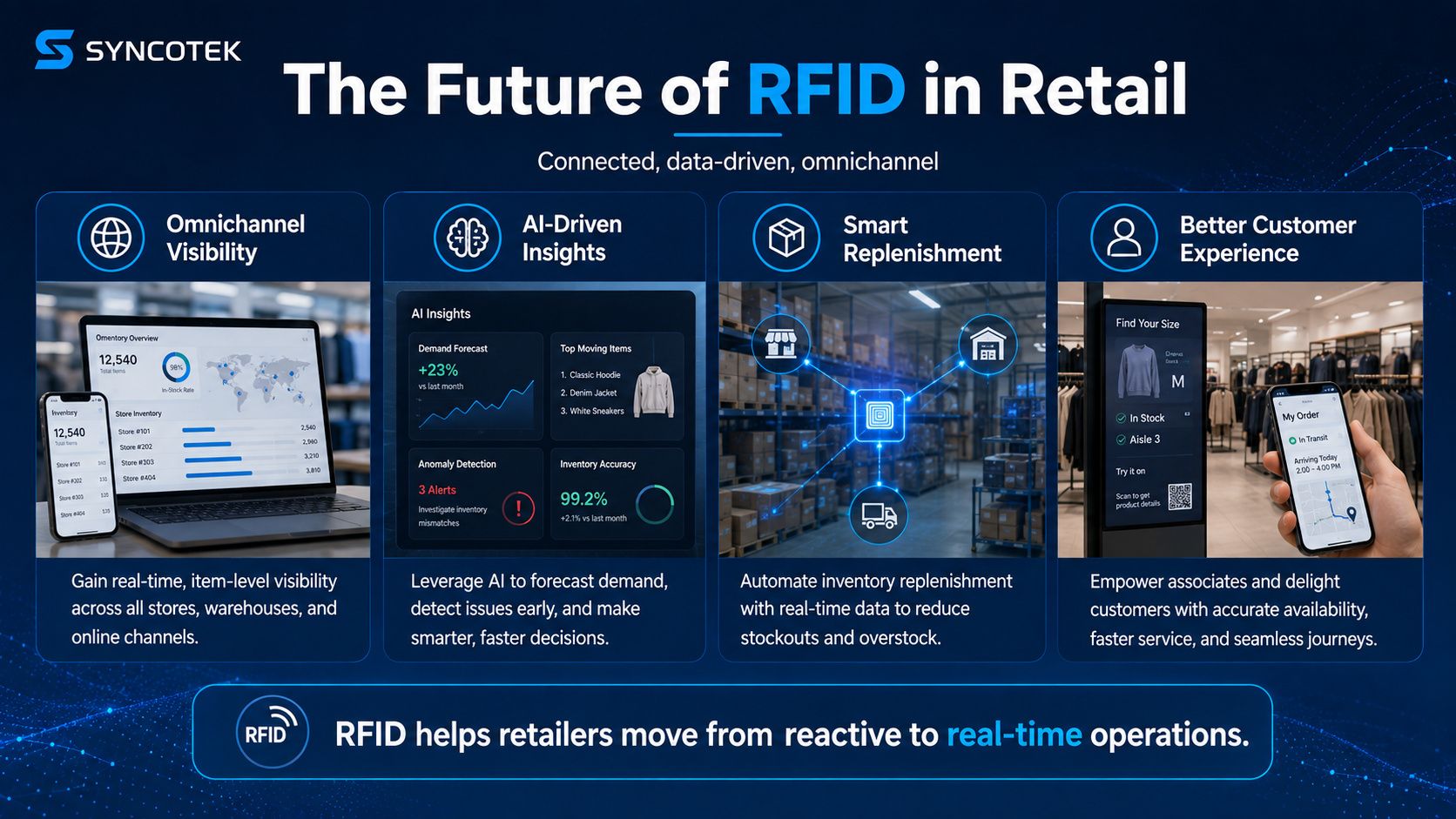
The next stage of retail RFID is less about simply counting tags and more about using item-level data throughout the business.
Retailers increasingly manage inventory as a shared network across:
RFID can provide more frequent physical inventory data to support this model.
RFID inventory events can be combined with sales history and demand forecasting to improve replenishment decisions.
Instead of waiting until a shelf is visibly empty, software can identify low availability earlier.
RFID provides structured physical-world data that can be analyzed alongside:
AI and analytics can use this information to identify anomalies, forecast demand, and prioritize store tasks.
RFID does not create the intelligence by itself. It improves the underlying data available to these systems.
Reliable inventory data can improve customer-facing services such as:
The customer may never interact directly with RFID, but the improved inventory visibility can still improve the shopping experience.
Before selecting hardware, define:
For tag encoding and setup, an RFID reader and writer can also be useful for sample validation, tag registration, and controlled programming.
Before scaling the system, confirm:
RFID retail inventory management gives retailers a practical way to connect individual physical products with digital inventory records.
The technology can support much more than occasional stock counting.
A complete retail RFID system can improve:
However, the success of the system depends on the complete deployment.
Retailers should evaluate the tag, product material, reader type, antenna configuration, read zone, software integration, employee workflow, and business rules together.
The goal is not simply to read more RFID tags.
The goal is to create more accurate, timely, and actionable inventory information that improves retail operations.
RFID retail inventory management uses RFID tags, readers, antennas, and software to identify individual products and maintain more current item-level inventory information.
RFID can identify many tagged products without individually scanning each visible barcode, making inventory counts faster and allowing stores to perform counts more frequently.
Yes. When each product receives a unique serialized RFID identifier, the system can manage inventory at item level rather than only by SKU quantity.
RFID is particularly useful for bulk inventory counting, item locating, and automated data capture. Barcodes remain valuable for POS, customer interaction, and low-cost identification. Many retailers use both.
Normally no. UHF RFID readers use radio waves and can detect compatible tags without visually seeing the printed RFID label.
Passive UHF RFID is widely used for item-level retail inventory because it supports relatively long read ranges and fast reading of multiple tags.
RFID can help retailers identify stock discrepancies and products that are available in the stockroom but missing from the sales floor, allowing faster replenishment.
Yes. More accurate store inventory can support click-and-collect, ship-from-store, same-day delivery, and other omnichannel fulfillment workflows.
Handheld readers are ideal for inventory counts, item searching, and mobile operations. Fixed readers are useful when automated detection is required at specific locations. Many systems use both.
UHF RFID hang tags, adhesive labels, and embedded apparel tags are common. The correct format depends on garment construction, branding, attachment requirements, and supply-chain workflow.
Yes, but standard RFID labels may perform poorly directly on metal. Specialized on-metal tags should be evaluated for these applications.
RFID can support loss-prevention and exception-detection workflows, but it should be integrated with the retailer's wider security strategy.
Yes. RFID reads normally need middleware or application software to associate tag IDs with products, remove duplicate reads, update inventory, and trigger retail workflows.
Start with a specific inventory problem, select a limited product group or store for a pilot, test tags on real products, validate reader performance, integrate software, measure results, and scale only after the workflow is proven.
Syncotek provides RFID readers, UHF reader modules, handheld terminals, antennas, RFID tags, desktop reader-writers, and related hardware for retail inventory, warehousing, asset management, logistics, and system integration.
Whether you are planning a handheld inventory-counting system, store receiving solution, fixed RFID portal, smart retail device, or OEM RFID integration project, Syncotek can help evaluate suitable hardware based on:
Explore Syncotek's complete RFID products to build a retail inventory solution around your actual workflow.
 Knowledge
To read RFID means to use an RFID reader to detect a tag and retrieve data stored on it (an ID, EPC, UID, or user memory). With passive tags, the reader also provides the RF energy the tag needs to respond. The “how” depends on the RFID type: NFC / HF (13.56 MHz): very short-range […]
READ MORE Knowledge
In an RFID system, most attention is usually placed on tags, readers, and antennas. However, cables, connectors, and adapters also play an important role in system performance. A well-selected RFID antenna cable helps transfer RF energy from the reader to the antenna with lower loss, while the right connector ensures a secure and compatible connection […]
READ MORE Knowledge
Retail inventory changes constantly. Products arrive from distribution centers, move from stockrooms to sales floors, are picked for online orders, transferred between locations, returned by customers, purchased in stores, misplaced, or occasionally lost. Traditional inventory systems can record these transactions, but the digital record is only useful when it accurately reflects what is physically present. […]
READ MORE Knowledge
What is load modulation? Load modulation is the method most HF RFID (13.56 MHz) and NFC tags use to send data back to a reader in the near field. Instead of actively transmitting RF power, the tag switches an electrical load (often a resistor or transistor network) across its antenna coil. That change in tag current is coupled back through mutual inductance and becomes a […]
READ MORE Uncategorized
Businesses often know what assets they own but cannot always answer a more urgent question: Where are those assets right now? A hospital may need to locate a mobile medical device. A factory may need to find a tool, container, forklift, or work-in-process item. A warehouse may need to know whether a pallet has entered […]
READ MOREIf you are interested in our services or need customized solutions, please feel free to contact us.