
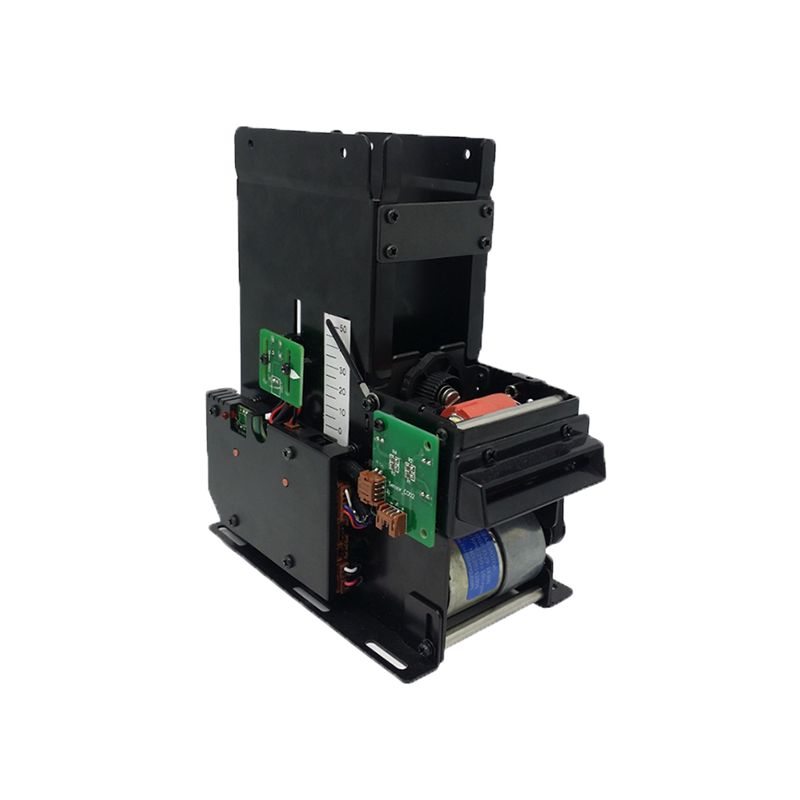
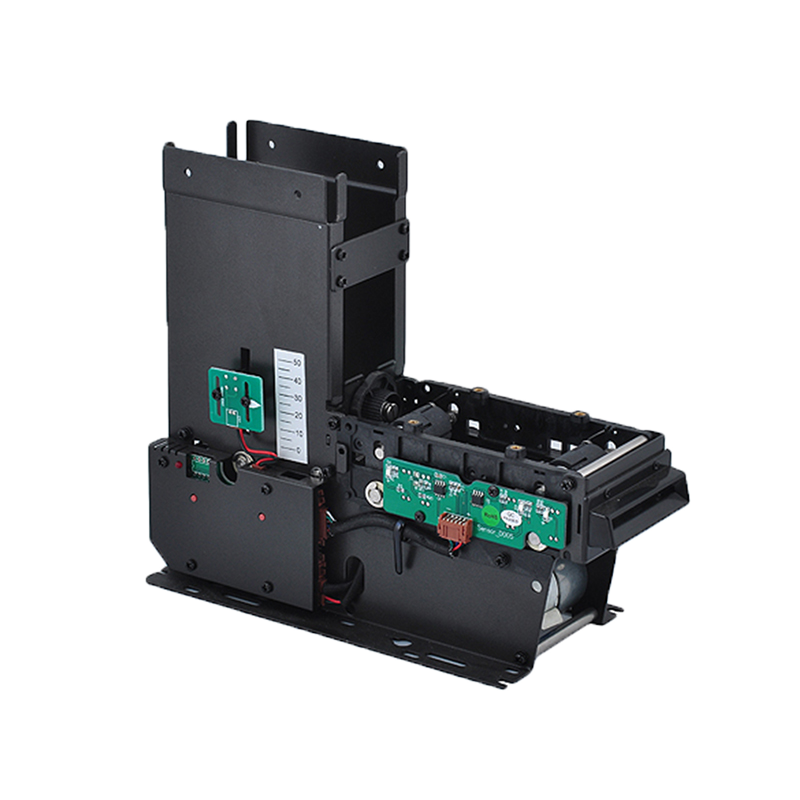

Industrial laundries, hospitals, hotels, uniform rental companies, nursing facilities, and textile service providers process large volumes of garments and linens every day.
These textile items move continuously between customers, collection points, sorting areas, washing machines, dryers, ironing systems, storage rooms, and distribution vehicles. Without reliable identification, it can be difficult to know how many items are in circulation, where each item is located, how many times it has been washed, or when it should be repaired or replaced.
RFID laundry tags provide each textile item with a unique digital identity. Once attached to a garment, towel, bedsheet, uniform, or other washable textile, the tag can be detected by compatible RFID readers throughout the laundry process.
Unlike ordinary apparel labels, laundry RFID tags are designed to tolerate repeated exposure to water, detergents, heat, pressure, bending, and mechanical handling. Commercial products are available in UHF, HF, and LF versions, with attachment formats including sew-in, pouch-mounted, and heat-sealable designs.
For Syncotek RFID projects, laundry tags should be selected as part of a complete textile management system that includes tags, readers, antennas, software, installation design, and operational workflow.
RFID laundry tags (rfid clothing tags) are durable electronic identification tags designed to remain attached to textile items during repeated commercial washing and finishing processes.
Each tag normally contains:
The RFID chip stores an identification code. When the textile passes through an RFID read zone, the reader captures that code and connects it with the corresponding textile record in the laundry management system.
That record may include:
An RFID laundry tag is therefore not simply a washable label. It is the physical connection between an individual textile item and its digital lifecycle record.
For a broader explanation of how RFID product formats differ, see Syncotek’s guide to RFID inlays, tags, and labels.
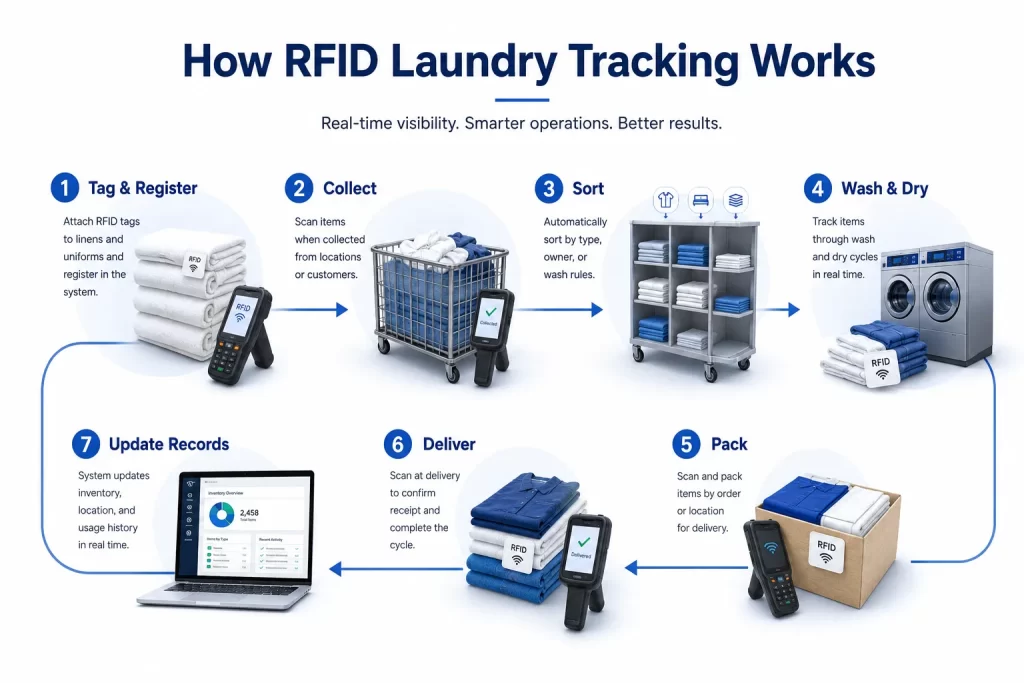
A typical RFID laundry management process includes six main stages.
Each garment or linen item receives an RFID laundry tag. The tag is registered in the software and linked to the item’s information.
For example, the database may identify the item as:
Tagged textiles are collected from customers, hospital departments, hotel rooms, factories, restaurants, or other facilities.
An RFID reading station can identify incoming items in bulk and record:
RFID data can help route textiles according to customer, fabric type, color, washing program, contamination level, or delivery destination.
The system may support sorting by:
RFID readers installed at key process points can record movement through:
Commercial RFID laundry systems can provide visibility throughout washing, sorting, distribution, transportation, and customer-site operations.
Before textiles are returned, RFID can verify that the correct items and quantities have been assigned to the correct customer or department.
This can reduce:
Every RFID reading event can update the item’s digital history, including location, process status, wash count, repair information, and customer assignment.
Over time, the data provides a complete view of the textile’s operational lifecycle.
Barcode systems normally require individual line-of-sight scanning. RFID can identify multiple textile items without visually locating every label.
This is particularly useful when processing:
UHF RFID systems are commonly selected when laundries need faster bulk reading and automated movement tracking.
Laundry companies often manage textiles distributed across several locations:
RFID helps businesses understand:
This provides a more accurate foundation for textile purchasing and allocation.
Textiles can be lost through incorrect sorting, delivery errors, internal movement, customer misuse, or poor return control.
RFID provides last-seen information and movement history, helping operators investigate where an item was last recorded.
Better traceability can help reduce:
Once an RFID tag is linked with customer and textile data, sorting systems can use that information to route items automatically.
For example, RFID can help separate:
Automated sorting reduces manual handling and supports higher throughput.
Laundry RFID systems can record how often each textile has been processed.
Wash-cycle data can help determine:
This supports lifecycle-based replacement rather than replacing textiles only when they visibly fail.
Industrial laundries may charge customers according to:
RFID can create more reliable transaction records and reduce disputes about the number of items collected, processed, or delivered.
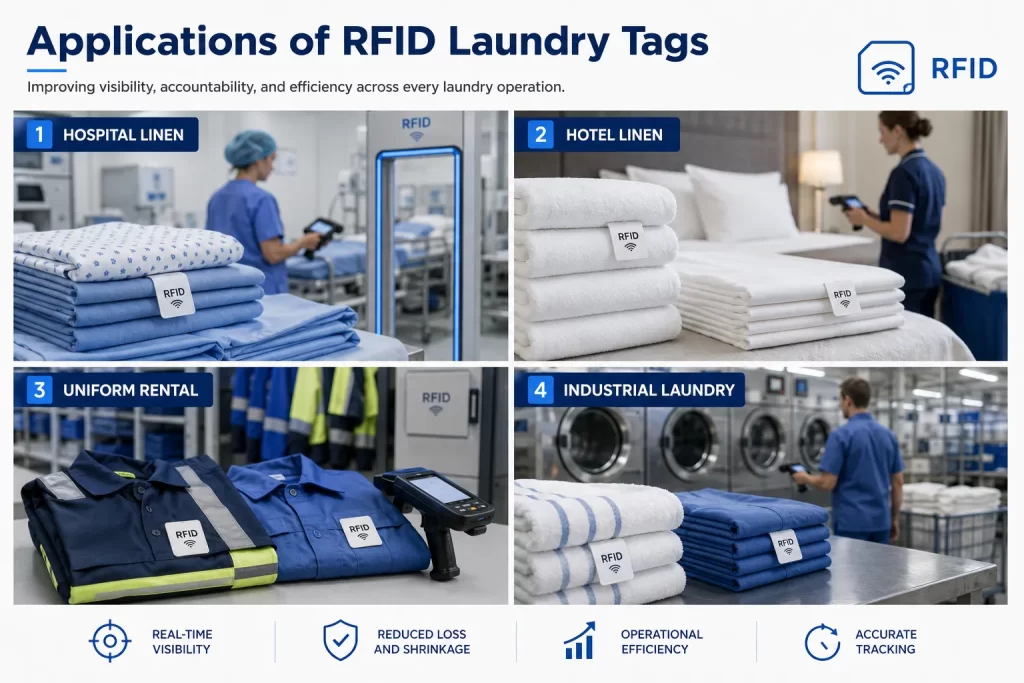
Hospitals manage large volumes of bedsheets, blankets, patient gowns, staff uniforms, surgical textiles, and reusable protective items.
RFID can help track:
Hospital environments may also require tags specifically evaluated for medical use. Some UHF textile tags are offered with MR-conditional designs for environments where compatibility with magnetic resonance procedures matters.
Hotels need a continuous supply of clean:
RFID can improve visibility between guestrooms, housekeeping, storage rooms, external laundries, and delivery areas.
It helps hotel operators understand:
Uniform rental and workwear service companies need to ensure that each employee receives the correct garments.
RFID can link uniforms with:
This is useful for:
RFID helps prevent garments from being delivered to the wrong employee or customer.
Care facilities often manage personal clothing in addition to institutional linen.
RFID can identify privately owned garments and reduce the risk of clothing being mixed between residents.
The system can connect each item with:
Restaurants, catering companies, and event venues use reusable tablecloths, napkins, chef uniforms, aprons, and cleaning textiles.
RFID can support quantity control, customer sorting, delivery verification, and textile loss analysis.
Cleanroom garments may require strict control over washing, use, inspection, and replacement.
RFID can help manage:
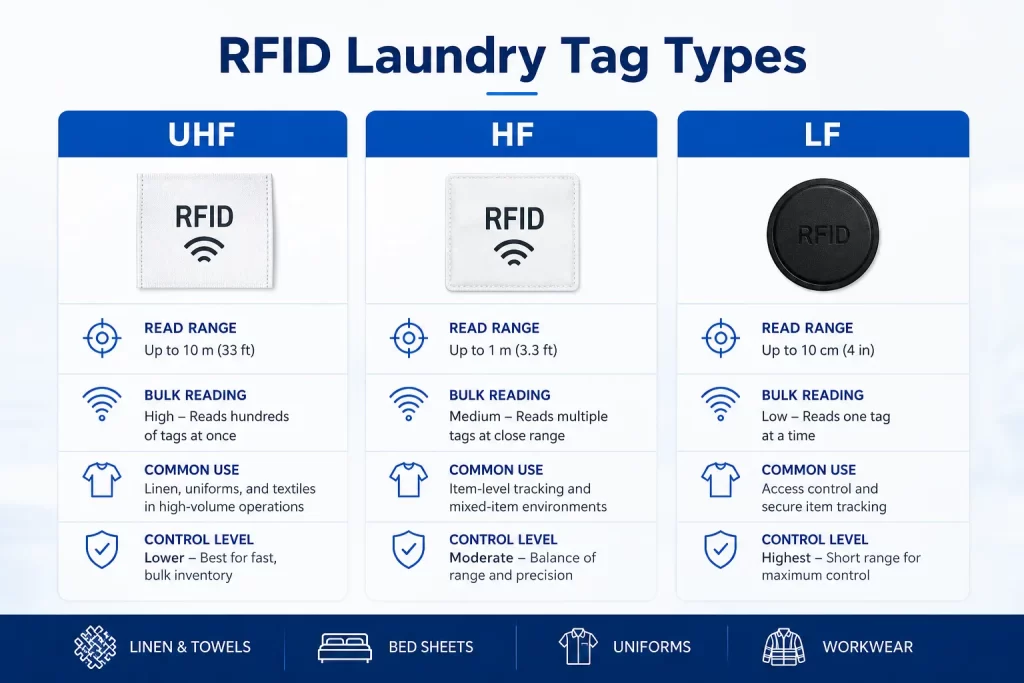
Laundry tags can be categorized by frequency, construction, and attachment method.
UHF laundry tags typically operate within regional UHF bands and often follow EPC Class 1 Gen 2 or ISO 18000-63 protocols.
Some commercial UHF textile tags are specified for up to 200 commercial washing cycles, while particular models list read ranges of up to approximately 5 meters under suitable conditions. These figures are model-specific and should not be treated as universal performance guarantees.
HF laundry tags commonly operate at 13.56 MHz. They may follow ISO 15693 or ISO 18000-3-related protocols.
A commercial HF laundry tag example from HID is specified to withstand 300 commercial washing cycles, illustrating that wash-cycle durability varies significantly by tag design and model.
LF technology has a long history in industrial textile identification and can still be used in established laundry systems.
The best frequency is determined by the existing system, required read distance, processing speed, tag size, and automation strategy.
Datamars lists UHF, HF, and LF textile transponders as part of current textile-identification solutions, confirming that multiple technologies remain relevant across different laundry installations.
Sew-in tags are stitched directly into a garment, linen hem, pocket, or fabric label.
Heat-sealable tags attach to the textile through a controlled heat and pressure process.
Heat-sealable UHF textile tags are available in compact formats designed for direct attachment to textiles.
Some RFID transponders are enclosed in a fabric pouch or textile housing and then sewn into the item.
The housing can help:
Rigid or button-style RFID tags may be used when small, highly protected transponders are required.
They can be suitable for:
However, rigid tags may be less comfortable in lightweight garments or bedding, so placement must be evaluated carefully.
A standard RFID label is not designed for industrial laundering.
Laundry tags must tolerate combinations of:
Official textile-tag product specifications commonly emphasize water, chemical, heat, and pressure resistance, but the exact limits differ by model.
This is why tag selection must be based on the actual laundry process rather than on a generic “washable” claim.
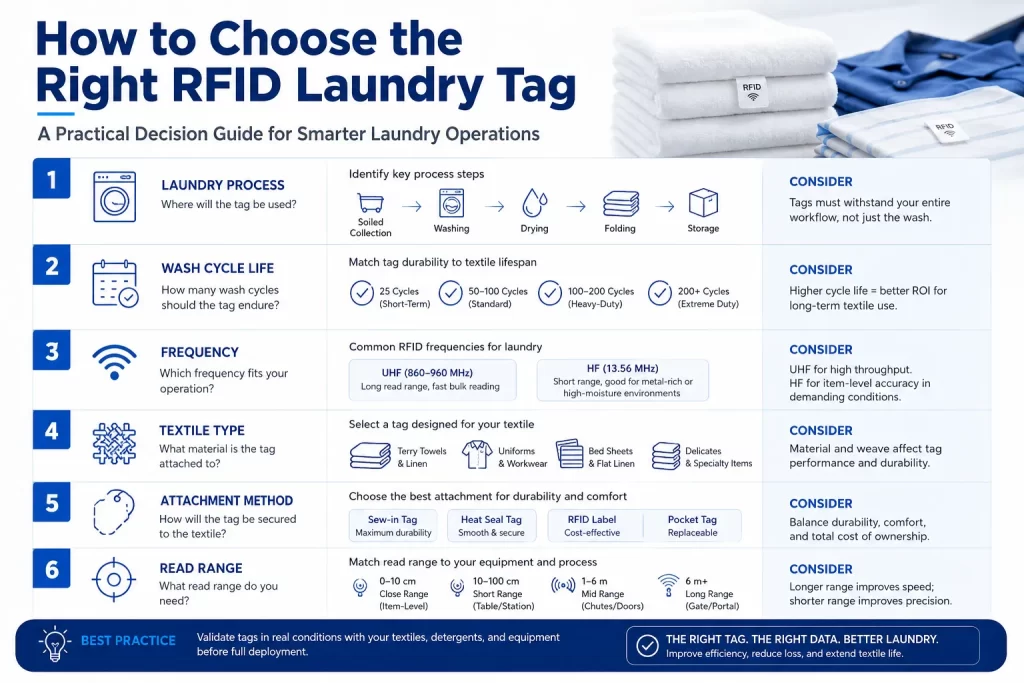
Document the complete textile process, including:
The selected tag must survive the most demanding stage of the process.
Ask how many commercial wash cycles the tag must survive.
A tag should ideally last as long as the textile item itself. Replacing failed tags before the textile is retired creates extra labor and weakens traceability.
Do not assume all laundry RFID tags have the same cycle rating. Commercial specifications may range from around 200 to 300 cycles in the examples reviewed, depending on frequency, housing, attachment, and application.
Choose the frequency based on:
UHF is commonly preferred for automated bulk reading. HF or LF may remain appropriate for controlled short-range or existing laundry installations.
The tag must fit the item.
A large fabric tag may work well in a bedsheet hem but may be unsuitable for:
Review:
Choose between:
The attachment method must survive the same conditions as the tag itself.
Required read range depends on the workflow.
Examples:
| Reading Point | Typical Requirement |
|---|---|
| Desktop verification | Short, controlled range |
| Laundry cart or bag | Moderate bulk reading |
| Conveyor station | Defined directional zone |
| Doorway or portal | Wider automatic detection |
| Storage inventory | Area or handheld scanning |
| Delivery cage | Bulk item verification |
The highest read range is not always the best choice. Laundry systems need reliable identification inside the intended zone while avoiding unwanted reads from nearby carts or textiles.
Syncotek’s guide on how to select the right RFID antenna explains gain, polarization, beamwidth, and read-zone control in more detail.
Depending on the market and application, buyers may request:
For example, several commercial textile RFID products list OEKO-TEX Standard 100 or MR-conditional properties, but these certifications apply only to the specific tested product.
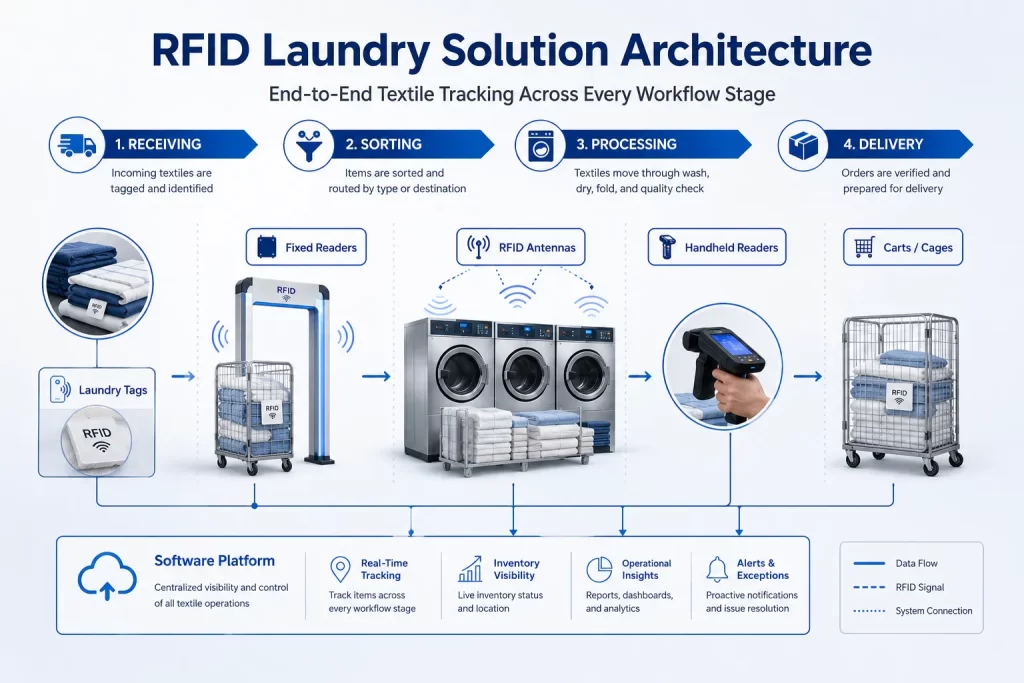
An RFID laundry solution includes more than washable tags.
Each textile requires a tag suitable for its material, washing conditions, expected lifecycle, and attachment method.
Fixed readers can be installed at:
They provide automatic data capture without requiring workers to scan each item manually.
Handheld readers are useful for:
Antennas define where textile tags are detected.
Laundry systems may use:
Commercial textile-identification systems include portals, cabinets, conveyors, tunnels, tabletops, and multi-frequency reading configurations.
Laundry transport cages and carts can also be RFID-tagged.
This allows the system to connect:
Rugged UHF tags are available specifically for laundry cages and can be designed for high-pressure, high-temperature, chemical-resistant environments.
Laundry management software converts RFID reads into operational information.
It may support:
Without software integration, RFID reads remain individual identification events rather than a complete textile management solution.
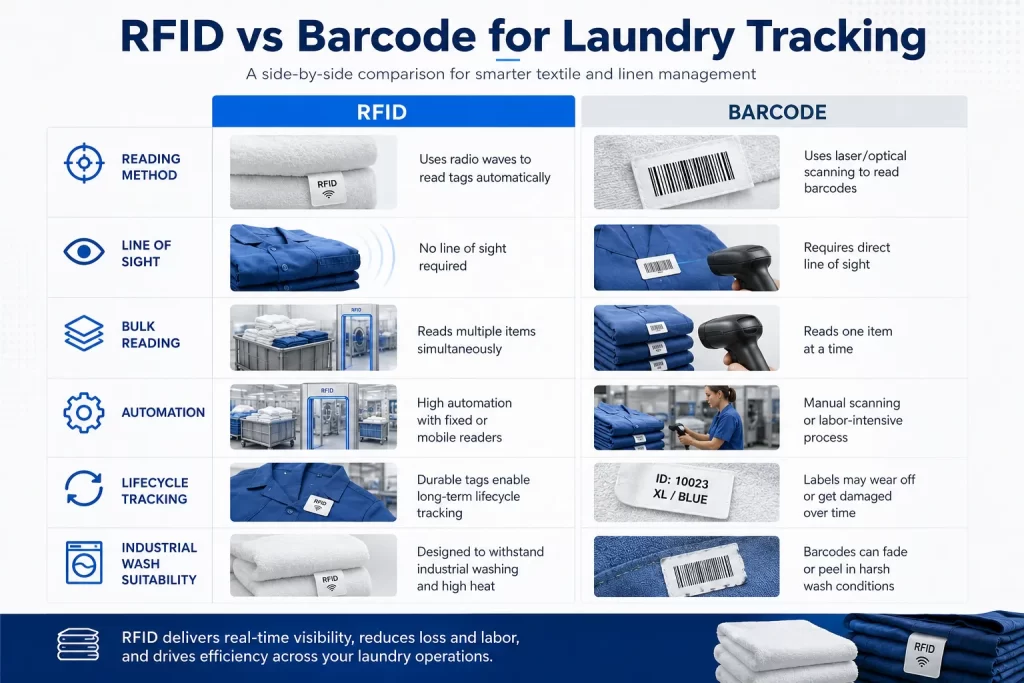
| Feature | Barcode Label | RFID Laundry Tag |
|---|---|---|
| Reading method | Optical | Radio frequency |
| Line of sight | Required | Not always required |
| Bulk reading | Limited | Supported |
| Read speed | Normally one by one | Multiple items can be detected |
| Process automation | Limited | Stronger |
| Textile lifecycle data | Possible but scan-dependent | Easier to automate |
| Industrial wash durability | Depends on label | Designed for laundry conditions |
| Cost | Lower | Higher initial cost |
Barcodes may remain useful for visual backup, but RFID provides stronger automation for high-volume textile operations.
A reader may capture textiles from a neighboring cart, bag, or process zone.
This can create incorrect counts or customer assignments.
Possible controls include:
Stray reads and the accurate assignment of readings to moving textiles are recognized technical challenges in automated laundry RFID systems.
Tags inside compressed bags or stacked wet laundry may be more difficult to read than tags separated in open space.
Testing should include:
Poor placement can reduce readability or expose the tag to excessive mechanical stress.
Avoid locations that are:
A UHF reader cannot normally read an HF or LF tag.
Before deployment, confirm:
Read range, wash-cycle life, and chemical resistance are influenced by actual process conditions.
Datasheet values should be used as selection references, followed by application testing with real:
Common goals include:
Start with a specific operational problem rather than installing RFID without a defined objective.
Document every point from collection to return:
Identify where RFID data would create useful decisions.
Pilot the solution with several item types, such as:
Different materials and sizes may require different tags or placements.
Compare sew-in, heat-seal, and pouch installation when appropriate.
Check:
Determine whether each stage needs:
Fixed systems also require suitable RFID cables, connectors, and adapters to maintain reliable reader-to-antenna performance.
Each tag ID should be connected to a clear textile record.
The software should define:
A reliable pilot should test complete production conditions, not only dry tags on a desk.
Measure:
Potential RFID laundry benefits include:
RFID lifecycle data can also help laundries reduce unnecessary textile replacement and better manage water, energy, and other processing resources.
Before selecting a washable RFID tag, confirm:
RFID laundry tags provide individual identification and lifecycle visibility for garments, linens, uniforms, towels, medical textiles, and other reusable fabric items.
By connecting each textile to a digital record, RFID can help industrial laundries, hospitals, hotels, care facilities, and uniform rental businesses automate receiving, sorting, processing, inventory management, delivery verification, billing, maintenance, and replacement planning.
The right RFID laundry tag depends on more than its frequency or stated wash-cycle rating. Buyers should evaluate textile type, attachment method, water and chemical exposure, temperature, pressure, read-zone design, certification, software compatibility, and expected service life.
For reliable deployment, tags, readers, antennas, software, and laundry processes must be tested as one complete system.
An RFID laundry tag is a washable electronic identification tag designed to remain attached to garments, linen, uniforms, towels, or other textiles during repeated commercial laundry processes.
Yes, laundry RFID tags are specifically designed for repeated exposure to water, detergent, heat, pressure, and textile handling. Exact limits vary by product and should be confirmed in the tag specification.
It depends on the product. Commercial examples may specify approximately 200 or 300 washing cycles, but actual performance depends on installation and process conditions.
Laundry tags are available in UHF, HF, and LF formats. UHF is commonly used for longer-range and bulk textile reading, while HF and LF can support controlled shorter-range or existing laundry systems.
UHF systems can read multiple textile tags in suitable bulk-reading environments. Actual performance depends on the textile bundle, moisture, antenna placement, tag orientation, and reader configuration.
Common attachment methods include sewing, heat sealing, fabric pouches, embedding, and rigid or button-style attachment.
Yes. RFID is used for hospital linen, uniforms, patient garments, and reusable medical textiles. Healthcare applications may require additional certifications or MR-conditional tag designs.
Yes. The system can increment a wash-cycle or process count whenever the tag passes through defined laundry read points.
RFID does not physically prevent loss, but it provides stronger inventory visibility, last-seen records, customer assignment, and movement history that can help identify and reduce loss.
A normal RFID label is generally not designed for repeated industrial washing. A laundry RFID tag uses protective materials and construction intended to tolerate water, chemicals, heat, pressure, and mechanical handling.
Need RFID Tags and Readers for Laundry or Textile Management?
Syncotek provides RFID readers, antennas, tags, modules, and system components for textile tracking, inventory management, manufacturing, asset identification, and industrial automation.
Whether you need washable UHF textile tags, handheld inventory readers, fixed laundry portals, conveyor reading stations, or RFID modules for system integration, Syncotek can help evaluate suitable components based on your textile type, wash process, read distance, installation environment, and software workflow.
Explore Syncotek’s complete RFID products for your laundry and textile tracking project.
 Knowledge
BarTender RFID software, BarTender RFID label printing, RFID label software, RFID printer software, RFID label encoding, RFID printer encoder, RFID label design, EPC encoding, RFID barcode label software, RFID serialization RFID projects do not depend only on tags, readers, antennas, and printers. Software also plays a critical role, especially when businesses need to design RFID […]
READ MORE Knowledge
An RFID reader and writer is a device that can both read data from RFID tags and write new data into compatible RFID tags. In many RFID projects, this type of device is also called an RFID reader-writer, RFID read-write device, or simply an RFID writer. The “read” function allows the device to detect RFID tags and collect stored information […]
READ MORE Knowledge
Tools are essential assets in many industries. Manufacturing plants, construction companies, hospitals, repair teams, rental businesses, warehouses, and maintenance departments all depend on tools being available, traceable, and properly maintained. However, tool management is often difficult. Tools may be misplaced, borrowed without record, left at job sites, stored in the wrong cabinet, sent for maintenance […]
READ MORE Knowledge
Industrial laundries, hospitals, hotels, uniform rental companies, nursing facilities, and textile service providers process large volumes of garments and linens every day. These textile items move continuously between customers, collection points, sorting areas, washing machines, dryers, ironing systems, storage rooms, and distribution vehicles. Without reliable identification, it can be difficult to know how many items […]
READ MORE Knowledge
Uniform tracking can be built with either barcodes or RFID. Both technologies can give every garment a unique identity and connect it with information such as: employee department size garment type issue date return status laundry status wash count repair history replacement status The main difference is how that identity is captured. A barcode normally […]
READ MOREIf you are interested in our services or need customized solutions, please feel free to contact us.