
Passive RFID is a type of radio frequency identification technology in which the tag has no internal battery. Instead, the tag is powered by energy from the RFID reader’s field and then sends data back to the reader. This battery-free design is the defining feature of passive RFID and one of the main reasons it is widely used in inventory, logistics, retail, access control, and asset identification.
In practical terms, passive RFID is popular because it combines automation with relatively simple tags. A passive tag usually contains an integrated circuit and an antenna, and in many cases it is built as a label, card, hard tag, or on-metal tag depending on the environment. Because the tag does not need a battery, it can be smaller, lighter, and cheaper than an active RFID tag.
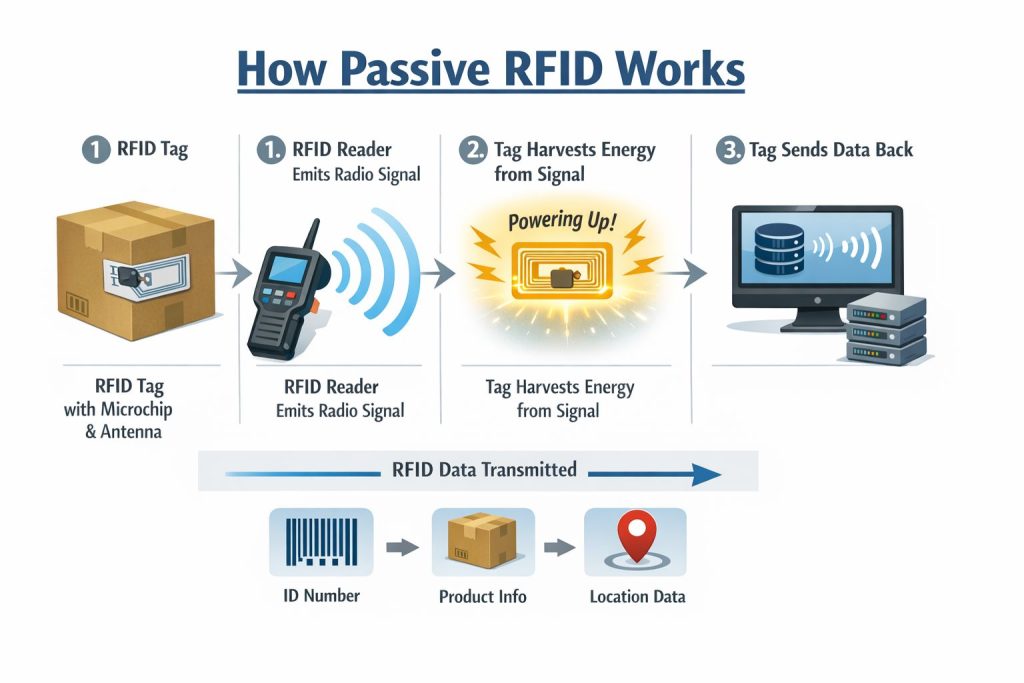
A passive RFID system typically includes a tag, a reader, one or more antennas, and software. The reader sends out radio energy. When a passive tag enters that field, the tag harvests enough energy to power its chip and respond. The reader then captures the tag’s data and sends it to software for inventory, tracking, filtering, or process control.
The exact uplink method depends on the RFID band. In passive UHF systems, the tag usually responds through backscatter, meaning it changes how it reflects the reader’s signal. In HF RFID and NFC systems, the tag-to-reader response is generally based on load modulation in the near field. This distinction matters because many people treat passive RFID as a single technology, but LF, HF, NFC, and UHF passive systems behave differently in range, physics, and use case.
In simple terms, passive RFID works because the reader does the heavy lifting. The reader powers the interaction, the tag responds with its identifier or other stored data, and the application software turns those reads into useful actions such as counting inventory, checking items in or out, verifying movement through a gate, or locating tools in a workflow.
Passive RFID is not limited to one frequency band. The most common passive RFID families are LF, HF, and UHF, and each fits different jobs. Syncotek’s UHF RFID overview summarizes the practical split well: LF around 125/134.2 kHz is used for very short-range identification such as animal ID and some tool scenarios; HF/NFC at 13.56 MHz is common for cards, tickets, libraries, and phone tap interactions; and UHF at 860–960 MHz is the main passive RFID option for logistics, inventory, portals, and work-in-process visibility.
LF passive RFID is generally chosen when read distance is short and the environment can be difficult. It is often associated with animal identification and certain industrial identification tasks. Syncotek’s UHF overview places LF at up to about 10 cm in typical use.
Related Read: https://syncotek.com/what-is-lf-rfid/
HF RFID operates at 13.56 MHz and is widely used for access cards, tickets, libraries, smart labels, and NFC-style tap interactions. Compared with LF, it can support different standards and user experiences, especially when phones or secure card-style interactions are involved. Syncotek’s UHF guide places typical HF/NFC use from tap range to around 1 meter in optimized ISO 15693-style cases.
Related Read: https://syncotek.com/hf-vs-nfc/
UHF passive RFID, often discussed under the RAIN RFID umbrella, is the most common option when the goal is longer read range, fast bulk reading, and no line-of-sight scanning. Impinj defines RAIN RFID as a passive, battery-free wireless technology, and Syncotek’s UHF article describes passive UHF as the foundation for logistics, inventory, portals, and item-level labeling.
Related Read: https://syncotek.com/what-is-uhf-rfid/
The simplest difference is power. Passive RFID tags have no battery and rely on the reader field for energy, while active RFID tags have their own power source and can transmit over much longer distances. Because passive tags are simpler, they are usually lower cost and more scalable for high-volume deployment. Because active tags are battery-powered, they are better suited to long-range monitoring and RTLS-style use cases.
In many projects, passive RFID is the right choice when the goal is to identify large numbers of items efficiently without putting a powered device on every item. That is why passive RFID dominates applications such as retail item tagging, warehouse inventory, carton or pallet handling, library systems, and tool identification. Active RFID is more likely to be selected when the goal is continuous long-range visibility over a wider area.
A useful way to think about the decision is this: passive RFID is usually better for scale and cost efficiency, while active RFID is usually better for range and continuous visibility. Syncotek’s own comparison article makes this difference explicit by positioning passive RFID for inventory, logistics, retail, WIP, asset ID, and high-volume tagging, while active RFID is positioned for RTLS, long-range monitoring, and moving assets across large areas.
Read range in passive RFID depends heavily on the frequency band, tag design, reader power, antenna setup, orientation, and environment. In general, passive UHF delivers the longest range among common passive RFID types, while HF and LF are shorter-range technologies. Zebra notes that passive RFID tags can transmit a unique serial number at distances of roughly five to 30 feet depending on the setup, while Impinj notes that high-performing passive UHF chips can be detected at distances of up to about 10 meters.
In real projects, quoted read range should always be treated carefully. Metal, liquids, dense packaging, tag orientation, antenna polarization, and installation height can all change the result. Syncotek’s UHF RFID guide highlights common issues such as metal and liquid interference and notes that on-metal tags, spacers, antenna angle adjustments, and multi-antenna layouts are often used to improve performance.
On the product side, Syncotek’s passive UHF lineup includes readers for different coverage needs. For example, the SR-RU1XG12C01 integrated reader is listed with a built-in 12 dBi antenna and a read distance of up to 25 meters, while the SR-RU471C fixed reader is designed around the Impinj E710 chip and supports fast multi-tag inventory with multiple antenna ports for zone-style deployments.
The biggest advantage of passive RFID is that the tag has no battery. That reduces cost and maintenance and makes it practical to tag very large numbers of items. This is one reason passive RFID has become the default choice in many inventory and logistics applications.
Another major advantage is scalability. Passive RFID can read many tags quickly, especially in UHF deployments.
Passive RFID also supports automation without requiring line-of-sight in many UHF applications. That makes it attractive for carton handling, portal reads, conveyor workflows, work-in-process tracking, and inventory counts where barcodes would require one-by-one aiming. Syncotek’s UHF guide explicitly lists no-line-of-sight operation, faster bulk reading, and automation-readiness as major UHF advantages.
A final advantage is tag variety. Passive RFID is available in labels, cards, hard tags, and specialized designs such as on-metal tags. On Syncotek’s site, for example, the TUA-PCB is a UHF PCB on-metal tag intended for tool-management style projects where ordinary labels would struggle on metal surfaces.
Passive RFID is not the best fit for every project. The first limitation is range. Even though passive UHF can reach useful distances, it still does not match the wide-area coverage of active RFID systems. If the application requires continuous long-range reporting across a site, passive RFID may not be enough on its own.
The second limitation is environmental sensitivity. Metal, liquids, tag orientation, and reader placement can have a strong effect on performance, especially in UHF systems. That does not mean passive RFID fails in those environments, but it does mean the tag type and antenna design must be selected more carefully.
The third limitation is that passive RFID is event-driven rather than continuously self-reporting. A passive tag usually responds when energized by a reader; it does not behave like a battery-powered device that can simply keep broadcasting its location. That difference is central to choosing between passive and active systems.
Passive RFID is used in many industries, but some applications appear again and again in high-ranking educational pages.
This is one of the most common passive RFID use cases. UHF passive RFID is widely used for counting items, locating stock, improving inventory accuracy, and reducing manual scanning effort in warehouses and stockrooms. Impinj describes RAIN RFID as a passive technology that connects everyday items and provides real-time and historical insight, which aligns closely with inventory and logistics workflows.
Passive RFID is especially strong where many low-cost items need to be identified quickly.
Passive RFID is also a good fit for tools, reusable containers, and fixed assets when the goal is identification and accountability rather than wide-area real-time tracking. Syncotek’s TUA-PCB on-metal tag and SR-RUX252 intelligent tool trolley are good examples of how passive UHF can support tool management workflows. The SR-RUX252 page describes automated management of RFID-tagged tools stored in drawers and quantifies major gains in inventory efficiency.
Passive UHF is commonly used at doors, tunnels, and gates where tagged items move through defined read zones. Syncotek’s SR-RU8604E UHF access gate is positioned exactly for this style of deployment, with strong multi-tag reading and built-in alarm capability.
Passive RFID is not only for fixed installations. Handheld and wearable readers are often used for mobile counts, exception handling, shelf checks, and field verification. Syncotek’s handheld lineup includes devices such as the SR-RU666, SR-RU672, SR-RU691BT, and wearable readers like the SR-RU6R5 and SR-RU6R20, all aimed at mobile UHF tag reading.
The first step is to decide what you are tagging. Apparel, cartons, pallets, tools, metal assets, library items, cards, and industrial components do not all need the same tag style or frequency band. Syncotek’s UHF RFID guide explicitly separates passive labels, on-metal tags, and hard tags as distinct choices for different environments.
The second step is to choose the right band. LF, HF/NFC, and UHF all belong to passive RFID, but they solve different problems. HF is often the right choice for card-like, short-range interactions. UHF is usually the right choice for longer-range inventory and logistics. The best selection comes from the workflow, not from the label “RFID” alone.
The third step is to design the read point properly. In UHF projects, antenna placement, zone definition, and reader selection are critical. A fixed reader with several antenna ports may be the best choice for portal or shelf coverage, while an integrated reader may fit a more compact deployment, and a handheld may be best for mobile counting. Syncotek’s product catalog reflects these different reader formats clearly.
Passive RFID is the most practical RFID choice for many everyday identification and tracking jobs because it is battery-free, scalable, and well suited to high-volume deployment. It is especially strong in inventory, logistics, retail, portal reads, tool identification, and many asset-management workflows where cost and scalability matter more than continuous wide-area reporting.
The most useful way to understand passive RFID is not just as “RFID without a battery,” but as a family of technologies that includes LF, HF/NFC, and UHF systems, each with its own physics, range, and best-fit applications. For most industrial and warehouse buyers, passive UHF is the version they mean when they ask about passive RFID, especially when they are comparing readers, tags, portals, and handheld devices for real deployments.
Two passive UHF RFID tags can look almost identical but behave very differently. One may provide excellent inventory performance on retail products. Another may offer larger user memory for manufacturing. A third may support advanced privacy functions. A fourth may combine RAIN RFID with NFC or provide battery-assisted sensor capabilities. Part of that difference comes […]
READ MORE Knowledge
RFID systems generally fall into two big tag categories: passive RFID and active RFID. They solve different problems. If you choose the wrong one, you’ll either overpay (active when passive is enough) or underperform (passive when you truly need real-time long-range visibility). This guide explains the differences in plain English, with practical selection criteria and […]
READ MORE Case Show
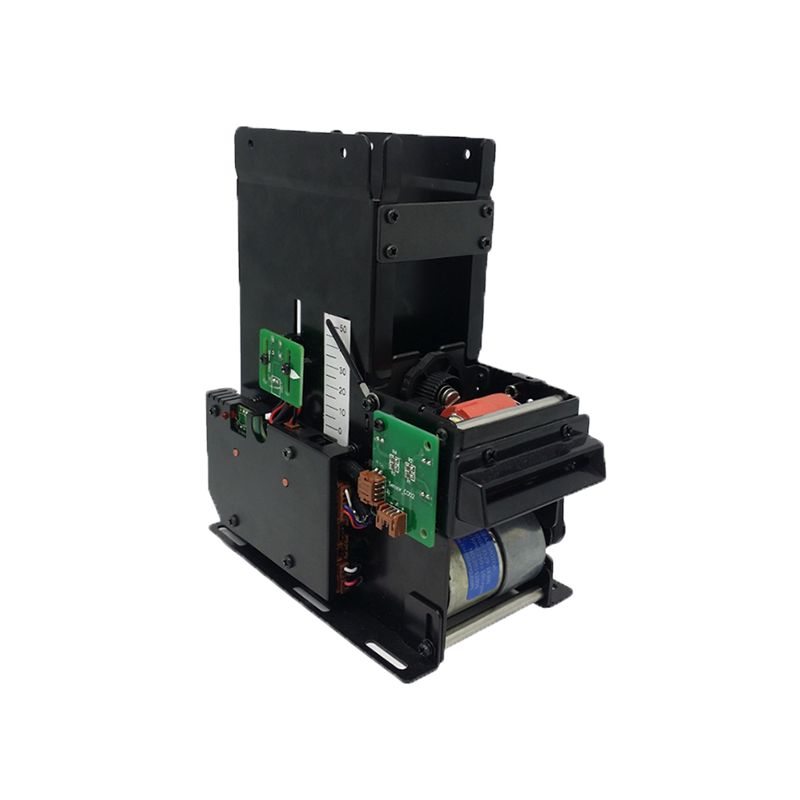
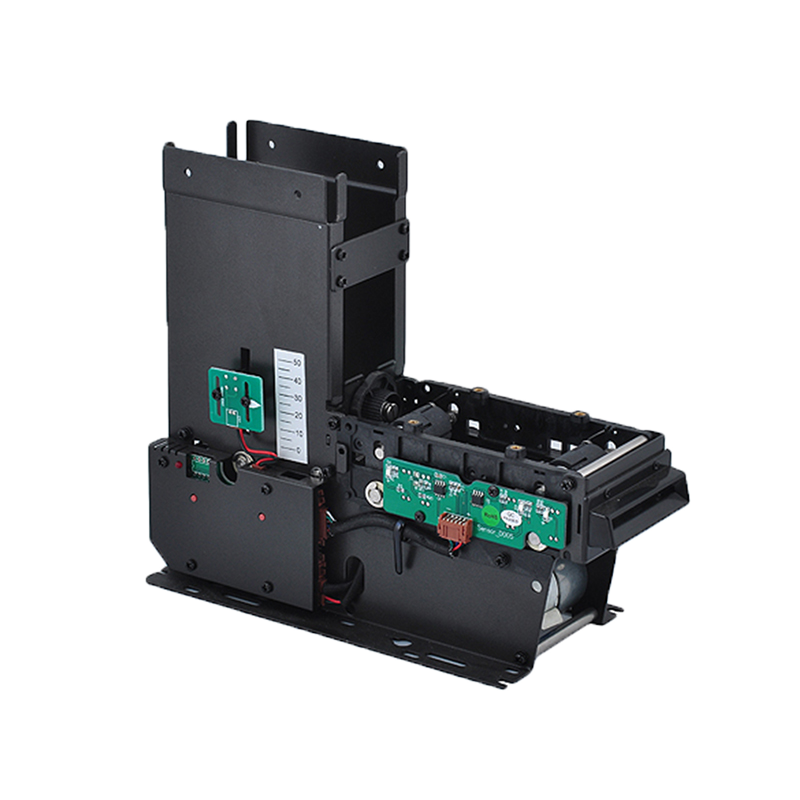
Card dispensers for Hotel Self-Check-in Kiosk
READ MORE Knowledge
An RFID tag may look like a simple adhesive label, plastic block, textile patch, card, or small industrial component. Inside, however, several electrical and mechanical elements work together to receive radio-frequency energy, process commands, store data, and communicate with an RFID reader. At its most basic level, a passive RFID tag contains: RFID Chip + […]
READ MORE Knowledge
HF RFID runs at 13.56 MHz and is widely used for access control badges, contactless payments, libraries, healthcare wristbands, and NFC phone tap experiences. When people say “HF RFID,” they often mean very different things—because HF is a frequency band, while standards define the protocol stack (how tags and readers actually communicate). More about HF […]
READ MOREIf you are interested in our services or need customized solutions, please feel free to contact us.