

In an RFID system, most attention is usually placed on tags, readers, and antennas. However, cables, connectors, and adapters also play an important role in system performance. A well-selected RFID antenna cable helps transfer RF energy from the reader to the antenna with lower loss, while the right connector ensures a secure and compatible connection between hardware components.
If the cable is too long, the connector type is wrong, or too many adapters are used, the RFID system may experience reduced read range, unstable performance, installation delays, or unnecessary troubleshooting.
Cables and connectors should not be treated as simple accessories. They are part of the RF signal path and should be selected together with the reader, antenna, read distance, installation environment, and system design.
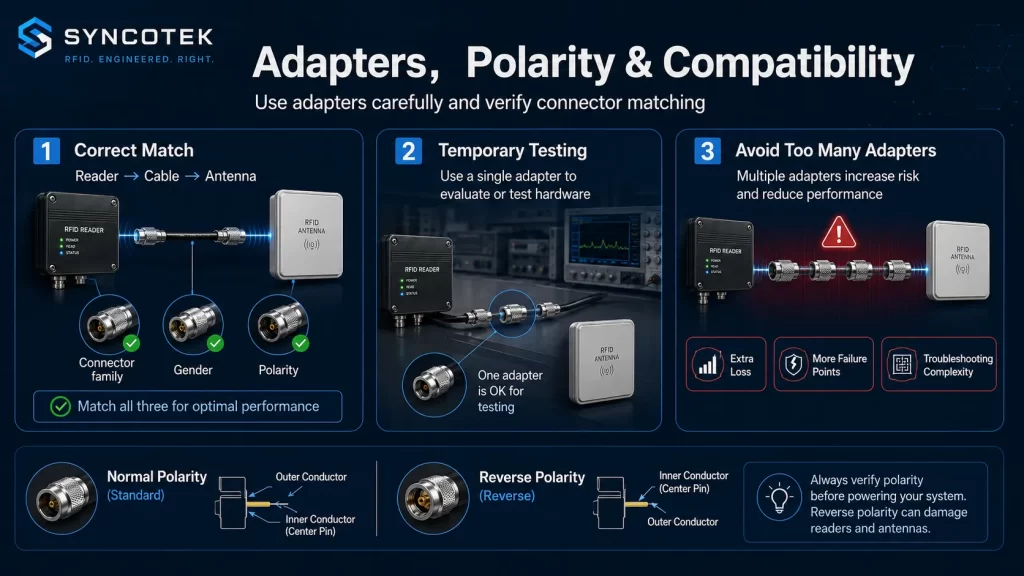
In a typical UHF RFID system, the RFID reader generates RF energy and sends it through an antenna port. The antenna cable carries that energy to the RFID antenna. The antenna then radiates the RF signal into the read zone to communicate with RFID tags.
A basic RFID reader-to-antenna connection usually includes:
The cable and connector must maintain signal integrity as much as possible. Any loss, mismatch, loose connection, or poor-quality component can affect how much usable RF energy reaches the antenna.
RFID performance is not determined only by reader power or antenna gain. Cable loss also affects the final energy available at the antenna.
For example, if a reader outputs a certain power level, part of that energy is lost as it travels through the cable. The longer the cable and the lower the cable quality, the more signal may be lost before reaching the antenna.
This matters especially in applications such as:
In these scenarios, cable loss can directly affect read range and read reliability.
Cable length is one of the first things to check. A longer cable gives more installation flexibility, but it also increases signal loss.
Use the shortest cable length that fits the installation safely and cleanly.
A cable that is much longer than necessary can reduce system efficiency. If a long cable is unavoidable, a lower-loss cable type should be considered.
Not all coaxial cables perform the same way. Some cables are thinner and more flexible, while others are thicker and better at reducing loss.
In RFID installations, common cable types may include:
The tradeoff is simple:
| Cable Type | Advantage | Limitation |
|---|---|---|
| Thin cable | Flexible, easy to route, good for short runs | Higher signal loss |
| Medium cable | Balanced flexibility and performance | May not suit long-distance runs |
| Low-loss cable | Better signal transfer over distance | Thicker, less flexible, harder to route |
A thicker low-loss cable may improve RF performance, but it may also be difficult to install in tight cabinets, compact reader enclosures, or moving equipment.
A coaxial cable includes an inner conductor, insulation, shielding, and outer jacket. This structure helps carry RF signals while reducing unwanted interference.
Good shielding and insulation help:
For industrial RFID projects, the outer jacket should also match the installation environment. Indoor office use, warehouse use, outdoor installation, high-temperature areas, and harsh industrial environments may require different cable protection levels.
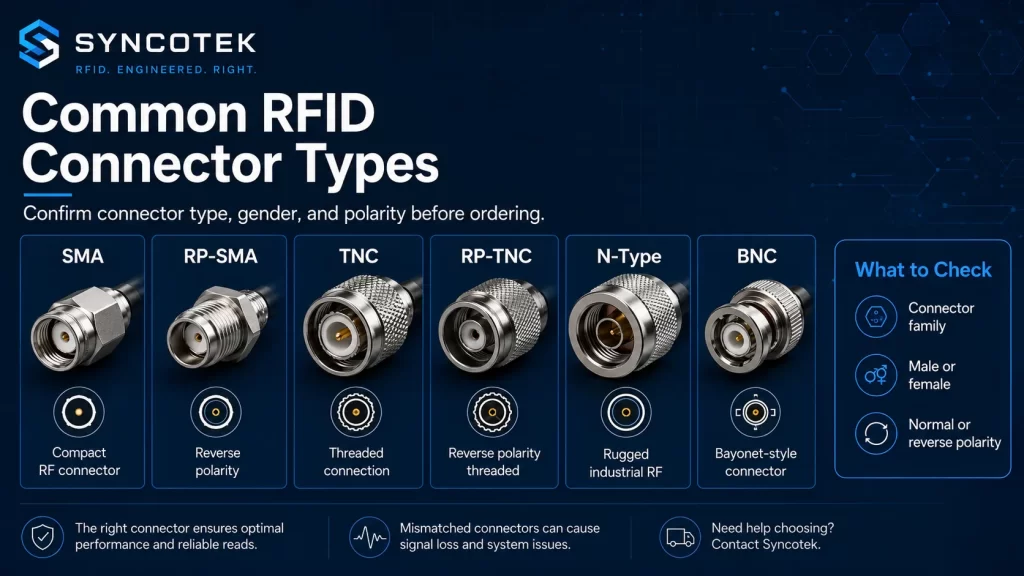
RFID systems commonly use coaxial connectors. The exact connector depends on the reader, antenna, cable, and region.
SMA connectors are compact and commonly used in RF systems. They are often found on smaller RFID devices, antennas, or compact reader configurations.
RP-SMA means reverse-polarity SMA. It looks similar to SMA but has a reversed center-pin arrangement. This is a common source of ordering mistakes.
TNC connectors use a threaded connection and are commonly used in RF applications where a more secure connection is needed.
RP-TNC is a reverse-polarity version of TNC. Some RFID readers and antennas use RP-TNC connectors, so it is important to confirm polarity before ordering cables.
N-Type connectors are often used in more rugged or higher-power RF applications. They are common in outdoor, industrial, or longer-range RF systems because they can provide a secure and robust connection.
BNC connectors use a bayonet-style locking mechanism and are common in testing, lab equipment, RF instruments, and some communication systems. They are less common than SMA, TNC, RP-TNC, or N-Type in many RFID fixed-reader deployments, but they may still appear in testing environments or specialized hardware.
Connector gender is one of the easiest places to make a mistake.
In general:
However, reverse-polarity connectors can make this more confusing because the center pin arrangement is reversed.
Before ordering an RFID cable, always confirm:
A cable with the right connector family but the wrong gender or polarity will not connect correctly.
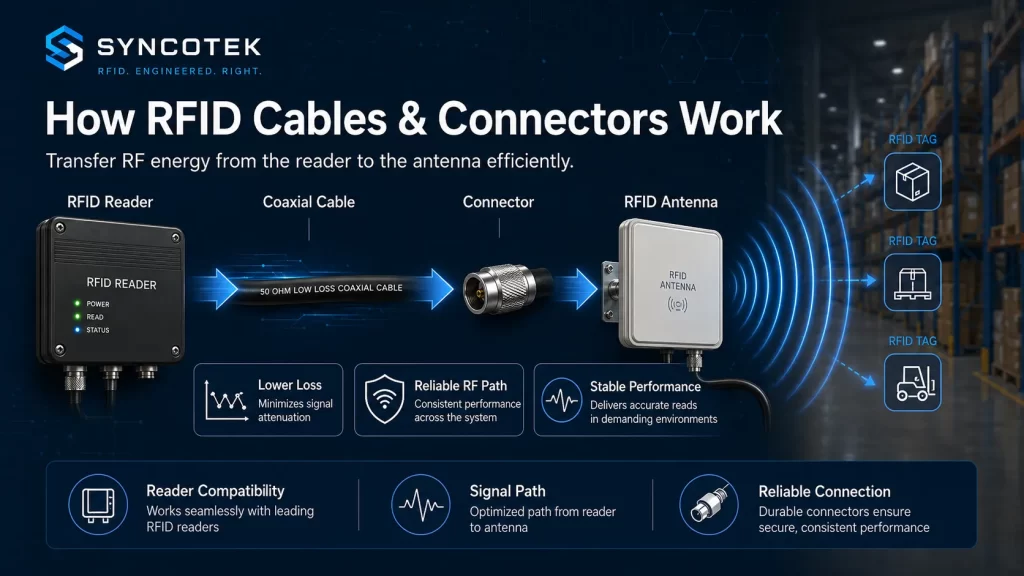
RFID projects often involve connectors such as SMA, RP-SMA, TNC, and RP-TNC. The “RP” means reverse polarity.
This does not simply mean “male” or “female.” It refers to the arrangement of the center contact.
In a typical normal-polarity connector, the male connector has the center pin, and the female connector receives it.
In a reverse-polarity connector, the center pin arrangement is reversed compared with the standard version.
This is why RP-SMA and SMA, or RP-TNC and TNC, should not be treated as interchangeable.
When selecting a cable for an RFID reader and antenna, follow three basic rules.
The connector family must match the hardware.
For example:
Connector names may look similar, but similar appearance does not always mean compatibility.
Normal-polarity and reverse-polarity connectors are different. RP-SMA should be matched with RP-SMA. RP-TNC should be matched with RP-TNC.
Do not assume that a connector will fit just because it looks similar.
In most cases, male connects to female, and female connects to male.
When checking compatibility, verify both:
This is especially important for RP connectors.
Cable loss is the amount of RF power lost as the signal travels through the coaxial cable. It is affected by:
A simple way to think about the signal path is:
Reader Output Power – Cable Loss = Power Reaching the Antenna
For a more complete view:
Reader Output Power – Cable Loss + Antenna Gain = Effective System Output
This is why cable selection matters. Even a powerful reader and high-gain antenna may underperform if too much energy is lost in the cable.
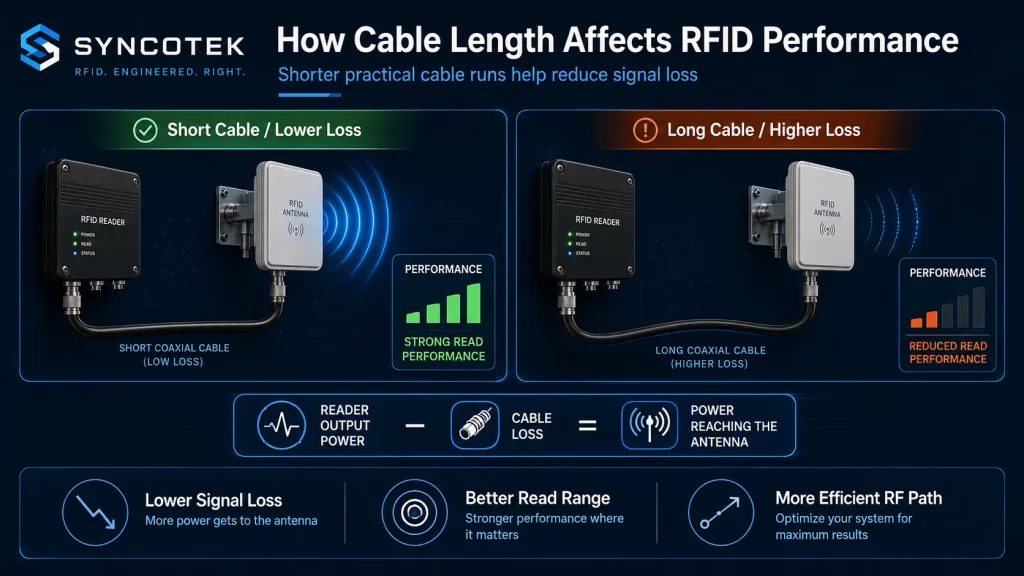
Longer cables usually create more loss. This can reduce read range, especially in fixed-reader systems where the antenna is far from the reader.
A reader is installed inside a control cabinet, while the antenna is mounted several meters away at a dock door, conveyor, or gate. If the cable is too long or too lossy, less power reaches the antenna, and the system may fail to read tags consistently.
An adapter is used when two connectors would otherwise not connect directly. For example, an adapter may convert one connector type to another or one gender to another.
Adapters can be useful in:
However, adapters should not be overused in final production installations.
Each adapter adds another connection point. More connection points can mean:
For long-term RFID installations, it is usually better to use a correctly specified cable with the right connector on each end instead of stacking multiple adapters.
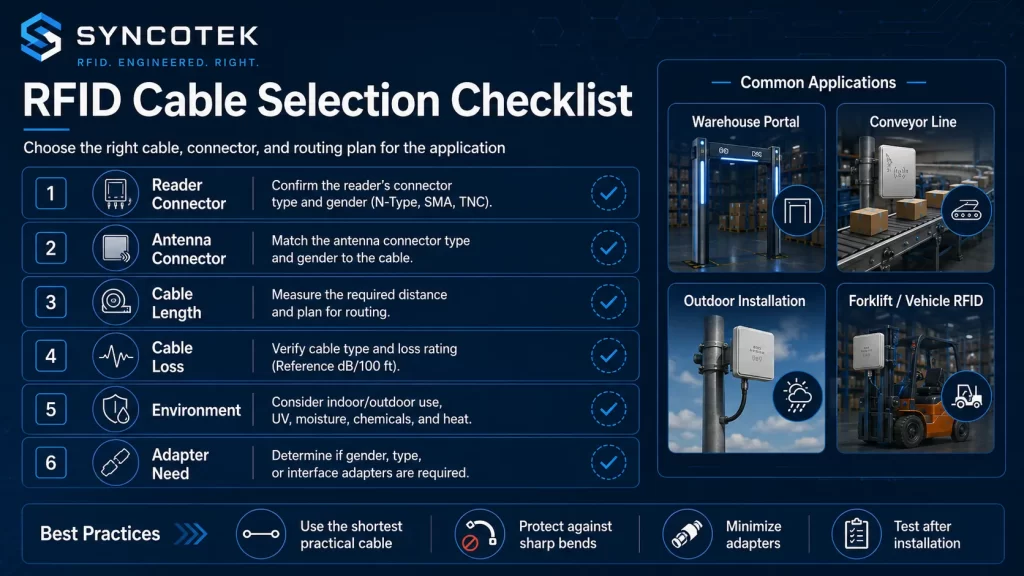
Before purchasing or installing RFID cables, confirm the following details.
| Selection Factor | What to Check |
|---|---|
| RFID frequency | UHF, HF, NFC, or other RF band |
| Reader connector | Type, gender, polarity |
| Antenna connector | Type, gender, polarity |
| Cable length | Shortest practical length |
| Cable loss | Suitable for required read range |
| Cable flexibility | Can it be routed safely? |
| Environment | Indoor, outdoor, vibration, heat, moisture |
| Mounting path | Cabinet, ceiling, portal, conveyor, vehicle |
| Adapter need | Temporary or permanent use |
| Compliance | Regional RF power limits and installation rules |
A warehouse portal may require multiple antennas mounted around a dock door, gate, or passage. Cable length should be minimized, and lower-loss cables may be needed if antennas are positioned far from the reader.
Conveyor systems may use fixed readers and antennas close to moving cartons, bins, or products. Cable routing should avoid moving parts, sharp edges, and high-vibration areas.
Outdoor RFID systems need cables and connectors that can handle moisture, temperature changes, UV exposure, and mechanical stress.
Forklift-mounted or vehicle-mounted RFID systems may experience vibration, movement, impact, and repeated cable flexing.
During testing, adapters can be helpful because they allow engineers to try different readers, antennas, and cable combinations quickly.
A cable may be long enough physically but still not suitable electrically. Cable loss must be considered.
SMA and RP-SMA, or TNC and RP-TNC, may look similar but are not interchangeable.
Adapters are useful for testing but can create extra loss and mechanical failure points in permanent systems.
A cable that works in an office test may fail in a warehouse, outdoor gate, or vehicle-mounted RFID system.
Sharp bends, crushed cables, exposed runs, or unsupported cable weight can reduce reliability.
When an RFID system has poor read range, the problem may not always be the tag or reader. Cable loss, loose connectors, wrong polarity, or damaged cable should also be checked.
To improve RFID system reliability, follow these practices:
Good installation practices reduce troubleshooting time and improve long-term system stability.
| Problem | Possible Cable or Connector Cause |
|---|---|
| Short read range | Cable too long, high cable loss, loose connector |
| No tag reads | Wrong connector, damaged cable, disconnected antenna |
| Intermittent reads | Loose connection, vibration, cable damage |
| Reads change after movement | Cable strain, unstable antenna position |
| Good lab result but poor field result | Different cable length, different connector, extra adapters |
| One antenna performs worse than others | Unequal cable loss or damaged connector |
Before replacing readers or antennas, check the cable path and connector condition.
RFID cables, connectors, and adapters may seem like small parts of an RFID system, but they directly affect RF signal delivery and system reliability. A properly selected cable helps transfer energy from the reader to the antenna with lower loss, while correct connectors ensure physical and electrical compatibility.
For reliable RFID deployment, cables should be selected based on read range, cable length, connector type, polarity, installation environment, and long-term system requirements. Adapters are useful during testing, but final installations should use properly specified cables whenever possible.
A strong RFID system is not built from the reader alone. It depends on every part of the signal path working correctly.
Most fixed RFID antenna systems use coaxial cables to connect the RFID reader to the antenna. The exact cable type depends on frequency, distance, installation environment, and required read performance.
Yes. Longer cables generally create more signal loss, which can reduce the RF power reaching the antenna and affect read range.
Common RFID-related connector types include SMA, RP-SMA, TNC, RP-TNC, N-Type, and sometimes BNC depending on the hardware and test setup.
RP means reverse polarity. It refers to the reversed center-pin arrangement compared with the standard connector version.
Yes. Adapters can be useful for testing or connecting different hardware. However, too many adapters may add loss and mechanical failure points, so they should be minimized in permanent installations.
Confirm the reader connector, antenna connector, cable length, cable loss, frequency, environment, and installation path. Then choose the shortest practical cable with the correct connectors and suitable performance.
Need RFID Hardware and Accessories for Your Deployment?
Syncotek provides RFID readers, antennas, tags, and related system components for warehouse inventory, manufacturing, logistics, asset tracking, and industrial identification applications.
If you are planning an RFID deployment and need help matching readers, antennas, cables, and installation components, Syncotek can help you evaluate a more suitable configuration based on your read distance, environment, hardware interface, and system goals.
 Knowledge
What are LLRP, ALE, and EPCIS (in one minute)? These three GS1/EPCglobal standards cover different layers of an RFID solution: LLRP (Low Level Reader Protocol): a low-level protocol between software and an RFID reader that provides fine control of a single reader. ALE (Application Level Events): a standard interface for applications to obtain filtered, consolidated RFID capture data (i.e., […]
READ MORE Knowledge
UHF RFID systems use radio waves to communicate between readers, antennas, and passive RFID tags. In a small installation with one reader, radio-frequency interference may be relatively easy to control. In a warehouse, factory, retail store, distribution center, or event venue with several readers operating at the same time, the RF environment becomes more complicated. […]
READ MORE Case Show
Card dispensers for Hotel Self-Check-in Kiosk
READ MORE Knowledge
RFID—Radio Frequency Identification—is a wireless technology that identifies objects using radio waves. An RFID system can detect items without line-of-sight, often in bulk, and can automate tracking across warehouses, factories, retail stores, hospitals, and security systems. This guide explains what RFID is, how it works, RFID frequencies (LF/HF/NFC/UHF/RAIN), tags and readers, passive vs active vs […]
READ MORE Knowledge
The RFID system auto-identifies vehicles' weight, calculates net weight, and provides real-time monitoring for optimized efficiency.
READ MOREIf you are interested in our services or need customized solutions, please feel free to contact us.