
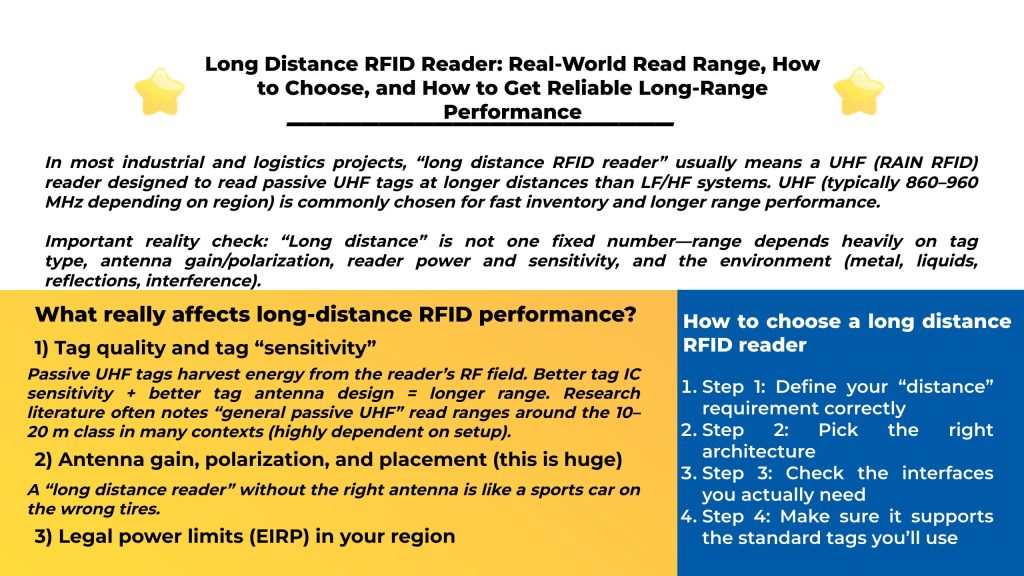
In most industrial and logistics projects, “long distance RFID reader” usually means a UHF (RAIN RFID) reader designed to read passive UHF tags at longer distances than LF/HF systems. UHF (typically 860–960 MHz depending on region) is commonly chosen for fast inventory and longer range performance.
Important reality check: “Long distance” is not one fixed number—range depends heavily on tag type, antenna gain/polarization, reader power and sensitivity, and the environment (metal, liquids, reflections, interference).
| Technology | Typical use | Range expectation |
|---|---|---|
| HF (13.56 MHz) | NFC-like interactions, libraries, access cards | Short range (inches to <1 meter class, depends on standard/use) |
| Passive UHF (RAIN / EPC Gen2) | Warehousing, retail, asset tracking | Often up to ~10+ meters, and can be higher in ideal setups |
| Active RFID (battery-powered tags) | Vehicle/yard tracking, long-range identification | Can reach hundreds of meters in some systems |
If your requirement is “read pallets, cartons, or assets from several meters away,” you’re almost always in passive UHF territory. If you need “read vehicles from far away with tags actively transmitting,” you’re likely looking at active RFID.
Most “long range UHF” solutions in global supply chain environments use EPC Gen2 / ISO/IEC 18000-63 (often written as ISO 18000-6C). This matters because it determines tag compatibility, multi-tag anti-collision behavior, and how reliably you can inventory many tags quickly.
Passive UHF tags harvest energy from the reader’s RF field. Better tag IC sensitivity + better tag antenna design = longer range. Research literature often notes “general passive UHF” read ranges around the 10–20 m class in many contexts (highly dependent on setup).
Tip: Don’t evaluate readers using random tags. Pick the tag family that matches your materials (carton, plastic, metal-mount, high-temp, etc.), then test.
A “long distance reader” without the right antenna is like a sports car on the wrong tires.
Reader output power is often listed in dBm (e.g., 30 dBm ≈ 1 W; 33 dBm ≈ 2 W). Actual radiated power depends on antenna gain and local regulations (FCC/ETSI/etc.). Many readers support regional band settings (EU/US) to stay compliant.
If you care about portals, conveyors, or fast counting, you need good multi-tag performance (anti-collision + fast inventory).
Fixed readers are typically used for:
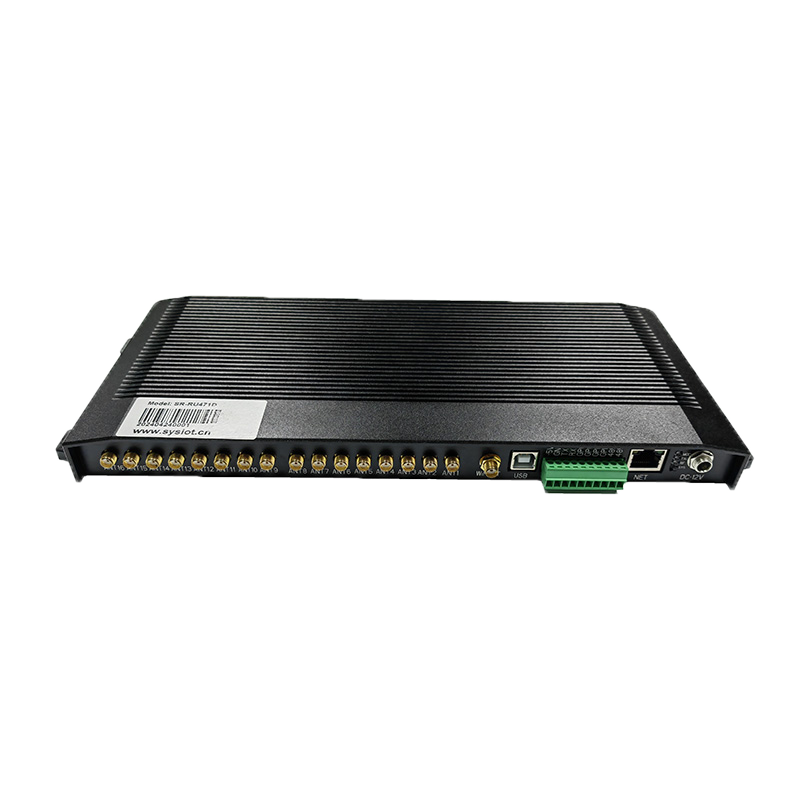
They usually provide multiple antenna ports (4/8/16) so you can shape coverage and reduce blind spots.
Example (Syncotek):
Note: “distance” specs are typically measured under specific lab conditions (antenna gain, test tag/card, environment). Always validate in your real scene.
Integrated readers often combine RF + antenna in one enclosure, useful when you want:
Access gates provide a structured read zone and are common for:
Handhelds are ideal when the operator moves:
Instead of “I need 20 meters,” define:
Common integration requirements:
Look for EPC Gen2 / ISO 18000-63 compatibility.
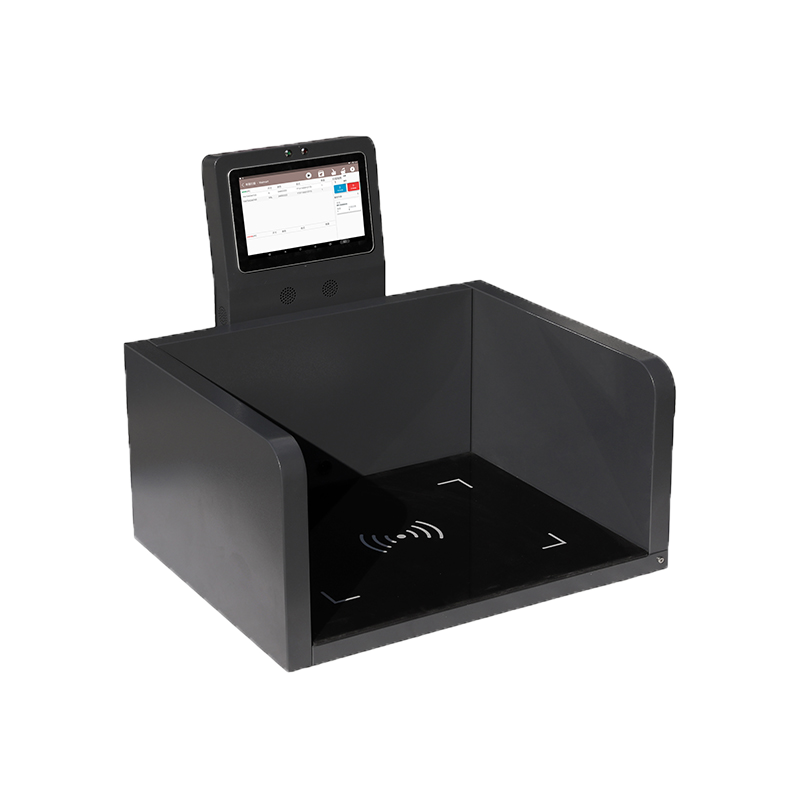
Syncotek’s RFID catalog includes multiple categories that are commonly used for long-range UHF deployments—UHF modules, integrated readers, fixed readers, desktop readers, access gates, handhelds, antennas, and tags.
Where to start for “long distance” projects:
Practical recommendation: If your project needs long-range + stable multi-tag reads, start with a fixed reader + the right antenna strategy, then optimize tags for your materials.
For passive tags, UHF (RAIN RFID) is the most common choice because it supports longer range and fast inventory.
Sometimes—under optimized conditions (tag/antenna/environment). Many real-world deployments are closer to “several meters to 10+ meters,” while academic or best-case setups can reach higher.
When you need very long range and tags can have batteries (vehicles, yards, specialized tracking). Active systems can reach much farther than passive systems.
 Case Show
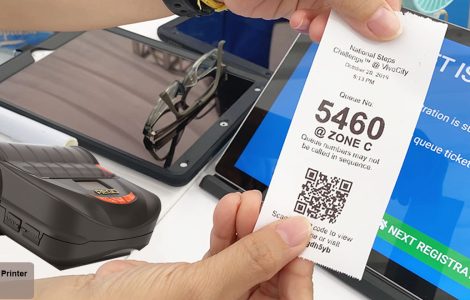
portable receipt printers for event ticket sales
READ MORE Knowledge
Near-field coupling is the communication method used by LF (125/134 kHz) and HF (13.56 MHz, including NFC) RFID systems. Instead of “radiating” like a long-range radio link, near-field RFID works more like a transformer: a reader coil creates a magnetic field, and the tag coil couples to that field to power up and exchange data. This is why LF/HF/NFC are typically short-range, […]
READ MORE Case Show
Cloud printing is a printing technology based on cloud services, which can be well matched with Internet applications.
READ MORE Knowledge
HF RFID runs at 13.56 MHz and is widely used for access control badges, contactless payments, libraries, healthcare wristbands, and NFC phone tap experiences. When people say “HF RFID,” they often mean very different things—because HF is a frequency band, while standards define the protocol stack (how tags and readers actually communicate). More about HF […]
READ MORE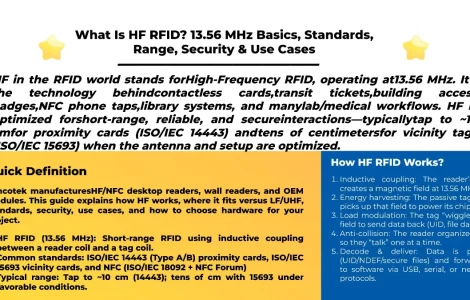 Knowledge
The RFID system auto-identifies vehicles' weight, calculates net weight, and provides real-time monitoring for optimized efficiency.
READ MOREIf you are interested in our services or need customized solutions, please feel free to contact us.