

An RFID tunnel is a controlled scanning station that identifies radio-frequency identification (RFID) tags on goods moving through a defined area. In logistics and retail distribution, it is often used to read multiple item-level UHF RFID tags inside a carton without opening the box or manually scanning every item.
The important distinction is that capturing RFID tags is not the same as verifying an order. A tunnel reader captures tag identifiers; connected software compares those identifiers with the expected packing list or shipment record. Together, the hardware and application can help identify missing, unexpected, or incorrectly packed items before a carton moves to the next logistics step.
RFID tunnel systems can be configured for automatic conveyors, semi-automatic single-carton scanning, or enclosed static reading. The right design depends on carton dimensions, tagged product materials, throughput, the number of tags, and the required warehouse management system (WMS) workflow.
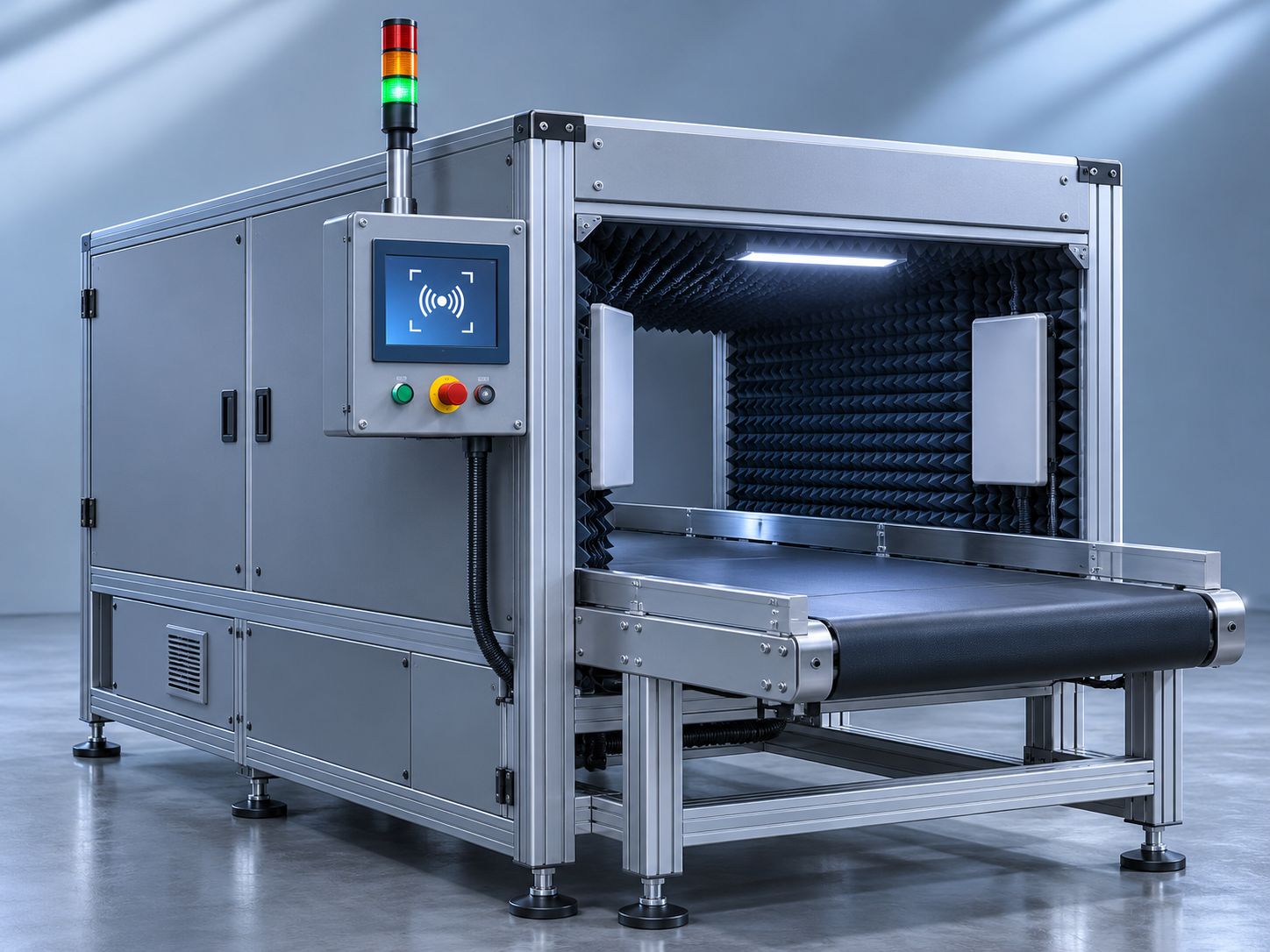
An RFID tunnel reader combines a UHF RFID reader, multiple antennas, an enclosure that helps define the scanning area, sensors, control electronics, and—on conveyor models—mechanical transport. A carton enters the read zone, the system captures available tag identifiers, and the resulting data is passed to a host application.
Unlike a bare fixed RFID reader installed near an open doorway, an RFID tunnel is built to provide a more controlled environment for scanning a defined batch of goods. This can be useful when a carton contains many individually tagged products that must be checked as a group.
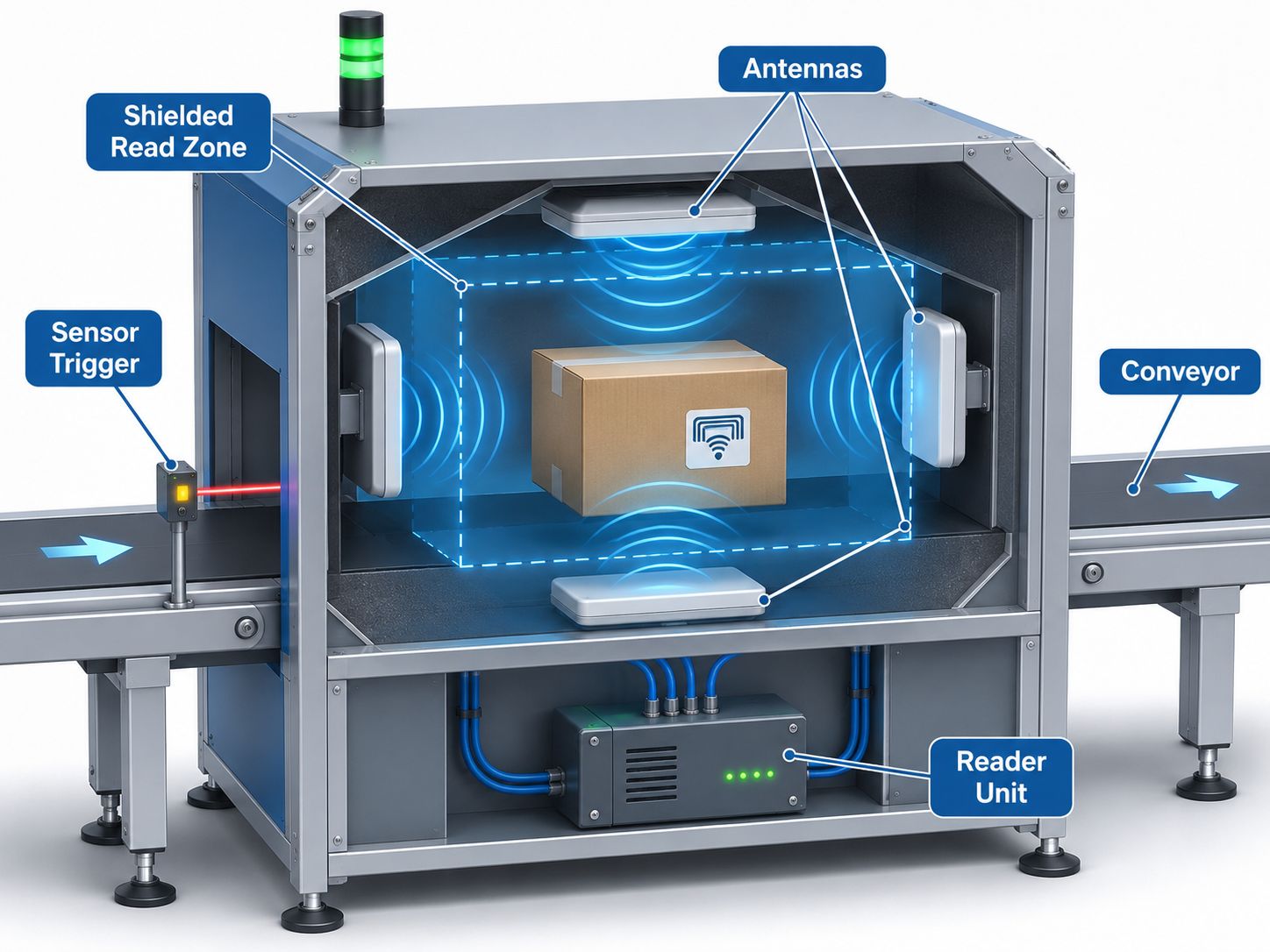
A high-power reader without careful antenna placement may capture tags on adjacent boxes or nearby shelves. This is a problem when the business goal is to identify only the items inside the carton currently being processed. An enclosure, suitable antenna geometry, sensor-triggered reads, power tuning, and application-level filtering work together to narrow the effective identification zone.
Shielding and optimized antenna positioning improve control; they do not automatically guarantee zero missed reads or zero cross-reads. The entire system needs validation with real products and packaging.
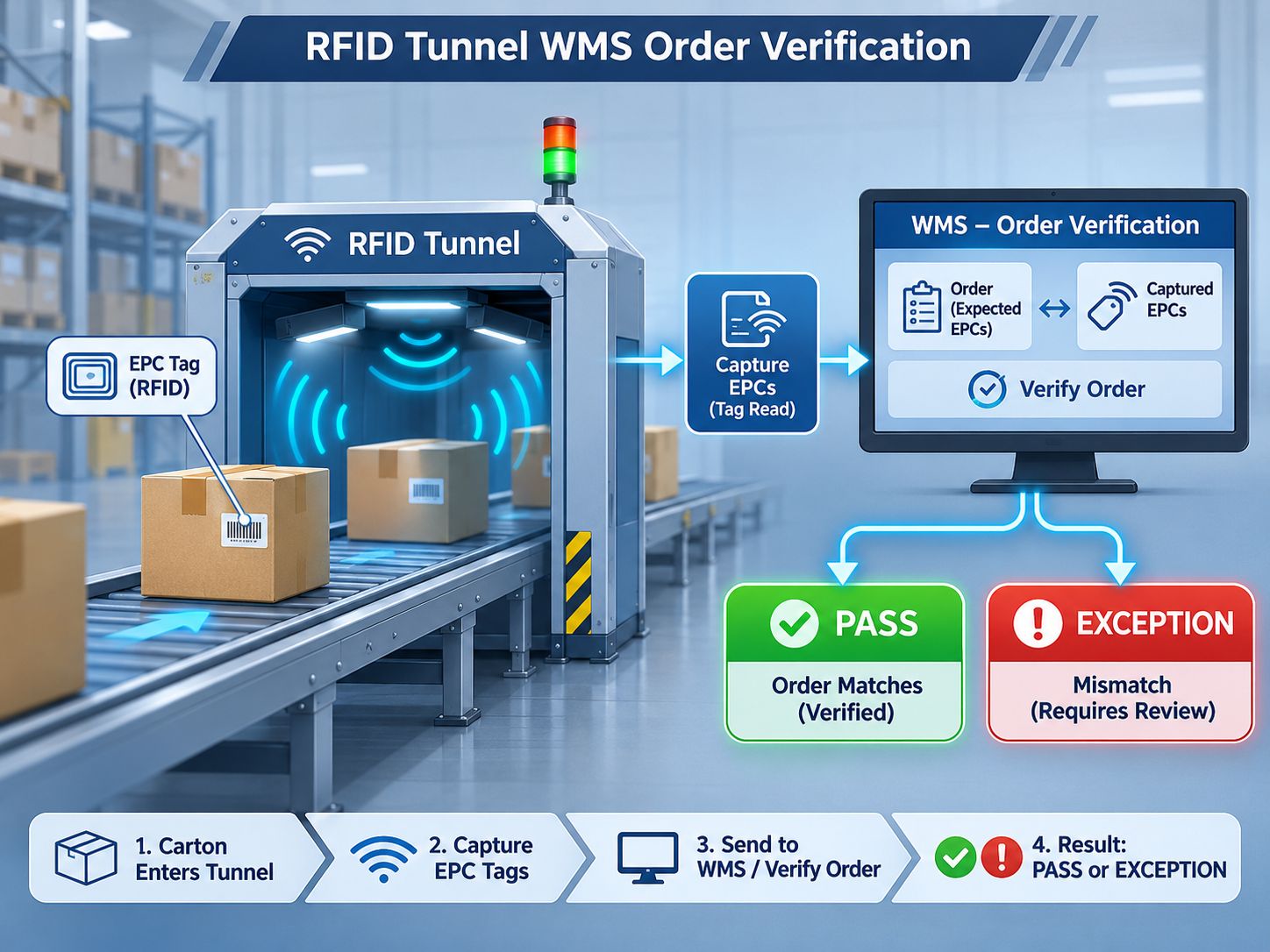
The physical reading operation is only the first half of a successful carton-verification workflow. The following sequence shows how the tunnel and host software work together.
A single carton is placed on a conveyor or into a controlled scanning chamber. Items inside carry compatible RFID tags, typically with serialized identifiers. The system must know which carton or shipment transaction is being processed—for example, from a carton label, a scanned shipping ID, or an upstream conveyor-control signal.
It is important to distinguish between a tag on the carton itself and the item-level tags inside it. Reading the outer carton tag establishes the container's identity; it does not prove that all the expected items are present.
As the carton reaches the designated point, a photoelectric sensor or controller starts the reading process. Depending on the equipment, the carton may continue moving, slow down, or remain stationary during the read. Timing must account for the movement of the product through the effective antenna coverage area.
The RFID reader inventories compatible tags in the read field. Multiple antennas can improve the opportunity to read tags with different orientations or positions within a box. The output is a set of observed tag identifiers and any additional reader metadata supported by the hardware.
A published tag-count capability, such as “200+ tags,” describes a specified or indicative test capability, not a guarantee that every carton containing that number of tags will be read successfully.
A tag may respond more than once during a scan, and an adjacent tag may occasionally be detected. Middleware or host logic groups reads into a defined scan session, removes duplicate observations of the same identifier, and applies zone and timing rules.
Repeated observations of one EPC are not multiple products. Likewise, physically distinct products carrying an incorrectly duplicated EPC cannot be reliably distinguished by that EPC alone. Tag encoding and data governance matter as much as the scanner.
The system retrieves the expected item-level EPC list, packing specification, or another appropriate reference from the WMS/ERP. It then compares that reference with the set of reliably captured EPCs.
For example, a carton with an expected list of 120 unique tagged garments might produce 119 matching EPCs plus one unexpected EPC. The host application should flag the missing expected identifier and the unexpected one. The numbers in this example illustrate the comparison logic; they are not a statement about tunnel performance.
When the application confirms that the transaction satisfies its configured rules, the conveyor can release the carton. If the comparison fails, the system may stop the carton, divert it to a review lane, trigger an indicator, or create an operator task—only when the installed mechanical controls and software support those actions.
An exception may result from a packing error, an unreadable tag, an unexpected adjacent read, incorrect master data, or a process mismatch. The investigation should identify the cause rather than assuming every missing EPC means a missing physical item.
RFID tunnels are particularly useful where cartons contain multiple tagged items and a logistics process needs to verify them at a repeatable checkpoint.
At receiving, a tunnel can capture item-level identifiers from incoming cartons. The WMS may compare them with an advance shipment notice, packing list, or pre-advised EPC set. This can help identify potential discrepancies before stock is put away.
At shipping, the system can compare captured EPCs with the expected items for a customer order or dispatch unit. This is a strong use case when a facility has many similar SKUs, sizes, or variants and wants to reduce unnoticed packing errors.
Apparel and footwear often have item-level serialized RFID tags. A tunnel can read multiple tagged garments or shoeboxes in a shipping carton while the WMS validates sizes, styles, quantities, or exact serialized item identities where the data is available. A tunnel does not directly identify size or style from an EPC without a corresponding product-data mapping.
In high-mix fulfillment operations, an RFID tunnel can serve as a final checkpoint after picking and packing. Whether it is worthwhile depends on item tagging coverage, order volumes, the physical packing format, and the cost of exceptions.
A 3PL may handle shipments from several brands, each with different item master data and identifier rules. The system should associate every read session with the correct brand, order, carton, or shipment before evaluating results. Cross-client data controls are essential.
For return shipments or rework batches, RFID may help identify the tagged items entering a sorting process. It cannot establish condition, authenticity, or return eligibility on its own; those require additional business rules and inspection.

The RFID tunnel and the warehouse application perform different jobs. Keeping them separate makes system design, testing, and exception handling more reliable.
| System layer | Primary responsibility | Typical output |
|---|---|---|
| RFID tags | Store identifiers on physical goods | EPC or other supported data |
| RFID tunnel hardware | Capture identifiers within the defined read session | Raw tag observations |
| Reader middleware or edge application | Filter, deduplicate, and associate reads with a carton | Session-level captured EPC set |
| WMS / ERP application | Compare identifiers with orders, packing records, or shipment plans | Verified transaction or exception |
| Conveyor control / operator interface | Apply permitted workflow actions | Pass, hold, divert, or review |
The host system needs a reliable transaction boundary. If two cartons are scanned too closely together, the application must not merge their EPC sets. Appropriate sensor triggers, carton spacing, conveyor synchronization, and time windows are important.
A robust verification operation should support three common comparisons:
Some facilities only have an expected quantity or SKU list rather than an exact serialized EPC list. Quantity- or SKU-based validation is possible when the tag-to-product mapping is reliable, but its error-detection capabilities differ from exact EPC matching. The validation method should be stated in the project requirements.
GS1 EPCIS provides a standardized way to represent and share visibility events across supply-chain processes. RFID can supply observations, while applications add business context—such as what was involved, when and where an event occurred, and the relevant business step. RFID readers alone do not automatically create complete, business-valid EPCIS events.
For guidance on item-level identification and carton checks, see the GS1 US Claims Compliance Implementation Guideline for the Apparel Industry. The GS1 EPCIS standard provides the underlying event-data framework.
Before integrating the tunnel with a WMS or ERP, confirm how the system will receive the carton identifier, expected EPC or SKU data, scan-start and scan-end signals, exception results, and successful completion acknowledgments. Also define behavior when the network is unavailable or a transaction must be rescanned.
These systems use related RFID technology but serve different physical workflows. They should not be evaluated only by comparing nominal read distance.
| Feature | RFID tunnel | RFID portal / gate | Handheld RFID reader |
|---|---|---|---|
| Typical process | Carton or contained-item verification | Movement through a doorway or open checkpoint | Mobile inventory and exception checks |
| Read-zone geometry | Enclosed or relatively controlled | Open or partially bounded passage | Operator-directed and movable |
| Typical tagged objects | Many item-level tags inside a carton | Pallets, containers, carts, or tagged assets | Items, locations, and assets |
| Automation | Conveyor or controlled batch scanning | Automatic passage detection | Operator-driven |
| Main design challenge | Dense packing, tag orientation, and cross-reads | Adjacent-zone interference and moving loads | Operator consistency and coverage |
| Best fit | Repeated carton verification at fixed stations | Inbound/outbound movement checkpoints | Flexible scanning and investigation |
A tunnel is often the better candidate when the goal is to validate many tags inside a known carton at a defined station. A portal may be more practical when forklifts or large logistics units pass through a dock. Handheld equipment is valuable for resolving exceptions and carrying out cycle counts away from fixed read points.
A complete warehouse system may use all three rather than selecting one technology for every task. Syncotek's RFID tunnel reader solutions are designed for controlled carton-level scanning; broader warehouse identification requirements may also involve RFID inventory management systems.
Selecting a tunnel begins with the goods and the material-flow process, not the reader chip alone.
For an established automated line, check conveyor compatibility, carton spacing, control interfaces, and whether the tunnel can operate at the required production rate. Semi-automatic or enclosed scanning stations may be more suitable when an operator loads one carton at a time, when volumes are lower, or when a more controlled stationary read is needed.
Confirm the maximum real carton dimensions, including bulging, tape, handles, and orientation during conveyance. Compare these with the equipment's published maximum passable box size—not only its outer machine dimensions. Load capacity must also cover the heaviest expected package.
Clothing, shoes, metal products, liquid-filled packaging, dense stacks of tags, and mixed materials create different radio-frequency environments. Real product testing is necessary.
Determine how many individual tags must be read in each box, how many boxes arrive per minute, and the required dwell time. A reader's short RF inventory cycle is not necessarily the same as end-to-end cartons-per-minute throughput; loading, acceleration, doors, verification, and rejection handling can affect the process.
Frequency ranges and permitted radiated power vary by country. Confirm the installation region and the applicable local RF configuration before procurement.
Syncotek offers several tunnel architectures for different handling processes. The following published configurations provide a practical starting point; final performance must be confirmed for the actual tagged contents and installation.
| Model | Machine type | Published maximum passable carton (mm) | Published load capacity | Typical selection rationale |
|---|---|---|---|---|
| SR-RUX237 | Automated conveyor, three independently controlled conveyors | 1000 × 750 × 750 | 50 kg | Automated carton scanning with E710-based reader platform |
| SR-RUX236 | Single-line conveyor tunnel | 800 × 800 × 600 | 50 kg | Single-line automated carton scanning |
| SR-RUX234 | Semi-automatic, electric shutter door | 700 × 700 × 700 | 50 kg | Operator-assisted single-box verification |
| SR-RUX223 | Motor-driven door, enclosed box-type scanner | 650 × 650 × 650 | Not specified here | Enclosed, controlled carton scanning |
| SR-RUX221 | Cart-type / static-reading tunnel | 850 × 730 × 900 | 200 kg | Heavier goods requiring stationary reading |
The SR-RUX237 product page describes an E710 reader platform, a published 200+ tag capability, a 3–5-second read cycle, and a 5–6-boxes-per-minute handling figure under the listed configuration. These values should be treated as product-specific published figures rather than guaranteed performance for every carton, tag population, or line layout. Consult the SR-RUX237 product page for its complete specifications.
Providing this information makes it possible to compare the correct hardware configurations instead of relying on a single headline specification.
RFID reading quality depends on both the radio-frequency installation and the integrity of the data used to validate each carton. A pilot should measure several distinct failure types rather than report only one overall percentage.
Metal can reflect RF energy and affect tag performance. Liquid-rich products can absorb or detune UHF signals. Dense packing may cause tag shadowing and orientation problems. Antenna diversity, tag positioning, and process adjustments may help, but no single tunnel layout works equally well for all packaged goods.
UHF tags can respond differently depending on antenna polarization, tag angle, nearby materials, and separation from other tags. When possible, test multiple normal packing arrangements, including the least favorable orientations.
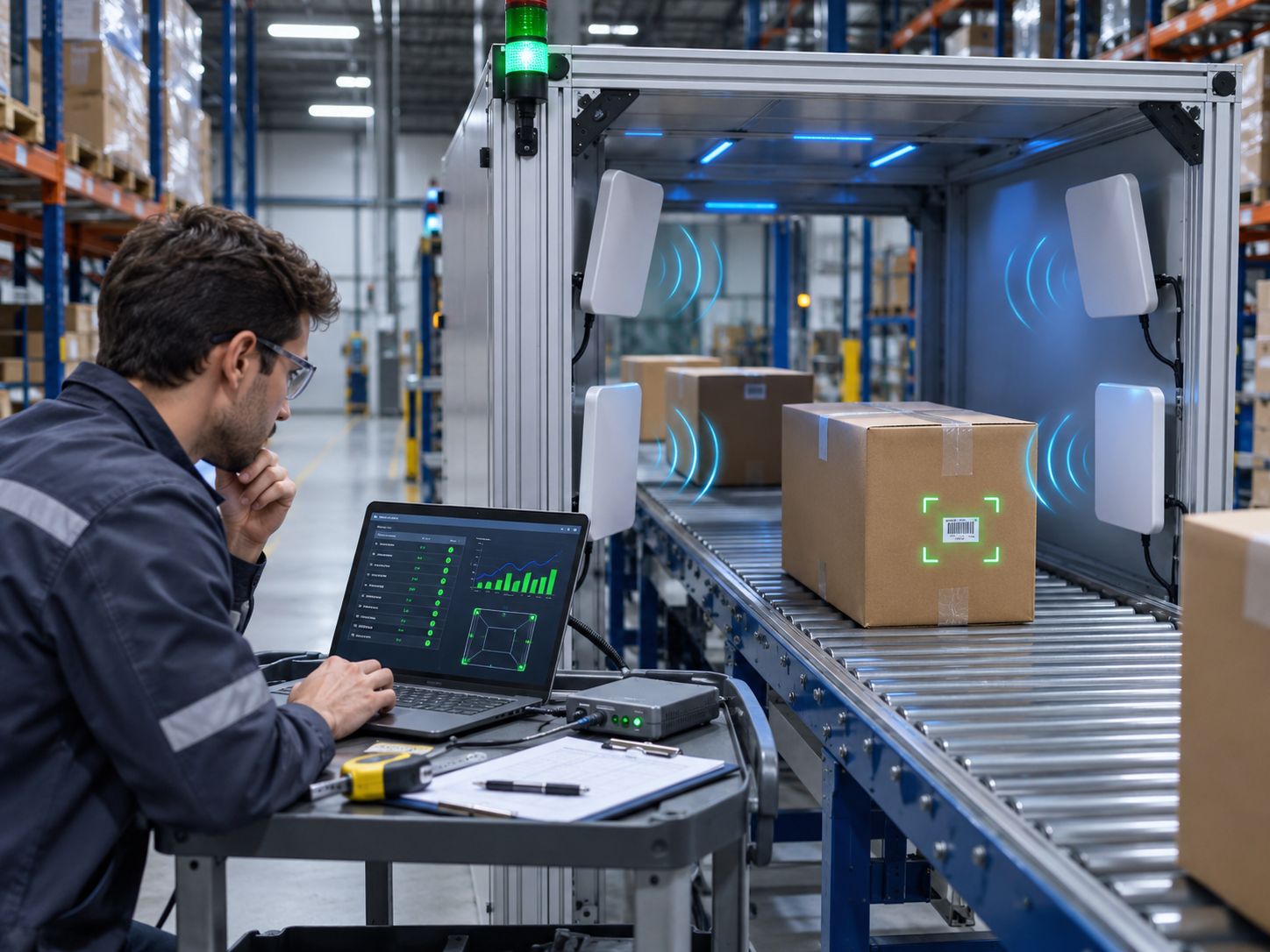
A missed read occurs when an expected tag is not captured during the intended scan. A cross-read occurs when the scan captures a tag outside the intended carton or read session. A system can appear to read many tags successfully while still producing incorrect carton-level results if cross-reads are not controlled.
Antenna placement, RF power, shielding details, tag dwell time, and the timing of trigger signals all influence results. Changing conveyor speed can alter the opportunity for each tag to be inventoried. Any tuning should be evaluated against both missing EPCs and unexpected EPCs.
Define acceptance criteria before testing. Useful measures include:
| Metric | What it measures | Why it matters |
|---|---|---|
| Expected EPC capture rate | Share of expected unique EPCs captured during the appropriate session | Detection reliability |
| Unexpected EPC rate | Identifiers captured that should not belong to the session | Read-zone control |
| Carton verification accuracy | Correct pass/exception decisions against independently checked contents | Business result accuracy |
| End-to-end throughput | Completed cartons per minute including handling and exceptions | Production-line fit |
| Exception recovery time | Time needed to review and reprocess a flagged carton | Operational impact |
| System availability | Uptime and recovery behavior during normal operations | Long-term process stability |
Test representative full and partial cartons, different item mixes, the most difficult tag orientations, repeated runs, and adjacent cartons. Separate the results caused by physical packing errors from the results caused by RFID reading or software configuration. A claimed 100% scan success under one test setup should not be generalized to all future production conditions.
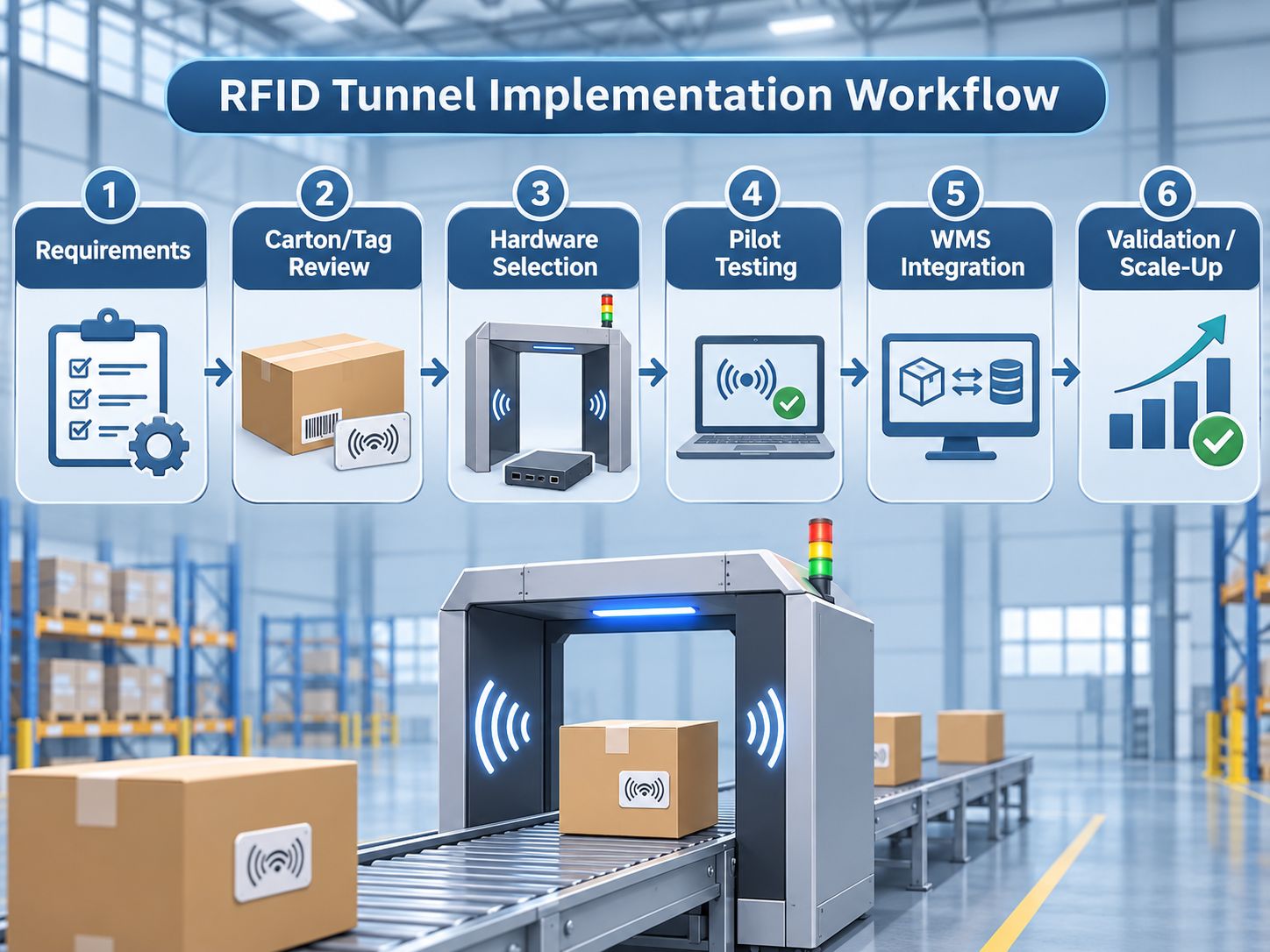
A staged project is easier to validate and maintain than an immediate full-line rollout.
Decide whether the primary goal is inbound checking, outbound order verification, inventory capture, or another process. Specify whether the application needs exact serialized EPC matching, SKU-based counts, or another acceptance rule.
Record the maximum carton size, weight, contents, tag specification, encoding quality, packing density, and number of tags. Collect sample cartons representing normal and difficult cases.
Choose between automatic conveyor, semi-automatic, or enclosed static-reading equipment. Define scanning-zone dimensions, antenna configuration, local frequency compliance, safety interfaces, and the controls needed for pass/exception handling.
Test the proposed machine at the intended workflow speed. Record both expected and unexpected EPCs, verify each scan result against known carton contents, and adjust the configuration systematically.
Connect scan sessions with carton IDs and expected-order records in the host system. Validate duplicate handling, retries, network outages, operator overrides, and any mechanical divert or hold mechanism.
Roll out after the agreed performance criteria are met. Document the reader settings, approved carton/tag configurations, software versions, operator procedures, and ongoing maintenance requirements. Revalidate performance when packaging, tag placement, or conveyor layouts change.
Yes, under suitable conditions. Passive UHF RFID does not require optical line of sight, so compatible item tags can be captured through cardboard. Results still depend on the tags, product materials, packing density, antenna configuration, and scan duration.
That depends on the machine, tags, contents, and scan conditions. Selected Syncotek models publish a capability of more than 200 tags per reading cycle, but the number of reliably captured EPCs in a particular carton must be confirmed through representative testing.
An RFID tunnel generally creates a relatively controlled scanning zone for cartons or contained goods. A portal is commonly used at an open passage or dock door to detect tagged logistics units as they move through. Selection depends on the objects, space, and required verification process.
It can support that process when the items have usable individual RFID identifiers and the host software has a reliable expected-item reference. A missing EPC may indicate an absent item or an unread tag; the system needs exception handling to distinguish those causes.
They can be a strong fit for item-level tagged apparel and footwear in distribution centers. Tag positioning, packing orientation, and the number of items inside each carton should be evaluated in the real workflow.
Published read-cycle and cartons-per-minute figures differ by model. For example, the Syncotek SR-RUX237 publishes a 3–5-second read cycle and 5–6 boxes per minute under its stated configuration. The actual line throughput also depends on carton handling, verification, and exception processing.
Yes, provided the model and integration layer support the required communication interfaces. The hardware supplies RFID reads, while software associates scan sessions with cartons and compares observed data against order or inventory records.
Begin with the largest expected carton, including its real transport orientation, plus its maximum weight. Then verify the machine's maximum passable box dimensions, handling capacity, read-zone performance, and workflow compatibility. Physical clearance alone does not establish reliable RFID performance.
No universal guarantee is appropriate. Even a well-designed system should be tested with the actual tag types, packaging materials, carton density, movement, and operating conditions. Evaluate missed reads, unintended reads, and the accuracy of the final order-verification decision separately.
RFID tunnels can help logistics and retail operations capture item-level RFID data and automate carton-verification checkpoints, but effective deployments rely on more than the tunnel enclosure. Reliable results require suitable tags, controlled read zones, well-defined scan sessions, accurate expected-order data, and practical exception workflows.
Syncotek offers automatic, semi-automatic, enclosed, and cart-type RFID tunnel reader solutions for different carton and warehouse processes. Explore the SR-RUX237 for conveyor-based carton capture, the SR-RUX234 for semi-automatic scanning, or the SR-RUX221 for heavier static-reading workflows.
To discuss a project, contact Syncotek with your maximum carton dimensions and weight, typical and maximum tag count, product materials, cartons-per-minute target, required frequency region, existing conveyor details, and WMS/ERP interface requirements. These details provide a practical basis for hardware selection and a representative pilot test.
 Knowledge
Choosing an RFID printer is not just about buying a machine that can print labels. In real deployments, the printer, RFID labels, inlay position, ribbon, application environment, and encoding workflow all have to work together. If any one of those elements is mismatched, you can end up with failed encoding, poor print quality, wasted labels, […]
READ MORE Knowledge
To read RFID means to use an RFID reader to detect a tag and retrieve data stored on it (an ID, EPC, UID, or user memory). With passive tags, the reader also provides the RF energy the tag needs to respond. The “how” depends on the RFID type: NFC / HF (13.56 MHz): very short-range […]
READ MORE Knowledge
What is a handheld barcode scanner? A handheld barcode scanner (also called a barcode reader) is an optical device that reads printed (or on-screen) barcodes and sends the decoded data to a computer, POS system, mobile device, or industrial controller. Typical scanners include a light source, optics/sensor, and decoder circuitry to interpret the barcode pattern and output the […]
READ MORE Knowledge
RAIN RFID and Bluetooth Low Energy can both be used to track physical assets, but they solve fundamentally different problems. A warehouse manager may ask: Which of our 5,000 tools and assets are currently present? A hospital may ask: Which room is this mobile equipment currently in? A data center may ask: Which servers are […]
READ MORE Knowledge
Large events require thousands of physical interactions to happen accurately and quickly. Attendees must receive valid credentials, enter through the correct gates, access the areas included in their ticket, attend sessions, purchase food or merchandise, interact with sponsors, and leave the venue safely. At the same time, organizers need visibility into: ticket validation attendee arrival […]
READ MOREIf you are interested in our services or need customized solutions, please feel free to contact us.