
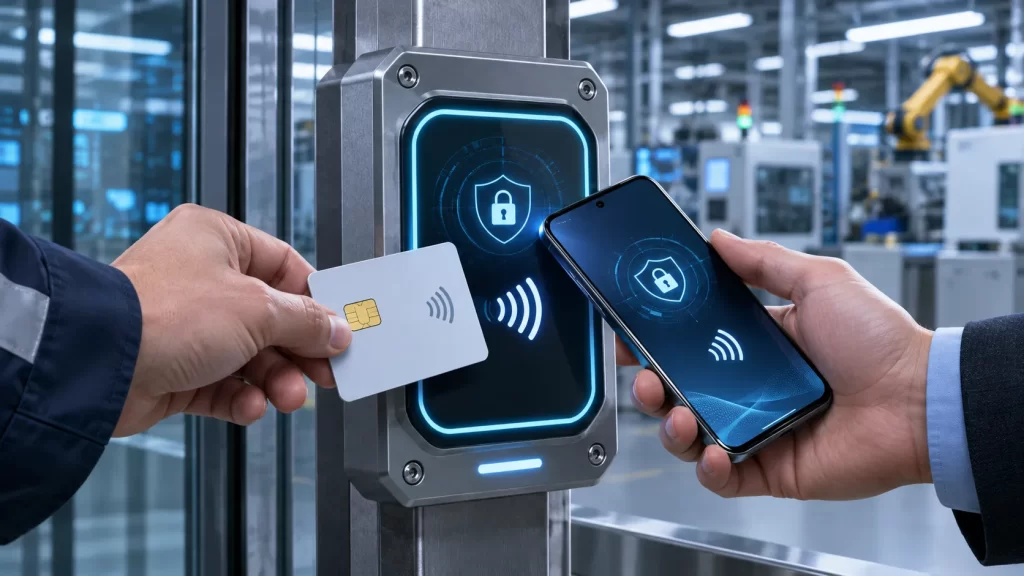
Near Field Communication (NFC) allows phones, smart cards, and readers to exchange data through a short-range wireless interaction. It is used in contactless access control, payments, ticketing, product authentication, smart packaging, and connected devices. Its short operating range is convenient, but it is not a complete security mechanism.
NFC security depends on the complete system: the tag or card, reader, application, network connection, backend, and the way cryptographic keys are managed. A basic tag that stores a public URL has very different security capabilities from a cryptographic smart card that supports mutual authentication and protected messaging.
This guide explains common NFC attacks, how secure NFC tags and readers reduce risk, and what buyers and system integrators should evaluate when building an NFC solution.
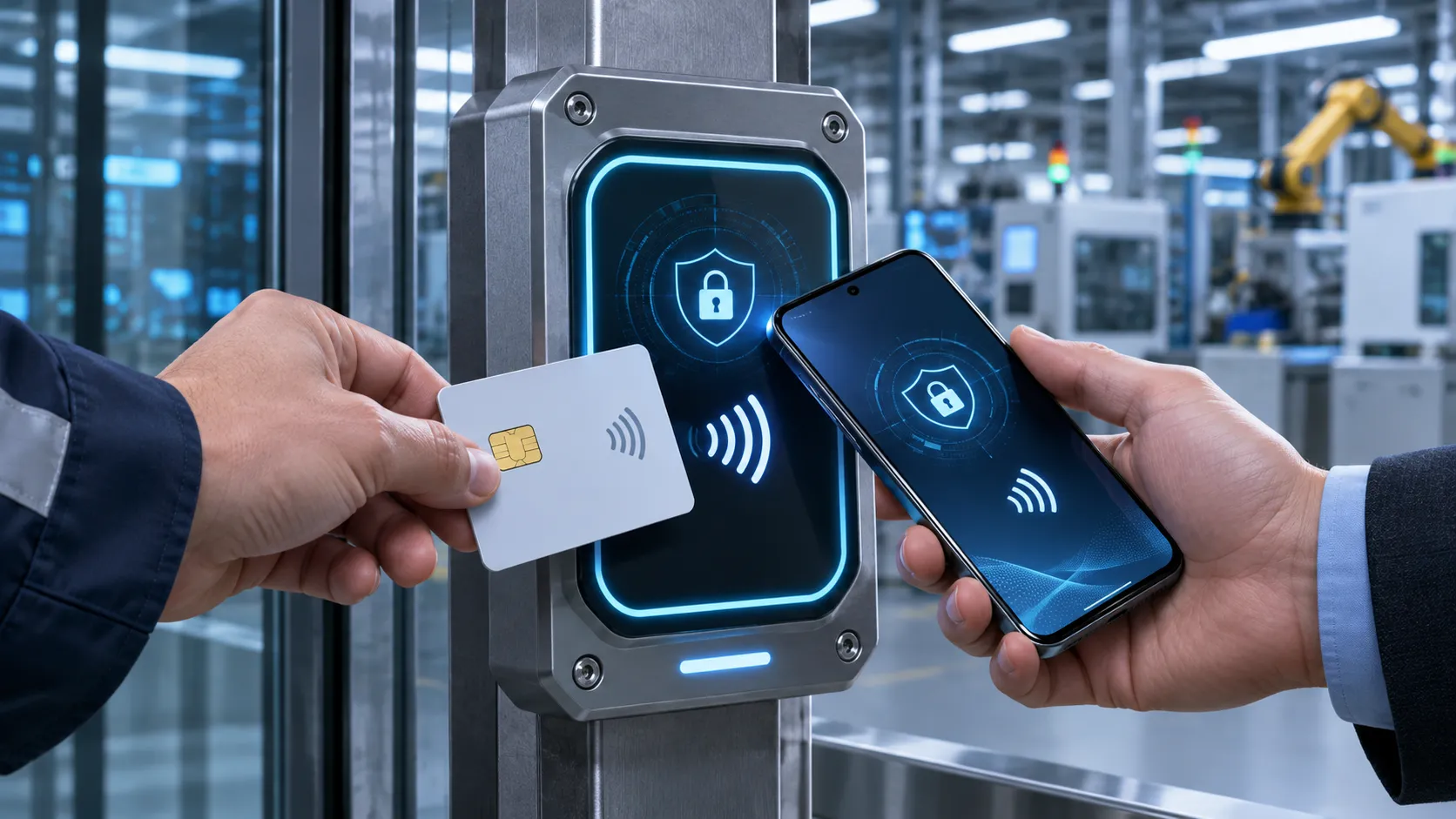
NFC can be used in secure systems, but NFC communication alone does not guarantee that data, devices, or transactions are protected. Security depends on the tag or card, reader, chip capabilities, application design, and backend verification.
NFC operates at 13.56 MHz and is designed for close-range communication. Short range can reduce casual exposure, but it does not replace authentication or encryption. Attackers may use specialized equipment, exploit weak application logic, or relay communication between devices.
A secure NFC deployment should answer four questions:
No. Short range is a useful physical characteristic, not a security guarantee. Actual communication distance depends on the antenna, reader, tag design, environment, and device configuration. A relay attack can forward communication between a legitimate card or phone and a reader through separate devices, without requiring the attacker to directly read the credential from a long distance.
Treat NFC's short range as one layer of risk reduction. Authentication, transaction authorization, secure messaging, and server-side validation are still necessary when an application handles access rights, payments, identity, or valuable products.
NFC is a communication technology. Payment security is a complete system involving the payment card or mobile wallet, secure hardware and software, the payment terminal, transaction cryptography, payment networks, and issuer controls.
A contactless payment transaction may use tokenization, cryptograms, transaction limits, and other controls that are not automatically present in an ordinary NFC tag interaction. A basic NFC sticker that opens a website does not inherit the security properties of a mobile payment wallet simply because both use NFC.
NFC systems commonly involve an NFC-enabled device or reader communicating with a tag, smart card, or another NFC device. Depending on the application, the exchange may involve an identifier, NDEF data, stored files, commands, or a cryptographic authentication process.
NFC is closely related to HF RFID and operates at 13.56 MHz. For background, see What Is NFC? and What Is HF RFID?.

An NFC tag may store a URL, text, contact information, application data, or other records in an NFC Data Exchange Format (NDEF) message. Many inexpensive tags are designed for straightforward reading and writing rather than strong cryptographic authentication.
A reader may retrieve a tag identifier or memory content and pass it to an application. If the application treats that information as proof of identity without checking authenticity, an attacker may be able to copy or imitate the data.
NDEF is a data format, not an encryption or authentication method. Storing a URL in an NDEF record does not make the URL trustworthy, and storing an asset number does not prove that the tag is attached to the genuine asset.
A standard NFC tag may be sufficient for public information, product instructions, or a simple link. A secure NFC tag is needed when an application must verify authenticity, protect sensitive data, restrict access, or detect unauthorized duplication.
| Capability | Basic NFC Tag | Cryptographic NFC Tag or Smart Card |
|---|---|---|
| Store a URL or identifier | Common | Supported |
| Read public data | Common | Supported, depending on configuration |
| Restrict writing | May support locking or password features | May support access conditions and cryptographic controls |
| Mutual authentication | Not generally available | Available on supported chips and protocols |
| Cryptographic message authentication | Not generally available | Available on supported products |
| Dynamic authentication data | Usually not available | Available on selected secure tags |
| Anti-counterfeiting | Limited on its own | Can support stronger verification when correctly implemented |
Check the exact chip, supported algorithms, authentication flow, memory access controls, key diversification options, and vendor documentation. The product name alone is not enough to determine security.
A secure NFC system normally combines several layers:
A weakness in any one layer can undermine the overall deployment.
The following threats are relevant to NFC-based access, identification, product authentication, and connected-device applications. Not every attack applies to every tag or system; practical risk depends on the chip, protocol, application, and deployment.
Eavesdropping occurs when an unauthorized party attempts to capture information exchanged between an NFC device and a reader. Close-range communication makes casual interception more difficult, but it does not guarantee confidentiality.
How to reduce the risk:
A relay attack forwards communication between a legitimate NFC device and a reader through an intermediary. The reader may believe that an authorized card or device is nearby even though the communication is being relayed from another location.
This is different from simply copying a tag. The attacker may not need to know the secret key or extract protected data; the attack attempts to extend or forward a valid exchange.
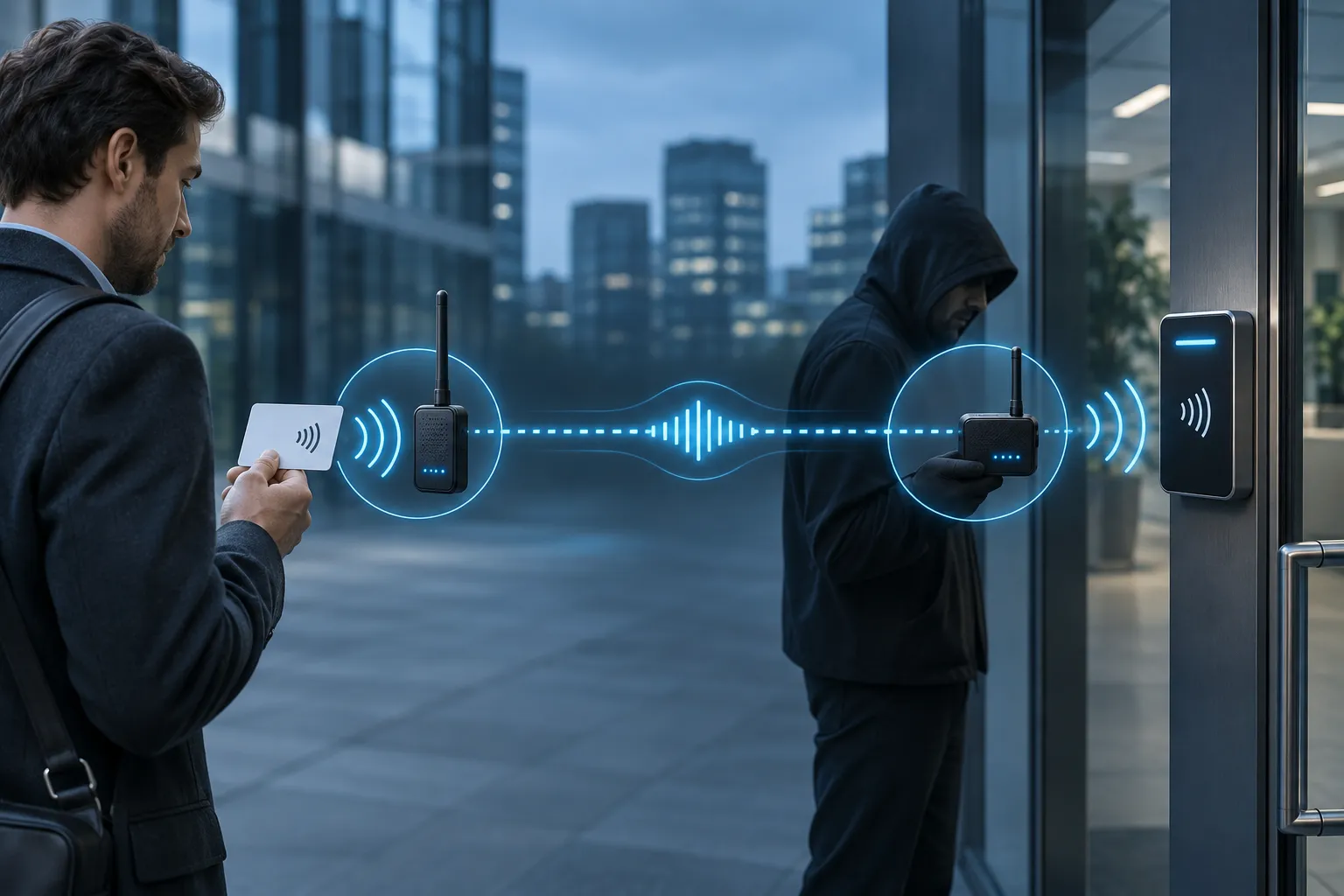
How to reduce the risk:
NIST identifies NFC relay man-in-the-middle activity as a mobile threat and recommends user authorization for relevant transactions and disabling NFC or unused NFC applications when they are not needed. These measures reduce exposure but should be combined with system-level authentication and risk controls.
Tag cloning means copying data from one NFC tag to another. Emulation means making a device or programmable component behave like a tag or card. Feasibility depends on the tag technology and security controls.
If a system grants access based only on a static identifier or publicly readable data, copying that information may be enough to impersonate the original tag. A UID should not automatically be treated as cryptographic proof of authenticity.
How to reduce the risk:
An NFC tag can contain a URL or other data that causes a phone or application to open a link or perform an action. A malicious tag may be placed over a legitimate tag, attached to a public poster, or distributed as a counterfeit product label.
The risk often comes from what the phone or application does with the data, rather than from the NFC radio exchange itself.
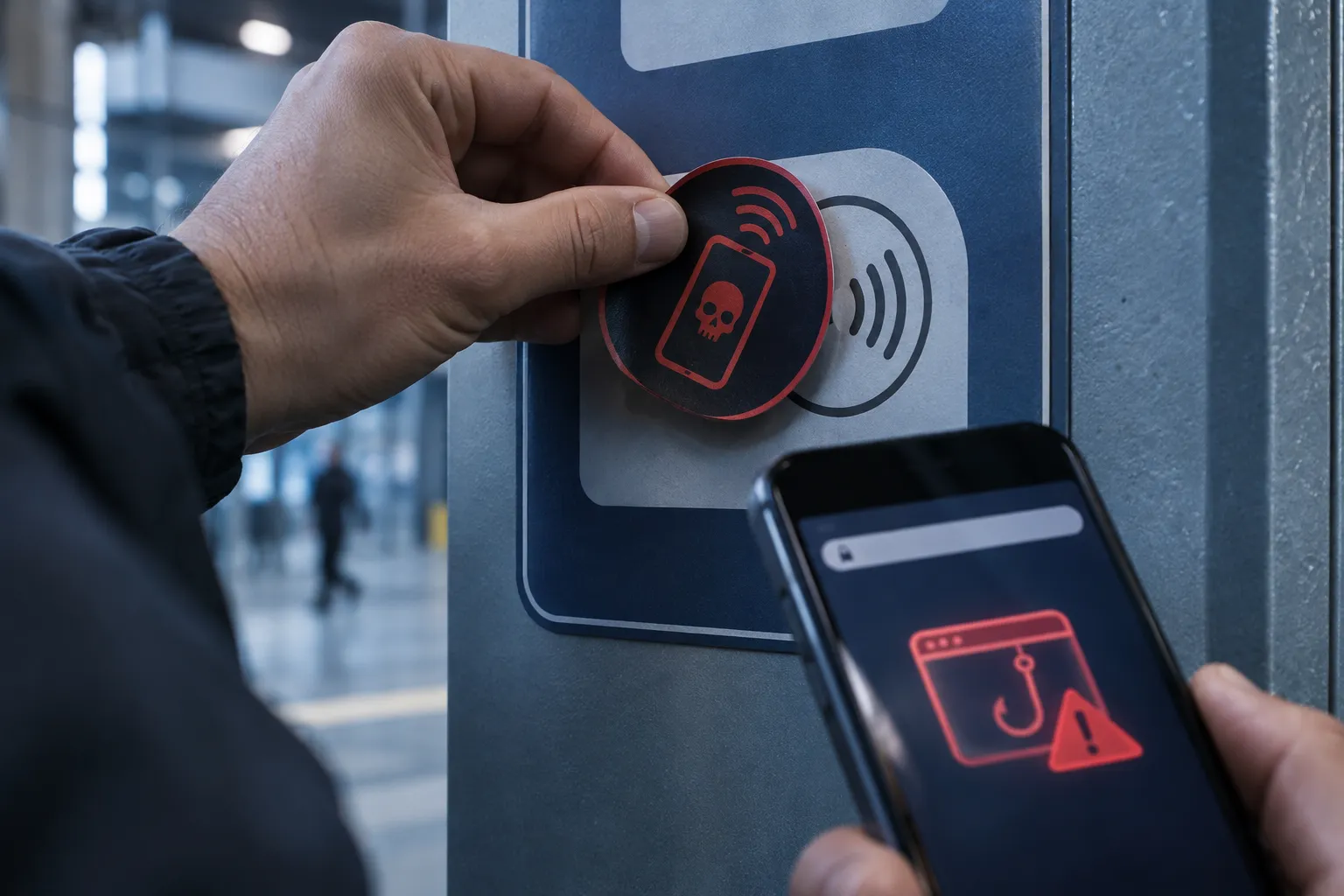
How to reduce the risk:
A read-only tag can reduce unauthorized rewriting through ordinary commands, but read-only status does not prove that the tag is genuine or that its content has not been copied.
If a tag's memory is writable without adequate access control, an attacker may change a URL, product identifier, configuration value, or other stored data. The impact depends on how the application uses that data.
How to reduce the risk:
A replay attack captures a previously valid message or response and attempts to reuse it later. Systems that rely on fixed, repeatable data are more exposed than systems that verify fresh cryptographic challenges.
How to reduce the risk:
A lost access card, smartphone, handheld reader, or provisioning device can expose an organization to unauthorized use. The risk increases when devices are not protected by user authentication or credentials cannot be revoked quickly.
How to reduce the risk:
Secure NFC applications should use authentication mechanisms that prove a tag or card possesses the expected cryptographic secret. Encryption protects confidentiality, while message authentication helps detect unauthorized changes. These functions are related but not interchangeable.

AES-128 is a symmetric-key cryptographic algorithm used in a number of secure NFC products. The tag and authorized system use cryptographic keys to authenticate messages or protect data.
Using AES-128 does not automatically make an entire NFC system secure. The implementation must also protect keys, use suitable authentication procedures, prevent replay, and validate messages correctly.
In mutual authentication, both sides participate in proving their identity or possession of the required cryptographic credentials. This is stronger than a design in which the reader simply accepts a static tag identifier.
A typical high-level process is:
The exact sequence and security properties depend on the chip and protocol. Follow the manufacturer's security documentation rather than implementing a custom cryptographic protocol.
Some secure NFC tags generate changing authentication data when read. A backend can verify the cryptographic value and determine whether it was generated by a genuine tag with the expected key.
Dynamic data can make simple copying of a static URL or identifier insufficient for successful verification. The backend must still validate the message correctly, protect keys, and handle counters or replay conditions according to the product's design.
A Secure Element (SE) is a protected environment for storing and using sensitive credentials. A Secure Access Module (SAM) is a security component used in some reader architectures to support cryptographic operations and key protection.
A SAM can help keep application keys out of ordinary host software, but its presence alone does not make a deployment secure. The system still needs sound key provisioning, access control, firmware protection, backend validation, and a defined process for key rotation and revocation.
A strong algorithm cannot compensate for exposed or poorly managed keys. A production NFC system should define how keys are generated and provisioned, whether keys are diversified, who can access key-management functions, how keys are stored, and how they are rotated, revoked, and recovered.
For larger deployments, consider a dedicated key-management system or hardware security module (HSM), with access restricted to authorized services and personnel. Never embed production master keys in ordinary application code or distribute one unrestricted key across every reader and tag.
Different NFC products are designed for different levels of protection. The correct choice depends on whether the application needs public data sharing, basic write protection, access control, product authentication, or secure credential storage.
Basic NFC tags are suitable for public URLs, product instructions, simple identification, and smart posters. Some products support password protection or memory locking, but these features should not be confused with strong cryptographic authentication.
Use a basic tag when the information is not sensitive and copying the tag would not create a meaningful security or financial risk.
Secure contactless smart cards can support cryptographic authentication, protected file access, and secure messaging. They are commonly considered for access control, identity, transport, and other applications where a static identifier is not sufficient.
The security features vary by card family and configuration. Check the supported algorithms, key structure, authentication modes, and certification information for the exact card product.
NXP's NTAG 424 DNA is an example of a secure NFC tag designed for applications that require stronger authentication and data protection. NXP lists AES-128 cryptography, Secure Unique NFC (SUN) message authentication, three-pass mutual authentication for protected data access, and protected communication over the contactless interface.
These capabilities can support product authentication and trusted connected-product experiences. They do not remove the need for secure backend verification and appropriate key management.
A useful selection principle is to match the tag's actual security features to the threat model. Do not select a secure tag solely because its product name includes the word "secure."
The security requirements differ by application. A public product-information tag does not need the same controls as an employee credential or a secure industrial configuration tag.
Payment systems require transaction-level protections beyond the NFC interface. These may include tokenization, cryptographic transaction data, device authentication, transaction authorization, and controls provided by the payment ecosystem.
An ordinary NFC tag should not be used as a substitute for a certified payment credential or payment terminal.
Access-control systems should authenticate credentials rather than rely only on a card's visible number or static UID. The system should support credential revocation, access schedules, role-based permissions, event logging, and secure communication between readers and controllers.
For higher-security deployments, evaluate the card's cryptographic capabilities, reader security, controller interfaces, and the way keys are managed across the system.
NFC can connect a physical product to a digital record. However, a copied static URL or tag identifier can be reused by counterfeit products.
Secure tags with dynamic authentication data can help a backend distinguish genuine tag responses from simple copies. Product authentication should also consider tag attachment, tamper evidence, packaging integrity, backend records, and the process for handling suspicious scans.
Industrial NFC applications may identify tools, machines, maintenance records, calibration status, or service history. If the tag only points to public or non-sensitive information, a basic tag may be sufficient.
If an NFC interaction can change machine settings, authorize maintenance, or grant access to restricted information, use stronger authentication and application authorization. Do not allow an unverified tag payload to trigger a privileged operation.
Healthcare deployments may use NFC for equipment identification, patient-related workflows, sample tracking, or access to digital records. Sensitive personal or medical information should not be stored as openly readable tag content.
Use the tag as a reference or authenticated credential, and retrieve protected information from an authorized application or backend after checking user permissions.
NFC tags in packaging can provide product information, warranty registration, usage instructions, and authenticity checks. A simple URL tag may be sufficient for public content, while anti-counterfeiting applications need stronger verification.
For high-value products, consider cryptographic tags, dynamic authentication, tamper-evident placement, and server-side checks that can identify repeated or geographically unusual scans.
An NFC reader is an important part of the security boundary. It communicates with the tag or card and passes information to the host application. A secure design must protect both the reader and the data path beyond it.
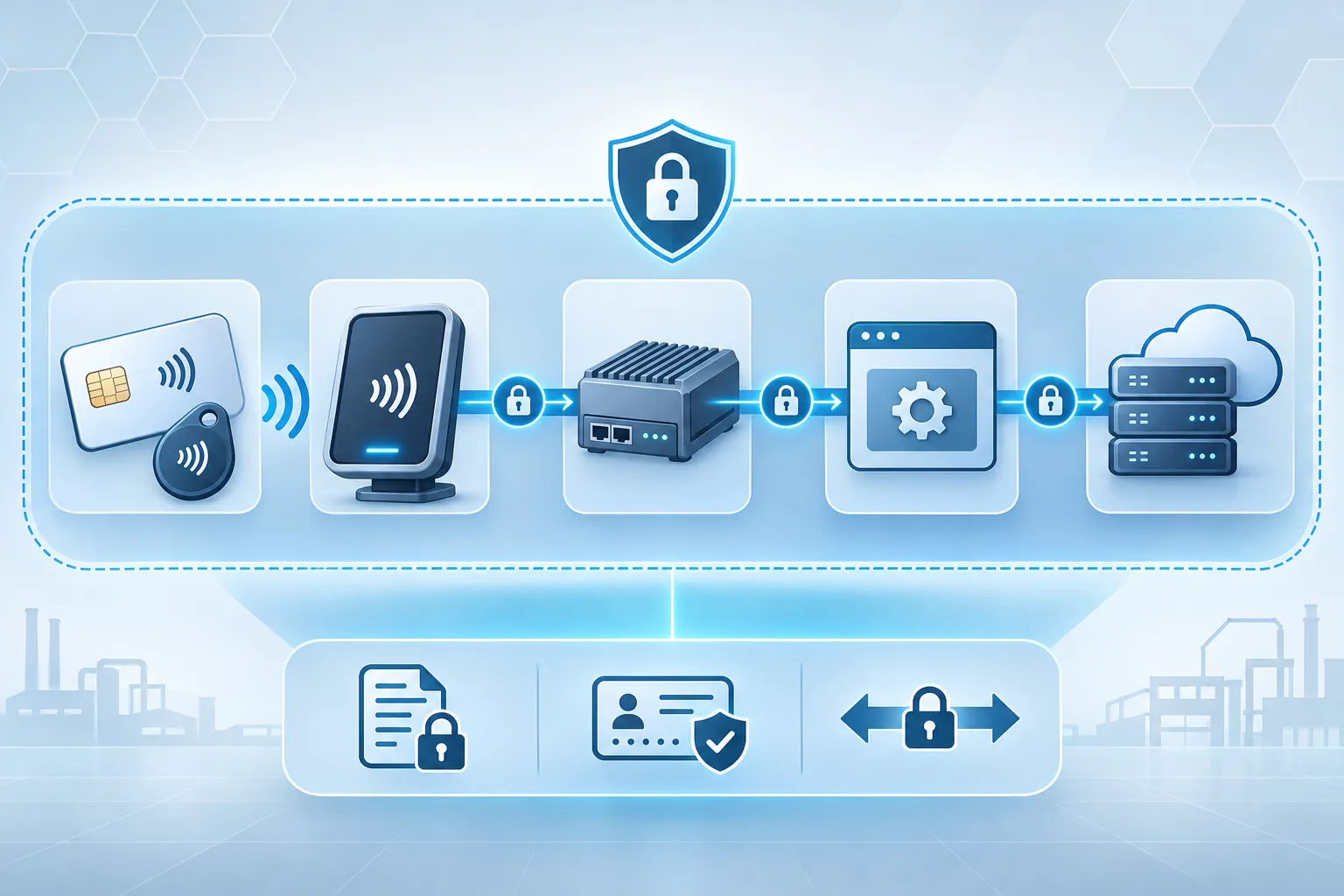
The reader should not automatically trust every tag it detects. Where authenticity is required, the reader or host application should run the tag's supported authentication procedure and verify the result.
Some applications also need to authenticate the reader to the card or tag. This can prevent unauthorized readers from accessing protected data or performing privileged commands, depending on the chip's capabilities.
Readers may connect to a host through USB, serial, or other interfaces. Protect the host application, operating system, driver, and local communication path. Restrict access to reader-management functions and avoid exposing sensitive commands to untrusted software.
For network-connected readers, use authenticated and encrypted communication with the application server. Keep firmware and software updated through a controlled process.
Some reader designs include SAM slots for security applications. A SAM can support secure storage and cryptographic operations, depending on the SAM product, reader integration, and application design.
Before selecting a reader with SAM support, verify the SAM type, supported commands, integration method, key-management model, and whether the application software can use the security functions required by the project.
The backend should verify authentication results, enforce permissions, detect replay or duplicate activity, and maintain audit records. A reader should not grant access merely because it has received a syntactically valid identifier or URL.
A robust architecture separates credential data, cryptographic keys, user permissions, and business logic. This makes it easier to revoke credentials, investigate abnormal activity, and update security policies.
A secure NFC deployment starts with the application's risks and requirements, not with the selection of a tag or reader alone.

Identify what the NFC interaction is allowed to do. Is it displaying public information, identifying an asset, opening a door, authenticating a product, or authorizing a transaction?
List the consequences of a copied tag, modified data, lost card, compromised reader, or unavailable backend. This threat assessment determines which security controls are necessary.
Choose the chip according to the required standard, memory, authentication method, encryption, write protection, operating environment, and expected service life.
For public information, a basic tag may be adequate. For access credentials or anti-counterfeiting, consider a product that supports cryptographic authentication and protected data access.
Confirm that the reader supports the tag or card technology, communication standard, operating mode, and required security functions.
Check the interface, driver, SDK, host platform, antenna arrangement, SAM support if needed, and the reader's operating environment. A reader that can read a tag is not necessarily capable of performing every authentication or secure-messaging operation required by the application.
Use the security mechanisms supported by the selected chip and protocol. Define how the reader and tag authenticate, which data is protected, how messages are verified, and how the system handles failed authentication.
Avoid custom cryptography. Use the manufacturer's documented security procedures and established protocols.
Create a controlled process for key generation, diversification, provisioning, storage, rotation, revocation, and recovery. Separate development and production keys, limit administrative access, and record key-management operations.
Test more than the normal tap interaction. Include unauthorized tags, copied data, repeated messages, modified NDEF records, lost credentials, network interruption, reader replacement, and backend failure.
Verify that the system rejects invalid authentication and that security events are logged. Test with the actual tags, readers, mobile devices, operating systems, and application software planned for deployment.
Track authentication failures, unusual scan patterns, duplicate credentials, firmware status, reader health, and access events. Define procedures for replacing tags, revoking credentials, updating firmware, and responding to suspected compromise.
Security is an ongoing operational process, not a one-time configuration.
Use this checklist when preparing an NFC project specification or requesting a reader and tag recommendation.
| Evaluation Area | Questions to Confirm |
|---|---|
| Application | What action does an NFC scan authorize or trigger? |
| Tag or card | Which chip and protocol are used? |
| Authentication | Is static identification sufficient, or is cryptographic authentication required? |
| Encryption | Which data needs confidentiality and protected messaging? |
| Anti-cloning | Does the chip support dynamic authentication or other anti-cloning controls? |
| Reader | Does the reader support the required tag, card, and authentication functions? |
| SAM | Is a SAM required? Which module and commands are supported? |
| Key management | How are keys generated, stored, diversified, rotated, and revoked? |
| Backend | Are credentials and transactions verified by a trusted service? |
| Interfaces | Are USB, serial, Ethernet, or other interfaces protected appropriately? |
| Software | Are drivers, SDKs, firmware, and operating systems supported? |
| Testing | Have cloning, replay, relay, tampering, and failure scenarios been evaluated? |
| Operations | How are lost cards, compromised readers, and security updates handled? |
NFC can be used in secure applications, but the technology alone does not guarantee security. Protection depends on the tag or card, reader, authentication, encryption, application logic, key management, and backend verification.
Some NFC tags can be copied or emulated, especially when a system relies only on static, publicly readable data. Secure NFC products can make cloning more difficult by using cryptographic authentication and dynamic data. The exact protection depends on the chip and system implementation.
A tag that exposes public data may be readable by a compatible nearby NFC device. Passwords, access controls, or cryptographic features can restrict access on supported tags. Do not store sensitive information in plain text on a tag simply because it is used at close range.
NFC is designed for close-range communication, but attacks can involve malicious tags, compromised applications, specialized equipment, or relay devices. A relay attack forwards communication between a legitimate card or device and a reader; it does not necessarily require the attacker to be physically next to both endpoints.
An NFC relay attack uses intermediary devices to forward communication between a genuine NFC credential and a reader. The reader may accept the relayed exchange as if the credential were nearby. User authorization, protocol-supported anti-relay controls, transaction checks, and backend risk controls can help reduce the risk.
Not every NFC application needs encrypted communication. A public tag that stores a public website address may not need confidentiality. Applications involving access credentials, identity, sensitive data, or valuable products should evaluate authentication, message integrity, encryption, and backend verification according to their threat model.
NFC is a short-range technology within the HF RFID family, while RFID also includes other frequency bands and use cases. Security depends on the tag, protocol, reader, and application rather than the name of the technology alone. See RFID vs. NFC for a broader comparison.
A normal NFC tag may store readable data and may offer basic write-protection features. A secure NFC tag can provide stronger controls such as cryptographic authentication, protected data access, secure messaging, or dynamic authentication values. Always verify the specific chip's documented features.
Not every NFC reader requires a SAM. A SAM may be useful when the application needs protected key storage or cryptographic operations in the reader. Whether it is required depends on the credential, security architecture, and system requirements.
Read-only configuration can prevent ordinary rewriting of the tag, but it does not prove that the tag is genuine or prevent its content from being copied. Applications that need authenticity should use suitable cryptographic verification.
Selecting an NFC reader requires more than checking the supported frequency. Buyers and system integrators should confirm the card protocols, authentication functions, host interface, software compatibility, SAM requirements, and the reader's role in the overall security architecture.
Syncotek's SK-AR2 NFC PC/SC Smart Card Reader supports ISO/IEC 14443 Type A and B cards, ISO/IEC 18092 NFC, PC/SC, and CCID. Its product information also lists two SAM slots with provision for two additional slots. These are reader capabilities; the security level of a finished system still depends on the selected cards, SAM configuration, key management, application software, and backend.
For mobile applications, the SR-RU605 handheld RFID reader lists NFC as an optional function alongside its UHF RFID capabilities. Confirm the required NFC configuration and protocol support for the intended deployment.
Explore the Syncotek RFID reader range or contact our team to discuss NFC reader integration, smart card compatibility, OEM requirements, and project-specific configurations.
 Knowledge
Hospitals manage large fleets of reusable medical equipment that move continuously between wards, treatment areas, equipment stores, operating theatres and maintenance departments. Infusion pumps, patient monitors, wheelchairs, beds and mobile carts can be difficult to locate when equipment is shared across departments or when inventory records are updated manually. RFID medical equipment tracking uses electronic […]
READ MORE Knowledge
An oilfield equipment yard may contain thousands of valuable assets: drilling pipes, industrial valves, pumps, generators, heavy tools, pressure-control equipment, and reusable assemblies. These assets move between storage areas, inspection stations, maintenance facilities, drilling sites, and rental customers. Yet equipment availability is not always easy to determine. A yard supervisor may need to answer several […]
READ MORE Knowledge
An RFID system may work perfectly during initial testing and then behave very differently after it is installed in a warehouse, factory, smart cabinet or production line. Common symptoms include: tags read intermittently expected read distance becomes shorter several tags on a pallet are consistently missed tags outside the intended area are detected a system […]
READ MORE Knowledge
What Is Load Modulation? Load modulation is the uplink method used by most HF RFID and NFC tags to send data back to a reader in the near field. The tag does not generate its own RF carrier. Instead, it changes its electrical load across the tag coil, and that change is coupled back into the reader’s magnetic […]
READ MORE Knowledge
ARC RFID certification is a common phrase used by buyers and suppliers looking for RFID tags that meet major end-user requirements. In practice, the Auburn University RFID Lab ARC Program is more specific: it defines application-based performance specifications, benchmarks passive UHF RFID inlays against those specifications, and publishes approved inlay lists. A separate ARC Quality […]
READ MOREIf you are interested in our services or need customized solutions, please feel free to contact us.