

Can an RFID tag tell you exactly where an asset is right now?
The correct answer is:
Sometimes — but it depends completely on the RFID architecture.
Not every RFID tracking system is a real-time locating system.
A passive UHF RFID system may tell you:
Asset A was detected at Warehouse Door 3 at 14:42.
A rack-level RFID system may tell you:
Server B is currently detected inside Rack R12.
An active RFID or Bluetooth location system may tell you:
Medical Cart C is currently in Zone B.
A UWB RTLS may be designed to calculate continuously updated physical coordinates.
All four systems can be described as "tracking," but they provide very different levels of location visibility.
This distinction is important because many RFID projects become unnecessarily expensive — or fail to meet expectations — when inventory, checkpoint tracking, zone presence and precise real-time location are treated as the same requirement.
The correct starting question is therefore not:
Which RFID tag provides the longest range?
It is:
What level of location visibility does the business actually need?
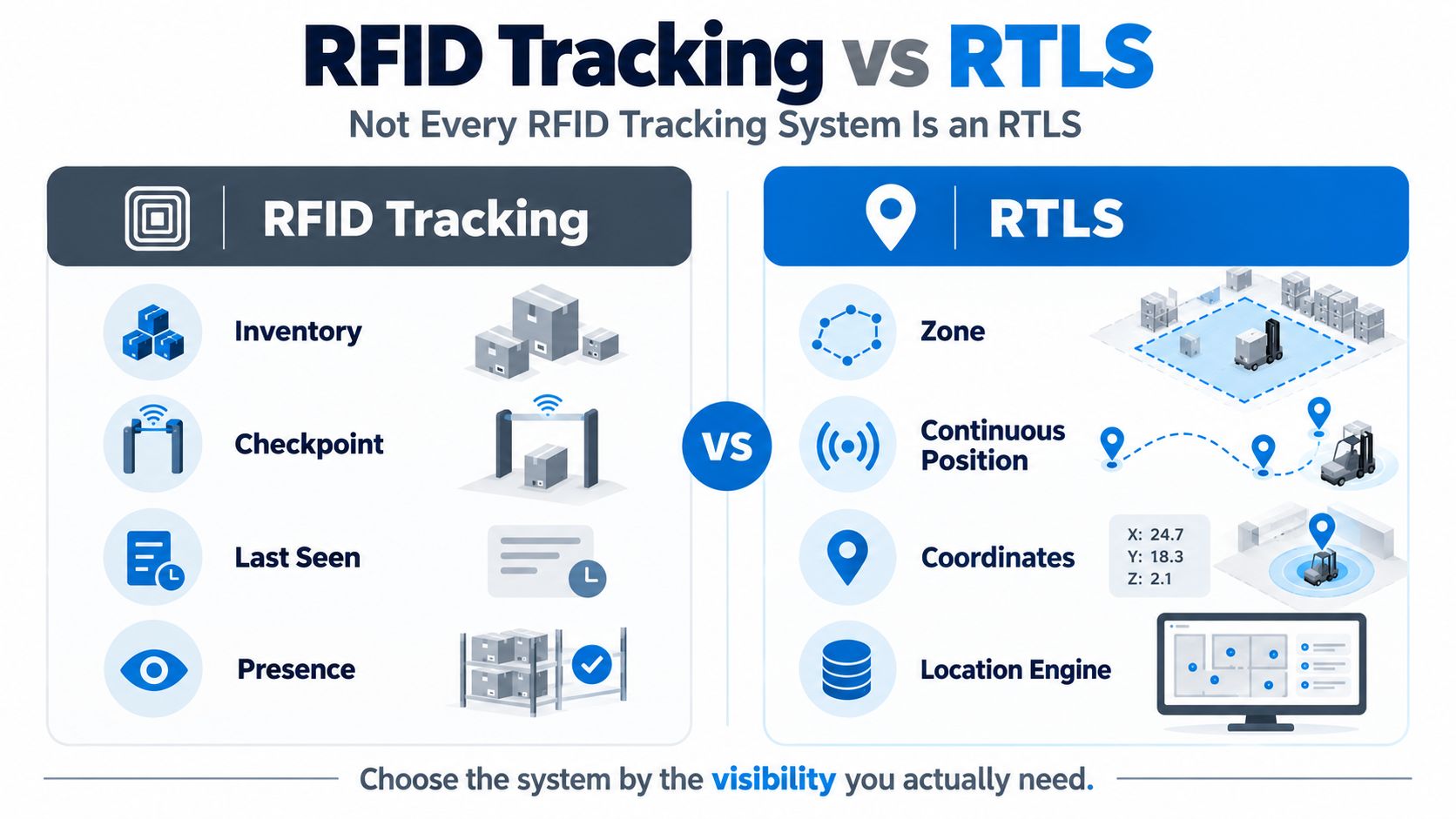
RFID tracking and RTLS overlap, but they are not identical.
| Capability | Passive RFID Tracking | RTLS |
|---|---|---|
| Asset identification | Strong | Strong |
| Bulk inventory | Strong | Possible |
| Checkpoint detection | Strong | Strong |
| Last-seen location | Strong | Strong |
| Presence / controlled zone | Possible | Strong |
| Continuous updates | Architecture-dependent | Core capability |
| Exact coordinates | Not standard | Possible |
| Location engine | Often unnecessary | Usually required |
| Passive battery-free tag | Yes | Depends on technology |
| Powered tag | Not required | Common |
| Large low-cost populations | Strong | More expensive |
A useful summary is:
RFID Tracking
often answers:
What is present?
What crossed this point?
Where was this asset last detected?
while:
RTLS
is designed to answer:
Where is this asset now?
possibly with continuously updated position information.
One reason RFID and RTLS discussions become confusing is that real-time is used to describe several different capabilities.
A worker scans an area with a handheld RFID reader.
Within seconds, the application displays:
This is real-time data capture.
But it is not continuous location tracking.
A tagged asset moves through an RFID portal.
The system immediately records:
Tool T102 crossed Tool Room Exit at 10:18.
Again, that event occurred in real time.
But the system does not necessarily know where the tool went afterward.
A specialized reader continuously monitors a:
The system may report:
Asset A is currently present in Zone 4.
This is much closer to continuous location visibility.
An RTLS continuously processes radio measurements to estimate:
and updates asset location as it moves.
That is the meaning most users expect when they hear:
Real-Time Location System.
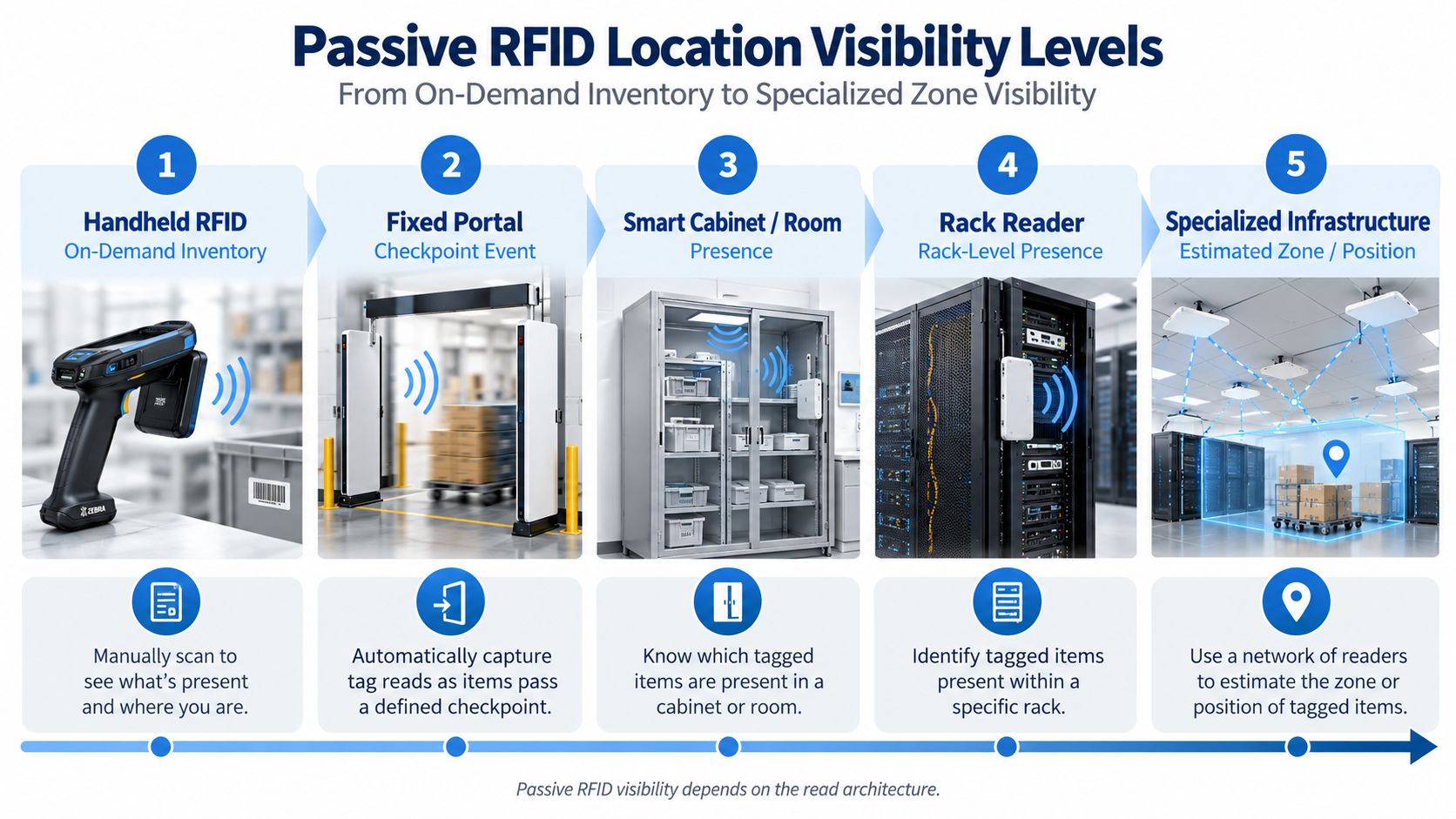
Passive RFID does not provide only one type of tracking.
Its visibility depends heavily on the reader infrastructure.
A useful model is to think of passive RFID as five levels.
A user carries a handheld UHF RFID reader.
The application asks:
Which tagged assets are currently around me?
This provides:
but only while the operator is scanning.
There is no continuous monitoring when the handheld reader is not present.
A fixed reader is installed at:
When a tag passes the read point, the system records:
Asset ID
This creates:
Asset A passed Door 4 at 15:10.
This is often called:
checkpoint tracking
or:
last-seen tracking.
If antennas continuously monitor a controlled physical space, the system can maintain a current list of tags believed to be inside.
For example:
Smart Cabinet A
Current Inventory:
This is more continuous than a simple doorway event.
Specialized RFID infrastructure can monitor individual racks.
For example:
Rack R12
Currently Detected:
The system can therefore maintain continuously updated:
rack-level presence
without claiming exact coordinates.
This architecture is particularly useful in data centers.
More sophisticated systems may use:
to estimate:
However, this should not be confused with a universal passive RFID capability.
The result depends heavily on:
Passive UHF / RAIN RFID is primarily an identification technology.
GS1 describes passive UHF / RAIN RFID as operating in the 860–930 MHz range and being mainly used for fast asset identification, inventory and tracking.
A passive tag does not normally know where it is.
Instead:
Reader Location Is Known
RFID Tag Is Detected
=
Asset Location Context
For example:
Reader:
WAREHOUSE-DOOR-3
Tag:
EPC-10428
Timestamp:
14:42
Software can infer:
EPC-10428 was detected at Warehouse Door 3 at 14:42.
That is extremely useful operational information.
But it does not mean:
EPC-10428 is currently at coordinates X=18.5, Y=4.2.
This is one of the most important RFID location concepts.
Suppose an antenna is mounted at:
Dock Door 7
and it reads a pallet tag.
What do you know?
You know:
The tag entered the effective RF read zone associated with Dock Door 7.
You do not automatically know:
unless additional infrastructure and algorithms are being used.
This is why read-zone design matters so much in passive RFID.
Handheld RFID readers often include asset-search functions.
The user selects:
Asset A102
and walks through the facility.
The reader may display stronger signal feedback as the user approaches the tag.
This is useful for finding:
But the process still requires:
Human Search
Therefore, it is better described as:
Proximity-Assisted Asset Search
rather than:
Real-Time Location System
The asset did not continuously report its position before the operator started searching.
Fixed readers are one of the strongest passive RFID architectures for physical asset movement.
Consider a tool room.
Tagged Tool
↓
Tool Room Exit
↓
Fixed RFID Reader
↓
Timestamp + Tool ID
↓
Asset Management System
The software may generate:
Torque Wrench TW-102 left Tool Room A at 11:28.
This is often enough to solve the actual business problem.
The company may not care where the wrench is every second.
It may only need to know:
If that requirement can be solved with checkpoint RFID, a full RTLS may be unnecessary.
Checkpoint infrastructure naturally creates:
Last Seen
data.
For example:
Asset:
Pump P104
Last Reader:
Maintenance Door 2
Last Seen:
2026-10-02 13:42
This does not guarantee the pump is still physically beside that doorway.
It means that was the latest known RFID event.
For many workflows, this is still extremely valuable.
Data centers provide a useful example of passive RFID location visibility without full RTLS.
If dedicated RFID infrastructure is installed around a rack, the system may continuously confirm whether tagged equipment is present.
This can answer:
Which physical server is in Rack R12?
without requiring:
What are its continuous XYZ coordinates?
The distinction is important.
In many business processes:
Correct rack
is the useful location.
Precision coordinates provide little extra operational value.
For a deeper example, see the Syncotek guide:
RFID Data Center Asset Tracking
Smart cabinets provide another controlled environment.
If a cabinet contains dedicated antennas and controlled power levels, the system can repeatedly inventory the contents.
It can answer:
Which medical supplies or tools are currently inside Cabinet A?
This is a form of:
continuous presence detection
but still not necessarily RTLS.
Yes, specialized systems can estimate tag position using multiple reader observations.
Possible measurement inputs include:
Software can combine those measurements to estimate:
However, passive UHF RF environments can be complex.
Metal structures, people, shelves and walls can create reflections and multipath.
Therefore:
Three ordinary RFID readers do not automatically create a precise triangulation system.
The full location architecture must be designed and validated for that purpose.
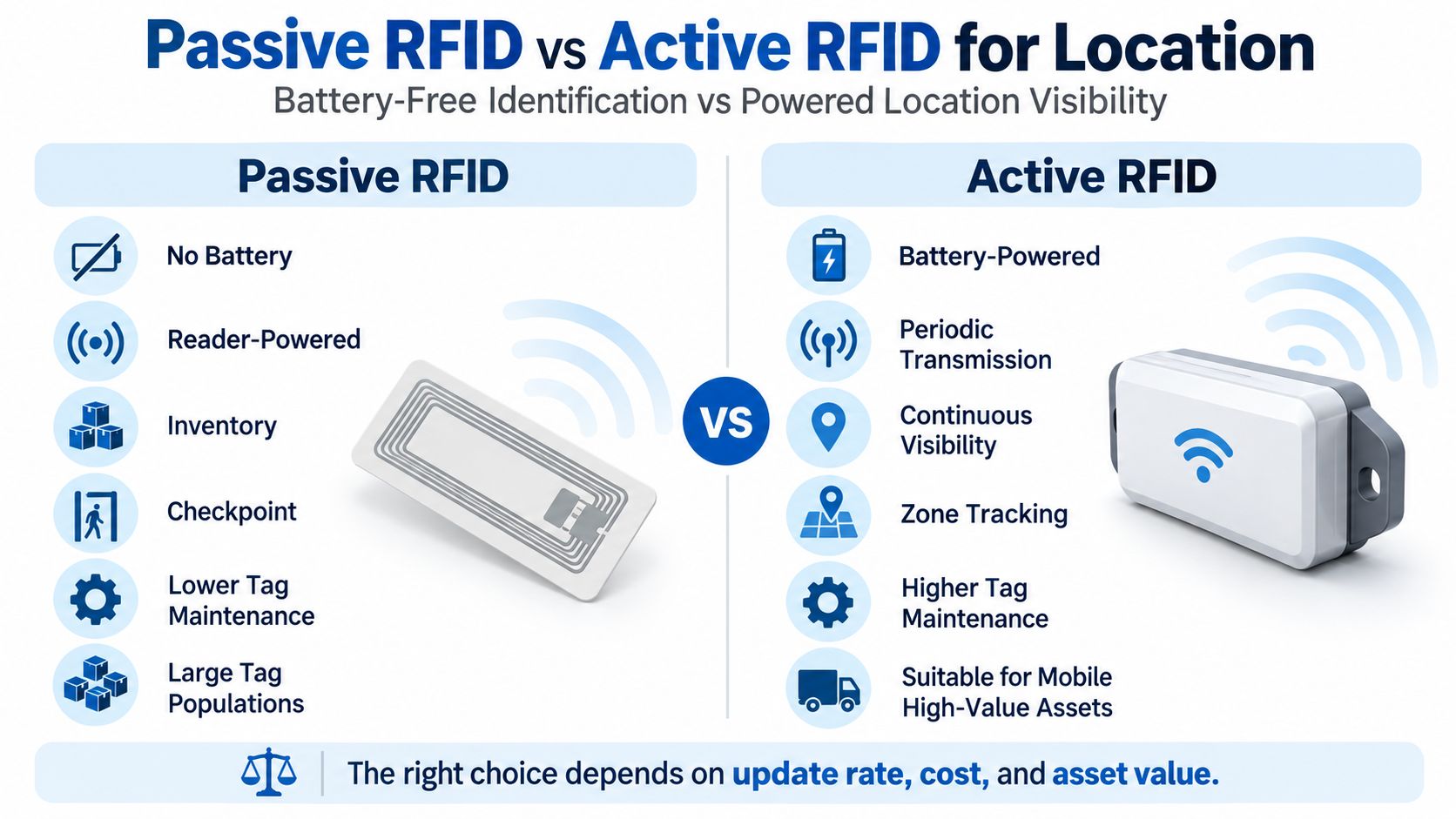
Passive and active RFID operate very differently.
| Factor | Passive RFID | Active RFID |
|---|---|---|
| Internal battery | No | Yes |
| Communication | Reader-powered / backscatter | Powered transmission |
| Tag maintenance | Low | Battery lifecycle required |
| Inventory | Excellent | Different architecture |
| Bulk low-cost tagging | Strong | Less attractive |
| Checkpoint detection | Excellent | Strong |
| Continuous transmission | No | Yes |
| Zone tracking | Possible | Strong |
| RTLS suitability | Specialized architecture | More natural |
| Tag cost | Lower | Higher |
| Mobile high-value assets | Possible | Strong fit |
An active RFID tag contains its own power source.
A simplified architecture is:
Battery-Powered Tag
→ Periodic RF Transmission
→ Receivers / Gateways
→ Location Engine
→ Asset Platform
Because the tag can transmit independently, the system can receive repeated observations without first energizing the tag from a passive reader.
This makes active technologies more natural for:
However, the tradeoff includes:
The economics change dramatically with asset count.
Consider:
Using a powered tag may be reasonable if continuous location saves significant operational time.
Managing:
can become far more difficult.
If the business only requires:
passive RFID can be much more attractive.
The term:
RFID RTLS
can sometimes create confusion because several powered wireless technologies can support real-time location.
Modern location architectures may use:
The best choice depends on:
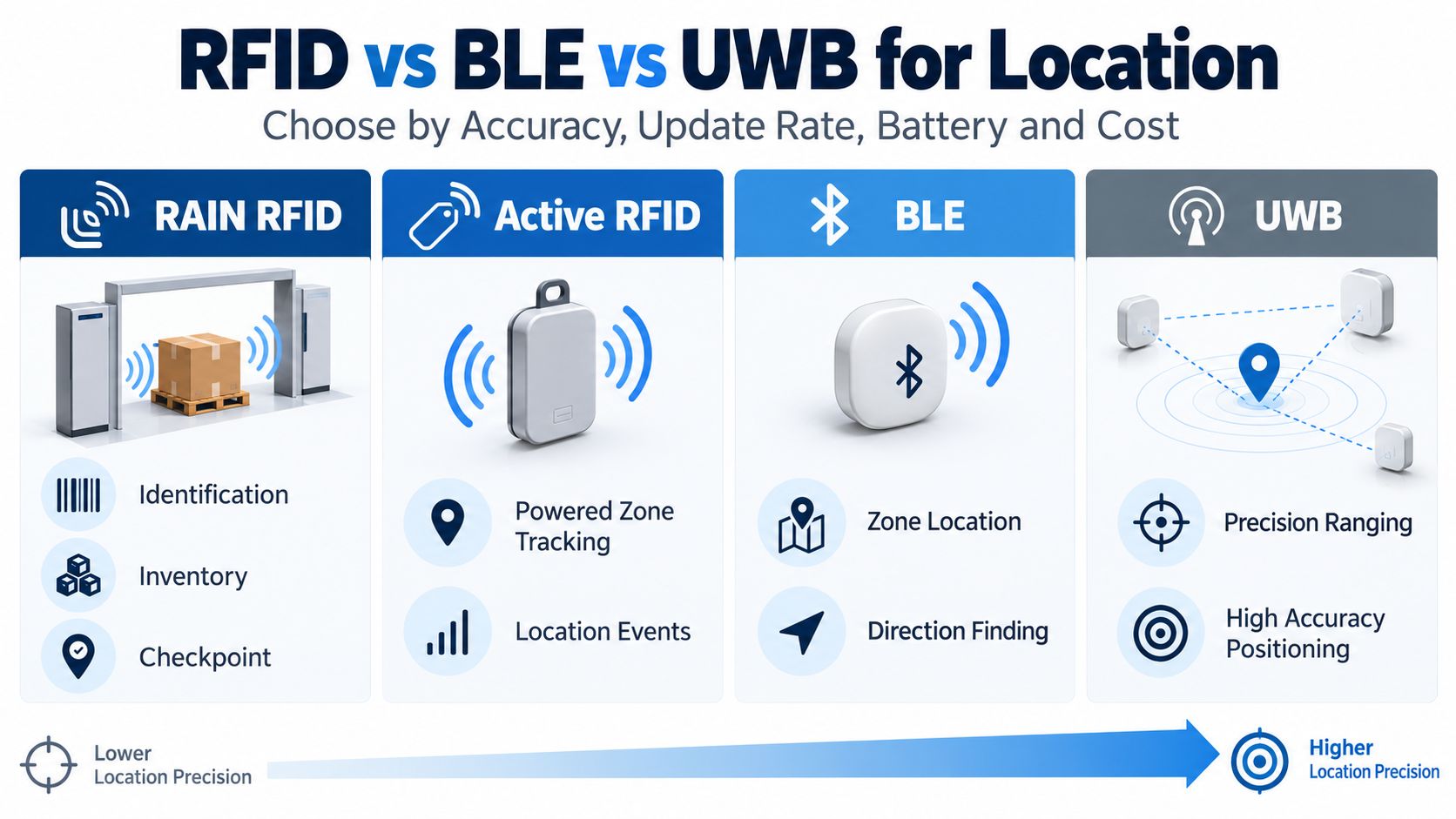
A simplified comparison is:
Best aligned with:
Useful for:
BLE is widely used in RTLS asset tracking.
Bluetooth SIG specifically lists real-time locating systems for assets and people as a major Bluetooth location-services use case.
With Bluetooth Direction Finding, systems can use:
for high-accuracy indoor positioning. Bluetooth SIG states that appropriate Direction Finding systems can reach centimeter-level location accuracy.
UWB is designed around precise ranging and positioning.
FiRa describes UWB positioning as using techniques such as:
for precise location.
Current FiRa specifications also include UL-TDoA specifically for infrastructure-based asset tracking.
The important point is not which technology is universally "best."
It is:
Which location capability does the project require?
Do not ask only:
How accurate is RFID?
Instead ask:
Which system architecture are we discussing?
For example:
Visibility:
Presence / Search
Visibility:
Checkpoint
Visibility:
Controlled Presence
Visibility:
Rack-Level Presence
Visibility:
Estimated Zone / Position
Visibility:
Zone / Position
depending on infrastructure.
Visibility:
Precision Ranging / Positioning
FiRa describes modern UWB as supporting precise ranging and positioning across factory, warehouse, hospital and other industrial environments.
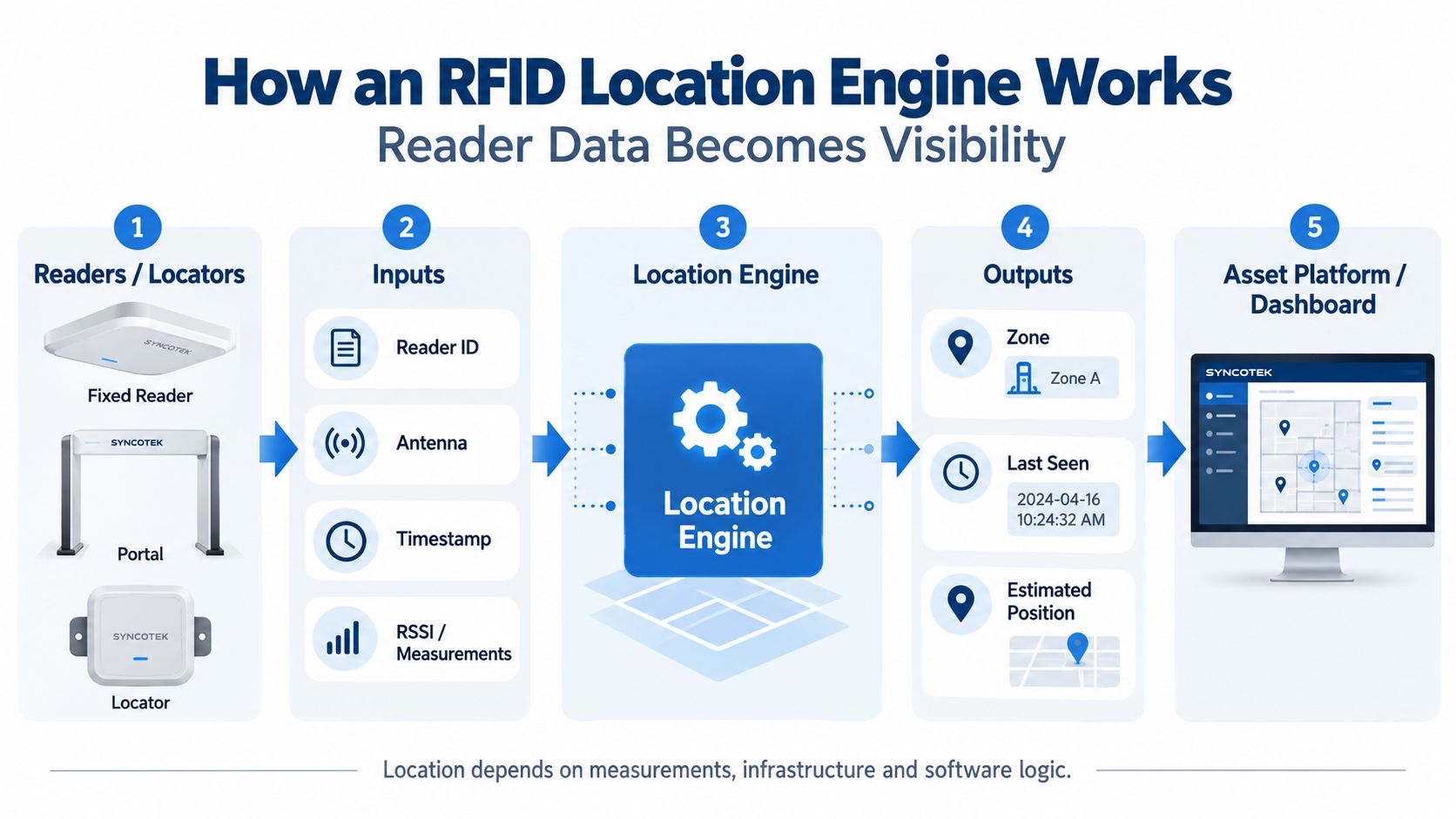
A location engine converts radio observations into useful location information.
A simplified architecture is:
Readers / Locators
↓
Measurements
↓
Location Engine
↓
Zone / Last Seen / Estimated Position
↓
Asset Platform
Depending on technology, inputs may include:
Software may apply:
The application may receive:
The location engine is one reason RTLS is more than simply installing tags and readers.
Raw data:
Reader A saw EPC 1042
must be given physical context.
The application needs to know:
Reader A
=
Warehouse Door 4
Only then does the RFID observation become:
EPC 1042 was last detected at Warehouse Door 4.
In more advanced systems, the location engine must combine multiple measurements.
This mapping layer is fundamental.
RTLS design is not only about accuracy.
Another important requirement is:
How often must location update?
Possible requirements include:
The required update rate affects:
A hospital cart search system may not require the same update frequency as:
A common mistake is to assume faster updates are always better.
If a customer only needs:
Which room contains this device?
an update every few minutes may be sufficient.
Increasing the frequency unnecessarily may:
Define the operational need first.
Many asset-management projects do not actually need full RTLS.
Business question:
Did the tool leave the controlled room?
Fixed RFID checkpoint tracking may solve the problem.
See:
RFID Tool Tracking
Question:
Which rack contains this server?
Rack-level RFID may be enough.
See:
RFID Data Center Asset Tracking
Question:
Which dock or partner last handled this tote?
Passive RFID checkpoint events may be ideal.
See:
RFID Tote Tracking
Question:
Which workstation is this production order currently at?
Readers installed at process transitions can provide excellent visibility.
See:
RFID WIP Tracking in Manufacturing
None of these applications necessarily require exact X/Y coordinates.
Other use cases have fundamentally different requirements.
Users may need to ask:
Where is the nearest available infusion pump right now?
Continuous zone or room location can significantly reduce search time.
Operations may need:
Systems may need to detect:
Navigation may require much higher location accuracy and faster updates.
In these cases, a dedicated RTLS architecture may be more appropriate than basic passive RFID.
RFID and RTLS systems can technically identify badges or devices carried by people.
However, people tracking creates additional requirements involving:
A system capable of tracking assets should not automatically be deployed for tracking people without a clearly defined business and privacy framework.
Passive RFID and RTLS technologies do not have to compete.
A valuable asset can use both.
For example:
used for:
used for:
Both identities can map to:
One Asset Record
in the backend.
This can create:
RFID
→ What asset is this?
plus
RTLS
→ Where is it now?
For a detailed technology comparison, see:
RAIN RFID vs BLE for Asset Tracking
False.
A longer RF range can actually make location interpretation more difficult because a reader may detect tags far outside the desired zone.
Controlled location systems often need:
smaller, predictable zones
rather than maximum range.
False.
Multiple reads alone do not guarantee reliable coordinates.
You need:
Not by default.
Passive RFID is primarily optimized for identification and inventory.
False.
A passive EPC tag used on retail inventory has a completely different architecture from a battery-powered location tag.
False.
Standard RFID identification tags do not automatically include sensors.
Temperature requires a dedicated:
False.
A system can report:
Asset detected at Door 4 now
in real time without knowing precise coordinates.
False.
RTLS describes a system capability.
The radio technology could be:
Start with passive RAIN RFID when the primary need is:
This is especially attractive when:
Tag Population Is Large
and:
Continuous Coordinates Are Not Required
A dedicated RTLS becomes more compelling when the business requires:
The value of this additional information should justify:
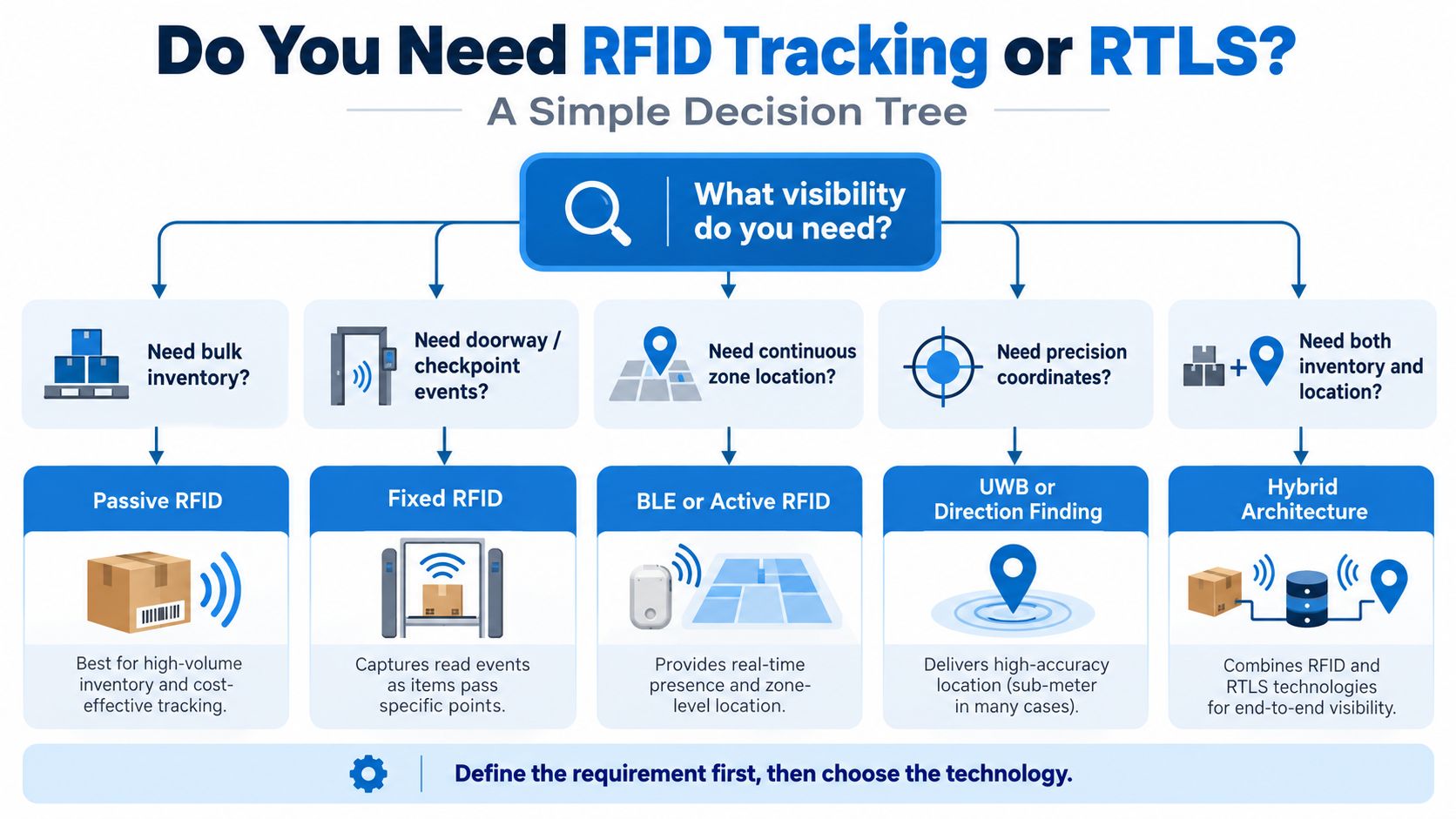
A simple decision process is:
Consider:
Passive RFID
Consider:
Fixed RFID
Consider:
Passive RFID with dedicated fixed infrastructure
Evaluate:
BLE / Active RFID / RTLS
Evaluate:
UWB
or:
Bluetooth Direction Finding
depending on application requirements.
Consider:
Hybrid RFID + RTLS
Do not start by asking vendors:
What is your maximum range?
Start with operational requirements.
Examples:
What assets are present?
Which doorway did the asset cross?
Which room contains the asset?
What are its coordinates?
Do you need:
These create very different architectures.
How frequently must the location change in software?
100 assets?
10,000?
1 million?
Tag quantity changes the economics dramatically.
Can the organization:
over the lifetime of the system?
Include:
Determine:
Examples:
Use:
Do not validate RTLS entirely on an empty test bench.
The most sophisticated system is not automatically the best system.
If checkpoint RFID solves the operational requirement reliably, there may be no reason to deploy precision RTLS.
Before selecting technology, confirm:
RFID RTLS generally refers to a real-time location architecture that uses RFID or related radio-tag technologies as part of a location system. However, not every RFID system qualifies as RTLS.
Yes, depending on the architecture. Passive RFID can provide real-time inventory, checkpoint events and controlled presence, while powered RFID or other RTLS architectures are better suited to continuous location.
Specialized passive RFID infrastructure can estimate zone or position, but conventional passive RFID should not automatically be treated as a precise RTLS.
Not normally. Standard UHF / RAIN RFID is primarily used for identification, inventory and tracking rather than continuously calculated exact coordinates. GS1 describes RAIN RFID primarily around fast identification, inventory and tracking.
Normally the reader or antenna location is known. When the tag is detected, software associates that read with the reader's physical location.
Ordinary passive RFID tags do not contain their own positioning system. They respond when interrogated by compatible readers.
Last-seen tracking records the most recent reader/location and timestamp where a particular RFID tag was detected.
Yes. Fixed RFID readers and antennas are commonly used to create controlled checkpoint read zones.
Yes, depending on reader placement and the ability to control the read zone. Room-level presence requires careful RF design.
Yes. Dedicated rack-level RFID architectures can determine which tagged equipment is present inside a known rack.
No. A handheld reader can perform inventory and proximity-assisted asset searching, but it does not continuously track assets while it is absent.
Specialized systems can combine observations from multiple readers to estimate position, but ordinary multiple-reader deployments do not automatically provide accurate triangulation.
Active RFID uses a tag with its own power source so it can transmit independently rather than relying entirely on reader-generated RF energy.
Passive RFID is attractive for large battery-free tag populations, inventory and checkpoints. Active RFID is more naturally suited to frequent transmissions and continuous location applications.
RAIN RFID is strong for identification and checkpoints. BLE is widely used for RTLS and supports advanced positioning methods such as Direction Finding.
Passive RFID is generally stronger for low-cost identification and checkpoint workflows. UWB is specifically designed around precise ranging and positioning and is used in real-time asset-location applications.
There is no single accuracy figure. It depends on whether the architecture uses handheld inventory, portals, controlled zones, specialized passive location infrastructure, active RFID or another RTLS technology.
A location engine processes measurements from readers or locators and converts them into outputs such as zone, last-seen point or estimated position.
No. RSSI is affected by walls, metal, people, reflections, antenna orientation and multipath.
RFID or RTLS badges can technically be used for personnel applications, but privacy, purpose, access control and local legal requirements must be considered.
Yes. Passive UHF / RAIN RFID tags operate without their own normal operating battery and receive energy from the reader field.
No. An event can be recorded instantly without providing precise physical coordinates.
RTLS becomes valuable when continuously updated asset location, room/zone visibility, route history or precise positioning creates meaningful operational value.
Syncotek provides passive UHF / RAIN RFID hardware for projects where the required visibility includes:
Our RFID hardware portfolio includes:
A typical passive RFID asset architecture may use:
RFID Tag
Handheld Reader
for inventory and asset search.
A more automated deployment may use:
RFID Tag
Fixed Reader
Antennas
for:
Syncotek focuses on the RFID identification and physical data-capture layer.
If a project's primary requirement is instead:
continuously calculate the position of every moving asset
then BLE, UWB, active RFID or another RTLS architecture should also be evaluated rather than forcing passive UHF RFID into the wrong role.
For an RFID visibility project, useful requirements include:
The most important question is not:
Can RFID track this asset?
It is:
How precisely, how frequently and at what cost do you actually need to know where the asset is?
Once that requirement is defined, it becomes much easier to choose between passive RFID tracking, controlled RFID presence, active location technologies and a full RTLS architecture.
 Knowledge
Active RFID is a type of radio frequency identification technology that uses battery-powered tags to transmit data to RFID readers. Because the tag has its own power source, it can send signals over a much longer distance than a passive RFID tag, which relies on the reader’s signal for energy. That is why Active RFID is commonly […]
READ MORE Knowledge
HF RFID runs at 13.56 MHz and is widely used for access control badges, contactless payments, libraries, healthcare wristbands, and NFC phone tap experiences. When people say “HF RFID,” they often mean very different things—because HF is a frequency band, while standards define the protocol stack (how tags and readers actually communicate). More about HF […]
READ MORE Knowledge
Choosing a UHF RFID fixed reader should not begin with one question: How far can this reader read? Maximum read distance is only one small part of a fixed RFID system. A reader that performs well at a warehouse dock door may be unnecessarily complex for a single workstation. A four-port reader can outperform a […]
READ MORE Knowledge
The RFID system auto-identifies vehicles' weight, calculates net weight, and provides real-time monitoring for optimized efficiency.
READ MORE Knowledge
RFID systems are designed to communicate wirelessly, which is exactly what makes them powerful in asset tracking, inventory management, logistics, access control, and identification workflows. But that same wireless behavior can also create problems. In some situations, you want RFID signals to move freely and read tags quickly. In others, you need to prevent unauthorized […]
READ MOREIf you are interested in our services or need customized solutions, please feel free to contact us.