

Digital Product Passports are changing the way manufacturers, brands, supply-chain operators, retailers, repairers, recyclers, and regulators think about product information.
Instead of product data remaining fragmented across ERP systems, spreadsheets, certificates, technical documents, service records, and recycling databases, a Digital Product Passport can connect a physical product with structured digital information that remains accessible throughout the relevant part of its lifecycle.
RFID can play an important role in this architecture.
However, one distinction needs to be clear from the beginning:
RFID is not the Digital Product Passport itself.
A Digital Product Passport, or DPP, is a digital information framework. RFID is one possible automatic identification and data-capture technology that can help identify a physical product, capture lifecycle events, and connect the product with digital systems.
In practice, an RFID-enabled DPP architecture may look like this:
Physical Product → Unique RFID Identity → RFID Reader → Enterprise System → DPP Platform → Authorized Product Information
This makes RFID particularly interesting for manufacturers and supply-chain operators that need more than consumer-facing access to information. RFID can automate identification during production, warehousing, logistics, retail, maintenance, reuse, and recycling.
A Digital Product Passport is a structured set of digital data associated with a product and accessible electronically through a data carrier.
Under the EU Ecodesign for Sustainable Products Regulation, or ESPR, a DPP is defined as product-specific data containing information required by the applicable product rules and accessible electronically through a data carrier. The regulation defines a data carrier broadly as a linear barcode, two-dimensional symbol, or another automatic identification and data-capture medium readable by a device.
Depending on the specific product regulation, DPP information may support areas such as:
Not every DPP will contain exactly the same information.
The actual required dataset will depend on the legislation and delegated act applicable to that product category.
Digital Product Passports are no longer only a future concept.
The European Commission's Digital Product Passport Registry became operational on July 20, 2026. The Registry provides infrastructure for DPP registration and supports integration through both a secure user interface and API.
At the same time, there is an important compliance distinction:
There is currently no general ESPR requirement saying that every product sold in the EU must already have a Digital Product Passport.
DPP obligations are being introduced product by product through specific EU rules and delegated acts. The European Commission explicitly states that the final legally binding requirements and compliance dates depend on product-specific legislation.
The first ESPR Working Plan provides an indicative roadmap including:
| Product Group | Indicative EU Timeline |
|---|---|
| Iron and steel | 2026 |
| Energy-related products | 2026–2029 |
| Textiles and apparel | 2027 |
| Tyres | 2027 |
| Aluminium | 2027 |
| Furniture | 2028 |
| Mattresses | 2029 |
| ICT products | 2029 |
These dates indicate when the Commission aims to develop or adopt relevant product rules. They should not automatically be treated as final mandatory compliance dates for every product in those categories.
For manufacturers planning RFID and DPP infrastructure, the practical lesson is clear:
Build an architecture that can adapt to product-specific DPP requirements instead of assuming one data format, one carrier, or one implementation will fit every product.
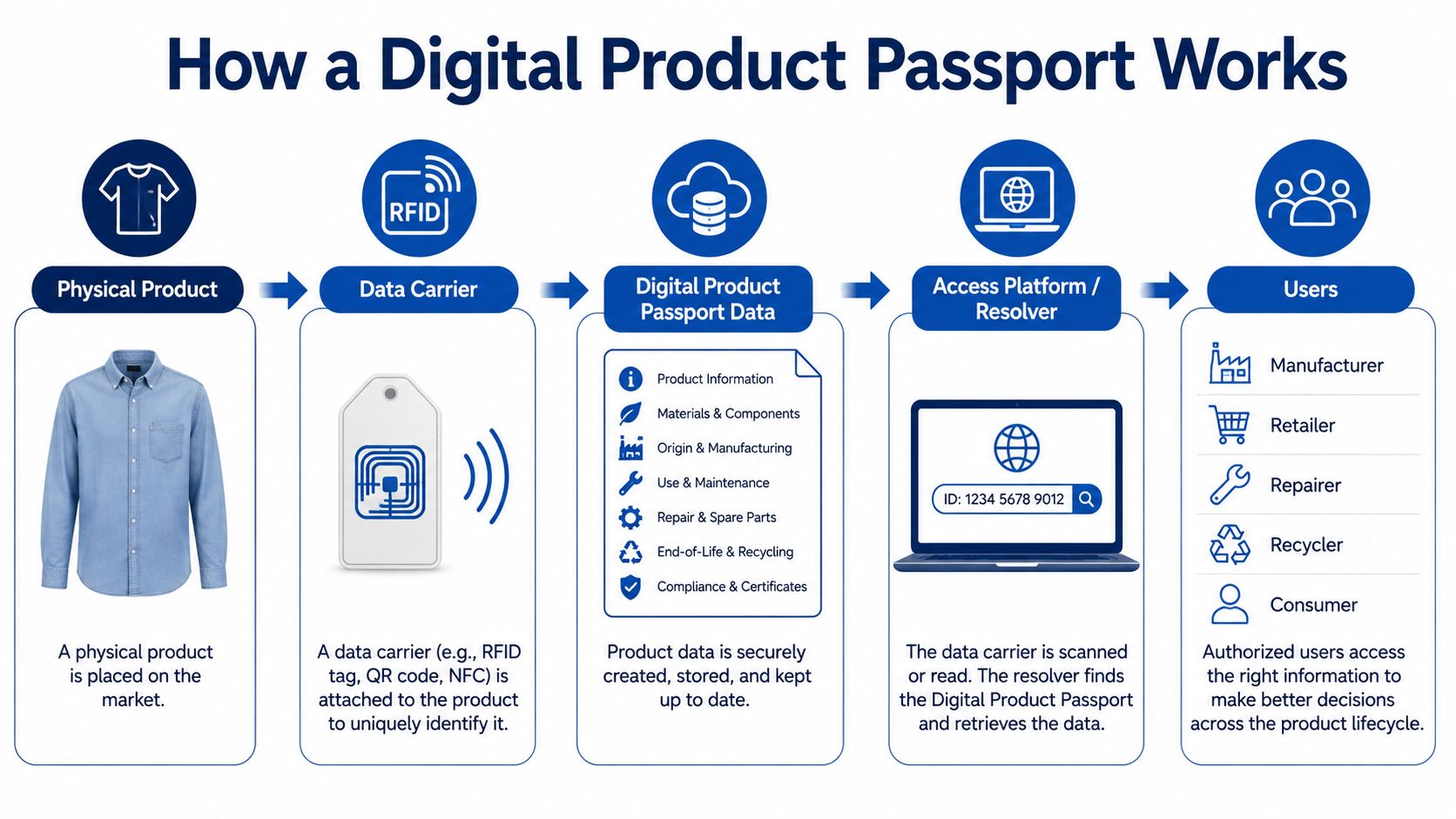
A simplified Digital Product Passport architecture contains five main layers.
The system begins with the actual physical product.
This might be:
The product needs a persistent identity that connects it with the correct digital information.
A data carrier is physically associated with the product, packaging, or accompanying documentation according to the applicable product rules.
Possible technologies may include:
Under ESPR, the product-specific delegated act determines which data carrier or carriers must be used and where they must be positioned.
The identifier resolves to the relevant digital product information.
The DPP does not necessarily need to store all of its data directly inside the physical tag.
A more scalable architecture is usually:
Identifier → Digital Record
rather than:
Entire Digital Passport Stored Inside the RFID Chip
This allows lifecycle information to be updated without rewriting a large dataset onto the physical carrier.
The identifier must connect users or systems with the correct DPP record.
This may involve:
Different users may require different information.
Examples include:
The applicable product rules determine which actors can access which information. ESPR specifically requires product-level rules to define access rights as part of DPP implementation.
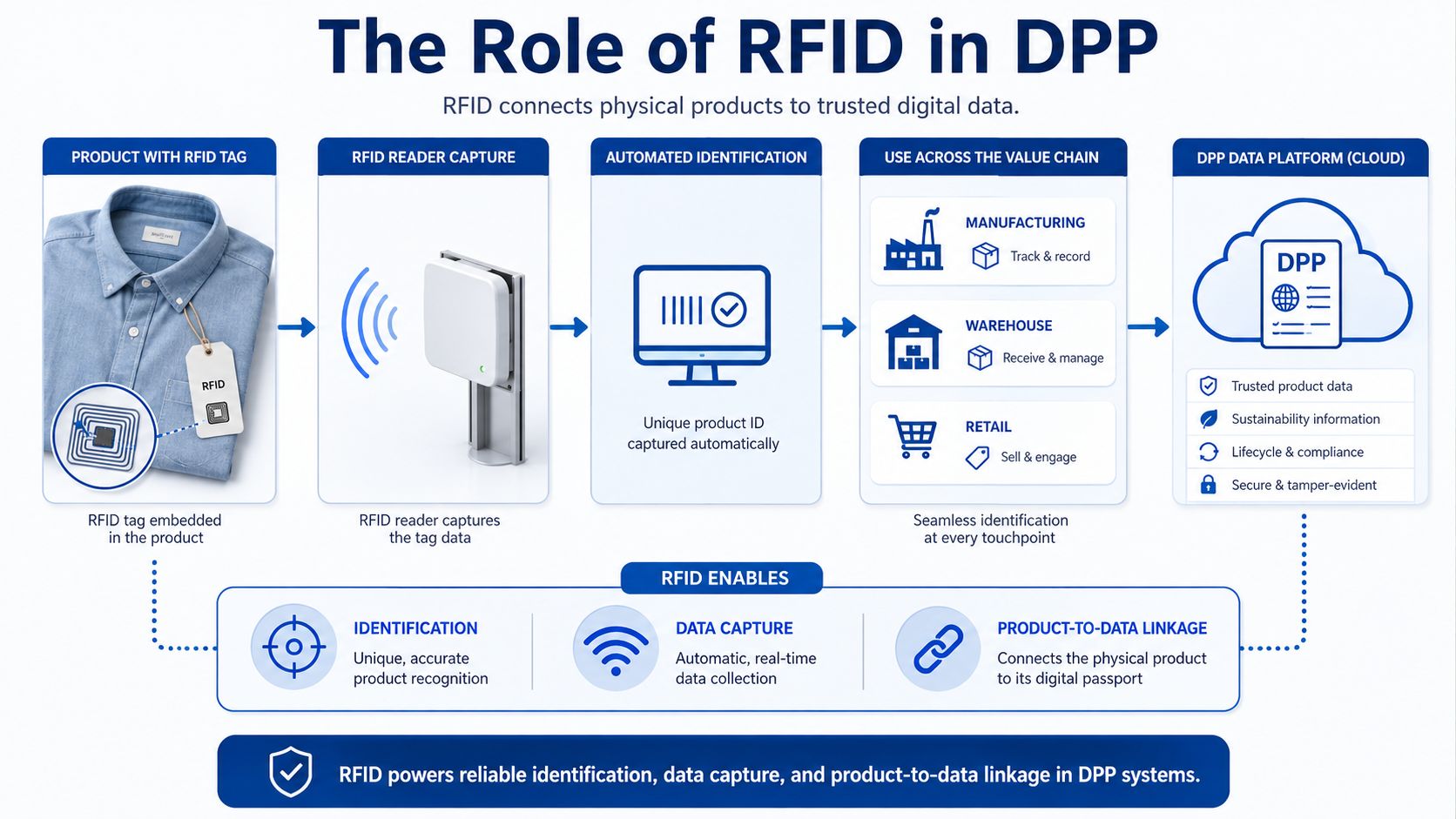
RFID can provide three particularly useful capabilities within a DPP architecture.
An RFID tag gives the physical product a machine-readable electronic identity.
Depending on the application, the tag may contain:
That identifier can then connect the tagged item with the corresponding product record.
For item-level applications, every physical product can receive an individual serialized identity.
This is where RFID has an important advantage over technologies that require a deliberate visual scan.
RFID readers can capture product identities automatically at selected checkpoints.
Examples include:
Manufacturing
RFID reader detects a product entering a production station.
Warehouse
RFID portal records finished goods entering inventory.
Distribution
RFID identifies products loaded for shipment.
Retail
Handheld or fixed RFID systems verify inventory.
Repair
A service center identifies the exact product and retrieves its maintenance record.
Recycling
A recycler identifies the product before determining the appropriate processing route.
RFID therefore provides not only a way to access product information but also a mechanism for generating lifecycle events.
The RFID tag does not need to contain the complete DPP.
A practical architecture might use:
RFID EPC / Unique ID
↓
RFID Reader
↓
Middleware
↓
ERP / MES / WMS / PLM
↓
DPP Platform
The physical identifier acts as a reliable key between the product and the digital record.
This approach also allows businesses to continue using the same RFID identity for operational processes such as:
while connecting relevant information with the DPP ecosystem.
No. RFID is not generally mandated by the ESPR as the required DPP technology.
This is one of the most important distinctions when discussing RFID and Digital Product Passports.
The ESPR defines a data carrier in technology-neutral terms as a linear barcode, two-dimensional symbol, or another automatic identification and data-capture medium readable by a device.
Furthermore, the product-specific delegated act determines:
Therefore:
Using RFID does not automatically make a product DPP compliant.
Likewise:
A product does not automatically need RFID simply because it requires a DPP.
RFID should be selected when it provides operational value and is compatible with the applicable regulatory and technical architecture.
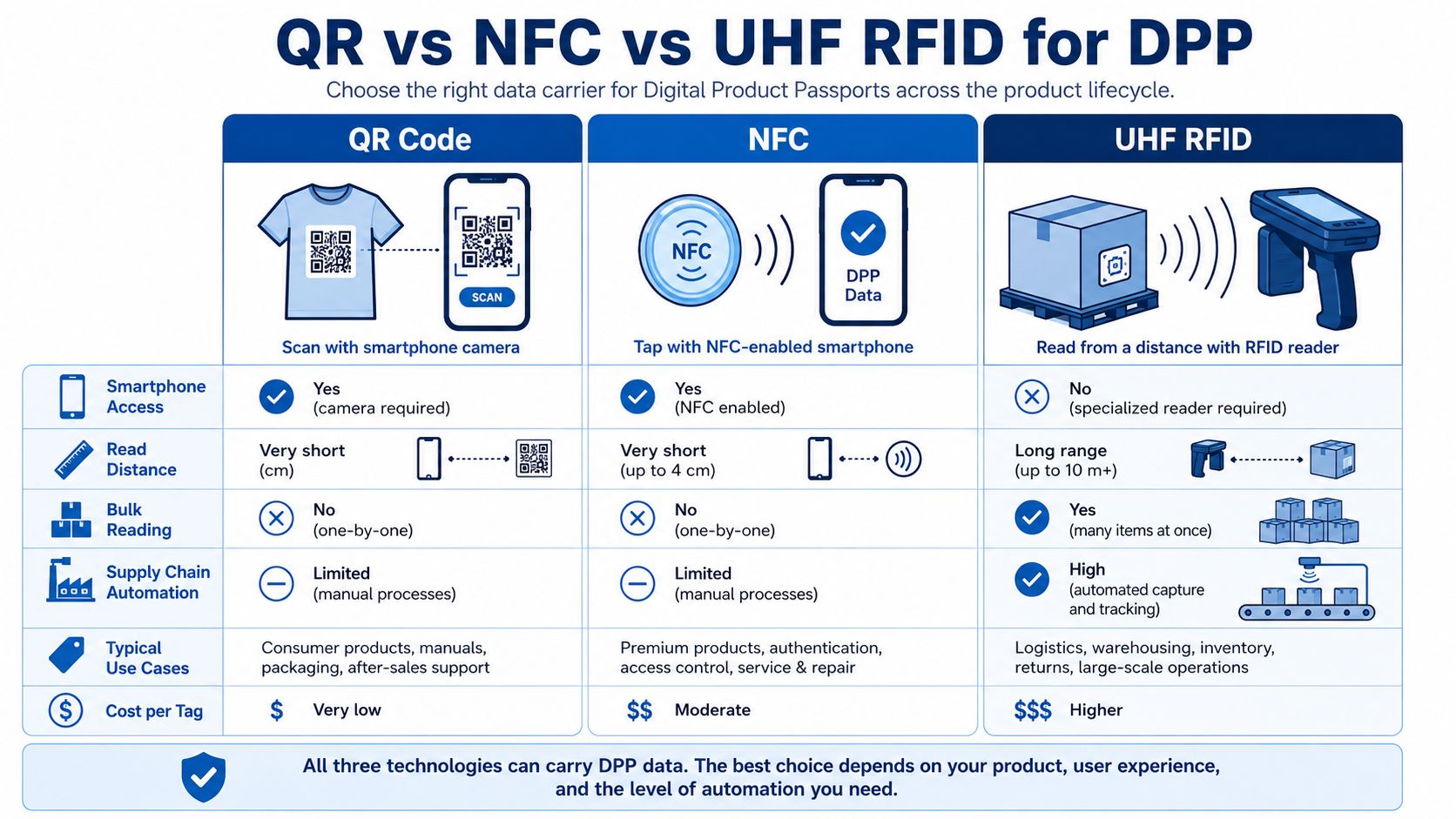
One of the most important DPP architecture decisions is how users and machines will identify the physical product.
QR codes, NFC, and UHF RFID each provide different strengths.
| Factor | QR / 2D Code | NFC / HF RFID | UHF RFID |
|---|---|---|---|
| Smartphone access | Excellent | Excellent on compatible phones | Usually requires dedicated reader |
| Interaction | Camera scan | Tap | Automatic or deliberate RFID read |
| Typical distance | Visual / close | Few centimeters | From near field to several meters |
| Bulk identification | Low | Limited | Excellent |
| Automated supply-chain capture | Limited | Limited | Strong |
| Consumer interaction | Excellent | Excellent | Usually indirect |
| Item-level automation | Limited | Moderate | Strong |
| Manufacturing integration | Moderate | Moderate | Strong |
| Warehouse inventory | Limited | Limited | Strong |
These technologies should not necessarily be treated as competitors.
A DPP system may use more than one physical identification technology.
QR codes are particularly suitable for consumer-facing access because almost every modern smartphone can scan them.
They work well for:
Their main limitation is automation.
A worker or machine normally needs optical visibility of the code.
NFC is suitable when the user is expected to deliberately tap a product.
Potential applications include:
NFC combines controlled short-range communication with wide smartphone compatibility.
UHF RFID is especially interesting when the DPP architecture also needs automated operational identification.
Typical applications include:
UHF RFID can identify many products without requiring an operator to scan each label visually.
For supply-chain operations, this can provide significantly more automation.
However, most consumer smartphones do not contain general-purpose UHF RFID readers.
For this reason, a product architecture could potentially use:
UHF RFID for supply-chain automation
plus
QR Code or NFC for consumer access
where allowed by the applicable product rules.
The correct carrier architecture must ultimately match both the regulatory requirement and the user experience.
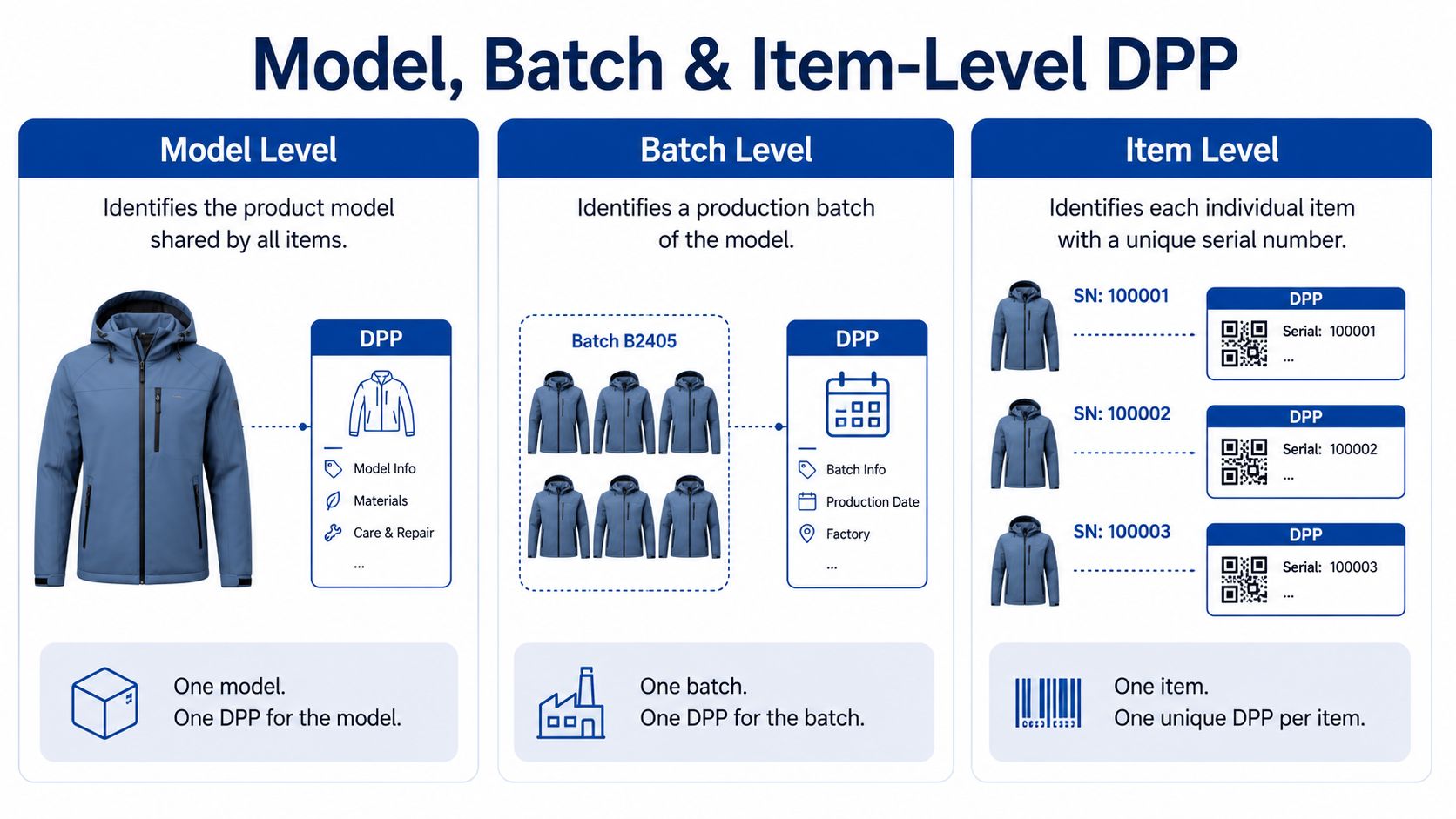
Not every Digital Product Passport necessarily identifies an individual physical unit.
Under ESPR, the applicable delegated act can specify whether the passport applies at model, batch, or item level.
This has a major impact on identification architecture.
A model-level passport identifies the product model.
For example, every unit of one jacket model might access the same core DPP.
This may be suitable when the required information is common across all products of the same model.
Examples:
A batch-level DPP distinguishes one production batch from another.
This can support information such as:
Batch identification provides more traceability than model-level identification without requiring a unique record for every item.
An item-level DPP distinguishes each individual physical product.
For example:
Jacket 100001
and
Jacket 100002
are treated as separate serialized objects.
This is where RFID becomes particularly powerful.
Passive UHF RFID already supports serialized item-level identification in many:
applications.
An item-level architecture can potentially associate lifecycle events with a specific physical unit, including:
Whether a specific DPP must operate at item level depends on the applicable product-specific rule.
A DPP should not be viewed as one standard static template for every product.
Depending on product-specific requirements, relevant information may include categories such as:
The actual fields must always follow the regulation applicable to that specific product.
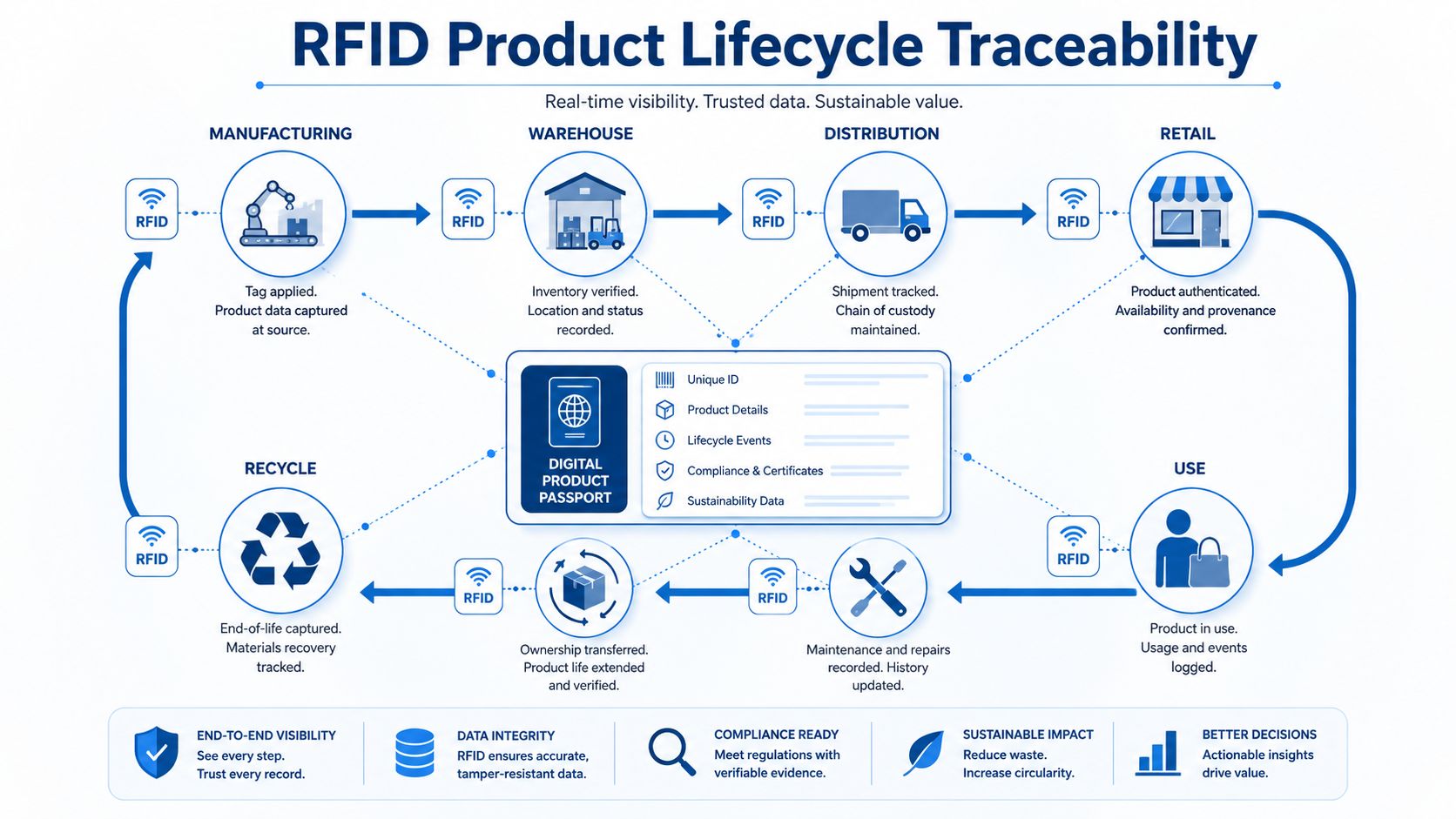
A major strength of RFID is that the same electronic identity can potentially remain useful at several stages of the physical product lifecycle.
RFID can be applied during or after production.
It can connect a finished item with:
Readers installed at production stations can automatically record the product as it moves through the factory.
Syncotek's guide to RFID in manufacturing explains how RFID can support WIP tracking, quality verification, tools, inventory, and finished-goods identification.
When finished products enter storage, RFID can support:
This creates operational data that may supplement relevant lifecycle records.
Products can be automatically detected at:
Instead of scanning each product individually, UHF RFID can capture multiple serialized items.
RFID can continue supporting:
See Syncotek's RFID retail inventory management guide for a detailed retail workflow.
A DPP may continue to provide value after the product is sold.
Depending on the product and applicable rules, the digital record can make information available for:
RFID may be used primarily by professional systems while a QR or NFC carrier provides a simpler consumer interface.
A repair provider could use a product identifier to retrieve the correct:
For serialized products, maintenance events may also be associated with an individual unit.
A persistent digital identity can help support circular business models.
Potential use cases include:
At the end of the product lifecycle, reliable identification can help recycling operators determine:
The RFID identity is valuable only if it remains physically readable and digitally connected to reliable information throughout the relevant lifecycle.
Manufacturers are likely to be among the organizations that gain the greatest operational benefit from combining RFID with DPP-related infrastructure.
RFID can give production equipment the ability to automatically identify products.
For example:
RFID Tag on Product
↓
Production Station Reader
↓
Product ID Captured
↓
MES Retrieves Work Order
↓
Process Completed
↓
Lifecycle Event Recorded
This architecture can help connect:
Instead of adding a completely separate DPP process after production, manufacturers can integrate product identification into existing factory workflows.
Retailers can benefit from the same physical identity before and after the point of sale.
An item-level RFID tag may support:
This creates an opportunity to use one physical identifier across both operational RFID applications and DPP-related information systems.
The architecture should still separate:
inventory data
from
regulated DPP data
where appropriate.
Not every RFID inventory event needs to become part of the formal product passport.
DPP initiatives are strongly connected with circular-economy goals.
Products increasingly need to remain identifiable beyond the original sale.
RFID can help service and circular-economy operators identify products automatically.
Potential workflows include:
Read product RFID tag → identify exact model → retrieve repair information.
Identify returned or refurbished product → update status in business system.
Identify individual component or product → determine usable parts and required processing.
Read identifier → retrieve material and disassembly information → select processing method.
This is where tag durability becomes extremely important.
A tag used for short-term retail inventory may not automatically be suitable for a product expected to remain identifiable for ten or twenty years.
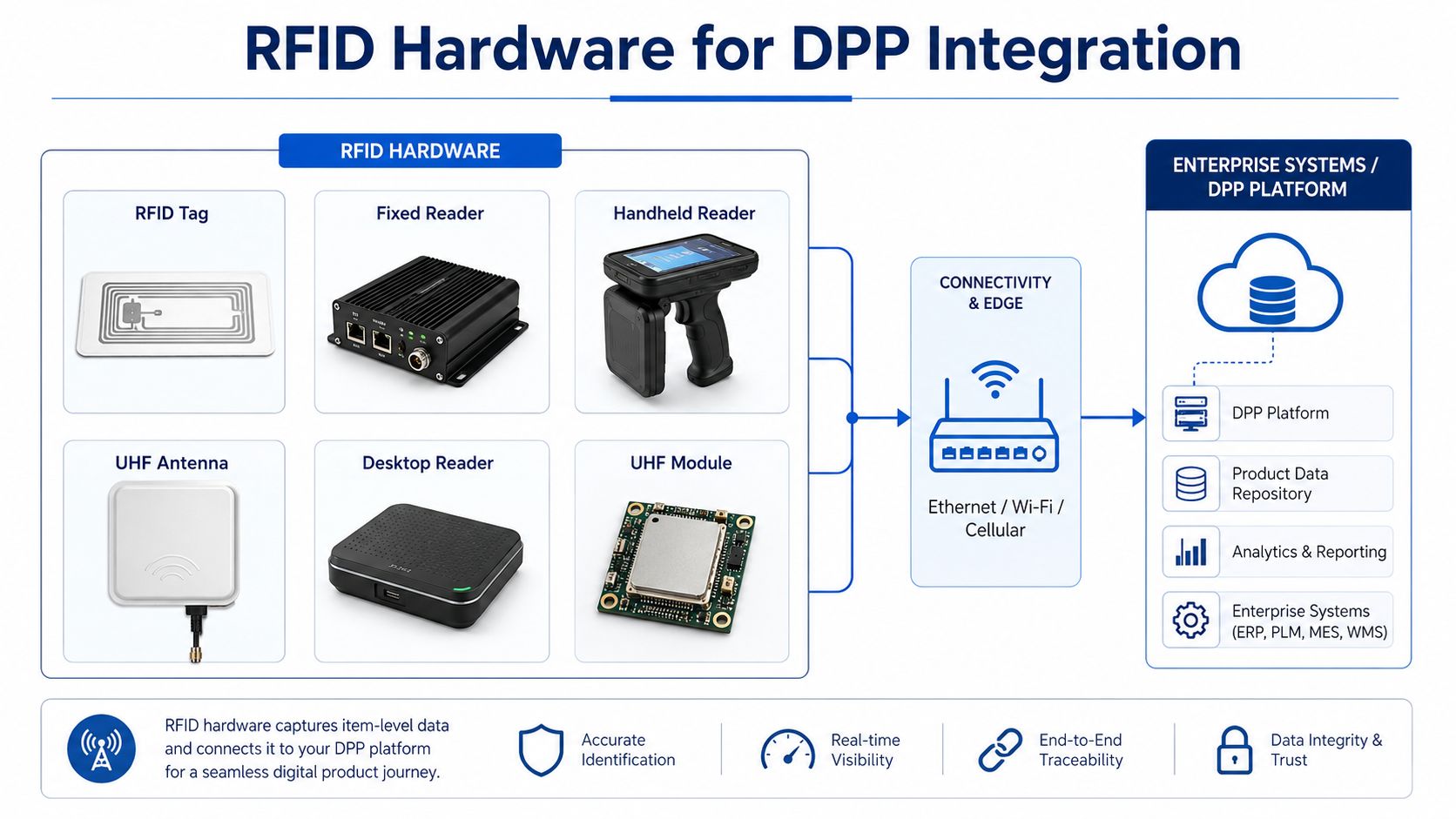
An RFID-enabled DPP project requires more than a tag.
A complete architecture can contain several layers.
The tag creates the physical electronic identity.
Possible formats include:
Tag selection depends on the product and lifecycle.
Readers capture the tag identity.
Different read points may require different hardware.
Fixed readers can support:
Syncotek provides UHF fixed readers with external antenna support and interfaces such as Ethernet, RS232/RS485 and GPIO for integration with industrial and enterprise systems.
Handhelds are suitable for:
Desktop readers can support:
Syncotek's desktop UHF RFID reader-writers support EPC Gen2 tag read/write and verification workflows through PC or host-system integration.
The antenna determines the RF read zone.
Projects may require:
The correct antenna depends on where products need to be identified.
RFID does not always need to be implemented as a finished external reader.
Manufacturers can embed a UHF RFID module directly into:
Syncotek's UHF modules support EPC Gen2 / ISO 18000-63 and are designed for OEM integration into printers, terminals, industrial lines, kiosks, and other devices.
Middleware converts raw RFID reads into meaningful business events.
It may:
RFID information may feed:
The DPP platform manages the data and access architecture required for the product passport.
Syncotek's role in this architecture is primarily the RFID identification and data-capture hardware layer, rather than claiming to replace the complete regulatory DPP platform.
Selecting a tag for DPP-related identification requires a longer-term perspective than selecting a tag for a short warehouse project.
Consider the following factors.
How long must the identifier remain usable?
A disposable package may have a short lifecycle.
Industrial equipment may operate for decades.
The ESPR framework requires DPP availability periods to reflect at least the expected lifetime specified for the relevant product.
The physical identification method therefore needs to be considered alongside the digital data-retention strategy.
RFID performance changes significantly depending on whether the tag is attached to:
Metal products may require specialized mount-on-metal RFID tags.
Consider exposure to:
Do you need:
Read distance should match the workflow rather than simply being maximized.
Determine whether the project requires:
Tags may be:
For long-lived DPP applications, attachment reliability becomes part of the traceability design.
RFID is sometimes described as automatically providing secure or tamper-proof identification.
That is too simplistic.
A basic passive RFID tag may contain a unique identifier but still provide limited protection against copying, removal, or substitution.
Security depends on the complete solution.
Possible security layers include:
A product identity becomes more trustworthy when the backend can verify:
The strongest architecture combines:
Physical Tag Security + Digital Identity + Backend Verification
rather than relying on the RFID label alone.
RFID is an identification and data-capture technology.
The DPP is the digital information system.
Keep these layers separate.
The ESPR does not establish a universal RFID mandate.
Product-specific rules determine the required carrier.
RFID memory is better suited to identification and selected application data.
The full DPP will generally be more scalable as a backend digital record.
Tag performance depends on:
Test RFID tags on the real product.
UHF RFID is excellent for supply-chain automation, but ordinary smartphones generally do not provide general-purpose UHF RFID reading.
If consumers need easy direct access, QR or NFC may need to complement UHF RFID where permitted.
A DPP architecture may need to remain available for many years.
The physical identifier should be designed for the intended product lifecycle.
Identification and authentication are different.
Use appropriate secure chips and backend controls where authenticity matters.
More data is not automatically better.
Decide which events actually matter to:
Avoid flooding the DPP platform with low-value raw read events.
DPP data under ESPR must use open, interoperable formats and avoid vendor lock-in.
RFID identifiers, enterprise systems, middleware, and DPP services should therefore be designed so data can move between systems reliably.
A practical project can be approached in ten steps.
Determine which EU or other product-specific legislation applies.
Do not begin by buying RFID hardware.
Is the passport:
This determines the required serialization strategy.
Evaluate:
based on both regulatory and operational requirements.
Determine how identifiers are generated, serialized, and mapped to digital records.
Test the tag on real products under actual environmental conditions.
Identify where data should be captured:
Connect RFID data with ERP, MES, WMS, PLM, or other relevant applications.
Map product identity and relevant lifecycle information to the Digital Product Passport service.
Determine:
Do not test only the manufacturing stage.
Consider how the product will be identified during:
Before deploying an RFID-enabled DPP project, confirm:
Digital Product Passports are creating a new connection between physical products and structured digital information.
RFID can become an important part of that connection, particularly when companies need automated identification throughout manufacturing, warehousing, logistics, retail, service, and end-of-life operations.
However:
RFID is not the Digital Product Passport.
RFID is not universally required by EU DPP rules.
Using an RFID tag alone does not make a product DPP compliant.
Its real value is providing a reliable physical identification and automated data-capture layer.
A well-designed architecture can use RFID to connect:
Physical Product
→ Unique Digital Identity
→ Lifecycle Events
→ Enterprise Systems
→ Digital Product Passport
For consumer-facing access, QR codes or NFC may remain more convenient. For automated supply-chain visibility, serialized UHF RFID can provide capabilities that optical identification alone cannot easily deliver.
The strongest DPP architectures may therefore combine technologies rather than forcing one carrier to solve every problem.
A Digital Product Passport is a structured set of product-specific data that can be accessed electronically through a physical data carrier.
No. The EU ESPR does not universally require RFID. Product-specific delegated acts determine which data carriers must be used.
Potentially yes. RFID can act as an automatic identification and data-capture layer connecting a physical product with its digital identity and DPP-related systems, subject to the applicable product rules.
It usually does not need to. A more scalable system stores an identifier on the RFID tag and uses that identifier to retrieve the relevant digital record from backend systems.
RFID identifies and communicates with physical products. A DPP is the digital data system containing product information.
Yes, where the applicable rules permit the architecture. QR can provide easy consumer smartphone access while UHF RFID can support automated supply-chain identification.
NFC offers short-range smartphone interaction. UHF RFID offers longer read distance, bulk reading, and stronger automation capabilities for manufacturing and logistics.
Most consumer smartphones cannot directly read standard UHF RAIN RFID tags. Dedicated UHF RFID hardware is generally required.
RFID is technically well suited to item-level serialized identification because every physical product can receive a unique electronic identity.
A model-level DPP associates information with a product model shared across multiple physical units.
A batch-level DPP associates information with a particular production batch.
An item-level DPP identifies each physical product individually, typically using a unique serial identity.
Not automatically. Security depends on the RFID chip, authentication capabilities, physical tag design, and backend verification system.
Current EU planning prioritizes areas including textiles and apparel, iron and steel, aluminium, tyres, furniture, mattresses, ICT, and energy-related products, while other EU legislation can introduce DPP requirements for additional sectors.
There is no single date for every product. Mandatory dates are established through the applicable product-specific EU legislation or delegated acts.
Syncotek provides RFID hardware for manufacturers, system integrators, software providers, and equipment developers building product-identification, traceability, and lifecycle-data-capture systems.
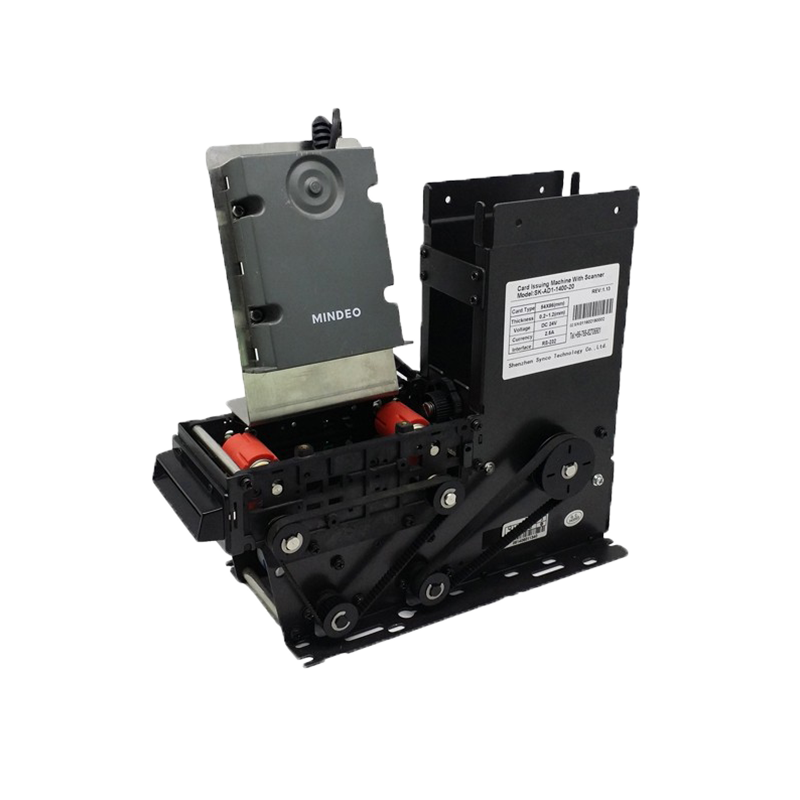
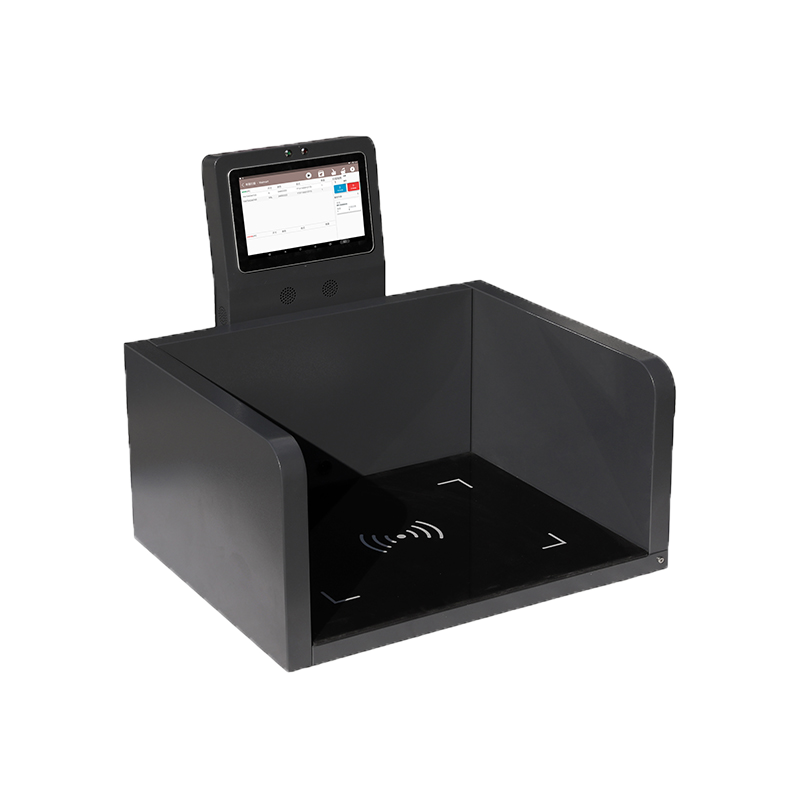
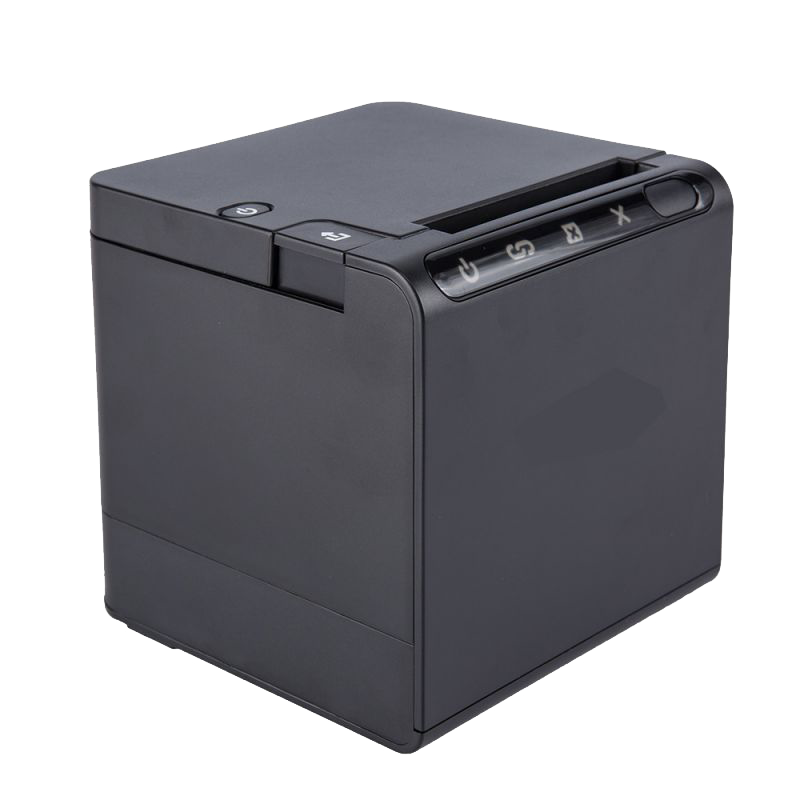
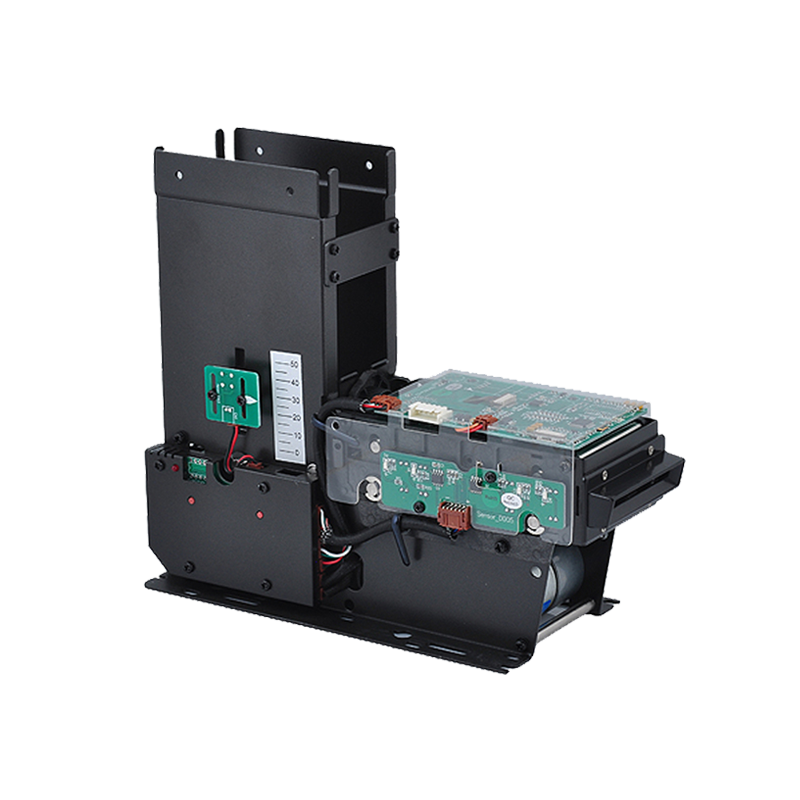
Our RFID portfolio includes:
These components can form the physical identification and automatic data-capture layer connecting products with ERP, MES, WMS, PLM, traceability systems, and DPP platforms.
Whether your project requires item-level UHF identification on a manufacturing line, automated warehouse capture, handheld lifecycle inspection, desktop product commissioning, or an embedded RFID module for custom equipment, Syncotek can help evaluate suitable hardware based on product material, read distance, environment, regional frequency, data architecture, and integration requirements.
Explore the complete Syncotek RFID product portfolio or review our RFID readers, modules, antennas and tags for your product traceability and DPP integration project.
 Knowledge
Digital Product Passports are changing the way manufacturers, brands, supply-chain operators, retailers, repairers, recyclers, and regulators think about product information. Instead of product data remaining fragmented across ERP systems, spreadsheets, certificates, technical documents, service records, and recycling databases, a Digital Product Passport can connect a physical product with structured digital information that remains accessible throughout […]
READ MORE Knowledge
The RFID system auto-identifies vehicles' weight, calculates net weight, and provides real-time monitoring for optimized efficiency.
READ MORE Knowledge
The RFID system auto-identifies vehicles' weight, calculates net weight, and provides real-time monitoring for optimized efficiency.
READ MORE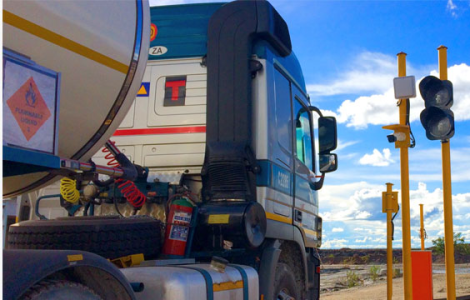 Case Show
The RFID system auto-identifies vehicles' weight, calculates net weight, and provides real-time monitoring for optimized efficiency.
READ MORE Knowledge
Barcode scanners are used in retail checkout, warehouses, manufacturing lines, hospitals, ticketing systems, self-service kiosks, parcel handling, access control, and inventory management. Although 1D and 2D barcode scanners may look similar, they differ in the symbols they can decode, the way they capture information, their ability to scan mobile screens, and the amount of data […]
READ MOREIf you are interested in our services or need customized solutions, please feel free to contact us.