
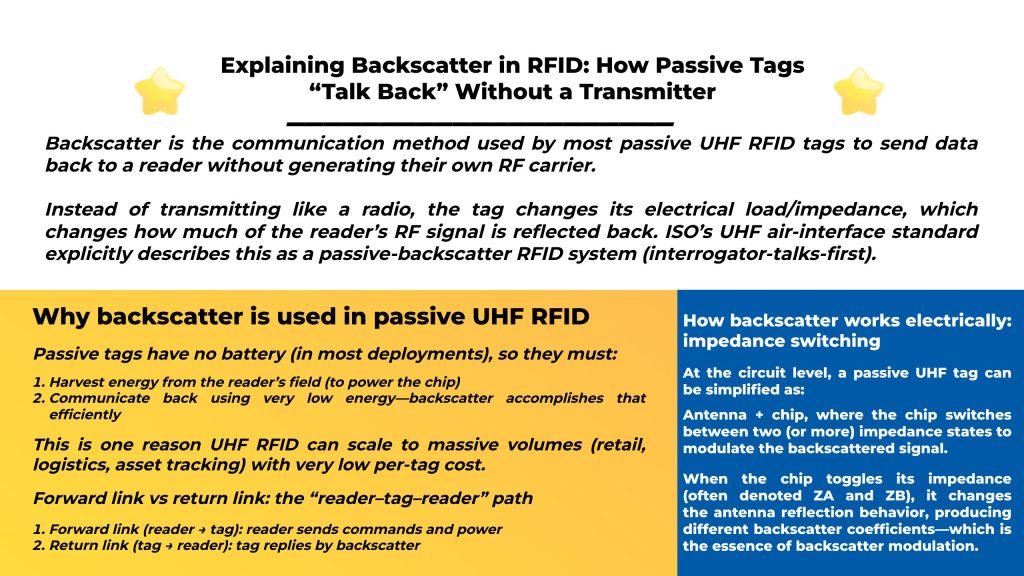
Backscatter is the communication method used by most passive UHF RFID tags to send data back to a reader without generating their own RF carrier.
Instead of transmitting like a radio, the tag changes its electrical load/impedance, which changes how much of the reader’s RF signal is reflected back. ISO’s UHF air-interface standard explicitly describes this as a passive-backscatter RFID system (interrogator-talks-first).
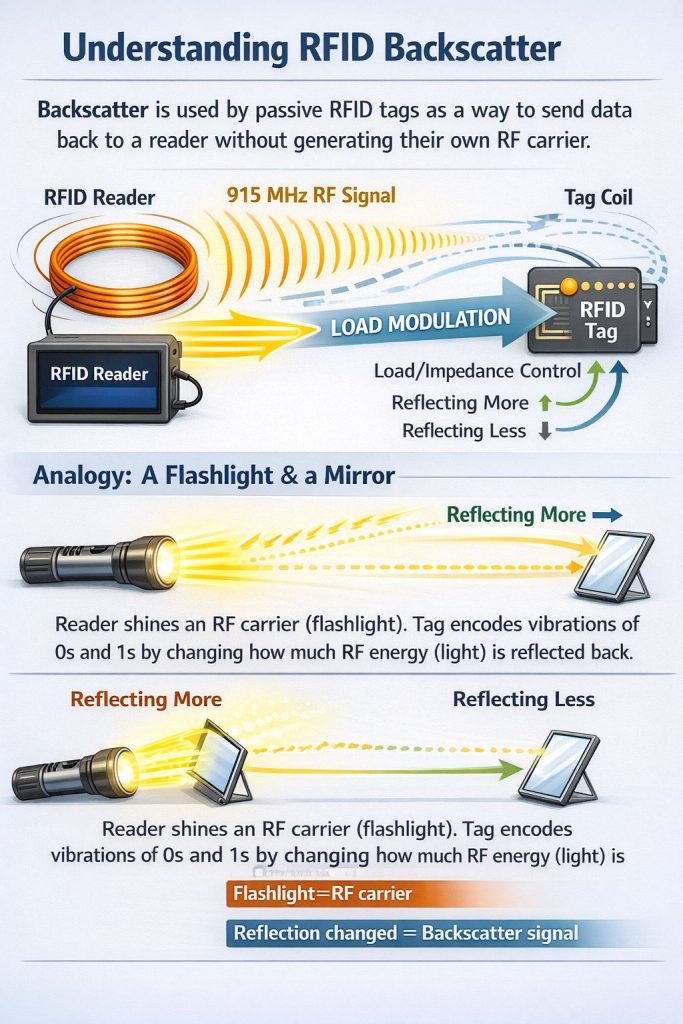
Simple analogy:
A reader shines a flashlight (RF carrier). The tag “blinks” by changing how reflective it is—encoding 0s and 1s in that reflection.
Passive tags have no battery (in most deployments), so they must:
This is one reason UHF RFID can scale to massive volumes (retail, logistics, asset tracking) with very low per-tag cost.
UHF RFID is often described as a reader → tag → reader link:
This two-hop nature matters because range is frequently limited by the return link (the reader must detect a very weak modulated reflection).
At the circuit level, a passive UHF tag can be simplified as:
Antenna + chip, where the chip switches between two (or more) impedance states to modulate the backscattered signal.
When the chip toggles its impedance (often denoted ZA and ZB), it changes the antenna reflection behavior, producing different backscatter coefficients—which is the essence of backscatter modulation.
The tag antenna and chip impedance must be matched well enough to:
Because the tag is reflecting the reader’s carrier, the receiver must detect a small change riding on top of a strong transmitted signal.
Researchers often describe this using concepts like the tag’s radar cross section (RCS) and measurement methods for tag backscatter strength.
In practice, the reader’s RF front-end and DSP must handle:
In RAIN RFID (UHF), the system design guidelines discuss different requirements for the forward link and tag backscatter return link, including return-link data-rate related parameters like BLF (backscatter link frequency).
Key takeaway: Your channel plan, filtering, and reader settings must support both:
(Exact modulation/coding details depend on the Gen2/ISO 18000-63 configuration, but the architectural principle remains: reader talks first; tag replies by backscatter.)
Both approaches involve changing impedance, but the coupling regime differs:
| Item | HF / NFC (13.56 MHz) | UHF RFID (860–960 MHz) |
|---|---|---|
| Coupling | Near-field inductive (coil-to-coil) | Far-field electromagnetic |
| Tag reply method | Load modulation (changes load on coil) | Backscatter (changes reflection coefficient) |
| Typical range | cm-level to short range | meters-level (depends on setup) |
If your project is UHF item tracking, “backscatter” is the core uplink concept.
If the tag antenna is poorly aligned with the reader antenna polarization, return-link signal can drop sharply. UHF RFID antenna and propagation work shows why orientation and channel conditions strongly impact tag performance.
Metal detunes antennas; liquids absorb RF energy. This affects:
Because the return link is weak, reader receiver sensitivity and interference rejection are often decisive—especially in dense RF environments.
Warehouses can create multipath that sometimes helps and sometimes hurts. A “good lab range” can fail in a reflective aisle unless antennas/zones are designed carefully.
UHF systems use anti-collision inventory methods; performance depends on tag density, movement, and reader configuration (session/Q, dwell time, etc.).
They don’t generate their own carrier like an active transmitter. They modulate the reflection of the reader’s carrier.
Writing usually requires more stable power/time at the tag than reading, so write distance is typically shorter and needs tighter zone control (even though it still uses the same backscatter-based uplink for acknowledgments).
If you’re deploying UHF backscatter systems (RAIN / EPC Gen2 / ISO 18000-6C), you’ll usually choose hardware based on:
Syncotek’s RFID catalog covers UHF modules, integrated readers, fixed readers, desktop readers, and more.
Example product pages show EPC Gen2 / ISO18000-6C support and development resources (SDK/demo), plus multi-interface options on certain models.
Backscatter is most commonly discussed for UHF passive RFID. HF/NFC usually uses load modulation in the near field, while UHF uses reflection/backscatter in the far field.
Often the return link (reader’s ability to detect a weak backscatter reply), plus tag powering and environmental losses.
Small differences in chip sensitivity, antenna design, matching, and placement on materials can significantly change harvested power and backscatter strength.
 Knowledge
HF RFID (High-Frequency Radio Frequency Identification) is a widely used RFID technology operating at 13.56 MHz. It’s best known for short-range, controlled reads, strong support for secure credentials, and the fact that NFC is built on the same HF band. If your project needs a tap / close-range user experience—like access control badges, library book tags, healthcare wristbands, or secure ID cards—HF […]
READ MORE Knowledge
Smart cards are used every day for payments, building access, public transportation, employee identification, hotel rooms, event admission, loyalty programs, and secure authentication. Although they often look like ordinary plastic cards, smart cards contain an integrated circuit that can store, process, or securely exchange digital information. Some smart cards must be inserted into a reader. […]
READ MORE Knowledge
Large events require thousands of physical interactions to happen accurately and quickly. Attendees must receive valid credentials, enter through the correct gates, access the areas included in their ticket, attend sessions, purchase food or merchandise, interact with sponsors, and leave the venue safely. At the same time, organizers need visibility into: ticket validation attendee arrival […]
READ MORE Knowledge
Passive RFID is a type of radio frequency identification technology in which the tag has no internal battery. Instead, the tag is powered by energy from the RFID reader’s field and then sends data back to the reader. This battery-free design is the defining feature of passive RFID and one of the main reasons it is […]
READ MORE Knowledge
UHF RFID systems use radio waves to communicate between readers, antennas, and passive RFID tags. In a small installation with one reader, radio-frequency interference may be relatively easy to control. In a warehouse, factory, retail store, distribution center, or event venue with several readers operating at the same time, the RF environment becomes more complicated. […]
READ MOREIf you are interested in our services or need customized solutions, please feel free to contact us.