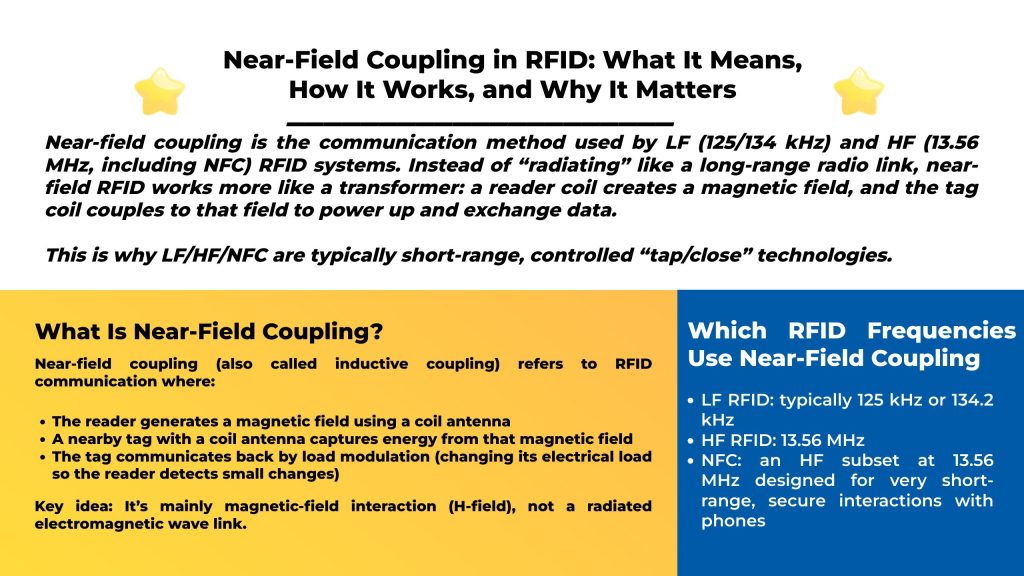
Near-field coupling is the communication method used by LF (125/134 kHz) and HF (13.56 MHz, including NFC) RFID systems. Instead of “radiating” like a long-range radio link, near-field RFID works more like a transformer: a reader coil creates a magnetic field, and the tag coil couples to that field to power up and exchange data.
This is why LF/HF/NFC are typically short-range, controlled “tap/close” technologies.
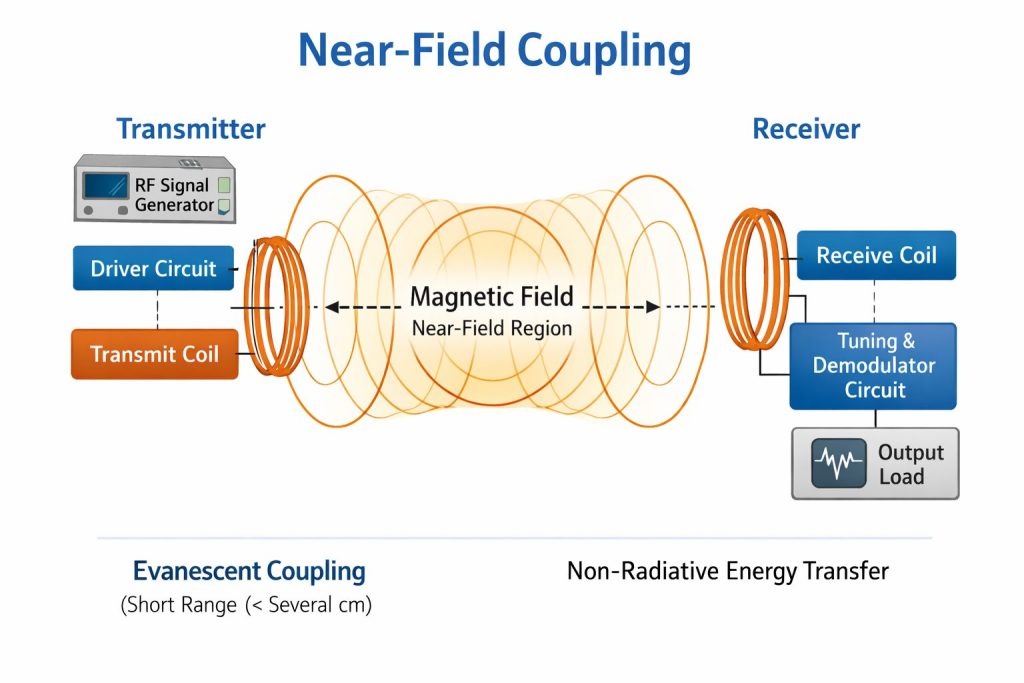
Near-field coupling (also called inductive coupling) refers to RFID communication where:
Key idea: It’s mainly magnetic-field interaction (H-field), not a radiated electromagnetic wave link.
Near-field coupling is used by:
UHF RFID (RAIN RFID) generally uses far-field backscatter, not near-field coupling (though “near-field UHF” antennas exist for special short-range control).
The reader drives current through a coil antenna, producing an alternating magnetic field.
When the tag coil is close enough, the magnetic field induces a voltage in the tag coil, powering the chip.
The tag changes its load (impedance), which slightly changes the magnetic field/current seen by the reader.
The reader detects these changes and decodes the data.
This is why the tag can be passive—it doesn’t need a battery.
Near-field magnetic coupling strength drops quickly with distance. In practice:
In real deployments, short range is often a feature because it naturally creates a controlled read zone.
Because the range is short, it’s easier to design “tap here” experiences:
Near-field systems can be easier to control in tight read zones with proper coil design.
HF smart cards and NFC have mature security approaches (depends on card/tag type), widely used for access and identity workflows.
Near-field is not for portals or large-area inventory.
Coupling depends on how the coils align:
Metal can detune coils and change field distribution. You may need:
| Feature | Near-Field Coupling (LF/HF/NFC) | Far-Field Backscatter (UHF/RAIN) |
|---|---|---|
| Main field type | Magnetic (H-field) | Radiated EM + backscatter |
| Typical range | cm | meters |
| Best for | Tap/controlled reads | Bulk inventory / logistics |
| Reads many tags at once | Limited/varies | Excellent |
| Smartphone support | NFC (HF) yes | No |
For “tap” workflows, guide the user:
HF/NFC tags differ (ISO 14443 vs ISO 15693, different chip types). Always test with the exact credential/tag family you will ship.
NFC uses near-field coupling (HF 13.56 MHz). NFC is an application-focused subset of HF RFID with phone interoperability rules.
UHF is typically far-field, but specialized near-field UHF antennas/tags exist for very short, controlled reads (useful to prevent stray reads). This is a niche design approach.
Short range helps control who can read the tag, but true security depends on tag type, encryption/authentication, reader security, and system design.
Near-field coupling is the magnetic, inductive method used by LF/HF/NFC RFID. It enables short-range, controlled reads—great for access cards, NFC phone taps, library tags, and close-range identification—while UHF is typically chosen when you need meters of range and bulk inventory speed.
If you tell me your scenario (LF/HF/NFC tag type, target range, metal nearby, form factor), I can recommend the best antenna approach and how to design a stable read zone.
 Knowledge
Metal asset tracking is one of the most important applications in RFID, but it is also one of the most technically challenging. Many companies want to use RFID to identify tools, machines, containers, laptops, racks, returnable transport items, and industrial equipment, only to discover that standard RFID labels do not perform well when placed directly […]
READ MORE Knowledge
RFID is often grouped into three main frequency families: LF (Low Frequency), HF (High Frequency), and UHF (Ultra-High Frequency). Picking the right band is one of the biggest decisions in any RFID project because it affects read range, speed, tag cost, phone compatibility, performance near metal/liquids, and system architecture. This guide compares LF vs HF vs UHF in a practical way […]
READ MORE Knowledge
The RFID system auto-identifies vehicles' weight, calculates net weight, and provides real-time monitoring for optimized efficiency.
READ MORE Knowledge
Large events require thousands of physical interactions to happen accurately and quickly. Attendees must receive valid credentials, enter through the correct gates, access the areas included in their ticket, attend sessions, purchase food or merchandise, interact with sponsors, and leave the venue safely. At the same time, organizers need visibility into: ticket validation attendee arrival […]
READ MORE Knowledge
Accurate cattle identification is essential for modern livestock management. Farms, ranches, feedlots, dairy operations, veterinary teams, and livestock markets all need reliable ways to identify individual animals, record movement, manage health data, and support traceability from farm to market. Traditional visual ear tags are simple and widely used, but they rely on manual reading. Workers […]
READ MOREIf you are interested in our services or need customized solutions, please feel free to contact us.