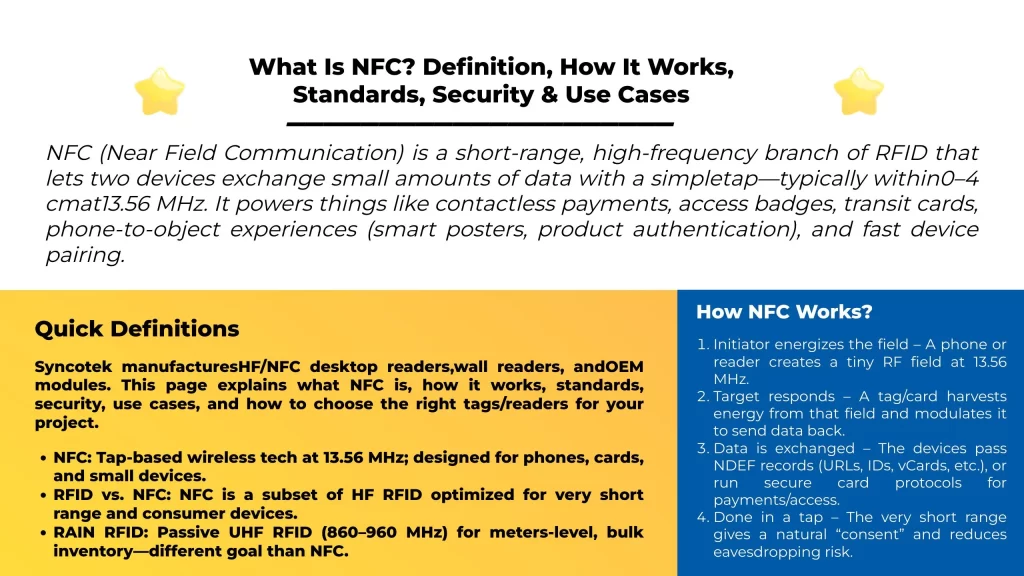
NFC (Near Field Communication) is a short-range, high-frequency branch of RFID that lets two devices exchange small amounts of data with a simple tap —typically within 0–4 cm at 13.56 MHz . It powers things like contactless payments, access badges, transit cards, phone-to-object experiences (smart posters, product authentication), and fast device pairing.
Syncotek manufactures HF/NFC desktop readers , wall readers , and OEM modules . This page explains what NFC is, how it works, standards, security, use cases, and how to choose the right tags/readers for your project.
Quick Definitions
NFC : Tap-based wireless tech at 13.56 MHz ; designed for phones, cards, and small devices.RFID vs. NFC subset of HF RFID optimized for very short range and consumer devices .RAIN RFID UHF RFID (860–960 MHz) for meters-level, bulk inventory —different goal than NFC.
How NFC Works
Initiator energizes the field – A phone or reader creates a tiny RF field at 13.56 MHz.Target responds – A tag/card harvests energy from that field and modulates it to send data back.Data is exchanged – The devices pass NDEF records (URLs, IDs, vCards, etc.), or run secure card protocols for payments/access.Done in a tap – The very short range gives a natural “consent” and reduces eavesdropping risk.
Typical data rates: 106 / 212 / 424 kbps (some implementations support more on specific protocols).Typical range: 0–4 cm (by design; short range = better UX and security).
NFC Operating Modes
Reader/Writer mode : A phone/reader reads or writes an NFC tag (e.g., open a URL, record product ID).Card Emulation (CE) : A phone or smartcard behaves like a contactless card (payments, transit, access). Implemented via Secure Element or HCE (Host Card Emulation) .Peer-to-Peer (P2P) : Two devices exchange small payloads (less common today).
Core Standards (What matters)
Air interface & proximity : ISO/IEC 14443 (Type A/B), ISO/IEC 18092 (NFCIP-1).Data formats : NFC Forum specifications; NDEF is the common record format.Tag types (NFC Forum) :
Type 1 (Topaz) – legacy, low capacityType 2 (NTAG / MIFARE Ultralight) – very common for marketing/product IDsType 3 (FeliCa) – popular in Japan transit/IDType 4 (ISO-DEP, e.g., DESFire, Contactless Smartcards) – advanced security Type 5 (ISO/IEC 15693 “vicinity”) – longer HF reach (tens of cm when optimized)
What You Can Build with NFC (Real-world Use Cases)
Contactless payments (phone or card)Access control & employee badges (doors, turnstiles, time & attendance)Transit & ticketing (fare media, event entry)Product authentication & anti-counterfeit (tap to verify origin)Consumer engagement (tap packaging for manuals, recipes, loyalty)After-sales & support (tap to register, get spare parts, start a chat)Industrial login & machine setup (tap badge to log in or load settings)Device pairing & onboarding (Bluetooth/Wi-Fi quick setup via NDEF records)Smart posters, museum labels, tourism wayfinding
NFC Tags & Smart Labels
An NFC tag is a chip + coil antenna inside a label, card, wristband, keyfob, sticker, or durable hard tag.
Key choices:
Memory size :
NTAG213 (~144 bytes NDEF) → short URLs/IDsNTAG215 (~504 bytes) → medium payloadsNTAG216 (~888 bytes) → long payloadsDESFire EV2/EV3 (Type 4) → secure apps , large memory, file system
Security features : Password protection, mutual authentication , encrypted sessions (Type 4 smartcards).Form factor & adhesive : Paper label, PET, PVC card, wristband, on-metal sticker (with spacer), high-temp label for industrial use.
Tip: For consumer taps, keep payloads small (clean URL, short ID). For protected credentials (access/payment), use Type 4 (DESFire/secure smartcards) .
NFC Readers & Devices
Phones : iOS and Android read NDEF tags and support card emulation (subject to OS and wallet policies).Desktop readers : USB/PC-SC readers for enrollment desks, labs, POS, kiosks.Wall readers & panels : Access control, time clocks, attendance.OEM modules : Embed NFC into printers, kiosks, robots, handhelds.
Interfaces & software: USB (HID/CDC), UART, Ethernet; SDKs; PC/SC; REST/MQTT via gateways.
Security & Privacy (Right-sized for your use case)
Strong credentials (Type 4) : Mutual authentication , session keys, and AES-grade crypto (e.g., DESFire EV2/EV3) for access/transit.Payments : EMVCo contactless + tokenization inside wallet apps/Secure Elements.Signed NDEF : Sign tag content to prevent tampering where authenticity matters.Best practices :
Minimize on-tag sensitive data (store references, not secrets).
Use HTTPS URLs and rotate tokens server-side.
Physically secure readers; keep firmware signed and updated.
NFC vs. RAIN RFID vs. QR vs. BLE (When to choose which)
Requirement Best Fit Why Tap with a phone at a few centimetersNFC Native in phones; great UX & security Read hundreds of items fast across metersRAIN RFID (UHF) Bulk inventory, long range Ultra-low cost & visual QR/Barcodes Print-only; no silicon cost Room-to-room presence, longer range BLE Battery-powered beacons, background presence
Common combo: Use RAIN for supply-chain visibility and NFC for consumer/after-sales engagement on the same product.
Advantages & Limitations of NFC
Advantages
Frictionless UX (tap), works with smartphonesShort range by design → reduces accidental reads, aids securityRobust security options (Type 4, payments, access)Low power tags (passive), simple infrastructure
Limitations
Very short range (must tap)Not for bulk, hands-off inventory (use UHF instead)On-metal surfaces require special “on-metal” tags or spacers
Implementation Guide (Step-by-Step)
Define the goal : open a URL, verify authenticity, control access, or store an ID?Pick the tag type & memory : NTAG213 (short URLs/IDs), 215/216 (bigger payloads), DESFire for secure credentials.Choose form factor : label/card/wristband/fob; on-metal if needed.Design the payload : NDEF with short links (HTTPS), UIDs that resolve to server data; sign when authenticity matters.Decide on locking : make tags read-only after encoding, or require a password.Test with phones : iOS and Android behaviors (background tag reading, app intents).Plan reader endpoints : desktop/wall readers (USB, Ethernet) for enrollment/access.Roll out : add “Tap Here” marks; train staff; monitor metrics (tap rate, conversions, failures).
Buying Checklist (NFC Projects)
Use case (payment, access, ID, engagement)Security level (open NDEF vs. DESFire mutual auth)Tag memory (213/215/216 or smartcard)Environment (on-metal, temperature, chemicals)Form factor (label, card, wristband, on-metal)Reader/device (phone, desktop, wall, OEM)Software (PC/SC, SDKs, app support, cloud endpoints)Volume & cost (tag BOM, encoding labor)Brand UX (graphics, placement, CTA: “Tap for…”)Lifecycle (firmware updates, revocation, key management)
Syncotek Solutions
HF/NFC Desktop Reader : USB/PC-SC, supports ISO/IEC 14443/15693 and NFC, ideal for enrollment desks, labs, POS .HF/NFC Wall Reader : Wiegand/OSDP, tamper switch, IP-rated options for doors & turnstiles .NFC OEM Module : UART/USB/Ethernet options, SDK and antenna kits for kiosks, printers, AMRs .Mixed Fleet : Pair UHF portals (warehouse) with NFC stations (retail/front-of-house) for end-to-end journeys.
FAQs
Is NFC the same as RFID? HF RFID tailored for short-range taps and smartphones. RFID also includes UHF (RAIN) for long-range inventory.
How far does NFC read? 0–4 cm . It’s intentionally short for usability and security.
Which NFC tag should I choose? NTAG213/215/216 . For secure credentials: DESFire EV2/EV3 (Type 4) .
Will NFC work on metal? on-metal NFC tags (with ferrite layer) or a spacer.
Can I lock my NFC tags? read-only or require a password (varies by chip family).

 Case Show
 Industry Info
 Case Show
 Case Show
 Knowledge