
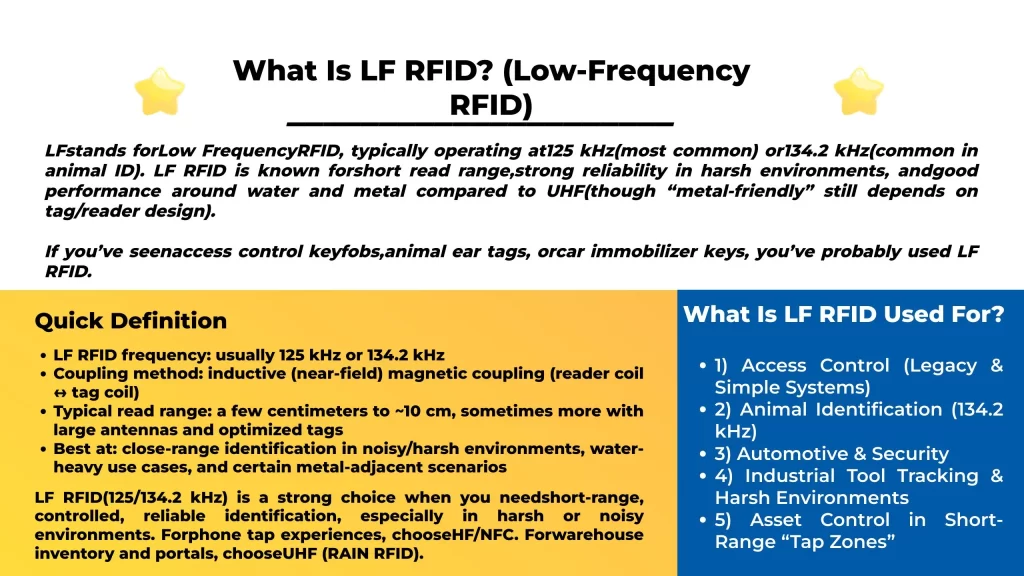
LF stands for Low Frequency RFID, typically operating at 125 kHz (most common) or 134.2 kHz (common in animal ID). LF RFID is known for short read range, strong reliability in harsh environments, and good performance around water and metal compared to UHF (though “metal-friendly” still depends on tag/reader design).
If you’ve seen access control keyfobs, animal ear tags, or car immobilizer keys, you’ve probably used LF RFID.
LF RFID operates in the near field:
Because the interaction is magnetic and very close-range, LF is typically stable and predictable in environments where high-frequency RF struggles.
| Feature | LF (125/134 kHz) | HF/NFC (13.56 MHz) | UHF (860–960 MHz) |
|---|---|---|---|
| Typical read range | Very short (cm) | Short (tap to ~10 cm; sometimes more) | Long (meters) |
| Best strength | Reliability in harsh/near-water/EMI environments | Phone compatibility (NFC), secure smartcards | Fast bulk reads, inventory, logistics |
| Anti-collision | Limited/varies by system | Good | Excellent |
| Smartphone readable? | No | Yes (NFC subset) | No |
| Best use cases | Animal ID, legacy access, rugged close reads | Access/tickets, libraries, phone taps | Warehouses, retail, portals, conveyors |
Rule of thumb:
LF’s magnetic coupling can be less sensitive to conditions that often reduce UHF performance (e.g., water-heavy environments or RF noise). This makes LF a strong choice for predictable, close-range reads.
A short read zone is often a feature, not a limitation:
LF remains common in legacy access control and simple ID systems with minimal data needs.
LF is not designed for portals, gates, or wide-area reads. If you need reads beyond close proximity, HF or UHF is usually better.
LF is generally not ideal for scanning lots of tags quickly (like warehouse inventory). UHF is the standard for that.
Many simple LF tags carry basic IDs. In access control, older LF credential types can be more vulnerable to cloning than modern encrypted systems (HF secure smartcards are preferred for high-security access).
LF can include multiple standards and legacy formats depending on the industry:
If your project involves regulated animal ID or security-critical access, confirm the exact standard/protocol required before selecting tags/readers.
In LF, antenna design is especially important because it defines read distance, read zone shape, and stability.
No. Phones typically support NFC (HF 13.56 MHz), not LF (125/134 kHz).
Neither is “better”—they serve different jobs. LF is best for close-range reliability. UHF is best for long-range and bulk reading.
LF can be more forgiving than UHF in some metal-adjacent scenarios, but metal still affects magnetic fields. Use appropriate tag housings, spacers, and antenna design.
Avoid LF when you need:
LF RFID (125/134.2 kHz) is a strong choice when you need short-range, controlled, reliable identification, especially in harsh or noisy environments. For phone tap experiences, choose HF/NFC. For warehouse inventory and portals, choose UHF (RAIN RFID).
If you tell me your use case (access control, animal ID, tool tracking, etc.), required range, and tag type/frequency, I can recommend the best LF approach and how to design a stable read zone.
 Case Show
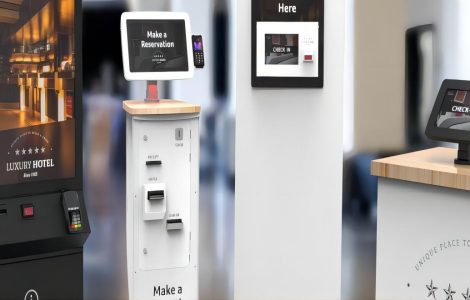
Card dispensers for Hotel Self-Check-in Kiosk
READ MORE Uncategorized
In RFID systems, read means the reader detects a tag and retrieves data from its memory. Write means the reader changes data stored on the tag (for example, writing a new EPC or user data), sometimes followed by locking that data to prevent future changes. Most commercial RFID deployments use UHF (RAIN RFID) for longer range and fast bulk scanning. The core air-interface […]
READ MORE Industry Info
How to Choose Frequency for Your Access Control System
READ MORE Knowledge
The RFID system auto-identifies vehicles' weight, calculates net weight, and provides real-time monitoring for optimized efficiency.
READ MORE Knowledge
HF RFID runs at 13.56 MHz and is widely used for access control badges, contactless payments, libraries, healthcare wristbands, and NFC phone tap experiences. When people say “HF RFID,” they often mean very different things—because HF is a frequency band, while standards define the protocol stack (how tags and readers actually communicate). More about HF […]
READ MOREIf you are interested in our services or need customized solutions, please feel free to contact us.