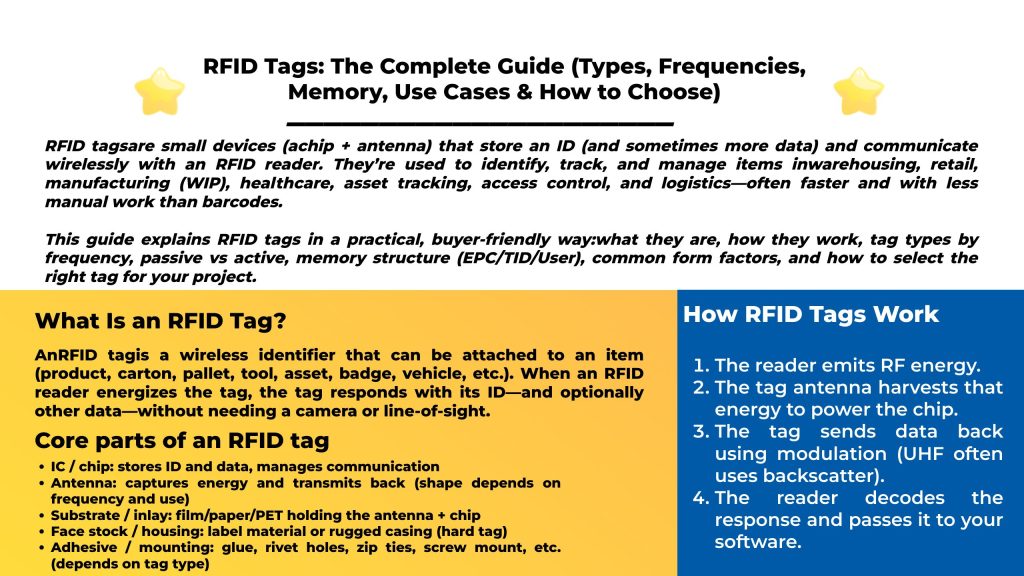
RFID tags are small devices (a chip + antenna) that store an ID (and sometimes more data) and communicate wirelessly with an RFID reader. They’re used to identify, track, and manage items in warehousing, retail, manufacturing (WIP), healthcare, asset tracking, access control, and logistics—often faster and with less manual work than barcodes.
This guide explains RFID tags in a practical, buyer-friendly way: what they are, how they work, tag types by frequency, passive vs active, memory structure (EPC/TID/User), common form factors, and how to select the right tag for your project.
1) What Is an RFID Tag?
An RFID tag is a wireless identifier that can be attached to an item (product, carton, pallet, tool, asset, badge, vehicle, etc.). When an RFID reader energizes the tag, the tag responds with its ID—and optionally other data—without needing a camera or line-of-sight.
Core parts of an RFID tag
IC / chip: stores ID and data, manages communication
Antenna: captures energy and transmits back (shape depends on frequency and use)
Substrate / inlay: film/paper/PET holding the antenna + chip
Face stock / housing: label material or rugged casing (hard tag)
Adhesive / mounting: glue, rivet holes, zip ties, screw mount, etc. (depends on tag type)
2) How RFID Tags Work
Most RFID tags in supply chain are passive:
The reader emits RF energy.
The tag antenna harvests that energy to power the chip.
The tag sends data back using modulation (UHF often uses backscatter).
The reader decodes the response and passes it to your software.
Need secure credentials? (HF Type 4 / DESFire-style tags)
Step 6: Validate adhesive/mounting and environment
Temperature range, UV exposure, chemicals, abrasion
Label facestock and adhesive compatibility with your surface
10) Tag Placement Tips (Often the Difference Between “Works” and “Doesn’t”)
Avoid placing standard UHF labels directly on metal (use on-metal)
For liquids, test placement:
move tag to the neck/cap
use a flag label (part of the label sticks out)
Keep tag antenna oriented to match reader polarization when possible
For portals, use multiple antennas to reduce orientation dead spots
For high-speed conveyors, use a tunnel layout (top/sides) and tune reader settings
11) Typical RFID Tag Challenges (and Fixes)
“My tags read fine in the lab but fail in production.”
Production introduces metal racks, forklifts, motion speed, tag stacking, and RF reflections Fix: pilot test with real items, real spacing, real speed; adjust antenna layout and filtering.
“We get too many duplicate reads.”
Fix: use edge filtering (RSSI threshold, dwell time, dedup windows) and physical read-zone control.
“Metal tools won’t read.”
Fix: use on-metal tags + correct mounting orientation + spacing; sometimes near-field antennas help.
12) How Syncotek Helps (Typical Delivery)
Syncotek supports RFID projects end-to-end with:
RFID readers and modules (UHF/HF based on system design)
Antenna selection and read-zone layout guidance
Pilot recommendations (tag shortlist + test plan)
OEM/ODM integration support for embedded systems
If you share your items + environment + range + region, you can usually shortlist the best tag family in one iteration.
FAQs About RFID Tags
What’s the difference between an RFID inlay and an RFID label?
An inlay is the antenna + chip on a substrate (often without printing/adhesive). A label adds facestock + adhesive and is usually printable.
Can RFID tags be printed like barcode labels?
Yes—many UHF tags are used as print-and-encode labels, where the printer prints graphics and the encoder writes the EPC/ID into the chip.
Do RFID tags work through cardboard and plastic?
Often yes. Metal and liquids are the main challenges.
Can a smartphone read RFID tags?
Phones typically read NFC (HF) tags, not UHF supply-chain tags.
How long do RFID tags last?
Passive tags can last many years; durability depends on packaging, temperature, chemicals, UV exposure, and mechanical wear.

 Knowledge
 Company Events
 Knowledge
 Knowledge
 Knowledge