
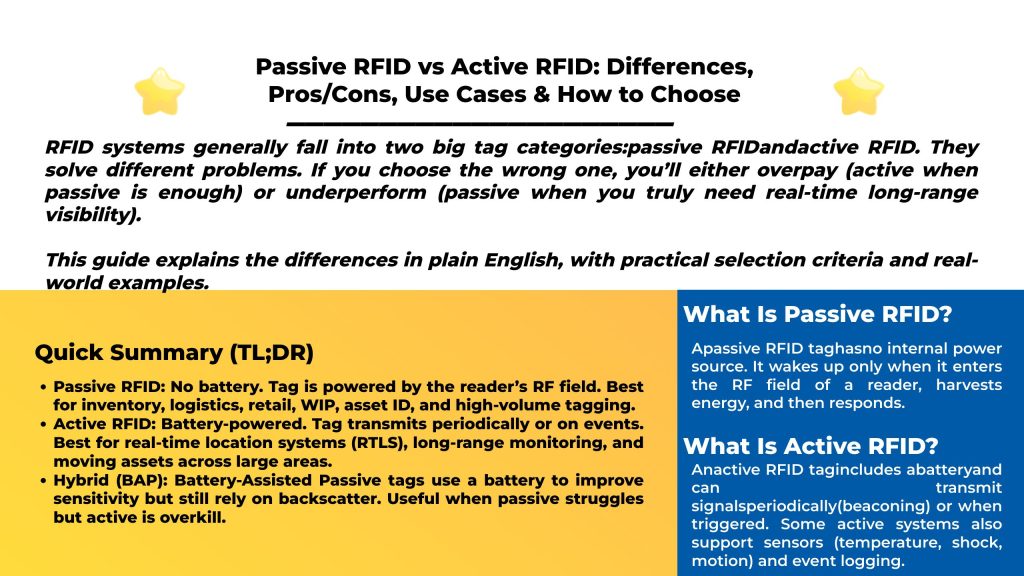
RFID systems generally fall into two big tag categories: passive RFID and active RFID. They solve different problems. If you choose the wrong one, you’ll either overpay (active when passive is enough) or underperform (passive when you truly need real-time long-range visibility).
This guide explains the differences in plain English, with practical selection criteria and real-world examples.
A passive RFID tag has no internal power source. It wakes up only when it enters the RF field of a reader, harvests energy, and then responds.
Range depends heavily on tag design, antenna gain, reader power, orientation, metal/liquid presence, and site noise.
An active RFID tag includes a battery and can transmit signals periodically (beaconing) or when triggered. Some active systems also support sensors (temperature, shock, motion) and event logging.
| Factor | Passive RFID | Active RFID |
|---|---|---|
| Power source | No battery (powered by reader field) | Battery-powered |
| Typical goal | Identify / count / track presence | Locate / monitor in real time |
| Read range | Short to medium (cm → meters, depends on LF/HF/UHF) | Long (often tens to hundreds of meters) |
| Tag cost | Lower (esp. UHF labels) | Higher |
| Maintenance | Minimal (no batteries) | Battery replacement, lifecycle planning |
| Infrastructure | Readers + antennas at choke points | Receivers/anchors across coverage area |
| Scalability | Excellent for millions of items | Better for fewer, high-value assets |
| Data model | Mostly “seen at read point” | Often “live status/location” |
| Best fit | Inventory, logistics, retail, WIP, item tracking | RTLS, yard tracking, large-area asset location |
Choose passive when you need:
Passive UHF labels make it feasible to tag large volumes of goods.
If items naturally pass through controlled points—dock doors, conveyors, gates, workstations—passive RFID is ideal.
No battery means fewer operational headaches.
Choose active when you need:
If assets move unpredictably and don’t pass fixed read points, active systems can provide continuous awareness.
Temperature, shock, tilt, movement, and other sensing features are commonly paired with active tags.
Active makes more sense when you’re tracking hundreds or thousands, not millions.
BAP tags contain a battery, but unlike active tags, they typically still communicate using backscatter like passive tags. The battery mainly improves sensitivity and reliability.
Use BAP when:
When comparing passive vs active, consider total cost of ownership (TCO):
Rule of thumb:
Passive is usually cheaper for high-volume item visibility. Active is usually justified for real-time location of high-value moving assets.
Answer these questions:
If your project is focused on inventory, logistics, portals, conveyors, and multi-tag reading, you’re typically in passive UHF (RAIN RFID) territory—where reader performance, antenna layout, and module selection matter most.
Syncotek supports OEMs and system integrators with:
If you tell me your scenario (items, environment, range, region, antenna count), I can recommend a passive vs active direction and a practical architecture.
Most UHF supply-chain systems (RAIN RFID / EPC Gen2) are passive. Active RFID is usually a different architecture (RTLS-style).
Passive can feel real-time at choke points (instant reads at a portal), but it won’t continuously locate assets throughout a facility without enough read points.
Battery lifecycle and higher infrastructure cost/complexity. It’s excellent when justified, but overkill for basic inventory.
When passive read rates are borderline and you want improved reliability without building a full active RTLS system.
 Uncategorized
In RFID systems, read means the reader detects a tag and retrieves data from its memory. Write means the reader changes data stored on the tag (for example, writing a new EPC or user data), sometimes followed by locking that data to prevent future changes. Most commercial RFID deployments use UHF (RAIN RFID) for longer range and fast bulk scanning. The core air-interface […]
READ MORE Knowledge
The RFID system auto-identifies vehicles' weight, calculates net weight, and provides real-time monitoring for optimized efficiency.
READ MORE Company Events
Holiday Notice for Chinese New Year 2024
READ MORE Knowledge
The RFID system auto-identifies vehicles' weight, calculates net weight, and provides real-time monitoring for optimized efficiency.
READ MORE Case Show
The RFID system auto-identifies vehicles' weight, calculates net weight, and provides real-time monitoring for optimized efficiency.
READ MOREIf you are interested in our services or need customized solutions, please feel free to contact us.