
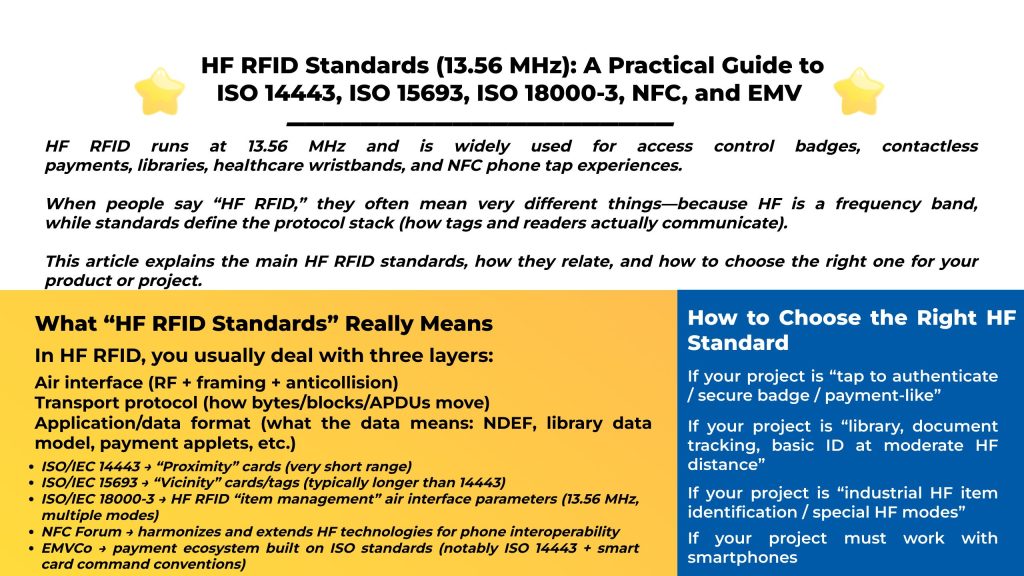
HF RFID runs at 13.56 MHz and is widely used for access control badges, contactless payments, libraries, healthcare wristbands, and NFC phone tap experiences.
When people say “HF RFID,” they often mean very different things—because HF is a frequency band, while standards define the protocol stack (how tags and readers actually communicate).
More about HF RFID : HF RFID (13.56 MHz) Explained: How It Works, Standards, Use Cases, Pros/Cons & Selection Guide
This article explains the main HF RFID standards, how they relate, and how to choose the right one for your product or project.
In HF RFID, you usually deal with three layers:
Different standards cover different layers:
ISO/IEC 14443 defines contactless “proximity” cards at 13.56 MHz, typically designed for very close operation (tap) and fast transactions.
Many ISO 14443 reader ICs and cards support 106 / 212 / 424 / 848 kbps operation, which is why 14443 is popular for payment and secure credential transactions.
ISO/IEC 15693 defines contactless “vicinity” tags/cards at 13.56 MHz, generally intended for longer read distances than proximity cards and for use cases like libraries and light asset identification.
15693 supports multiple coding/data-rate options; widely seen implementations emphasize “inventory + block reads/writes” rather than high-speed transaction exchange.
ISO/IEC 18000-3 is part of the ISO 18000 family for RFID “item management,” and Part 3 covers 13.56 MHz. It defines the physical layer + collision management + protocol values for HF RFID systems, organized into non-interoperable modes.
If your HF project is more like industrial RFID item identification (not cards/payments), you may see 18000-3 referenced—especially when talking about system modes and high-throughput scenarios.
Practical takeaway: “18000-3 compliant” is not always enough—verify which mode your tags and readers support.
HF systems—especially ISO 14443-based “smart cards”—often use APDUs (Application Protocol Data Units) defined in ISO/IEC 7816-4. This is the command/response structure used broadly in smart-card ecosystems and is commonly associated with payment and secure credentials.
Why it matters:
Two cards can both be “ISO 14443” and still behave very differently at the application level depending on whether they use:
NFC is built on 13.56 MHz HF technology, but the NFC Forum adds interoperability requirements and defines operating modes (e.g., reader/writer, card emulation, peer-to-peer).
NFC devices commonly support these technology labels:
This mapping appears directly in NFC Forum device requirements documentation.
For NFC interface/protocol, ISO/IEC 18092 defines communication modes for NFC devices operating at 13.56 MHz, including active and passive communication modes.
Practical takeaway:
If you want “tap with a phone,” align your tags/data formats with NFC requirements (not just “HF RFID”).
Realted Read: https://syncotek.com/hf-vs-nfc/
If your use case is contactless payment, the ecosystem is driven by EMVCo specifications, which are based on underlying ISO standards including ISO/IEC 14443 (contactless) and ISO/IEC 7816 (smart card conventions).
Practical takeaway:
Payment terminals and payment cards are not “generic ISO 14443 devices”—they must follow EMVCo requirements and testing.
In library deployments, HF RFID is often paired with the ISO 28560 family, which standardizes a data model and encoding rules for RFID tags used in libraries (commonly on 13.56 MHz tags).
Practical takeaway:
If you build readers/writers for libraries, you’ll likely need to support:
| Standard / Body | Typical “Feel” | Strengths | Common Uses |
|---|---|---|---|
| ISO/IEC 14443 (A/B) | Proximity / tap | Fast transactions, widely used for secure credentials and payment foundations | Payments, secure access badges, eID |
| ISO/IEC 15693 | Vicinity | Longer-range HF, memory/block style operations | Libraries, documents, light assets |
| ISO/IEC 18000-3 | Item management HF | Defines HF RFID modes for item identification; mode matters | Industrial HF item ID, specialized deployments |
| ISO/IEC 7816-4 | Smart card commands | APDU command/response conventions | Payments, secure credentials (application layer) |
| NFC Forum | Phone interoperability | NFC-A/B/F/V mapping; mode definitions | Smartphone tap tags, card emulation, P2P |
| EMVCo | Payment ecosystem | Payment-specific requirements and testing | Contactless payment terminals/cards |
The most common are ISO/IEC 14443 (proximity), ISO/IEC 15693 (vicinity), and ISO/IEC 18000-3 (HF item management modes). NFC and EMV add additional ecosystem requirements.
NFC operates at 13.56 MHz and is built on HF technologies, but the NFC Forum defines interoperability requirements and technology mappings (NFC-A/B/F/V).
Many access systems use ISO/IEC 14443, but “best” depends on security requirements, credential type, and controller ecosystem.
Libraries often use HF tags and follow ISO 28560 data model requirements, typically implemented on HF tag technologies such as ISO 15693.
 Knowledge
RFID is often grouped into three main frequency families: LF (Low Frequency), HF (High Frequency), and UHF (Ultra-High Frequency). Picking the right band is one of the biggest decisions in any RFID project because it affects read range, speed, tag cost, phone compatibility, performance near metal/liquids, and system architecture. This guide compares LF vs HF vs UHF in a practical way […]
READ MORE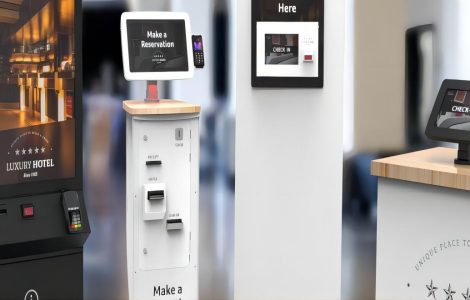 Case Show
Card dispensers for Hotel Self-Check-in Kiosk
READ MORE Company Events
Our new website offers streamlined access and insights into our latest products, solutions and services to better serve customers globally.
READ MORE Knowledge
A passive RFID tag is the most common RFID tag type in the world. It has no battery. Instead, it is powered by the electromagnetic field generated by an RFID reader. Passive tags are the foundation of RAIN UHF RFID item labeling (retail, logistics), HF/NFC access cards and smart labels, and many LF identification systems. This guide explains what passive tags are, how they work, the differences […]
READ MORE Knowledge
Learn the real differences between RFID and NFC—frequencies, range, security, smartphone compatibility, data models, and use cases. See when to choose UHF RFID (RAIN) vs. NFC, and how Syncotek readers fit your project.
READ MOREIf you are interested in our services or need customized solutions, please feel free to contact us.