

Hospitals manage large fleets of reusable medical equipment that move continuously between wards, treatment areas, equipment stores, operating theatres and maintenance departments. Infusion pumps, patient monitors, wheelchairs, beds and mobile carts can be difficult to locate when equipment is shared across departments or when inventory records are updated manually.
RFID medical equipment tracking uses electronic tags and compatible readers to identify individual assets and record inventory or movement events. A handheld UHF RFID reader can help staff audit an equipment room, while fixed readers can capture tagged assets passing through selected checkpoints. The resulting events can be associated with an asset register or computerized maintenance management system (CMMS).
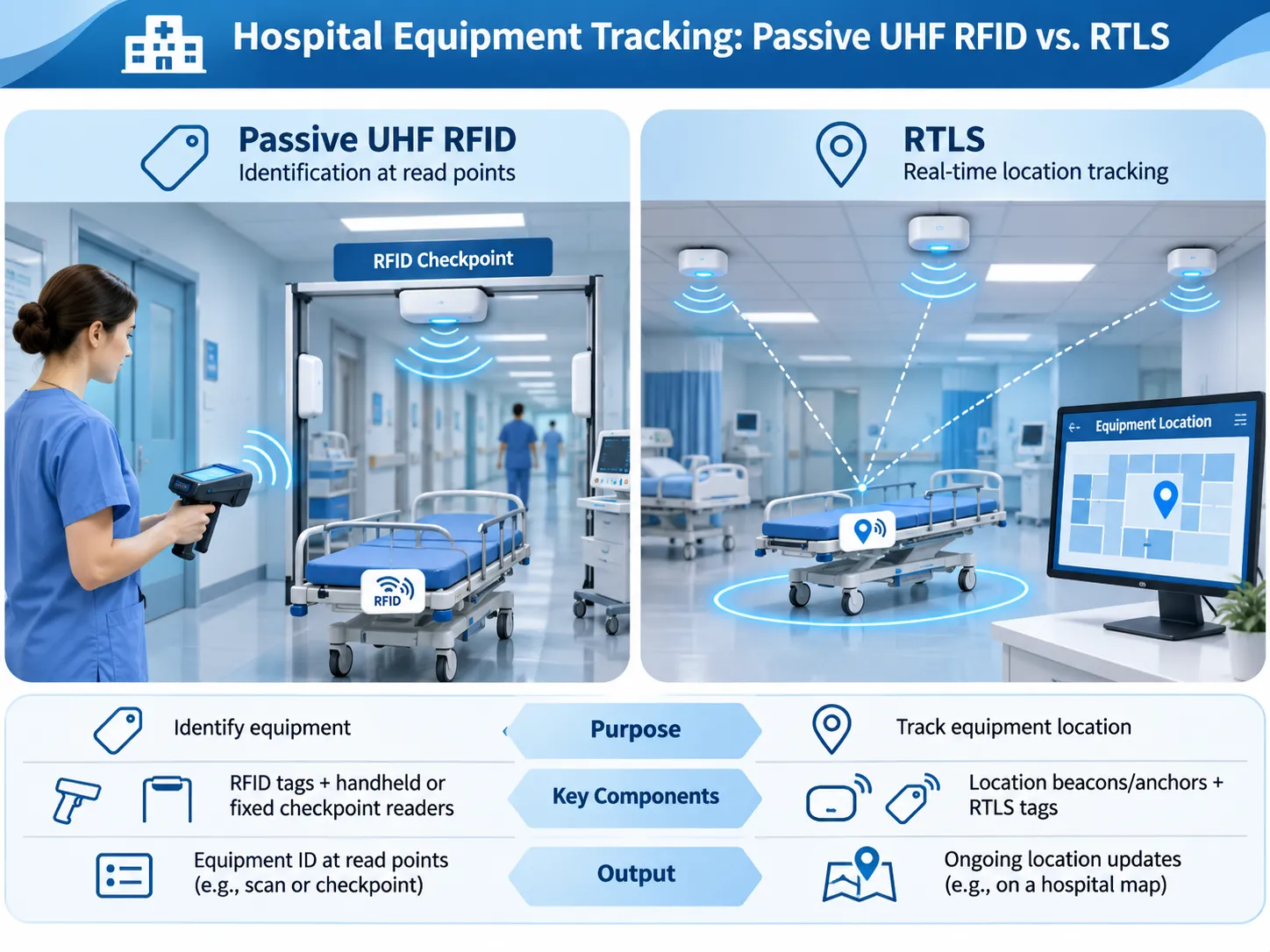
The required architecture depends on how often the hospital needs location information. Passive UHF RFID is generally suited to inventory checks and checkpoint-based visibility. It does not continuously report an asset’s location by itself. If staff need frequent or near-real-time location updates across clinical areas, an active RFID, BLE, Wi-Fi, UWB or hybrid real-time location system (RTLS) may be more appropriate.
This guide focuses on reusable medical equipment and the practical decisions involved in selecting tags, readers, read points and software integration. For a broader overview of RFID applications across medical supplies, linen, smart cabinets and healthcare operations, see Syncotek’s RFID in Healthcare guide.

An RFID system identifies a tagged asset when the tag is within a compatible reader’s effective read zone. Software can then associate the read with an asset record, reader location and timestamp. What the hospital can conclude depends on the reader architecture and the business rules applied to each event.
| Information required | What RFID can provide | Important limitation |
|---|---|---|
| Asset identity | A tag identifier mapped to an equipment record | The tag must be correctly associated with the asset |
| Inventory presence | A list of compatible tagged assets detected during a scan | A missed read does not automatically prove that an asset is missing |
| Last-seen location | The last registered reader or inventory location | This is not necessarily the asset’s current room |
| Movement through a checkpoint | An event recorded when an asset passes a configured read point | Antenna coverage and event logic must distinguish intended movement from nearby reads |
| Current room or zone | A zone estimate when the system has suitable readers or RTLS infrastructure | A single passive UHF read point cannot provide continuous location everywhere |
| Availability or maintenance status | A status displayed by the asset application | RFID identification alone does not determine whether equipment is clean, functional, calibrated or ready for use |
A useful hospital asset record may contain the hospital asset number, equipment category, manufacturer, model, department, maintenance status, inspection history and the RFID identifier assigned to the item. The RFID tag usually carries an identifier rather than the full asset record. The hospital’s software remains the source of operational information.
This distinction matters. A reader can detect an infusion pump, but it cannot determine whether the pump has been cleaned, passed inspection or is clinically ready. Those conditions must come from approved staff workflows, maintenance records or connected systems.
RFID is most useful for reusable assets that move between departments, need regular inventory checks or pass through defined issue-and-return points. Tag selection should be based on the actual equipment surface and workflow, not simply the equipment category.

| Equipment type | Tag selection to evaluate | Suitable read method | Design considerations |
|---|---|---|---|
| Infusion and syringe pumps | Compact UHF tag selected for the actual housing surface; on-metal design where required | Handheld inventory, fixed checkpoint or RTLS | Keep clear of controls, displays, vents, connectors, labels and cleaning surfaces |
| Wheelchairs | On-metal UHF tag for an approved frame location, or an active RTLS tag when frequent location updates are required | Handheld inventory, checkpoint reader or RTLS | Check frame material, tag attachment, impact exposure and cleaning |
| Hospital beds | Tag mounted to an approved bed-frame location; active tag if continuous location is required | Handheld inventory, fixed checkpoint or RTLS | Consider large metal structures, moving parts, cleaning procedures and bed accessories |
| Portable patient monitors | Small tag compatible with the device’s exterior surface | Handheld inventory or selected fixed checkpoint | Avoid ventilation openings, display areas, connectors and service labels; review EMC requirements |
| Mobile medical carts | A cart-level tag, individual asset tags or both, depending on the required tracking granularity | Handheld inventory or fixed read point | Decide whether the system must identify the cart, every device on it, or both |
| Portable ultrasound and diagnostic equipment | Tag selected for the enclosure material and available mounting area | Handheld inventory or RTLS | Confirm that the tag does not obstruct service access or interfere with cleaning |
| Biomedical engineering tools and test equipment | Compact UHF or on-metal tag suited to the tool surface | Handheld inventory or controlled tool-room read point | Match tag size, attachment method and read zone to the tool and storage process |
The matrix is a starting point for engineering evaluation, not a universal tag specification. A tag that works on a plastic enclosure may not perform well on a metal frame. Two devices in the same category may also have different housings, cleaning requirements and available mounting areas.
Before selecting a tag, inspect the equipment and identify an approved external mounting surface. The proposed location should not cover the manufacturer’s label, serial number, controls, display, ventilation, connectors, moving parts or service access points.
For equipment with a metal housing or frame, evaluate a purpose-designed on-metal UHF tag. For plastic or composite surfaces, a conventional label or another suitable tag construction may be more appropriate. Test the selected tag after it is attached to the actual equipment, because the surface, curvature, nearby metal and tag orientation can change read performance.
Hospitals should also confirm that the tag and attachment method tolerate the cleaning agents, moisture, abrasion and temperature exposure specified for the equipment. Do not assume that an industrial tag is automatically suitable for medical-device disinfection, sterilization or autoclave cycles.
A practical deployment starts with an agreed asset workflow. The hospital identifies which equipment should be tagged, how assets are registered, where inventory checks will occur and which movement events need to be recorded.

Each physical item needs a unique asset identity in the hospital’s asset management system. Before tagging begins, remove duplicate records, confirm equipment identifiers and decide which fields staff need to see when searching for an asset.
Assign a unique RFID identifier to each selected item and associate it with the existing asset record. The association should be checked before the equipment returns to service. A tag that is readable but linked to the wrong asset creates inaccurate inventory and maintenance records.
Handheld readers are suitable for staff-led inventory checks in equipment rooms, wards or maintenance areas. Fixed readers can be installed at selected doors, equipment libraries, issue-and-return counters or other controlled locations where automatic event capture is useful.
Not every doorway needs a reader. A fixed read point is most valuable when it corresponds to a defined business event, such as equipment entering a store or being returned to a central library.
The reader captures tag identifiers. Middleware or application software can filter repeated reads, associate events with the reader location and timestamp, and apply rules that distinguish an intended movement from an incidental read.
For example, a read at an equipment-store entrance may create a store-entry event. The system should not assume that the asset remains in the store indefinitely; a later read, staff confirmation or another workflow event may be needed to update its status.
Validated events can update the asset’s last-seen location, inventory status or transfer history. The application can display equipment that was not found during an inventory check, identify assets that need staff review or help technicians locate equipment scheduled for maintenance.
The application, not the RFID tag alone, determines whether an asset is available, clean, functional or due for inspection.
RFID events can be passed to an asset management platform or CMMS through supported interfaces, APIs, SDKs or middleware. The integration should define asset-ID mapping, user permissions, event filtering, exception handling and how maintenance or cleaning status is updated.
For organizations that need standardized visibility-event exchange across systems, GS1 EPCIS can be evaluated as an event data standard. EPCIS describes events involving objects and business processes; it is not a reader feature and is not mandatory for every hospital asset project.
The phrase “RFID tracking” can describe different technologies. The hospital should first define the required location update frequency and precision, then select the technology and infrastructure that can meet that requirement.
| Technology | How identification or location is obtained | Typical hospital use | Main trade-off |
|---|---|---|---|
| Passive UHF RFID with handheld reader | A battery-free tag responds when scanned by a compatible reader | Periodic inventory, asset search and audit | Requires staff to perform a scan; no continuous location between scans |
| Passive UHF RFID with fixed reader | A tag is detected when it enters a configured read zone | Equipment-room entrances, issue-and-return points and selected checkpoints | Provides read-point events, not automatic hospital-wide coordinates |
| Active RFID | A battery-powered tag transmits according to the system design | Frequent location updates for selected mobile assets | Tags need batteries and a supporting reader infrastructure |
| BLE or Wi-Fi RTLS | Powered tags or devices communicate with a network of receivers or access points | Room- or zone-level location workflows, depending on design | Coverage, update rate, location accuracy and battery life depend on the deployed system |
| UWB RTLS | Tags and anchors use ultra-wideband ranging methods | Applications requiring more precise location estimates | More infrastructure and site engineering may be required |
| Hybrid architecture | Different technologies are assigned to different asset groups | Passive UHF for inventory plus RTLS for high-value mobile equipment | Requires clear data integration and technology governance |
Passive UHF RFID is worth evaluating when the hospital needs to identify many assets during a scheduled inventory, check which items are present in a storage area or record that an asset passed a controlled checkpoint. Passive tags do not need an onboard battery for normal tag communication, which can make them practical for large asset populations.
A handheld reader can support periodic searches and inventory rounds. A fixed reader can automate selected events. Neither arrangement should be described as continuous real-time location unless the wider system provides that capability.
If a clinical team needs frequent updates on the current location of mobile equipment across multiple wards, an RTLS architecture may be more suitable. Active RFID, BLE, Wi-Fi and UWB systems use different tag, receiver and location-estimation methods. The required update frequency, room-level coverage, accuracy, battery maintenance, network capacity and software integration should be assessed before choosing a platform.
A hospital may use passive UHF RFID for periodic inventory and selected checkpoints while using active tags or another RTLS technology for a smaller group of high-value or time-critical mobile assets. This avoids requiring every item to use the same technology when the operational needs are different.
Published hospital projects show that asset tracking architectures vary with the equipment population, location requirements and existing network infrastructure. The following examples are third-party deployments. They are not Syncotek customer projects and should not be interpreted as performance guarantees for another site.
As part of a 2023/24 wireless trial, NHS England and Mid Cheshire Hospitals NHS Foundation Trust implemented an RTLS system across treatment centres and operating theatres. The first phase included 400 infusion pumps tagged with RFID and Bluetooth Low Energy (BLE) tags over three months. The location system used the hospital’s Wi-Fi 6 network.
The NHS case study reports that the first phase grew to 450 tracked devices, including infusion pumps, bladder scanners and patient trolleys in operating theatres. It also reports a 75% decrease in clinical incidents related to tracked equipment and up to 30 minutes per day saved for frontline staff locating equipment.
The important technical point is that this was an RTLS deployment using RFID and BLE tags with Wi-Fi infrastructure. It is an example of a location-focused architecture, not evidence that a passive UHF handheld reader alone can provide continuous hospital-wide location.
Source: NHS England Digital — Implementing a Real Time Location Service for medical device tracking
An Impinj customer story describes a 700-bed academic medical center in the United States that used RAIN RFID tags to identify approximately 22,000 mobile medical devices, including IV pumps, dialysis machines and sequential compression devices. More than 200 fixed readers collected equipment data, which was made available to staff through Accruent software.
The case study explains that the system helped technicians locate devices scheduled for preventive maintenance or post-use cleaning. It also reports that automated asset visibility helped the medical center avoid $750,000 in unnecessary equipment purchases.
This example illustrates the role of fixed RFID infrastructure and asset-management software at scale. The reported financial result belongs to that specific customer story and should not be treated as a typical or guaranteed saving for other hospitals.
Source: Impinj — Medical Center Ups Efficiency with RAIN RFID Asset Management
A published East Kent Hospitals case study describes approximately 5,000 medical devices fitted with active RFID tags across the Trust’s equipment libraries, including more than 1,000 beds. Networked readers and asset-management software were used to support equipment visibility and maintenance workflows.
The same case study also describes a mobile RFID trolley fitted with a UHF reader and three antennas. It was used by clinical engineering staff to search for devices carrying passive RFID tags, with a typical stated read range of up to 11 metres under the described setup. The system was integrated with the Trust’s F2 asset management system.
This example is useful because it shows that active and passive RFID can serve different purposes in the same hospital program: active tags for location visibility of selected mobile equipment, and passive UHF for inventory and targeted searches.
Source: RFiD Discovery — East Kent Hospitals case study (PDF)
The reader should match the workflow, not simply the longest advertised read range. A hospital inventory project, a controlled equipment-store entrance and a continuous location project require different architectures.
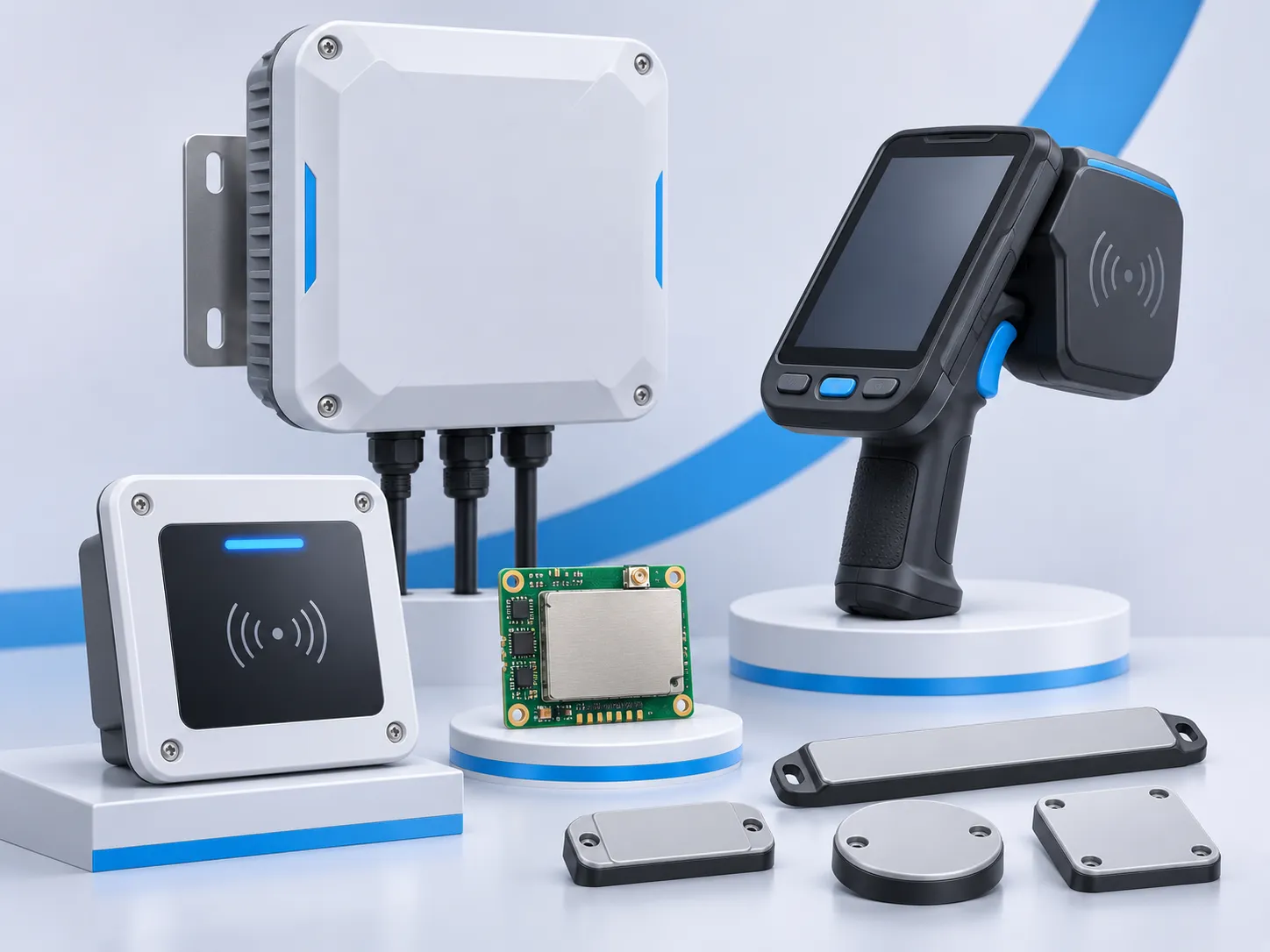
A handheld reader is a practical choice for staff-led inventory rounds, asset searches and periodic audits. It allows the user to scan a defined room or equipment group without installing fixed readers throughout the hospital.
Syncotek’s SR-RU666 UHF Handheld Reader is an Android-based handheld terminal with UHF RFID capability. The published product page lists Android 11 and UHF configurations based on Impinj E710/E510 chip options. Confirm the exact configuration, frequency band, software interface and regional compliance requirements for the target market.
A fixed reader can capture tag events at an equipment-store entrance, service counter or controlled transfer point. The read zone should be designed to detect the intended movement while limiting reads from adjacent rooms or nearby assets.
Syncotek’s SR-RU471B UHF Fixed Reader is based on the Impinj E710 platform and provides four SMA antenna ports with multiple interface options. It can be evaluated for multi-antenna checkpoint prototypes. The final antenna positions, RF power and event logic must be validated at the hospital site.
An integrated reader combines reader electronics and an antenna in one unit. This can simplify a compact checkpoint or cabinet installation where its antenna pattern and read range match the intended zone.
Review Syncotek’s UHF Integrated Reader range when evaluating a compact equipment-room or cabinet read point. Select the exact model only after checking antenna gain, frequency, output power, interface, mounting location and the required read-zone boundary.
A desktop reader/writer can be used at an asset-registration workstation to read or encode tags and associate their identifiers with asset records. Syncotek’s SR-RU723 UHF Desktop Reader is a USB-connected reader/writer with demo software and SDK support. It is intended for desktop commissioning and development workflows, not continuous location tracking.
Medical-equipment manufacturers and system integrators may want to incorporate RFID into a custom cabinet, terminal or asset-management device. In that case, an embedded UHF module may be more suitable than a standalone reader.
Explore Syncotek’s UHF RFID Module range for OEM integration discussions. The final design needs to account for antenna placement, enclosure materials, power, interfaces, firmware, RF exposure and the host equipment’s applicable regulatory requirements.
Metal can detune or shield a conventional UHF tag antenna. If the tag must be attached directly to a metal frame or housing, evaluate a purpose-designed on-metal tag.
Syncotek’s Mount-on-Metal UHF RFID Tags include industrial tag families for conductive surfaces. These are candidate products for technical evaluation, not a claim that every model is certified or validated for medical equipment, clinical use, disinfection or sterilization.
For every candidate tag, check the available mounting area, surface curvature, attachment method, cleaning chemicals, moisture, abrasion, temperature exposure and read performance in the final position. Confirm suitability with the medical-device manufacturer and the hospital’s biomedical engineering team.
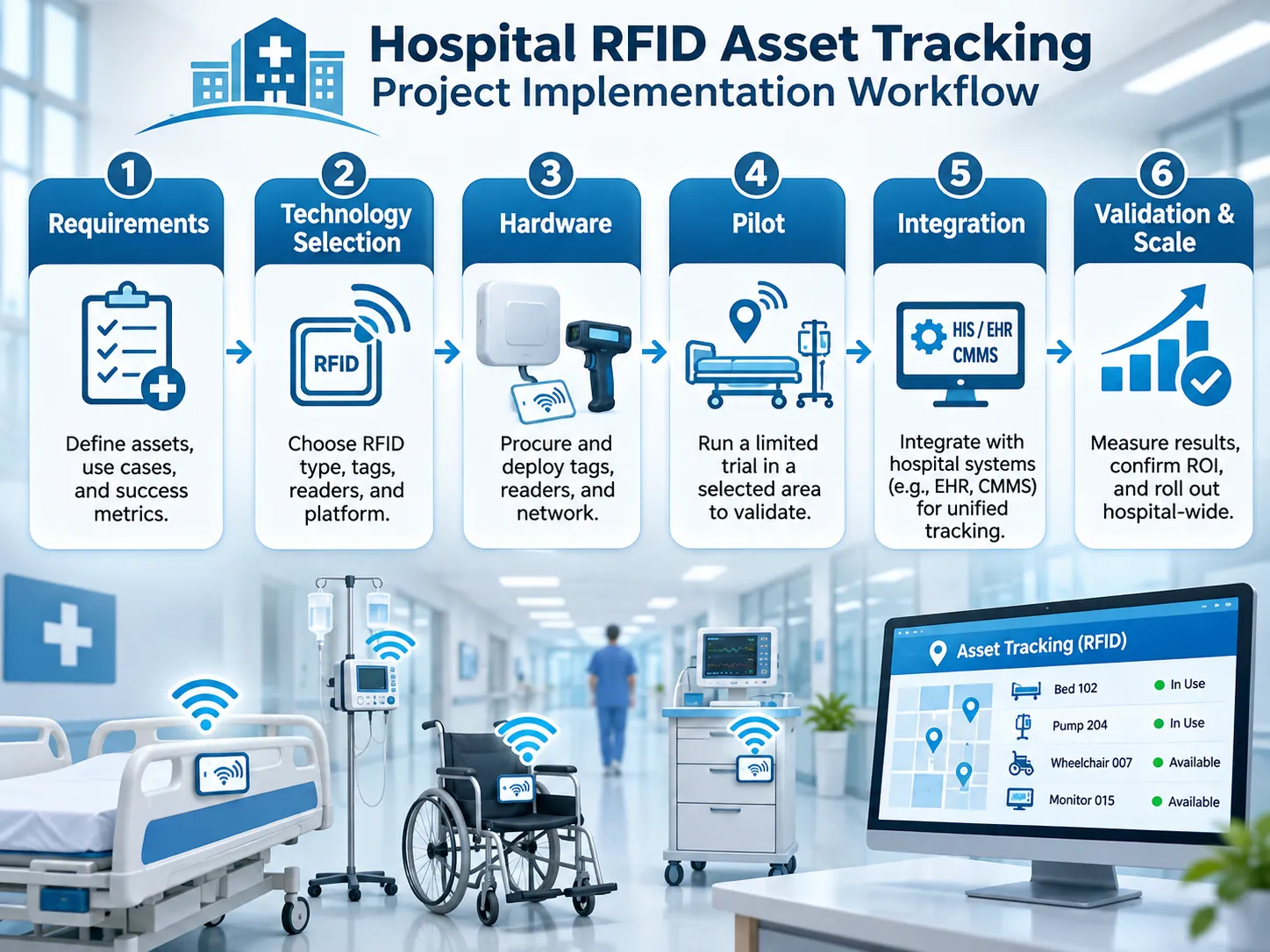
A staged rollout helps the hospital validate the technology and operating process before expanding to additional departments.
List the equipment categories, approximate quantities, departments and current inventory process. Decide whether the first project is intended to improve periodic inventory, reduce time spent searching, record issue-and-return events or provide more frequent location updates.
Choose between handheld passive UHF, fixed passive UHF checkpoints, active RFID, BLE, Wi-Fi, UWB or a hybrid approach. Base the decision on the required update frequency, location precision, coverage, tag maintenance and budget.
Choose representative tags for each equipment surface and reader types for the planned workflow. Confirm regional frequency, antenna configuration, interfaces, mounting conditions and software integration requirements. Test the tags on actual equipment before approving a large order.
Map equipment rooms, issue-and-return counters and other useful checkpoints. For installations near clinical equipment, involve biomedical engineering and complete the hospital’s EMC/EMI review and site approval before testing.
Test representative equipment, normal staff movement and realistic storage conditions. Map tag identifiers to asset records and define how the software handles missing assets, duplicate reads, unexpected reads, transfers and maintenance status.
Compare pilot results with the acceptance criteria agreed by the hospital and project team. Resolve read-zone, tag-placement and workflow issues before expanding to other departments or asset groups.
A pilot should test the complete workflow under representative hospital conditions. A successful tag read in a laboratory does not prove that the system will work reliably on a metal infusion pump, among crowded equipment carts or near adjacent clinical areas.

| Pilot metric | What to measure | How to test |
|---|---|---|
| Tag-to-asset mapping accuracy | Whether each tag is associated with the correct equipment record | Audit a sample of tagged assets against the asset register |
| Read completeness | Whether expected tags are detected during a defined inventory or checkpoint test | Repeat scans with representative asset orientations and normal operating conditions |
| Unwanted read rate | Whether tags outside the intended zone are captured | Test adjacent rooms, nearby corridors and equipment passing outside the read zone |
| Event and location accuracy | Whether a read is assigned to the correct reader, location and time | Compare system logs with observed asset movements |
| Integration accuracy | Whether validated events update the correct asset record and workflow | Trace sample events from reader output through middleware to the target application |
| Inventory completion time | How long staff need to complete a defined inventory task | Compare the same asset group and process before and during the pilot |
| Tag durability | Whether tags remain attached and readable after normal cleaning and use | Inspect and retest tags after the hospital’s specified cleaning exposure |
There is no universal read-rate target that applies to every hospital, tag, reader and workflow. The hospital, solution integrator and hardware supplier should agree on the sample size, test conditions, measurement method and acceptance thresholds before the pilot begins.
Include different housing materials, asset sizes, tag positions and storage arrangements. Test both stationary inventory and normal movement through any proposed fixed read zone. Record the reader model, frequency configuration, RF power, antenna type, antenna position, tag model, asset type and test result so that performance can be reproduced.
The pilot should confirm more than whether a reader can detect a tag. Check whether the right asset record is updated, whether a read event is assigned to the right location, whether duplicate events are handled correctly and whether staff can act on missing or unexpected assets.
For fixed readers installed near clinical equipment, complete the hospital’s EMC/EMI assessment and site approval before testing. Do not move directly from a successful bench test to unrestricted clinical deployment.
Metal surfaces can affect tag antenna performance, while water-rich materials and dense equipment arrangements can change the RF environment. Test tags on the actual equipment and in the normal storage configuration. Avoid relying on a read-range figure measured with a different tag orientation or surface.
Hospitals use cleaning agents and processes that vary by equipment type and department. Confirm the expected chemical exposure, moisture, temperature and mechanical wear. Do not assume that a general-purpose industrial tag is suitable for sterilization or autoclaving unless the exact tag has been designed and validated for that process.
A useful system needs to capture the intended asset within the intended zone. Increasing RF power without considering the site layout can increase unwanted reads. Antenna placement, polarization, tag orientation, reader timing, movement speed and software filtering should be tuned together.
RFID readers transmit radio-frequency energy. Hospitals should assess the electromagnetic environment before installing fixed readers or conducting tests near electronic medical equipment. The U.S. FDA recommends that healthcare facilities identify RF transmitters and critical-use areas, coordinate the purchase and installation of electronic equipment, and involve clinical or biomedical engineering personnel in EMC management.
Review the FDA guidance on RFID and the FDA/CDRH recommendations for EMC/EMI in healthcare facilities. The hospital should also consult medical-device manufacturers and its own engineering and safety procedures. No general statement that RFID is safe in every clinical area can replace a site-specific assessment.
Use an asset identifier on the RFID tag rather than patient information. Restrict access to asset-location and maintenance records, protect reader-to-application communications and define event-log retention. If the project connects to hospital information systems, the hospital’s IT, privacy and security teams should review the data flows and permissions.
RFID asset tracking should not be confused with patient identification, medication administration, clinical monitoring or regulatory UDI compliance. Those workflows have separate requirements and should be designed and validated independently.
Not by itself. A passive UHF tag responds when it is within a compatible reader’s effective zone. A handheld scan or fixed read point can record where and when an asset was detected, but it does not continuously provide the asset’s location between reads. Frequent location updates generally require an active RFID, BLE, Wi-Fi, UWB or other RTLS architecture.
It depends on the required workflow. Passive UHF RFID may be suitable for periodic inventory or checkpoint identification. If staff need frequent location updates for pumps moving across wards, evaluate an RTLS solution. The tag must be attached to an approved surface and tested with the pump’s actual housing, cleaning process and operating environment.
Yes, if a suitable on-metal tag is selected and tested in its final mounting position. A conventional UHF label may perform poorly on a metal frame. Check the tag’s dimensions, mounting method, durability and read performance on the actual asset.
It can identify multiple tagged devices if each item has a suitable tag and the reader configuration can capture them. The system must be designed around the required level of identification. A tag on the cart identifies the cart; it does not automatically identify every medical device placed on it.
No. Fixed readers should be installed where automatic event capture provides a clear operational benefit, such as equipment libraries, selected entrances or issue-and-return points. Handheld readers may be more economical for periodic room-level inventory. A hospital requiring frequent location updates should evaluate RTLS coverage rather than assuming that a large number of passive UHF readers will provide continuous positioning.
Yes. Reader events can be transferred through supported interfaces, APIs, SDKs or middleware. The integration must map tag identifiers to asset records and define how inventory, location, issue-and-return and maintenance events are processed. The reader does not replace the hospital’s asset-management or CMMS software.
Do not assume so. A tag must be specifically designed and validated for the actual temperature, pressure, chemicals, attachment method and sterilization cycle. General industrial IP ratings do not establish autoclave or medical sterilization compatibility.
RFID readers transmit RF energy, so electromagnetic compatibility must be evaluated for the intended site and reader configuration. Hospitals should involve biomedical or clinical engineering, consult medical-device manufacturers and follow the facility’s EMC/EMI procedures before deployment near critical equipment.
A hospital RFID project should begin with the asset workflow, required location update frequency and equipment environment. Passive UHF handheld readers can support inventory and asset searches. Fixed readers can capture events at selected checkpoints. If continuous or frequent location updates are required, the project may need active RFID, BLE, Wi-Fi, UWB or a hybrid RTLS architecture.
Syncotek provides UHF RFID handheld readers, fixed readers, integrated readers, desktop reader-writers, embedded UHF modules and on-metal tag options for system integrators and OEM projects. These products can provide the RFID identification and data-capture layer for a wider hospital asset-management solution. The hospital’s software provider or system integrator remains responsible for the asset workflow, RTLS functions where required, clinical integration and application-level business rules.
Explore the Syncotek RFID reader portfolio or contact Syncotek to discuss a hardware configuration for your application.
When requesting a recommendation, provide:
 Knowledge
Hospitals manage large fleets of reusable medical equipment that move continuously between wards, treatment areas, equipment stores, operating theatres and maintenance departments. Infusion pumps, patient monitors, wheelchairs, beds and mobile carts can be difficult to locate when equipment is shared across departments or when inventory records are updated manually. RFID medical equipment tracking uses electronic […]
READ MORE Knowledge
A modern data center may contain thousands of physical IT assets distributed across: rooms cages rows racks storage areas staging zones repair areas multiple facilities Servers, switches, storage appliances and network equipment are also moved, upgraded, replaced and decommissioned throughout their lifecycle. The challenge is not simply knowing how many devices the organization purchased. Data […]
READ MORE Knowledge
In an RFID system, the antenna is one of the most important components that determines how well tags can be read. The reader generates RF energy, but the antenna controls how that energy is transmitted into the read zone and how tag responses are received. Many RFID projects focus heavily on tags and readers, while […]
READ MORE Knowledge
Learn the real differences between RFID and NFC—frequencies, range, security, smartphone compatibility, data models, and use cases. See when to choose UHF RFID (RAIN) vs. NFC, and how Syncotek readers fit your project.
READ MORE Knowledge
Reusable totes, bins, crates and returnable containers are easy to overlook because they are not usually the products being sold. But in many warehouses and manufacturing supply chains, they are valuable operational assets. A company may own 5,000 reusable totes and still struggle to answer basic questions: How many are currently available? How many are […]
READ MOREIf you are interested in our services or need customized solutions, please feel free to contact us.