

RAIN RFID and Bluetooth Low Energy can both be used to track physical assets, but they solve fundamentally different problems.
A warehouse manager may ask:
Which of our 5,000 tools and assets are currently present?
A hospital may ask:
Which room is this mobile equipment currently in?
A data center may ask:
Which servers are installed in this rack?
A factory may ask:
Did this tagged tool leave the controlled tool room?
These are all described as asset tracking, but they require different levels of identification and location visibility.
That is why comparing RAIN RFID and BLE only by "read range" misses the real engineering decision.
A better starting point is:
Do you primarily need to identify and inventory assets, or do you need continuous information about where powered assets are located?
In general:
RAIN RFID is particularly strong for battery-free identification, high-volume inventory and controlled checkpoint detection.
BLE is particularly strong when powered tags need to broadcast regularly for continuous proximity, zone or positioning applications.
And some projects benefit from using both.
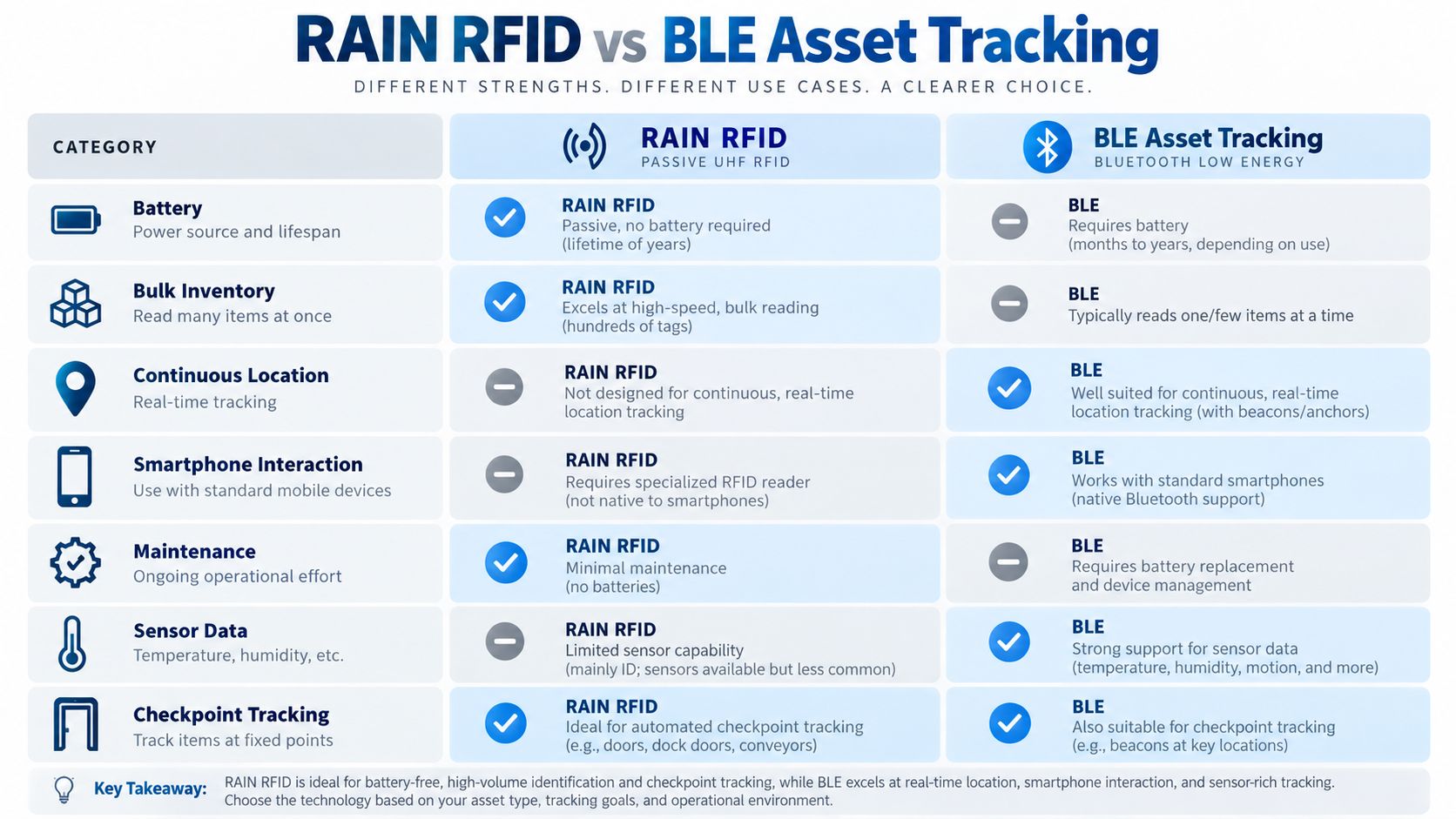
| Requirement | RAIN RFID | BLE |
|---|---|---|
| Battery-free asset tag | Strong | Usually requires battery |
| Bulk inventory | Strong | Not its primary architecture |
| Handheld asset audit | Strong | Possible with different workflow |
| Fixed doorway detection | Strong | Possible |
| Continuous location updates | Limited without suitable fixed infrastructure | Strong |
| Zone / room visibility | Possible with infrastructure | Strong |
| High-precision positioning | Not primary purpose | Possible with Direction Finding |
| Smartphone compatibility | Limited for passive UHF | Strong |
| Tag battery maintenance | None for passive tags | Required |
| Very large tag populations | Attractive | Battery/tag cost becomes important |
| Sensor telemetry | Specialized tags | Natural fit for powered devices |
| Automated checkpoints | Strong | Possible |
| Asset identity / serialization | Strong | Strong |
The important word here is fit, not "winner."
The correct technology depends on what information the business actually needs.
Before selecting RFID, BLE or any RTLS technology, define the level of visibility required.
Question:
What asset is this?
Both RFID and BLE can provide an identity.
Question:
Which assets are currently present in this room, warehouse or tool crib?
RAIN RFID is particularly strong here because many passive tags can be inventoried without individual line-of-sight scanning.
Question:
Which assets crossed this doorway?
A fixed RAIN RFID portal is a natural architecture.
Question:
Where was this asset last detected?
RAIN RFID fixed readers can provide this at defined read points.
BLE gateways can also provide last-seen information.
Question:
Which room or general area contains the asset?
BLE gateway networks are commonly designed for this type of visibility.
Question:
Where is this asset now?
This begins moving into RTLS territory.
BLE can support continuously updated location architectures because powered BLE tags periodically transmit signals.
Question:
What is the asset's current position within the room?
Bluetooth Direction Finding using Angle of Arrival or Angle of Departure can support much higher-accuracy positioning than simple RSSI-based proximity systems. Bluetooth SIG describes Direction Finding as supporting positioning systems capable of centimeter-level accuracy under suitable implementations.
The correct technology therefore depends on which of these questions actually matters.
RAIN RFID is the industry term commonly used for passive UHF RFID based on the GS1 EPC UHF Gen2 / ISO/IEC 18000-63 ecosystem.
GS1 describes RAIN RFID systems as passive UHF systems in which the reader provides RF energy to the tag and the tag responds through backscatter communication.
A typical architecture is:
Passive RFID Tag
↔
Handheld or Fixed Reader
→
Middleware
→
Asset Management System
Passive tags normally contain no battery.
This is a major architectural advantage when an organization needs to identify:
of physical items.
Common RAIN RFID asset-tracking applications include:
RAIN RFID is particularly effective for fast asset identification, inventory and tracking, which is also how GS1 characterizes passive UHF RFID applications.
For a complete implementation guide, see:
BLE means Bluetooth Low Energy.
Instead of relying on energy from a reader, a typical BLE asset tag contains its own battery and periodically transmits wireless signals.
A basic system looks like:
Battery-Powered BLE Asset Tag
→
BLE Gateway / Locator
→
Network
→
Location / Asset Platform
Because the tag can transmit autonomously, BLE is naturally suited to workflows requiring frequent visibility updates.
Potential BLE asset-tracking applications include:
Depending on system architecture, BLE may provide:
More advanced BLE architectures add Direction Finding or newer ranging technologies.
The biggest difference begins with the tag.
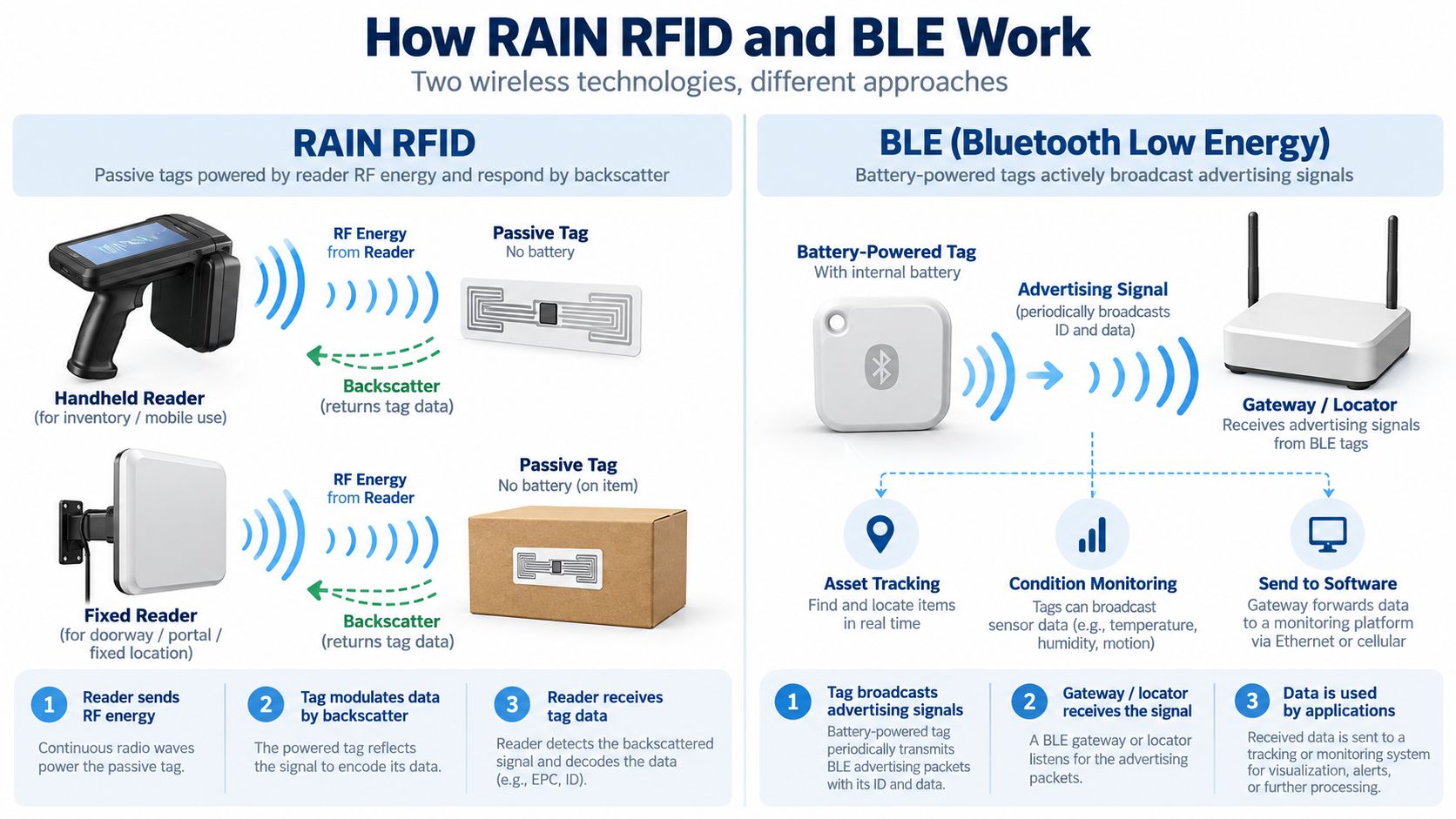
The reader transmits RF energy.
The passive tag receives that energy.
The tag then responds using backscatter.
GS1's Gen2 standard explicitly defines passive tags as receiving their operating energy from the reader's RF signal rather than relying on an internal battery.
Simplified:
Reader
→ RF Energy
→ Passive Tag
→ Backscatter
→ Reader
The BLE tag usually contains:
Battery + Bluetooth Radio + Antenna
It can periodically broadcast advertising packets.
A gateway or locator receives those signals and forwards data into the application.
Simplified:
Powered BLE Tag
→ Advertising Signal
→ Gateway / Locator
→ Location Platform
That one architectural difference influences:
RAIN RFID's battery-free tag architecture is one of its biggest advantages for large asset populations.
A passive RFID tag does not need periodic battery replacement.
That is valuable when managing:
BLE tags, by contrast, normally require an internal energy source.
Battery life depends on factors such as:
Therefore, it is misleading to say:
BLE tags always last X years.
The correct question is:
What maintenance workload does this BLE configuration create over the expected deployment life?
Consider two projects.
100 high-value mobile machines.
BLE battery maintenance may be entirely reasonable.
100,000 low-value reusable assets.
Replacing and managing thousands of batteries becomes a much more significant operating consideration.
RAIN RFID removes that particular maintenance requirement.
This does not automatically make RAIN RFID cheaper overall.
It means tag battery maintenance is not part of its passive-tag TCO.
One of RAIN RFID's strongest capabilities is high-volume physical inventory.
GS1 notes that unique identifiers on passive UHF tags can be captured at very high rates without optical line-of-sight scanning.
Consider an IT asset audit.
Technician:
Find asset
→ Find label
→ Align scanner
→ Scan
→ Repeat
Technician:
Select inventory task
→ Walk through area with handheld reader
→ Detect tagged assets
→ Compare Expected vs Found
This makes RAIN RFID particularly useful for:
A RAIN RFID application can produce results such as:
Expected:
1,250 assets
Found:
1,237
Missing:
13
Unexpected:
4
The value is not simply that the reader "reads farther."
The value is that the workflow reduces individual manual scanning.
Handheld UHF RFID readers can also support directed asset searching.
The application selects one EPC.
The technician walks through the facility.
Reader feedback increases as the operator moves closer to the target tag.
This can help find:
However, this is better described as:
proximity-assisted search
rather than:
real-time coordinates
The system still requires the operator to search.
BLE provides a different model.
Because the powered tag broadcasts signals, gateways or mobile devices can use those signals to estimate:
Depending on the architecture.
For example:
Asset Pump-104
Last detected:
Room B12
or:
Asset Cart-27
Current Zone:
Emergency Department
This can be much more useful when users need location information before physically searching.
RAIN RFID is very strong when asset movement can be associated with specific physical transition points.
Examples include:
Workflow:
Tagged Asset
→ Controlled Read Zone
→ Fixed RFID Reader
→ Movement Event
→ Asset Software
The application can answer:
Asset A crossed Door 4 at 14:32.
This is often enough for many business processes.
You do not necessarily need continuous coordinates if you only need to know:
Did this asset leave the controlled area?
Now consider a different requirement:
Where is Pump 104 right now?
A handheld RFID reader sitting in a charging cradle cannot answer that.
BLE tags can continuously or periodically advertise.
A network of BLE gateways or locators can therefore provide repeated observations without an employee walking around with a reader.
This makes BLE more natural for:
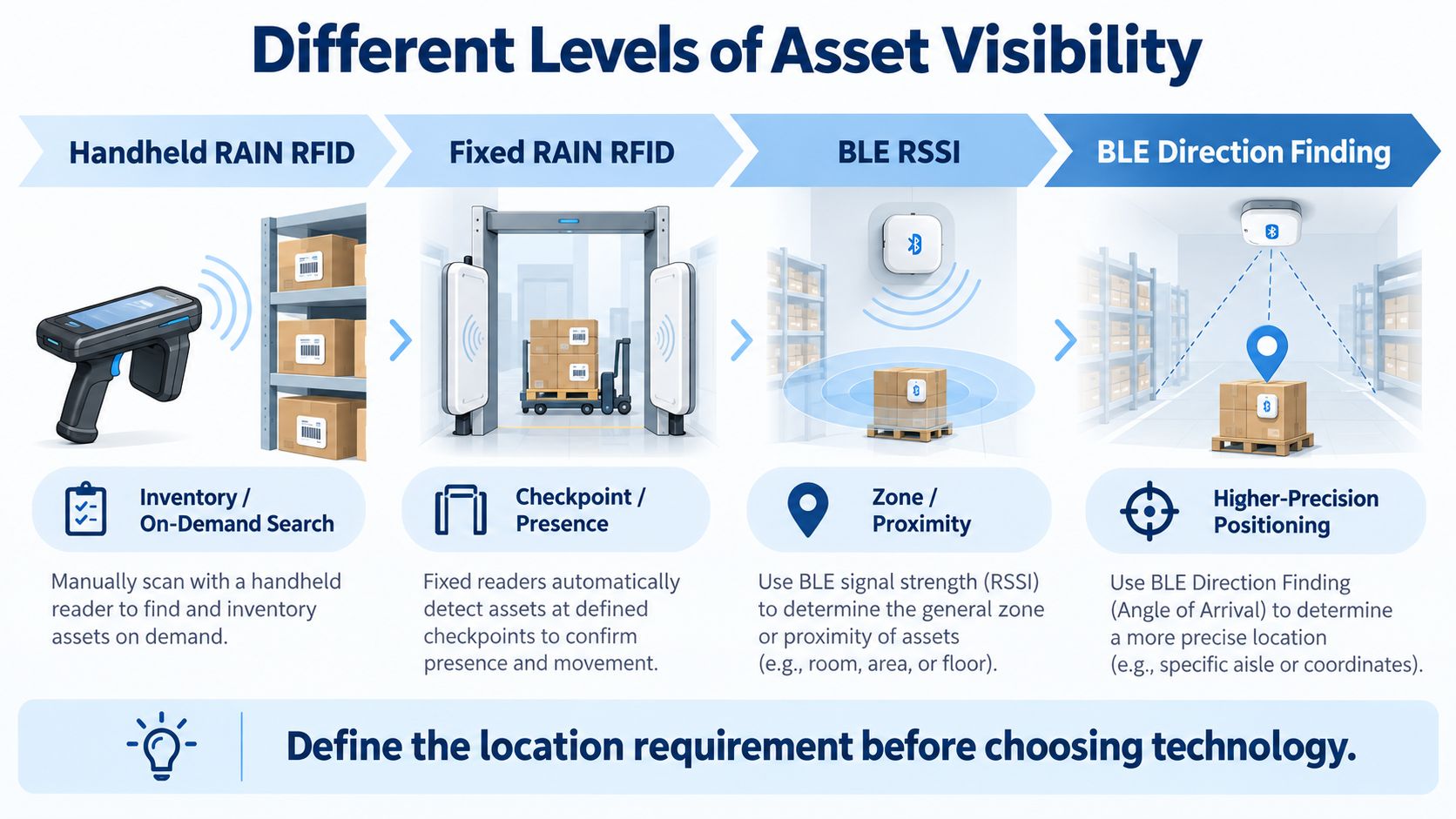
It helps to think of asset tracking as a spectrum.
Provides:
Inventory / On-Demand Search
Provides:
Checkpoint / Presence / Last Seen
Provides:
Proximity / Zone Estimation
Provides:
Higher-Precision Positioning
The important lesson is:
Define the location requirement before choosing the technology.
Many BLE location systems estimate proximity from RSSI:
Received Signal Strength Indicator
In simplified terms, a stronger received signal often suggests the BLE tag is closer to the receiver.
However, radio propagation is affected by:
Therefore:
RSSI is not the same as precise distance.
Bluetooth SIG's technical material similarly distinguishes conventional RSSI-based distance estimation from more advanced direction-finding and ranging approaches.
RSSI can still be valuable for:
when the application does not need precision coordinates.
Bluetooth Direction Finding significantly changes the old assumption that Bluetooth is only useful for approximate proximity.
Bluetooth supports two principal direction-finding methods:
A transmitting BLE asset tag sends a special signal.
A fixed locator with multiple antennas measures the signal across its antenna array.
The system calculates the direction from which the signal arrived.
Bluetooth SIG specifically identifies AoA as suitable for RTLS applications where buildings need to determine the location of people or things.
A fixed transmitter uses an antenna array.
A receiving device measures the transmitted signal and estimates its direction relative to the locator.
AoD is often associated with indoor positioning and navigation use cases.
Bluetooth SIG says Direction Finding can support positioning systems capable of centimeter-level accuracy under suitable system implementations.
The important qualification is:
Accuracy depends on the complete location system, not Bluetooth alone.
There is another important 2026 consideration.
Bluetooth Core 6.0 adds Channel Sounding, which enables Bluetooth devices to cooperate in calculating distance using more advanced ranging techniques than basic RSSI.
This means BLE location architectures should no longer be evaluated only as:
RSSI beacon tracking.
Modern Bluetooth positioning can combine capabilities such as:
depending on the application and supported hardware.
For this reason, an up-to-date RAIN RFID vs BLE comparison should not treat BLE as a simple 10–30 meter beacon technology.
It is better to compare visibility architecture than promise universal accuracy numbers.
| Architecture | Typical Purpose |
|---|---|
| Handheld RAIN RFID | Inventory and asset search |
| Fixed RAIN RFID Portal | Checkpoint / last-seen |
| Controlled RAIN Infrastructure | Presence / zone depending on design |
| BLE RSSI | Proximity / approximate zone |
| BLE Direction Finding | Higher-precision positioning |
| UWB | Precision RTLS |
Each layer requires increasingly sophisticated infrastructure.
For a broader location-technology explanation, see:
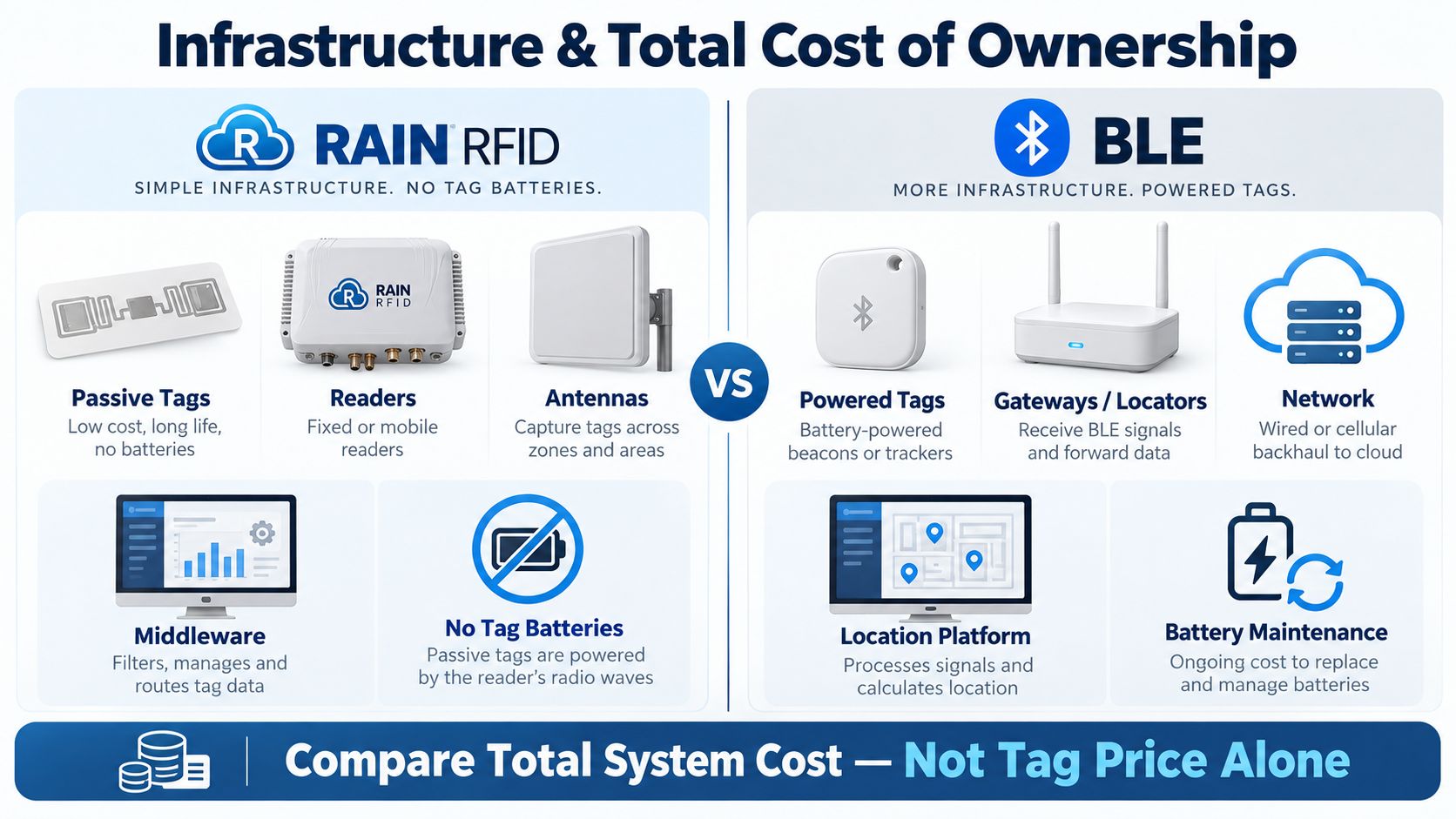
Tag price alone is not enough to compare RAIN RFID and BLE.
The correct comparison is:
Total System Cost
Possible components include:
Passive tags do not add a battery-maintenance program.
Possible components include:
A simple BLE deployment may require relatively little infrastructure.
A high-accuracy enterprise AoA system can require significantly more.
Therefore:
BLE is not automatically simpler than RFID, and RFID is not automatically cheaper than BLE.
The architecture decides.
One of the simplest enterprise asset-tracking deployments can be:
Passive Tags
Handheld Reader
Asset Software
There may be almost no permanent RF infrastructure.
This is attractive for:
Automatic checkpoints require:
Infrastructure increases, but movement capture becomes automatic.
BLE requires receivers throughout the areas where asset visibility is required.
A basic deployment may use:
BLE Tags
→ Gateways
→ Cloud / Asset Platform
High-accuracy BLE systems may require:
So do not compare:
one passive RFID tag
against:
one BLE tag
Compare the complete systems.
Passive RAIN RFID tags can be very economical at scale, particularly simple labels.
But industrial asset tags can cost much more than retail RFID labels.
Likewise, BLE tags range from simple beacons to sophisticated sensor devices.
The better formula is:
TCO
=
Tag / Device Cost
Reader / Locator Infrastructure
Software
Installation
Integration
Battery Maintenance
Device Replacement
Operational Labor
This creates a more useful comparison than tag price alone.
BLE has a clear architectural advantage here.
Modern smartphones natively support Bluetooth.
That makes BLE attractive for:
Passive UHF RAIN RFID is different.
Most standard smartphones do not function as full-purpose UHF RAIN RFID readers.
Applications normally require:
If standard smartphones are a core part of the workflow, BLE deserves serious consideration.
Powered BLE devices are naturally suited to sensor integration.
A BLE asset tag can potentially include:
depending on hardware design.
Passive RAIN RFID sensor tags also exist.
However:
ordinary passive RFID asset tag ≠ sensor tag
If sensor telemetry is central to the business requirement, BLE may provide a more natural powered architecture.
Neither technology magically eliminates RF challenges around metal.
A conventional UHF label may become detuned on metal.
Use:
On-Metal RFID Tag
for assets such as:
Metal can also affect:
BLE tag placement still matters.
The correct conclusion is not:
BLE works on metal while RFID does not.
Both systems require appropriate antenna and enclosure design.
Technology type does not determine mechanical durability.
A passive RFID tag can be:
A BLE tag can also be built inside a rugged industrial enclosure.
So compare:
rather than assuming one radio technology is inherently more durable.
RAIN RFID and BLE use different security architectures.
It is too simplistic to say:
BLE broadcasts, therefore RFID is more secure.
or:
BLE uses encryption, therefore BLE is more secure.
RAIN RFID can support capabilities including:
GS1 documents password-based memory locking and additional methods for protecting tag data.
BLE supports its own:
The real security posture depends on:
Device + Protocol + Configuration + Credential Management + Backend
Security should be designed from the application threat model rather than selected solely from the wireless technology name.
Consider laptops, servers and network equipment.
Requirement:
Verify all 2,000 IT assets each month.
RAIN RFID handheld inventory is a strong fit.
RAIN RFID can also support:
See:
RFID Data Center Asset Tracking
If the requirement is:
Continuously identify which room contains a mobile laptop or test unit.
BLE may be a stronger starting architecture.
The important distinction is:
Audit
vs
Continuous Location
Consider a hospital managing infusion pumps.
Perform fast weekly inventory.
RAIN RFID may be highly effective.
Staff need to know which department currently has Pump 104.
BLE zone tracking may be more useful.
Staff need precise indoor coordinates.
A more advanced BLE Direction Finding or another RTLS architecture should be considered.
This is why "asset tracking" should never be treated as one requirement.
RAIN RFID is particularly strong for:
See:
However, if a company wants to continuously locate expensive mobile service equipment across a very large facility, BLE or another RTLS technology may become more appropriate.
Returnable totes and containers are a strong RAIN RFID use case.
A passive tag can remain attached for many reuse cycles without tag-battery maintenance.
Fixed readers can detect movement at:
See:
But if the business needs to know a tote's continuously changing location throughout a large yard, checkpoint RFID may not be sufficient.
BLE or another location architecture may need evaluation.
RAIN RFID deserves serious consideration when the project requires:
Example:
We have 30,000 tools and assets and need to complete inventory much faster.
That strongly points toward RAIN RFID evaluation.
BLE deserves serious consideration when the project requires:
Example:
We need staff to open an application and see which hospital zone currently contains Pump 104.
That points toward BLE/location infrastructure.
Some requirements are more demanding.
For example:
Continuously locate an autonomous mobile asset with very high positional accuracy and low latency.
Then the project may need to evaluate technologies such as:
The technology should follow the required:
Yes.
This is one of the most useful conclusions in the comparison.
RAIN RFID and BLE are not mutually exclusive.
A high-value mobile asset could have:
RAIN RFID Identity
for:
and:
BLE
for:
Both datasets can then connect to the same asset record.
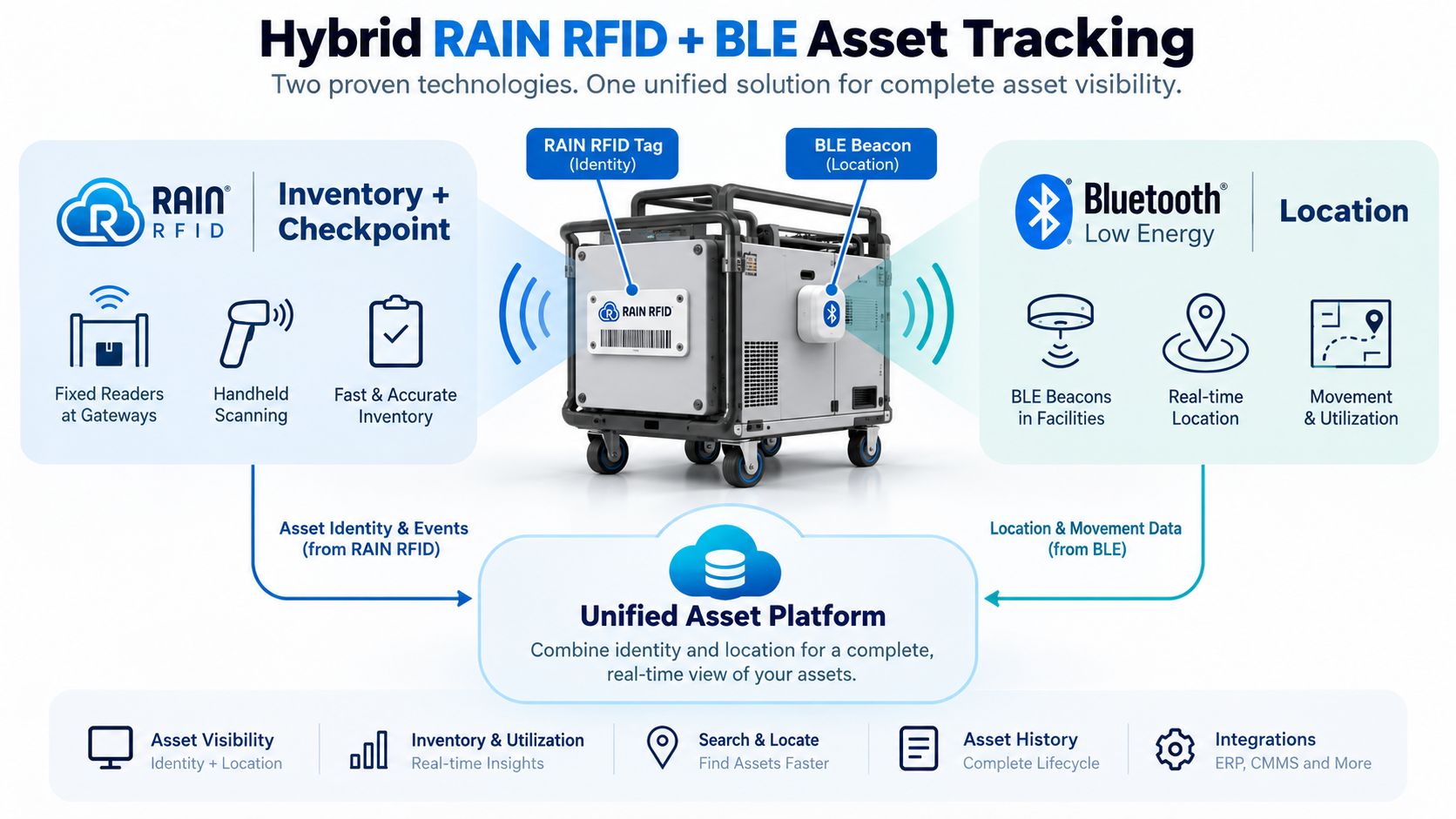
A hybrid architecture might look like:
Physical Asset
↓
Passive RFID Tag
→ Handheld / Fixed Reader
→ Identity + Inventory + Checkpoint Events
Powered BLE Device
→ Gateway / Locator
→ Location + Movement Data
Both feed:
Unified Asset Management Platform
This can answer two different questions:
RAIN RFID:
Is this the correct asset?
BLE:
Where is it now?
Hybrid architecture may be justified when:
It is unlikely to make sense for every low-value asset.
Again, project economics matter.
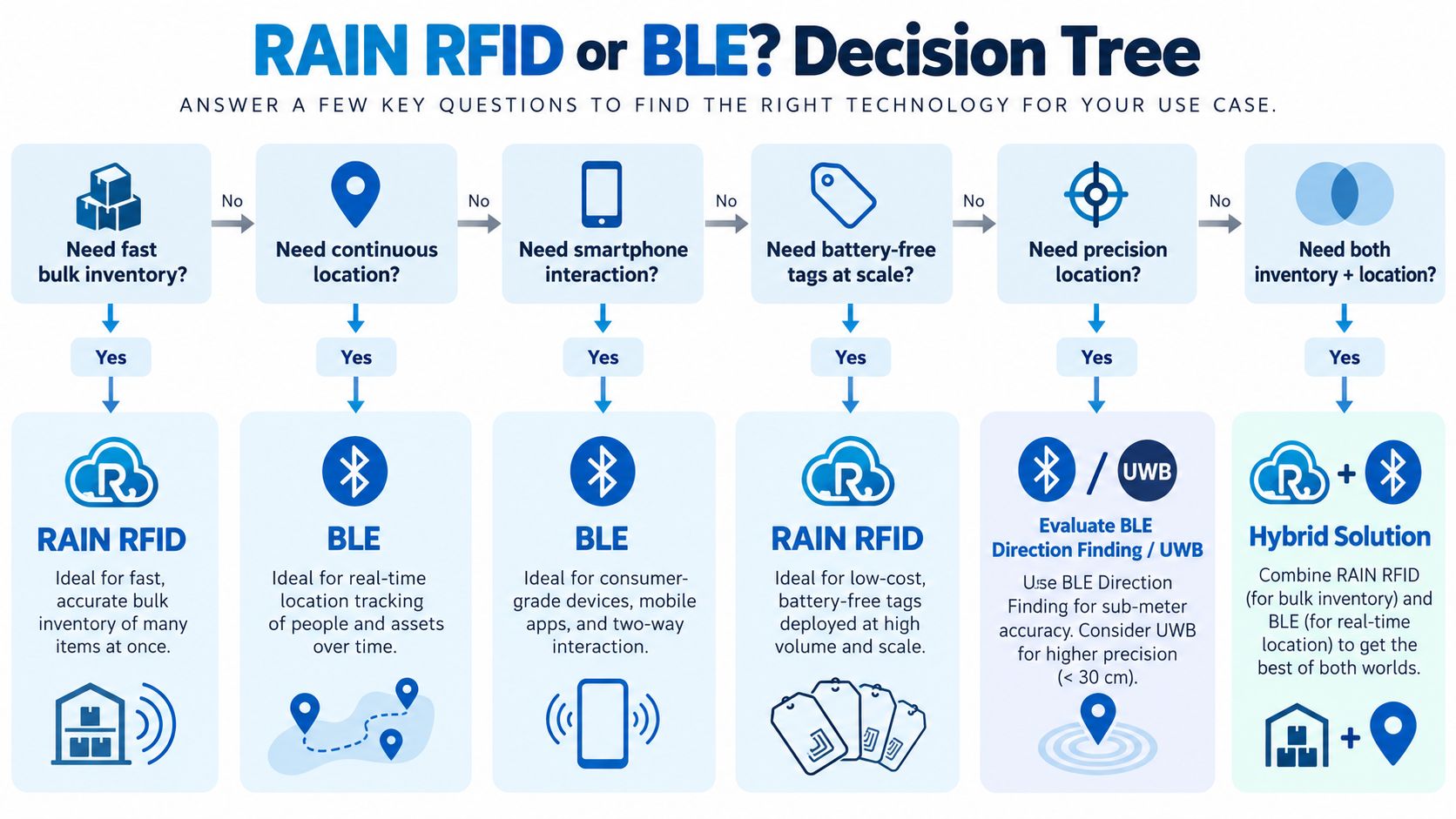
Use the following questions as a starting point.
Yes
→ Evaluate RAIN RFID
Yes
→ Evaluate BLE / RTLS
Yes
→ RAIN RFID becomes especially attractive.
Yes
→ BLE has a major advantage.
Yes
→ BLE is often a natural starting point, though specialized RFID sensor tags also exist.
Yes
→ RAIN RFID is a strong candidate.
Yes
→ Evaluate BLE Direction Finding, Channel Sounding or UWB according to required accuracy and architecture.
Yes
→ Consider a hybrid architecture.
Before choosing technology, document the project requirement.
100?
10,000?
1,000,000?
Scale changes the economics.
A battery-powered tag may be reasonable for a $20,000 asset but difficult to justify for a $3 reusable item.
Mobility strongly affects the location requirement.
These are not the same requirement.
Once a day?
Every time the asset crosses a doorway?
Every minute?
Several times per second?
Building?
Room?
Zone?
Aisle?
Coordinates?
This becomes particularly important at scale.
For example:
If yes, BLE deserves special consideration.
Tag and locator placement need real-world testing.
Infrastructure cost changes with site size.
Examples:
The architectures are fundamentally different.
Inventory and checkpoint detection are not the same as real-time positioning.
It does not by default.
Basic RSSI-based BLE can provide proximity or zone estimates; precision requires suitable positioning infrastructure.
Powered tags create lifecycle-management requirements.
High-accuracy BLE systems can require extensive locator infrastructure.
Compare total system cost.
A few gateways may be simple.
An enterprise AoA positioning deployment is a different engineering project.
Fixed RAIN RFID readers are widely used for automated:
Start with the required outcome.
Before confirming the architecture, define:
RAIN RFID is generally a passive UHF identification technology where readers energize battery-free tags and receive backscatter responses. BLE asset tracking typically uses battery-powered devices that actively transmit Bluetooth Low Energy signals.
Neither is universally better. RAIN RFID is particularly strong for inventory, identification and checkpoints. BLE is stronger when continuous powered location or wireless telemetry is required.
Not automatically. RAIN RFID can provide inventory, presence, checkpoint and last-seen visibility. Continuous precise position requires suitable additional infrastructure or another RTLS technology.
Most BLE asset tags use batteries or another local power source because they transmit wireless signals independently.
Yes. Standard passive RAIN RFID tags receive operating energy from the RFID reader's RF field.
Yes, when deployed with appropriate gateways, locators and location software.
It depends on the architecture. RSSI-based systems often provide proximity or zone information, while Bluetooth Direction Finding using AoA/AoD can support much higher-accuracy positioning.
Bluetooth Direction Finding is a Bluetooth LE capability using Angle of Arrival or Angle of Departure measurements to determine signal direction and support high-accuracy positioning.
Channel Sounding is a Bluetooth 6.0 capability designed to provide secure and more precise distance measurements between Bluetooth devices.
AoA means Angle of Arrival. A transmitting device sends a direction-finding signal while a receiving locator uses an antenna array to estimate the direction from which the signal arrived.
It depends on the whole deployment. Compare tags, readers or locators, installation, network, software, batteries, maintenance and operational labor rather than tag price alone.
RAIN RFID can be effective for equipment inventory and checkpoint workflows. BLE may be more appropriate when staff need continuous room or zone visibility.
RAIN RFID is strong for bulk IT asset audits and checkpoints. BLE may be more appropriate for continuously locating mobile equipment.
RAIN RFID is well suited to tool inventories, issue/return and controlled tool rooms. BLE may add value where continuous location of expensive mobile tools is required.
Standard smartphones generally do not act as general-purpose UHF RAIN RFID readers. Dedicated UHF hardware is normally required.
Yes. Bluetooth compatibility is one of BLE's important advantages for mobile applications.
Yes. RAIN RFID can provide identity, inventory and checkpoint events while BLE provides continuous location information to the same asset-management platform.
BLE is a wireless technology that can be used to build RTLS systems. The complete RTLS also requires infrastructure and software to determine location.
It depends on the requirement. For fast inventory with battery-free tags, RAIN RFID is particularly attractive. If all 10,000 assets require continuous location, BLE or another RTLS architecture may be more appropriate, but battery and infrastructure costs should be evaluated carefully.
Syncotek focuses on the passive UHF / RAIN RFID hardware layer for asset identification, inventory and automated read-point projects.
Our RFID portfolio includes:
RAIN RFID is particularly worth evaluating when your project requires:
However, if the core project requirement is:
continuously determine the position of every moving asset
rather than:
identify, inventory or detect the asset at known read points
then BLE, UWB or another RTLS architecture should also be evaluated.
For a RAIN RFID feasibility discussion, useful project information includes:
Continue with:
RFID Data Center Asset Tracking
The most important decision is not RFID or Bluetooth.
It is defining exactly what the business needs to know about each physical asset.
Once that requirement is clear, the correct identification, checkpoint, location or hybrid architecture becomes much easier to design.
 Company Events
Our new website offers streamlined access and insights into our latest products, solutions and services to better serve customers globally.
READ MORE Knowledge
Active RFID is a type of radio frequency identification technology that uses battery-powered tags to transmit data to RFID readers. Because the tag has its own power source, it can send signals over a much longer distance than a passive RFID tag, which relies on the reader’s signal for energy. That is why Active RFID is commonly […]
READ MORE Knowledge
Metal asset tracking is one of the most important applications in RFID, but it is also one of the most technically challenging. Many companies want to use RFID to identify tools, machines, containers, laptops, racks, returnable transport items, and industrial equipment, only to discover that standard RFID labels do not perform well when placed directly […]
READ MORE Uncategorized
Passive UHF RFID tags can communicate without a battery, cellular connection, Wi-Fi radio, or conventional transmitter. This is possible because the tag does not generate a completely independent radio signal. Instead, it receives energy from an RFID reader, powers its integrated circuit, and changes how much of the reader’s RF energy is reflected back. This […]
READ MORE Knowledge
Tools are essential assets in many industries. Manufacturing plants, construction companies, hospitals, repair teams, rental businesses, warehouses, and maintenance departments all depend on tools being available, traceable, and properly maintained. However, tool management is often difficult. Tools may be misplaced, borrowed without record, left at job sites, stored in the wrong cabinet, sent for maintenance […]
READ MOREIf you are interested in our services or need customized solutions, please feel free to contact us.