

RAIN RFID systems have been built around EPC UHF Gen2 for many years, but today's deployments are becoming more demanding.
Modern applications may need to identify:
At the same time, existing RFID deployments cannot simply abandon the enormous installed base of Gen2 tags and readers.
This is where Impinj Gen2X becomes important.
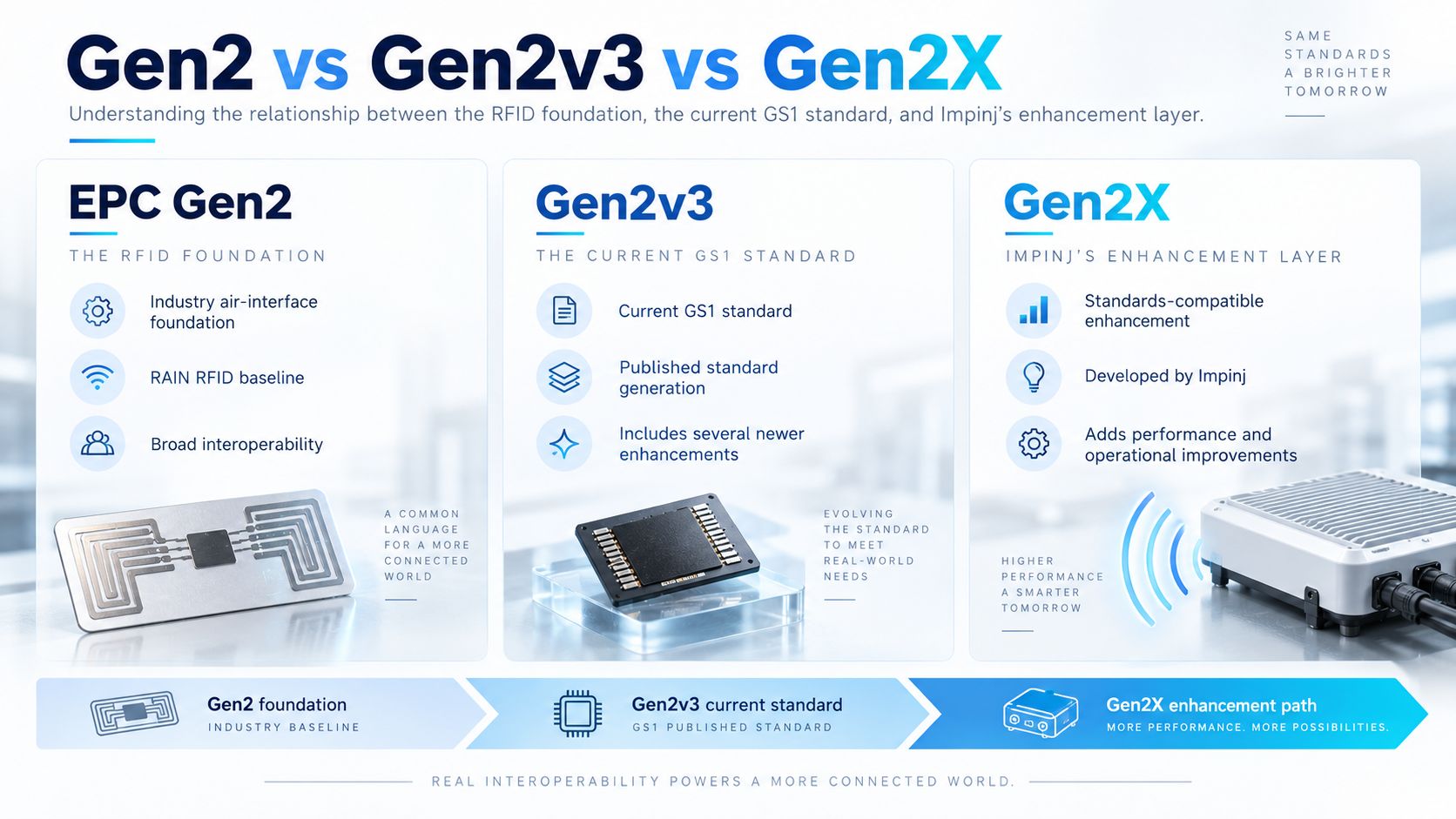
Gen2X is not a replacement for EPC Gen2 and it is not a new GS1 RFID standard.
Instead, Impinj describes Gen2X as a standards-compatible enhancement to the RAIN RFID radio standard, adding additional performance, tag-selection, read-zone and protection capabilities while maintaining interoperability with existing Gen2 systems.
A simplified way to think about it is:
EPC Gen2
= the industry foundation
Gen2v3
= the current GS1 standard generation
Gen2X
= an additional standards-compatible capability layer developed by Impinj
For RFID system integrators and OEM developers, this distinction matters.
A Gen2X deployment does not necessarily mean replacing every RFID tag and reader.
The practical question is:
Can Gen2X improve the specific performance limitation in your existing RFID application enough to justify enabling or adopting it?
The names are similar, which can create confusion.
They refer to different things.
| Technology | What It Is | Main Role |
|---|---|---|
| EPC UHF Gen2 | Industry RFID air-interface foundation | Defines how passive UHF RFID readers and tags communicate |
| Gen2v3 | Current generation of GS1 EPC UHF Gen2 standard | Adds newer standardized capabilities |
| Gen2X | Impinj standards-compatible enhancement | Adds additional performance and protection capabilities |
| M700 / M800 | Impinj endpoint IC families | RFID tag chips |
| E310 / E510 / E710 | Impinj reader IC platforms | Reader/module silicon |
Understanding these layers prevents one of the most common misconceptions:
Gen2X is not Gen2v4 and is not a replacement standard for Gen2v3.
EPC UHF Gen2 defines the radio interface between passive UHF RFID readers and tags.
It covers areas such as:
Modern RAIN RFID systems used in:
are generally built around this ecosystem.
Gen2v3 is the newer generation of the GS1 EPC UHF Gen2 air-interface standard.
As of September 2026, the current GS1 specification is:
EPC UHF Gen2 Version 3.0.1
published on February 26, 2026.
The specification covers RFID communications between 860 MHz and 930 MHz.
Gen2v3 introduced or standardized newer capabilities including improvements related to:
Impinj contributed several technologies that became part of Gen2v3, including power-up waveform shaping, configurable field strength during inventory initiation and tag-selection concepts.
Gen2X is a collection of RFID performance and protection capabilities developed by Impinj.
It builds on the existing Gen2 ecosystem rather than creating an incompatible replacement architecture.
The current Gen2X capability set focuses on areas such as:
Impinj currently positions Gen2X as interoperable with standard Gen2 systems and available across tags, reader ICs, readers and partner hardware.
Gen2X and Gen2v3 overlap, but they are not the same.
Some capabilities originally developed within the Gen2X technology toolbox have become part of the broader Gen2 standard evolution.
Examples include:
Gen2X then extends beyond these standardized capabilities with additional Impinj-specific performance and protection functions.
A useful way to visualize the relationship is:
Gen2
→ Industry foundation
Gen2v3
→ Updated industry standard
Gen2X
→ Standards-compatible capabilities that work with the Gen2 ecosystem and extend beyond some standardized functions
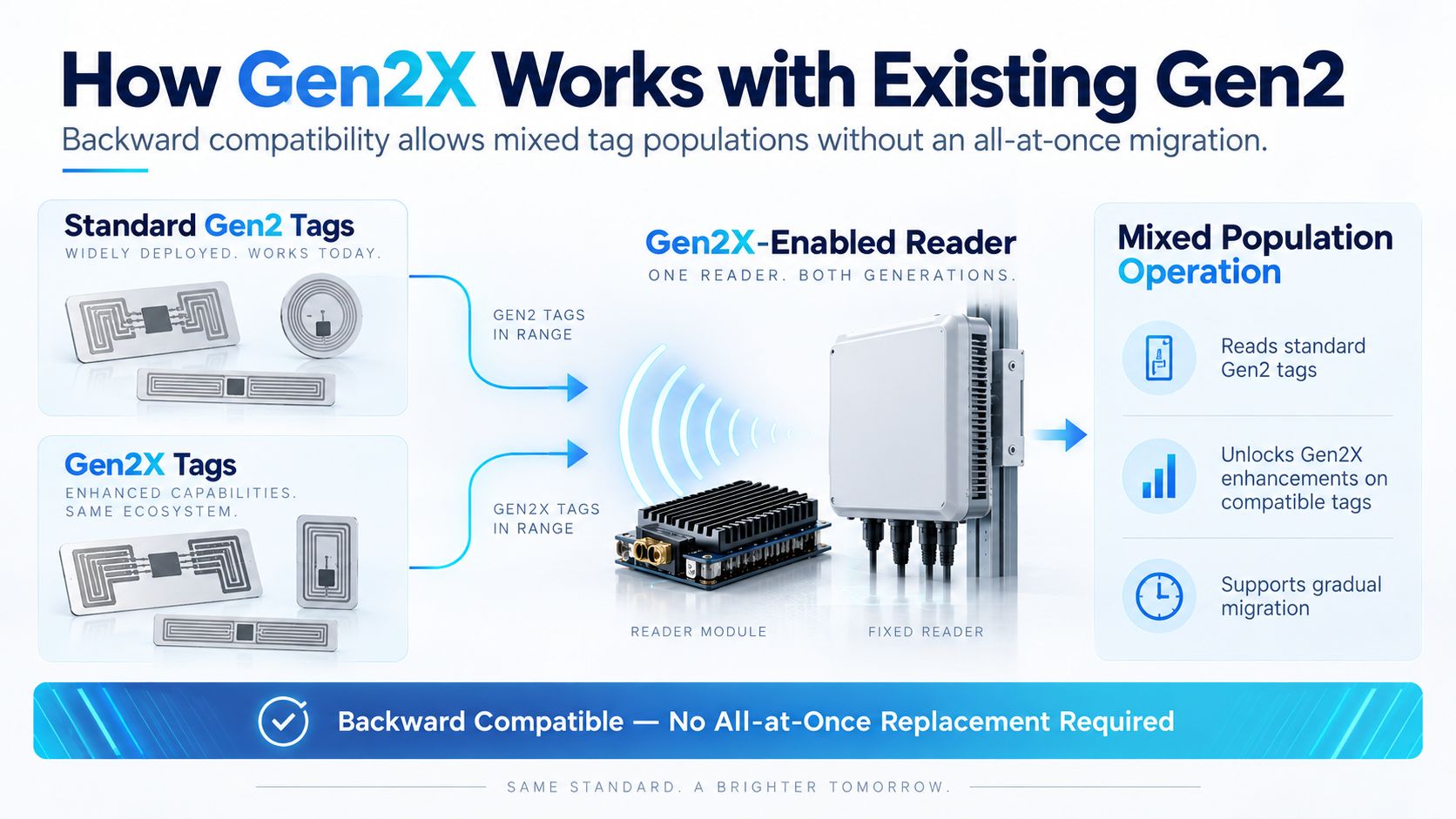
One of the most important Gen2X characteristics is backward compatibility.
A company does not need to replace its entire RFID infrastructure or tag population at once.
Consider three scenarios.
The system operates as a conventional RAIN RFID deployment.
The reader can continue reading conventional Gen2 tags.
Gen2X does not prevent normal Gen2 operation.
The system can use compatible Gen2X capabilities in addition to normal Gen2 operation.
This means a deployment can contain:
Existing Gen2 Tags
New Gen2X-Capable Tags
at the same time.
Impinj states that Gen2X-enabled readers dynamically handle Gen2 and Gen2X operation in mixed tag populations.
That is strategically important for enterprise RFID.
A company with millions of existing Gen2 tags does not need an all-at-once migration.
Gen2X capability depends on the RFID endpoint IC inside the tag.
Current Impinj product families with Gen2X support include the M800 series and Gen2X-capable M700-series products.
The current Impinj M700 platform documentation describes Gen2X capabilities including:
while M800-based tags have formed a major part of the commercial Gen2X ecosystem.
By 2026, Impinj reported more than 100 production Gen2X-enabled inlays in the ecosystem.
That means Gen2X is no longer only a laboratory or concept-stage technology.
However, the exact supported Gen2X feature set can depend on:
Always check the specific tag IC documentation rather than assuming every tag marketed as Gen2X supports every feature identically.
Gen2X is also moving beyond an Impinj-only endpoint-chip ecosystem.
In January 2026, Impinj and EM Microelectronic announced a licensing agreement for EM Microelectronic to integrate Gen2X into future endpoint ICs.
This matters because broader silicon support can improve:
Gen2X should therefore increasingly be understood as an ecosystem capability rather than simply a feature of one finished Impinj reader.
Gen2X support depends on both reader hardware and firmware.
Impinj's E-family reader IC ecosystem is especially important here.
Current Impinj E500 and E700 reader IC documentation explicitly includes Gen2X performance and protection capabilities.
Many existing E-family-based readers can gain Gen2X capability through firmware.
Impinj reported more than 50 production readers and modules with Gen2X support and notes that many were upgraded through firmware rather than complete hardware replacement.
However:
An RFID reader using Impinj E-series silicon should not automatically be described as Gen2X-enabled unless the finished reader firmware and software implementation support the required Gen2X functions.
This distinction is important for OEM developers and system integrators.
Syncotek currently offers several UHF RFID reader modules and fixed readers built around Impinj reader IC platforms including:
For example, the SR-MU931S platform provides E310/E510/E710 options and field-upgradable firmware, while SR-MU951A / SR-MU971A modules use E510 / E710 reader ICs. Syncotek also offers E710-based fixed-reader architectures.
These platforms place Syncotek hardware within the broader Impinj E-family ecosystem.
However, Gen2X availability for any specific finished Syncotek model should be confirmed according to:
before it is specified in an OEM project.
This is especially important when upgrading an existing installed reader fleet.
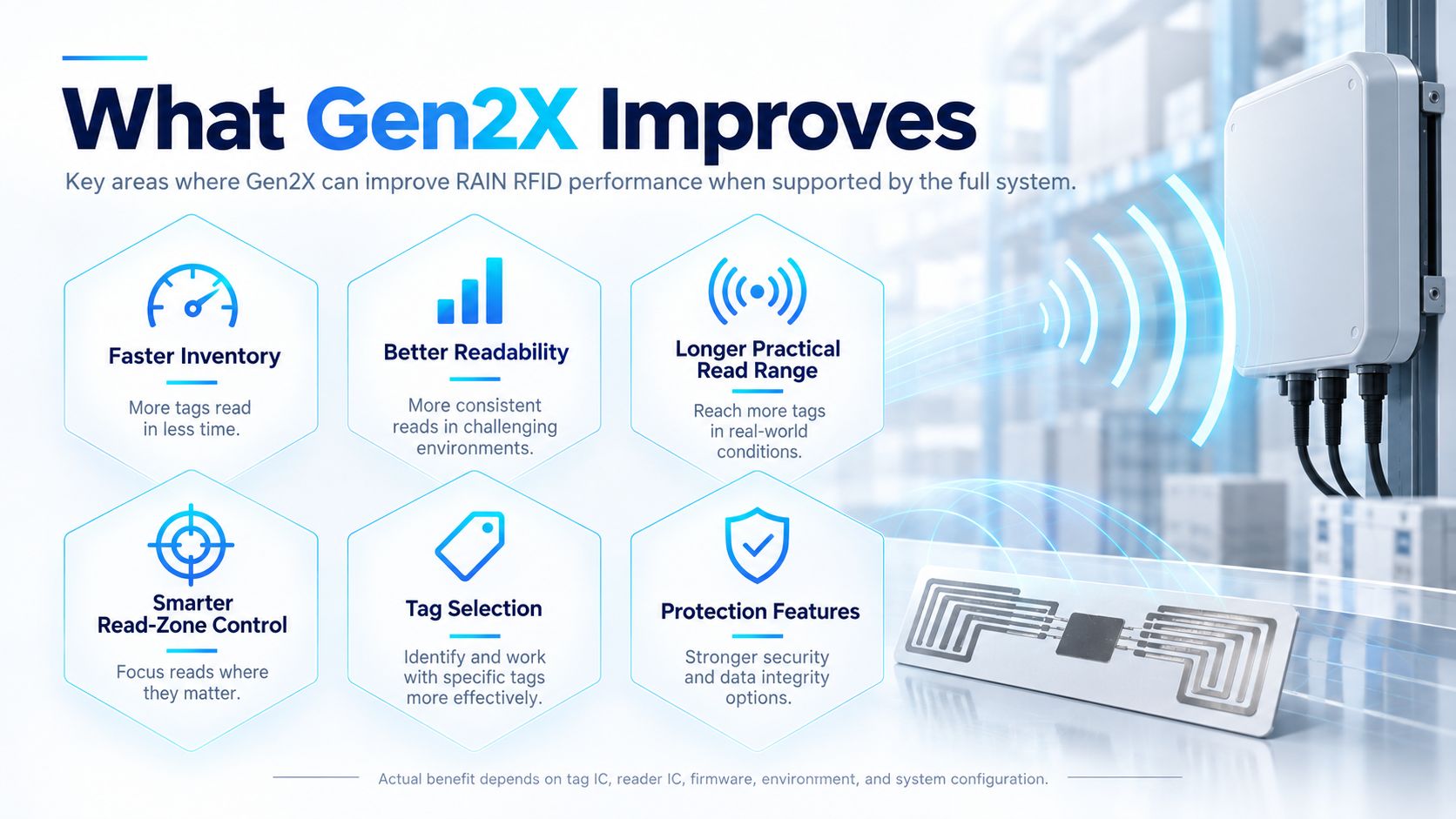
Gen2X is not one single performance feature.
It is a toolbox addressing several RFID system limitations.
The main areas include:
Reduce the time required to inventory tag populations.
Improve reliability in challenging RF conditions.
Help readers detect harder-to-read tags.
Reduce unnecessary participation from unwanted tags.
Allow the reader to focus on tags relevant to the current operation.
Support privacy, memory integrity and endpoint authentication workflows.
The actual benefit depends on:
Tag IC + Reader IC + Firmware + RF Environment + Application Configuration
not simply whether the word "Gen2X" appears in a datasheet.
One of the strongest commercial Gen2X claims is reduced inventory time.
Impinj currently states that Gen2X can accelerate inventory cycles by up to 2× under suitable conditions by reducing tag backscatter data and communication errors.
This can matter in applications such as:
Consider a handheld inventory application.
The real business metric is not:
How many theoretical tags per second does the reader support?
It is:
How long does an employee need to complete an accurate physical inventory?
Reducing inventory-round overhead can improve the operational result.
However:
2× is an upper-bound capability statement, not a guaranteed improvement for every RFID system.
A project already limited by:
may see very different results.
Some RFID items are simply harder to identify than others.
Examples include:
Gen2X includes mechanisms intended to improve the tag-to-reader communication link and reader sensitivity to compatible tag responses.
Impinj describes Gen2X as improving readability especially for smaller tags and challenging item environments.
This does not mean:
Any RFID tag will now work perfectly on metal.
Correct tag selection remains essential.
A standard retail label attached directly to a steel machine still has a tag-design problem.
Gen2X is an enhancement to a correctly engineered RFID system, not a replacement for appropriate on-metal tag construction.
Read range is often discussed as if it were a single reader specification.
In reality:
Practical Read Range
=
Tag Sensitivity
Gen2X adds link improvements intended to help readers detect more difficult compatible tags.
Impinj has reported potential read-range improvement of up to 75% in applicable conditions, particularly around smaller tags, densely packed goods and traditionally difficult items containing metal or liquids.
Again, this should not be interpreted as:
Every existing RFID system will read 75% farther after a firmware update.
Actual improvement depends on the full RFID architecture.
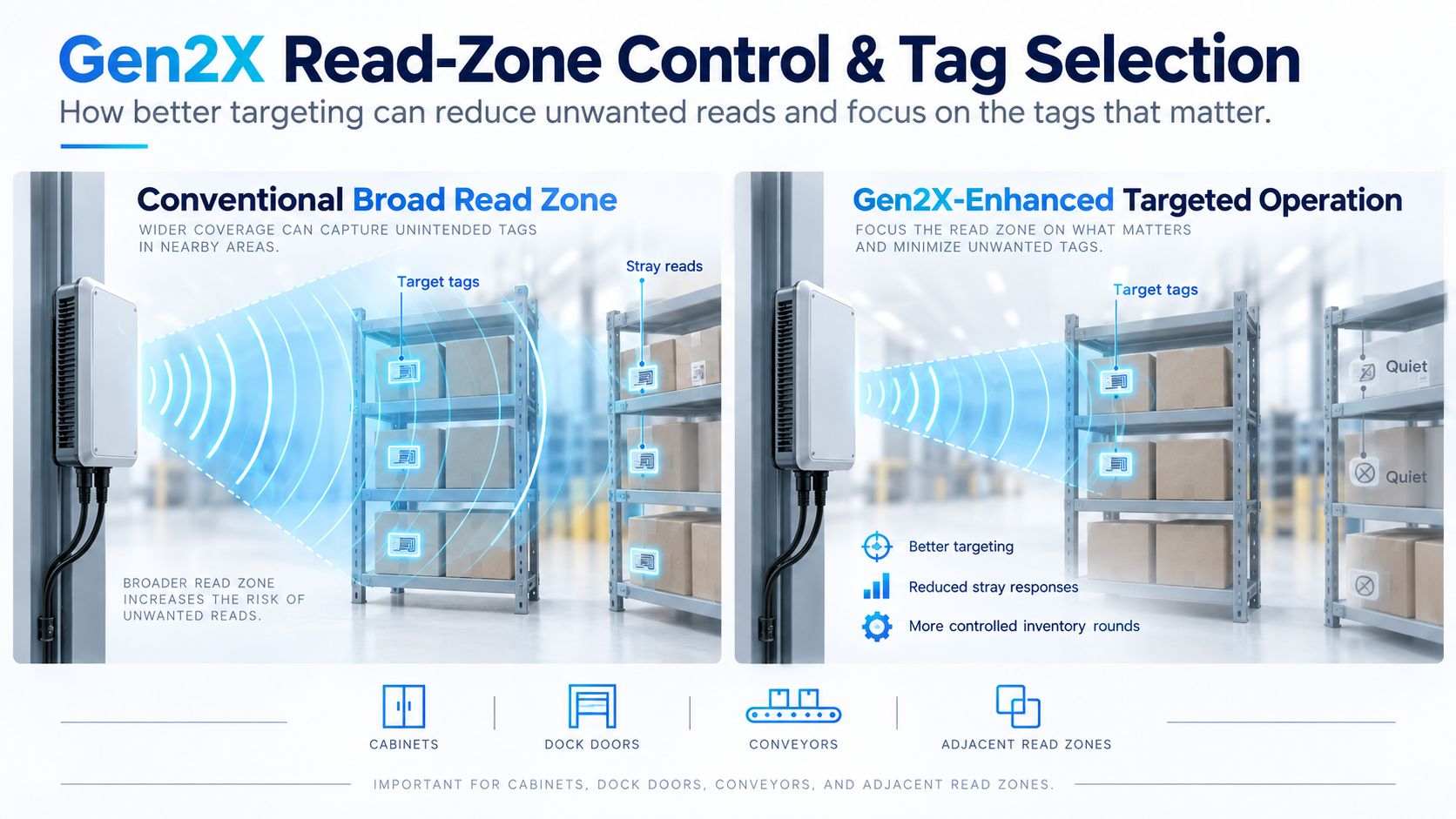
Longer RFID range is not always desirable.
Modern automated systems often have the opposite problem:
The reader detects too many tags.
Examples include:
Reader inside Cabinet A detects items inside Cabinet B.
Reader detects both the pallet crossing the doorway and another pallet waiting nearby.
Reader identifies products outside the intended inspection station.
Tags outside the actual transaction zone respond.
This is a read-zone control problem.
Gen2X includes capabilities designed to help reduce unwanted tag responses and focus inventory on the intended tag population.
This is especially important as RAIN RFID moves from:
Manual Inventory
toward
Autonomous Reading
where readers operate continuously without a human deciding exactly when to scan.
Repeated inventory creates an interesting RFID challenge.
In autonomous environments, a reader may repeatedly see the same tags while trying to identify new or relevant items.
Gen2X includes reinventory mechanisms intended to improve how tags participate in repeated inventory operations.
Combined with appropriate read-zone techniques, these capabilities can help reduce unwanted tag responses and make automatic read zones more controlled.
However:
Fast Reinventory does not eliminate the need for RF engineering.
The installation still needs:
Tag selection is another important Gen2X concept.
Instead of simply asking:
Which tags are visible?
the system can become more selective about:
Which tags should participate in this inventory round?
Current Impinj Gen2X capabilities allow readers to better select tags of interest while causing other tags to remain quiet during the relevant operation.
Potential applications include:
 Knowledge
An RFID tag may look like a simple adhesive label, plastic block, textile patch, card, or small industrial component. Inside, however, several electrical and mechanical elements work together to receive radio-frequency energy, process commands, store data, and communicate with an RFID reader. At its most basic level, a passive RFID tag contains: RFID Chip + […]
READ MORE Knowledge
Choosing a UHF RFID fixed reader should not begin with one question: How far can this reader read? Maximum read distance is only one small part of a fixed RFID system. A reader that performs well at a warehouse dock door may be unnecessarily complex for a single workstation. A four-port reader can outperform a […]
READ MORE Knowledge
RFID systems generally fall into two big tag categories: passive RFID and active RFID. They solve different problems. If you choose the wrong one, you’ll either overpay (active when passive is enough) or underperform (passive when you truly need real-time long-range visibility). This guide explains the differences in plain English, with practical selection criteria and […]
READ MORE Knowledge
What are LLRP, ALE, and EPCIS (in one minute)? These three GS1/EPCglobal standards cover different layers of an RFID solution: LLRP (Low Level Reader Protocol): a low-level protocol between software and an RFID reader that provides fine control of a single reader. ALE (Application Level Events): a standard interface for applications to obtain filtered, consolidated RFID capture data (i.e., […]
READ MORE Guide
Guide
Choosing the right UHF RFID reader is one of the most important decisions in an RFID project. The reader determines how far tags can be detected, how many tags can be inventoried, how stable the system will be in real environments, and how easily RFID data can be connected to your software, kiosk, warehouse system, production line, […]
READ MOREIf you are interested in our services or need customized solutions, please feel free to contact us.