

Uniform tracking can be built with either barcodes or RFID.
Both technologies can give every garment a unique identity and connect it with information such as:
The main difference is how that identity is captured.
A barcode normally requires the operator to find the label, point a scanner at it, and scan one garment deliberately.
RFID uses radio frequency identification. With the correct RFID tags and reader infrastructure, uniforms can be detected without visually locating every label, and multiple garments can be identified during the same reading process.
That leads to a simple starting point:
Barcode is usually simpler and less expensive.
RFID provides stronger automation and bulk-reading capability.
Neither technology is automatically the right choice for every uniform operation.
A small uniform room issuing a limited number of garments each day may get excellent results from barcodes.
A large hotel, hospital laundry, industrial workwear provider, cleanroom facility, or uniform rental company processing thousands of garments may benefit much more from RFID.
Some organizations do not need to choose only one.
A barcode + RFID hybrid architecture can preserve existing barcode workflows while introducing RFID at the points where manual scanning becomes the bottleneck.
A uniform tracking system gives each garment an individual identity and records what happens to that item throughout its operational life.
Instead of knowing only:
500 blue work shirts are in inventory
the system can potentially know:
Uniform U104257 is a men's medium work shirt assigned to Employee 318, returned yesterday, currently in laundry, and has completed 47 wash cycles.
This item-level history can support:
The identification technology can be:
The software remains the system of record.
The barcode or RFID tag simply provides the link between the physical garment and its digital record.
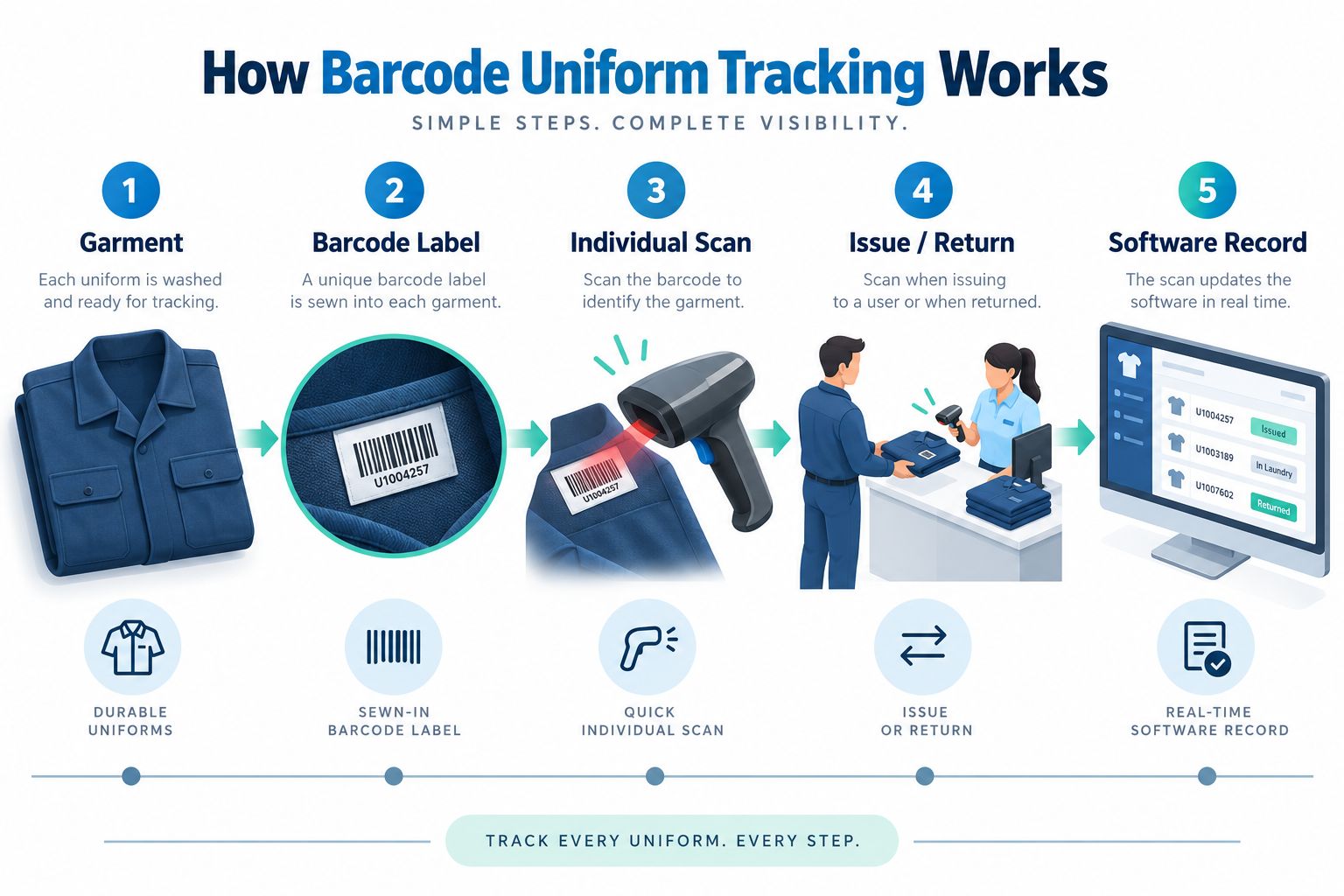
Barcode uniform tracking uses a durable printed code assigned to each garment.
A basic process looks like:
Garment
→ Unique Barcode
→ Individual Scan
→ Issue / Return Transaction
→ Uniform Management Software
Each uniform receives its own barcode.
For example:
U104257
The database can associate this ID with:
The important point is that the barcode should identify the individual garment, not just the garment SKU, if lifecycle tracking is required.
The label may be:
An ordinary paper barcode label is not appropriate for repeated industrial washing.
The label construction needs to tolerate the actual process, including:
When the garment changes status, staff scan the code.
For example:
Issue
Employee ID → Garment Barcode → Issued
Return
Garment Barcode → Returned
Laundry Dispatch
Garment Barcode → Sent to Laundry
Laundry Return
Garment Barcode → Clean Inventory
Each scan creates a deliberate transaction.
That is one of barcode's strengths.
The system knows that an employee intentionally scanned that particular garment at that particular point in the process.
The software stores the event and updates garment status.
Over time, this creates a history of:
Barcode systems can offer:
Barcode can be an excellent solution when the transaction volume remains manageable.
The main limitation is manual scanning.
Each barcode generally needs:
As volume grows, the scanning task grows with it.
If a laundry cart contains hundreds of uniforms, employees may need to handle and scan every garment individually.
That is where RFID becomes more attractive.
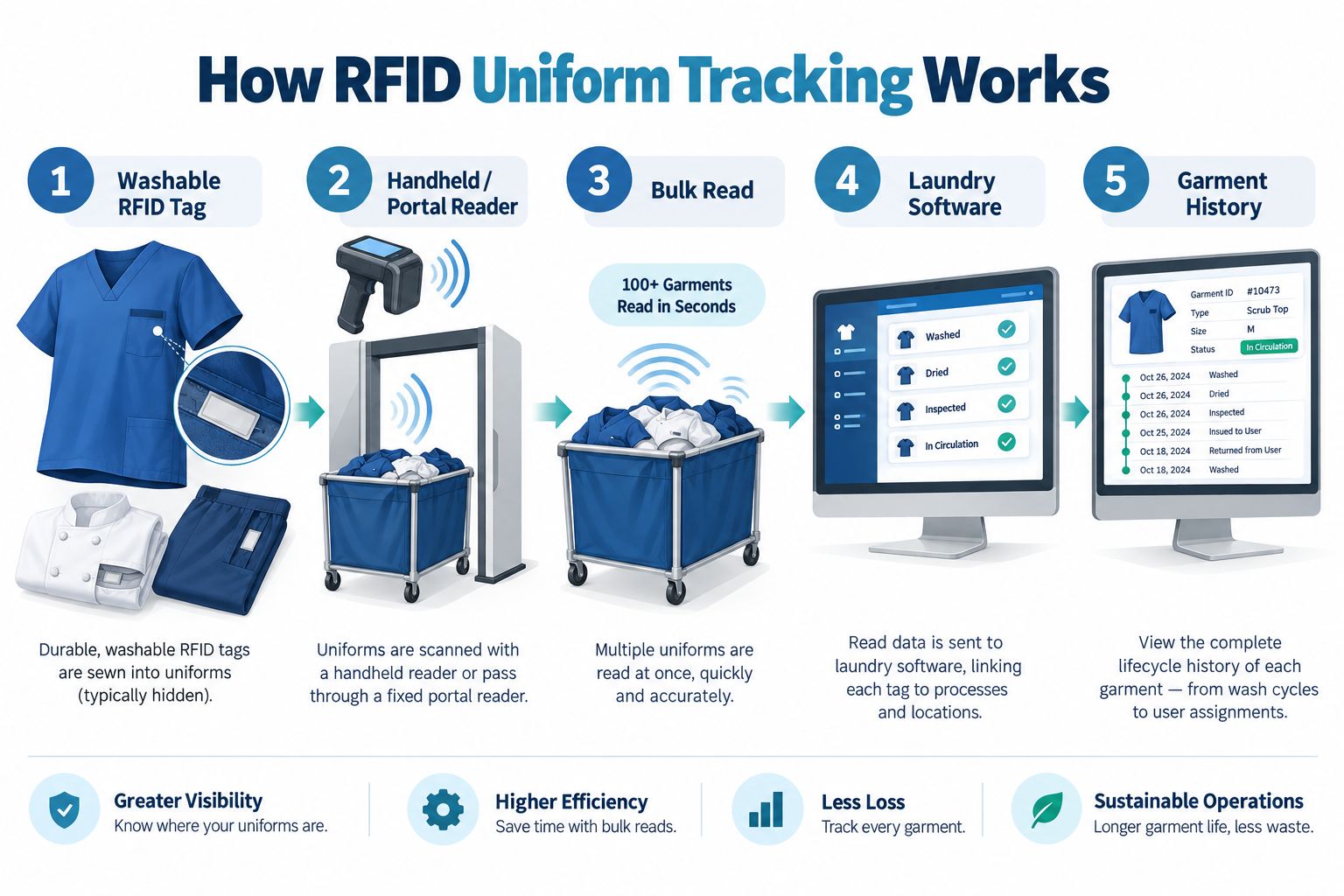
RFID uniform tracking replaces or supplements the visible optical code with an electronic RFID identity.
A typical workflow is:
Washable RFID Tag
→ Handheld / Fixed Reader
→ RFID Identification
→ Laundry or Uniform Software
→ Garment Lifecycle Record
Each uniform receives a durable RFID laundry tag.
The RFID tag normally contains:
Unlike an ordinary UHF label, a laundry RFID tag is specifically designed for repeated textile processing.
For detailed tag construction, attachment methods, laundry environments, and reader deployment, see Syncotek's RFID Laundry Tags guide.
The RFID EPC or other identifier is associated with the garment record.
For example:
RFID EPC
→ Uniform U104257
→ Employee 318
→ Medium Work Shirt
The detailed garment history remains in the software rather than needing to be stored directly inside the RFID chip.
A compatible RFID reader can identify the tag electronically.
Depending on the workflow, the reader may be:
This is the major operational difference.
Under suitable conditions, UHF RFID can identify multiple garments during one read process.
For example:
Laundry Cart
→ RFID Read Zone
→ Multiple Garment IDs Captured
→ Inventory Updated
The operator does not need to visually find every label.
Each meaningful RFID event can update:
RFID therefore reduces the amount of manual identification required at high-volume process points.
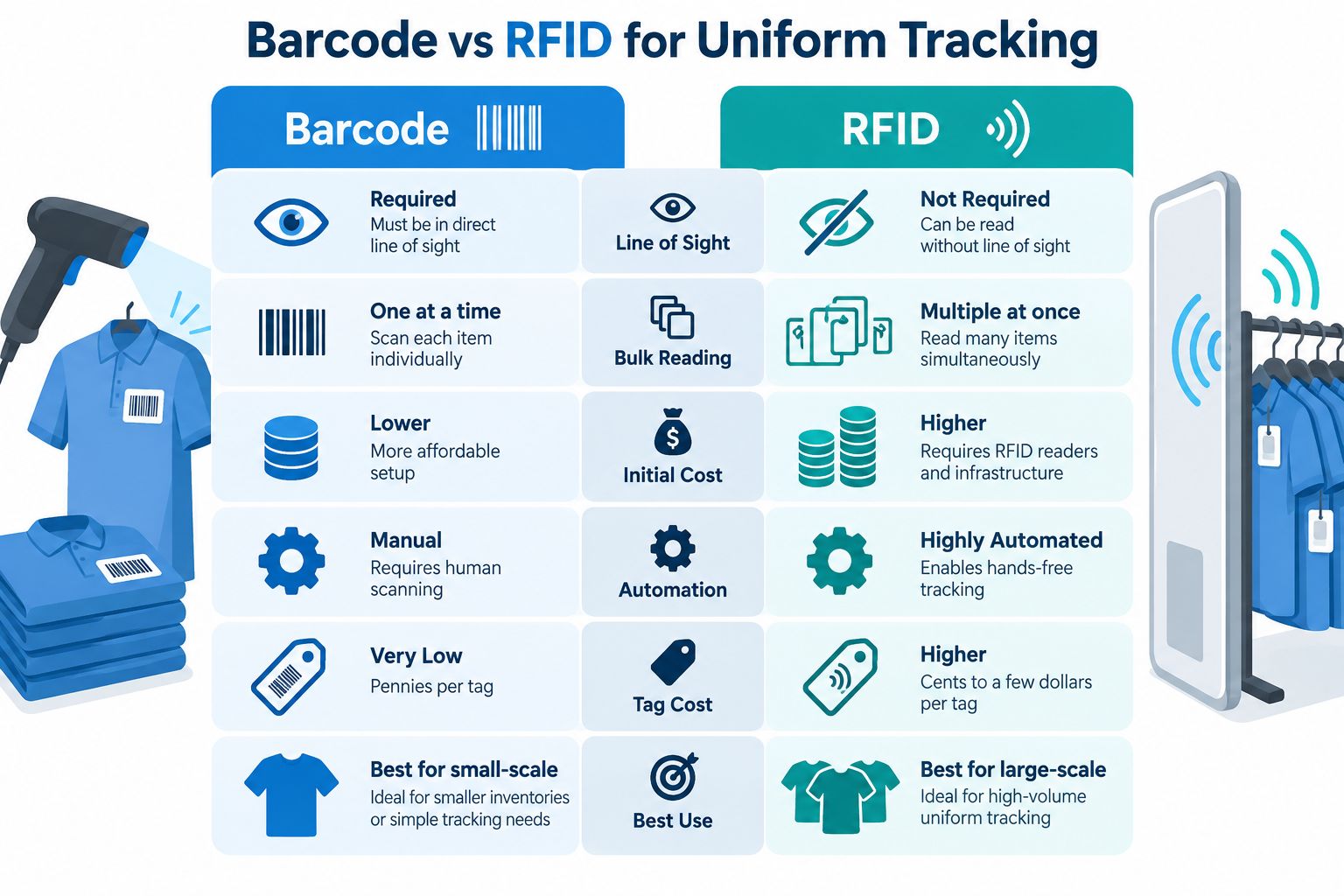
The correct technology depends on the workflow rather than which system appears more advanced.
| Factor | Barcode | RFID |
|---|---|---|
| Identification method | Optical | Radio frequency |
| Line of sight | Required | Usually not required |
| Garments per read | Normally one | Multiple possible |
| Initial hardware cost | Lower | Higher |
| Tag cost | Lower | Higher |
| Deployment complexity | Lower | Higher |
| Manual scanning | Required | Can be reduced |
| Bulk laundry count | Labor-intensive | Strong use case |
| Automated portals | Limited | Strong |
| Intentional issue transaction | Excellent | Excellent with correct workflow |
| Garment searching | Manual | RFID-assisted searching possible |
| Software integration | Required | Required |
| Best fit | Lower-volume/manual workflows | Higher-volume/automated workflows |
Barcode labels and scanners are generally less expensive.
This makes barcode attractive for:
The organization can start collecting useful garment history without building RF infrastructure.
A full RFID deployment may require:
That makes the initial project more complex.
The investment becomes easier to justify when RFID removes a substantial amount of repetitive scanning labor or enables workflows that barcode cannot automate efficiently.
RFID is not automatically necessary simply because uniforms need to be tracked.
Barcode can be the better solution when several of the following conditions are true.
If employees process only a limited number of uniforms each day, individual scanning may not be a major burden.
Barcode provides a lower-cost entry into item-level uniform tracking.
Consider an issue counter where the employee already hands each uniform to the wearer.
Scanning the barcode during that interaction adds little extra work.
A barcode scan clearly represents:
This employee intentionally scanned this garment.
That can be useful for issue, return, and accountability workflows.
The organization may already have:
Reusing that infrastructure can reduce project cost.
If uniforms do not move through the process in large carts, bags, or batches, RFID's strongest advantage may not create enough additional value.
RFID becomes increasingly attractive when manual scanning itself becomes the operational problem.
RFID is particularly useful when organizations manage:
of circulating garments.
Industrial laundries may process large bags, carts, or cages of garments.
Scanning every barcode individually creates a major labor requirement.
RFID handheld readers can simplify periodic stock counts.
Uniforms may move between:
Automated RFID read points can provide stronger movement visibility.
Uniform return chutes, cabinets, and collection systems can incorporate RFID identification without requiring users to scan every garment manually.
Handheld RFID can assist staff searching for a particular tagged garment or category of garments.
If the organization wants to automatically record:
RFID provides a stronger physical automation layer.
The choice does not have to be:
Barcode OR RFID
A hybrid architecture can use each technology where it performs best.
For example:
Employee card or barcode
↓
RFID tag
↓
Employee ID + RFID Garment
↓
RFID bulk identification
This architecture keeps deliberate employee identification while automating garment processing.
Another approach is:
Barcode for Issue / Return
RFID for Laundry and Inventory
The visible barcode can also provide a backup method if RFID equipment is unavailable.
Organizations with an existing barcode system may already have years of garment history.
Replacing the entire system immediately may create unnecessary disruption.
Instead:
Existing Barcode ID
↔
New RFID EPC
↔
Same Garment Database Record
Both identities can point to the same garment.
This makes gradual migration possible.
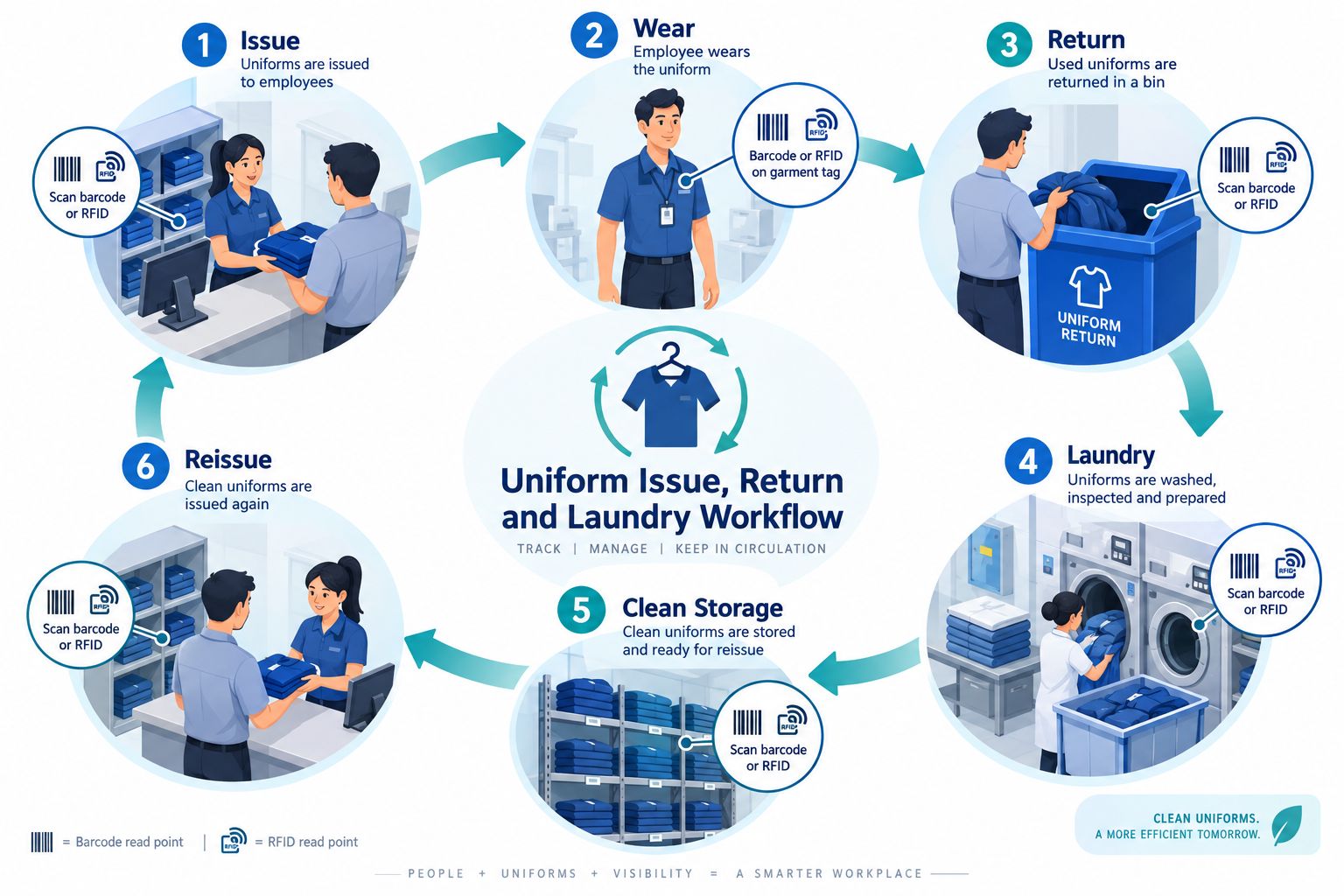
A complete uniform lifecycle often includes six repeating stages.
A clean garment is issued to an employee.
The system records:
With barcode, staff scan the garment.
With RFID, the uniform may be identified with a handheld reader or controlled issue station.
The employee uses the garment.
The uniform remains associated with the employee or department.
The used garment is returned.
Barcode approach:
Find Label → Scan → Returned
RFID approach:
Garment Enters RFID Read Point → Returned
The exact workflow should still prevent accidental or neighboring reads.
Returned garments enter the laundry process.
RFID becomes particularly useful here because large quantities may move together.
Clean garments return to inventory.
The system may record:
The garment is issued again.
The cycle repeats until the garment is:
This creates a full lifecycle history.
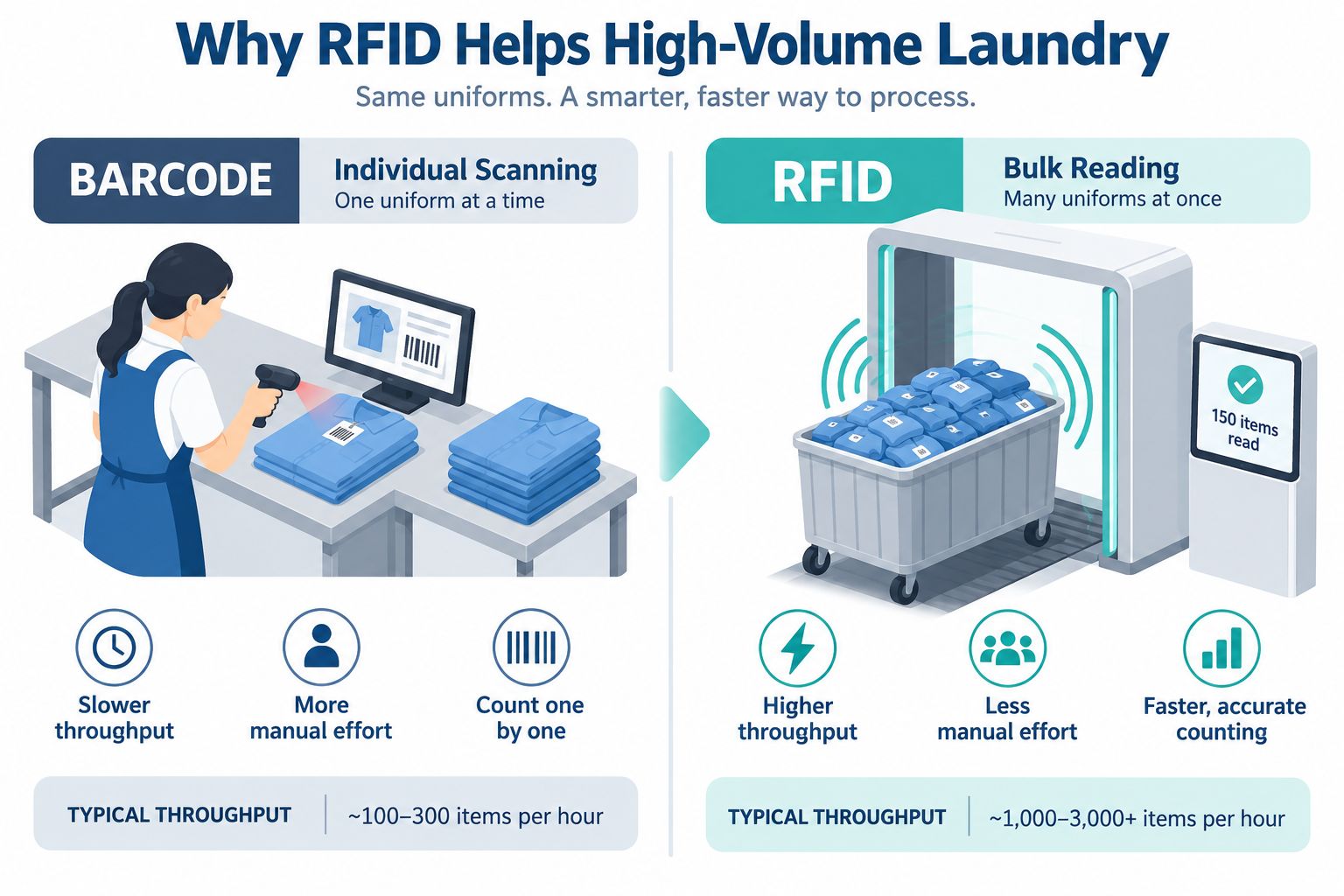
The greatest difference between barcode and RFID often appears during high-volume laundry operations.
Consider a cart containing many uniforms.
The operator normally needs to:
The process is straightforward, but labor increases approximately with the number of garments being processed.
A properly designed RFID process can look like:
Laundry Cart
→
RFID Portal / Reading Station
→
Multiple Tags Captured
→
Software Count
The operator does not need to locate every individual label.
This can create major efficiency gains when carts, bags, or garment batches move frequently.
RFID should not be treated as magical counting.
Actual performance depends on:
Dense, compressed, or wet textiles can behave differently from individual dry garments.
Pilot testing should therefore reproduce the real laundry workflow.
An RFID uniform system contains more than washable tags.
The tag needs to withstand the actual laundry environment.
Evaluate:
Do not use a standard retail RFID label simply because it is UHF compatible.
See RFID Laundry Tags for detailed tag selection.
A handheld reader is useful for:
Handheld readers are often the easiest first step when moving from barcode to RFID.
Fixed readers can support:
The reader can connect to several antennas to create controlled zones.
The antenna determines where RFID tags are detected.
Possible designs include:
The objective is not maximum read distance.
The objective is reliable identification inside the correct process zone.
OEM manufacturers can embed UHF reader modules into:
This is particularly useful when RFID needs to become part of the finished machine rather than operate as an external reader.
Explore Syncotek's UHF RFID reader modules for embedded RFID applications.
Barcode systems also require the correct hardware.
A dedicated scanner is suitable for:
For scanner formats, interfaces, and 1D/2D selection, see Syncotek's Handheld Barcode Scanner Guide.
A 2D area imager can read both traditional 1D barcodes and symbols such as QR Code.
This provides more flexibility if the organization later uses:
A mobile computer can combine:
This allows employees to scan and update inventory away from a fixed workstation.
A hybrid handheld can support both identification technologies.
This can be useful during migration because the same operator may encounter:
Syncotek provides mobile UHF RFID handheld configurations that can combine UHF RFID with barcode scanning for inventory and field workflows.
This supports a gradual transition rather than requiring every label and workflow to change on the same day.
The decision between barcode and RFID can also depend on industry.
Hotels may track:
Barcode can be suitable for smaller properties.
RFID becomes more attractive for larger resorts and centralized laundry operations with substantial garment volumes.
Potential items include:
Hospitals with large laundry operations may benefit from washable RFID tags and automatic laundry identification.
For broader healthcare applications, see RFID in Healthcare.
Factories may manage:
Uniform identity can be linked with:
Cleanroom garment management may need additional history such as:
Any tracking system must be selected according to the actual cleanroom and laundry requirements.
Large properties may manage thousands of employee uniforms across many departments.
High employee count and centralized wardrobe operations can make automation more valuable.
A practical selection framework is:
The decision should be based on workflow economics rather than the technology name.
Avoid choosing RFID based on generic claims about percentage savings.
The relevant question is:
How much does the current identification process actually cost our operation?
A practical ROI model can evaluate:
Calculate time spent on:
Estimate:
Poor visibility may cause organizations to keep more uniforms than necessary.
Better tracking may allow more accurate par levels.
Measure:
Include:
Then compare:
Annual Operational Savings
against
RFID Deployment Cost
RFID is most compelling when high processing volume turns manual identification into a recurring labor cost.
Technology should solve a measurable operational problem.
If barcode scanning is already efficient, RFID may not generate sufficient value.
Labels need to survive the actual textile-processing environment.
Ordinary retail UHF labels are not designed for repeated industrial washing.
Use purpose-built laundry RFID tags.
If the goal is lifecycle tracking, each individual garment needs a unique identity.
"Blue Shirt, Medium" is not enough.
The system needs:
"Blue Shirt, Medium, Item U104257."
Barcode labels must remain visible enough to scan.
RFID tags should be positioned to support both wearer comfort and reliable RF performance.
Real deployment conditions affect performance.
Test:
First determine:
Then select the reader and antenna architecture.
Neither barcode nor RFID creates a uniform management system by itself.
The identifier must update a reliable garment database.
Organizations do not necessarily need a complete one-time conversion.
Barcode and RFID can coexist.
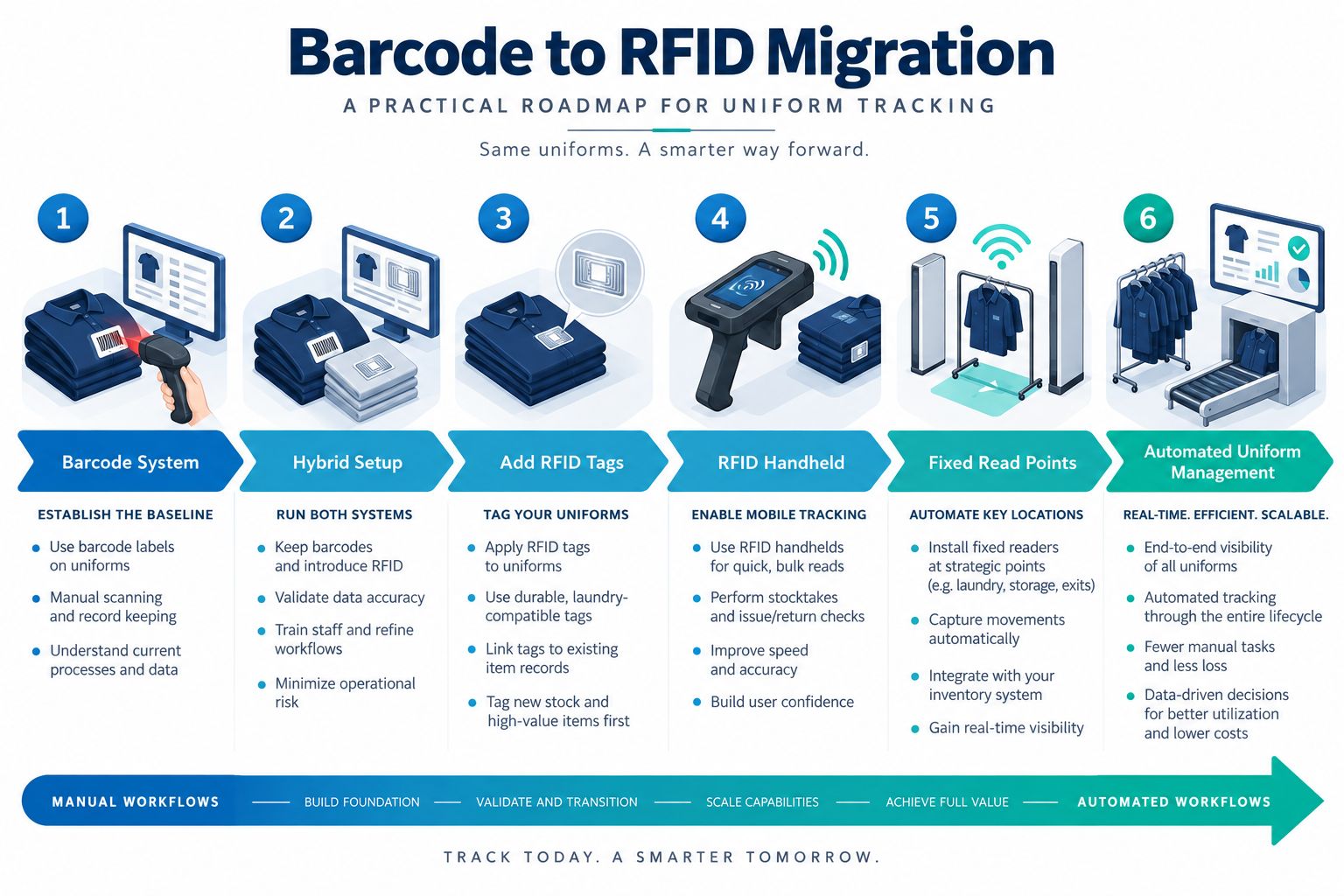
Moving from barcode to RFID does not require replacing the entire system on day one.
A staged migration can reduce cost and operational risk.
Continue using the current:
This establishes the baseline.
Measure:
Add an RFID field to the existing garment record.
For example:
Garment ID: U104257
Barcode: U104257
RFID EPC: E2801170200001A2B
Both identifiers now reference the same item.
Start with:
Avoid retagging the entire fleet before the workflow is proven.
Use handheld readers for:
This provides RFID benefits without installing a large fixed infrastructure immediately.
Once the workflow is stable, automate areas with the greatest volume.
Examples:
RFID events can then automatically update the uniform system.
Barcode can remain available for:
This approach allows the operation to transition according to actual ROI.
Before choosing barcode, RFID, or hybrid tracking, confirm:
Each garment receives a unique barcode. Staff scan the garment during issue, return, laundry, inventory, or other transactions, and the software updates the individual garment record.
Yes. Barcode remains a practical solution for lower-volume operations, organizations with limited budgets, and workflows where garments are already handled individually.
RFID uniform tracking uses washable electronic RFID tags attached to garments. Compatible readers identify the tags and connect each garment with its digital lifecycle record.
Barcode is generally simpler and less expensive. RFID is better suited to high-volume operations that need bulk identification and greater automation. The best choice depends on the workflow.
Yes. The barcode must normally be visible to the optical scanner.
Yes, UHF RFID can identify multiple compatible laundry tags within a properly designed read zone. Actual performance depends on garment density, moisture, tag orientation, reader configuration, and antenna design.
Specialized textile barcode labels can be designed for laundering, but ordinary paper or general-purpose labels are not suitable.
Ordinary retail RFID labels normally should not be used for industrial laundry. Use RFID tags specifically designed for repeated washing and textile processing.
Washable textile RFID tags designed for uniforms, workwear, linen, and commercial laundry are typically used. UHF RFID is common where bulk reading is required.
Yes. The software can increment a wash or processing count when a garment is detected at defined laundry process points.
Yes. A uniform can have both a visible barcode and an RFID identity, or different technologies can be used at different workflow stages.
Not necessarily. If garment volume is modest and manual scanning is efficient, barcode may provide better economics. RFID becomes more attractive as processing volume and automation requirements increase.
Depending on the workflow, laundries can use handheld UHF readers, fixed readers, portal antennas, embedded reader modules, or specialized reading stations.
Yes. A unique RFID tag can associate each garment with an employee, department, size, issue status, wash history, and lifecycle record.
A handheld RFID reader can assist with searching for specific tagged garments or inventory within a defined area, depending on the tag and environment.
Keep the existing garment database, associate a new RFID EPC with each garment record, begin with a limited RFID pilot, add handheld readers, and introduce fixed RFID read points where automation creates measurable value.
Syncotek provides hardware for barcode, RFID, and hybrid automatic-identification systems.
For uniform, workwear, laundry, and textile applications, the Syncotek portfolio includes:
A small uniform room may only require barcode scanning.
A large laundry may benefit from RFID bulk identification.
An organization moving between the two can use a hybrid architecture while preserving its existing garment database and workflows.
Syncotek focuses on the identification hardware and integration layer, helping system integrators and OEM customers choose suitable reader, tag, antenna, module, and barcode configurations according to garment volume, wash conditions, read points, automation requirements, and software architecture.
Explore Syncotek's complete RFID product portfolio or review our RFID Laundry Tags for your uniform and textile tracking project.
 Knowledge
When people compare near-field vs far-field in RFID, they are really comparing two different ways energy and data move between the reader and the tag. In RFID, near-field systems are based on magnetic coupling and are typically associated with LF and HF/NFC, while far-field systems are based on radiated electromagnetic waves and backscatter and are typically associated with UHF RFID. That difference affects range, […]
READ MORE Knowledge
Rental businesses depend on the same assets moving repeatedly between warehouses, customers, job sites, service areas, vehicles, and return stations. This continuous movement creates a difficult inventory-management problem. A rental company may own the correct number of assets but still be unable to answer basic operational questions: Which items are available right now? Which customer […]
READ MORE Knowledge
Programming an RFID tag means writing useful data into the tag’s memory so that the tag can identify a product, carton, pallet, asset, tool, document, or other tracked item in an RFID system. Many RFID tags are supplied with pre-programmed data, but real projects often require custom encoding. For example, a business may need to […]
READ MORE Knowledge
RFID can make warehouse inventory counting faster, automate selected receiving and shipping checkpoints, and reduce repetitive manual scanning. But does that mean every warehouse should replace barcodes with RFID? Not necessarily. Radio Frequency Identification (RFID) offers significant operational advantages, particularly in warehouses with frequent inventory movements, large item populations, and demanding verification processes. However, these […]
READ MORE Knowledge
What Is Load Modulation? Load modulation is the uplink method used by most HF RFID and NFC tags to send data back to a reader in the near field. The tag does not generate its own RF carrier. Instead, it changes its electrical load across the tag coil, and that change is coupled back into the reader’s magnetic […]
READ MOREIf you are interested in our services or need customized solutions, please feel free to contact us.