
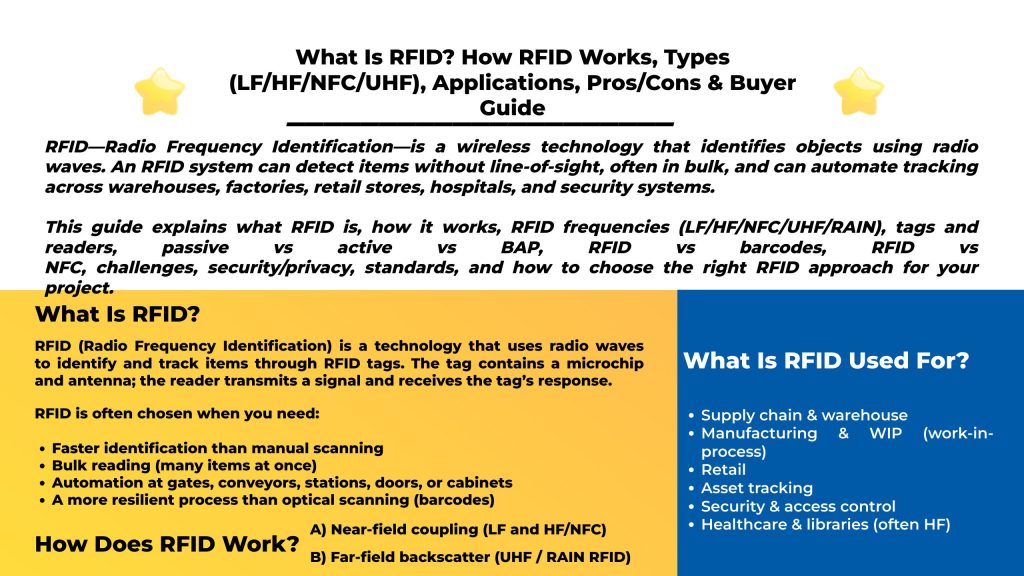
RFID—Radio Frequency Identification—is a wireless technology that identifies objects using radio waves. An RFID system can detect items without line-of-sight, often in bulk, and can automate tracking across warehouses, factories, retail stores, hospitals, and security systems.
This guide explains what RFID is, how it works, RFID frequencies (LF/HF/NFC/UHF/RAIN), tags and readers, passive vs active vs BAP, RFID vs barcodes, RFID vs NFC, challenges, security/privacy, standards, and how to choose the right RFID approach for your project.
RFID (Radio Frequency Identification) is a technology that uses radio waves to identify and track items through RFID tags. The tag contains a microchip and antenna; the reader transmits a signal and receives the tag’s response.
RFID is often chosen when you need:
RFID works via communication between a reader and a tag, using one of two physical methods depending on frequency:

(source mouser.com)
More About Near-field coupling: https://syncotek.com/near-field-coupling/
Key performance factors (in any RFID system):
RFID is used anywhere you need identification with less manual effort.
RFID “type” is often defined by frequency:
| Band | Frequency | Typical Read Range | Strengths | Common Use Cases |
|---|---|---|---|---|
| LF | 125/134 kHz | cm (very short) | Stable close-range, some harsh environments | Animal ID, legacy access, immobilizers |
| HF | 13.56 MHz | cm to ~tens of cm | Secure card ecosystem, controlled reads | Access cards, libraries, healthcare |
| NFC | 13.56 MHz (HF subset) | ~0–4 cm | Phone compatibility, “tap” UX | Mobile interactions, pairing, tickets |
| UHF (RAIN) | 860–960 MHz | meters (often 1–10 m+) | Bulk reading, speed, automation | Warehouse, retail, logistics, WIP |
Rule of thumb:
A complete RFID solution typically includes:
Important: RFID projects succeed when hardware and software are designed together—especially read zones, filtering, and business logic.
An RFID tag is a chip + antenna, packaged to fit the use case.
Many UHF tags have memory banks like:
An RFID reader powers and communicates with tags, then outputs tag data to software.
Antennas define read zone shape, coverage, and reliability. Two key concepts:
Good read zones reduce:
| Feature | RFID | Barcode/QR |
|---|---|---|
| Line-of-sight | Not required (often) | Required |
| Bulk reading | Yes (especially UHF) | Usually no |
| Speed | High | Medium |
| Automation | Excellent | Limited by scan action |
| Cost per item | Higher | Lowest |
Practical takeaway:
If your goal is automation + bulk throughput, RFID is often worth it. If your goal is lowest cost labeling, barcodes win.
Simple rule:
RFID often reads the same tag multiple times by design. Your system must handle this using:
Many systems “work in the lab” but fail in production due to reflections, motion, stacking, or environmental noise. Always pilot in real conditions.
Security is not only about the tag—it’s a system design topic.
Best practices:
You’ll often see:
Tip: Always match frequency + protocol + regional regulatory band to your deployment country and system requirements.
RFID is a way to identify items wirelessly using a tag and a reader—often faster and more automatic than scanning a barcode.
Phones generally read NFC (HF) tags. Most phones cannot read UHF (RAIN RFID) supply-chain tags without an external accessory.
No. RFID is better for automation and bulk reads. Barcodes are better for lowest-cost visual labeling.
It depends:
Read zone design and real-world environment issues (metal/liquid, interference), plus missing filtering and business logic—more than “reader power.”
 Knowledge
Rental businesses depend on the same assets moving repeatedly between warehouses, customers, job sites, service areas, vehicles, and return stations. This continuous movement creates a difficult inventory-management problem. A rental company may own the correct number of assets but still be unable to answer basic operational questions: Which items are available right now? Which customer […]
READ MORE Knowledge
What is an RFID chip? An RFID chip is a small integrated circuit (IC) used in radio-frequency identification systems to store an identifier and/or data and communicate wirelessly with an RFID reader. In everyday conversations, “RFID chip” can mean two different things: RFID tag chip (Tag IC / transponder IC) – the chip inside a […]
READ MORE Knowledge
Digital Product Passports are changing the way manufacturers, brands, supply-chain operators, retailers, repairers, recyclers, and regulators think about product information. Instead of product data remaining fragmented across ERP systems, spreadsheets, certificates, technical documents, service records, and recycling databases, a Digital Product Passport can connect a physical product with structured digital information that remains accessible throughout […]
READ MORE Knowledge
HF RFID runs at 13.56 MHz and is widely used for access control badges, contactless payments, libraries, healthcare wristbands, and NFC phone tap experiences. When people say “HF RFID,” they often mean very different things—because HF is a frequency band, while standards define the protocol stack (how tags and readers actually communicate). More about HF […]
READ MORE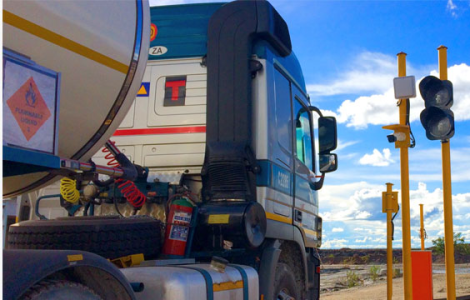 Case Show
The RFID system auto-identifies vehicles' weight, calculates net weight, and provides real-time monitoring for optimized efficiency.
READ MOREIf you are interested in our services or need customized solutions, please feel free to contact us.