
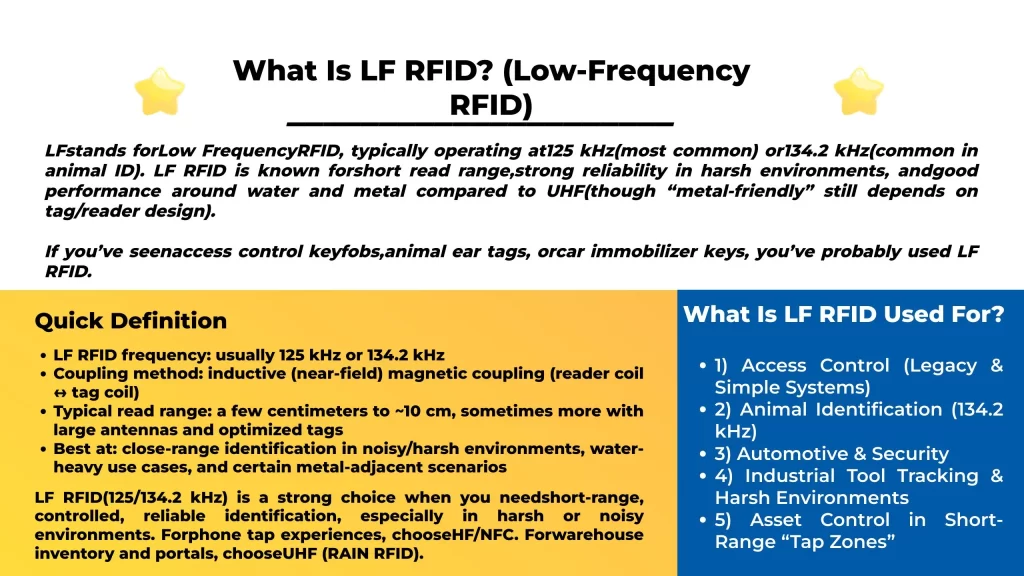
LF stands for Low Frequency RFID, typically operating at 125 kHz (most common) or 134.2 kHz (common in animal ID). LF RFID is known for short read range, strong reliability in harsh environments, and good performance around water and metal compared to UHF (though “metal-friendly” still depends on tag/reader design).
If you’ve seen access control keyfobs, animal ear tags, or car immobilizer keys, you’ve probably used LF RFID.
LF RFID operates in the near field:
Because the interaction is magnetic and very close-range, LF is typically stable and predictable in environments where high-frequency RF struggles.
| Feature | LF (125/134 kHz) | HF/NFC (13.56 MHz) | UHF (860–960 MHz) |
|---|---|---|---|
| Typical read range | Very short (cm) | Short (tap to ~10 cm; sometimes more) | Long (meters) |
| Best strength | Reliability in harsh/near-water/EMI environments | Phone compatibility (NFC), secure smartcards | Fast bulk reads, inventory, logistics |
| Anti-collision | Limited/varies by system | Good | Excellent |
| Smartphone readable? | No | Yes (NFC subset) | No |
| Best use cases | Animal ID, legacy access, rugged close reads | Access/tickets, libraries, phone taps | Warehouses, retail, portals, conveyors |
Rule of thumb:
LF’s magnetic coupling can be less sensitive to conditions that often reduce UHF performance (e.g., water-heavy environments or RF noise). This makes LF a strong choice for predictable, close-range reads.
A short read zone is often a feature, not a limitation:
LF remains common in legacy access control and simple ID systems with minimal data needs.
LF is not designed for portals, gates, or wide-area reads. If you need reads beyond close proximity, HF or UHF is usually better.
LF is generally not ideal for scanning lots of tags quickly (like warehouse inventory). UHF is the standard for that.
Many simple LF tags carry basic IDs. In access control, older LF credential types can be more vulnerable to cloning than modern encrypted systems (HF secure smartcards are preferred for high-security access).
LF can include multiple standards and legacy formats depending on the industry:
If your project involves regulated animal ID or security-critical access, confirm the exact standard/protocol required before selecting tags/readers.
In LF, antenna design is especially important because it defines read distance, read zone shape, and stability.
No. Phones typically support NFC (HF 13.56 MHz), not LF (125/134 kHz).
Neither is “better”—they serve different jobs. LF is best for close-range reliability. UHF is best for long-range and bulk reading.
LF can be more forgiving than UHF in some metal-adjacent scenarios, but metal still affects magnetic fields. Use appropriate tag housings, spacers, and antenna design.
Avoid LF when you need:
LF RFID (125/134.2 kHz) is a strong choice when you need short-range, controlled, reliable identification, especially in harsh or noisy environments. For phone tap experiences, choose HF/NFC. For warehouse inventory and portals, choose UHF (RAIN RFID).
If you tell me your use case (access control, animal ID, tool tracking, etc.), required range, and tag type/frequency, I can recommend the best LF approach and how to design a stable read zone.
 Knowledge
What does OEM mean? OEM most commonly stands for Original Equipment Manufacturer. In business and manufacturing, an OEM is a company that makes a component, subsystem, or product that another company sells (often under its own brand)—or incorporates into a finished product sold to end customers. The key idea OEM describes a role in the supply chain: OEM (maker) → […]
READ MORE Knowledge
What Is Load Modulation? Load modulation is the uplink method used by most HF RFID and NFC tags to send data back to a reader in the near field. The tag does not generate its own RF carrier. Instead, it changes its electrical load across the tag coil, and that change is coupled back into the reader’s magnetic […]
READ MORE Knowledge
Smart cards are used every day for payments, building access, public transportation, employee identification, hotel rooms, event admission, loyalty programs, and secure authentication. Although they often look like ordinary plastic cards, smart cards contain an integrated circuit that can store, process, or securely exchange digital information. Some smart cards must be inserted into a reader. […]
READ MORE Knowledge
Barcode scanners are used in retail checkout, warehouses, manufacturing lines, hospitals, ticketing systems, self-service kiosks, parcel handling, access control, and inventory management. Although 1D and 2D barcode scanners may look similar, they differ in the symbols they can decode, the way they capture information, their ability to scan mobile screens, and the amount of data […]
READ MORE Knowledge
Active RFID is a type of radio frequency identification technology that uses battery-powered tags to transmit data to RFID readers. Because the tag has its own power source, it can send signals over a much longer distance than a passive RFID tag, which relies on the reader’s signal for energy. That is why Active RFID is commonly […]
READ MOREIf you are interested in our services or need customized solutions, please feel free to contact us.