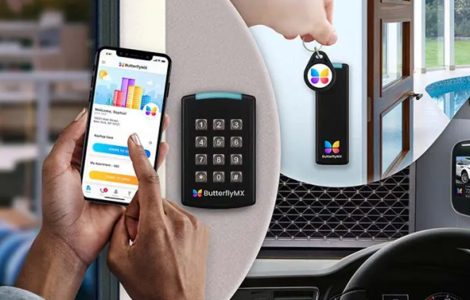
Card Device

What Is HF?

  • Dec 11, 2025
  • Knowledge
What Is HF?

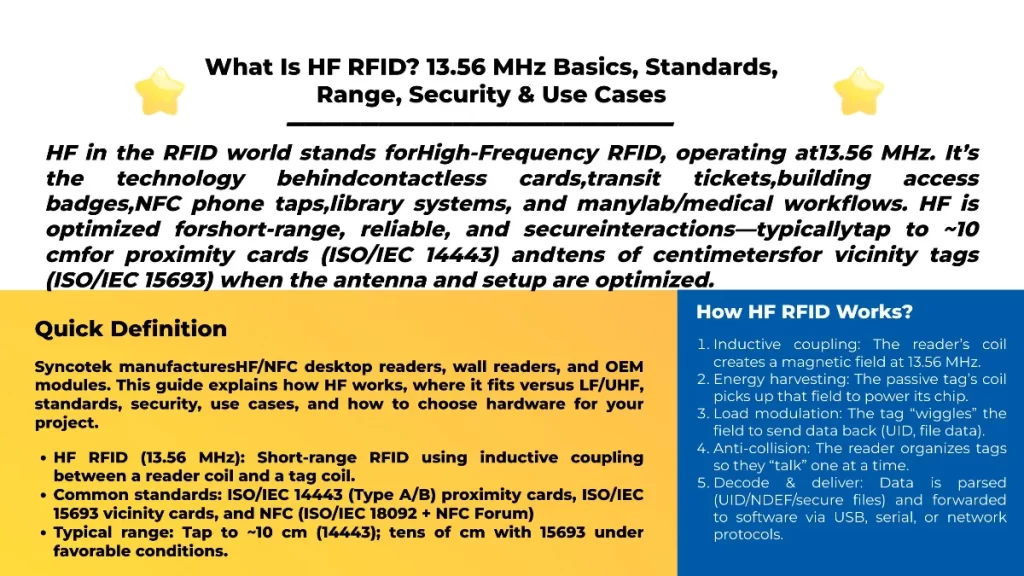
HF in the RFID world stands for High-Frequency RFID, operating at 13.56 MHz. It’s the technology behind contactless cards, transit tickets, building access badges, NFC phone taps, library systems, and many lab/medical workflows. HF is optimized for short-range, reliable, and secure interactions—typically tap to ~10 cm for proximity cards (ISO/IEC 14443) and tens of centimeters for vicinity tags (ISO/IEC 15693) when the antenna and setup are optimized.

Syncotek manufactures HF/NFC desktop readers, wall readers, and OEM modules. This guide explains how HF works, where it fits versus LF/UHF, standards, security, use cases, and how to choose hardware for your project.

Quick Definition

  • HF RFID (13.56 MHz): Short-range RFID using inductive coupling between a reader coil and a tag coil.
  • Common standards: ISO/IEC 14443 (Type A/B) proximity cards, ISO/IEC 15693 vicinity cards, and NFC (ISO/IEC 18092 + NFC Forum).
  • Typical range: Tap to ~10 cm (14443); tens of cm with 15693 under favorable conditions.

How HF RFID Works

  1. Inductive coupling: The reader’s coil creates a magnetic field at 13.56 MHz.
  2. Energy harvesting: The passive tag’s coil picks up that field to power its chip.
  3. Load modulation: The tag “wiggles” the field to send data back (UID, file data).
  4. Anti-collision: The reader organizes tags so they “talk” one at a time.
  5. Decode & deliver: Data is parsed (UID/NDEF/secure files) and forwarded to software via USB, serial, or network protocols.

HF vs. LF vs. UHF (Where HF Fits)

FeatureLF (125/134.2 kHz)HF (13.56 MHz)UHF (860–960 MHz, RAIN)
Typical rangeUp to ~10 cmTap to ~10 cm (14443); tens of cm (15693)Meters; 10–20 m when tuned
CouplingMagnetic (inductive)Magnetic (inductive)Electromagnetic (far-field backscatter)
Read many at onceLimitedModerate (depends on protocol/tags)Excellent (bulk inventory)
Phone compatibilityNoYes (NFC is HF)No (needs external reader)
Best forAnimal ID, toolsCards, tickets, labs, libraries, medicalLogistics, portals, inventory

HF Standards (What You’ll See in Specs)

  • ISO/IEC 14443 Type A/B — “Proximity” cards/badges (tap-range), used for building access, transit, ID.
  • ISO/IEC 15693 — “Vicinity” tags with longer HF reach, popular in libraries, labs, asset trays.
  • ISO/IEC 18092 & NFC ForumNFC profiles for phones; NDEF is the common data format for links and small payloads.
  • Secure smartcards — Families like MIFARE DESFire / FeliCa / Type 4 use mutual authentication and modern crypto.

Typical HF Use Cases

  • Access control & time-attendance: 14443/Type 4 badges, NFC phones/wearables

  • Transit & ticketing: Fare media, event entry
  • Cashless & payments: Wallet cards/phones (via CE—card emulation)
  • Libraries & labs: 15693 item tagging, specimen tubes, tray audits
  • Healthcare & pharma: Sample IDs, instrument pairing, bedside workflows (policy-driven)
  • Retail engagement: NFC “tap for info,” warranties, loyalty
  • Industrial: Operator login, setup tokens, machine parameters via NFC/HF tags

Strengths of HF

  • Great user experience: Intentional tap reduces misreads and makes training easy.
  • Smartphone-friendly (NFC): No extra reader needed for many consumer scenarios.
  • Robust security options: Mutual auth, AES-grade crypto (Type 4 credentials).
  • Material tolerance at short range: Performs predictably near liquids/metal at tap distances (on-metal HF tags help further).

Limitations (and how to handle them)

  • Short range by design: Not for portals or bulk inventory—use UHF for meters.
  • On-metal needs attention: Use on-metal HF/NFC tags (ferrite layer) or a spacer.
  • Throughput: HF inventories fewer items at once than UHF; design workflows accordingly.

HF Tags & Data Models

  • 14443 “proximity” cards: UID plus secure file systems (Type 4).
  • 15693 “vicinity” labels: Longer HF reach; great for items, trays, and shelves.
  • NFC tags (Type 2/4/5): NDEF payloads (URLs, IDs, vCards); can be read-only or password-protected; Type 4 supports crypto apps.
  • Form factors: Paper/PET labels, PVC cards, wristbands, fobs, on-metal labels, high-temp/polyimide for industry.

HF Readers & Integration

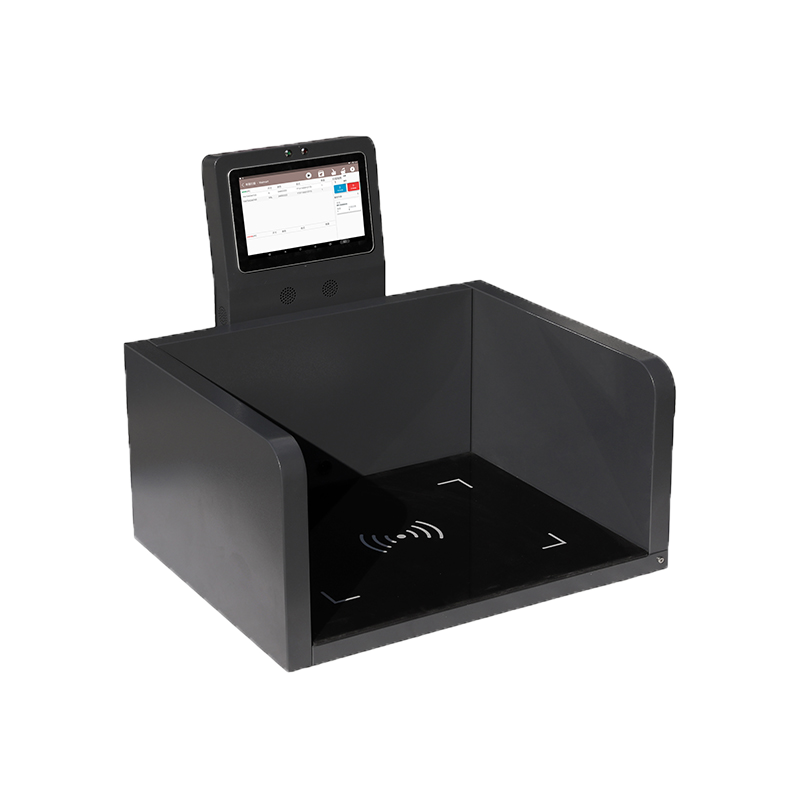
  • Desktop readers (USB/PC-SC): Enrollment desks, labs, POS, kiosks.
  • Wall/door readers: Wiegand/OSDP for access control, time-attendance.
  • NFC phones: Reader/Writer mode for NDEF, Card Emulation for credentials.
  • OEM modules: UART/USB/Ethernet with external antennas for kiosks, printers, AMRs.

Software & protocols: PC/SC, serial APIs, REST/MQTT via gateways; SDKs for Windows/Linux/Android.

Security & Privacy with HF

  • Mutual authentication and session keys on secure smartcards (Type 4) protect credentials and files.
  • Signed NDEF to prevent content tampering on consumer tags.
  • Best practices: Minimize sensitive data on tags; use HTTPS; rotate keys/tokens; keep firmware signed and updated.

When to Choose HF (Decision Triggers)

  • You want tap-based UX with phones or cards.
  • You need secure credentials for doors, transit, or cashless.
  • Your items are small/close (benchtops, trays, cabinets) and you don’t need meters of range.
  • You’re building consumer engagement (tap packaging for info/loyalty).

Choose UHF instead when you need bulk, long-range inventory (portals, conveyors, vehicle lanes).

Implementation Playbook (Step-by-Step)

  1. Define the job: Access, ticketing, ID link, or consumer engagement?
  2. Pick the standard: 14443/Type 4 for secure credentials; 15693 for longer HF reach; NFC (Type 2/4/5) for phone taps.
  3. Select the tag: Memory size (NTAG213/215/216 vs. DESFire), form factor (label/card/fob/on-metal), environment (chemicals/temperature).
  4. Design the payload: NDEF (short HTTPS URL/ID) or secure files; decide on read-only vs. password/keys.
  5. Choose the reader: Desktop USB (PC/SC), wall reader with Wiegand/OSDP, or phone (NFC).
  6. Integrate & secure: Use TLS for network links, signed firmware, key management; log and alert on critical events.
  7. Pilot & tune: Validate read positions, user prompts (“Tap here”), signage, and throughput.
  8. Roll out: Train staff; monitor tap rates, failure codes, and support tickets.

Syncotek HF/NFC Solutions

  • HF/NFC Desktop Reader: USB/PC-SC; supports 14443/15693/NFC for enrollment, labs, POS.
  • HF/NFC Wall Reader: Wiegand/OSDP; tamper switch; IP-rated options for doors/turnstiles.
  • HF/NFC OEM Module: UART/USB/Ethernet; antenna kits and SDK for kiosks, printers, AMRs.
  • Mixed fleets: Pair UHF portals (warehouse) with HF/NFC stations (front-of-house/access) for end-to-end programs.

FAQs

Is HF the same as NFC?
NFC is a subset of HF at 13.56 MHz with phone-friendly modes and NDEF. All NFC is HF; not all HF is NFC.

How far does HF read?
Tap-range (~0–10 cm) for 14443; tens of centimeters for 15693 when optimized.

Can HF do secure access?
Yes—Type 4 smartcards (e.g., DESFire) support mutual auth and strong crypto.

Will HF work on metal?
Yes, with on-metal HF/NFC tags (ferrite layer) or a small spacer.

Can I use HF and UHF together?
Absolutely. Use UHF for logistics (back-of-house), HF/NFC for user interaction and access.

Related Articles

Need Any Hardware Custom Solution? Contact Us!

If you are interested in our services or need customized solutions, please feel free to contact us.

Get in Touch