
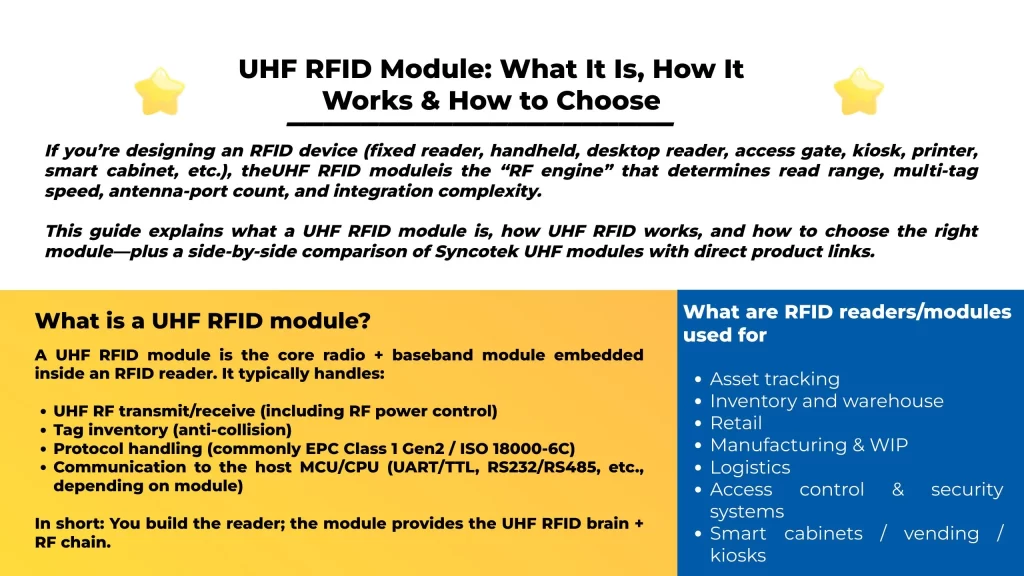
If you’re designing an RFID device (fixed reader, handheld, desktop reader, access gate, kiosk, printer, smart cabinet, etc.), the UHF RFID module is the “RF engine” that determines read range, multi-tag speed, antenna-port count, and integration complexity.
RFID (Radio Frequency Identification) is a technology that uses radio waves to identify and track objects using tags. Unlike barcodes, RFID can often read multiple items quickly and does not require strict line-of-sight (depending on materials and environment).
A UHF RFID module is the core radio + baseband module embedded inside an RFID reader. It typically handles:
In short: You build the reader; the module provides the UHF RFID brain + RF chain.
Most UHF RFID deployments are passive:
Performance depends heavily on RF power, antenna gain/polarization, tag type, tag orientation, and the environment.
Common use cases include:
RFID is often grouped by frequency:
UHF is the go-to choice when you need:
longer read distance, fast inventory, and many tags at once (RAIN RFID / EPC Gen2 style systems).
Most UHF module projects you’ll see for logistics/retail/industry are passive UHF RFID (EPC Gen2 / ISO 18000-6C).
A typical UHF RFID system includes:
If you’re building a product line or custom hardware, modules reduce RF complexity and speed up development.
Typical ranges in Syncotek’s lineup include:
Examples from Syncotek product pages:
If you’re doing fast inventory (moving items, dense tag populations), prioritize modules with strong inventory speed specs, buffering, and anti-collision performance.
Examples:
Common integration interfaces include:
Examples:
Check whether your device is battery-powered, USB-powered, or has a wider input rail.
UHF RFID must match local regulations and supported bands.
Size matters when you’re designing handhelds, compact desktop devices, or embedded terminals.
Examples:
Below are the modules you shared (plus the core category list). Use the “Best for” notes to shortlist quickly.
Notes: Specs below are summarized from the Syncotek product pages you provided. Real-world range depends on antenna, tag, and environment.
| Model | Antenna ports / connector | Max RF output | Typical frequency support | Speed highlights | Interface highlights | Size (mm) | Best for |
|---|---|---|---|---|---|---|---|
| SR-MU931S | Compact SMD form factor | 27 dBm | 865–868 / 902–928 | up to 1000 pcs/s (chip-dependent) | — | — | Low-power compact devices |
| SR-MU961A | MMCX + FPC 30-pin | 33 dBm | ETSI/GB/FCC listed | >400 times/s; multi-tag capacity | TTL UART (FPC) | 56×35.6×3.8 | Embedded terminals / compact readers |
| SR-MU961B | 4× SMA | 33 dBm | ETSI/GB/FCC listed | up to 300 tags/s; 0–15 m reading spec | — | 71.5×52.5×6.5 | 4-zone readers, cabinets, portals |
| SR-MU961C | 8× SMA | 33 dBm | ETSI/GB/FCC listed | >400 times/s; 8-antenna fast polling | TTL UART | 71.5×92.5×7 | Multi-zone / dense tag areas |
| SR-MU961D | 16× SMA | 33 dBm | ETSI/GB/FCC listed | 0–15 m reading spec | — | 82×178×7.5 | Conveyor/dock door multi-antenna systems |
| SR-MU921AS | 1× SMA | 30 dBm | 840–960 optional | >100 pcs/s; >25 m claim w/ antenna/tag | TTL UART + RS232 + RS485 | 61×43×10 | Single-zone long-range integration |
| SR-MU922B | 4× SMA | 30 dBm | 840–960 optional | >100 pcs/s; >25 m claim w/ antenna/tag | TTL UART + RS232 + RS485 | 75×51×10 | 4-antenna long-range projects |
| SR-MU951A | 1× MMCX | 33 dBm | 865–868 / 902–928 | 700–1000 pcs/s class | RS232 (3.3V TTL level) | 57×36.8×7.3 | High-performance 1-port designs |
| SR-MU971B | 4× SMA | 33 dBm | 865–868 / 902–928 | 700–1000 pcs/s class | RS232 (3.3V TTL level) | 67.5×51×7.75 | High-performance 4-port systems |
| SR-MU951C / SR-MU971C | 8× SMA | 33 dBm | 865–868 / 902–928 | 700–1000 pcs/s class | RS232 (3.3V TTL level) | 91×69.5×7.75 | 8-port high-performance deployments |
| SR-MU951D / SR-MU971D | 16× SMA | 33 dBm | 865–868 / 902–928 | 700–1000 pcs/s class | RS232 (3.3V TTL level) | 57×36.8×7.3 | 16-port high-performance systems |
UHF RFID is powerful, so you should plan for:
An RFID reader is a complete device that powers and communicates with RFID tags (via antenna), then sends tag data to software. A module is the internal component used to build the reader.
Tracking, inventory, asset management, access control, logistics, manufacturing WIP, and many other automation workflows—especially where fast multi-tag reading is needed.
Most smartphones can read NFC (HF, 13.56 MHz), not UHF. For UHF RFID, you typically need a UHF reader module/device (or an external accessory designed for UHF).
NFC is a subset of HF RFID designed for very short-range, secure interactions (phones/cards). UHF RFID is typically used for longer range and fast inventory.
A quick rule of thumb:
 Knowledge
What does OEM mean? OEM most commonly stands for Original Equipment Manufacturer. In business and manufacturing, an OEM is a company that makes a component, subsystem, or product that another company sells (often under its own brand)—or incorporates into a finished product sold to end customers. The key idea OEM describes a role in the supply chain: OEM (maker) → […]
READ MORE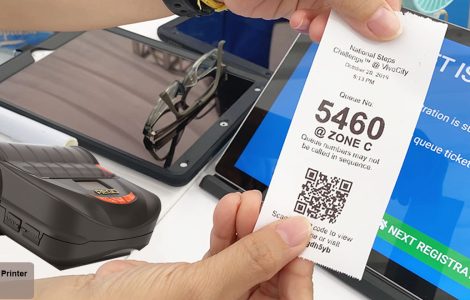 Case Show
portable receipt printers for event ticket sales
READ MORE Knowledge
What is load modulation? Load modulation is the method most HF RFID (13.56 MHz) and NFC tags use to send data back to a reader in the near field. Instead of actively transmitting RF power, the tag switches an electrical load (often a resistor or transistor network) across its antenna coil. That change in tag current is coupled back through mutual inductance and becomes a […]
READ MORE Knowledge
RFID—Radio Frequency Identification—is a wireless technology that identifies objects using radio waves. An RFID system can detect items without line-of-sight, often in bulk, and can automate tracking across warehouses, factories, retail stores, hospitals, and security systems. This guide explains what RFID is, how it works, RFID frequencies (LF/HF/NFC/UHF/RAIN), tags and readers, passive vs active vs […]
READ MORE Knowledge
What is RFID software? RFID software is the layer that turns RFID hardware signals (readers, antennas, tags, sensors) into usable data and workflows—inventory updates, asset movements, shipping/receiving events, access logs, and analytics. In most real deployments, RFID systems require middleware: software that sits between RFID interrogators (readers) and enterprise applications (WMS/ERP/MES/POS). It manages/configures devices and processes raw tag data by filtering duplicates […]
READ MOREIf you are interested in our services or need customized solutions, please feel free to contact us.