
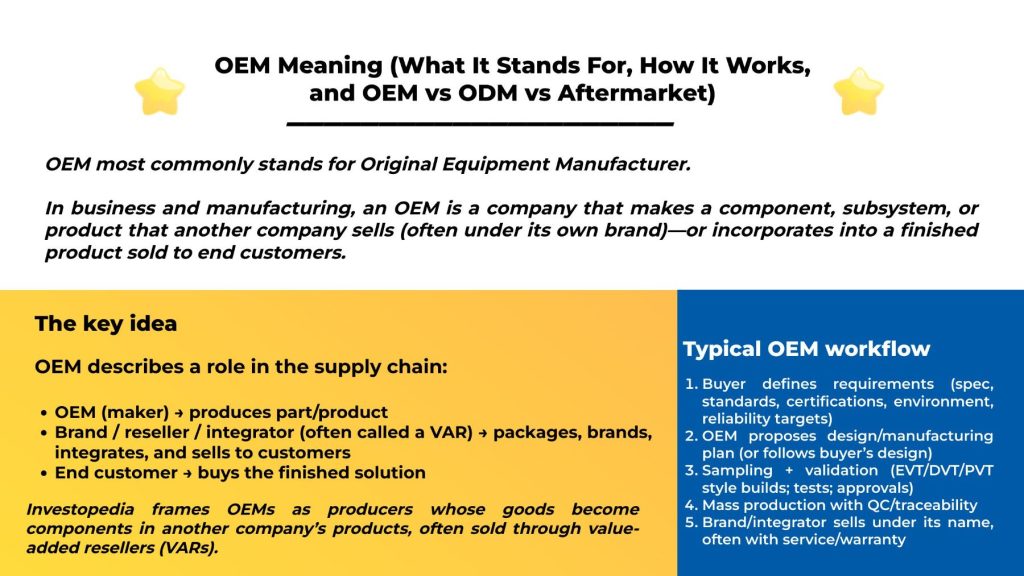
OEM most commonly stands for Original Equipment Manufacturer.
In business and manufacturing, an OEM is a company that makes a component, subsystem, or product that another company sells (often under its own brand)—or incorporates into a finished product sold to end customers.
OEM describes a role in the supply chain:
Investopedia frames OEMs as producers whose goods become components in another company’s products, often sold through value-added resellers (VARs).
Depending on the industry, “OEM” may refer to different—but related—things:
These three terms often show up together in “factory sourcing” and “China manufacturing” discussions:
| Model | Who designs? | Who manufactures? | Whose brand is on the product? | Best when… |
|---|---|---|---|---|
| OEM | Usually the buyer/brand (or shared) | Factory/OEM | Buyer/brand | You have specs/design and want a factory to produce it |
| ODM | Factory (design capability is central) | Factory | Buyer/brand (usually) | You want faster launch using factory’s existing design platform |
| OBM | Brand itself | Brand or its factories | Brand’s own | You want to build long-term brand + channels |
This “level of design involvement” distinction is a common way top explainers separate OEM/ODM/OBM.
Practical shortcut:
In automotive, “OEM parts” is a consumer-facing phrase:
(Important nuance: a supplier can be “OEM” for one car model but “aftermarket” for another—channels overlap.)
In tech, OEM also shows up in licensing:
Pros
Cons
Pros
Cons
Most commonly Original Equipment Manufacturer.
A company that manufactures parts, components, or products used in another company’s finished goods and sold under that company’s branding (common in auto, electronics, industrial).
It depends on your goal (fit, warranty, price, performance). In automotive, OEM parts emphasize “original-equipment” alignment while aftermarket offers broader options and often lower cost.
OEM usually manufactures to the buyer’s design/spec; ODM provides more design ownership and sells a design platform that brands can label.
Syncotek is an RFID manufacturer focused on OEM/ODM collaboration for companies building RFID products or solutions. We support partners who need:
If you already have a product definition (performance targets, interface, mechanical constraints, protocol requirements), Syncotek can manufacture and deliver according to your requirements—helping you reduce time-to-market and ensure stable production quality.
If you want to launch quickly, you can start from mature RFID hardware platforms and customize key parts (firmware features, UI/LED behavior, output interfaces, housing, labeling, accessories, etc.).
For channel brands and integrators, OEM often includes:
If you are building an RFID product line, an OEM partner should not only “manufacture,” but also help you succeed in integration, deployment, and long-term stability.
If you need an RFID OEM manufacturer for modules/readers—or want to build your own branded RFID hardware line—Syncotek can help with selection, integration guidance, and production support.
 Knowledge
The RFID system auto-identifies vehicles' weight, calculates net weight, and provides real-time monitoring for optimized efficiency.
READ MORE Knowledge
RFID is often grouped into three main frequency families: LF (Low Frequency), HF (High Frequency), and UHF (Ultra-High Frequency). Picking the right band is one of the biggest decisions in any RFID project because it affects read range, speed, tag cost, phone compatibility, performance near metal/liquids, and system architecture. This guide compares LF vs HF vs UHF in a practical way […]
READ MORE Knowledge
A passive RFID tag is the most common RFID tag type in the world. It has no battery. Instead, it is powered by the electromagnetic field generated by an RFID reader. Passive tags are the foundation of RAIN UHF RFID item labeling (retail, logistics), HF/NFC access cards and smart labels, and many LF identification systems. This guide explains what passive tags are, how they work, the differences […]
READ MORE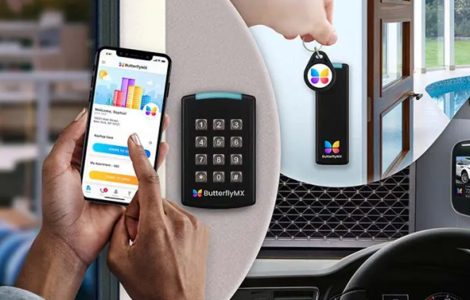 Industry Info
How to Choose Frequency for Your Access Control System
READ MORE Company Events
Our new website offers streamlined access and insights into our latest products, solutions and services to better serve customers globally.
READ MOREIf you are interested in our services or need customized solutions, please feel free to contact us.