

In an RFID system, the antenna is one of the most important components that determines how well tags can be read. The reader generates RF energy, but the antenna controls how that energy is transmitted into the read zone and how tag responses are received.
Many RFID projects focus heavily on tags and readers, while antenna selection is treated as a secondary decision. In reality, the wrong antenna can cause short read range, missed tags, false reads, unstable performance, or unwanted reads outside the intended area.
A good antenna is not simply the one with the highest gain. It is the one that creates the right read zone for the application.
An RFID antenna connects to an RFID reader and radiates RF energy into a defined area. When RFID tags enter that field, they receive energy from the antenna, respond with their stored data, and send the signal back to the reader through the same RF path.
A basic RFID system usually includes:
The antenna affects:
This is why antenna selection should be part of the system design from the beginning, not an accessory decision at the end.
The first step is to confirm the RFID frequency used by the system. RFID systems may operate at LF, HF/NFC, UHF, or microwave frequencies. The antenna must match the frequency band of the reader and tags.
For most warehouse, logistics, manufacturing, retail, and asset tracking applications, UHF RFID is commonly used. UHF RFID antenna selection often focuses on the 860–960 MHz range, with different regional frequency requirements in the US, Europe, and other markets. Global UHF antennas are often designed to cover a wide frequency range, while region-specific antennas may offer slightly better performance in certain deployments.
Use a global UHF antenna for general applications when flexibility is important. Consider a region-specific antenna when the project requires longer read distance, more difficult read conditions, or optimized local performance.
RFID antennas are available in different forms and designs. The right type depends on the application and read-zone requirement.
| Antenna Type | Best Use |
|---|---|
| Circular polarized antenna | General warehouse, portals, moving items, unknown tag orientation |
| Linear polarized antenna | Fixed tag orientation, longer read range, more focused read zones |
| Near-field antenna | Short-range item-level reading and tag singulation |
| Patch antenna | Common fixed RFID applications and directional read zones |
| Low-profile antenna | Limited installation space or cleaner mounting appearance |
| Rugged outdoor antenna | Outdoor, industrial, or harsh environments |
The antenna should match the way tags move through the read zone. A conveyor, a dock door, a shelf, a tool room, and a vehicle gate may all require different antenna designs.
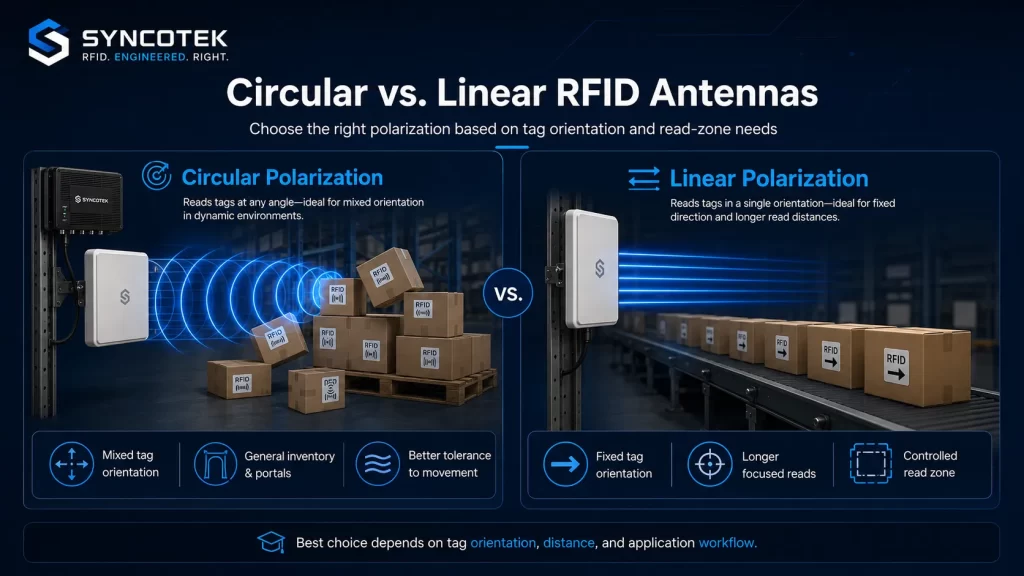
Polarization is one of the most important RFID antenna selection factors. It describes how the RF wave radiates from the antenna.
A circular polarized antenna radiates RF energy in a rotating pattern. This makes it more tolerant of tag orientation. It is usually a better choice when tag position, angle, or height may vary.
Circularly polarized antennas are often selected when the system needs to read tags that may not always face the same direction. Competitor technical guides consistently position circular polarization as useful when tag angle and orientation are uncertain.
A linear polarized antenna radiates energy in one plane. It can provide stronger performance when tag orientation is controlled and aligned with the antenna.
A linear antenna may offer better read distance in the right conditions, but it can miss tags if the tag orientation does not match the antenna plane.
Antenna gain affects how strongly the antenna focuses RF energy in a particular direction. It is usually expressed in dBi.
Higher-gain antennas can generally support longer read distances, but they also create a narrower beam. Lower-gain antennas usually provide shorter read distance but wider coverage. This gain-versus-coverage tradeoff is one of the core antenna selection rules.
This means the highest-gain antenna is not always the best choice. If your goal is to cover a wide doorway or avoid reading tags too far away, a lower or medium-gain antenna may be more suitable.
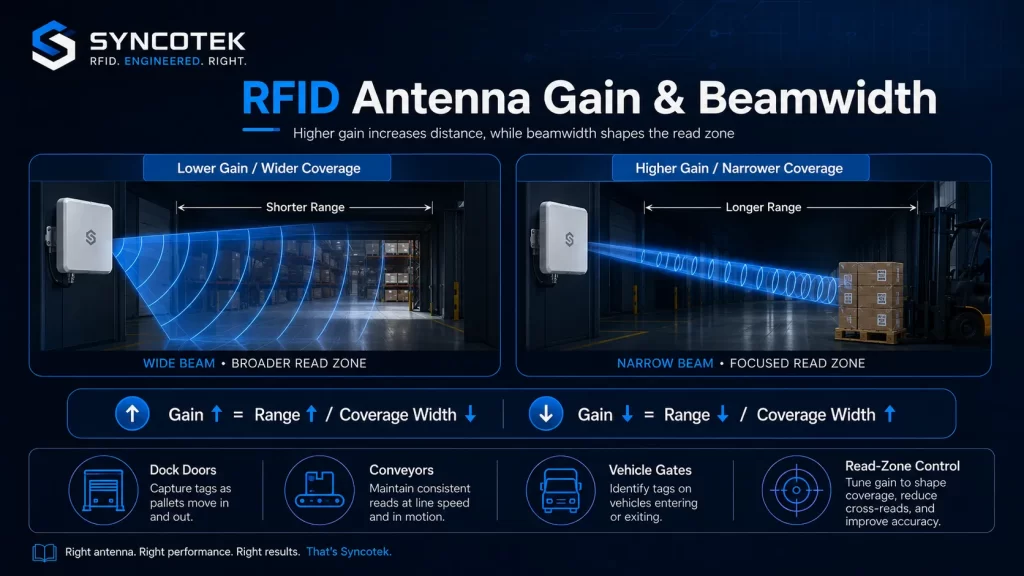
Beamwidth describes how wide the antenna’s RF field is. It helps define the physical read zone.
An antenna with a wide beamwidth covers more area but usually has a shorter read range. An antenna with a narrow beamwidth can read farther but covers a smaller area. Antenna gain and beamwidth are closely related: higher gain usually means narrower beamwidth.
For example, a dock door may need antennas that cover the pallet path without reading tags from nearby staging areas. A conveyor may need a narrower and more controlled beam to avoid reading items before or after the intended checkpoint.
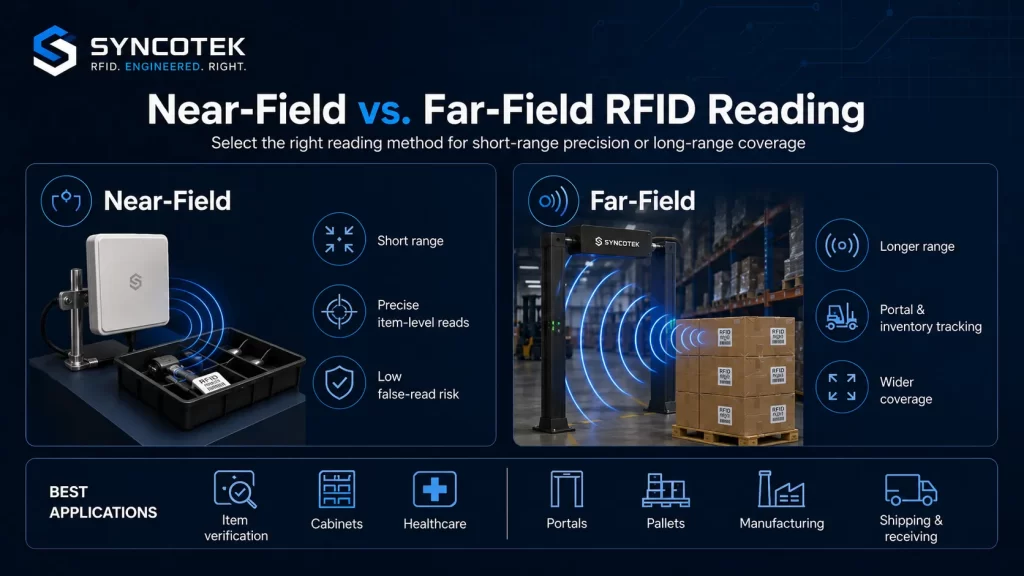
UHF RFID systems can use near-field or far-field antenna behavior depending on the application.
Near-field antennas are designed for short-range reading. They are useful when the system needs to read tags very close to the antenna and avoid reading other tags nearby.
Far-field antennas are used for longer-distance reading and are more common in warehouse, logistics, manufacturing, and asset tracking applications.
The choice depends on whether you need precise short-range control or wider long-range coverage.
The antenna connector must match the reader and cable configuration. RFID antennas may use connector types such as N-Type, RP-TNC, SMA, or other RF connectors depending on the hardware design.
Before selecting an antenna, confirm:
For permanent installations, avoid stacking multiple adapters unless necessary. A properly specified cable with the correct connector on each end is usually more reliable.
Antenna installation has a major impact on RFID performance. Even a good antenna can perform poorly if it is mounted in the wrong place or aimed incorrectly.
Antenna orientation should match the intended read zone. In many RFID projects, small changes in antenna angle can significantly affect read accuracy.
RFID antennas may be installed indoors, outdoors, in warehouses, factories, parking areas, gates, cold storage, dusty environments, or industrial facilities.
For harsh environments, antenna durability matters.
Some antennas are suitable for general indoor use, while others are built for outdoor or rugged industrial environments. The source material also notes that antenna enclosures and ruggedness should match the installation environment.
RFID antennas do not only read what you want them to read. If the read zone is not designed properly, the system may read tags outside the intended area.
The best antenna choice is one that reads the target tags reliably while avoiding unrelated tags nearby.
In many projects, controlling the read zone is just as important as maximizing read range.
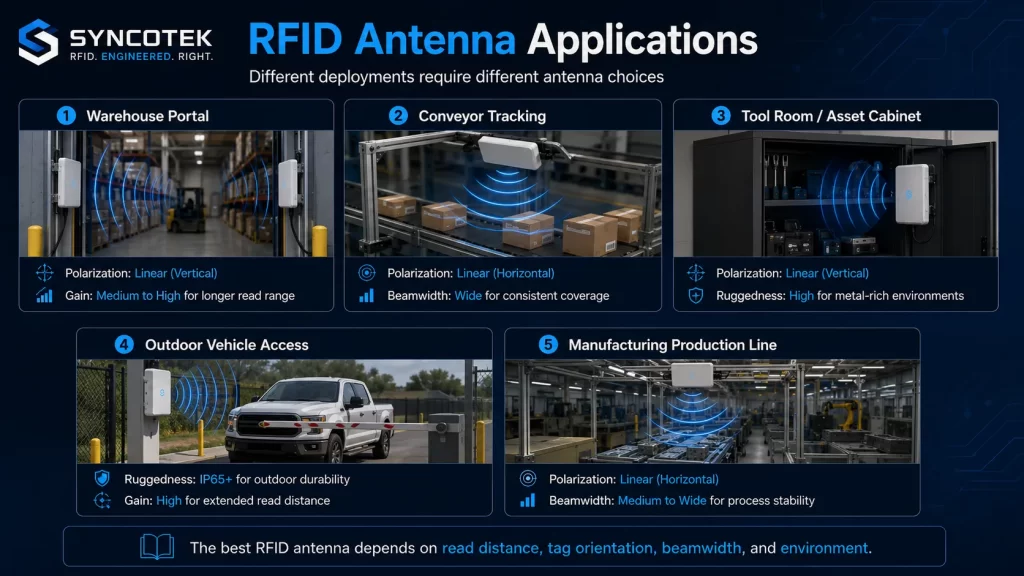
A warehouse portal usually needs to read tagged pallets, cartons, or containers passing through a dock door or gate.
Circular polarization is often preferred because pallet and carton tag orientations may vary.
Conveyor applications need accurate reads at specific process points.
If tags are consistently oriented, linear polarization may work well. If tag orientation varies, circular polarization may be safer.
Tool rooms, asset cabinets, and check-in/check-out areas need controlled reading to avoid reading nearby assets unintentionally.
In these applications, reading too far can create data errors.
Vehicle and yard tracking applications may require longer read distances and antennas mounted outdoors.
The antenna should be aimed to read the intended lane or entry point, not the surrounding area.
Retail item-level inventory requires fast reading of many tagged items, often with mixed orientations.
For shelves or item singulation, near-field antennas may also be useful.
Manufacturing RFID systems may track WIP items, tools, fixtures, bins, or finished goods moving through production stages.
In manufacturing, antenna placement should match the workflow, not just the physical space.
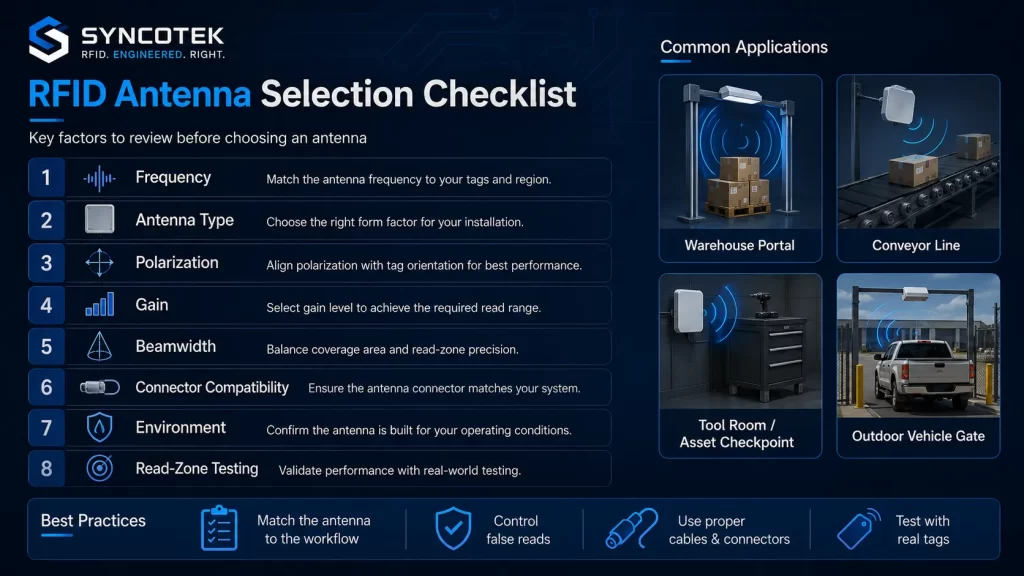
Before purchasing or installing an RFID antenna, confirm the following:
| Selection Factor | What to Check |
|---|---|
| Frequency | LF, HF/NFC, UHF, or region-specific UHF band |
| Antenna type | Circular, linear, near-field, patch, low-profile, rugged |
| Polarization | Circular for variable tag orientation; linear for fixed orientation |
| Gain | Match read distance and coverage needs |
| Beamwidth | Define the required read-zone width and shape |
| Read range | Confirm realistic distance in the actual environment |
| Connector | Match antenna, cable, and reader connector type |
| Mounting | Check angle, height, bracket, and available space |
| Environment | Indoor, outdoor, moisture, dust, vibration, temperature |
| Interference | Metal, liquids, other readers, nearby tags |
| False-read risk | Avoid reading outside the intended area |
| Cable loss | Choose proper cable length and type |
| Testing | Validate performance with real tags and real movement |
Higher gain is not always better. It may create a narrow beam and read tags too far away or outside the target zone.
If tag orientation is unknown, a linear antenna may miss reads. Circular polarization is often better for mixed orientations.
Read range alone is not enough. Beamwidth determines whether the antenna covers the right area.
Even if the antenna is suitable, the system may fail if the cable, connector, or polarity is wrong.
Indoor antennas may not survive outdoor or harsh industrial conditions.
Datasheet performance is not the same as real-world performance. Metal, liquids, mounting angle, reader power, and tag placement can all change results.
A system that reads too much can be as problematic as a system that reads too little. The goal is controlled accuracy, not maximum uncontrolled reading.
To improve RFID antenna performance, follow these practices:
Selecting the right RFID antenna is essential for building a reliable RFID system. The antenna controls the shape, direction, and strength of the RF field, which directly affects read range, read accuracy, and read-zone control.
The best antenna is not always the largest, strongest, or highest-gain model. The best antenna is the one that matches your frequency, tag orientation, required read distance, beamwidth, mounting environment, connector configuration, and application workflow.
For Syncotek RFID projects, antenna selection should be treated as part of the complete system design. Tags, readers, antennas, cables, software, and installation layout must work together to achieve stable and accurate RFID performance.
An RFID antenna transmits RF energy from the reader into the read zone and receives tag responses. It helps define the read range, read direction, and coverage area.
A circular polarized UHF RFID antenna is often suitable for warehouse portals because pallet and carton tag orientations may vary.
Circular antennas are more tolerant of tag orientation. Linear antennas can provide stronger performance when tag orientation is fixed and aligned.
Not always. Higher gain can increase read distance but usually creates a narrower beam. The right gain depends on the required read zone.
Beamwidth describes how wide the antenna’s RF field is. It affects how much area the antenna covers and how controlled the read zone is.
Yes, but outdoor applications should use antennas with suitable environmental protection, mounting hardware, weather resistance, and proper cable protection.
Use proper antenna gain, beamwidth, mounting angle, reader power, shielding, and read-zone testing to avoid reading tags outside the intended area.
Need Help Choosing RFID Antennas for Your Deployment?
Syncotek provides RFID readers, antennas, tags, and related system components for warehouse inventory, logistics, manufacturing, access control, and industrial asset tracking applications.
If you are planning an RFID system and need help matching antennas with readers, tags, cables, and installation environments, Syncotek can help you evaluate a suitable RFID configuration based on your read distance, tag orientation, read-zone design, and deployment goals.
 Knowledge
Can an RFID tag tell you exactly where an asset is right now? The correct answer is: Sometimes — but it depends completely on the RFID architecture. Not every RFID tracking system is a real-time locating system. A passive UHF RFID system may tell you: Asset A was detected at Warehouse Door 3 at 14:42. […]
READ MORE Knowledge
Accurate cattle identification is essential for modern livestock management. Farms, ranches, feedlots, dairy operations, veterinary teams, and livestock markets all need reliable ways to identify individual animals, record movement, manage health data, and support traceability from farm to market. Traditional visual ear tags are simple and widely used, but they rely on manual reading. Workers […]
READ MORE Knowledge
A production manager may know that Work Order WO-1026 is scheduled to finish today. But that does not necessarily answer: Where is the order physically located? Has machining actually started? Did it complete inspection? Has it been waiting between operations for four hours? Was a required production step skipped? Did it enter rework? Which workstation […]
READ MORE Knowledge
An RFID tag may look like a simple adhesive label, plastic block, textile patch, card, or small industrial component. Inside, however, several electrical and mechanical elements work together to receive radio-frequency energy, process commands, store data, and communicate with an RFID reader. At its most basic level, a passive RFID tag contains: RFID Chip + […]
READ MORE Knowledge
RFID is often grouped into three main frequency families: LF (Low Frequency), HF (High Frequency), and UHF (Ultra-High Frequency). Picking the right band is one of the biggest decisions in any RFID project because it affects read range, speed, tag cost, phone compatibility, performance near metal/liquids, and system architecture. This guide compares LF vs HF vs UHF in a practical way […]
READ MOREIf you are interested in our services or need customized solutions, please feel free to contact us.